1986 CHEVROLET CORVAIR cooling
[x] Cancel search: coolingPage 22 of 56
Downloaded from www.Manualslib.com manuals search engine the rubber in the wiper blades. Check the blades periodi
cally and replace them whenever they show signs of
streaky or otherwise poor wiping action.
Pressing
once on the windshield wiper and washer
knob will cause the washer to squirt a measured amount
of water or other cleaning agent onto the glass and will
at the same time turn on the wiper. The wiper must
then
be manually turned off, when the washing process
is completed.
Water or cleaning agent needed for operation of
the windshield washers is carried in a plastic water jar
attached to the dash panel withiri the luggage compart
ment. Keep the
washer jar Ailed to a level 2 inches below
the top of
the jar.
CAUTION: Be sure to have the fluid level in the washer
reservoir
checked regularly, with special attention to
keeping the reservoir fil/ed during periods of heavy use.
GM Washer Solvent should be used as directed to pre
vent freezing
damage and for better cleaning of the
windshield under
aI/ conditions. Do not use radiator anti
freeze as this will cause paint damage.
In the winter, fill the washer jar only % full to allow
for expansion if the solution freezes. In freezing weather,
pre-warm the windshield using the heater defrosters before using the washers.
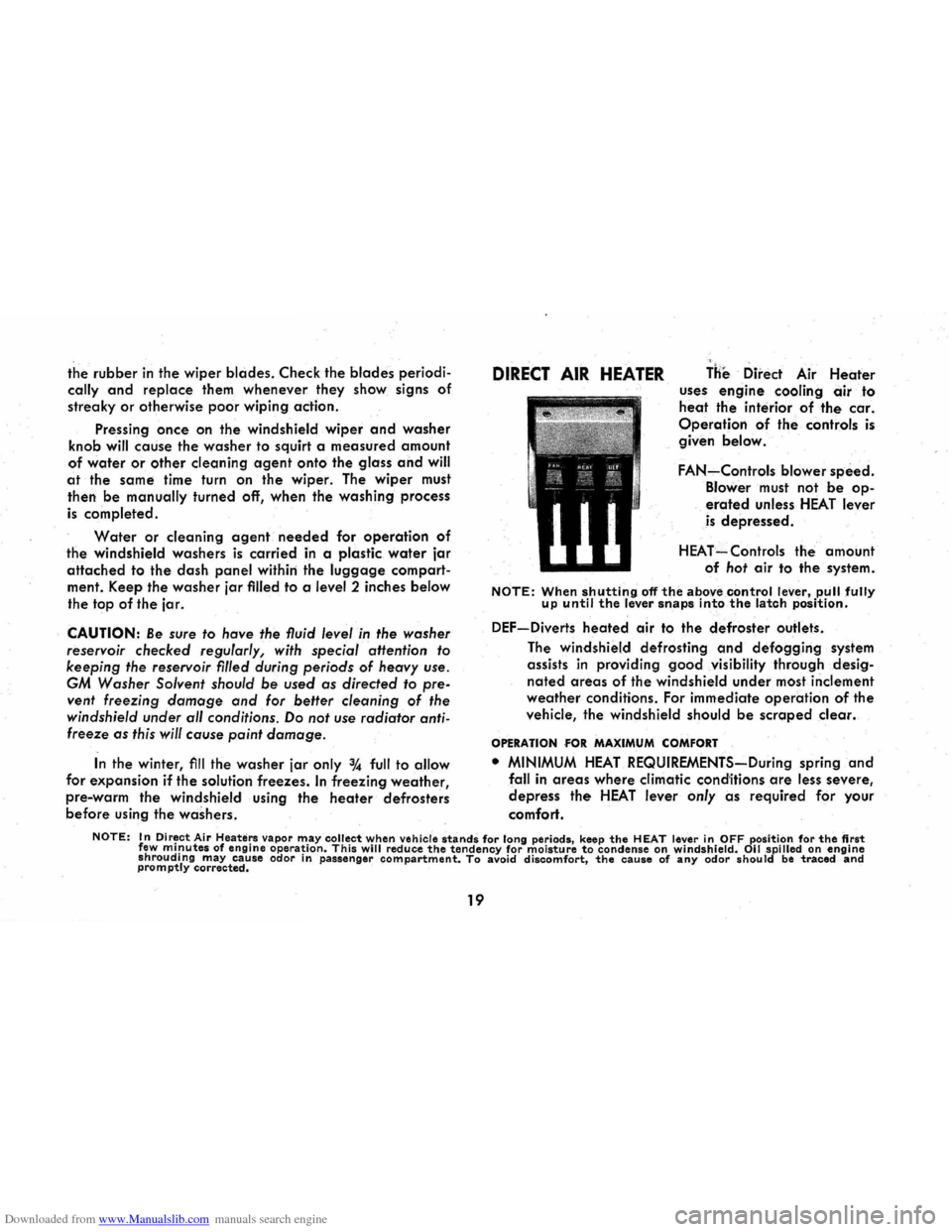
DIRECT AIR HEATER THe Direct Air Heater uses engine cooling air to
heat the interior of the car.
Operation of the controls is
given below.
FAN-Controls blower speed.
Blower must not be op
erated unless HEAT lever
is depressed.
HEAT=Controls the amount
of hot air to the system.
NOTE: When shutting off the above control lever, pull fully up until the lever snaps into the latch position.
DEF-Diverts heated air to the defroster outlets.
The windshield defrosting
and defogging system
assists
in providing good visibility through desig
nated areas of the windshield under most inclement
weather conditions. For immediate operation of the
vehicle, the windshield should
be scraped clear.
OPERATION FOR MAXIMUM COMFORT
• MINIMUM HEAT REQUIREMENTS-During spring and
fall in areas where climatic conditions are less severe,
depress the HEAT lever only as required for your
comfort.
NOTE: In Dir~ct Air Heauirs vapor m.ay collectwhen vehicle stands for long periods, keep the HEAT lever in OFF position for the first few ml!lutes of engine operatIon. This will reduce the tendency for moisture to condense on windshield. 011 spilled on engine shroudIng may cause odor in passenger compartment. To avoid discomfort, the cause of any odor should be traced and promptly corrected.
19
Page 23 of 56
Downloaded from www.Manualslib.com manuals search engine • MAXIMUM HEAT REQUIREMENTS-Depress HEAT lever
to extreme down position.
If heat becomes exces
sive, pull up HEAT knob to desired position.
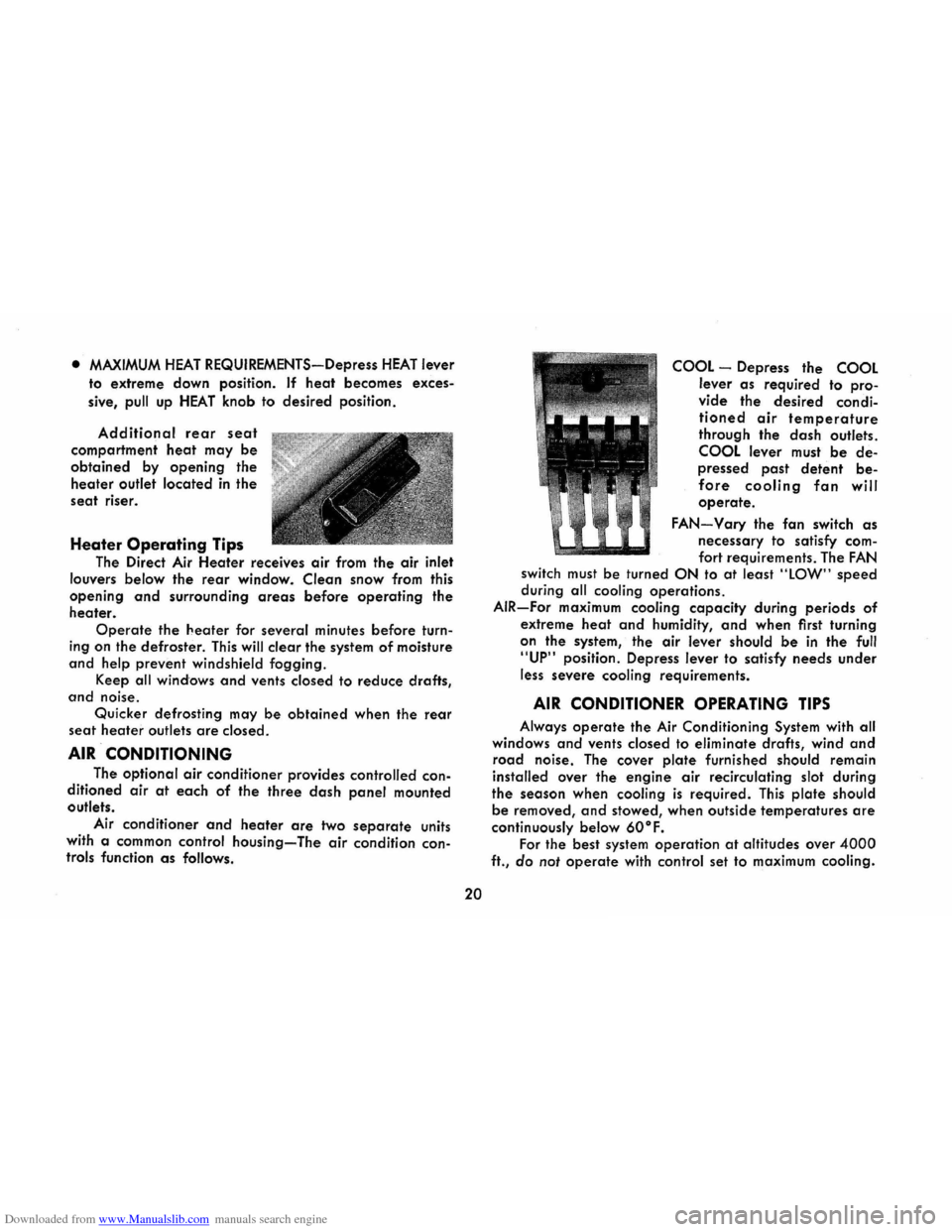
Additional rear seat
compartment heat may be
obtained by opening the
heater outlet located in the
seat riser.
Heater Operating Tips
The Direct Air Heater receives air from the air inlet
louvers below the
rear window. Clean snow from this
opening
and surrounding areas before operating the
heater.
Operate the heater for several minutes before turn
ing on the defroster. This will clear the system of moisture
and help prevent windshield fogging.
Keep
all windows and vents closed to reduce drafts,
and noise.
Quicker defrosting may
be obtained when the rear
seat heater outlets are closed.
AIR CONDITIONING
The optional air conditioner provides controlled con
ditioned air at each of the three dash panel mounted
outlets.
Air conditioner
and heater are two separate units
with a common control
housing-The air condition controls function as follows.
20
COOL -Depress the COOL
lever as required to pro
vide the desired condi
tioned air temperature
through the dash outlets.
COOL lever must be de
pressed past detent be
fore cooling fan will
operate.
FAN-Vary the fan switch as
necessary to satisfy com
fort requirements. The FAN
switch must be turned ON to at least "lOW" speed
during all cooling operations.
AIR-For maximum cooling capacity during periods of
extreme heat and humidity, and when first turning
on the system, the air lever should
be in the full
"UP" position. Depress lever to satisfy needs under
less
severe cooling requirements.
AIR CONDITIONER OPERATING TIPS
Always operate the Air Conditioning System with all
windows
and vents closed to eliminate drafts, wind and
road noise. The cover plate furnished should remain
installed over the engine air recirculating slot during
the season when cooling
is required. This plate should
be removed, and stowed, when outside temperatures are
continuously below 60°F.
For the best system operation at altitudes over 4000
ft., do not operate with control set to maximum cooling.
Page 32 of 56
Downloaded from www.Manualslib.com manuals search engine inches to assure that the lid lock mechanism is en
gaged.
For proper engine cooling keep the vents located
below the
rear window free of ice, snow and leaves.
LUGGAGE COMPARTMENT
The luggage compartment is located beneath the
lid at the front of the car.
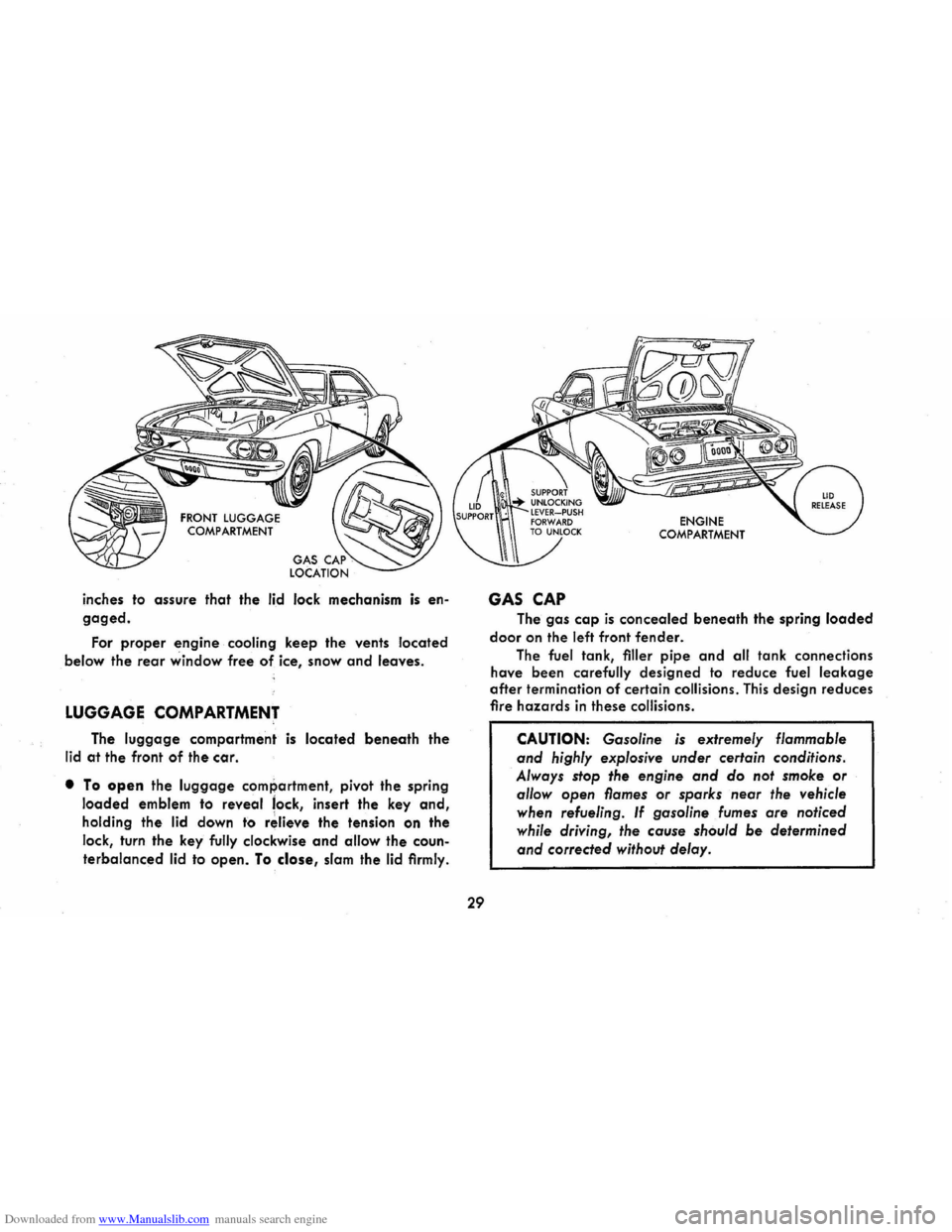
• To open the luggage compartment, pivot the spring
loaded emblem to reveal lock, insert the key and,
holding the lid down to r~lieve the tension on the
lock, turn the key fully clockwise
and allow the coun
terbalanced lid to open. To close, slam the lid firmly.
29
GAS CAP
ENGINE COMPARTMENT
The gas cap is concealed beneath the spring loaded
door on the left front fender.
The fuel tank, filler pipe and all tank connections
have been carefully designed to reduce fuel
leakage
after termination of certain collisions. This design reduces
fire hazards in these collisions.
CAUTION: Gasoline is extremely flammable
and highly explosive under certain conditions.
Always stop the engine
and do not smoke or
allow open flames or sparks near the vehicle
when refueling.
If gasoline fumes are noticed
while driving,
the cause should be determined
and corrected without delay.
Page 37 of 56
Downloaded from www.Manualslib.com manuals search engine level, remove the oil gauge rod (dip stick), wipe it
clean and reinsert it firmly for an accurate reading.
The oil level should be maintained in the safety margin,
neither going above the FULL line nor below the ADD
mark. Reseat the gauge firmly after taking the reading.
DO NOT OVERFilL.
COOLING SYSTEM CARE
The engine fan belt should be checked for tightness
at regular intervals. When a new belt is needed use only
the approved premium belt available from your Chev
rolet dealer. If any other belt is installed, replace with
recommended belt when possible.
Watch the TEMP-PRESS and GEN-FAN indicators on the
instrument
panel for signs of overheating.
Air inlet louvers, located in the panel below the rear
window, supply air for engine combustion and cooling
and for the Direct Air Heater. Make sure the louvers are
never sealed or blocked.
TIRES
The factory installed tires on your car are selected
to provide the best all around tire performance for all
normal operation. When inflated as recommended in
the
tire inflation pressure table they have the load
carrying capacity to operate satisfactorily at all loads
up to and including the specified full rated load, at all
normal highway speeds.
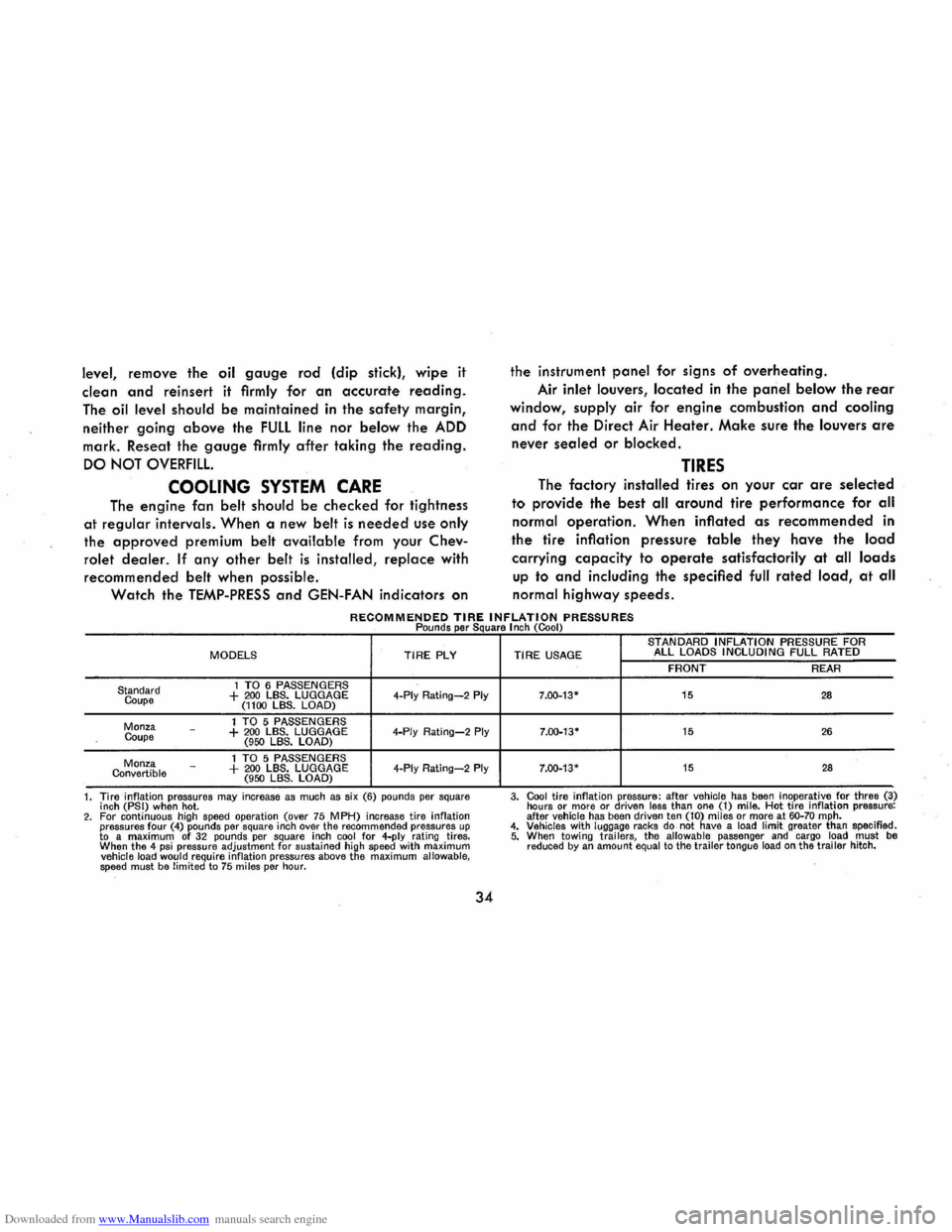
RECOMMENDED TIRE INFLATION PRESSURES Pounds per Square I nch (Cool)
MODELS TIRE PLY
1 TO 6 PASSENGERS Standard
Coupe + 200 LBS. LUGGAGE 4-Ply Rating-2 Ply (1100 LBS. LOAD)
1 TO 5 PASSENGERS Monza
Coupe -+ 200 LBS. LUGGAGE 4-Ply Rating-2 Ply (950 LBS. LOAD)
1 TO 5 PASSENGERS Monza Convertible -+ 200 LBS. LUGGAGE 4-Ply Rating-2 Ply (950 LBS. LOAD)
1. Tire inflation pressures
may increase as much as six (6) pounds per square
inch (PSI) when hot. 2. For continuous high speed operation (over 75 MPH) increase tire inflation pressures four (4) pounds per square inch over the recommended pressures up to a maximum of 32 pounds per square inch cool for 4-ply rating tires.
When the 4 psi pressure adjustment for sustained high speed with maximum vehicle load would require inflation pressures above the maximum allowable, speed must be limited to 75 miles per hour.
34
STANDARD INFLATION PRESSURE FOR TIRE USAGE ALL LOADS INCLUDING FULL RATED
FRONT REAR
7.00-13-15 28
7.00-13· 15 26
7.00-13· 15 28
3. Cool tire inflation pressure: after vehicle has been inoperative for three (3)
hours or more or driven less than one (1) mile. Hot tire inflation pressure:
after vehicle has been driven ten (10) miles or more at 60-70 mph. 4. Vehicles with luggage racks do not have a load limit greater than specified. 5. When towi ng trai lers, the allowable passenger and cargo load must be reduced by an amount equal to the trailer tongue load on the trailer hitch.
Page 46 of 56
Downloaded from www.Manualslib.com manuals search engine AIR CONDITIONING
Have your Chevrolet Dealer check your air conditioning
system
at some time during the winter months to be
sure there has been no loss in cooling output. Dur
ing
the summer, see your Chevrolet Dealer immedi
ately if you suspect the system is not performing as
it should.
BRAKE LININGS
Brake linings should be periodically inspected for wear.
The frequency of this inspection depends upon driv
ing conditions such
as traffic or terrain, and also
the driving techniques of individual owners. Your
Chevrolet Dealer is best qualified to advise you as
to how often this inspection should be performed.
When brakes require relining use genuine General
Motors Parts or equivalent.
BRAKE MASTER CYLINDER
Every 6,000 miles-Check fluid level in each reservoir
and maintain % II below lowest edge of each open
ing with G.M. Hydraulic Brake Fluid Supreme No. 11
PARKING BRAKE AND CLUTCH PULLEYS
AND CABLES
Every 12,000 miles-lubricate pulleys under dash. Re
move. the tunnel cover under vehicle and lubricate
pulleys
and cable bearing points with a water resist
ant EP chassis grease which meets General Motors
43
Specification #GM 6031 M. Lubricate gearshift lever
ball and socket (see page 38) at the same time.
FRONT WHEEL BEARINGS
Clean, repack with high melting point wheel bearing
lubricant, and adjust whenever the wheels and hub
are removed. Replace grease seals at the same time.
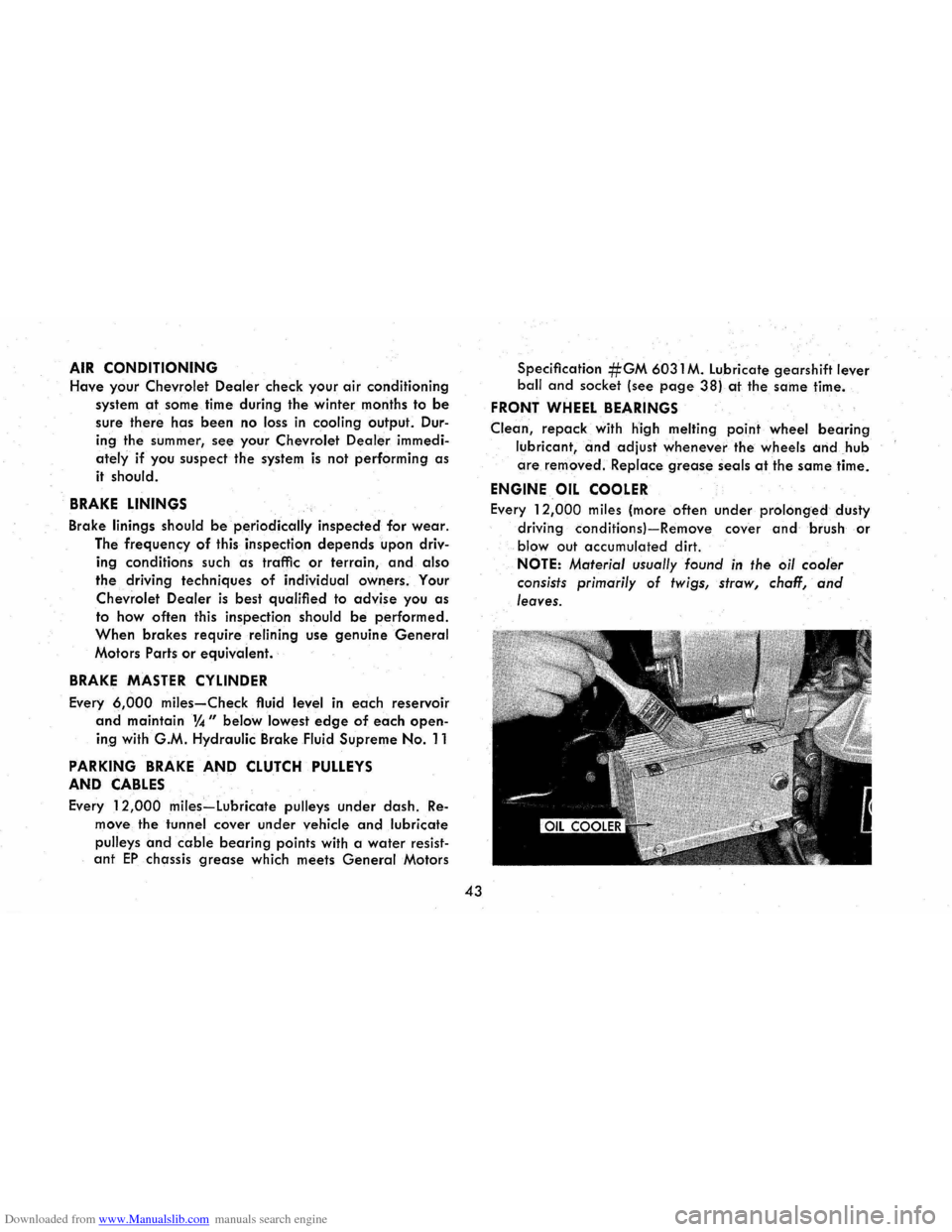
ENGINE OIL COOLER
Every 12,000 miles (more often under prolonged dusty
driving
conditionsl-Remove cover and brush or
blowout accumulated dirt.
NOTE: Material usually found in the oil cooler
consists primarily
of twigs, straw, chaff, and
leaves.
Page 47 of 56
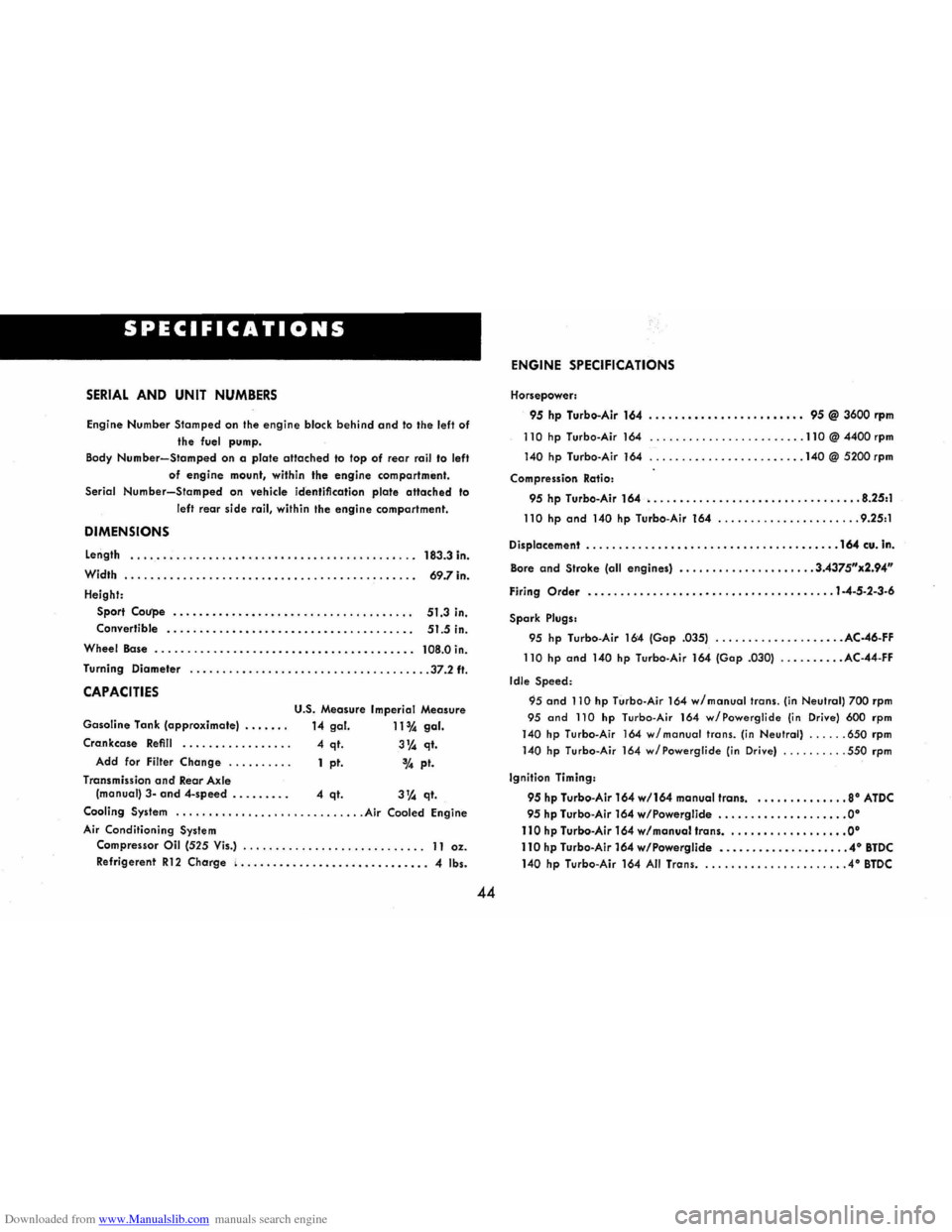
Downloaded from www.Manualslib.com manuals search engine SPECIFICATIONS
SERIAL AND UNIT NUMBERS
Engine Number Stamped on the engine block behind and to the left of
the fuel pump.
Body
Number-Stamped on a plate attached to top of rear rail to left
of engine mount, within the engine compartment .
Serial
Number-Stamped on vehicle identification plate attached to
left
rear side rail, within the engine compartment.
DIMENSIONS
Length .•...............•.•.•..................•... 183.3 in.
Width
.......•....•. . ....•..••......•.............• 69.7 in.
Height: Sport
Coupe ......•...••• ..•..••............•..•• 51.3 in.
Convertible
..........•.....••..•...•............. 51.5 in.
Wheel Base
...................•..•...•.... , ........ 108.0 in.
Turning Diameter .
.•..........•............... ........ 37.2 ft.
CAPACITIES
U.S. Measure Imperial Measure
Gasoline Tank (approximate) ...... .
14 gal. 11 % gal.
Crankcase Refill •....•..... ...... 4 qt. 3~ qt.
Add for Filter Change ......... . 1 pt. 3,4 pt.
Transmission
and Rear Axle
(manual) 3-and 4-speed ........ . 4 qt. 3~ qt.
Cooling System .....••...................... Air Cooled Engine
Air Conditioning System
Compressor Oil (525 Vis.) ...•............. ......... " 11 oz.
Refrigerent
R12 Charge ( •......•................•.... 4 Ibs.
44
ENGINE SPECIFICATIONS
Horsepower:
95 hp Turbo-Air 164 ......••.•.•........•.•• 95 @ 3600 rpm
110 hp Turbo-Air 164 ........................ 110 @ 4400 rpm
140 hp Turbo -Air 164 ........................ 140 @ 5200 rpm
Compression Ratio:
95 hp Turbo-Air 164 •...•........•.•.••••.•...••.•••. 8.25:1
110 hp and 140 hp Turbo-Air 164 ...................... 9.25:1
Displacement
......•....••••••..••••••...•..•.••\
•.•• 164 cu. In.
Bore and Stroke (all engines) ................. .... 3.4375"x2.94"
Firing Order •.........•..•••••••..•.•.••.•\
..••..•. 1-4-5-2-3·6
Spark Plugs.
95 hp Turbo-Air 164 (Gop .035)
.................... AC-46-FF
110
hp and 140 hp Turbo-Air 164 (Gop .030) .......... AC- 44-FF
Idle
Speed:
95 and 110 hp Turbo-Air 164 wi manual trans. (in Neutral) 700 rpm
95
and 110 hp Turbo-Air 164 w/Powerglide (in Drive) 600 rpm
140 hp Turbo-Air 164 wi manual trans. (in Neutral) ...... 650 rpm
140 hp Turbo-Air 164 w/Powerglide (in Drive) .......... 550 rpm
Ignition Timing:
95 hp Turbo-Air 164 wl164 manual trans •..•...•.•••.•. 8· ATDC
95 hp Turbo-Air 164 w/Powerglide ••.•..•••.••••..•••• 0·
110 hp Turbo-Air 164 wi manual Irons •....•..•..••....•. 0·
110 hp Turbo-Air 164 w/Powerglide •.••..•••.•..•••••.. 4· BTDC
140 hp Turbo-Air 164 All Trans ....................... 4° BTDC
Page 52 of 56
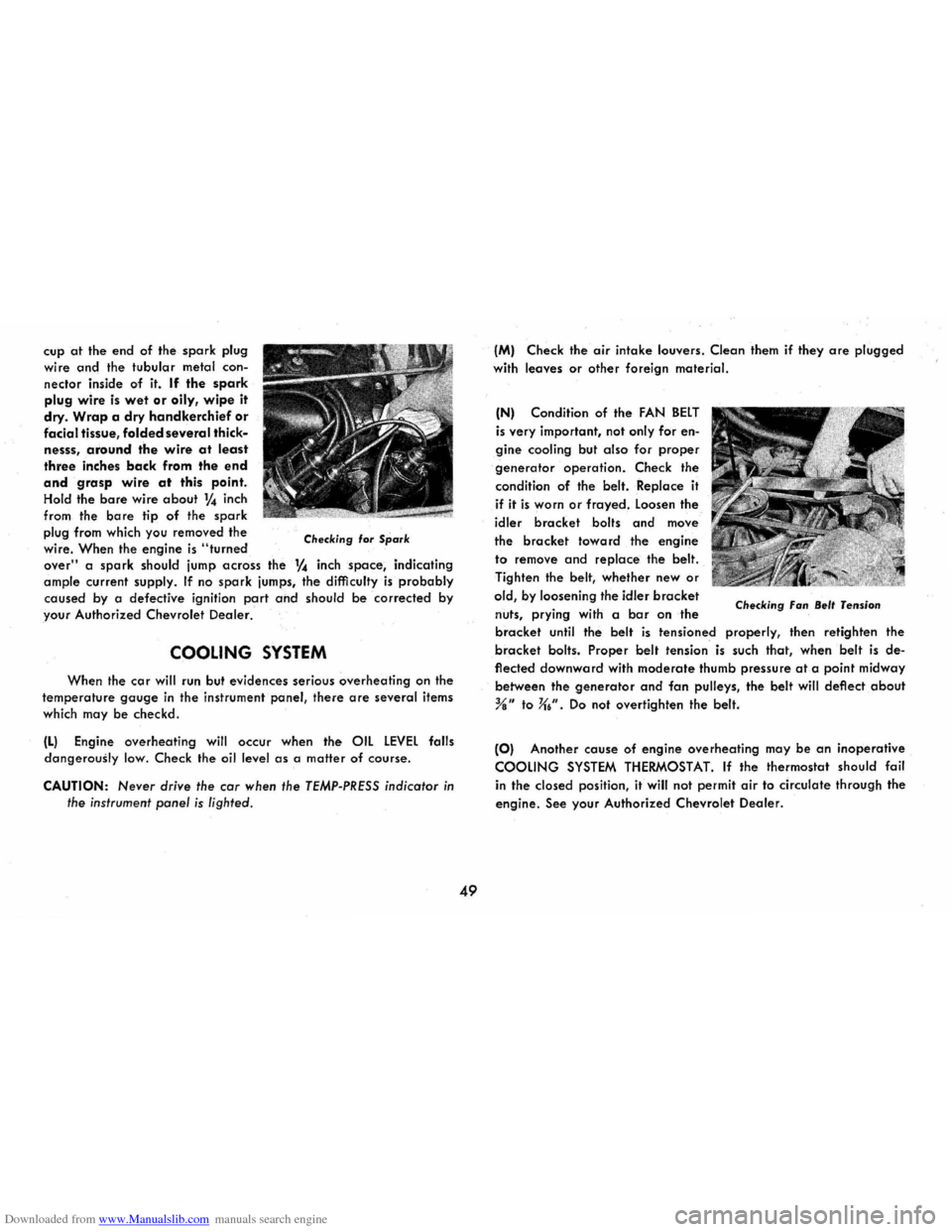
Downloaded from www.Manualslib.com manuals search engine cup at the end of the spark plug
wire
and the tubular metal con
nector inside of it. If the spark
plug wire is wet or oily, wipe it
dry.
Wrap a dry handkerchief or
facial tissue, folded several thick
nesss, around the wire at least
three inches back from the end
and grasp wire at this point.
Hold the
bare wire about V4 inch
from the bare tip of the spark
plug from which you removed the
wire. When the engine is "turned Checking for Spork
over" a spark should jump across the V4 inch space, indicating
ample current supply.
If no spark jumps, the difflcultyis probably
caused by a defective ignition part and should be corrected by
your Authorized
Chevrolet Dealer.
COOLING SYSTEM
When the car will run but evidences serious overheating on the
temperature
gauge in the instrument panel, there are several items
which may
be checkd.
(L) Engine overheating will occur when the OIL LEVEL falls
dangerously low.
Check the oil level as a matter of course.
CAUTION: Never drive the car when the TEMP-PRESS indicator in
the instrument panel is lighted.
49
1M) Check the air intake louvers. Clean them if they are plugged
with leaves
or other foreign material.
IN) Condition of the FAN BELT
is very important, not only for en
gine cooling but also for proper
generator operation. Check the
condition of the belt. Replace
it
if it is worn or frayed. Loosen the
idler
bracket bolts and move
the
bracket toward the engine
to remove and replace the belt.
Tighten the belt, whether new
or
old, by loosening the idler bracket
nuts, prying with a bar on the Checking Fan Be" Tension
bracket until the belt is tensioned properly, then retighten the
bracket bolts. Proper belt tension is such that, when belt is de
flected downward with moderate thumb pressure at a point midway
between the
generator and fan pulleys, the belt will deflect about
:Va" to K6". Do not overtighten the belt.
(0) Another cause of engine overheating may be an inoperative
COOLING SYSTEM THERMOSTAT. If the thermostat should fail
in the closed position, it will not permit air to circulate through the
engine.
See your Authorized Chevrolet Dealer.
Page 55 of 56
Downloaded from www.Manualslib.com manuals search engine INDEX Page Air Cleaner. . . . . . . . . .. , .. . . . . . . .. . . . . . . . . . . .......... 42 Air Conditioning.. ............ ... .... .• . . .20,43 & 44 Air Injection Reactor......... ........... . ... ... 38 Air Recirculating Cover Plate. . . . . . . . . . . .• . . . . .. . . . .. . . 20 Air Vents. . . . . . . . . . . . . . . . . . . . . . . 22 Ash Tray. ........ .. ... 22 Battery........... ............ ....•...•................. 42 Brake Adjusters...................... .. .. ... ............. 17 Brake System Warning Light. . ................. 14 Brake Lmings. . ....... ....... ........ ............... 43 Brake Main Cylinder.. ........... . ...... 43 Brake-Parking. . ............ .......... . .. 18 & 43 Bright Metal Parts..... .. ..................... '. 30 Chassis Lubrication. . . . . . . . . . . . . . 41 Cigarette Lighter. . . .. .... ... .. . . . .. .. " 22 Circut Brea ker. . . . . . ................. .. .............. 15 & 45 Cleaning Hints Exterior Appearance........ .... .... . ............ . 30 Interior Appearance.. ............... . ............. ........ 31 Clutch Adjustment......... 17 Clutch Cross Shaft. . . .. . . . . . . . ... .. . . 41 Clutch Pedal.. .. . .. .. .. .. . . .. .. . .. .. . 17 Clutch Pulleys & Cables..................... . 43 Cooling System. . . . . . . . . . . . . . . . . . ........ ....... 34 & 43 Crankcase.ventilation (Positive). 37 Dimmer Switch... .......... ..... 16 Distributor. . . . . . . 42 Doors and Locks. .. ..... .................. .• ................. 23 Driving for Economy..... ...... ...... 7 Emergency Start. . . . . . . . . . . . . . . . . . 12 Engine Compartment.... . . . . . . . . . . . . . . . . . . . .. .. . . 28 Engine Fuel. . . . . . . . . . . . . . . . . . . . . . . . . . . . . . . . . . . . . . . . . .. 32 Engine Lubrication. . . . . . . . . .. . . . .• . . . . . . . • . . . . . . .33& 38 Fan Belt........ .... ..................... ..... 38 Foreign Country Operation. .................. 32 Front Suspension. . . . . . . . . . . . . . ... . . . . . . . . . . . . . . . . . . . . . 41 Front Wheel Bearings.. . ............. .......... . 43 Fuel Filter. . . . . . . . . . . . . . . •. . . . . . . . . .. . . . . 41 Fuel Guage.. ............ 13 Fuses.. .. .. ... ...................... ..... 45 ~s~p.......... ~ Gen·Fan .Indicator........ 13 Hazard Warning Flasher. . 17 Headrest...... . . ....... ... .. ........ 26 Heater............................... ..... .. .......... 19 Ignition Switch. . . . . . . . . . . . . . . . . .. . . . . . . . . . . . . 8 Jacking the Car. . . . .. . . . . . . . . . . .. . . . . . . . . . . . . . . . . . . . . . . . . . . . . . .. 36
52
Keys............... . ......... .............. . Light Control Knob ...................... . . Luggage Compartment ................... . Maintenance and Lubrication (Periodic) .. Octane Requirements. . . . . ......... . Oil Filter .... ............ . Pa rking Bra ke Operation . ..................... . Service .......... ...... . Polishing Your Corvair... . . ... . . . . . .. . .........•. .... ........ Positraction Axle. . . ... ............... .. ...... .. .. .... . Radios. . . . .... . ........... . Rear Axle.... . . ...................................... . . Rocking Car .............. . Occupant Restraint Belts .. . . Seats Front Seat Back Lock ....... .•...... Front Seat Adjustment. Rear Seat-Folding ... Service Bra kes. . . . . . . . . .. . ......................... ... . Serial and Unit Numbers .......... .. . Spare Tire..... . .• ......... .................•.•. Specifications. . . . ................... ... .. .• ........ Speedometer ... .. ............... . Starting the Engine .... . Steering Lin kage ...... . Steering Gear ............... . Telescoping Steering Column. Temp·Press Indicator. Tires. Towing ..... Trailer Hauling. Transmission Manual Operation. ................ . ....... .. .... . Service ................... .. .. ...... .. . Powerglide Operation. Service ...... . Operating Tips ....... . Trouble Shooting Guide.......... . .............. ... . Directional and Lane Change Signal. . ....• ...•.... Warm·up... ............ . ....... .. ........... ... . Washing Your Corvair. . . ........ . White Sidewall Tires.. . . . . . . . . . . . . . . ......... .. . Windshield Wipers and Washers. . . .. .. .. .. .
Page 22 16 29 38 32 39
18 43 30 12 21 41 12 24
23 24 27 17 44 36 44 13 8 41 38 22 13 34 12 50
9 39
10 40 11 46 16 9 30 31 18