1986 CHEVROLET CORVAIR clutch
[x] Cancel search: clutchPage 11 of 56
Downloaded from www.Manualslib.com manuals search engine STARTING THE ENGINE
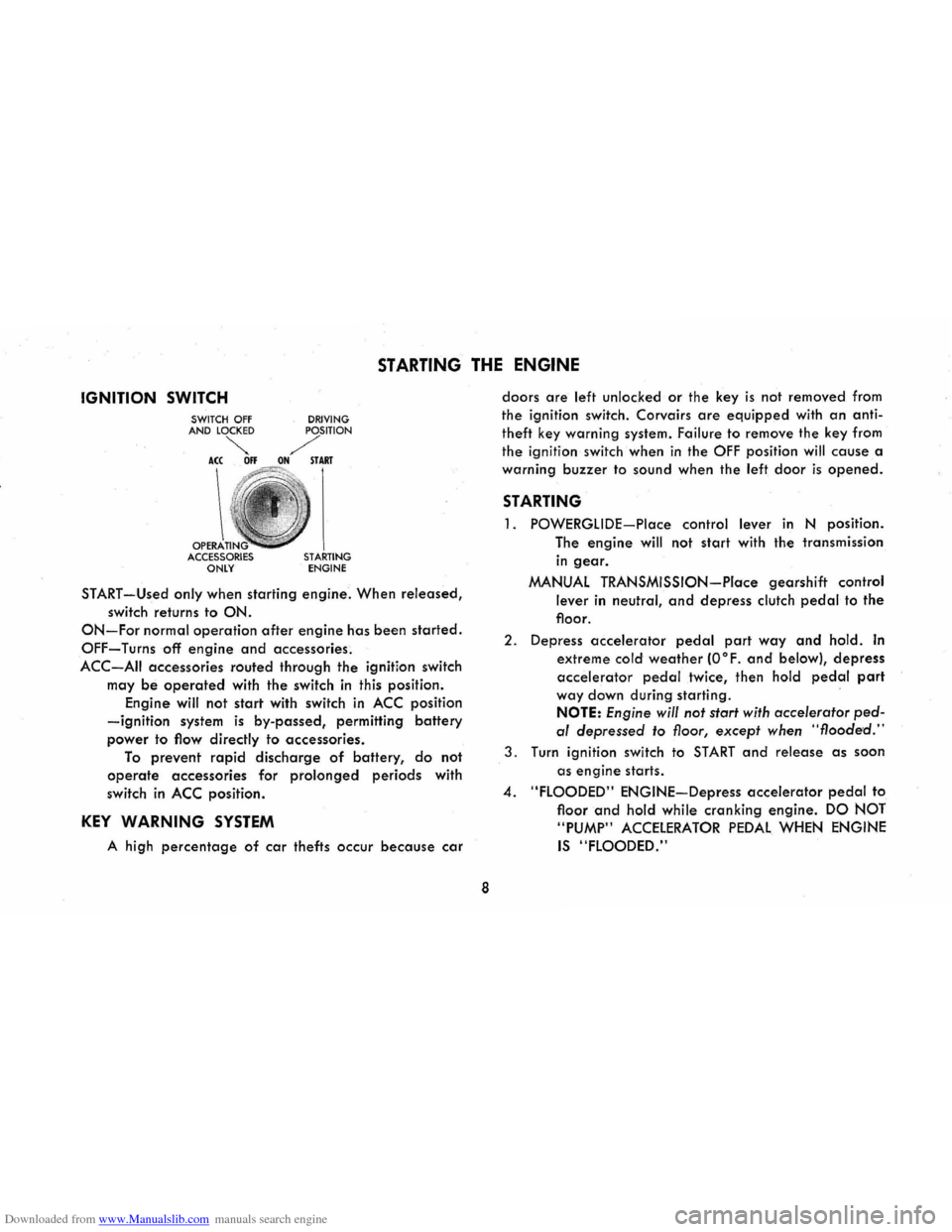
IGNITION SWITCH
OPERA ACCESSORIES ONLY DRIVING STARTING ENGINE
START-Used only when
starting engine. When released,
switch returns to ON.
ON-For normal operation after engine has been started.
OFF-Turns off engine and accessories.
ACC-AII accessories routed through the ignition switch
may
be operated with the switch in this position.
Engine will not
start with switch in ACC position
-ignition system is by-passed, permitting battery
power to flow directly to accessories.
To prevent rapid discharge of battery, do not
operate accessories for prolonged periods with
switch
in ACC position.
KEY WARNING SYSTEM
A high percentage of car thefts occur because car
8
doors are left unlocked or the key is not removed from
the ignition switch. Corvairs
are equipped with an anti
theft key warning system. Failure
to remove the key from
the ignition switch when
in the OFF position will cause a
warning
buzzer to sound when the left door is opened.
STARTING
1. POWERGLIDE-Place control lever in N position.
The
engine will not start with the transmission
in gear.
MANUAL TRANSMISSION-Place gearshift control
lever in neutral, and depress clutch pedal to the
floor.
2. Depress accelerator pedal part way and hold. In
extreme cold weather (O°F. and below), depress
accelerator pedal twice, then hold pedal part
way down during starting .
NOTE: Engine will not start with accelerator ped
al depressed to floor, except when "flooded."
3. Turn ignition switch to START and release as soon
as
engine starts .
4. "FLOODED" ENGINE-Depress accelerator pedal to
floor
and hold while cranking engine. DO NOT
"PUMP"
ACCELERATOR PEDAL WHEN ENGINE
IS "FLOODED."
Page 12 of 56
Downloaded from www.Manualslib.com manuals search engine WARM-UP
Never race engine or drive at high speeds until
engine has
had a chance to warm up. Driving with
moderate accelerator pedal application will prevent
stalling
and hesitation, especially during cold weather.
Failure
to allow sufficient warm up time can cause un
necessary wear to engine, axle or transmission parts
because of inadequate lubrication.
DRIVING WITH THE
MANUAL TRANSMISSIONS
The three-speed and optional four-speed trans
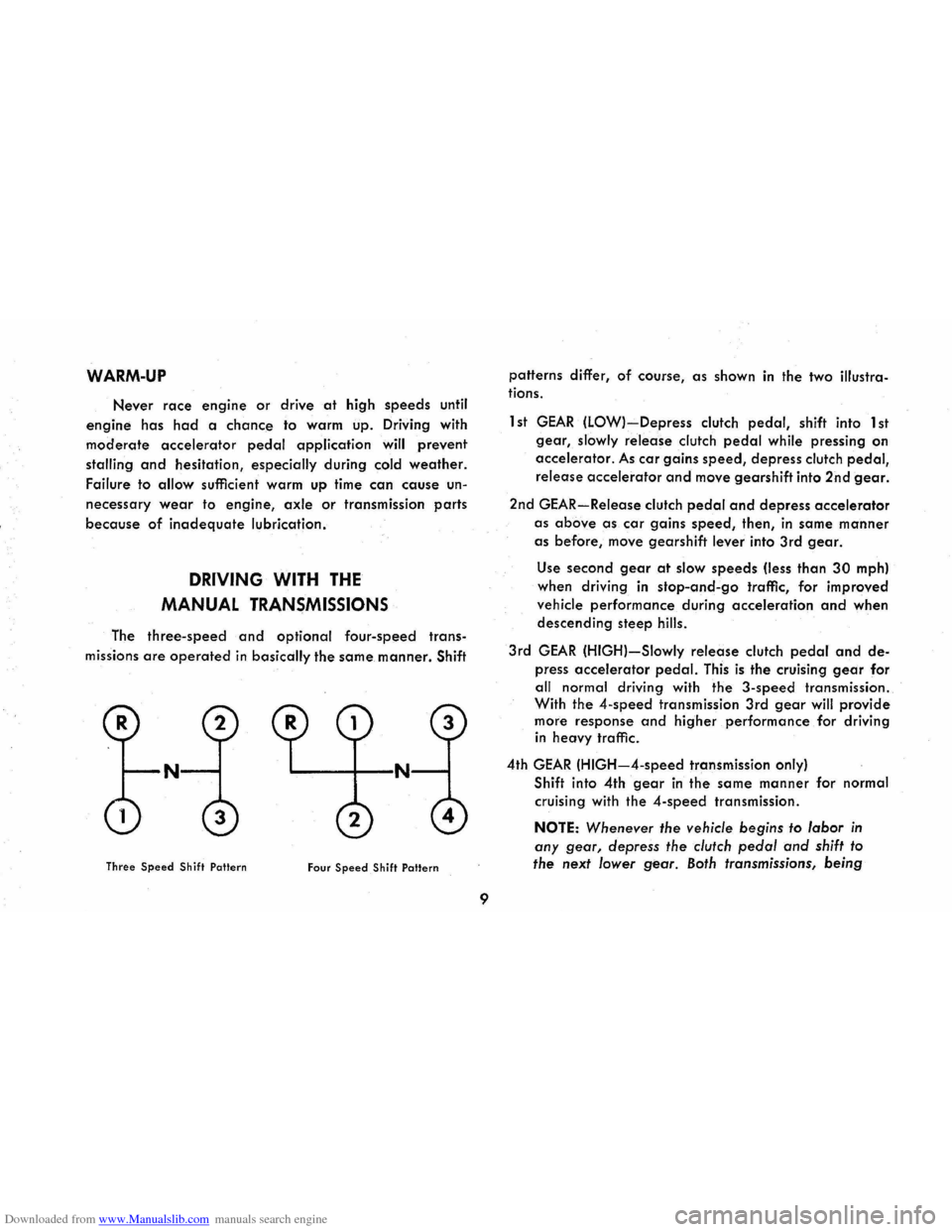
missions are operated in basically the same manner. Shift
N "'-----+--N
Three Speed Shift Pallern Four Speed Shift Pattern
9
patterns differ, of course, as shown in the two illustra
tions.
1 st
GEAR (LOW)-Depress clutch pedal, shift into 1 st
gear, slowly release clutch pedal while pressing on
accelerator.
As car gains speed, depress clutch pedal,
release accelerator and move gearshift into 2nd gear.
2nd GEAR-Release clutch pedaI and depress accelerator
as above as car gains speed, then, in same manner
as before, move gearshift lever into 3rd gear.
Use second gear at slow speeds (less than 30 mph)
when driving
in stop-and-go traffic, for improved
vehicle performance during acceleration
and when
descending steep hills.
3rd
GEAR (HIGH)-Slowly release clutch pedal and de
press accelerator pedal. This is the cruising gear for
all normal driving with the
3-speed transmission.
With the
4-speed transmission 3rd gear will provide
more response
and higher performance for driving
in heavy traffic.
4th
GEAR (HIGH-4-speed transmission only)
Shift into 4th
gear in the same manner for normal
cruising with the
4-speed transmission.
NOTE: Whenever the vehicle begins to labor in
any gear, depress the clutch pedal and shift to
the next lower
gear. Both transmissions, being
Page 13 of 56
Downloaded from www.Manualslib.com manuals search engine fully synchronized, may be downshifted into first
gear at any speed below 20 mph.
TO STOP-Release the accelerator and depress the
brake pedal. As car slows down, depress the clutch
pedal and move the gearshift lever into neutral.
NEUTRAL-For use when starting or idling engine.
REVERSE-Operate as for 1 st gear but always at a
slow speed.
CAUTION: When parking or leaving the car unattended,
even for a few minutes, remove the ignition key, place
the selector lever in first gear or reverse if manual trans
mission, and fully apply the parking brake.
DRIVING WITH THE POWERGLIDE TRANSMISSION
The optional Powerglide transmission is a completely
automatic transmission which replaces the standard clutch
and transmission. After starting the engine with the se
lector lever
in N (neutral) position, merely select the
range desired and depress the accelerator. The Power
glide
transmission will do the rest.
Automatic transmission shift
quadrants of all GM
cars continue the uniform sequence of selector positions.
This particularly benefits multicar families and those who
occasionally drive other cars. Shift indicators are ar
ranged as follows: "Reverse", "Neutral" and the forward
driving
ranges. All automatic transmissions are equipped
with a starter interlock system designed to permit start
ing the engine only when the transmission selector is in
the "Neutral" position. For additional engine braking
effect,
as sometimes needed in mountainous driving,
place the transmission in an intermediate or low range.
10
The dash-mounted driving range selector is equipped
with mechanical stops to prevent unintentional shifting
into reverse
and low ranges. Move lever to the left, to
override stop,
and continue shift for selection of reverse
or low ranges.
With
lever in 0 position the transmission starts in
automatic low gear and will shift to cruising gear at
some point between approximately 12 and 50 mph,
depending on the accelerator position. Thus, a slow start
with a steady, gradual increase of pressure on the accel
erator pedal will enable the transmission to shift into the
more economical cruising gear in the shortest possible
time. Hard acceleration for fast starts will cause the trans
mission to remain in low gear for a considerably longer
period.
When driving at speeds below 45 mph, the transmis-
Page 15 of 56
Downloaded from www.Manualslib.com manuals search engine TRANSMISSION OPERATING TIPS
EMERGENCY STARTING
Your Corvair may be started in an emergency by
pushing. When being pushed to start the engine, turn
off all unnecessary electrical loads, turn the ignition to "ON", and (if manual transmission) depress the
clutch and place the shift lever in high gear or, (if
powerglide) move selector lever to NEUTRAL position.
Release the clutch when car speed reaches 10 to 15 miles per hour (manual transmission); move the selector
lever to LOW position when car speed reaches 20 to
25 miles per hour (powerglidel. Bumpers and other
parts contacted by the pushing vehicle should be pro
tected from damage while pushing. Never tow the car
to start.
TOWING
Normally your Corvair may be towed with all four
wheels on the ground for distances up to 50 miles at
12
speeds of less than 35 mph. The engine should be off
ahd the transmission in neutral.
However, the drive wheels (rear wheels) must be
raised off the ground or the drive shaft disconnected
when the transmission
is not operating properly or when
a speed
of 35 mph or distance of 50 miles will be exceeded.
CAUTION: If car is towed on its front wheels only, the
steering wheel must
be secured with the wheels in a
straight ahead position .
ROCKING CAR
If it becomes necessary to rock the car to free it
from sand, mud or snow, move the selector lever from "D" to "R" (automatic transmission) or the shift lever
from forward to reverse (manual transmission) in a
repeat pattern while simultaneously applying moderate
pressure to the accelerator. Do not race engine. Avoid
spinning wheels when trying to free the car.
Page 20 of 56
Downloaded from www.Manualslib.com manuals search engine If the system is not functioning properly, a legal hand
signal should be given, since failure to indicate a turn
is considered a moving traffic violation in many states.
Always signal for a turn
at a reasonable distance before actu 'ally making it.
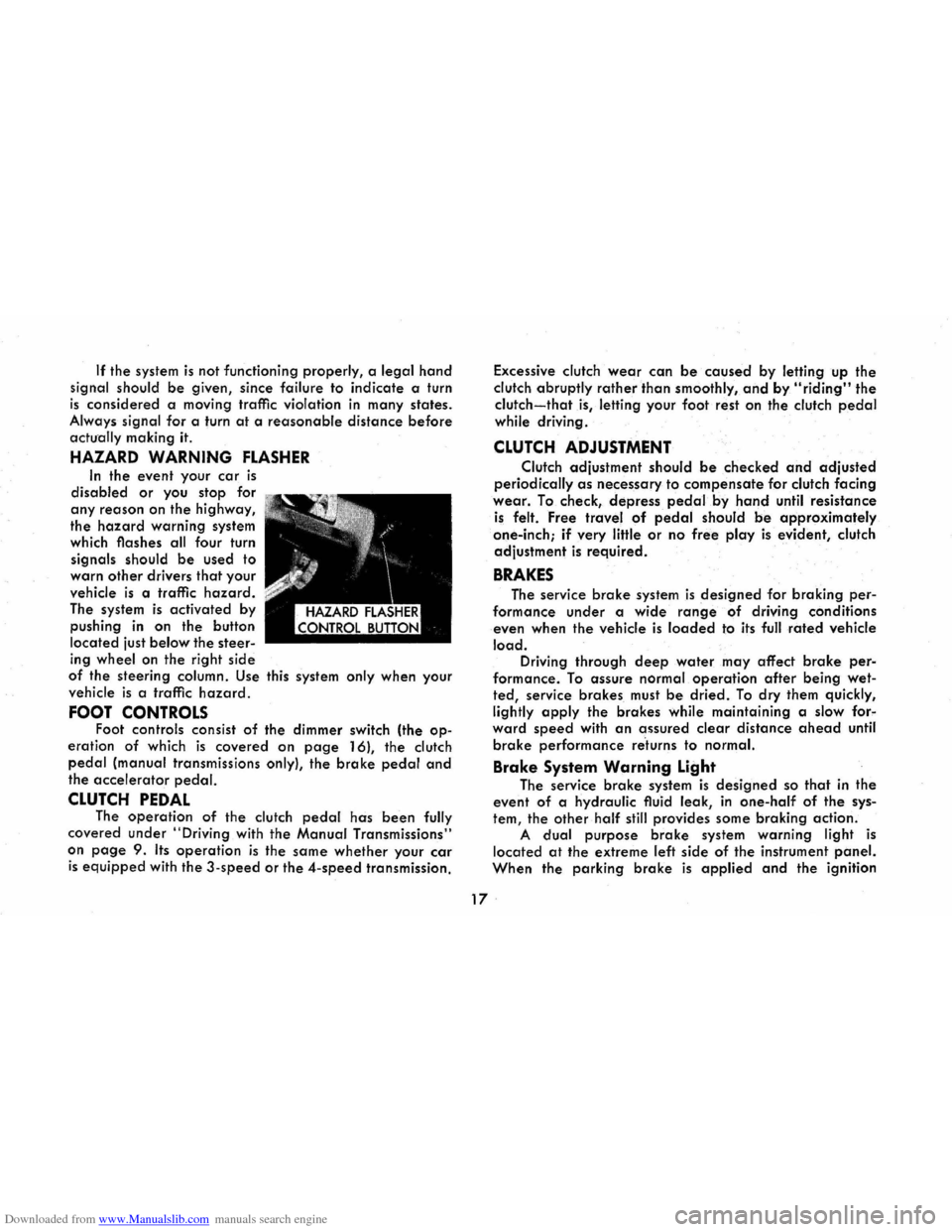
HAZARD WARNING FLASHER
In the event your car is
disabled or you stop for
any reason on the highway,
the
hazard warning system
which flashes all four turn
signals should
be used to
warn
other drivers that your
vehicle
is a traffic hazard.
The system is activated by
pushing
in on the button
located just
below the steer
ing wheel on the right side
of the steering column. Use this system only when your
vehicle
is a traffic hazard.
FOOT CONTROLS Foot controls consist of the dimmer switch (the op
eration of which is covered on page 16), the clutch
pedal (manual transmissions only), the brake pedal and
the accelerator pedal.
CLUTCH PEDAL The operation of the clutch pedal has been fully
covered under
"Driving with the Manual Transmissions"
on
page 9. Its operation is the same whether your car
is equipped with the 3-speed or the 4-speed transmission. Excessive
clutch
wear can be caused by letting up the
clutch abruptly
rather than smoothly, and by "riding" the
clutch-that is, letting your foot rest on the clutch pedal
while driving .
CLUTCH ADJUSTMENT
Clutch adjustment should be checked and adjusted
periodically as necessary to compensate for clutch facing
wear. To check, depress pedal.by hand until resistance
is felt. Free travel of pedal should be approximately
one-inch;
if very little or no free play is evident, clutch
adjustment
is required.
BRAKES
The service brake system is designed for braking per
formance under a wide range of driving conditions
even when the vehicle
is loaded to its full rated vehicle
load. Driving through deep water may affect brake per
formance. To assure normal operation after being wet
ted, service brakes must be dried. To dry them quickly,
lightly
apply the brakes while maintaining a slow for"
ward speed with an assured clear distance ahead until
brake performance re'turns to normal.
Brake System Warning Light
The service brake system is designed so that in the
event of a hydraulic fluid leak,
in one-half of the sys
tem, the other half still provides some braking action.
A dual purpose brake system warning light is
located at the extreme left side of the instrument panel.
When the parking brake is applied and the ignition
17 .
Page 44 of 56
Downloaded from www.Manualslib.com manuals search engine CHASSIS LUBRICATION
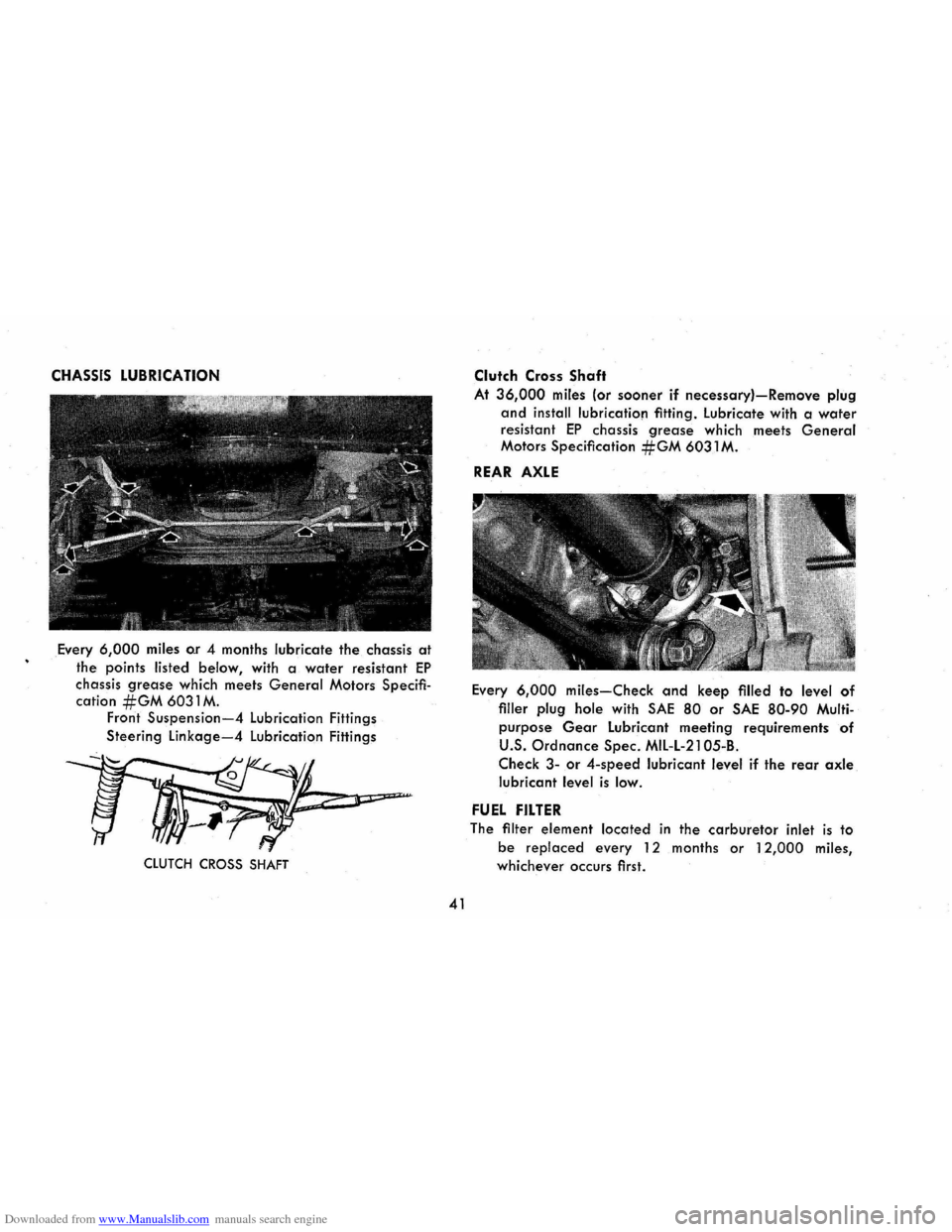
Every 6,000 miles o.r 4 months lubricate the chassis at
the points listed below, with a water resistant EP
chassis grease which meets General Motors Specifi
cation #GM 6031 M. Front Suspension-4 Lubrication Fittings
Steering
Linkage-4 Lubrication Fittings
, WJ~P;=-
CLUTCH CROSS SHAFT
41
Clutch Cross Shaft
At 36,000 miles (or sooner if necessary)-Remove plug
and install lubrication fitting. Lubricate with a water
resistant EP chassis grease which meets General
Motors Specification #GM 6031 M.
REAR AXLE
Every 6,000 miles-Check and keep filled to level of
filler plug hole with SAE 80 or SAE 80-90 Multi
purpose Gear Lubricant meeting requirements of
U.S. Ordnance Spec. MIL-L-21 05-B.
Check 3-or 4-speed lubricant level if the rear axle
lubricant level is low.
FUEL FILTER
The filter element located in the carburetor inlet is to
be replaced every 12 months or 12,000 miles,
whichever occurs first.
Page 46 of 56
Downloaded from www.Manualslib.com manuals search engine AIR CONDITIONING
Have your Chevrolet Dealer check your air conditioning
system
at some time during the winter months to be
sure there has been no loss in cooling output. Dur
ing
the summer, see your Chevrolet Dealer immedi
ately if you suspect the system is not performing as
it should.
BRAKE LININGS
Brake linings should be periodically inspected for wear.
The frequency of this inspection depends upon driv
ing conditions such
as traffic or terrain, and also
the driving techniques of individual owners. Your
Chevrolet Dealer is best qualified to advise you as
to how often this inspection should be performed.
When brakes require relining use genuine General
Motors Parts or equivalent.
BRAKE MASTER CYLINDER
Every 6,000 miles-Check fluid level in each reservoir
and maintain % II below lowest edge of each open
ing with G.M. Hydraulic Brake Fluid Supreme No. 11
PARKING BRAKE AND CLUTCH PULLEYS
AND CABLES
Every 12,000 miles-lubricate pulleys under dash. Re
move. the tunnel cover under vehicle and lubricate
pulleys
and cable bearing points with a water resist
ant EP chassis grease which meets General Motors
43
Specification #GM 6031 M. Lubricate gearshift lever
ball and socket (see page 38) at the same time.
FRONT WHEEL BEARINGS
Clean, repack with high melting point wheel bearing
lubricant, and adjust whenever the wheels and hub
are removed. Replace grease seals at the same time.
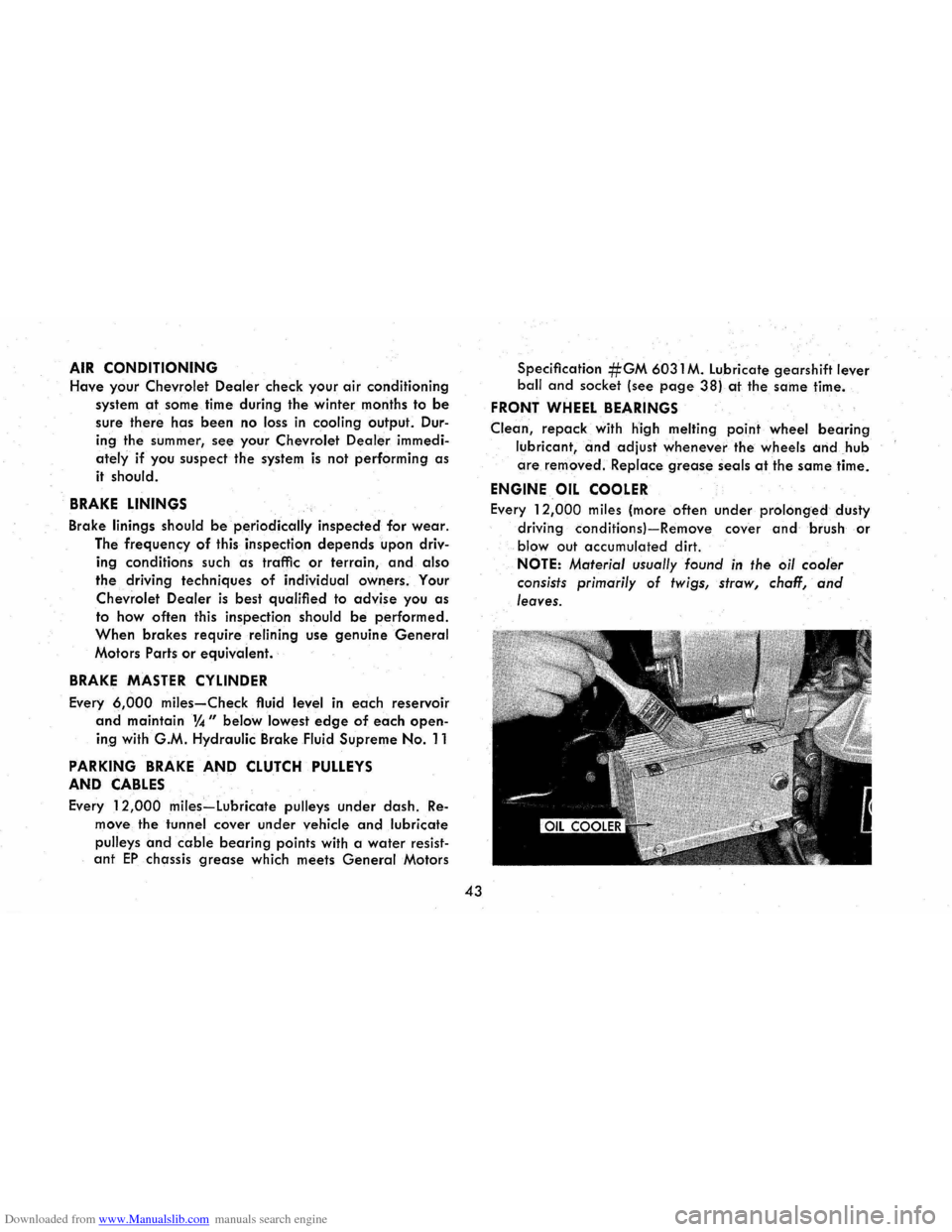
ENGINE OIL COOLER
Every 12,000 miles (more often under prolonged dusty
driving
conditionsl-Remove cover and brush or
blowout accumulated dirt.
NOTE: Material usually found in the oil cooler
consists primarily
of twigs, straw, chaff, and
leaves.
Page 55 of 56
Downloaded from www.Manualslib.com manuals search engine INDEX Page Air Cleaner. . . . . . . . . .. , .. . . . . . . .. . . . . . . . . . . .......... 42 Air Conditioning.. ............ ... .... .• . . .20,43 & 44 Air Injection Reactor......... ........... . ... ... 38 Air Recirculating Cover Plate. . . . . . . . . . . .• . . . . .. . . . .. . . 20 Air Vents. . . . . . . . . . . . . . . . . . . . . . . 22 Ash Tray. ........ .. ... 22 Battery........... ............ ....•...•................. 42 Brake Adjusters...................... .. .. ... ............. 17 Brake System Warning Light. . ................. 14 Brake Lmings. . ....... ....... ........ ............... 43 Brake Main Cylinder.. ........... . ...... 43 Brake-Parking. . ............ .......... . .. 18 & 43 Bright Metal Parts..... .. ..................... '. 30 Chassis Lubrication. . . . . . . . . . . . . . 41 Cigarette Lighter. . . .. .... ... .. . . . .. .. " 22 Circut Brea ker. . . . . . ................. .. .............. 15 & 45 Cleaning Hints Exterior Appearance........ .... .... . ............ . 30 Interior Appearance.. ............... . ............. ........ 31 Clutch Adjustment......... 17 Clutch Cross Shaft. . . .. . . . . . . . ... .. . . 41 Clutch Pedal.. .. . .. .. .. .. . . .. .. . .. .. . 17 Clutch Pulleys & Cables..................... . 43 Cooling System. . . . . . . . . . . . . . . . . . ........ ....... 34 & 43 Crankcase.ventilation (Positive). 37 Dimmer Switch... .......... ..... 16 Distributor. . . . . . . 42 Doors and Locks. .. ..... .................. .• ................. 23 Driving for Economy..... ...... ...... 7 Emergency Start. . . . . . . . . . . . . . . . . . 12 Engine Compartment.... . . . . . . . . . . . . . . . . . . . .. .. . . 28 Engine Fuel. . . . . . . . . . . . . . . . . . . . . . . . . . . . . . . . . . . . . . . . . .. 32 Engine Lubrication. . . . . . . . . .. . . . .• . . . . . . . • . . . . . . .33& 38 Fan Belt........ .... ..................... ..... 38 Foreign Country Operation. .................. 32 Front Suspension. . . . . . . . . . . . . . ... . . . . . . . . . . . . . . . . . . . . . 41 Front Wheel Bearings.. . ............. .......... . 43 Fuel Filter. . . . . . . . . . . . . . . •. . . . . . . . . .. . . . . 41 Fuel Guage.. ............ 13 Fuses.. .. .. ... ...................... ..... 45 ~s~p.......... ~ Gen·Fan .Indicator........ 13 Hazard Warning Flasher. . 17 Headrest...... . . ....... ... .. ........ 26 Heater............................... ..... .. .......... 19 Ignition Switch. . . . . . . . . . . . . . . . . .. . . . . . . . . . . . . 8 Jacking the Car. . . . .. . . . . . . . . . . .. . . . . . . . . . . . . . . . . . . . . . . . . . . . . . .. 36
52
Keys............... . ......... .............. . Light Control Knob ...................... . . Luggage Compartment ................... . Maintenance and Lubrication (Periodic) .. Octane Requirements. . . . . ......... . Oil Filter .... ............ . Pa rking Bra ke Operation . ..................... . Service .......... ...... . Polishing Your Corvair... . . ... . . . . . .. . .........•. .... ........ Positraction Axle. . . ... ............... .. ...... .. .. .... . Radios. . . . .... . ........... . Rear Axle.... . . ...................................... . . Rocking Car .............. . Occupant Restraint Belts .. . . Seats Front Seat Back Lock ....... .•...... Front Seat Adjustment. Rear Seat-Folding ... Service Bra kes. . . . . . . . . .. . ......................... ... . Serial and Unit Numbers .......... .. . Spare Tire..... . .• ......... .................•.•. Specifications. . . . ................... ... .. .• ........ Speedometer ... .. ............... . Starting the Engine .... . Steering Lin kage ...... . Steering Gear ............... . Telescoping Steering Column. Temp·Press Indicator. Tires. Towing ..... Trailer Hauling. Transmission Manual Operation. ................ . ....... .. .... . Service ................... .. .. ...... .. . Powerglide Operation. Service ...... . Operating Tips ....... . Trouble Shooting Guide.......... . .............. ... . Directional and Lane Change Signal. . ....• ...•.... Warm·up... ............ . ....... .. ........... ... . Washing Your Corvair. . . ........ . White Sidewall Tires.. . . . . . . . . . . . . . . ......... .. . Windshield Wipers and Washers. . . .. .. .. .. .
Page 22 16 29 38 32 39
18 43 30 12 21 41 12 24
23 24 27 17 44 36 44 13 8 41 38 22 13 34 12 50
9 39
10 40 11 46 16 9 30 31 18