Page 498 of 885
I
FA-l8FRONT AXLE AND SUSPENSION - Front Drive Shaft
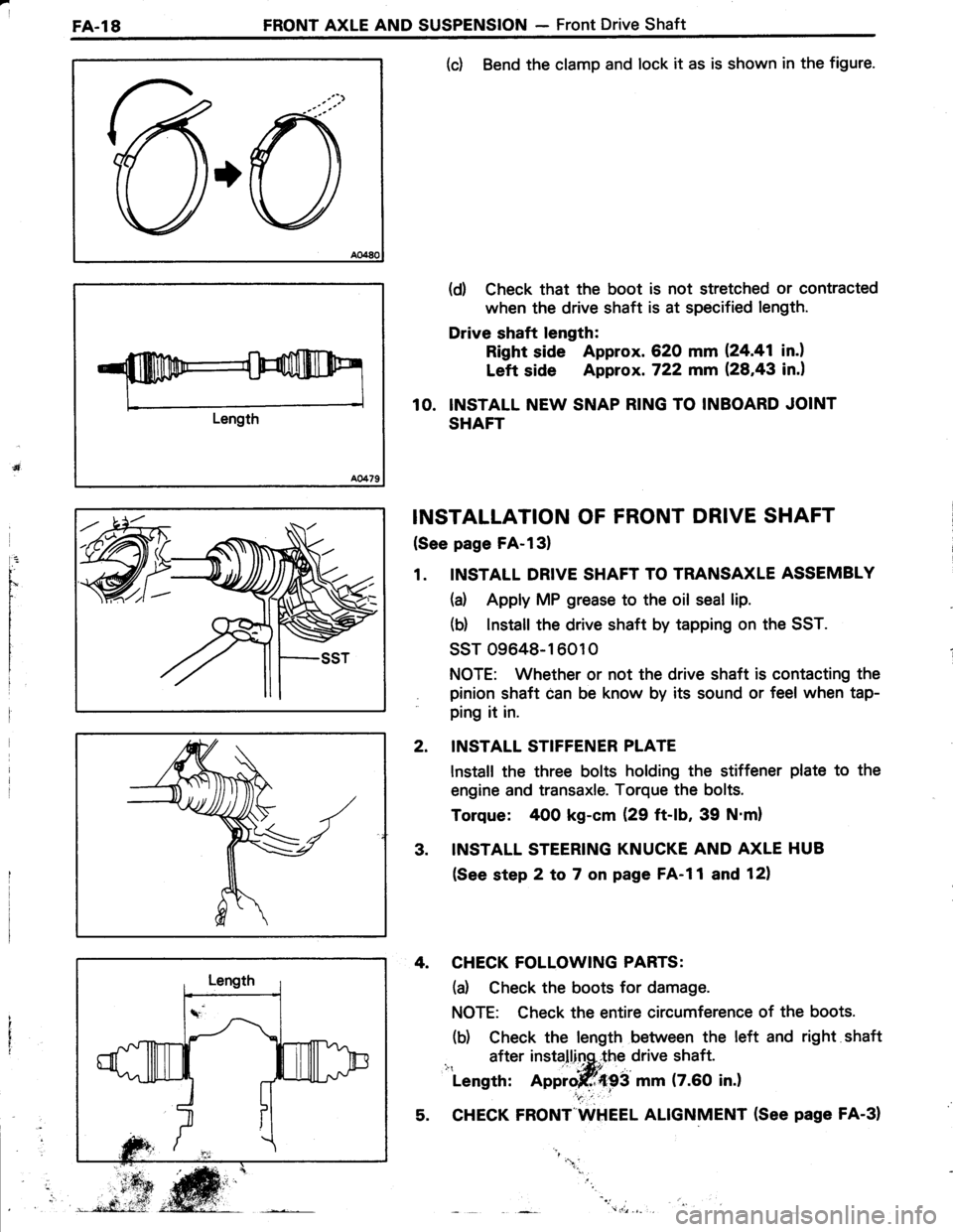
Length
(c) Bend the clamp and lock it as is shown in the figure.
(d) Check that the boot is not stretched or contracted
when the drive shaft is at specified length.
Drive shaft length:
Right side Approx. 620 mm 124.41 in.l
Left side Approx. 722 mm (28,43 in.)
10. INSTALL NEW SNAP RING TO INBOARD JOINT
SHAFT
INSTALLATION OF FRONT DRIVE SHAFT
(See page FA-l3)
1. INSTALL DRIVE SHAFT TO TRANSAXLE ASSEMBLY
(a) Apply MP grease to the oil seal lip.
(b) lnstall the drive shaft by tapping on the SST.
ssT 09648-16010
NOTE: Whether or not the drive shaft is contacting the
pinion shaft can be know by its sound or feel when tap-
ping it in.
INSTALL STIFFENER PLATE
lnstall the three bolts holding the stiffener plate to the
engine and transaxle. Torque the bolts.
Torque: 400 kg-cm (29 ft-lb, 39 N'm)
INSTALL STEERING KNUCKE AND AXLE HUB
(See step 2 to 7 on page FA-l1 and 12)
4. CHECK FOLLOWING PARTS:
(d Check the boots for damage.
NOTE: Check the entire circumference of the boots.
(b) Check the length between the left and right shaft
after installinq,.the drive shaft.i": ' -|*itLength: Approjff{93 mm (7.60 in.)
5. CHECK FRONT"WHEEL ALIGNMENT (See page FA-31
2.
3.
"1.
Page 507 of 885
FRONT AXLE AND SUSPENSION - Front SuspensionFA-27
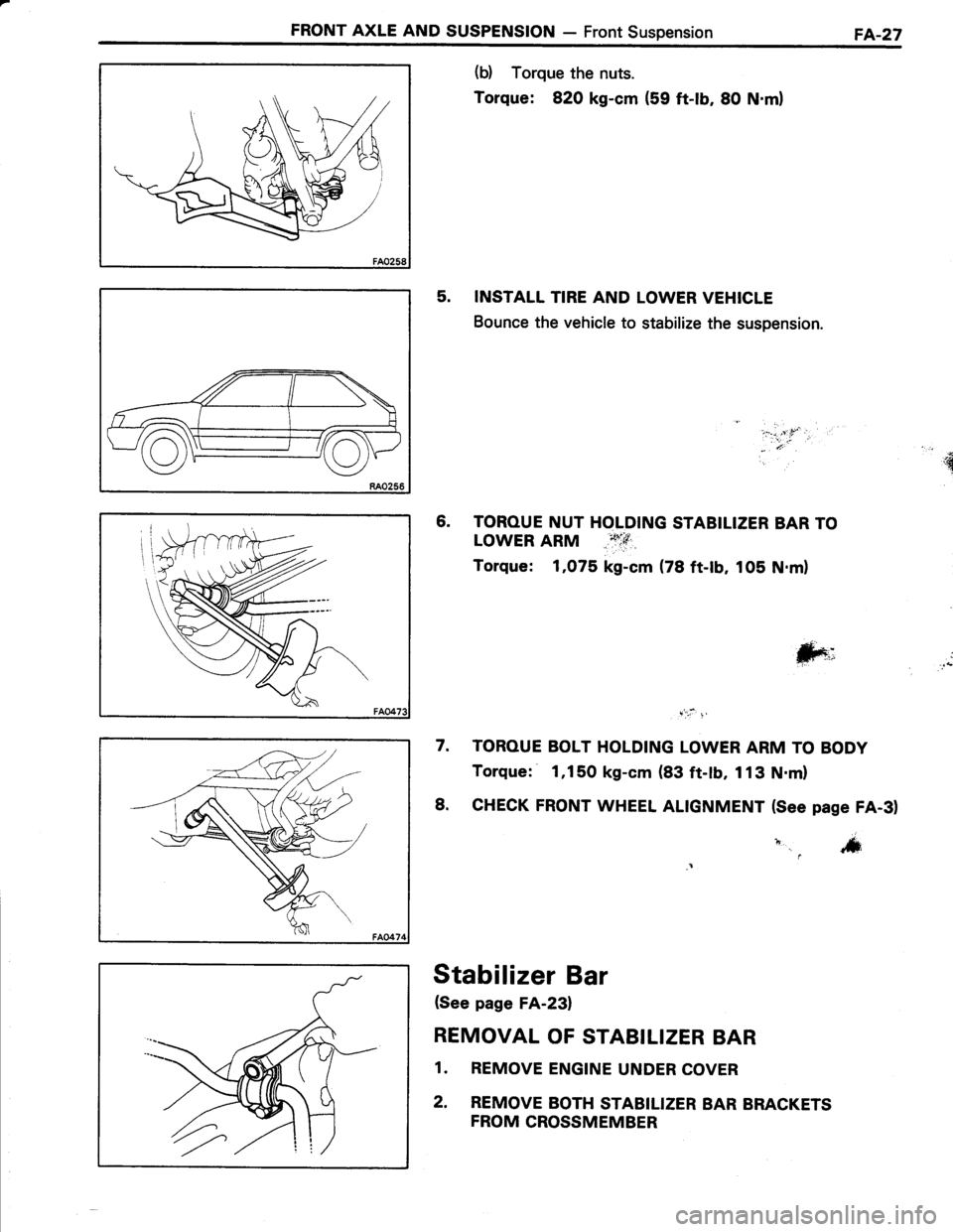
(b) Torque the nuts.
Torque: 820 kg-cm (59 ft-lb, 8O N.ml
5. INSTALL TIRE AND LOWER VEHICLE
Bounce the vehicle to stabilize the suspension.
6. TOROUE NUT HOLDING STABILIZER BAR TO
LOWER ARM ,#i{:Torque: 1,O75 kg-cm (78 ft-lb, lOb N.m)
!:rt !'
7. TOROUE BOLT HOLDING LOWER ARM TO BODY
Torque: 1,150 kg-cm (83 ft-tb, 113 N.ml
8. CHECK FRONT WHEEL ALIGNMENT (See pase FA-31
o '. '*'t
Stabifizer Bar
(See page FA-231
REMOVAL OF STABILIZER BAR
1. REMOVE ENGINE UNDER COVER
2. REMOVE BOTH STABILIZER BAR BRACKETS
FROM CROSSMEMBER
;;.".r:,!""
- .ti'" ..q
Page 508 of 885
a
FA.28FRONT AXLE AND SUSPENSION - Front Suspension
3. DISCONNECT BOTH STABILIZER BAR ENDS
TO LOWER ARM
4. REMOVE STABILIZER BAR
CAUTION: Be careful not to lose the spacer.
INSTALLATION OF STABILIZER BAR
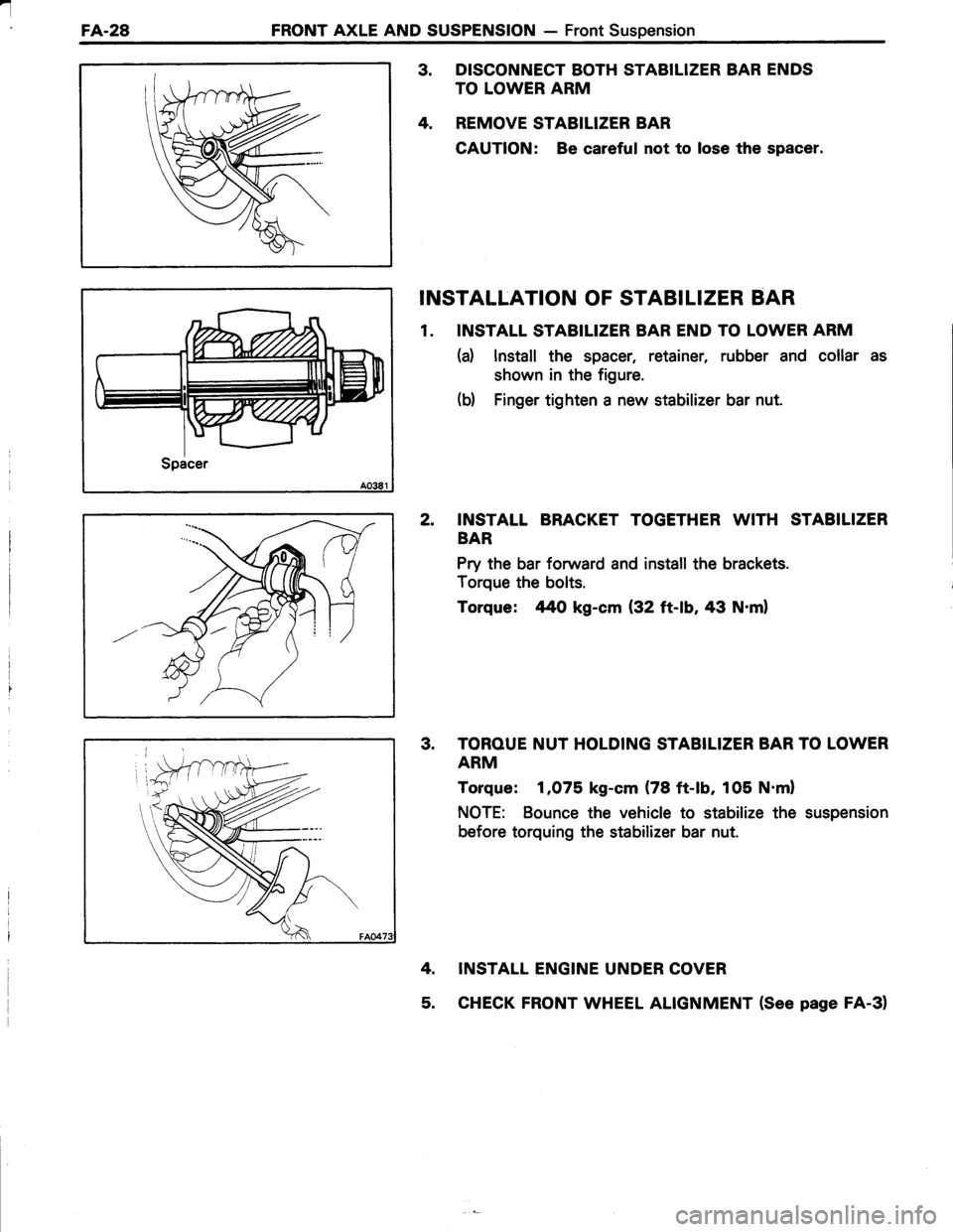
1. INSTALL STABILIZER BAR END TO LOWER ARM
(d lnstall the spacer, retainer, rubber and collar as
shown in the figure.
(b) Finger tighten a new stabilizer bar nut.
2. INSTALL BRACKET TOGETHER WITH STABILIZER
BAR
Pry the bar forward and install the brackets.
Torque the bolts.
Torque: rt4o kg-cm (32 ft-lb,43 N.ml
3. TOROUE NUT HOLDING STABILIZER BAR TO LOWER
ARM
Torque: 1,O75 kg-cm (78 ft-lb, 105 N.ml
NOTE: Bounce the vehicle to stabilize the suspension
before torquing the stabilizer bar nut.
4. INSTALL ENGINE UNDER COVER
5. CHECK FRONT WHEEL ALIGNMENT (See page FA-3)
Page 565 of 885
Stop Light Switch
Pedal Push Rod
Pedal Freeplay
Asphalt SheetPedat Height
BRAKE SYSTEM - Checks and
CHECKS AND ADJUSTMENTS
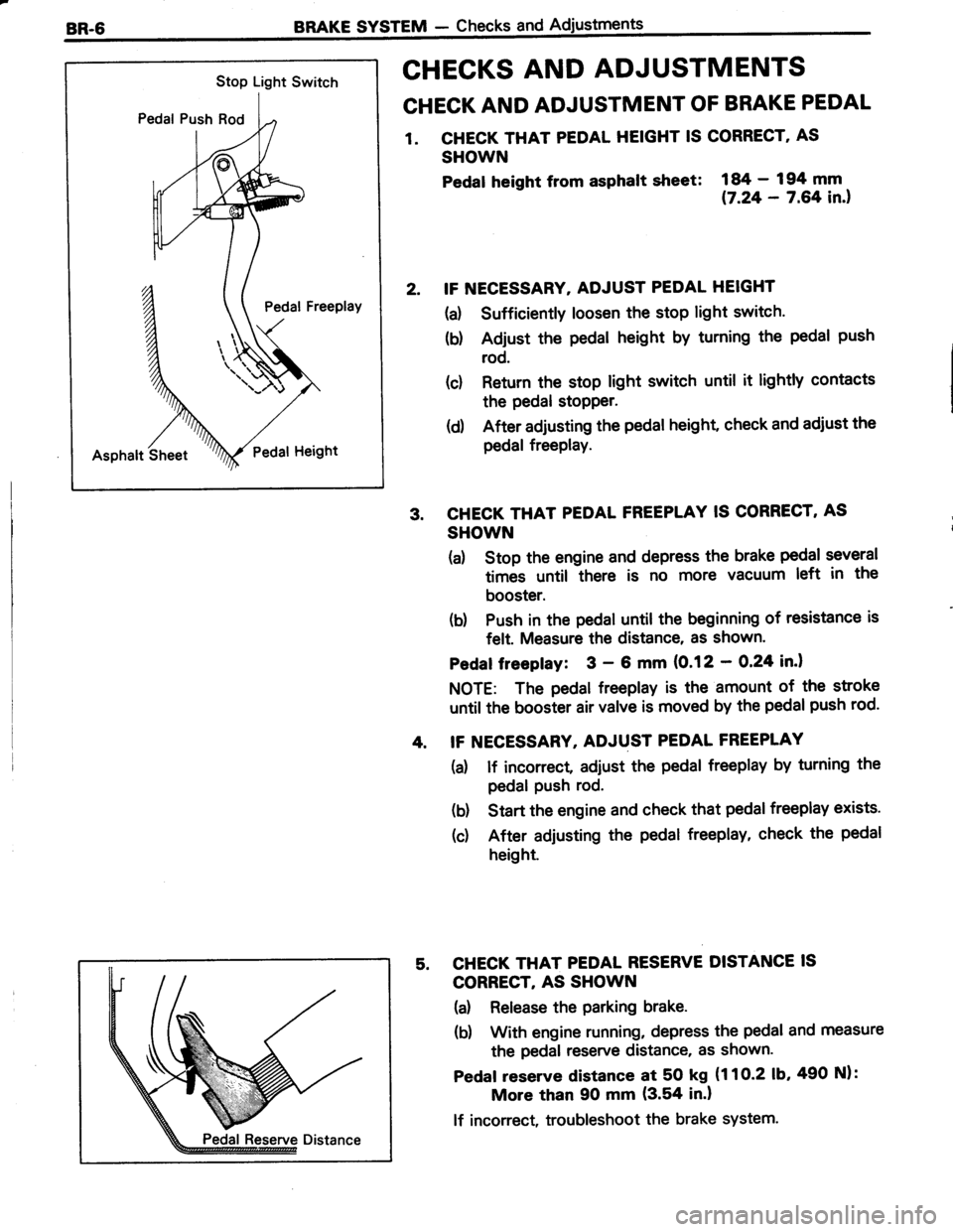
CHECK AND ADJUSTMENT OF BRAKE PEDAL
1. CHECK THAT PEDAL HEIGHT IS CORRECT' AS
SHOWN
Pedat heisht from asphalt slreet:
i#;:?ifil.,
IF NECESSARY. ADJUST PEDAL HEIGHT
(a) Sufficiently loosen the stop light switch.
(b) Adjust the pedal height by turning the pedal push
rod.
(c) Return the stop light switch until it lightly contacts
the pedal stopper.
(d) After adjusting the pedal height, check and adiust the
pedal freePlay.
CHECK THAT PEDAL FREEPLAY IS CORRECT, AS
SHOWN
(a) Stop the engine and depress the brake pedal several
times until there is no more vacuum left in the
booster.
(b) Push in the pedal until the beginning of resistance is
felt. Measure the distance, as shown'
Pedaf freepfay: 3 - 6 mm (0.12 - O,24 in.l
NOTE: The pedal freeplay is the amount of the stroke
until the booster air valve is moved by the pedal push rod.
IF NECESSARY, ADJUST PEDAL FREEPLAY
(a) lf incorrect adiust the pedal freeplay by turning the
pedal Push rod.
(b) Start the engine and check that pedal freeplay exists.
(c) After adjusting the pedal freeplay, check the pedal
height.
CHECK THAT PEDAL RESERVE DISTANCE IS
CORRECT, AS SHOWN
(a) Release the parking brake.
(b) With engine running, depress the pedal and measure
the pedal reserve distance, as shown.
Pedaf reserve distance at 50 kg (1 1 O-2 1b,490 Nl:
More than 90 mm (3.54 in.l
lf incorrect, troubleshoot the brake system.
Page 566 of 885
BRAKE SYSTEM - Checks and AdjustmentsBR-7
@@
VV
1 st 2nd
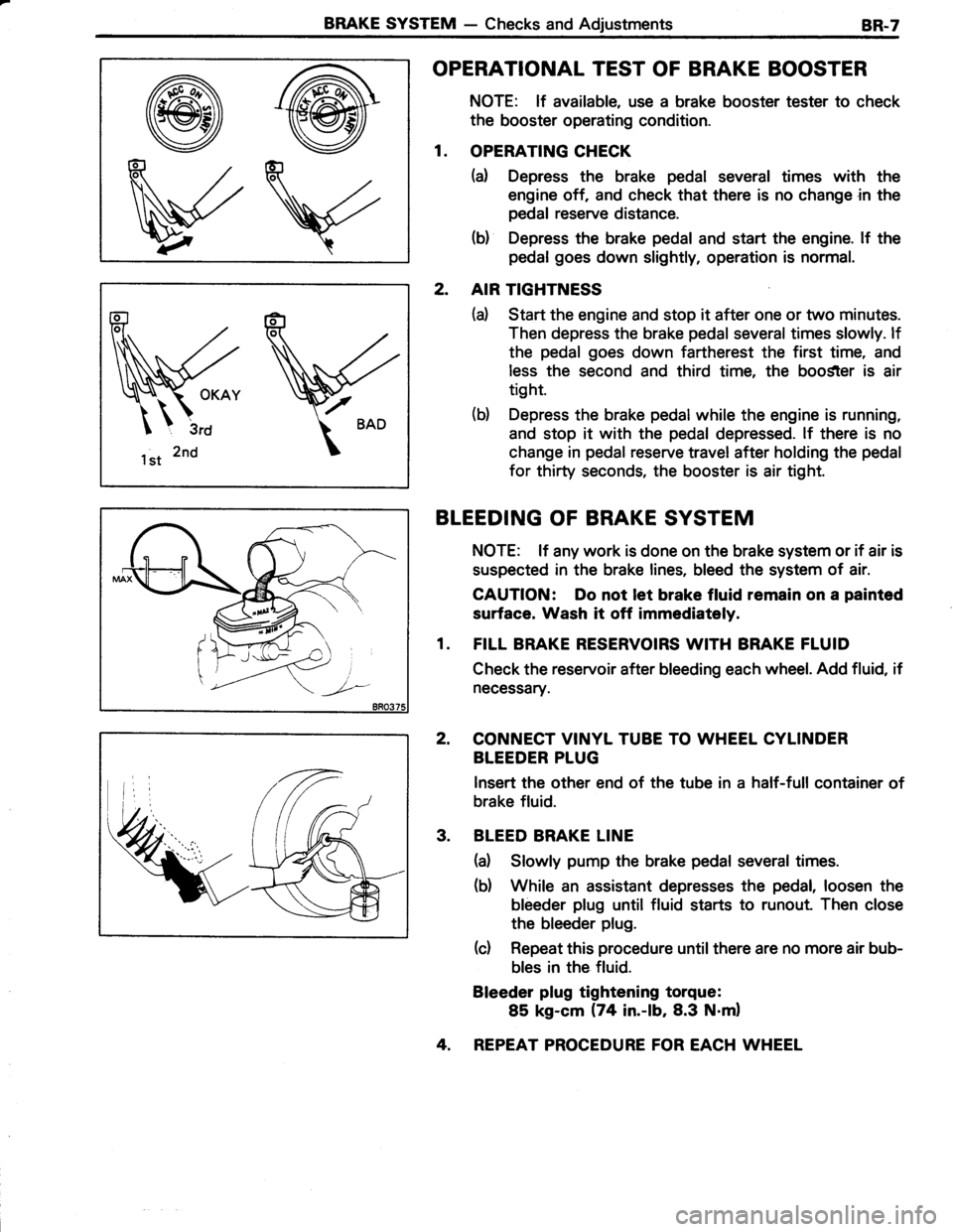
OPERATIONAL TEST OF BRAKE BOOSTER
NOTE: lf available, use a brake booster tester to check
the booster operating condition.
1. OPERATING CHECK
(a) Depress the brake pedal several times with the
engine off, and check that there is no change in the
pedal reserve distance.
(b) Depress the brake pedal and start the engine. lf the
pedal goes down slightly, operation is normal.
2. AIR TIGHTNESS
(d Start the engine and stop it after one or two minutes.
Then depress the brake pedal several times slowly. lf
the pedal goes down fartherest the first time, and
less the second and third time, the boo$ter is air
tight.
(b) Depress the brake pedal while the engine is running,
and stop it with the pedal depressed. lf there is no
change in pedal reserve travel after holding the pedal
for thirty seconds, the booster is air tight.
BLEEDING OF BRAKE SYSTEM
NOTE: lf any work is done on the brake system or if air is
suspected in the brake lines, bleed the system of air.
CAUTION: Do not let brake fluid remain on a painted
surface. Wash it off immediataly.
1. FILL BRAKE RESERVOIRS WITH BRAKE FLUID
Check the reservoir after bleeding each wheel. Add fluid, if
necessary.
2, CONNECT VINYL TUBE TO WHEEL CYLINDER
BLEEDER PLUG
lnsert the other end of the tube in a half-full container of
brake fluid.
3. BLEED BRAKE LINE
(a) Slowly pump the brake pedal several times.
(b) While an assistant depresses the pedal, loosen the
bleeder plug until fluid starts to runout. Then close
the bleeder plug.
(c) Repeat this procedure until there are no more air bub-
bles in the fluid.
Bleeder plug tightening torque:
85 kg-cm (74 in.-lb,8.3 N.m)
4. REPEAT PROCEDURE FOR EACH WHEEL