1985 FORD GRANADA weight
[x] Cancel search: weightPage 158 of 255
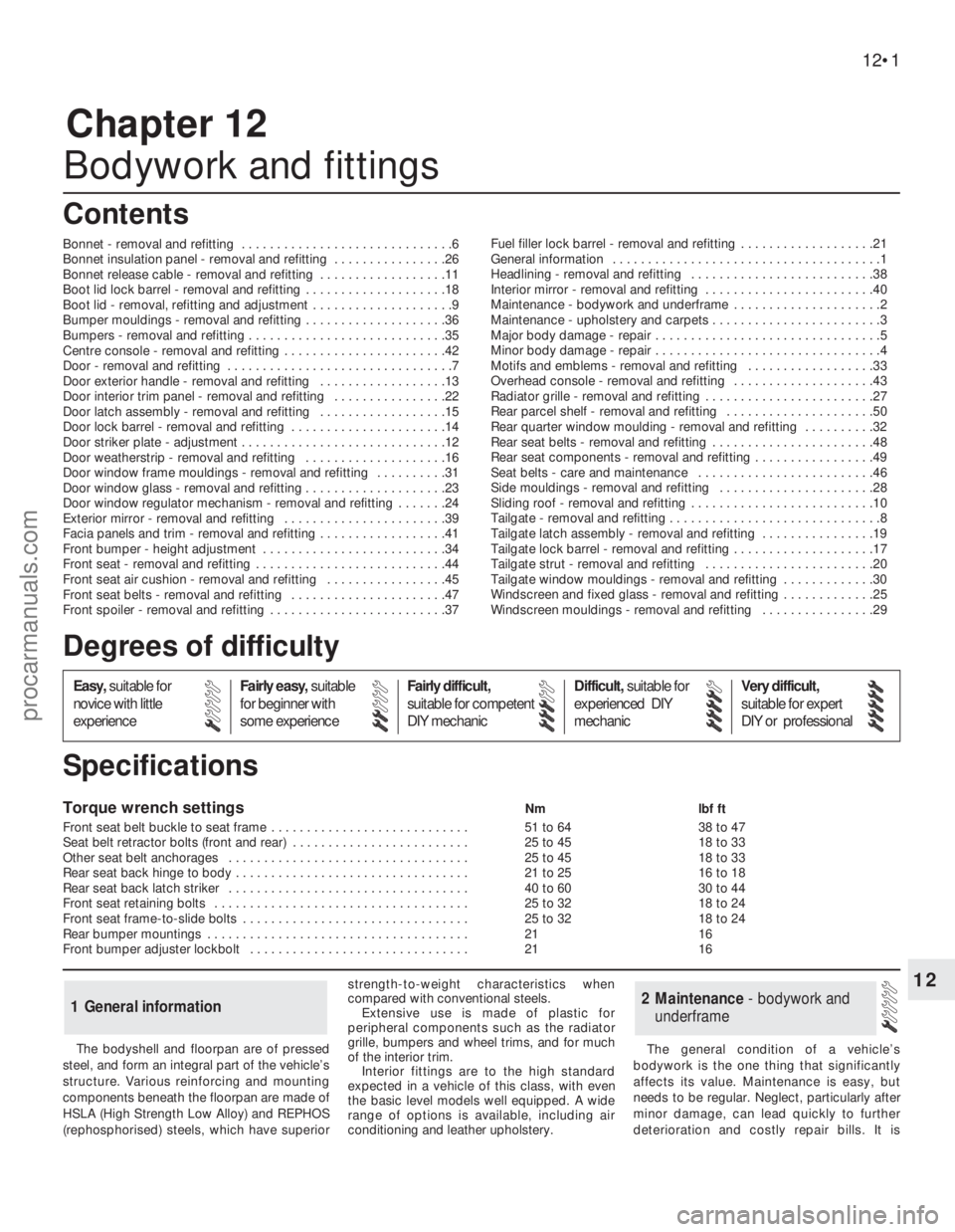
Chapter 12
Bodywork and fittings
Bonnet - removal and refitting . . . . . . . . . . . . . . . . . . . . . . . . . . . . . .6
Bonnet insulation panel - removal and refitting . . . . . . . . . . . . . . . .26
Bonnet release cable - removal and refitting . . . . . . . . . . . . . . . . . .11
Boot lid lock barrel - removal and refitting . . . . . . . . . . . . . . . . . . . .18
Boot lid - removal, refitting and adjustment . . . . . . . . . . . . . . . . . . . .9
Bumper mouldings - removal and refitting . . . . . . . . . . . . . . . . . . . .36
Bumpers - removal and refitting . . . . . . . . . . . . . . . . . . . . . . . . . . . .35
Centre console - removal and refitting . . . . . . . . . . . . . . . . . . . . . . .42
Door - removal and refitting . . . . . . . . . . . . . . . . . . . . . . . . . . . . . . . .7
Door exterior handle - removal and refitting . . . . . . . . . . . . . . . . . .13
Door interior trim panel - removal and refitting . . . . . . . . . . . . . . . .22
Door latch assembly - removal and refitting . . . . . . . . . . . . . . . . . .15
Door lock barrel - removal and refitting . . . . . . . . . . . . . . . . . . . . . .14
Door striker plate - adjustment . . . . . . . . . . . . . . . . . . . . . . . . . . . . .12
Door weatherstrip - removal and refitting . . . . . . . . . . . . . . . . . . . .16
Door window frame mouldings - removal and refitting . . . . . . . . . .31
Door window glass - removal and refitting . . . . . . . . . . . . . . . . . . . .23
Door window regulator mechanism - removal and refitting . . . . . . .24
Exterior mirror - removal and refitting . . . . . . . . . . . . . . . . . . . . . . .39
Facia panels and trim - removal and refitting . . . . . . . . . . . . . . . . . .41
Front bumper - height adjustment . . . . . . . . . . . . . . . . . . . . . . . . . .34
Front seat - removal and refitting . . . . . . . . . . . . . . . . . . . . . . . . . . .44
Front seat air cushion - removal and refitting . . . . . . . . . . . . . . . . .45
Front seat belts - removal and refitting . . . . . . . . . . . . . . . . . . . . . .47
Front spoiler - removal and refitting . . . . . . . . . . . . . . . . . . . . . . . . .37Fuel filler lock barrel - removal and refitting . . . . . . . . . . . . . . . . . . .21
General information . . . . . . . . . . . . . . . . . . . . . . . . . . . . . . . . . . . . . .1
Headlining - removal and refitting . . . . . . . . . . . . . . . . . . . . . . . . . .38
Interior mirror - removal and refitting . . . . . . . . . . . . . . . . . . . . . . . .40
Maintenance - bodywork and underframe . . . . . . . . . . . . . . . . . . . . .2
Maintenance - upholstery and carpets . . . . . . . . . . . . . . . . . . . . . . . .3
Major body damage - repair . . . . . . . . . . . . . . . . . . . . . . . . . . . . . . . .5
Minor body damage - repair . . . . . . . . . . . . . . . . . . . . . . . . . . . . . . . .4
Motifs and emblems - removal and refitting . . . . . . . . . . . . . . . . . .33
Overhead console - removal and refitting . . . . . . . . . . . . . . . . . . . .43
Radiator grille - removal and refitting . . . . . . . . . . . . . . . . . . . . . . . .27
Rear parcel shelf - removal and refitting . . . . . . . . . . . . . . . . . . . . .50
Rear quarter window moulding - removal and refitting . . . . . . . . . .32
Rear seat belts - removal and refitting . . . . . . . . . . . . . . . . . . . . . . .48
Rear seat components - removal and refitting . . . . . . . . . . . . . . . . .49
Seat belts - care and maintenance . . . . . . . . . . . . . . . . . . . . . . . . .46
Side mouldings - removal and refitting . . . . . . . . . . . . . . . . . . . . . .28
Sliding roof - removal and refitting . . . . . . . . . . . . . . . . . . . . . . . . . .10
Tailgate - removal and refitting . . . . . . . . . . . . . . . . . . . . . . . . . . . . . .8
Tailgate latch assembly - removal and refitting . . . . . . . . . . . . . . . .19
Tailgate lock barrel - removal and refitting . . . . . . . . . . . . . . . . . . . .17
Tailgate strut - removal and refitting . . . . . . . . . . . . . . . . . . . . . . . .20
Tailgate window mouldings - removal and refitting . . . . . . . . . . . . .30
Windscreen and fixed glass - removal and refitting . . . . . . . . . . . . .25
Windscreen mouldings - removal and refitting . . . . . . . . . . . . . . . .29
Torque wrench settingsNm lbf ft
Front seat belt buckle to seat frame . . . . . . . . . . . . . . . . . . . . . . . . . . . . 51 to 64 38 to 47
Seat belt retractor bolts (front and rear) . . . . . . . . . . . . . . . . . . . . . . . . . 25 to 45 18 to 33
Other seat belt anchorages . . . . . . . . . . . . . . . . . . . . . . . . . . . . . . . . . . 25 to 45 18 to 33
Rear seat back hinge to body . . . . . . . . . . . . . . . . . . . . . . . . . . . . . . . . . 21 to 25 16 to 18
Rear seat back latch striker . . . . . . . . . . . . . . . . . . . . . . . . . . . . . . . . . . 40 to 60 30 to 44
Front seat retaining bolts . . . . . . . . . . . . . . . . . . . . . . . . . . . . . . . . . . . . 25 to 32 18 to 24
Front seat frame-to-slide bolts . . . . . . . . . . . . . . . . . . . . . . . . . . . . . . . . 25 to 32 18 to 24
Rear bumper mountings . . . . . . . . . . . . . . . . . . . . . . . . . . . . . . . . . . . . . 21 16
Front bumper adjuster lockbolt . . . . . . . . . . . . . . . . . . . . . . . . . . . . . . . 21 16
12•1
Easy,suitable for
novice with little
experienceFairly easy,suitable
for beginner with
some experienceFairly difficult,
suitable for competent
DIY mechanicDifficult,suitable for
experienced DIY
mechanicVery difficult,
suitable for expert
DIY or professional
Degrees of difficulty
Specifications Contents
12
The bodyshell and floorpan are of pressed
steel, and form an integral part of the vehicle’s
structure. Various reinforcing and mounting
components beneath the floorpan are made of
HSLA (High Strength Low Alloy) and REPHOS
(rephosphorised) steels, which have superiorstrength-to-weight characteristics when
compared with conventional steels.
Extensive use is made of plastic for
peripheral components such as the radiator
grille, bumpers and wheel trims, and for much
of the interior trim.
Interior fittings are to the high standard
expected in a vehicle of this class, with even
the basic level models well equipped. A wide
range of options is available, including air
conditioning and leather upholstery.The general condition of a vehicle’s
bodywork is the one thing that significantly
affects its value. Maintenance is easy, but
needs to be regular. Neglect, particularly after
minor damage, can lead quickly to further
deterioration and costly repair bills. It is
2 Maintenance - bodywork and
underframe1 General information
procarmanuals.com
Page 244 of 255
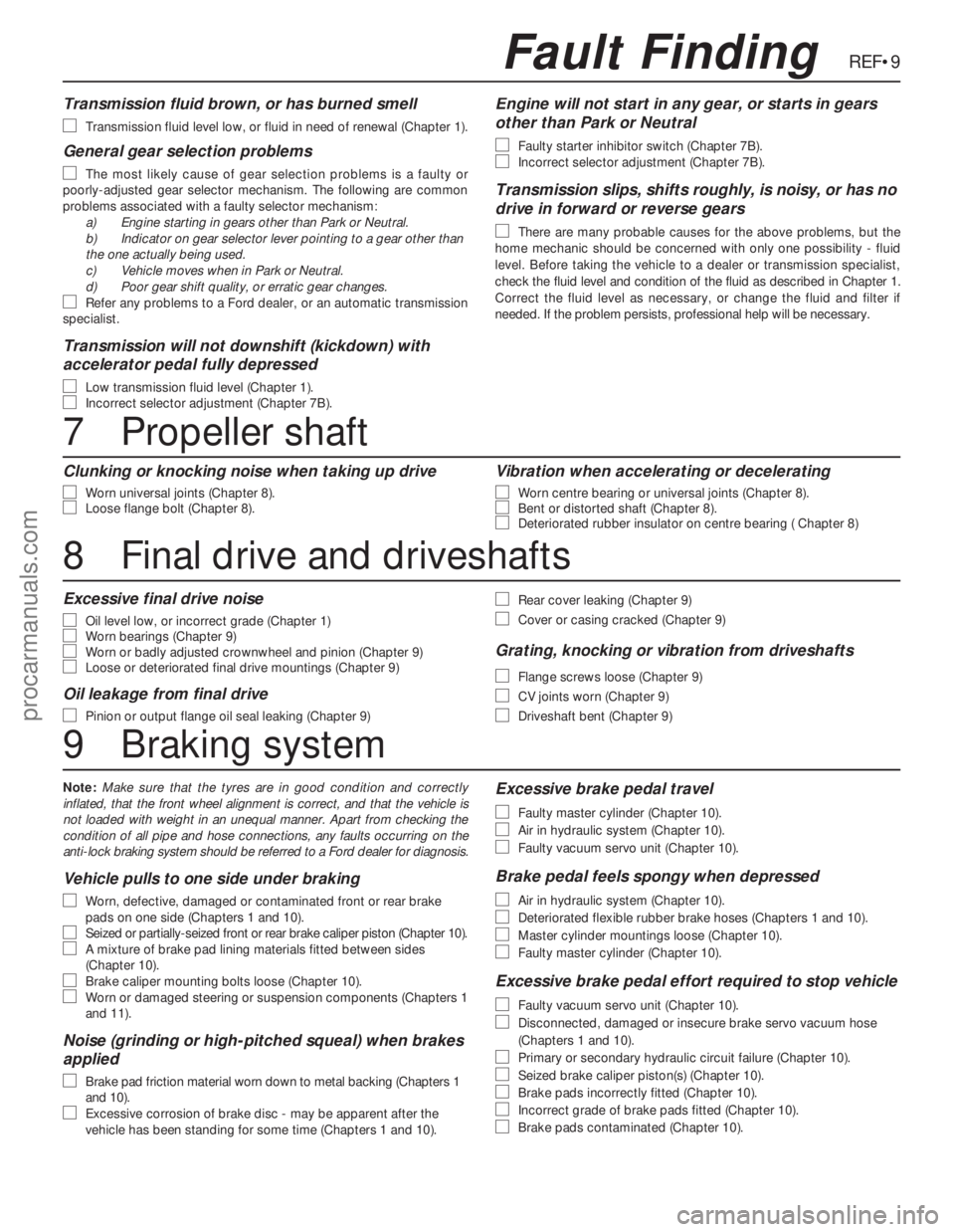
Transmission fluid brown, or has burned smell
m m
Transmission fluid level low, or fluid in need of renewal (Chapter 1).
General gear selection problems
m m
The most likely cause of gear selection problems is a faulty or
poorly-adjusted gear selector mechanism. The following are common
problems associated with a faulty selector mechanism:
a)Engine starting in gears other than Park or Neutral.
b)Indicator on gear selector lever pointing to a gear other than
the one actually being used.
c)Vehicle moves when in Park or Neutral.
d)Poor gear shift quality, or erratic gear changes.
m
mRefer any problems to a Ford dealer, or an automatic transmission
specialist.
Transmission will not downshift (kickdown) with
accelerator pedal fully depressed
m m
Low transmission fluid level (Chapter 1).
m
mIncorrect selector adjustment (Chapter 7B).
Engine will not start in any gear, or starts in gears
other than Park or Neutral
m m
Faulty starter inhibitor switch (Chapter 7B).
m
mIncorrect selector adjustment (Chapter 7B).
Transmission slips, shifts roughly, is noisy, or has no
drive in forward or reverse gears
m m
There are many probable causes for the above problems, but the
home mechanic should be concerned with only one possibility - fluid
level. Before taking the vehicle to a dealer or transmission specialist,
check the fluid level and condition of the fluid as described in Chapter 1.
Correct the fluid level as necessary, or change the fluid and filter if
needed. If the problem persists, professional help will be necessary.
REF•9Fault Finding
7Propeller shaft
Clunking or knocking noise when taking up drive
m m
Worn universal joints (Chapter 8).m
mLoose flange bolt (Chapter 8).
Vibration when accelerating or decelerating
m m
Worn centre bearing or universal joints (Chapter 8).m
mBent or distorted shaft (Chapter 8).m
mDeteriorated rubber insulator on centre bearing ( Chapter 8)
8Final drive and driveshafts
Excessive final drive noise
m m
Oil level low, or incorrect grade (Chapter 1)m
mWorn bearings (Chapter 9)m
mWorn or badly adjusted crownwheel and pinion (Chapter 9)m
mLoose or deteriorated final drive mountings (Chapter 9)
Oil leakage from final drive
m m
Pinion or output flange oil seal leaking (Chapter 9)
m
mRear cover leaking (Chapter 9)
m
mCover or casing cracked (Chapter 9)
Grating, knocking or vibration from driveshafts
m m
Flange screws loose (Chapter 9)
m
mCV joints worn (Chapter 9)
m
mDriveshaft bent (Chapter 9)
9Braking system
Note:Make sure that the tyres are in good condition and correctly
inflated, that the front wheel alignment is correct, and that the vehicle is
not loaded with weight in an unequal manner. Apart from checking the
condition of all pipe and hose connections, any faults occurring on the
anti-lock braking system should be referred to a Ford dealer for diagnosis.
Vehicle pulls to one side under braking
m m
Worn, defective, damaged or contaminated front or rear brake
pads on one side (Chapters 1 and 10).
m mSeized or partially-seized front or rear brake caliper piston (Chapter 10).m
mA mixture of brake pad lining materials fitted between sides
(Chapter 10).
m mBrake caliper mounting bolts loose (Chapter 10).m
mWorn or damaged steering or suspension components (Chapters 1
and 11).
Noise (grinding or high-pitched squeal) when brakes
applied
m m
Brake pad friction material worn down to metal backing (Chapters 1
and 10).
m mExcessive corrosion of brake disc - may be apparent after the
vehicle has been standing for some time (Chapters 1 and 10).
Excessive brake pedal travel
m m
Faulty master cylinder (Chapter 10).
m
mAir in hydraulic system (Chapter 10).
m
mFaulty vacuum servo unit (Chapter 10).
Brake pedal feels spongy when depressed
m m
Air in hydraulic system (Chapter 10).
m
mDeteriorated flexible rubber brake hoses (Chapters 1 and 10).
m
mMaster cylinder mountings loose (Chapter 10).
m
mFaulty master cylinder (Chapter 10).
Excessive brake pedal effort required to stop vehicle
m m
Faulty vacuum servo unit (Chapter 10).
m
mDisconnected, damaged or insecure brake servo vacuum hose
(Chapters 1 and 10).
m mPrimary or secondary hydraulic circuit failure (Chapter 10).
m
mSeized brake caliper piston(s) (Chapter 10).
m
mBrake pads incorrectly fitted (Chapter 10).
m
mIncorrect grade of brake pads fitted (Chapter 10).
m
mBrake pads contaminated (Chapter 10).
procarmanuals.com
Page 249 of 255
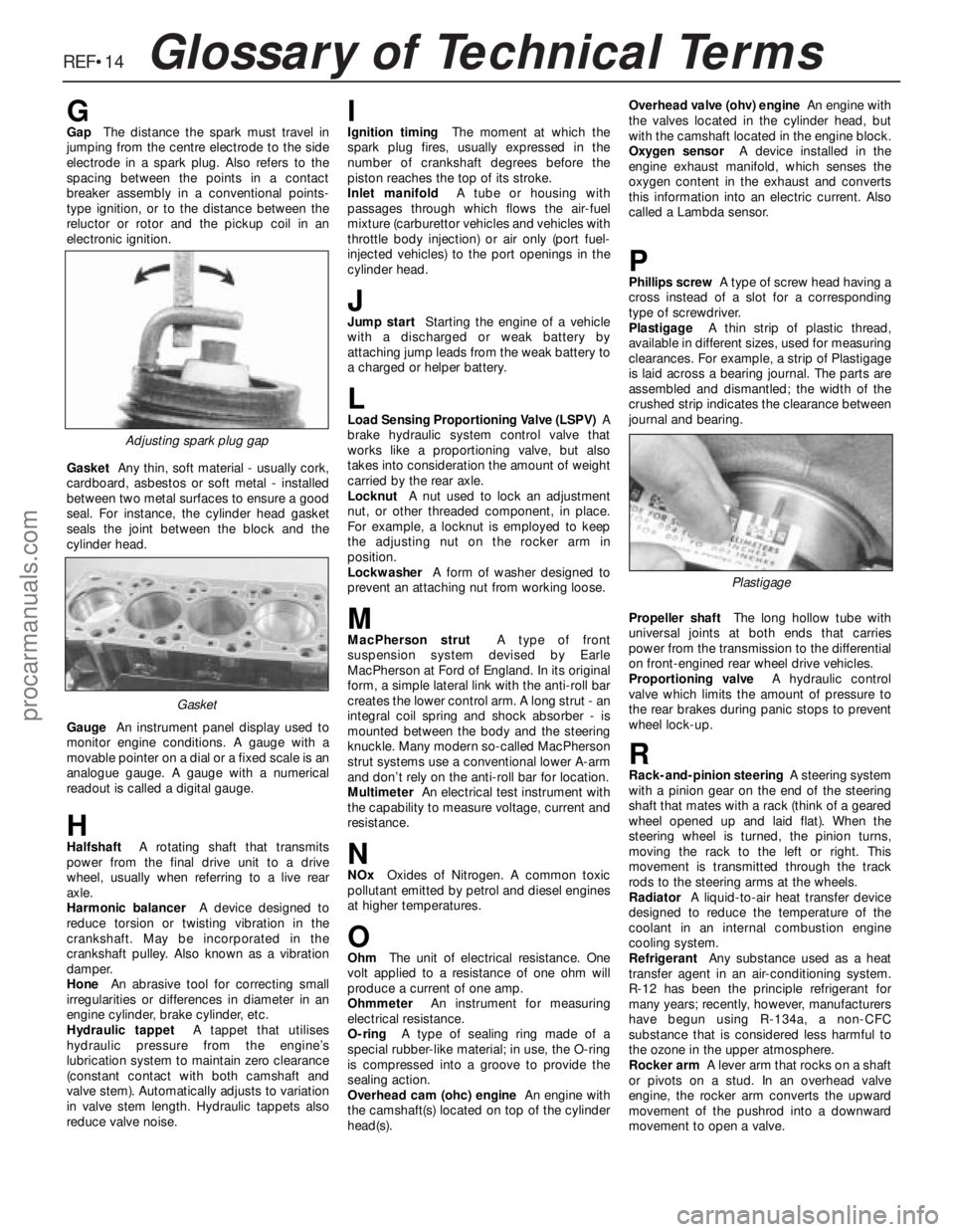
REF•14Glossary of Technical Terms
GGapThe distance the spark must travel in
jumping from the centre electrode to the side
electrode in a spark plug. Also refers to the
spacing between the points in a contact
breaker assembly in a conventional points-
type ignition, or to the distance between the
reluctor or rotor and the pickup coil in an
electronic ignition.
GasketAny thin, soft material - usually cork,
cardboard, asbestos or soft metal - installed
between two metal surfaces to ensure a good
seal. For instance, the cylinder head gasket
seals the joint between the block and the
cylinder head.
GaugeAn instrument panel display used to
monitor engine conditions. A gauge with a
movable pointer on a dial or a fixed scale is an
analogue gauge. A gauge with a numerical
readout is called a digital gauge.
HHalfshaftA rotating shaft that transmits
power from the final drive unit to a drive
wheel, usually when referring to a live rear
axle.
Harmonic balancerA device designed to
reduce torsion or twisting vibration in the
crankshaft. May be incorporated in the
crankshaft pulley. Also known as a vibration
damper.
HoneAn abrasive tool for correcting small
irregularities or differences in diameter in an
engine cylinder, brake cylinder, etc.
Hydraulic tappetA tappet that utilises
hydraulic pressure from the engine’s
lubrication system to maintain zero clearance
(constant contact with both camshaft and
valve stem). Automatically adjusts to variation
in valve stem length. Hydraulic tappets also
reduce valve noise.
IIgnition timingThe moment at which the
spark plug fires, usually expressed in the
number of crankshaft degrees before the
piston reaches the top of its stroke.
Inlet manifoldA tube or housing with
passages through which flows the air-fuel
mixture (carburettor vehicles and vehicles with
throttle body injection) or air only (port fuel-
injected vehicles) to the port openings in the
cylinder head.
JJump startStarting the engine of a vehicle
with a discharged or weak battery by
attaching jump leads from the weak battery to
a charged or helper battery.
LLoad Sensing Proportioning Valve (LSPV)A
brake hydraulic system control valve that
works like a proportioning valve, but also
takes into consideration the amount of weight
carried by the rear axle.
LocknutA nut used to lock an adjustment
nut, or other threaded component, in place.
For example, a locknut is employed to keep
the adjusting nut on the rocker arm in
position.
LockwasherA form of washer designed to
prevent an attaching nut from working loose.
MMacPherson strutA type of front
suspension system devised by Earle
MacPherson at Ford of England. In its original
form, a simple lateral link with the anti-roll bar
creates the lower control arm. A long strut - an
integral coil spring and shock absorber - is
mounted between the body and the steering
knuckle. Many modern so-called MacPherson
strut systems use a conventional lower A-arm
and don’t rely on the anti-roll bar for location.
MultimeterAn electrical test instrument with
the capability to measure voltage, current and
resistance.
NNOxOxides of Nitrogen. A common toxic
pollutant emitted by petrol and diesel engines
at higher temperatures.
OOhmThe unit of electrical resistance. One
volt applied to a resistance of one ohm will
produce a current of one amp.
OhmmeterAn instrument for measuring
electrical resistance.
O-ringA type of sealing ring made of a
special rubber-like material; in use, the O-ring
is compressed into a groove to provide the
sealing action.
Overhead cam (ohc) engineAn engine with
the camshaft(s) located on top of the cylinder
head(s).Overhead valve (ohv) engineAn engine with
the valves located in the cylinder head, but
with the camshaft located in the engine block.
Oxygen sensorA device installed in the
engine exhaust manifold, which senses the
oxygen content in the exhaust and converts
this information into an electric current. Also
called a Lambda sensor.
PPhillips screwA type of screw head having a
cross instead of a slot for a corresponding
type of screwdriver.
PlastigageA thin strip of plastic thread,
available in different sizes, used for measuring
clearances. For example, a strip of Plastigage
is laid across a bearing journal. The parts are
assembled and dismantled; the width of the
crushed strip indicates the clearance between
journal and bearing.
Propeller shaftThe long hollow tube with
universal joints at both ends that carries
power from the transmission to the differential
on front-engined rear wheel drive vehicles.
Proportioning valveA hydraulic control
valve which limits the amount of pressure to
the rear brakes during panic stops to prevent
wheel lock-up.
RRack-and-pinion steeringA steering system
with a pinion gear on the end of the steering
shaft that mates with a rack (think of a geared
wheel opened up and laid flat). When the
steering wheel is turned, the pinion turns,
moving the rack to the left or right. This
movement is transmitted through the track
rods to the steering arms at the wheels.
RadiatorA liquid-to-air heat transfer device
designed to reduce the temperature of the
coolant in an internal combustion engine
cooling system.
RefrigerantAny substance used as a heat
transfer agent in an air-conditioning system.
R-12 has been the principle refrigerant for
many years; recently, however, manufacturers
have begun using R-134a, a non-CFC
substance that is considered less harmful to
the ozone in the upper atmosphere.
Rocker armA lever arm that rocks on a shaft
or pivots on a stud. In an overhead valve
engine, the rocker arm converts the upward
movement of the pushrod into a downward
movement to open a valve.
Adjusting spark plug gap
Plastigage
Gasket
procarmanuals.com
Page 251 of 255
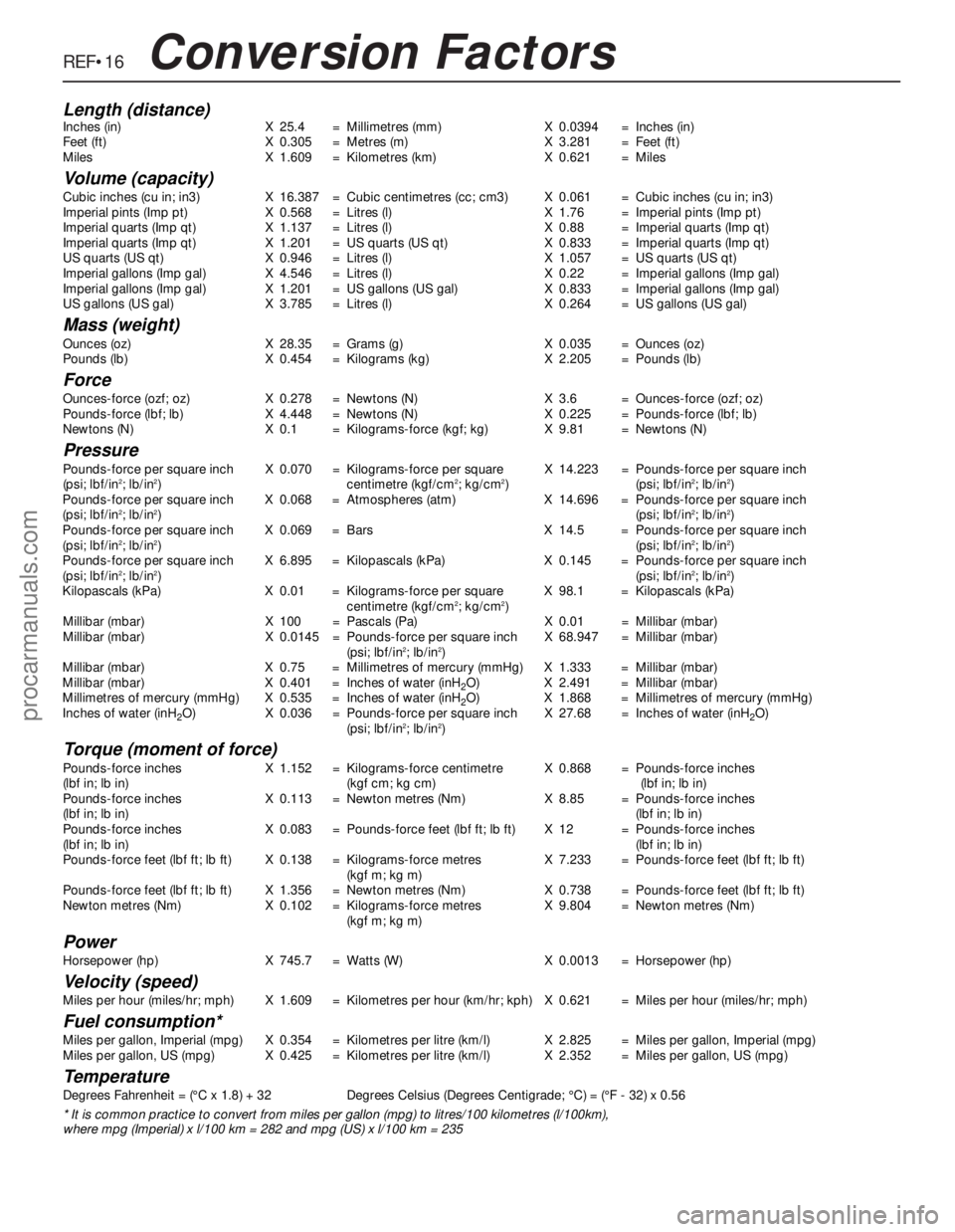
REF•16
Length (distance)Inches (in)X25.4=Millimetres (mm)X0.0394=Inches (in)
Feet (ft)X0.305=Metres (m)X3.281=Feet (ft)
MilesX1.609=Kilometres (km)X0.621=Miles
Volume (capacity)
Cubic inches (cu in; in3)X16.387=Cubic centimetres (cc; cm3)X0.061=Cubic inches (cu in; in3)
Imperial pints (Imp pt)X0.568=Litres (l)X1.76=Imperial pints (Imp pt)
Imperial quarts (Imp qt)X1.137=Litres (l)X0.88=Imperial quarts (Imp qt)
Imperial quarts (Imp qt)X1.201=US quarts (US qt)X0.833=Imperial quarts (Imp qt)
US quarts (US qt)X0.946=Litres (l)X1.057=US quarts (US qt)
Imperial gallons (Imp gal)X4.546=Litres (l)X0.22=Imperial gallons (Imp gal)
Imperial gallons (Imp gal)X1.201=US gallons (US gal)X0.833=Imperial gallons (Imp gal)
US gallons (US gal)X3.785=Litres (l)X0.264=US gallons (US gal)
Mass (weight)
Ounces (oz)X28.35=Grams (g)X0.035=Ounces (oz)
Pounds (lb)X0.454=Kilograms (kg)X2.205=Pounds (lb)
Force
Ounces-force (ozf; oz)X0.278=Newtons (N)X3.6=Ounces-force (ozf; oz)
Pounds-force (lbf; lb)X4.448=Newtons (N)X0.225=Pounds-force (lbf; lb)
Newtons (N)X0.1=Kilograms-force (kgf; kg)X9.81=Newtons (N)
Pressure
Pounds-force per square inchX0.070=Kilograms-force per squareX14.223=Pounds-force per square inch
(psi; lbf/in2; lb/in2)centimetre (kgf/cm2; kg/cm2)(psi; lbf/in2; lb/in2)
Pounds-force per square inchX0.068=Atmospheres (atm)X14.696=Pounds-force per square inch
(psi; lbf/in
2; lb/in2)(psi; lbf/in2; lb/in2)
Pounds-force per square inchX0.069=BarsX14.5=Pounds-force per square inch
(psi; lbf/in
2; lb/in2)(psi; lbf/in2; lb/in2)
Pounds-force per square inchX6.895=Kilopascals (kPa)X0.145=Pounds-force per square inch
(psi; lbf/in
2; lb/in2)(psi; lbf/in2; lb/in2)
Kilopascals (kPa)X0.01=Kilograms-force per squareX98.1=Kilopascals (kPa)
centimetre (kgf/cm
2; kg/cm2)
Millibar (mbar)X100=Pascals (Pa)X0.01=Millibar (mbar)
Millibar (mbar)X0.0145=Pounds-force per square inchX68.947=Millibar (mbar)
(psi; lbf/in
2; lb/in2)
Millibar (mbar)X0.75=Millimetres of mercury (mmHg)X1.333=Millibar (mbar)
Millibar (mbar)X0.401=Inches of water (inH
2O)X2.491=Millibar (mbar)
Millimetres of mercury (mmHg)X0.535=Inches of water (inH
2O)X1.868=Millimetres of mercury (mmHg)
Inches of water (inH
2O)X0.036=Pounds-force per square inchX27.68=Inches of water (inH2O)
(psi; lbf/in2; lb/in2)
Torque (moment of force)
Pounds-force inchesX1.152=Kilograms-force centimetreX0.868=Pounds-force inches
(lbf in; lb in)(kgf cm; kg cm)(lbf in; lb in)
Pounds-force inchesX0.113=Newton metres (Nm)X8.85=Pounds-force inches
(lbf in; lb in)(lbf in; lb in)
Pounds-force inchesX0.083=Pounds-force feet (lbf ft; lb ft)X12=Pounds-force inches
(lbf in; lb in)(lbf in; lb in)
Pounds-force feet (lbf ft; lb ft)X0.138=Kilograms-force metresX7.233=Pounds-force feet (lbf ft; lb ft)
(kgf m; kg m)
Pounds-force feet (lbf ft; lb ft)X1.356=Newton metres (Nm)X0.738=Pounds-force feet (lbf ft; lb ft)
Newton metres (Nm)X0.102=Kilograms-force metresX9.804=Newton metres (Nm)
(kgf m; kg m)
Power
Horsepower (hp)X745.7=Watts (W)X0.0013=Horsepower (hp)
Velocity (speed)
Miles per hour (miles/hr; mph)X1.609=Kilometres per hour (km/hr; kph)X0.621=Miles per hour (miles/hr; mph)
Fuel consumption*
Miles per gallon, Imperial (mpg)X0.354=Kilometres per litre (km/l)X2.825=Miles per gallon, Imperial (mpg)
Miles per gallon, US (mpg)X0.425=Kilometres per litre (km/l)X2.352=Miles per gallon, US (mpg)
Temperature
Degrees Fahrenheit = (°C x 1.8) + 32Degrees Celsius (Degrees Centigrade; °C) = (°F - 32) x 0.56
* It is common practice to convert from miles per gallon (mpg) to litres/100 kilometres (l/100km),
where mpg (Imperial) x l/100 km = 282 and mpg (US) x l/100 km = 235
Conversion Factors
procarmanuals.com