1984 CHEVROLET CAVALIER length
[x] Cancel search: lengthPage 14 of 105
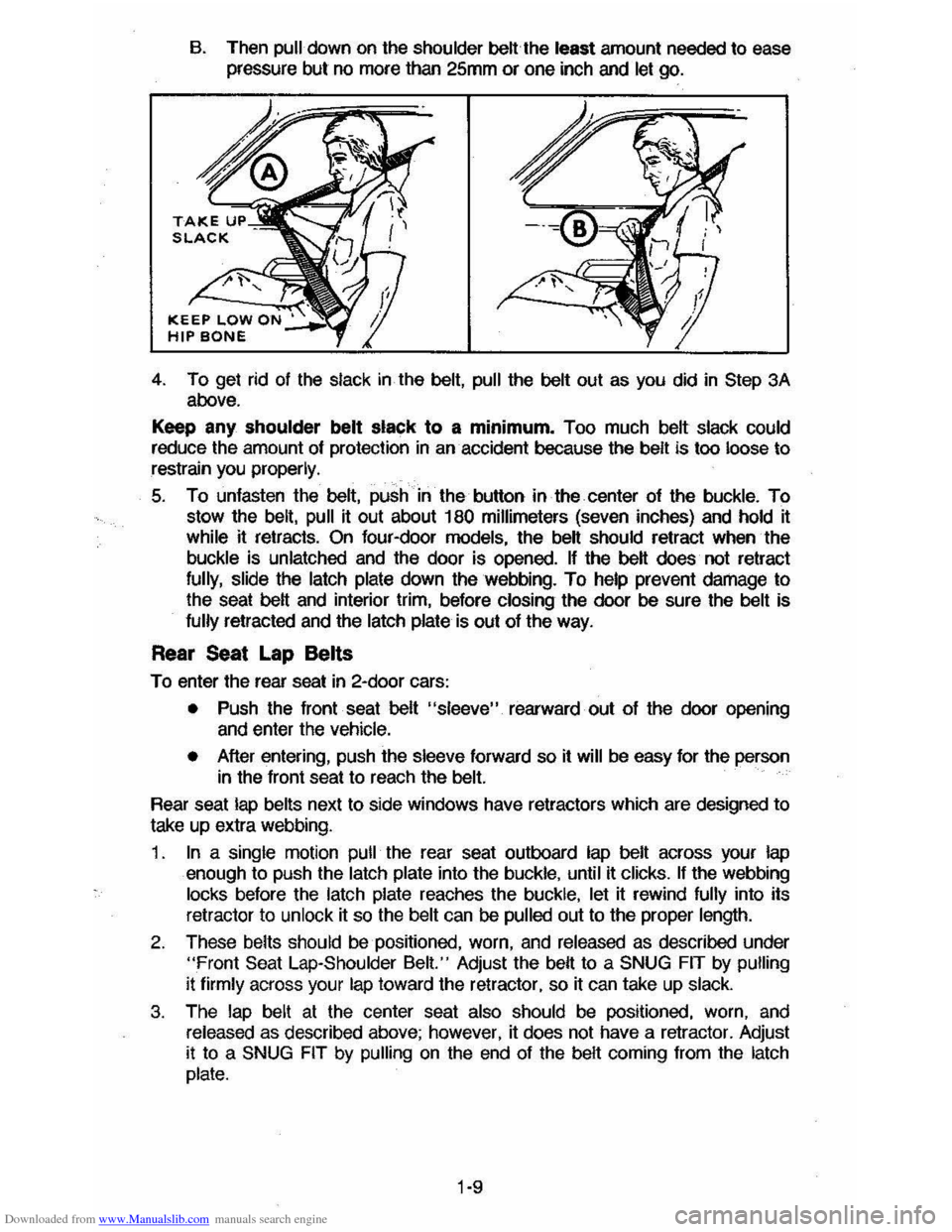
Downloaded from www.Manualslib.com manuals search engine B. Then pull down on the shoulder beUthe teast amount needed to ease
pressure but no more than 25mm or one inch and let go.
4. To get rid of the slack in the belt, pull the belt out as you did in Step 3A above.
Keep any
shoulder belt stack to a minimum. Too much belt slack could reduce the amount of protection in an· accident because the belt is too loose to restrain you properly.
5. To unfasten the belt, push in the button in the center of the buckle. To
stow the
belt, pull it out about 180 millimeters (seven inches) and hold it
while it retracts. On four-door models, the beH should retract when the
buckle is unlatched and the door is opened. If the beH does not retract
fully,
slide the latch plate down the webbing. To help prevent damage to
the seat beH and interior trim, before closing the door be sure the belt is
fully retracted
and the latch plate is out of the way.
Rear Seat Lap Belts
To enter the rear seat in 2-door cars:
• Push the front seat belt "sleeve" rearward out of the door opening and enter the vehicle.
•
After entering, push the sleeve forward so it will be easy for the person in the front seat to reach the belt.
Rear seat lap belts next to side windows have retractors which are designed to
take up extra webbing.
1 .
In a single motion pull the rear seat outboard lap belt across your lap enough to push the latch plate into the buckle, until it clicks. If the webbing
locks before the latch plate reaches the buckle, let it rewind fully into its
retractor to
unlock it so the belt can be pulled out to the proper length.
2. These belts should be positioned, worn, and released as described under
"Front Seat Lap-Shoulder Belt." Adjust the beH to a SNUG FIT by pulling
it firmly across your lap toward the retractor, so it can take up slack.
3. The lap belt at the center seat also should be positioned, worn, and
released as described above; however, it does not have a retractor. Adjust it to a SNUG FIT by pulling on the end of the beH coming from the latch
plate.
1·9
Page 15 of 105
Downloaded from www.Manualslib.com manuals search engine 4. To lengthen the center seat lap belt, place the latch plate at a right angle
to the belt webbing and pull on the latch plate; the belt should then slide
easily.
Rear Seat Shoulder Belts (Dealer-Installed Accessory)
Except Convertible
When properly worn with a lap bell, a shoulder belt (available for rear outboard
seats) can give riders added protection. It can prevent or reduce impact with the inside of the vehicle by restraining the upper body in a collision, especially
in a frontal impact.
1 . To use the detachable
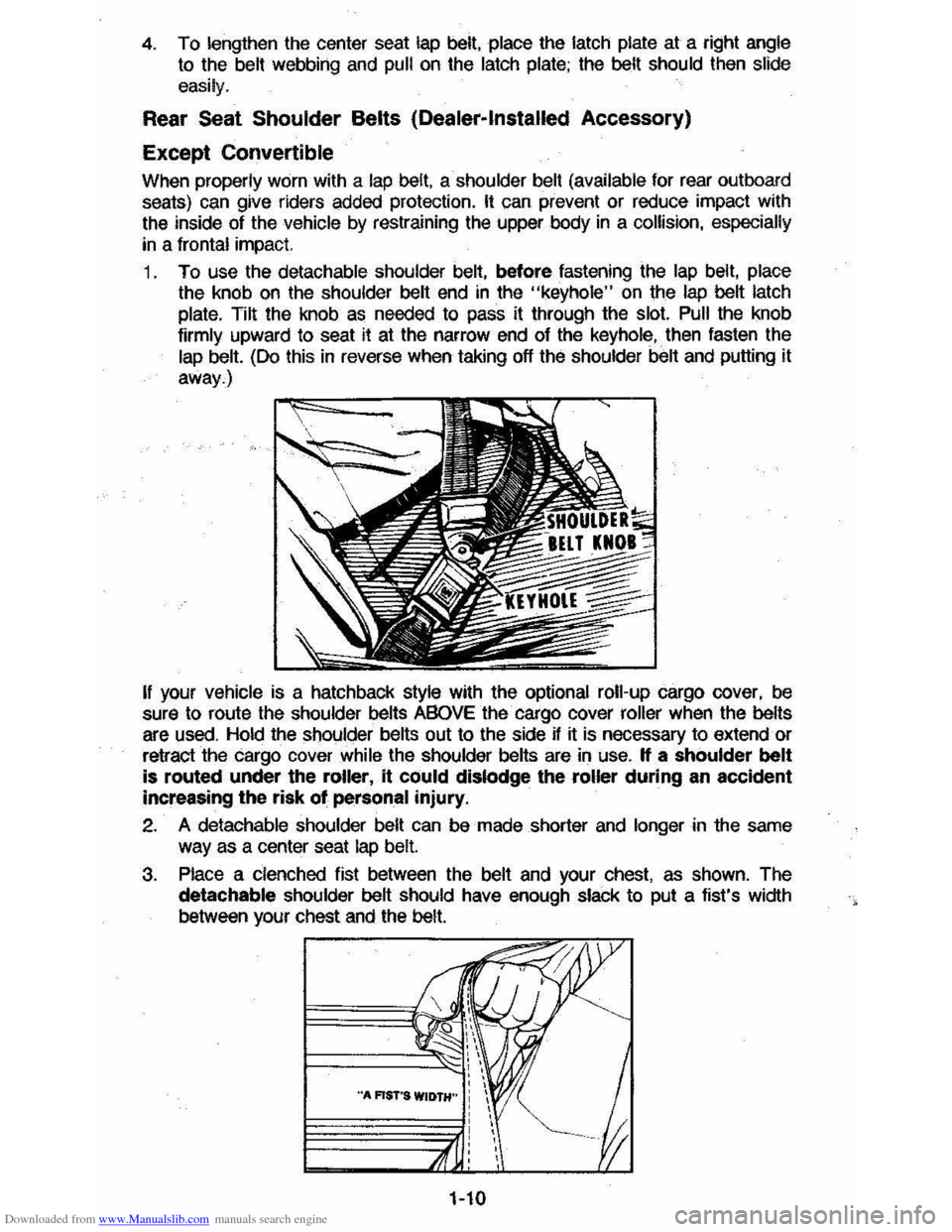
shoulder belt, before fastening the lap belt, place the knob on the shoulder belt end in the "keyhole" on the lap bell latch
plate. Tilt
the knob as needed to pass it through the slot. Pull the knob
firmly upward to seat it at the narrow end of the keyhole, then fasten the lap belt. (Do this in reverse when taking off the shoulder belt and putting it
away.)
If your vehicle is a hatchback style with the optional roll-up cargo cover, be
sure to route the shoulder belts ABOVE the cargo cover roller when the belts are used. Hold the Shoulder belts out to the side if it is necessary to extend or
retract the cargo cover
while the shoulder belts are in use. If a shoulder belt
is routed under the roller, it eQuid dislodge the roller during an accident
increasing
the risk of personal injury.
2. A detachable shoulder belt can be made shorter and longer in the same way as a center seat lap belt.
3. Place a clenched fist between the belt and your chest, as shown. The
detachable shoulder belt should have enough slack to put a fist's width
between your chest
and the belt.
1-10
Page 49 of 105
Downloaded from www.Manualslib.com manuals search engine To listen to an earlier selection, slide EJECT button to the right ("REV") until it locks. When the tape reaches the end, the EJECT button will automatically
return to center position and the tape will resume playing.
To stop reverse at any time, return the EJECT button to its center position.
NOTE: Belore turning off ignition, eject the cassette tape. Insertion 01 the
cassette tape cartridge overrides the radio and the time-ol-day
will be
displayed continuously.
For best results, use only cassettes which are 30 to 60 minutes in length.
ETR AM-FM Stereo (Seek/Scan) with Cassette 5-Band
Equalizer and Clock
VDL+BAL
~o ~ PAOG·ACL
TUNE --Y-FADE
~O
~ AM-FM
o,~ -, 'M ST
".f AM.
SCAN 1 2 3 4 SEEK
-IlIIIIIIlIIIII IIDIDI IBIIIIII IIDDID IDIDID DIIIIIII!IIIII
PWR LOUD
DIb! AUTO REVERSE
DNIl .Cr02
CD
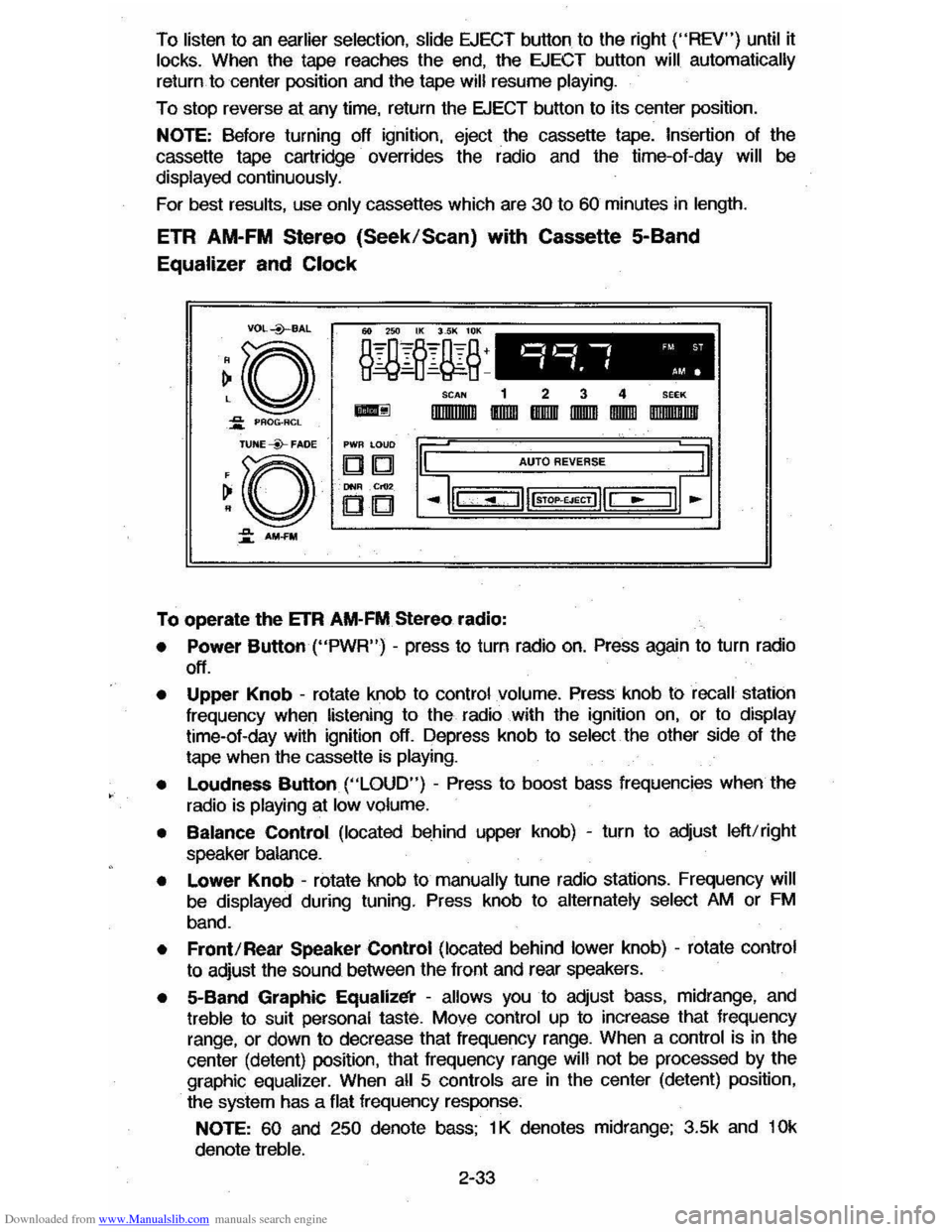
To operate the ETR AM-FM Stereo radio:
• Power Button ("PWR") -press to turn radio on. Press again to turn radio
off.
• Upper Knob -rotate knob to control volume. Press knob ti:> recall station
frequency when listening to the radio with the ignition on, or to display time-ol-day with ignition off. Depress knob to select the other side 01 the
tape when the cassette
is playing.
•
Loudness Button ("LOUD") - Press to boost bass frequencies when the
radio is
playing at low volume.
• Balance Control (located behind upper knob) -turn to adjust left/right
speaker balance.
• Lower Knob -rotate knob to manually tune radio stations. Frequency will
be displayed during tuning. Press knob to alternately select AM or FM
band.
• Front/Rear Speaker Control (located behind lower knob) -rotate control
to adjust the sound between the lront and rear speakers.
• 5-Band Graphic Equalizl!i' -allows you to adjust bass, midrange, and treble to suit personal taste. Move control up to increase that frequency
range, or down to decrease that frequency range. When a control is in the
center (detent) position, that
Irequency range will not be processed by the
graphic equalizer. When all 5 controls are in the center (detent) position,
the system has a flat frequency response:
NOTE: 60 and 250 denote bass; 1 K denotes midrange; 3.5k and 10k
denote treble.
2-33
Page 51 of 105
Downloaded from www.Manualslib.com manuals search engine Insertion of the cassette tape cartridge overrides the radio and the time-of-day will be displayed continuously .
Press the Dynamic Noise Reduction (DNRTM) button to rerrove high
frequency background
hiss on AM. FM. FM stereo. and tape.
Select the setting
fO( proper tape equalization(CrO .)as follows:
1. Select 70 usec (push button in).
2. Select 120 usec (button is out).
The
equalization setting which is desired will vary according to the type of tape
being used. Chrome and metal tapes have 70 usec equalization. while Iron tapes have 120 usec equalization .
The tape bias is often indicated on the cassette label or case .
For best
resu~s. use only tapes which are 30 to 60 minutes in length.
MOBILE RADIO SYSTEMS
Mobile two-way radiO units and mobile telephone equipment are subject to federal rules and must be installed by trained personnel. Certain such
equipment or the manner of its installation may
possibly adversely affect
vehicle operation. Expenses incurred to protect the vehicle systems from the interaclion of these added mobile communication systems are not the
responsibiWty of Chevrolet Motor Division.
Citizen Band (CB)
racios and garage door openers normally will not affect
vehicle
operation.
Fixed Mast Antenna
The fixed mast antenna is designed to withstand most car washes without
damage .
It cannot be adjusted up or down. If the mast becomes slightly bent.
you can straighten it by hand . The mast antenna can be replaced
if severely
bent (by vandalism . etc .) . Mast antennas must be kept clean for good
performance .
OTHER CONTROLS AND FEATURES
HATCHBACK LID
To open the hatchback lid. use the oval-head key in the lock at the rear of the
car .
Close the lid firmly to be sure it locks.
LlFTGATE OPERATION (STATION WAGONS)
To open the liftgate. use the oval-head key in the outside . lock. (Two gas
support struts. one at
each side of the glass . are designed to help hold the
gate open.)
CAUTION: TIle Ilftg" or hatchback lid should be claed while driving to help avoid
drawing dangerous exhaust S .... Into the eIIr. (8M "Engine Extulust GuCautlon (Carbon Monoxide)" at the 'beginning of "Starting and Operating," Section 2 of thl, manual.)
If you have to drive with the liftgate or hatchback lid open. these precautions
should be observed :
• Close all other windows .
2-35
Page 56 of 105
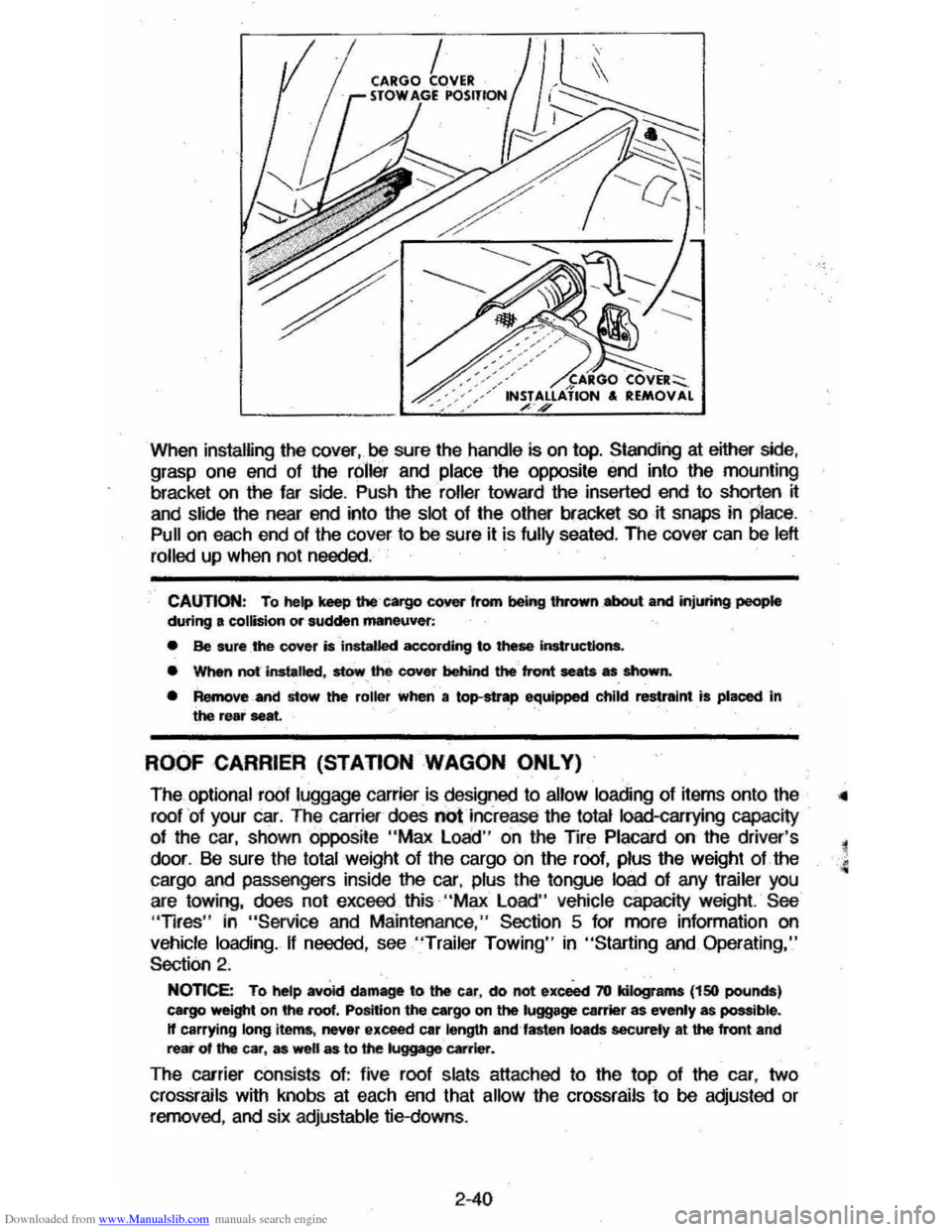
Downloaded from www.Manualslib.com manuals search engine When installing the cover,oo sure the handle is on top. Standing at either side, grasp one end of the roller and place the opposite end into the mounting
bracket on
the far side . Push the roller toward the inserted end to shorten it
and slide the near end into the slot of the other bracket so it snaps in place.
Pull on each end of the cover to 00 sure it is fully seated. The cover can be left
rolled
up when not needed .
CAUTION: To help keep u.., cargo cover from being thrown .,.a,oot and jnjlM'ing people during a collision or sudden maneuver:
• Be sure _the cover is installed according to these Instructions.
• WMn not-instalted, stow, the cover behind the front seats as shown.
• Remove and stow the roiler when a top-strap equipped child restraint is placed In the rear seat.
ROOF CARRIER (STAnON WAGON ONLY)
The optional roof luggage carrier is designed to allow loading of items onto the
roof
' of your car. The carrier does not increase the total Ioad-carrying capacity
of the car, shown oppoSite "Max Load " on the TIre Placard on the driver's
door. Be sure the
total weight of the cargo on the roof, plus the weight of the
cargo and passengers inside
the car, plus the tongue load of any trailer you
are towing, does not exceed this· "Max Load" vehicle capacity weight. See "Tires" in "Service and Maintenance," Section 5 for more information on
vehicle loading. If needed, see "Trailer Towing" in "Starting and. Operating,"
Section 2 .
NOnce: To hetp avOid damage to the car, do not exceect 70 kilograms (150 pounds) cargo weight on the roof. Position the cargo on the luggage carrier as evenly as possible. If carrying long items , never exceed car length emUasten loads eacurely at the front and rear of the car, as well as to the luggage ~rier.
The carrier consists of: five roof slats attached to the top of the car, two
crossrails with knobs at each end that allow the crossrails to 00 adjusted or removed, and six adjustable tie-downs.
2-40
Page 92 of 105
Downloaded from www.Manualslib.com manuals search engine SECTION 6
SPECIFICATIONS
These specifications are given here for information only. Before using them
see cautions and other instructions throughout this manual -the index may help you locate such items. For more information, see the service manual cover·
lng the chassis or body part in question. Your Chevrolet dealer may also be
able to help.
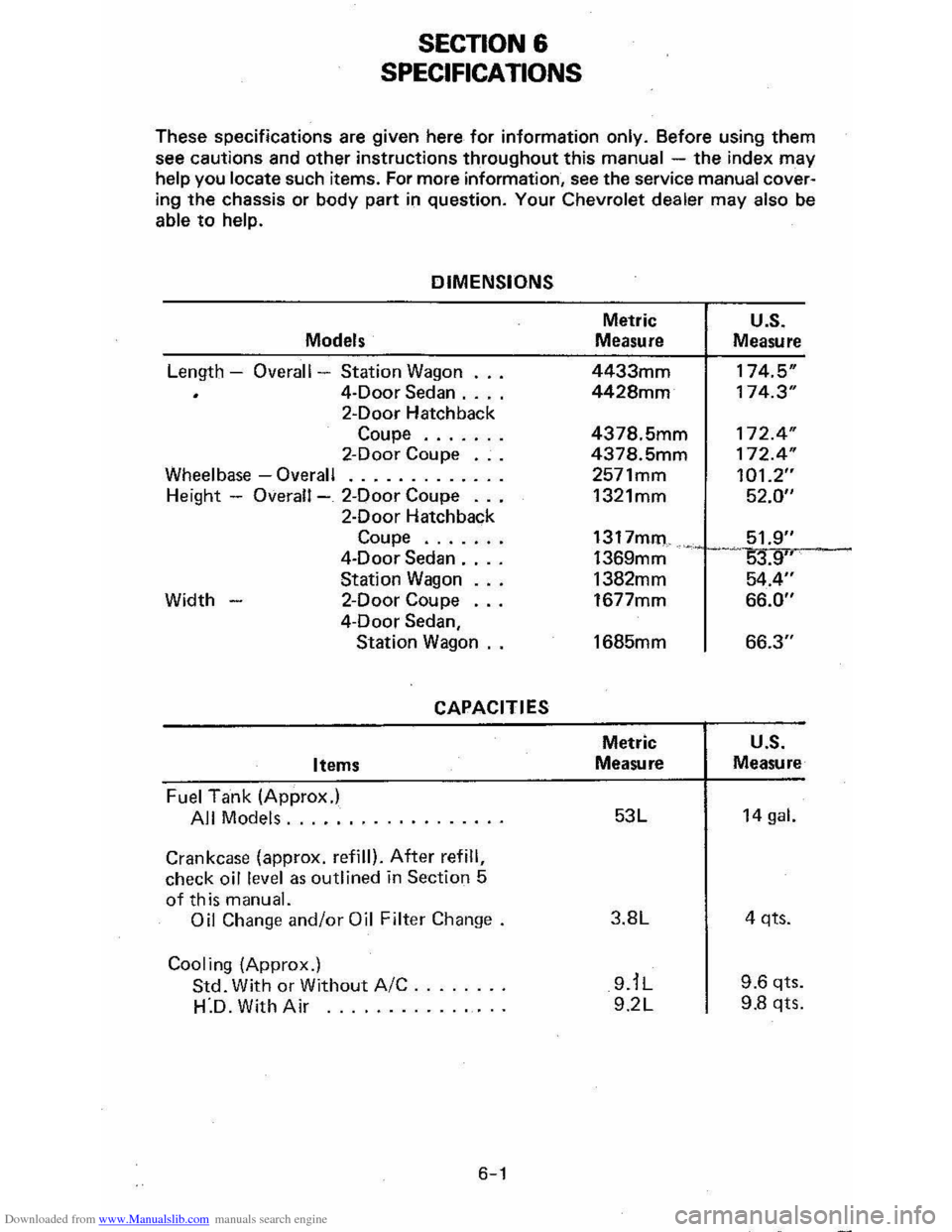
DIMENSIONS
Models
Length -Overall -Station Wagon
4-Door Sedan .... 2-Door Hatchback
Coupe ...... . 2-Door Coupe .. .
Wheelbase -Overall ............ . Height -Overall-_ 2-Door Coupe .. .
2·Door Hatchback
Coupe ...... .
4-Door
Sedan ... .
Station
Wagon Width - 2-Door Coupe ...
4·Door Sedan,
Station Wagon ..
CAPACITIES
Items
Fuel Tank (Approx.)
All Models ................. .
Crankcase (approx, refill). After refill, check oil level as outlined in Section 5
of this manual. Oil Change and/or Oil Filter Change.
Cooling (Approx.)
Std. With or Without AIC ...••... H·D. With Air ...........•...
6-1
Metric
Measure
4433mm
4428mm
4378.5mm
4378.5mm
2571mm
1321mm
1317mm 1369mm
1382mm
1677mm
1685mm
Metric
Measure
53L
3.8L
9.iL 9.2L
-
U.S. Measure
174.5"
174.3"
172.4 "
172.4"
101.2" 52.0"
51.9" 53.9" 54.4"
66.0"
66.3"
U.S. Measure
14 gal.
4 qts.
9.6 qts.
9.8 qts.