1984 CHEVROLET CAVALIER tow
[x] Cancel search: towPage 75 of 105
Downloaded from www.Manualslib.com manuals search engine NOTICE: H you need to replace the fuel cap, use only a cap specified for your model. An incorrect fuel cap can result in a serious maHunction of the fuel system or emission control system. You can get a correct replacement cap from your dealer.
CATALYTIC CONVERTER
The catalytic converter is an emission control device added to the exhaust system to reduce exhaust gas pollutants. The converter contains
a ceramic material coated with noble metal catalysts. To prevent contamination
and loss of effectiveness of the catalysts. unleaded gasoline must be used.
Unleaded
gasoline also reduces spark plug fouling, exhaust system corrosion and engine oil deterioration. Leaded gasoline will also damage the oxygen
sensor
in the Computer Command Control system which could affect emission
control.
To help prevent damage:
1. Keep your engine properly maintained. Engine malfunctions involving the
electrical, carburetion, electronic fuel injection or ignition systems may
result in unusually high catalytic converter and exhaust system
temperatures which, under extreme malfunctioning conditions, may ignite
interior floor ·covering materials above the converter. Do not keep driving
your vehicle if you detect engine misfire, noticeable loss of
performance, or other unusual operating conditions. Instead, have it
serviced promptly. See the Maintenance Schedule folder for information on inspecting and maintaining the engine, exhaust system, and other
components.
2. Do not push or tow this vehicle to start it. This may result in unusually
high catalytic converter
and exhaust system temperatures which under
extreme conditions may ignite interior floor-covering material above the
converter.
Disregarding these instructions
could damage the catalytic converter, the vehicle, or nearby property and affect warranty coverage.
COMPUTER COMMAND CONTROL SYSTEM
Most vehicles sold in the United States (and some vehicles sold in Canada)
have the Computer Command Control system.
The Computer Command Control system monitors the exhaust stream with
an oxygen sensor. Based on sensor signals, the electronic control module adjusts
the air-fuel ratio
as needed. It is very important to use only unleaded
gasoline in vehicles equipped with the Computer Command Control system.
Leaded gasoline will damage the oxygen sensor,
and may affect emission
control.
"Check Engine" Light
Most vehicles sold in the United States (and some vehicles sold in Canada)
have the Computer Command Control system.
Vehicles
.with the Computer Command Control system, include a "CHECK
ENGINE" light
on the instrument panel designed to indicate the need for
system service. It will come on during engine starting to let you know the bulb
is working. (The
light will stay on a short time aiter the engine starts.) Have the
system repaired if the "CHECK ENGINE" light does not come on during engine
starting.
If the light comes on, either intermittently or continuously while driving,
service to the Computer Command Control system is required. Although in
5-2
Page 76 of 105
Downloaded from www.Manualslib.com manuals search engine most cases the vehicle is drivable, and does not require towing, see your
authorized dealer as soon as possible for service of the system.
Continued
driving without having the Computer Command Control system serviced could eventually cause damage to the emission control system. It
could
also affect fuel economy and drivability .
ENGINE OIL AND FILTER RECOMMENDATIONS
The following engine oil recommendations are based upon the operation . of your engine with the fuels recommended under "Fuel Requirements" in Section 2 of this manual.
Checking Oil Level
The engine oil must be kepi at the right level to help assure proper lubrication
of your vehicle's engine. n Is normal for an engine to use some oil, and some
engines may use more oil when they are new.
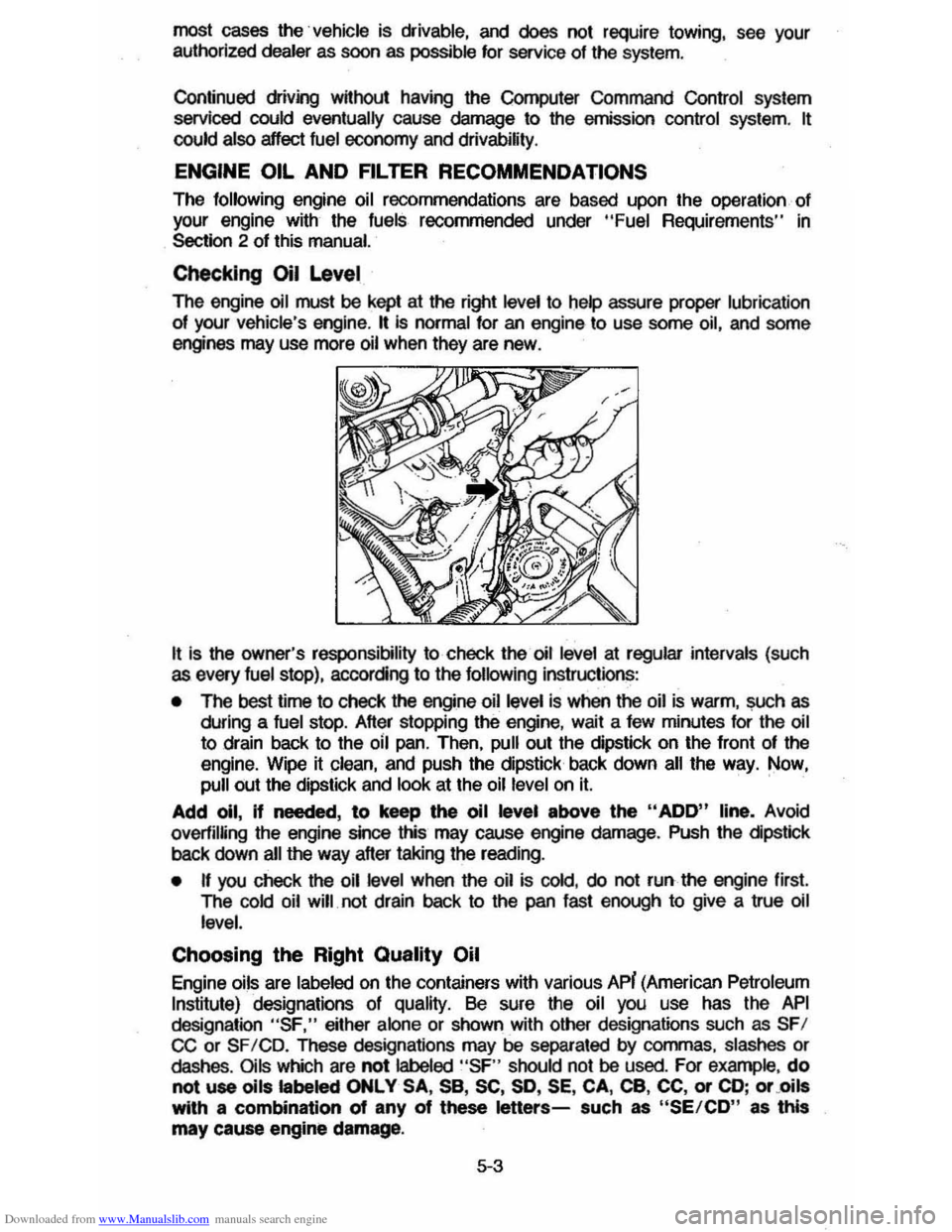
It is the owner's responsibility to check the oil level at regular intervals (such as every fuel stop), accorcing to the following instructions:
• The best time to check the engine oil level is when the oil is warm, ~h as
during a fuel stop. After stopping the engine, wait a few minutes for the oil
to drain back to the oil pan. Then, pull out the dipstick on the front of the
engine. Wipe it clean, and push the dipstick back down
all the way. Now, pull out the dipstick and look at the oil level on It. '
Add 011, If needed, to keep the 011 level above the "ADD" line, Avoid
overfilUng
the engine since this may cause engine damage. Push the cipstlck
back down all the way after taking the reading.
• n you check the oil level when the oil is cold, do not run the engine first.
The
cold oil will. not drain back to the pan fast enough to give a true oil
level.
Choosing the Right Quality Oil
Engine oils are labeled on the containers with various APi (American Petroleum
Institute) designations of quality. Be sure the oil you use has the API
designation "SF," either alone or shown with other designations such as SFI CC or SF ICD. These designations may be separated by commas. slashes or dashes. Oils which are not labeled "SF " should not be used. For example , do
not use oils labeled ONLY SA, sa, SC, SO, SE, CA, ca, CC, or CD; or .oils with a combination of any of these letters-such as "SE/CD" as this
may cause engine damage.
5·3
Page 78 of 105
Downloaded from www.Manualslib.com manuals search engine Oil Identification Logo
A logo (symbol) has been developed to help you select the oil you should use,
and it probably will be included on oil cans sometime during 1983. The top
portion of the logo shows the oil quality by API designations such as SF, SFI
CC, or others. The center portion of the logo will probably show the SAE
viscosity grade, such as SAE 5W-30. "Energy Conserving," shown in the lower portion, indicates that the oil has fuel-saving capabilities.
Change Intervals
The oil and oil filter change intervals for your engine are based on the use of
SF-quality oils and high-quality fi~ers such as AC oil filters. Using oil other
than SF-quality, or oil and filter change intervals longer than
recommended could reduce engine life. Damage to engines due to improper
maintenance or use of incorrect
oil quality and/ or viscosity is not covered by
the Chevrolet new car warranties.
Your engine was
filled with a high-quality engine oil when it was built. You do
not have to change this oil before the first recommended change interval.
Oil
and filter change intervals depend upon how you use your vehicle. The
following should assist in determining the proper oil and fi~er change intervals:
TVPEOFUSE CHANGE INTERVAL
• Operating
in dusty areas.
• Towing a trailer.
• Idling for extended periods andlor low speed operation such as found • Change engine oil and filter every
in police, taxi or door-Ie-door de-livery service. 3,000 miles (4 800 kilometers) or 3
rn.onths, whichever comes first.
• Operating when outside tempera-tures-remain below freezing and when most trips are less than 4 miles' (6 kilometers)~
• Operating on a daily basis, as a • Chan:ge engine oil every 7,500 general rule, for several miles and miles (12 000-km) or 12 months,
when none of the above conditions whichev.er comes first. Change en·
apply. gine oil filter at first oil change. then every other oil change if mileage determines· when you change oil. If time determines change intervals, change the filter with each oil change.
Engine Oil Additives
Engine oils contain a variety of additives. Your engine should not need any
extra additives
K you use the recommended oil quality and change intervals. However, H you think your engine has an oil-related problem, a supplemental
additive ("GM Engine Oil Supplement") is available that may solve your problem without causing other difficuHies. Consu~ your dealer who can provide
you
w~h this tested and approved additive.
Used Oil Disposal
Do not dispose of used engine oil (or any other oil) in a careless manner such
as pouring it on the ground, into sewers, or into streams or bodies of water.
Instead, recycle it by taking it to a used oiL collection facility which may be
found
in your area. If you have a problem disposing of your used oil, it is
suggested that you contact your
dealer or a service station.
5-5
Page 85 of 105
Downloaded from www.Manualslib.com manuals search engine CAVAUER BUMPER SYSTEM
The front and rear bumpers have a rubber- ike plastic cover over an energy
absorbing impact bar.
In an impact , the cover may return to its original shape
without showing that it was struck.
If the impact was great enough, the energy
absorbing devices and impact bar may have been damaged.
To be sure the burrc:>er is in a state of full readiness , it should be checked by your Chevrolet
dealer . The check should be mada if you can sae Ihat the burrc:>er is out of
position . " should also be checked ij the car has been in a serious collision in
which the bumper was struck, even when no damage to the bumper system
can be seen.
TIRES
CAUTION: To reduce the risk of loa of vehicle control and personal injury:
• The tires MUST BE properly in118Wd, and your vehicle MUST NOT BE overioaded (Me the Tir. Placard on the driver'. door).
• Your vehiele MUST NOT BE operated at speeds fa. than 85 mph ('140 km/h) un .... _ft-has police pursuit tires or equlVaienthigh ·speed capability tirea , regllf'dless of the legal speed 1irn!L Be Stn to cOIl$un a Ure dealer to determine II the tires on your vehicle are hlgh speed capability tires before operating )our vehk:le at such
-For more safety information, see the reat of this "Tire.~' ,~on.
The tires installed on your vehicle are engineered to provide a proper balance
of these peffor~ characteristics under noonal driving conditions :
• Endurance
• Handling
•
Noise
• Aide
• Road Hazard Resistance
• Aoling Resistance
• Traction
• Tread Mileage
This section has some tipS on how you can get the most benefit from these
tires .
Vehicle Loading
The tires on your vehicle will perform well at all normal loads when. inflated as
recommended on the Tire
Placard (located on the driver's door of your vehicle). Do not load your vehicle beyond the load limits (total kilograms or
pounds) shown on the Tire Placard . The placard tells you the design limits of the vehicle, not just of the tires .
Station wagon loads should be moved as far forward as possible. Luggage carriers do not increase the maximum load limits shown on the Tire Placard. See also "Stowing Things In (or On) The Car" in Section 2 of this manual.
5-12
Page 88 of 105
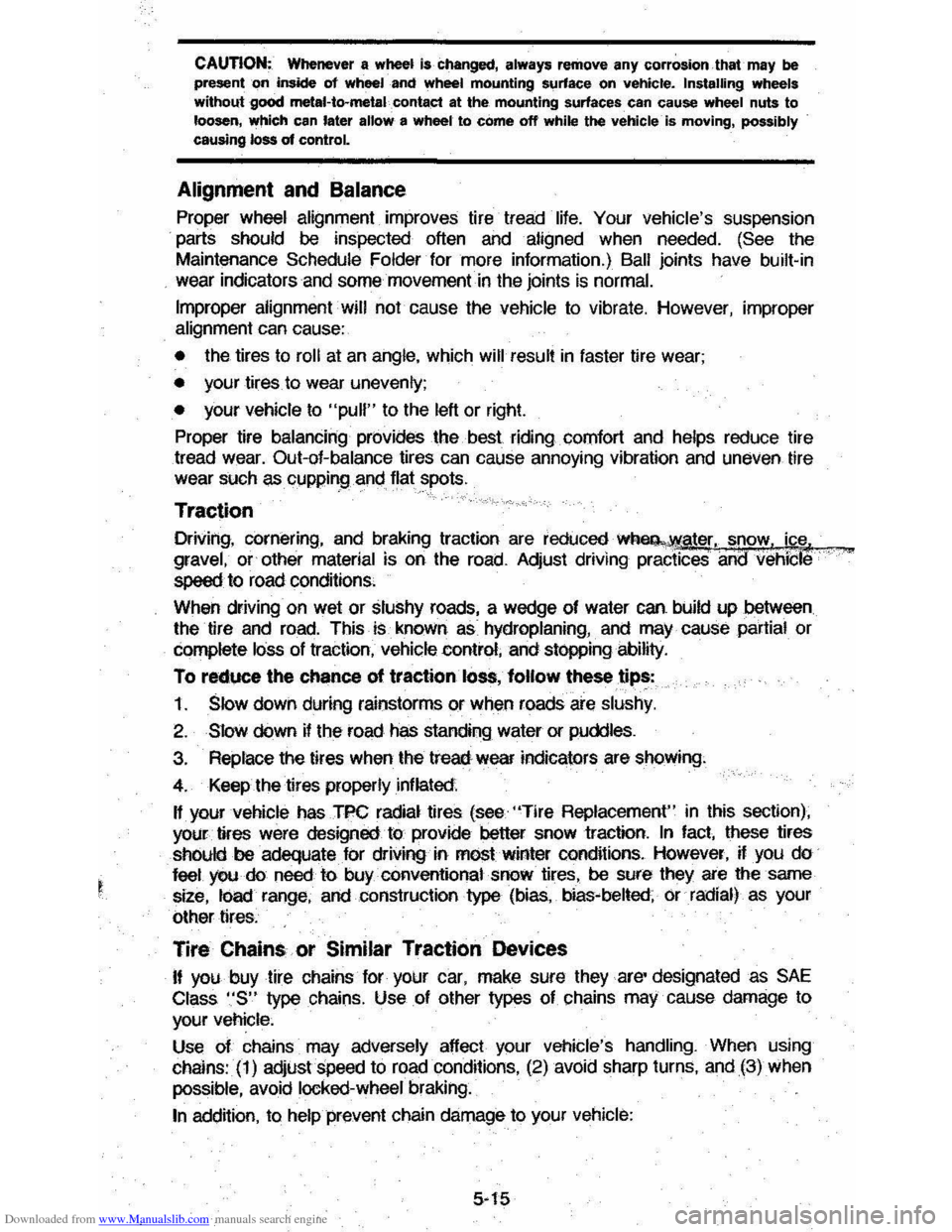
Downloaded from www.Manualslib.com manuals search engine CAUTION; Whenever a wheel is changed, always remove any corrOsion that may be present on inside of wheeland wheel mounting surface on vehicle. Installing wheels
without good metal·to--metalcontact at the mounting surfaces can cause wheel nuts to
loosen, which can later allow a wheel to come off while the vehicle -is moving, possibly
causing loss of control.
Alignment and Balance
Proper wheel alignment improves tire tread life. Your vehicle's suspension
parts should be inspected often and
aligned when needed. (See the
Maintenance
Schedule Folder for more information.) Ball joints have built-in
wear indicators and some movement in the joints is normal.
Improper alignment • will not-cause the vehicle to vibrate. However, improper
alignment can cause:
• the tires to roll at an angle, which will result in faster tire wear;
• your tires _ to wear unevenly;
•
your vehicle to "pull" to the left or right.
Proper tire balancing provides the
best riding comfort and helps reduce tire
tread wear. Out-of-balance tires can cause annoying vibration and uneVen tire
wear such as cupping and flat spots.
Traction
Driving, cornering, and braking traction are reduced -w~ater. snovv' ic:e., gravel, or other material is on the road. Adjust driving practices and vehiCia
speed to road conditions.
When driving on wet
or sluShy roads, a wedge of water can build up between
the tire and road. This is known as hydroplaning, and may cause partial or
complete loss of traction, vehicle control, and stopping ability.
To red\ICe the chance of traclion loss, follow these tips:
1. Slow down during rainstorms or when roads are slushy.
2. StoW down if the road has standing water or puddles.
3. Replace the tires when the tread wear indicators are showing.
4. Keep the tires properly inflated.
H your vehicle has Tpc radial tires (see "Tire Replacement" in this section),
yoU, .lifes were designed to provide better snow traction. In fact, these tires
shOuld be adequate for driving in mO$ wiAter conditions. Howeve" ij you do feel you do need to buyconvenlional snow tires, be sure they are the same
size, load range, and .construction type (bias, bias· belled, Or radial) as your
other tires.
Tire Chain$ or Similar Traction Devices
If you buy tire chains for your car, make sure they are'designated as SAE
Class "S" type chaios. Use of other types of chains may cause damage to
your vehicle.
Use
of chains may adversely affect your vehicle's handling. -When using
chains: (1) adjust speed to road conditions, (2) avoid sharp turns, and (3) when
possible, avoid
locked-wheel braking.
In addition, to help prevent chain damage to your vehicle:
5-15
Page 100 of 105
Downloaded from www.Manualslib.com manuals search engine SECTION 7
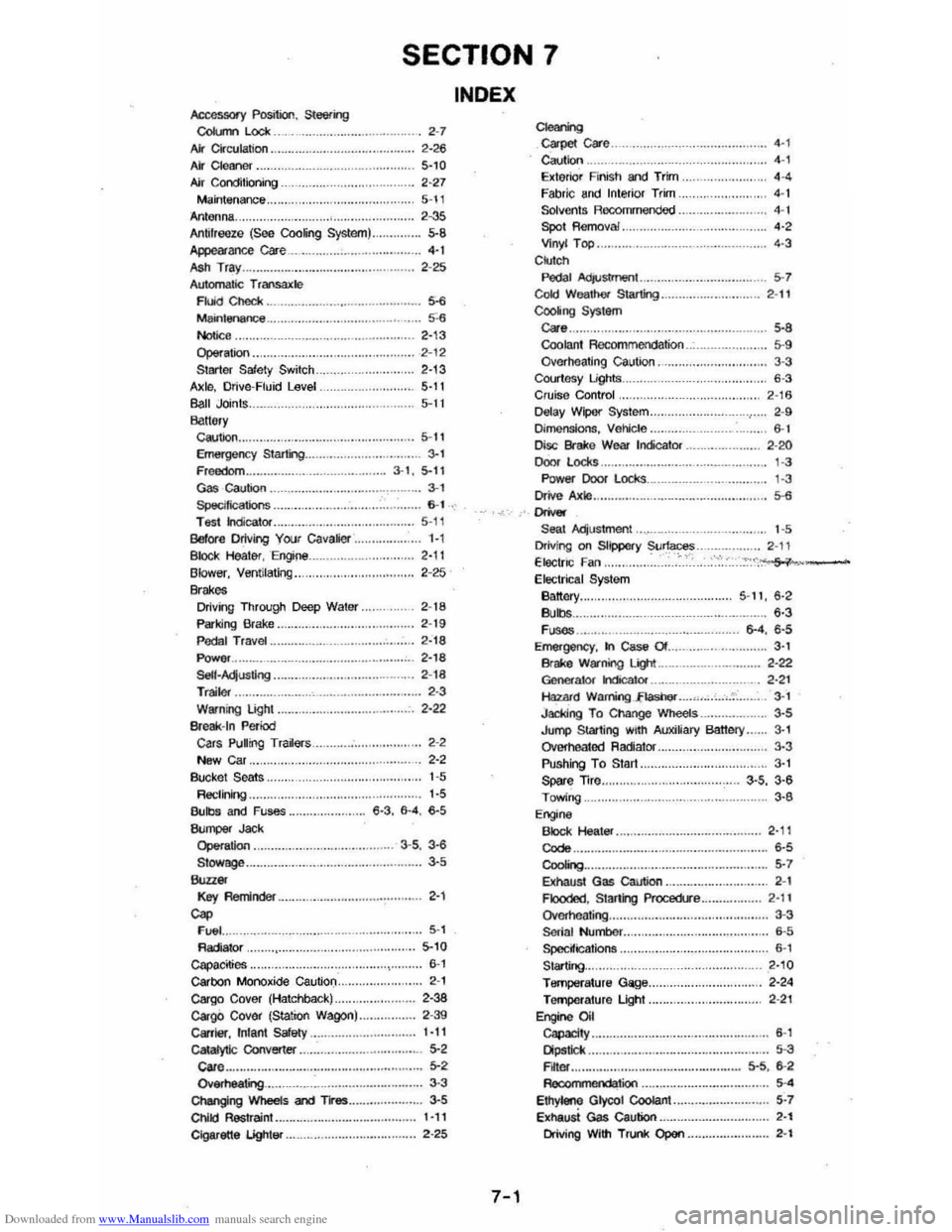
Accessory Position, Steering CoIl.m Lock 2-7 AIr Cir ctJlalioo. . 2-26 Ai' Cleaner. 5-,0 Air Conditio ning ............ . 2-27 M ainte nance .. Antenna . 5-\1 2 -35 5-8 Antifreeze (See Coo~ng System) .. Appearance cae ...• ....•.. 4·t .... ...... 2 -25 ASh Tra y .. Automatic T 'ansalC!e Fluid Chedi: . ___ .. . _ ..... _ ._ ... ... . Maintenance .. Notice ,. .. Op$ralion .. Surter Safety Switch Axlo, Drive-Fluid Level Ball Joints. Ba"&,y
· ....... 5-6 .... 5'-6 2,13 · .... 2 -12 2'13
........ . 5-11 5-1 I
Caution.. 5-11 Emergenc y Starling.. 3-1 Freedom.. .. 3·1 , 5-11 Gas caution . ___ ............. ..... ... . ...... .... 3·, Specilicalions .... ... ... ... .. ... .. .. . T esl indlealor .. Belor e Driving Your cavalier .. B loc k Healer, Engine Blower, Ventilating .. Brakes Driving Through Deep Water "
Parking Brake .. P eda l TraVel .. Power ... SelI·AqusIing ...... ... ..... .. ... .. .. . T railer ..... . Warning Light .. Br eak -In Period Cars Pulrng Tra~ars New Car .. Bucke l Seats .. R ttelininQ .. Bulbs and Fuses ..
""_ Jad< Operation . Stowage ............. ... ... .. .... •..•. • _ ..
Key RemiAder .. Cap FIJI:II .. R adiator Capa.cities .. carbon Monoxide Caution .. Cargo Cover (Hatchback) .. cargO Cover (Station Wagon) ... Carrier, Infant Safety .. cataIytlc Converter .. care .... OwNheatng ....... . Changing Wheels and Tl"es .. Ct\IICI Restraint.. Cigarette lightsr ..
. .... 6 -1 . . . 5-1 1 1-1 2-11 2-25
2 -18
2 -19
2·18 •.••.•. 2, 18 2-1 8 ....... ... .. 2· 3 2·22
2-2
2-2
1 -5
1-5
6 ·3. 6·4 . 6-5
3 ·5 . 3-6 ........ . 3-5
· ....... 2·'
5 -1 5-10 .... .. 6-1 2 -1 2-38 2 -39 1·11 5-2 ...... .... 5-2 ..3 -3 ....•.••. . 3·5 1-11 · ..... 2-25
INDEX
7-1
C1eri'9 c;a.pet care .. Caution .. Exteriof Finish and Trim Fabri c and Interio r Trim .. Solvents Racomme nded Spot Removal. Vinyl Top .. C kl tch
. .... 4·' . ..... 4 -' 4 -' 4 -1
4 -1
..,
4-3
PeDa l Acl/Ustmeot ........ ... ... ... .......... ........ 5·7 Cold Wealhet Starting ... ... ... ...... ... ... ...... 2·11 CooIiIl9 System care. .. . 5 ·8 Coolan t Rocommeodation 5-9 Overhea ting caution. 3-3 Courtosy Lights .. 6-3 Cruis e Con trof 2-16 Defay Wipo( Sys tem ....................... ,.. 2 -9 [)jmensions, Ve)jcle.. . ......... 6-1 [Xsc Brake Wear IrKicator .......... 2-20 Door locks ' -3 Power Door l ocks ... Drive Axle
"""" Seal Adjus tment. .. Driving on Slippery Surfaces Electn c Fan .. Electric al System Battory .. Bulbs .• . . FI.ISOS ..•..• Emergency. In Case Of . Brake W~ning Liglt .. 1
-3
.• 5·6
1 -5 2 -\' .... ~::<',~~-
5 '11, 6·2 '·3 6-4. 6·5 . .... ..... .. 3 · . ... 2 ·22 Geoefator hdicalor... . ...... 2 ·2 1 Hazru"d Warring . .,fLashef ... -'. __ .... ,,, 3 ·1 Jaddng T o Change Wheels 3·5 Jump Starling with Auxi~ary Banel)'. . 3· Overhe.1tod Radiator.. 3·3 Pushing To Start.. 3-I Spar e Trre.. . . .................... 3-5 , 3·6 Towing.. 3·6 Engine Block Heater ... Codo .. CooIO>g •••.
2 ·' , . . .. . 6·5
5 ·7
8I:haust Gas Caution ............... ... ... ... ... 2-1 Flooded, Staring Procedlre ................ 2·11 Qvome ating ................... ....... .... ............. . 3-3 Serial NulTlbef.. . .... 6-5 Specifications . ............... . ..... . .. ..... .......... 6-' Starting... 2·10 Temperature Gage.. 2 ·24 TefTlP(Iralure Light. 2 -21 EnginO Oil Capacity .. Dipstick •• F~Of . . .
. ............ ....... ... .. .... .......... ... 6-1
Reoo .. wnonootion .. Ethyteno Glycol Coolant .• EXhaUst Gas Caution . .
• •••• 5 -3 5·5. 6 ·2
5 ·'
5 ·7 . ....... 2·' Driving With Trunk Open ..... .. ............. . 2-'
Page 102 of 105
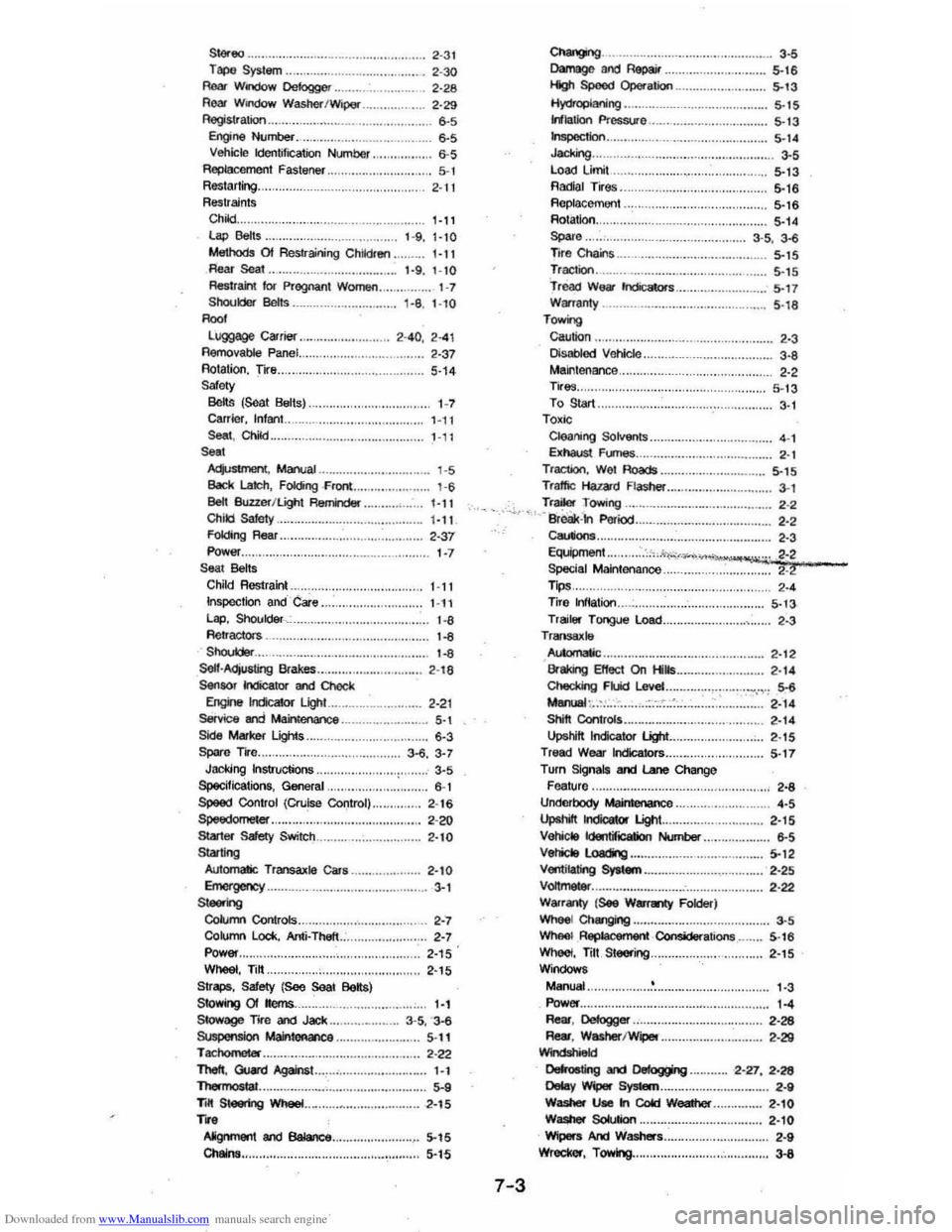
Downloaded from www.Manualslib.com manuals search engine STereo.. 2-3 1 Tapu System ..... ....... .............. ........... 2-30 Rear WnJow Defogger ...•.•.......•.• .. . 2,26 Roar Window Washer/Wiper.. .. 2,29 Aegstration.. &5 Engine Number. &5 VehICle identifICation Number. &5 Replacement Fastener .. 5 -1
Restarting.
Restraints Child ... Lap Belts .. Methods Of Restr~ring Children •.. ReM Seat .. Reslraill lor Pfegnan WomtHI • . Shoulder Belts ___________ .......•..•.•.. Rool
2 -11
'-II ',9, 1-10 1-11 1·9 . HO H H l. l-10
Luggage
ca-rier .... ...... ............. 2-40, 2-4 Removable Panel. 2-37 Rotation. Tire .. Safoty BeltS (Seat Belts) .
5-14
,-, Carrior, InfiYIt . 1 -11 Seal, Child .... ..... ..... .... .. . .•.. 1-1 1
.. " Adj;stment, M
'-II 1-11 1-6 1-6
1-6 SOouIcIer_.. . _ .. _ ....... .............•.•.• SoII.Adjusting Bfakes Sensor Indicator and Check Eogr.e Irdcator Light . Service and Mainl:enMC8 •. Side Marker Ligtts ..
••.•. 2·1 8
2-21 . ....... 5,1 '-3 Spare Tire .. ... .............. 3·6. 3-7 Jacking Instructions .. Specifications, General,. $peed Control (Cruise Control) ..
-. 8tafteJ Sdety Switch ... _ .... _ ..........•.•
.... "'" Automatic Transaxle cars .. Emergency .. S-.. ColImn Controls .. Column Lock, Anti-Theft Power ..
3-5 ' -I 2 -16 2 -2<) 2-10
. ... 2-10 ...... 3-1
2-7 ... 2-7 .. '. 2-15 ' Wheel, Tilt ............. ; ........................... 2·15 Straps, Safety (See Seat Belts)
Stowing 01 Items. .. .............. . 1-' 3·5 , '3-6 Stowage Tire and Jack .. Suspension Maintenance .. 5·11 Tachomeler ...... ... ..... ........... ............ ..... 2·22 Theft, ou.d Againsl... 1-1 ThennostaI ..... ........ 5-9 Tilt SMering WheeL. r .. Alignment and Balance ... Chains •.
........ -2-15
5-15
5-15
Changing .................... .... ..... ................. 3.5 Damage al'l(j Repaj!' ... . .. ...... .. .... .......... 5-16 High Speod Operation __ ............•..•.•. 5-13 Hydroplaning .. _ ................. 5 .15 Wlallorl Pr~e.. . ..................... 5 .13 W;pection ... 5-14 Jackng... 3·5 L03(I Limit . Radial Tires .. Replacemont .. Rotation . Spare .. Tire Chains ..
5·13
5·16
5'16 5·14 3 -5 , 3-6 5 '15 Trac tion ........................... .................. 5 -1 5 lreacl W6iI' 1r"IcIicaIors.. 5017 Warranty ......... _ .................................. 5-18 T_
Caution ........ ~obIod Vehicle .. Mal1tonance , . Tires ...... . To Starl .. To)[iC Cleaning Solvents .. E)[haust n..mes .. Traction . Wei Roads ..
2-3
3 -8
2 ·2
5 ·13 3-1
.. .... ..... 4-1 2 -1 5 '15
Traffic Hazard Flasher ......... ... .... ......... 3,1
, T~ TOWing .... ............. ........ .............. 2 -2 -~,-u,_ BreOk~" Pofiod ................. ....... ............ . 2.2
7-3
CauIioc:II .................. ...... ...................... 2·3
~=~~'~~~~~·~':~~~~~~~~:::~:i·~~:;;---Tips.. 2.4 Tire W1ation.... 5.13 Trailer Tongue Load .............. ........ ,.. 2.3 TrlWlSaX!e AlAomaIic .. 2· 12 'Braking EtIect On Hills ....... 2·14 Checking FUd Level ............... ........ ¥,.,.: 506 ManuaI·, .. : ::.;:-... 2-14 ShIft Controls .. Upshift Indlcator light .. 2 -14 2 ·15 Tread Wear Ind"lCators.. 5·17
Turn Signals and Lane Change Feature ............................................... , 2·8 UndorbOcly Maintenance.. .. .......... 4·5 Upshift Indicator Light.. 2·15 Vehicle kJentjicaliCJO Number.. 6·S Vetjcte Loadir1g •.•.......... _ .......... _........ 5'12 Ventilating System .................... , .......... 2·25 Voltmeter ....................... .. 2·22 Wamny {Sue W.f1Iflty Folder; Wheel Cha.lgiog ................. ... .. _ ............... 3 -5
Wheel Replacement·Considerations.. 5 ·16 Wheel, Tilt. Steering.. 2·t5 Window$ Manual.. 1.3 Power ........ ................................... ......... 1·4 Rear, Defogger .................................... 2.28 Rear , Washer/Wipel. . 2·29
-0et0atIng ..:I 08t0gging .......... 2-27, 2-28 DMay Wiper System .. _ .................. ........ 2·9 Washer Uae In Cold WNilher .. WUhet Solution .. Wipers And Washers .. Wrecker , TOWing ..
2-10
2-10
2-. 3 ..