1984 CHEVROLET CAVALIER tires
[x] Cancel search: tiresPage 87 of 105
Downloaded from www.Manualslib.com manuals search engine 4. Always use a tire pressure gage when checking inflation pressures (we
suggest you purchase a
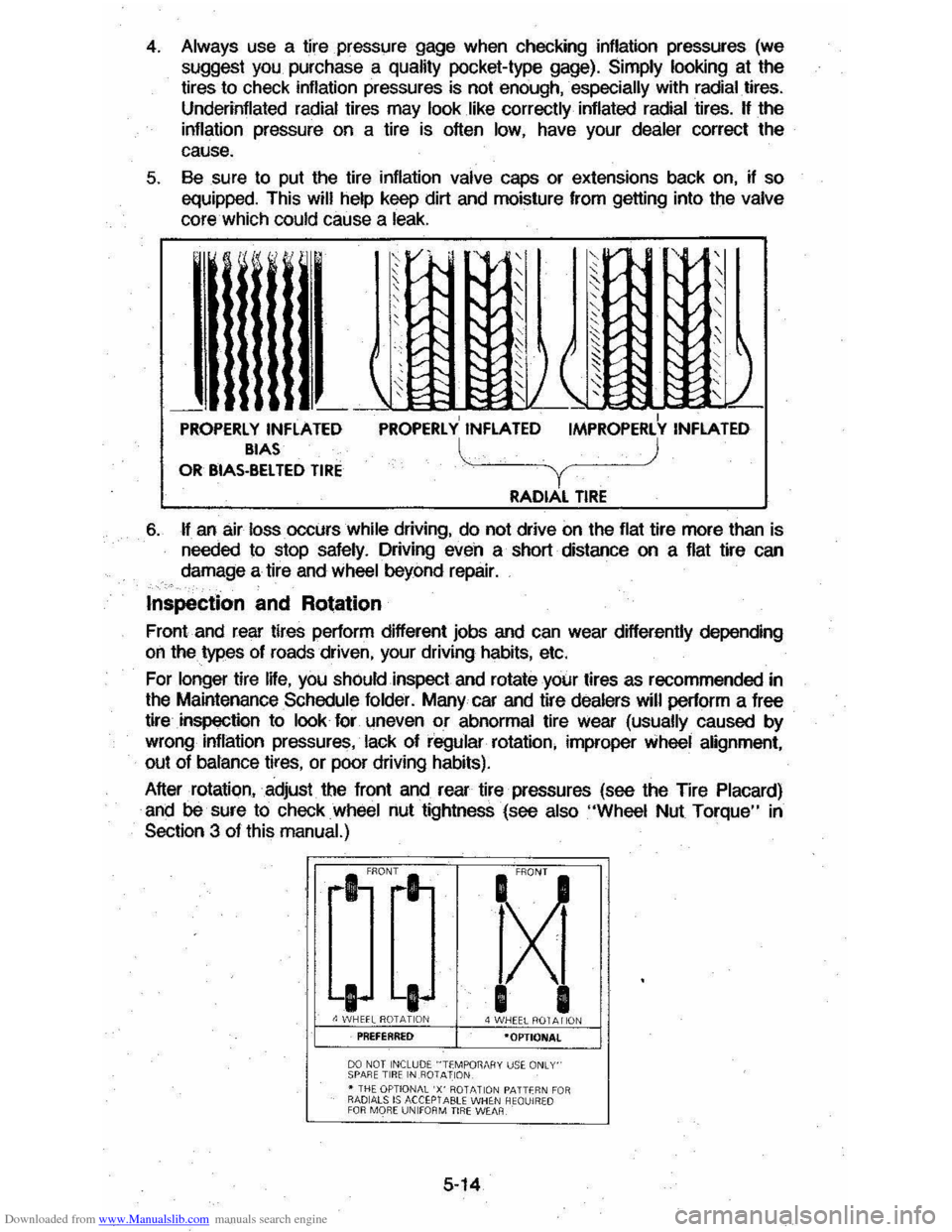
quality pocket-type gage). Simply looking at the tires to check inflation pressures is not enough, . especially with radial. tires.
Underinflated radial tires may look like correctly inflated radial tires. H the
inflation pressure on a tire is often low, have your dealer correct the
cause.
5. Sesure to put the tire inflation valve caps or extensions back on, if so
equipped. This will help keep dirt and moisture from getting into the valve core which could cause a leak.
't! [' V-. , ,-',/ ,
~v"
, " ,
, ,,-I"-v " I'V " ' v-I'-,
" "
,/ " I~ ~::;: ~ ~, ,/
~ J ( " ~ ~ ~ r;S ) :::: ~ ~ t;: ~/ 2~ t: ,
\' , --I PROPERLY INflATED PROPERLY INFLATED IMPROPERLY INFLATED BIAS l ) OR BIAS-BelTED TIRE Y RADIAL TIRE
6. H an air loss. occurs while driving, do not drive on the flat tire more than is
needed to stop safely. Driving even a short distance on a flat tire can
damage a tire and
wheel beyond repair.
Inspection and Rotation
Front and rear tires perform different jobs and can wear differently depending
on the types of roads driven, your driving habits, etc.
For
longer tire IHe, you shOuld inspect and rotate your tires as recommended in
the Maintenance Schedule folder. Many car and tire dealers will perform a free
tire
inspection to look for \meven or abnormal tire Wear (usually caused by
wrong inflation pressures, lack of regular rotation, improper wheel alignment,
out of bslance tires, or poor driving habits).
After rotation, adjust the front and rear tire pressures (see the Tire
Placard)
and be sure to check wheel nut tightness (see also "Wheel Nut Torque" in
Section 3 of this manual.)
fXi
I I 4 WHEEL ROT A I iON ·OPTIONAl
00 NOT INCLUDE "TfMPOT1MIY uS~ ONLY' SPARE TIR E IN .R01 AllON • THE OPTIONAL 'X' ROTATIO N PATTfR N FO R RADIALS IS ACCEPTABU WHE N HEQUIRW
FOR MO RE UNIfOR M TIRE WEAR
5-14
Page 88 of 105
Downloaded from www.Manualslib.com manuals search engine CAUTION; Whenever a wheel is changed, always remove any corrOsion that may be present on inside of wheeland wheel mounting surface on vehicle. Installing wheels
without good metal·to--metalcontact at the mounting surfaces can cause wheel nuts to
loosen, which can later allow a wheel to come off while the vehicle -is moving, possibly
causing loss of control.
Alignment and Balance
Proper wheel alignment improves tire tread life. Your vehicle's suspension
parts should be inspected often and
aligned when needed. (See the
Maintenance
Schedule Folder for more information.) Ball joints have built-in
wear indicators and some movement in the joints is normal.
Improper alignment • will not-cause the vehicle to vibrate. However, improper
alignment can cause:
• the tires to roll at an angle, which will result in faster tire wear;
• your tires _ to wear unevenly;
•
your vehicle to "pull" to the left or right.
Proper tire balancing provides the
best riding comfort and helps reduce tire
tread wear. Out-of-balance tires can cause annoying vibration and uneVen tire
wear such as cupping and flat spots.
Traction
Driving, cornering, and braking traction are reduced -w~ater. snovv' ic:e., gravel, or other material is on the road. Adjust driving practices and vehiCia
speed to road conditions.
When driving on wet
or sluShy roads, a wedge of water can build up between
the tire and road. This is known as hydroplaning, and may cause partial or
complete loss of traction, vehicle control, and stopping ability.
To red\ICe the chance of traclion loss, follow these tips:
1. Slow down during rainstorms or when roads are slushy.
2. StoW down if the road has standing water or puddles.
3. Replace the tires when the tread wear indicators are showing.
4. Keep the tires properly inflated.
H your vehicle has Tpc radial tires (see "Tire Replacement" in this section),
yoU, .lifes were designed to provide better snow traction. In fact, these tires
shOuld be adequate for driving in mO$ wiAter conditions. Howeve" ij you do feel you do need to buyconvenlional snow tires, be sure they are the same
size, load range, and .construction type (bias, bias· belled, Or radial) as your
other tires.
Tire Chain$ or Similar Traction Devices
If you buy tire chains for your car, make sure they are'designated as SAE
Class "S" type chaios. Use of other types of chains may cause damage to
your vehicle.
Use
of chains may adversely affect your vehicle's handling. -When using
chains: (1) adjust speed to road conditions, (2) avoid sharp turns, and (3) when
possible, avoid
locked-wheel braking.
In addition, to help prevent chain damage to your vehicle:
5-15
Page 89 of 105
Downloaded from www.Manualslib.com manuals search engine • Install the chains on the front tires as tightly as possible, then tighten them
again after driving 1/4 to 1/2 mile (0.4 to 0.8 kilometer). The use of chains
on the rear tires is not recommended; the chains may contact and
possibly damage the vehicle. If you intend to use chains on the rear tires, be sure
there is enough clearance.
• Do not exceed 45 mph (70 km/h), or the chain manufacturer's speed limitation, if lower.
• Drive in a restrained manner and avoid large bumps, potholes, severe turns and other manuevers which CQuid cause the tires to bounce up and down.
• Follow any other instructions of the chain manufacturer which do not
disagree with the above.
Spare Tire
For the use and installation of your spare tire, see "In Case of Emergency,"
Section 3 of this manual.
Tire Replacement
CAUTION:" 00 not mix different tire construction types (such as radial, bias, and biasbetted) on your vehicle exceptio emergencies, because your vehicle's handling could be affected and may result in loss Of control. This caution does not apply to a compact spare tire furnished with your vehicle.
On most vehicles originally eqUipped with radial tires, you will find a TPC Spec.
No. (Tire Performance Criteria Specification Number)
molded into the tire
sidewall
near the tire size marking. This shows that the tire meets rigid size
and performance standards which were developed for your vehicle. The TPC
Spec. No. assures a proper combination of endurance,
handHng, load capacity,
ride and traction on wet, dry, or snow-covered surfaces. When you replace your tires with tires having the same TPC Spec. No., your new tires will be
compatible with your vehicle.
When replacing tires with those not having a TPC Spec. No., you should use
the same size, load range, and construction type (bias, bias-belted, or radial)
as the original tires on your vehicle. A different size or type of tire may affect
such things as ride, handling, speedometer/odometer calibration, vehicle
ground clearance, and tire or tire chain clearance to the body or chassis. If
replacing only a single tire, it should be paired on the same axle with the least worn tire of the other three.
Uniform Tire Quality Grading
The following information relates to the tire grading system developed by the
United States
National Highway Traffic Safety Administration which will grade
tires by traction and temperature performance. (This applies only to vehicles
sold in the United States.)
Traction -A, B, C
The traction grades, from highest to lowest are: A, S, and C. They represent
the tire's
::ability to stop on wet pavement as measured under controlled
conditions on specified government test
~urfaces of asphalt and concrete. A
tire marked C may have poor traction performance.
Warning: The traction grade assigned to this tire is based on braking (straight
ahead) traction tests
and does not include cornering (turning) traction.
5-16
Page 90 of 105
Downloaded from www.Manualslib.com manuals search engine ,
Temperature -A, B, C
The temperature grades are A (the highest), B, and C, representing the tire's
resistance 10 the generation of heat and its ability 10 dissipate heat when tested
under controlled conditions on a specified indoor laboratory test wheel.
Sustained high temperature can cause the material of the tire to degenerate
and reduce tire life, and excessive temperature can lead to sudden tire failure .
The grade
C corresponds 10 a level of performance which all passenger car
tires must meet under the Federal Motor
Vehicle Safety Standard No. 109. Grades B and A represent higher levels of performance on the laboratory lest
wheel than the ",nimum required by law.
Warning : The temperature grade forlhis tire is established for a tire that is properly inflated and not overloaded . . Excessive speed, underinflation, or
excessive loading, either separately or in combination , can cause heal buildup and possible tire failure .
These grades are molded on the sidewalls 01 passenger car tires.
While
the tires available as 'standard or optional equipment .on General
Motors vehicles may vary with respect to these grades, all such tires meet General Motors performance s!andards and have been approved for
use on General Motors vehicles. All passenger car tires must conform to Federal safety requirements in addition to these grades.
You
should replace your tires when:
1 . The tires are worn to a point where 1.6
milHmeters (2/ 32 inch) or less t.read remains, or the cord or fabric is showing. '.
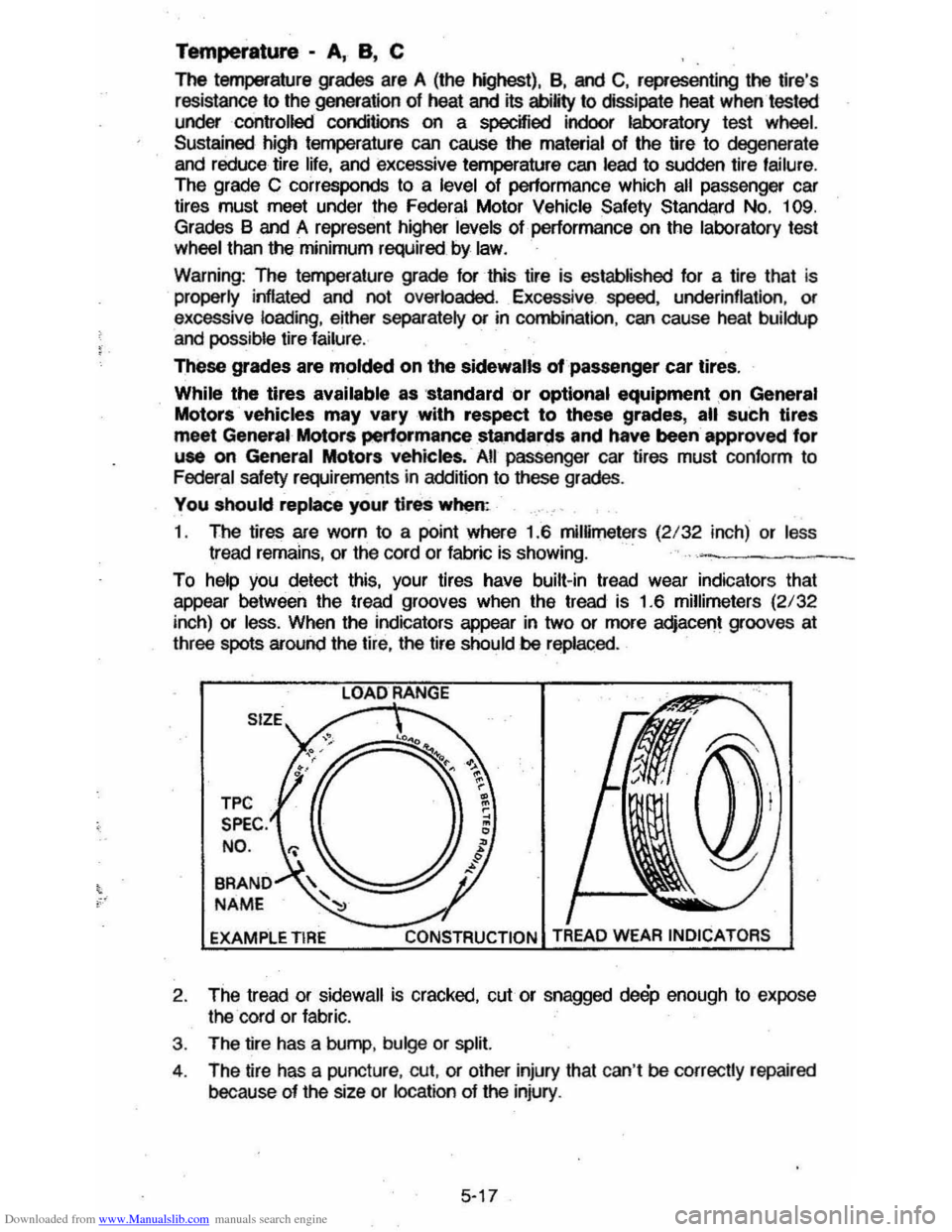
To help you detect this, your tires have built-in tread wear indicators that
appear between the tread grooves when the tread is 1.6 millimeters
(2/32
inch) or less. When the indicators appear in two or more adjacent grooves at
three spots around the tire, the tire should be replaced.
TPC
SPEC. NO .
BRAND
NAME
EXAMPLE TIRE LOAD
RANGE
CONSTRUCTION
2
. The tread or sidewall is cracked, cut or snagged deep enough to expose
the cord or fabric.
3. The tire has a bump , bulge or split.
4 . The tire has a puncture , cut, or other injury thai can 't
be correctly repaired
because of the size or
location of the injury .
5-17
Page 91 of 105
Downloaded from www.Manualslib.com manuals search engine Wheel Replacement
Damaged wheels must be replaced. For example, replace wheels if they are
bent,
cracked,or heavily rusted, or if wheel nuts often become loose. Also
replace wheels which leak air (except some aluminum wheels which can be repaired-- see your authorized dealer). See the Caution under "Inspection and
Rotation"
in this section regarding the importance of obtaining good metal-tometal contact when replacing or changing wheels.
Do not use bent wheels which have been straightened, and do not use inner
tubes in leaking wheels designed for tubeless tires. Such wheels may have
structural damage and could fail without warning. When replacing wheels for
any reason, the new wheels should be equal in load limit. diameter, width,
offset, and mounting configurations to those originally installed on your vehicle.
A wheel of the wrong size or type may adversely affect such things
as wheel
and bearing life, brake cooling, speedometer I odometer calibration, stopping
ability, headlight
aim, bumper height, vehicle ground clearance, and tire or tire
chain clearance to the body and chassis. Replacement with used wheels is not advised; they may have been treated harshly or have very high mileage, and
could fail without warning.
You can get wheels from your dealer.
Warranty
Tires are warranted by the tire manufa9turers. Warranty information is included
in the manufacturer's Warranty folder furnished With your vehicle.
5-18
Page 99 of 105
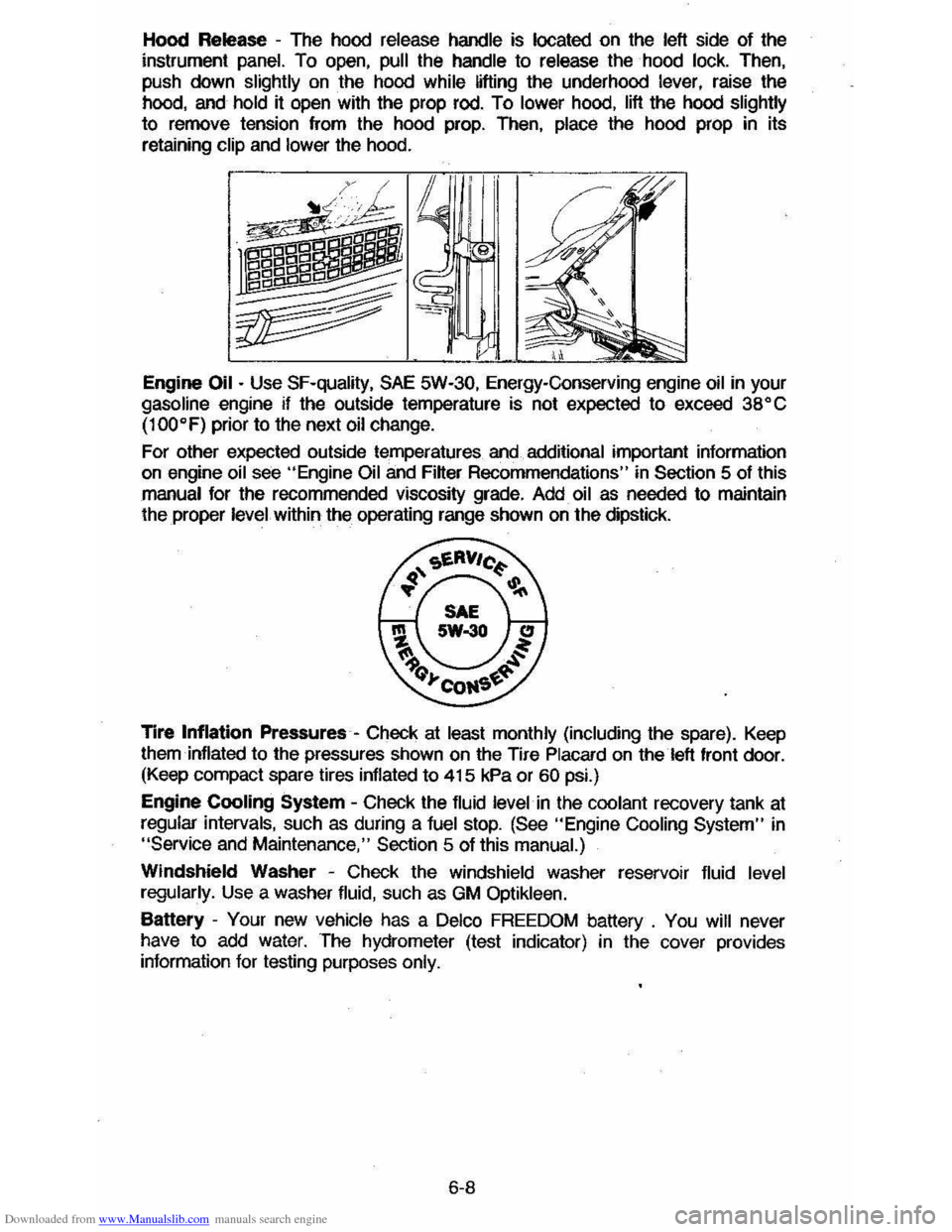
Downloaded from www.Manualslib.com manuals search engine Hood Release -The hood release handle is located on the left side of the
instrument panel. To open, pull the handle to release the hood lock. Then,
push down
slightly on the hood while lifting the underhood lever, raise the
hood, and hold it open with the prop rod. To lower hood, lift the hood slightly
to remove tension from the hood prop. Then, place the hood prop in its
retaining
clip and lower the hood.
Engine
Oil - Use SF-quality, SAE 5W-30, Energy-Conserving engine oil in your gasoline engine if the outside temperature is not expected to exceed 38" C
(100"F)
prior to the next oil change.
For other expected outside temperatures
and additional important information on engine oil see "Engine Oil and Filter Recommendations" in Section 5 of this
manual for the recommended viscosity grade. Add oil as needed to maintain
the proper level within the operating range shown on the dipstick.
Tire
Inflation Pressures -Check at least monthly (including the spare). Keep
them inflated to the pressures shown on the Tire Placard on the left front door. (Keep compact spare tires inflated to 415 kPa or 60 psi.)
Engine
Cooling System -Check the fluid level in the coolant recovery tank at
regular intervals, such as during a fuel stop. (See "Engine Cooling System" in "Service and Maintenance," Section 5 of this manual.)
Windshield Washer -Check the windshield washer reservoir fluid level
regularly. Use a washer fluid, such as GM Optikleen.
Battery -Your new vehicle has a Delco FREEDOM battery . You will never
have to add water. The hydrometer (test indicator) in the cover provides information for testing purposes only.
6-8
Page 101 of 105
Downloaded from www.Manualslib.com manuals search engine Exha.Ist SysttIm ChecltS .. 2·1 Parked Witt! Engine Rt.nning .. 2 ·' PulIng A Tr.JiIer '2·2 Flanmable 0ea1ing Sotvents . " . " 4 ·1 -. . Haz«d W.ning .. ... ... ......... .. ........ ... . . .. 3-1 Turn Signal .. 2 ·8 FloOded Engine, Starting.. .." 2'11 Floor Controls ... ................................. " 2~ 1 8 Fluid Capacities .. Drive Axle ..... . Power Steoring .. . Radiatof ..... Transaxle .\uklma tic ..
e ·" , .. . : ..... 5·1 0 .. , 5· 9; 5 ·1 0 5,6
Trensaxle MInJaI ............. .............. 5 ·6 wn:tshIekJ Washer .... . 2·9 F oreign Countries. Operation In.. 2 ·6 Freeing car From Mud and Sand .......... 3 ·8 Fuet . Requirements.. 5·1 Fuel StatiOn Information.. 6 ·7 Flimet . Engine EIChaust.. .. ..... ....... 2·1 ,,'" Chart ..... . ................... 6-5 location ..... -.""","" .. ................. 6·4 . ..... 2 ·22 . 2·24
"""""" -... .. .................................. 6-1 Do No! Usc For Cleaning F~1er cap location .. Fumes ................ ........ .. Gage .. Recommendations .... GIov ... .QQx" .. , ........ ,
.............. , 6-'
GUl¥d AgaInst Theft ................. .......... ..
2·' 2·'" 2 ·5
2 ·23
,.,
H atc hback Coupe .................... ........... .. '2-3 5 3·' Hazwd WarrWng Flasher ..
-Buzz ... FlicKering (Circuit BreMer) Hi!11 Beern Difmler SWitch ug,t S .whch., ....... Hei1Ier Operatioli .. Hitches. Trailer .. Hood
........ 6-4. 6-5 .... 2-9. 2·24
Latch Maintenance.. 5·10 RMese... .. ............................. ......... 6-7 Horn .......................... .............. 2,'8 How To ~ YOOl Gas Mileage TipS ...................................... .. ,' 2-8 IdI!InOOCaIiOn Num:lers Eng;no ........ 6-' VehiCle ......... ... . ....-Indic ator LIgtlI, Upshift ..
.. ............. 6 ·5 1 -2 ,2 ·7 2 -\5 Inflation Pressure, Tires.. 5 -1 3 Inlets. Ventilation System ............ 2-25 . 2·28 Inside RearvloW Mirror .. Instrument Panel .. J"" Caution 3·. Operation.. 3-5
S torage ................................. 3-5, 3-6 Jump Strilg With Booster Bat1ery. 3-1. 3-2 Keys.. 1-1 latches Door.. 1 ·3 Hood.. 5- 10,6·7 Light s.. 6·3
7-2
-.... .. .... ................. ........... 6-3 Brake Wamir'lIiJ.. 2-22 8rigtIt 8Mm IncicaIor .......................... 2-24 Bright Beam Switch ............................... 2-9 Bub Chart 6-3 Courtesy... 6 -3 Engine Tempe!'8ture Indicator.. 2 -21 Generator IndicalOf.. 2-21 Hazard Flasher" .................................. 3-1 Hsadlamp Circu it Breaker.. 6-5 H~.. 6-3 HeadIamp Warning Buzzer.. 2 -2 5 Oil Pr9S5Ufe IndicalOr... 2·21 SidemaIkcr .n................ . ................ 6 ·3 SWitch .. Tail SfId Brake .... Turn Slg\aJ Indicator .. Upshift Indicator LIglt .. Looks Door.. Ignition ..
. ....... .-... 2 ·2 4 . 6·3 2 -8 . 6-3 2-15
'·3 2·' Power Door:... '·3 Steemg Column .. . 2-7 Luggage Carrier.. 2·40. 2,4 1 luggaQe CompartmenI , Orimg wtile Open.. . ...... ........ .. . 2 ,1 Manual T ransaJlle Shift PoinIs .. ...................... ... .. 2·14 2 -1 4 Upshift Irdcator light ........... ... ............ 2-1 5 Mirrors Convex .. Rear View .. Mountainous Torroln Driving Down Grade s .. New car Break-In ..
1-4, 1-5
2-11 2 ·2 Odometer 2-20 Oil Pr9SfUe Gage.. . ........................ 2·24
Oil Pr88SUfe Ugr'II ................. " .......... ... .. 2 ·21 Operation in Foreign GoU'11ries ........... ~" 2--6 orher' c:or.oI!I and Featl.Ke! .. ..... ...... .. 2·35 Overheatad Engine Gage.. 2-24 Indicator light ....... ........................... 2-21 What To Do ....................................... 3-3 Parking Brake ... . . .. .. ... .. .. 2-19 , 2-22 lights.. . ......... .... ........... 6-3 Precautions .. .. .... ............. . "-Brakes ....................... ..... ... ... ... ... ........ 2 '1 8 Door locks.. ' ·3 ....... Steering .. Windows .................. . Pressure, Tire tllflatio'n .. Radiator Coolant .. Coolant Level Inspection .. Overheating ... Pressu-e Cac:I ... ..-
,. , 2 -15 ,..
.. .. 5-13
5·' 5· '
3·3 5·10
NoA ............ ................... ........ ... ... ........ . 2-30 AM/FM
AM /FM Stereo C assette .. Anlerna .....
ContrOls-A I.
Mobile Raol o System s ..
2·30 2-32, 2-33 2 -3 5 2·29 . 2-35
Page 102 of 105
Downloaded from www.Manualslib.com manuals search engine STereo.. 2-3 1 Tapu System ..... ....... .............. ........... 2-30 Rear WnJow Defogger ...•.•.......•.• .. . 2,26 Roar Window Washer/Wiper.. .. 2,29 Aegstration.. &5 Engine Number. &5 VehICle identifICation Number. &5 Replacement Fastener .. 5 -1
Restarting.
Restraints Child ... Lap Belts .. Methods Of Restr~ring Children •.. ReM Seat .. Reslraill lor Pfegnan WomtHI • . Shoulder Belts ___________ .......•..•.•.. Rool
2 -11
'-II ',9, 1-10 1-11 1·9 . HO H H l. l-10
Luggage
ca-rier .... ...... ............. 2-40, 2-4 Removable Panel. 2-37 Rotation. Tire .. Safoty BeltS (Seat Belts) .
5-14
,-, Carrior, InfiYIt . 1 -11 Seal, Child .... ..... ..... .... .. . .•.. 1-1 1
.. " Adj;stment, M
'-II 1-11 1-6 1-6
1-6 SOouIcIer_.. . _ .. _ ....... .............•.•.• SoII.Adjusting Bfakes Sensor Indicator and Check Eogr.e Irdcator Light . Service and Mainl:enMC8 •. Side Marker Ligtts ..
••.•. 2·1 8
2-21 . ....... 5,1 '-3 Spare Tire .. ... .............. 3·6. 3-7 Jacking Instructions .. Specifications, General,. $peed Control (Cruise Control) ..
-. 8tafteJ Sdety Switch ... _ .... _ ..........•.•
.... "'" Automatic Transaxle cars .. Emergency .. S-.. ColImn Controls .. Column Lock, Anti-Theft Power ..
3-5 ' -I 2 -16 2 -2<) 2-10
. ... 2-10 ...... 3-1
2-7 ... 2-7 .. '. 2-15 ' Wheel, Tilt ............. ; ........................... 2·15 Straps, Safety (See Seat Belts)
Stowing 01 Items. .. .............. . 1-' 3·5 , '3-6 Stowage Tire and Jack .. Suspension Maintenance .. 5·11 Tachomeler ...... ... ..... ........... ............ ..... 2·22 Theft, ou.d Againsl... 1-1 ThennostaI ..... ........ 5-9 Tilt SMering WheeL. r .. Alignment and Balance ... Chains •.
........ -2-15
5-15
5-15
Changing .................... .... ..... ................. 3.5 Damage al'l(j Repaj!' ... . .. ...... .. .... .......... 5-16 High Speod Operation __ ............•..•.•. 5-13 Hydroplaning .. _ ................. 5 .15 Wlallorl Pr~e.. . ..................... 5 .13 W;pection ... 5-14 Jackng... 3·5 L03(I Limit . Radial Tires .. Replacemont .. Rotation . Spare .. Tire Chains ..
5·13
5·16
5'16 5·14 3 -5 , 3-6 5 '15 Trac tion ........................... .................. 5 -1 5 lreacl W6iI' 1r"IcIicaIors.. 5017 Warranty ......... _ .................................. 5-18 T_
Caution ........ ~obIod Vehicle .. Mal1tonance , . Tires ...... . To Starl .. To)[iC Cleaning Solvents .. E)[haust n..mes .. Traction . Wei Roads ..
2-3
3 -8
2 ·2
5 ·13 3-1
.. .... ..... 4-1 2 -1 5 '15
Traffic Hazard Flasher ......... ... .... ......... 3,1
, T~ TOWing .... ............. ........ .............. 2 -2 -~,-u,_ BreOk~" Pofiod ................. ....... ............ . 2.2
7-3
CauIioc:II .................. ...... ...................... 2·3
~=~~'~~~~~·~':~~~~~~~~:::~:i·~~:;;---Tips.. 2.4 Tire W1ation.... 5.13 Trailer Tongue Load .............. ........ ,.. 2.3 TrlWlSaX!e AlAomaIic .. 2· 12 'Braking EtIect On Hills ....... 2·14 Checking FUd Level ............... ........ ¥,.,.: 506 ManuaI·, .. : ::.;:-... 2-14 ShIft Controls .. Upshift Indlcator light .. 2 -14 2 ·15 Tread Wear Ind"lCators.. 5·17
Turn Signals and Lane Change Feature ............................................... , 2·8 UndorbOcly Maintenance.. .. .......... 4·5 Upshift Indicator Light.. 2·15 Vehicle kJentjicaliCJO Number.. 6·S Vetjcte Loadir1g •.•.......... _ .......... _........ 5'12 Ventilating System .................... , .......... 2·25 Voltmeter ....................... .. 2·22 Wamny {Sue W.f1Iflty Folder; Wheel Cha.lgiog ................. ... .. _ ............... 3 -5
Wheel Replacement·Considerations.. 5 ·16 Wheel, Tilt. Steering.. 2·t5 Window$ Manual.. 1.3 Power ........ ................................... ......... 1·4 Rear, Defogger .................................... 2.28 Rear , Washer/Wipel. . 2·29
-0et0atIng ..:I 08t0gging .......... 2-27, 2-28 DMay Wiper System .. _ .................. ........ 2·9 Washer Uae In Cold WNilher .. WUhet Solution .. Wipers And Washers .. Wrecker , TOWing ..
2-10
2-10
2-. 3 ..