1979 DATSUN 210 service
[x] Cancel search: servicePage 157 of 548

Emission
Control
System
SERVICE
DATA
AND
SPECIRCATIONS
INSPECTION
AND
ADJUSTMENT
AIR
PUMP
Air
pressure
With
engine
speed
at
2
600
pm
mrriHg
inHg
More
than
100
3
94
E
G
R
SYSTEM
Thermal
vacuum
valve
opening
temperature
U
S
A
models
except
FU
model
FU
and
Canada
models
Oc
OF
oC
F
SO
to
63
122
to
145
40
to
63
104
to
145
T
C
S
SYSTEM
Thermal
vacuum
valve
Except
Canada
and
FU
models
Closing
temperature
oC
F
Opening
temperature
OC
F
Above
SO
to
63
122
to
145
Below
5
to
18
41
to
64
5
to
18
and
SO
to
63
41
to
64
and
122
to
145
TIGHTENING
TORQUE
Air
pump
Bea
ring
cover
securing
bolt
Rotor
ring
screw
End
cover
bolt
Pulley
securing
bolt
Thermal
vacuum
valVe
BP
T
valve
mounting
sere
Top
detecting
switch
Catalytic
converter
bolt
kg
m
ft4b
kg
m
ft
lb
kg
m
ft
Ib
kg
m
ft
b
kg
m
ft
lb
kg
m
ft
Ib
kg
m
ft
Ib
kg
m
ft
lb
0
1
to
0
2
0
7
to
1
4
0
5
to
0
7
3
6
to
5
1
0
7
to
0
9
5
1
to
6
5
0
75
to
0
90
5
4
to
6
5
Less
than
2
2
16
0
38
to
0
51
2
7
to
3
7
2
0
to
3
0
14
to
22
2
6
to
3
4
19
to
25
EC
38
Page 158 of 548
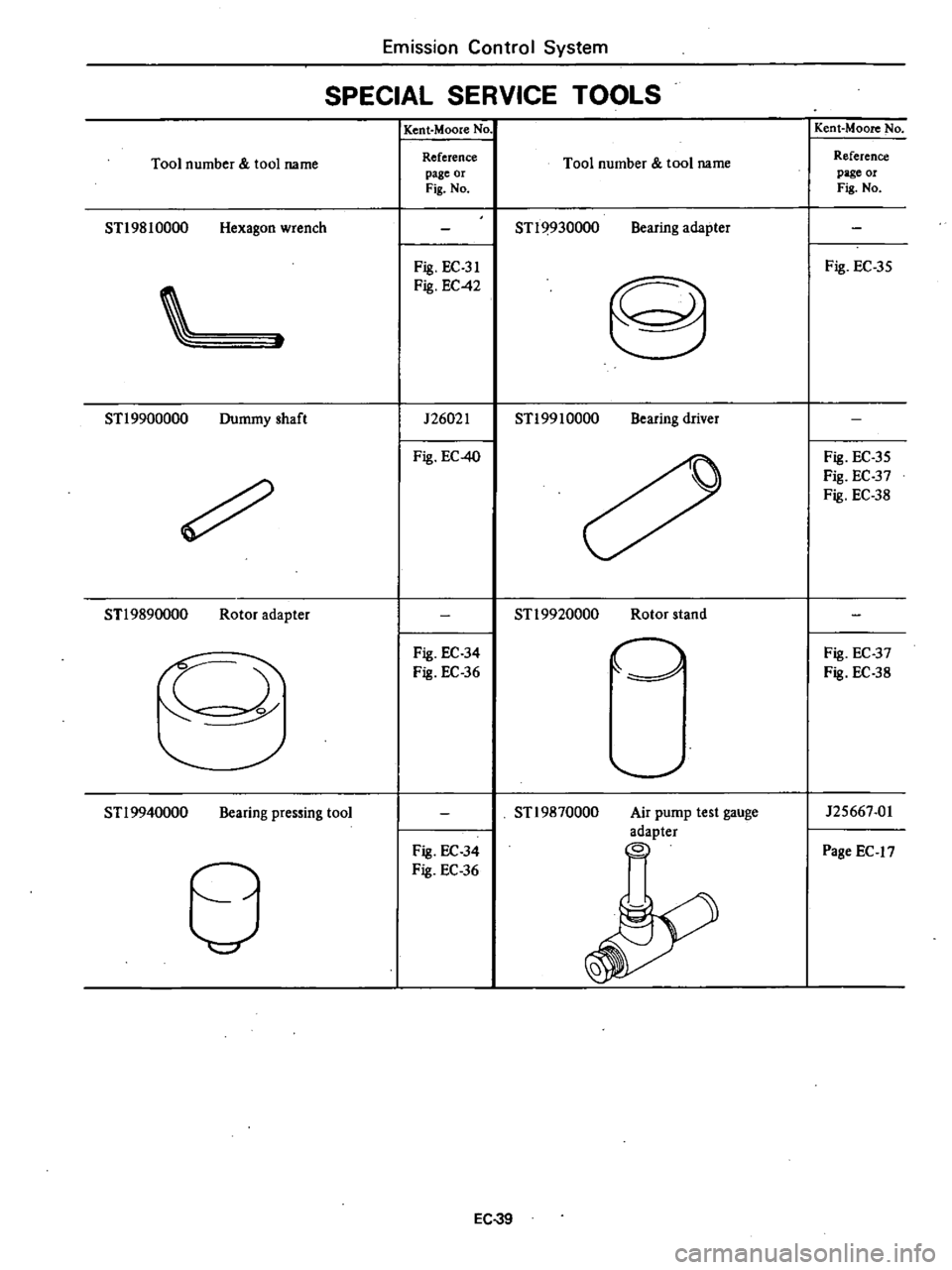
Emission
Control
System
SPECIAL
SERVICE
TOOLS
Kent
Moore
No
Kent
Moore
No
Tool
number
tool
name
Reference
page
or
Fig
No
Tool
number
tool
name
Reference
page
or
Fig
No
STl98l0000
Hexagon
wrench
STl9930000
Bearing
adapter
Fig
EC
31
Fig
EC
35
Fig
EC
42
@j
STl9900000
Dummy
shaft
126021
STl99
10000
Bearing
driver
Fig
EC
40
Fig
EC
35
Fig
EC
37
Fig
EC
38
STl9890000
Rotor
adapter
STl9920000
Rotor
stand
r
Fig
EC
34
CJ
Fig
EC
37
J
Fig
EC
36
Fig
EC
38
STl9940000
Bearing
pressing
tool
STl9870000
Air
pump
test
gauge
125667
01
adapter
Fig
EC
34
0
Page
EC
17
Fig
EC
36
EC
39
Page 159 of 548

DATSUN
210
Model
8310
Series
SECTIONEE
ENGINE
ELECTRICAL
SYSTEM
CONTENTS
BATTERY
CHECKING
ELECTROLYTE
LEVEL
CHECKING
SPECIFIC
GRAVITY
CHARGING
INSTALLATION
STARTING
MOTOR
STARTING
CIRCUIT
CONSTRUCTION
REMOVAL
AND
INSTALLATION
DISASSEMBL
Y
CLEANING
AND
INSPECTION
ASSEMBL
Y
TEST
CHARGING
CIRCUIT
ALTERNATOR
DESCRIPTION
REMOVAL
DISASSEMBLY
INSPECTION
AND
REPAIR
ASSEMBLY
ALTERNATOR
TEST
REGULATOR
DESCRIPTION
INSPECTION
IGNITION
CIRCUIT
EE
2
EE
2
EE
2
EE
3
EE
3
EE
4
EE
4
EE
5
EE
6
EE
6
EE
6
EE
8
EE
8
EE
10
EE
13
EE
13
EE
14
EE
14
EE
14
EE
16
EE
17
EE
1B
EE
18
EE
18
EE
20
DESCRIPTION
DISTRIBUTOR
CONSTRUCTION
CHECKING
AND
ADJUSTMENT
I
ISASSEMBL
Y
AND
ASSEMBLY
IC
IGNITION
UNIT
DESCRIPTION
REMOVAL
AND
INSTALLATION
CHECKING
IC
IGNITION
SYSTEM
IGNITION
COIL
SPARK
PLUG
INSPECTION
CLEANING
AND
REGAP
SERVICE
DATA
AND
SPECIFICATIONS
GENERAL
SPECIFICATIONS
INSPECTION
AND
ADJUSTMENT
TIGHTENING
TORQUE
TROUBLE
DIAGNOSES
AND
CORRECTIONS
I
BATTERY
II
STARTING
MOTOR
III
ALTERNATOR
Including
voltage
regulator
IV
IGNITION
CIRCUIT
EE
20
EE
22
EE
22
EE
23
EE
23
EE
24
EE
24
EE
25
EE
25
EE
28
EE
29
EE
29
EE
29
EE
30
EE
30
EE
31
EE
33
EE
34
EE
34
EE
35
EE
36
EE
37
Page 171 of 548

DESCRIPTION
The
alternator
incorporates
an
Ie
voltage
regulator
which
maintains
volt
age
within
the
specified
range
and
prevents
output
voltage
from
rising
higher
than
the
specified
value
Except
for
the
Ie
circuit
alternator
parts
are
essentially
the
same
as
those
of
the
conventional
type
alternator
Service
procedures
outlined
in
this
section
are
restricted
to
information
on
other
than
the
voltage
regulator
In
the
alternator
a
magnetic
field
is
CD
Engine
Electrical
System
ALTERNATOR
produced
by
the
rotor
which
consists
of
alternator
shaft
field
coil
pole
pieces
and
slip
rings
The
slip
rings
pressed
in
the
shaft
conduct
only
a
small
field
current
Output
current
is
generated
in
the
armature
coils
located
in
the
stator
The
stator
has
three
windings
and
generates
three
phase
alternating
current
Silicon
diodes
act
like
a
one
way
valve
for
electricity
so
that
charging
current
passes
easily
but
reverse
current
is
shut
out
In
this
alternator
pack
type
silicon
diodes
are
used
as
main
diodes
Nine
diodes
three
negative
three
positive
and
three
sub
diodes
are
installed
in
positive
and
negative
plates
as
an
assembly
These
diodes
are
direct
soldered
at
their
tips
and
constructed
with
posi
tive
and
negative
conjunction
They
are
mounted
on
the
two
plates
which
combine
the
function
of
heat
dissipating
plate
and
positive
negative
terminals
and
are
light
in
weight
and
easy
to
service
EE13
1
Pulley
assem
bly
2
Front
cover
3
Front
bearing
4
Rotor
Qj
5
Rear
bearing
6
Stator
7
Diode
Set
plate
assembly
8
Brush
assembly
9
Ie
voltage
regulator
10
Rear
cover
11
Through
bolt
EE647
Fig
EE
30
Alternator
Page 173 of 548

INSPECTION
OF
STATOR
Continuity
test
Stator
is
normal
when
there
is
continuity
between
individual
stator
coil
terminals
When
there
is
no
conti
nuity
between
individual
terminals
cable
is
broken
Replace
stator
assembly
EE533
Fig
EE
40
Testing
Stator
for
Continuity
2
Ground
test
If
each
lead
wire
of
stator
coil
including
neutral
wire
is
not
conduc
tive
with
stator
core
condition
is
satisfactory
If
there
is
continuity
stator
coil
is
grounded
EE534
Fig
EE
41
Testing
Stator
for
Ground
INSPECTION
OF
DIODE
Perform
a
continuity
test
on
diodes
in
both
directions
using
an
ohmmeter
There
are
six
main
diodes
and
tluee
sub
diodes
attached
to
set
plate
Three
main
diodes
are
attached
to
positive
EEl
plate
and
three
others
to
negative
8
plate
Three
sub
diodes
are
attached
to
terminals
The
continuity
test
should
be
per
formed
on
each
diode
between
the
terminal
and
plate
Engine
Electrical
System
Conductive
direction
EE045
Main
diode
installed
on
8
plate
is
a
positive
diode
which
allows
cur
rent
to
flow
from
terminal
to
EEl
plate
only
In
other
words
current
does
not
flow
from
8
plate
to
terminal
1
plate
2
Terminal
Fig
EE
43
Impecting
Positive
Diode
EE046
2
Main
diode
installed
on
Gplate
is
a
negative
diode
which
allows
current
to
flow
from
Gplate
to
terminal
only
In
other
words
current
does
not
flow
from
terminal
toGplate
1
plate
2
Tenninal
Fig
EE
44
Impecting
Negatiue
Diode
EE047
EE
15
rp
m
1
plate
2
ptate
3
Diode
Fig
EE
42
Conductive
Direction
of
Diode
3
Correct
direction
of
current
flow
for
three
sub
diodes
is
shown
in
Fig
EE
4S
Direction
of
electric
current
EE650
Fig
EE
45
Sub
Diode
If
current
flows
in
both
positive
and
negative
directions
diode
is
short
circuited
If
current
flows
in
one
direc
tion
only
diode
is
in
good
condition
If
there
is
a
faulty
main
diode
replace
all
diodes
as
an
assembly
See
table
below
These
diodes
are
unservicea
ble
Page 181 of 548

CHECKING
AND
ADJUSTMENT
CAP
AND
ROTOR
HEAD
Cap
and
rotor
head
should
be
in
spected
periodically
as
specified
in
the
Main
teoanee
Schedule
Remove
cap
and
clean
all
dust
and
carbon
deposits
from
cap
and
rotor
from
time
to
time
If
cap
is
cracked
or
is
leaking
replace
wi
th
a
new
one
ADVANCE
MECHANISMS
SpecHlcatlons
Refer
to
Service
Data
and
Specifica
tions
for
distributor
Vacuum
advance
mechanism
mechanical
parts
If
vacuum
advance
mechanism
fails
to
operate
properly
check
for
the
followin
B
items
and
correct
the
mal
function
as
required
I
Check
vacuum
inlet
for
signs
of
leakage
at
its
connection
If
necessary
retighten
or
replace
with
a
new
one
2
Check
vacuum
diaphragm
for
air
leak
If
leak
is
found
replace
vacuum
controUer
assembly
3
Inspect
breaker
plate
for
smooth
moving
If
plate
does
not
move
smoothly
this
condition
could
be
due
to
sticky
steel
balls
or
pivot
Apply
grease
to
steel
halls
or
if
necessary
replace
breaker
plate
as
an
assembly
Centrifugal
advance
mechanical
parts
When
cause
of
engine
malfunction
is
traced
to
centrifugal
advance
mecha
nical
parts
use
distributor
tester
to
check
its
characteristics
If
nothing
is
wrong
with
its
charac
teristics
conceivable
causes
are
faulty
or
abnormal
wear
of
driving
part
or
others
So
do
not
disassemble
it
In
the
event
of
improper
character
istics
check
closely
rotor
shaft
assem
bly
governor
weight
and
shaft
If
any
of
the
above
parts
are
mal
functioning
replace
the
parts
Engine
Electrical
System
DISASSEMBLY
AND
ASSEMBLY
DISASSEMBLY
I
Take
off
cap
and
remove
rotor
head
2
Remove
Ie
ignition
unit
Refer
to
IC
Ignition
Unit
for
removal
and
in
stallation
3
Remove
stator
and
magnet
by
removing
stator
securing
screws
4
Remove
vacuum
controller
by
removing
securing
screws
EE746
Fig
EE
59
Removing
Vacuum
Controller
5
Using
two
pry
bars
or
suitable
puller
pry
reluctor
from
shaft
CAUTION
When
removing
reluctor
be
careful
not
10
distort
or
damage
the
teeth
6
Remove
roll
pin
7
Remove
pick
up
coil
assembly
8
Remove
breaker
plate
setscrews
and
remove
breaker
plate
assembly
EE703
Fig
EE
60
Removing
Breaker
Plate
Setscrews
9
Punch
knock
pin
out
and
remove
pinion
EE
23
EE704
Fig
EE
61
Removing
Knock
Pin
10
Remove
rotor
shaft
and
drive
shaft
assembly
EE705
Fig
EE
62
Removing
Rotor
Shaft
and
Drive
Shaft
Assembly
11
Mark
rotor
shaft
and
drive
shaft
Remove
packing
from
the
top
of
rotor
shaft
and
unscrew
rotor
shaft
setscrew
Remove
rotor
shaft
EE706
Fig
EE
63
Removing
Rotor
Shaft
12
Mark
one
of
the
governor
springs
and
its
bracket
Also
mark
one
of
the
governor
weights
and
its
pivot
pins
13
Carerully
unhook
and
remove
governor
springs
14
Remove
governor
weights
A
r
ply
grease
to
guvernor
weights
after
disassembling
Page 188 of 548

Engine
Electrical
System
SERVICE
DATA
AND
SPECII
ICATIONS
GENERAL
SPECIFICATIONS
BATTERY
Type
A
pplied
model
Capacity
V
AH
STARTING
MOTOR
Type
Applied
model
System
voltage
v
No
load
Terminal
voltage
v
Current
A
Revolution
rpm
ALTERNATOR
Type
Nominal
rating
Ground
pol
trity
Minimwn
revolution
under
no
load
When
14
volt
is
applied
Hot
output
current
PuUeyratio
Regulated
output
voltage
N50Z
NS70
U
S
A
Canada
U
S
A
Optional
12
60
12
65
SI14
160B
S1I4
163E
Non
reduction
gear
type
U
S
A
M
T
USA
A
T
US
A
M
T
Optional
12
11
5
Less
than
60
More
than
7
000
LR15049
V
A
1250
Negative
rpm
Less
than
1
000
A
rpm
More
than
40
2
500
50
5
000
2
06
v
144to15
0
EE
30
S1I4
253
Reduction
gear
type
Canada
U
S
A
Optional
11
Less
than
100
More
than
3
900
Page 197 of 548

DATSUN
210
Model
8310
Series
SECTIONER
ENGINE
REMOVAL
INSTAllATION
CONTENTS
ENGINE
REMOVAL
AND
INSTALLATION
REMOVAL
INSTALLATION
ER
2
ER
3
ER
5
ENGINE
MOUNTING
INSULATOR
SERVICE
DATA
AND
SPECIFICATIONS
TIGHTENING
TORQUE
ER
5
ER
6
ER
6