1976 CHEVROLET VEGA heating
[x] Cancel search: heatingPage 17 of 87
Downloaded from www.Manualslib.com manuals search engine STARTING AND OPERATING
Engine Exhaust Gas Caution (Carbon Monoxide)
AvoId Inhaling exhaust gases because
they contaIn carbon monoxide, which by
Itselt is colorless and odorless. Carbon
monoxide Is a dangerous gas that can
cause unconsciousness and is potentially
lethal.
If at any time you suspect that exhaust
fumes are entering the passenger compartment, have the cause determined and
corrected as soon as possible. If you must
drIve under these conditions, drive only
with
all windows fully open.
The best protection agaInst carbon
monoxide entry Into the car body Is a
properly maIntaIned engine exhaust system, car body and body ventilatIon system, It Is recommended that the exhaust system
and body be Inspected by a competent
mechanIc.
• Each time the vehIcle Is raised for an 011 change.
• Whenever 8 change Is noticed In the
sound Of the exhaust system.
• Whenever the exhaust system, underbody or rear of the vehicle Is damaged.
See your MaIntenance Schedule folder
for inspection procedure.
To allow proper operation of the car's
ventilation system, keep aIr Inlet grille
forward of windshield and rear ventilation
grille on station wagon quarter. panels
clear ot snow or other
obstruction at all times, and prevent cargo from blocking
the inside vent holes on the underside of the quarter panels.
SITTING IN A PARKED CAR WITH ENGINE RUNNING FOR AN EXTENDED PERIOD IS NOT RECOMMENDED.
Do not run engine In confined areas
such as garages any more than needed
to move vehIcle In
or out of area. When vehIcle Is stopped In an UNCONFINED area with the engine runnIng for any more
than a short perIod, adjust heating or cooling system to force outsIde aIr into
car as follows:
2-1
1. On cars not equipped with air conditioning, set fan to medium or high
speed and upper control lever to any
position except OFF.
2. On cars equipped with air conditIoning, set fan to medium or high speed
and upper control lever to any position
except
OFF or MAX.
The trunk lid should be closed while drIving to help prevent inadvertently drawing exhaust gases into the car. It is
unwise to drIve at high speeds for long
durations with the trunk lid open. However, it tor some reason the trunk must remain
open for a period while moving, or electrical wiring or other cable connections to
a trailer must pass through the seal be
tween trunk
lid and body, the following
precautions should be observed:
• Close all windows.
• Adjust heating or cooling system to
force outsIde air into car as described In Items 1 and 2 above but with fan set
at hIgh speed.
• On cars equIpped with outside aIr vents In or under Instrument panel, open vents
fully.
Page 25 of 87
Downloaded from www.Manualslib.com manuals search engine cluster flashes to indicate proper
operation of the front and rear turn
signal lamps.
If the indicator lamp
remains on and does not flash,
check for a defective lamp bulb.
If
the indicator fails to light when the
lever
is moved, check the fuse and
indicator bulb.
NOTE: For operation of hazard
flasher, see page 3-1, in
Section "In
Case of Emergency."
Horn
The horn on your car is actuated
by firmly pressing on the pad in the
center of the steering wheel.
As a good motorist,
~se of the
horn should be kept at a minimum.
However, acquaint yourself
as soon
as possible with this function of
your car, should it ever become
necessary to give a warning to a
pedestrian
or another motorist.
Power Steering
If the steering system power as
sist fails due to some malfunction,
or because the engine has stalled,
the vehicle can still be steered.
However, much greater effort
is re
quired, particularly in sharp turns.
Tilt Steering Wheel
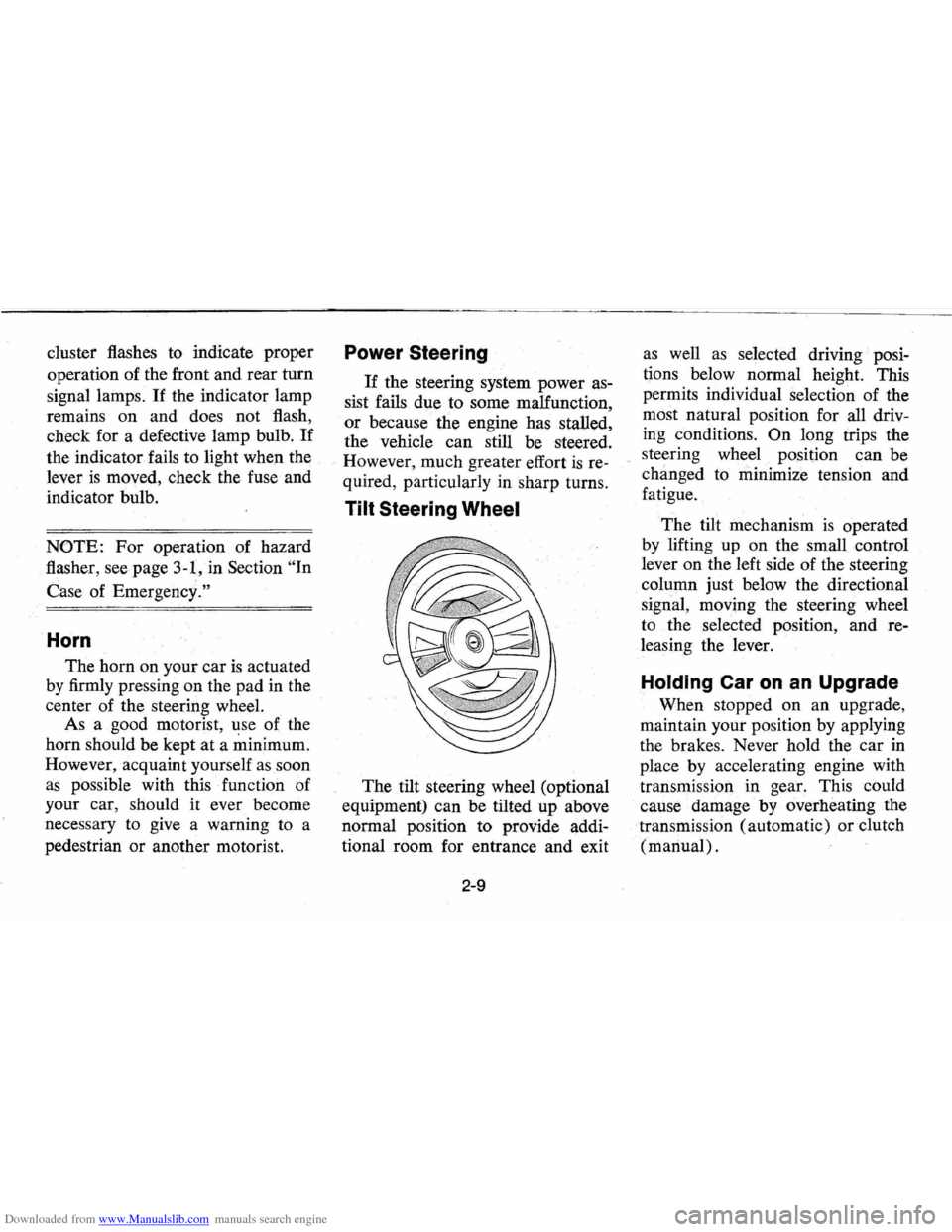
The tilt steering wheel (optional
equipment) can be tilted up above
normal position to provide addi
tional room for entrance and exit
2-9
as well as selected driving· posi
tions below normal height. This
permits individual selection of the
most natural position for
all driv
ing conditions.
On long trips the
steering wheel position can be
changed to minimize tension and
fatigue.
The tilt mechanism
is operated
by lifting up on the small control
lever on the left side of the steering
column just below the directional
signal, moving the steering wheel
to the selected position, and re
leasing the lever.
Holding Car on an Upgrade
When stopped on an upgrade,
maintain your position by applying
the brakes. Never hold the car
in
place by accelerating engine with
transmission in gear. This could
cause damage by overheating
the
. transmission (automatic) or clutch
(manual) .
Page 26 of 87
Downloaded from www.Manualslib.com manuals search engine Parking Your Car
Always engage the parking brake
and place the automatic transmis
sion selector lever in
"Park" posi- tion
when leaving your
car un
attended. Also with automatic
transmissions, never park for pro
longed periods with engine idling
and transmission in gear, especially
FLOOR CONTROLS
Braking System
The service brake system is de
signed for braking performance
under a wide range of driving con
ditions even when the vehicle
is
loaded to its full rated vehicle load.
NOTE: Operation of the brake
system warning light
is covered on
page 2-15 in the section on
"In
strument Panel."
Power Brakes
• On cars with power brakes, if
power assist to the brakes
is in
terrupted due to a stalled engine
or some malfunction, two or
more brake applications nor
mally can be made using reserve
power.
• If the brake pedal is held down,
2-10
if your car is equipped with air
conditioning. This practice
is detri
mental to the transmission, due
to
overheating.
the system
is designed to bring
the car to a full stop on reserve
power. However, the reserve
power
is partially depleted each
time the brake pedal
is applied
and released. Do not pump
brakes when brake power assist
has been interrupted, except
when necessary in order to main
tain steering control on slippery
surfaces.
• When reserve power is exhausted,
the vehicle can still be stopped
by applying greater force to the
pedal.
Page 31 of 87
Downloaded from www.Manualslib.com manuals search engine Generator Indicator Light
The red light will go on when
the ignition key
is in the "on" posi
tion, but before the engine
is started.
After the engine starts, the light
should go out and remain out.
If
the light remains on when engine
is running, have your Authorized
Chevrolet Dealer locate and correct
the trouble
as soon as possible.
Temp. Pressure Indicator
Light
This indicator light is provided
in the instrument cluster to quickly
warn of an overheated engine
and/or extreme low oil pressure
or oil supply. This light will be on
when the ignition switch is turned
"ON" and should go out after the
engine
is started. Occasionally the
light may be seen to flicker momen
tarily, but this will do no harm. Ex
treme low oil pressure or oil supply
will prevent the electric fuel pump from
operating and under this con
dition the engine will not run.
If the light comes on during ex
treme driving conditions, such
as an
extended idle, turn off the air con
ditioner (if used) and run the en
gine slightly faster than idle speed
with the transmission in
neutral
gear. If the light does not go off
within a short period of time (1-2
minutes), then turn the engine off
until the cause of
the overheating is
corrected. Glance at the instrument
cluster frequently
as you drive to
see if this light is on.
Add Coolant Indicator Light
This indicator light is provided to
warn of a low coolant condition in
the radiator.
If coolant level is low
the yellow
"Add Coolant" warning
light will glow. Coolant level in the
coolant recovery tank, and radiator,
should be checked at the first oppor
tunity.
If necessary add sufficient
2-15
coolant to both the radiator and
coolant recovery tank.
(See Service
and Maintenance, Section 5, for
proper procedure) .
If frequent
additions are required, see your
dealer for a complete cooling sys
tem check.
Brake System Warning
Light
The service brake system is a dual
system designed so that one part will
provide some braking action in the
event of loss of hydraulic pressure
in the other part of the system.
If the
warning light labeled
"Brake" lo
cated in the speedometer face comes
on and stays
on when the ignition is
on and after the brakes have been
firmly applied
it may indicate that
there
is a malfunction in one part of
the brake system.
• As a reminder, the light is de
signed to come
on with the park
ing brake applied and the igni
tion on.
Page 36 of 87
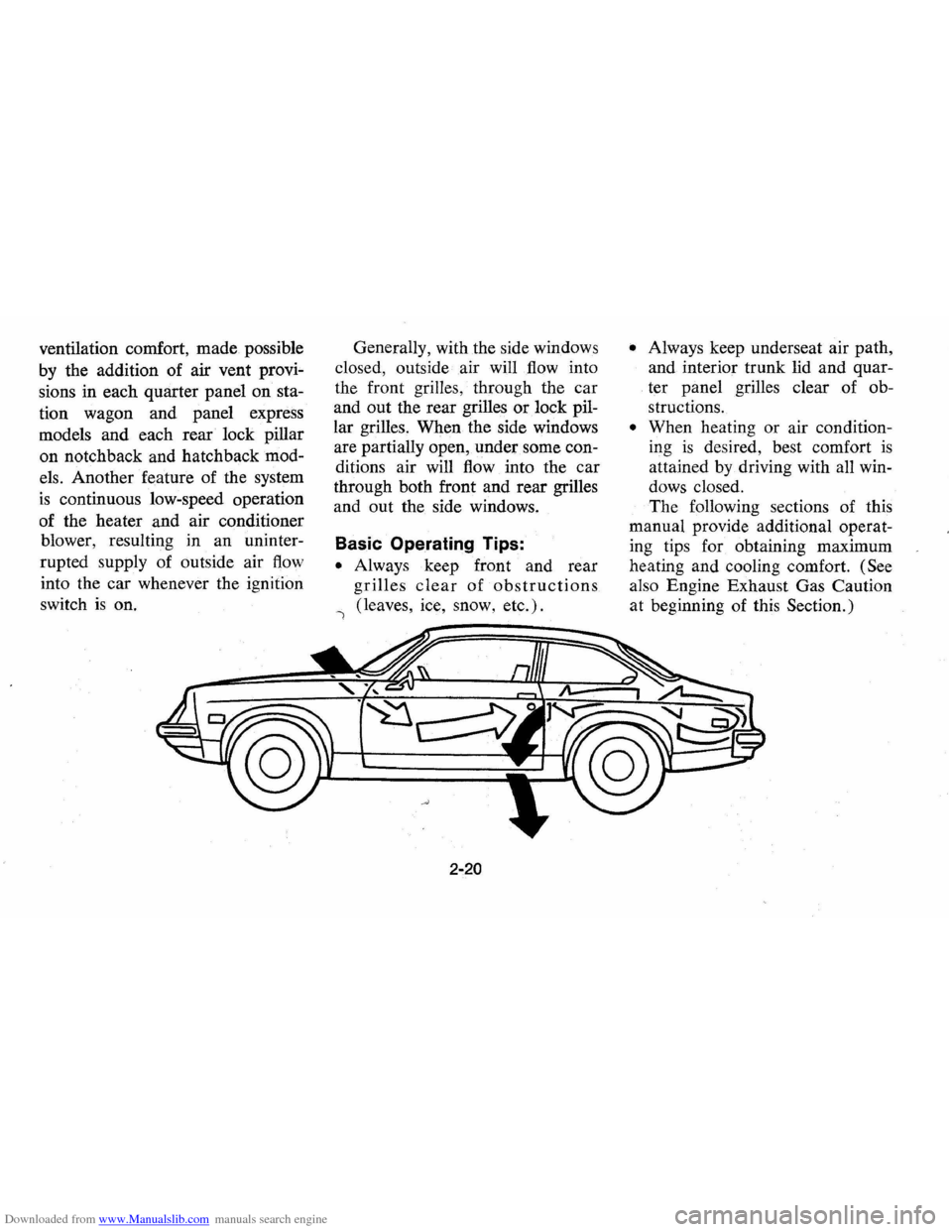
Downloaded from www.Manualslib.com manuals search engine ventilation comfort, made possible
by the addition of air vent provi
sions in each quarter panel on sta
tion wagon and panel express
models and each rear lock pillar
on notchback and hatchback mod
els. Another feature of the system
is continuous low-speed operation
of the heater and air conditioner
blower, resulting in an uninter
rupted supply of outside air
flow
into the car whenever the ignition
switch
is on. Generally,
with the side windows
closed, outside· air will
flow into
the front grilles, through the car
and out the rear grilles
or lock pil
lar grilles. When the side windows
are partially open, under some con
ditions air will
flow into the car
through both front and rear grilles
and out the side windows.
Basic Operating Tips:
• Always keep front and rear
grilles clear of obstructions
, (leaves, ice, snow, etc.).
2-20
• Always keep underseat air path,
and interior trunk lid and quar
ter panel grilles clear of ob
structions.
• When heating or air condition
ing
is desired, best comfort is
attained by driving with all win
dows closed.
The following sections of this
manual provide additional operat
ing tips for obtaining maximum
heating and cooling comfort.
(See
also Engine Exhaust Gas Caution
at beginning of this Section.)
Page 38 of 87
Downloaded from www.Manualslib.com manuals search engine Heater Operating Tips
• Clear snow and ice from hood
and air inlet in front of wind
shield and air vent grille in rear
fender,
or roof side panel to im
prove heater and defroster
effi
ciency and reduce the probability
of fogging on inside of wind
shield.
• Clear windshield, rear window,
outside m.irrors and all side win
dows of ice and snow before
driving vehicle.
• Operate blower on "HIGH" for
a
few seconds before moving the
vehicle, to help clear the intake
ducts of snow to further reduce
the possibility of fogging on in
side of windshield.
• Keep all windows and vents
closed to reduce dust, road and wind
noise and uncomfortable
drafts.
• For most satisfactory heater
operation and air circulation,
operate fan on low or medium
speeds for normal operation and
high speeds for quick warm-up
and during extremely low tem
peratures.
• For adequate rear seat heating,
the area beneath the front seat
must not be blocked by carpet
ing, rags, paper or other material
and fan should operate on high
blower.
Electro-Clear Rear Window
Defogger
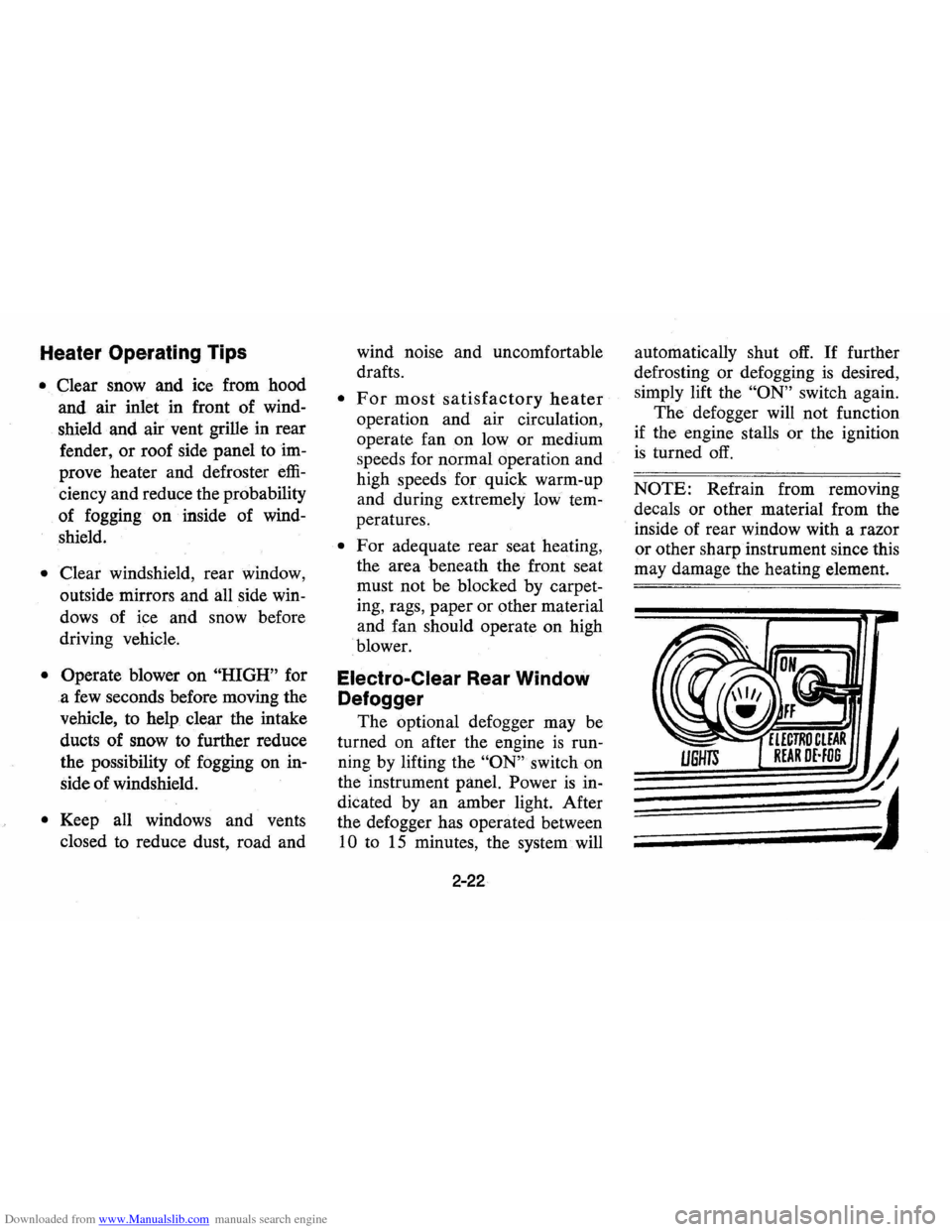
The optional defogger may be
turned on after the engine
is run
ning by lifting the
"ON" switch on
the instrument panel. Power
is in
dicated by an amber light. After
the defogger has operated between
10 to 15 minutes, the system will
2-22
automatically shut off. If further
defrosting or defogging
is desired,
simply lift the
"ON" switch again.
The defogger will not function
if the engine stalls or the ignition
is turned off.
NOTE: Refrain from removing
decals
or other material from the
inside of rear window with a razor
or other sharp instrument since this
may damage the heating element.
Page 39 of 87
Downloaded from www.Manualslib.com manuals search engine Four Season Air Conditioning System
g
HI OFF r--A/C ---. ECOIIOMY ,-HUT D'Ef MAX -HT
(
. 0 o
LO
nil
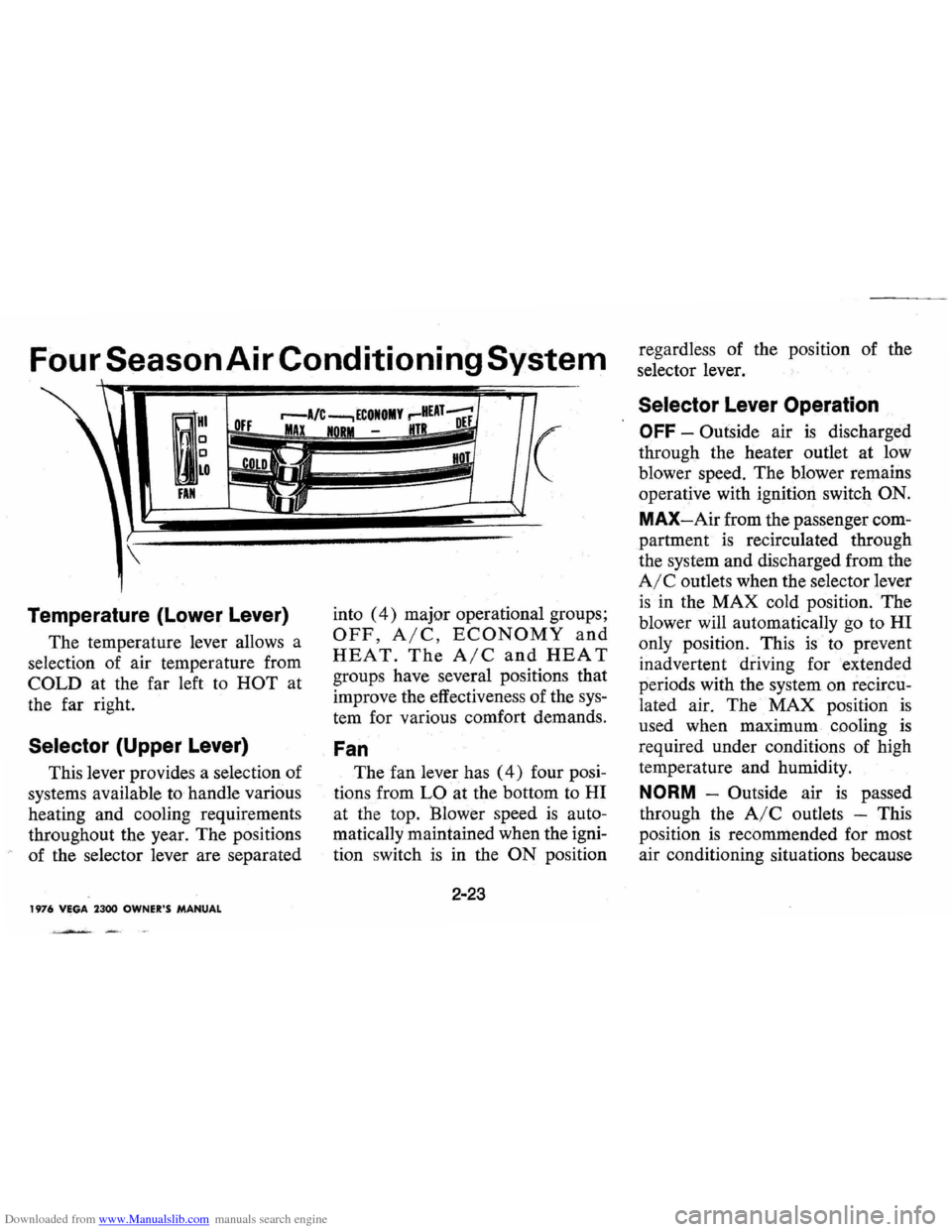
Temperature (Lower Lever)
The temperature lever allows a
selection of air temperature from
COLD at the far left to HOT at
the far right.
Selector (Upper Lever)
This lever provides a selection of
systems available to handle various
heating and cooling requirements
throughout the year. The positions
of the selector lever are separated
1976 VEGA 2300 OWNER'S MANUAL
.. ~ -..-~.
into (4) major operational groups;
OFF, AIC, ECONOMY and
HEAT. The AIC and HEA T
groups have several positions that
improve the effectiveness of the
sys
tem for various comfort demands.
Fan
The fan lever has (4) four posi
tions from
LO at the bottom to HI
at the top. Blower speed is auto
matically maintained when the igni
tion switch
is in the ON position
2-23
regardless of the position of the
selector lever.
Selector Lever Operation
OFF -Outside air is discharged
through the heater outlet at low
blower speed. The blower remains
operative with ignition switch
ON.
MAX-Air from the passenger com
partment
is recirculated through
the system and discharged from the
AIC outlets when the selector lever
is in the MAX cold position. The
blower will automatically go to
HI
only position. This is' to prevent
inadvertent driving for extended
periods with the system on recircu
lated air. The MAX position
is
used when maximum cooling is
req uired under conditions of high
temperature and humidity.
NORM -Outside air is passed
through the
AIC outlets -This
position
is recommended for most
air conditioning situations because
Page 67 of 87
Downloaded from www.Manualslib.com manuals search engine protection at -20o
P (-28°C) or
below to ensure protection against
corrosion
and · loss of coolant
from boiling even though freezing
temperatures are not expected.
• Add ethylene glycol base coolant
that meets
GM Specification
1899-M when coolant additions
are required because of coolant
loss
or to provide additional pro
tection against freezing at tem
peratures lower than -20oP
(-28°C), and in Canada to
-35°P (-37°C).
NOTE: Alcohol or methanol base
coolants or plain water are not
recommended for your vehicle at
any time.
Your vehicle, if equipped with
standard 4-cylinder engine, has
an aluminum cylinder block.
When adding anti-freeze, rust
inhibitors, or cleaners, make
certain they are safe for
use
with aluminum components.
Radiator Pressure Cap
The radiator cap, a 15 lb. pres
sure type, must be installed tightly,
otherwise coolant may be lost and
damage
t6 engine may result from
overheating. Radiator pressure caps
should be checked periodically for
proper operation.
If replacement is
required specify AC.
Thermostat
The cooling system is protected
and controlled by a thermostat that
maintains a satisfactory engine
operating temperature. This
ther
mostat is installed in the engine
coolant outlet and
is designed for
continuous use through both winter
and summer. When replacement
is
necessary, Delco parts are recom
mended.
5-9
CHASSIS ITEMS
Rear Axle Lubricant
Standard -Every 6 months or
7,500 miles, whichever occurs first,
check lubricant level and add
lubri
cant, if necessary, to fill to level of
filler plug hole.
Use SAE 80W or
SAE80W-90GL-5 Gear Lubricant.
cant.
(Por vehicles operated in
Canada, use
SAE 80W Gear Lubri
cant.)
Positraction -Drain aJ,ld refill
after the first 15,000 miles then
maintain same
as standard axle but
use only the special positraction lu
bricant available from your Chev
rolet Dealer, part number 1051022.