1976 CHEVROLET VEGA check engine
[x] Cancel search: check enginePage 35 of 87
Downloaded from www.Manualslib.com manuals search engine Fill the washer jar only % full
during the winter to allow for ex
pansion if the temperature should
fall low enough to freeze the
solution.
• Check washer fluid level regu
larly-do it frequently when the
weather
is bad.
• Use fluid such as GM OPTI
KLEEN to prevent freezing
damage, and to provide better
cleaning.
II
WASHER WIPER
• Do not use radiator anti-freeze
in windshield washer; it could
cause paint damage.
• In cold weather, warm the wind
shield with defrosters before us
ing
washer-to help prevent icing
that may seriously obscure vision.
Air Vents
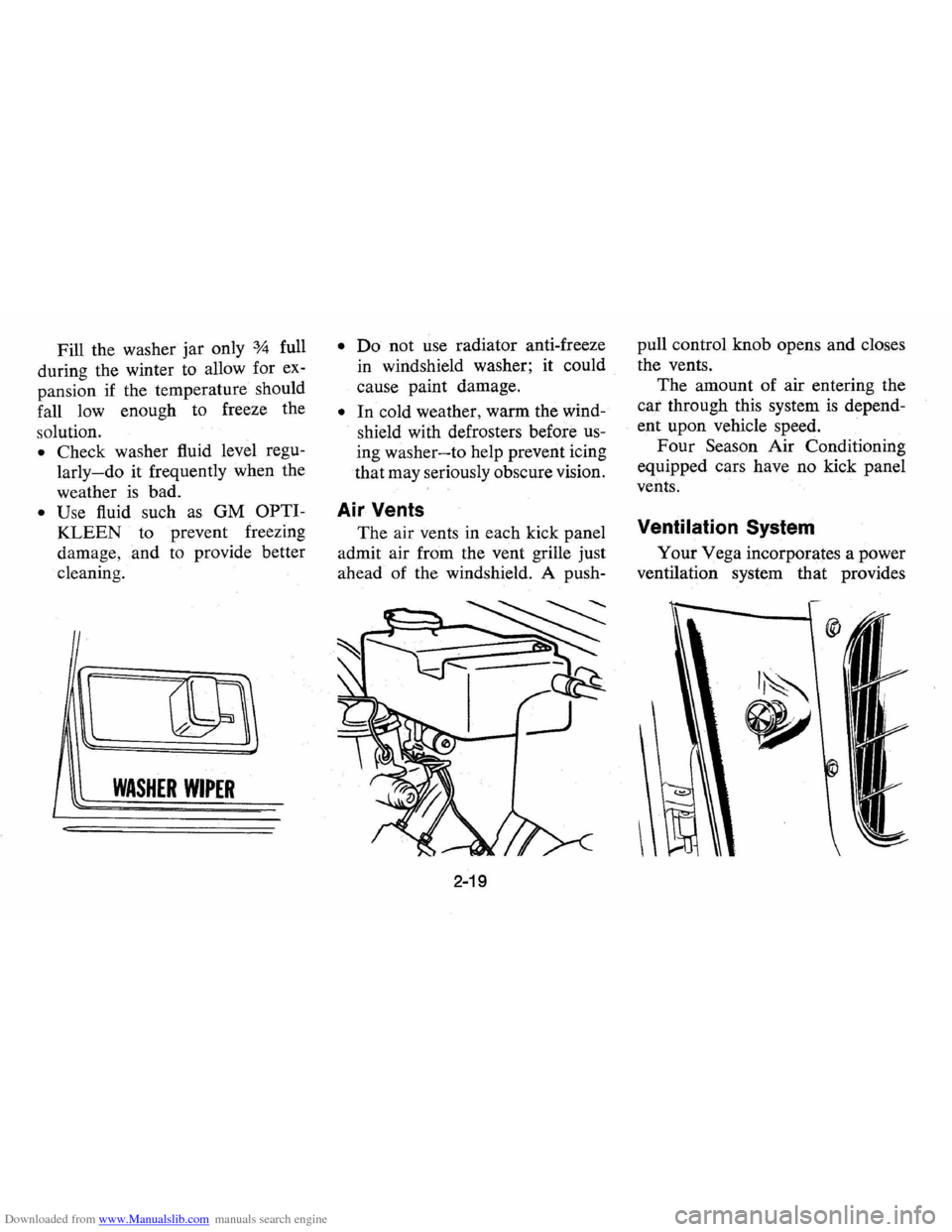
The air vents in each kick panel
admit air from the vent grille just
ahead of the windshield. A push-
2-19
pull control knob opens and closes
the vents.
The amount of air entering the
cat through this system is depend
ent upon vehicle speed.
Four Season Air Conditioning
equipped cars have no kick panel
vents.
Ventilation System
Your Vega incorporates a power
ventilation system that provides
Page 47 of 87
Downloaded from www.Manualslib.com manuals search engine 35 mph, for distances up to 50
miles, provided the driveline, axle,
transmission, and steering system
are otherwise normally operable.
Use only towing equipment specifi
cally designed for
this purpose
following the instructions of the
towing equipment manufacturer.
A separate safety chain system
must
be used for such towing and
steering must be unlocked, trans
mission in neutral and the parking
brake released. Attachments must
be made to main structural mem
bers of the car. Do not attach to
bumpers or associated brackets.
Remember that power brake and
power steering assist will not be
available when engine
is inopera
tive.
Recreational Towing
Vega models with a manual 3-
or 4-speed transmission may be
towed (with propshaft installed) be-hind
another vehicle
as a "dinghy"
at freeway speeds if additional SAE
80
or SAE 90 Gear Lubricant is
added to the transmission. This can
be accomplished · by removing the
filler plug and installing a
900-;.2
inch pipe street elbow fitting and
adding one quart
(2 lbs.) of SAE
80
or 90 Gear Lubricant. Use the
filler plug to cap the elbow fitting.
The additional lubricant will have
no adverse affect to the transmis
sion during normal use of the
ve
hicle and may be left in the trans
mission.
EMERGENCY STARTING
A car with a discharged battery
may
be started by using energy
3-2
from a battery in another car
called "jump starting".
NOTICE: Do not push or tow this
vehicle
to start. Damage to the cata
lytic converter and/or to other parts
of the vehicle may result.
Jump Starting
Jump starting may be dangerous
and should
be attempted only if, the
following three conditions are met.
If they are not,we strongly recom
mend that you leave the starting to
a competent mechanic.
• The battery in the OTHER vehi
cle must
be 12 volt and nega
tively grounded,
like the one in
THIS car. (Check the other car's
owner's manual to
see if it is.)
• The battery in THIS car must be
equipped with flame arrestor
vents (like the original-equip
ment Delco Freedom battery)
Page 50 of 87
Downloaded from www.Manualslib.com manuals search engine smooth motion.
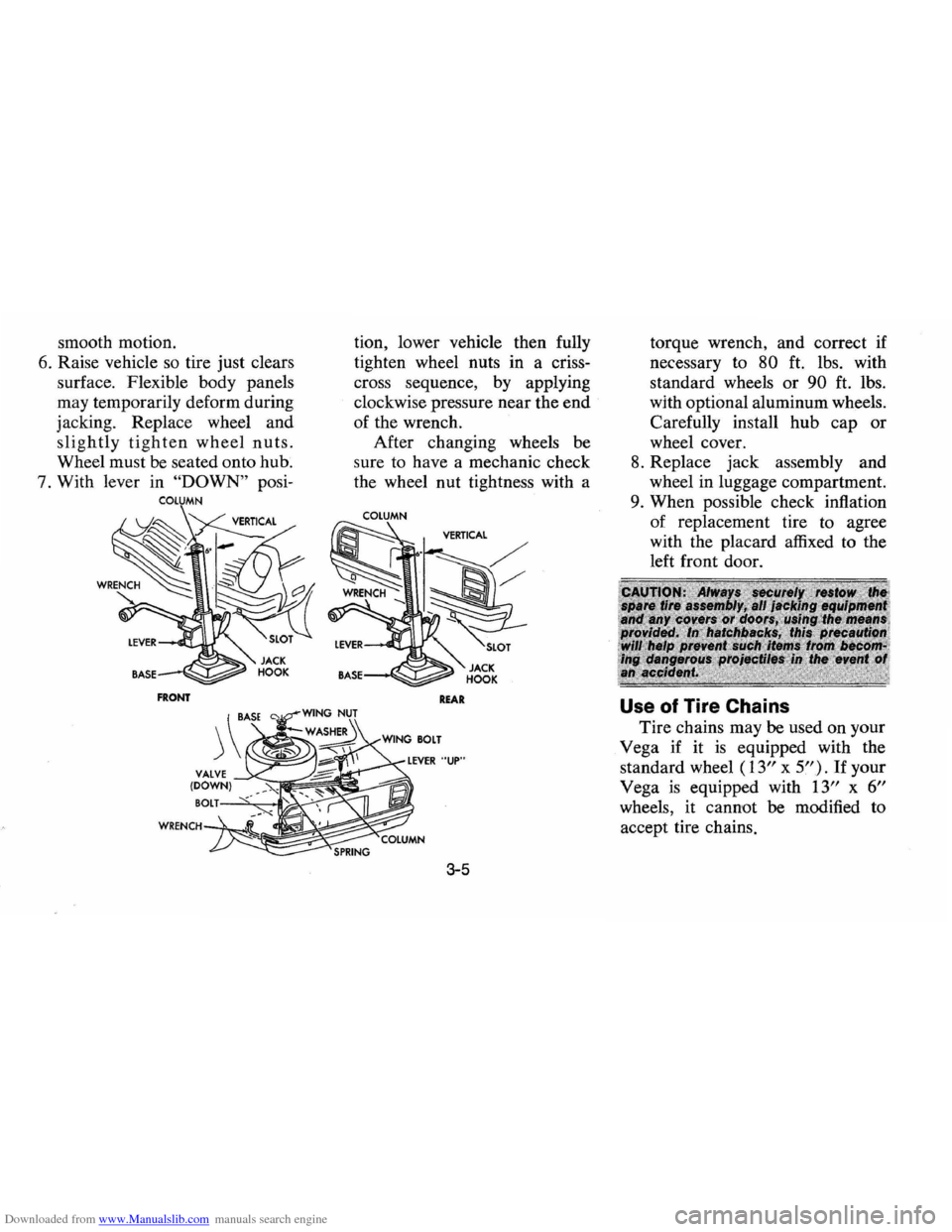
6. Raise vehicle so tire just clears
surface. Flexible body panels
may temporarily deform during
jacking. Replace wheel and
slightly tighten wheel nuts.
Wheel must be seated onto hub.
7. With lever in
"DOWN" posi
COLUMN
FRONT
tion, lower vehicle then fully
tighten wheel nuts in a criss
cross sequence, by applying
clockwise pressure near the
end
of the wrench.
After changing wheels
be
sure to have a mechanic check
the wheel nut tightness with a
COLUMN
REAR
3-5
torque wrench, and correct if
necessary to
80 ft. lbs. with
standard wheels
or 90 ft. lbs.
with optional aluminum wheels.
Carefully install
hub cap or
wheel cover.
8. Replace jack assembly and
wheel in luggage compartment.
9. When possible check inflation
of replacement tire to agree
with the placard affixed to the
left front door.
Use of Tire Chains
Tire chains may be used on your
Vega if it
is equipped with the
standard wheel
(13" x 5"). If your
Vega
is equipped with 13" x 6"
wheels, it cannot be modified to
accept tire chains.
Page 61 of 87
Downloaded from www.Manualslib.com manuals search engine A high quality SE oil was in
stalled in your engine at the factory.
It is not necessary to change this
factory-installed oil prior to the
recommended normal change pe
riod. However, check the oil level
more frequently during the break
in period since higher oil consump
tion
is normal until the piston rings
become seated.
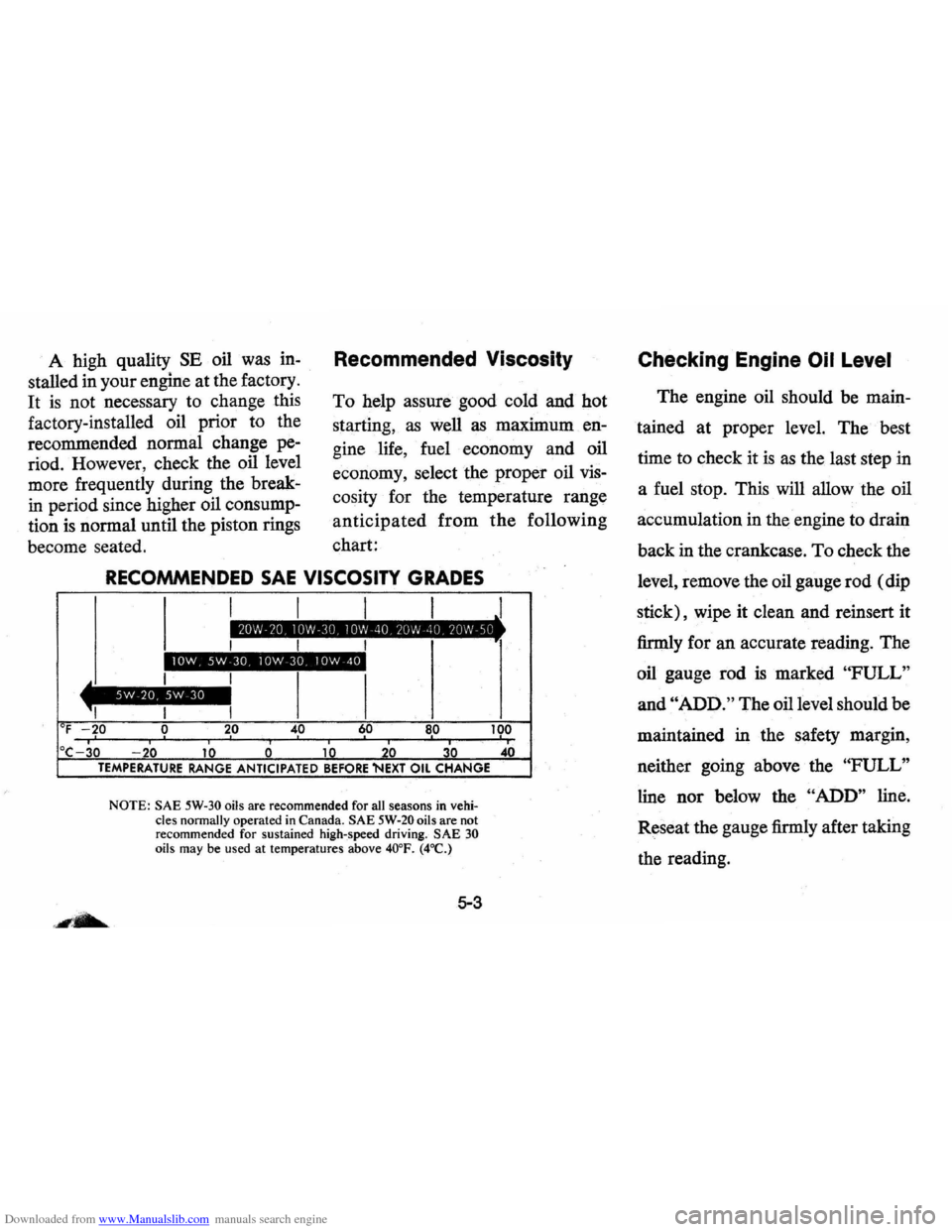
Recommended Viscosity
To help assure good cold and hot
starting, .
as well as maximum en
ginelife, fuel economy and oil
economy, select the proper oil
vis
cosity for the temperature rang¥
anticipated from the following
chart:
RECOMMENDED SAE VISCOSITY GRADES
I I I I 20N 20 lOW-3~ 10N')0 2UN ·;0 20,V sc
lOW 5w 30 lOW 30 lOW 40
TEMPERATURE RANGE ANTICIPATED BEFORE 'NEXT OIL CHANGE
NOTE : SAE 5W-30 oils are recommended for all Seasons in vehicles normally operated in Canada. SAE 5W-20 oils are not
recommended for sustained high-speed driving. SAE 30 oils may be used at temperatures above 40°F. (4°C.)
5-3
100 , i 40
Checking Engine Oil Level
The engine oil should be main
tained at proper level. The best
time to check it
is as the last step in
a fuel stop. This will allow the oil
accumulation in the engine to drain
back in the crankcase. To check the
level, remove the oil gauge rod (dip
stick), wipe it clean and reinsert it
firmly for an accurate reading. The
oil gauge rod is marked "FULL"
and "ADD." The oil level should be
maintained in the safety margin,
neither going above the
"FULL"
line nor below the "ADD" line.
Reseat the gauge firmly after taking
the reading.
Page 62 of 87
Downloaded from www.Manualslib.com manuals search engine Supplemental Engine Oil
Additives
The regular use of supplemental
additives
is specifically not recom
mended and will increase operat
ing costs. However, supplemental
additives are available that can
ef
fectively and economically solve
certain specific problems without
causing other difficulties.
For ex
ample, if higher detergency is re
quired to reduce varnish and sludge
deposits resulting from some un
usual operational difficulty, a thor
oughly tested and approved addi
tive-"G.M. Super Engine Oil Sup
plement" -is available at your Chev
rolet dealer.
In the event of an
operational problem, consult your
dealer for advice before using sup
plemental additives.
Air Cleaner
When replacement of Air Cleaner
filter element
is necessary, an AC
ACron air filter element
is recom
mended.
Drive Belts
Every 12 months or 15,000
miles-inspect drive belts for wear,
fraying, cracking, and tension. Belts
which are in
pOQr condition should
be replaced immediately.
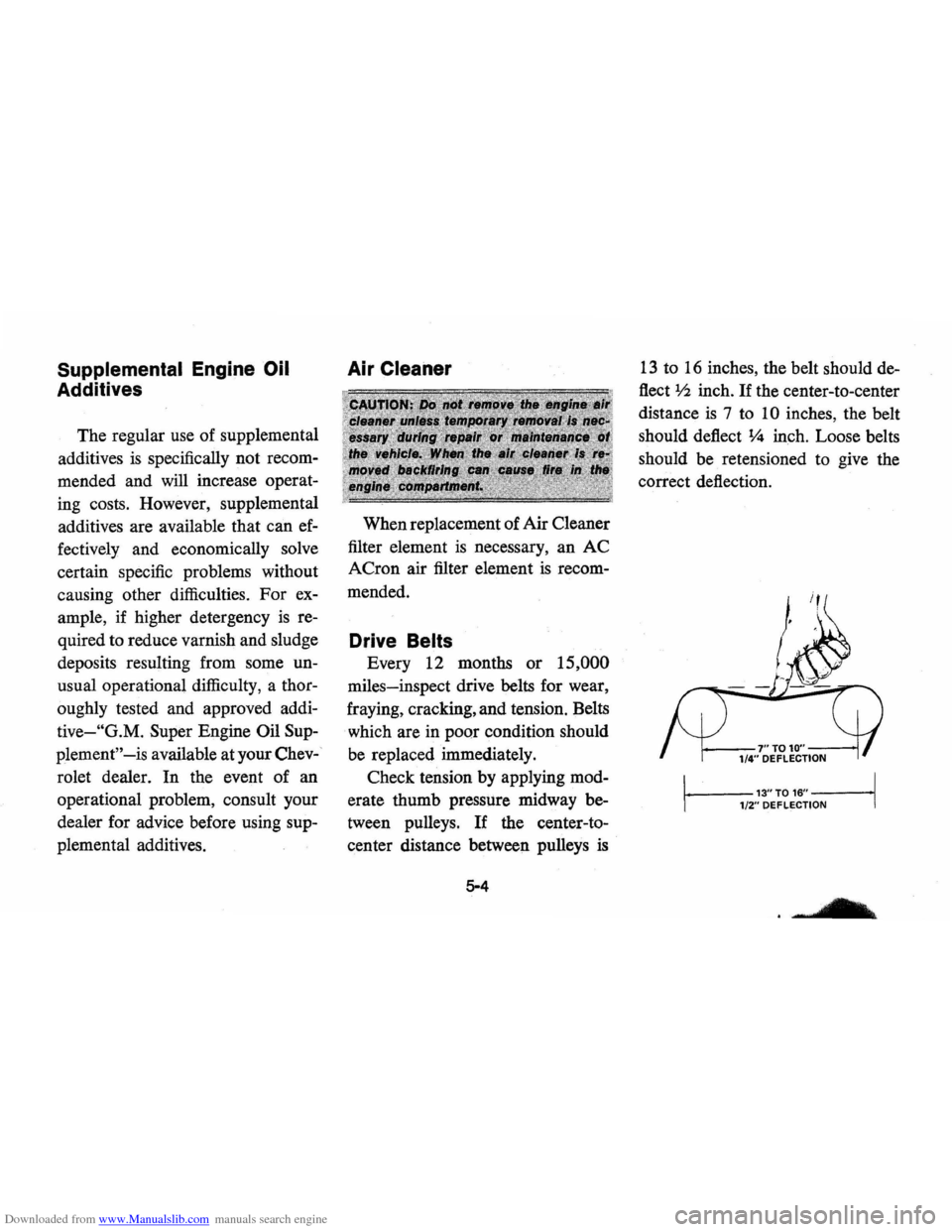
Check tension by applying mod
erate thumb pressUre midway be
tween pulleys.
If the center-to
center distance between pulleys
is
5-4
13 to 16 inches, the belt should de
flect
'h inch. If the center-to-center
distance
is 7 to 10 inches, the belt
should deflect
~ inch. Loose belts
should be retensioned to give the
correct deflection.
1----7'· TO 10" --~ 1/4" DEFLECTION
I· 13" TO 16" I ~"DEFLECTI~
Page 63 of 87
Downloaded from www.Manualslib.com manuals search engine TRANSMISSION ITEMS
Automatic Traiismission
Fluid Level
Recommendations
Use automatic transmission
fluids identified with the mark
DEXRON®-II available from your
Chevrolet dealer or local service
station.
Check the fluid level at each en
gine oil change period.
Automatic transmissions are fre
quently overfilled because the fluid
level
is checked when the fluid is
cold and the dipsick indicates fluid
should
be added. However, the low
reading may be normal since the
fluid level will rise
as the fluid tem
perature increases. A level change
of over
% inch will occur as fluid
temperature rises from
60° F. to
180° F. (16° C. to 82° C.)
Overfilling can cause foaming
and loss of fluid through the vent.
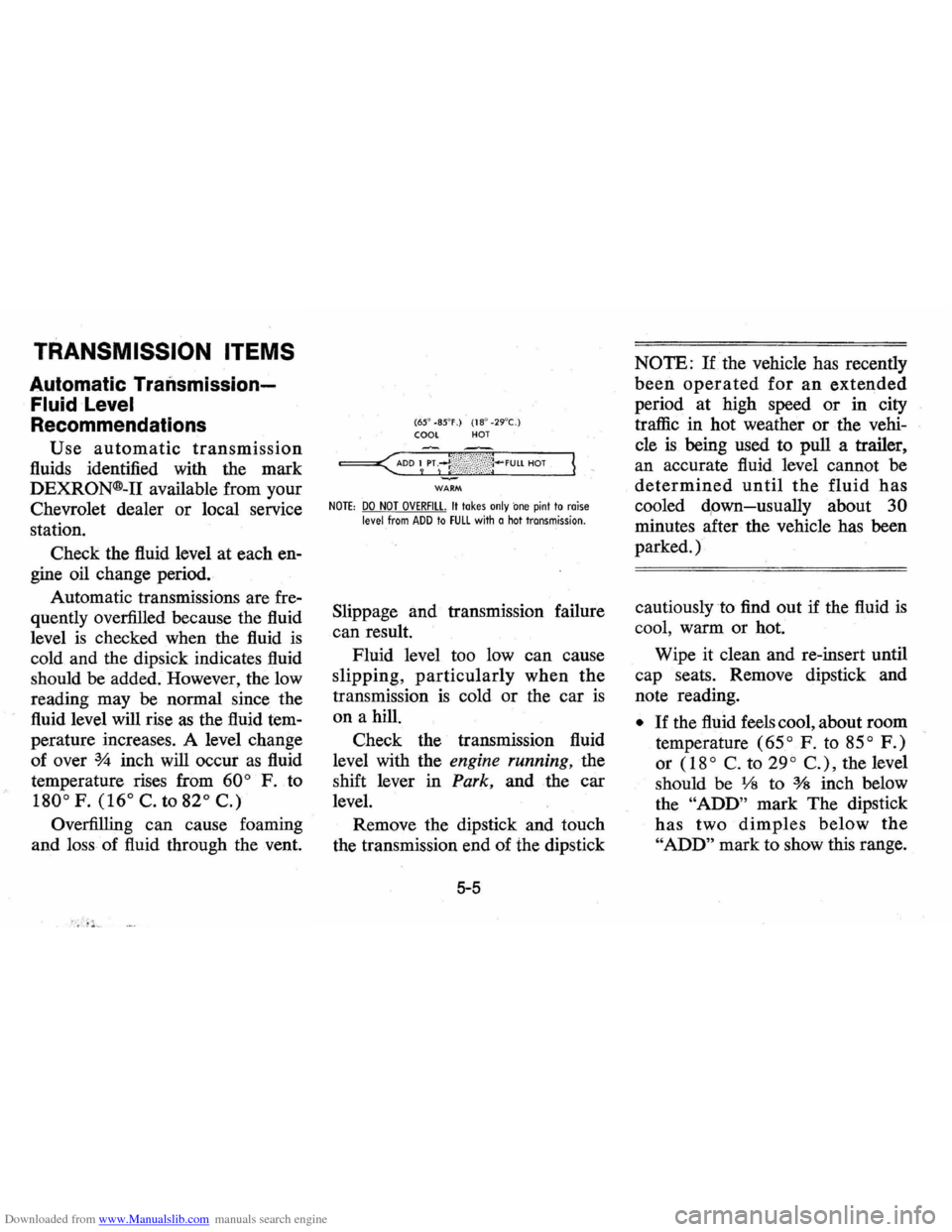
(65' -85'F .) (18 ' -29'C.) COOl HOT
WARM
NOTE: DO NOT OVERFill. It takes only 'one pint to raise level from ADD to FUll with a hot transmission.
Slippage and transmission failure
can result.
Fluid level too low can cause
slipping,
particularly when the
transmission is cold or the car is
on a hill.
Check the transmission fluid
level with the
engine running, the
shift lever in
Park, and the car
level.
Remove the dipstick and touch
the transmission end of the dipstick
NOTE: If the vehicle has recently
been operated for an extended
period at high speed or in city
traffic in hot weather
or the vehi
cle
is being used to pull a trailer,
an accurate fluid level cannot be
determined until the fluid has
cooled dpwn-usually about 30
minutes after the vehicle has been
parked.)
cautiously to find out if the fluid
is
cool, warm or hot.
Wipe it clean and re-insert until
cap seats. Remove dipstick and
note reading.
• If the fluid feels cool, about room
temperature
(65° F. to 85° F.)
or (18° C. to 29° C.), the level
should be
Vs to % inch below
the
"ADD" mark The dipstick
has two dimples below the
"ADD" mark to show this range.
Page 64 of 87
Downloaded from www.Manualslib.com manuals search engine • If it feels warm, the level should
be close to the
"ADD" mark
( either slightly above
or beloW).
• If it feels hot (cannot be held
comfortably) the level should
be
between the "ADD" and
"FULL" marks.
NOTE: DO NOT OVERFILL. It
takes only one pint to raise level
from
ADD to FULL with a hot
transmission.
Automatic Transmission
Drain
Intervals
The transmission operating tem
perature resulting from the type of
driving conditions under which
your vehicle
is used is the main
consideration in establishing the
proper frequency of transmission
fluid changes.
If you do not use your vehicle
under severe conditions, change the
fluid and filter every
60,000 miles.
Refer to section 6,
"Specifications",
for required fluid quantities.
If the vehicle is usually driven
under one
or more of the follow
ing conditions-considered severe
transmission
service-change the
transmission fluid and filter every
15,000 miles.
• In heavy city traffic.
• Where the outside temperature
regularly reaches
90° F. (32°
C.) for extended periods.
• In very hilly or mountainous
areas.
• Frequent trailer pUlling.
• Commercial uses, such as taxi,
police
car or delivery service.
Manual Transmissions
Lubricant
Level
Every 6 months or 7,500 miles,
whichever occurs first, check lubri
cant level and add lubricant, if nec
essary, to
fill to . level of filler plug
hole.
5-6
• 3-Speed and 4-Speed-Use SAE
80W or SAE 80W-90 GL-5
Gear Lubricant. (For those
vehicles normally operated in
Canada, use
SAE 80W GL5
Gear Lubricant. )
Transmission Shift Linkage
(Manual and Automatic)
Every 7,500 miles or 6 months
lubricate shift linkage and
on
manual transmission floor controls
lever contacting faces with water
resistant
EP chassis lubricant which
meets
GM specification 6031 M.
Clutch Cross -Shaft -Every
30,000 miles or sooner if necessary
-Remove the plug, install a lubri
cation fitting and lubricate with
water resistant
EP Chassis Lubri
cant which meets GM Specification
6031M.
Page 65 of 87
Downloaded from www.Manualslib.com manuals search engine ENGINE COOLING
SYSTEM
The recovery type cooling sys
tem 'is standard on all Chevrolet
passenger cars. The coolant ex
pands with rising temperature and
the overflow
is collected in the
recovery tank. When the system
temperature drops, the coolant
is
drawn back into the radiator. The
cooling system has been filled at
the factory with a high -quality, in
hibited ,
year-around coolant that
meets the standards of General
Motor s Specification 1899-M. This
coolant solution provides freezing
protection to
-20oP (- 28 °C),
and in Canada to -35°P
(-37°C), and it has been formu
lated to be used without replace
ment for two years
or 30,000 miles.
After two years or
30,000 miles,
the coolant should be drained to
prevent rust
or corrosion in the
radiator and engine.
Cooling System Care
Do not remove radiator cap to
check coolant level, but check visu
ally in the
"see thru" coolant re
covery tank at
least as frequently
as needed. Level should be at the
"full cold" mark on the recovery
tank when the system
is cold and
at the
"full hot" mark at normal
operating temperature.
Add a 50/
50
mixture of high-quality ethylene
glycol antifreeze and water for
coolant additions.
If frequent addi
tions are required, see
your' dealer
for a cooling system check.
NOTE: If recommended quality
antifreeze
is used, supplemental in
hibitors or additives claiming to
provide increased capability are not
necessary. They may be detrimen
tal to the efficient operation of the
system, and represent an unneces
sary operating expense.
5-7
The cooling system should be
serviced every year as follows:
1. Wash radiator cap and filler neck
with clean water.
2. Check coolant for proper level
and freeze protection.
3 . Test system and radiator cap for
proper pressure holding capacity
(15 psi). If required, use cap
designed by
AC for coolant re
covery systems, and specified for
your model.
4. Tighten hose clamps and inspect
all hoses. Replace hoses if swol
len, checked or otherwise deteri
orated.
5 . Clean frontal area of radiator
core and air conditioning con
denser.