1976 CHEVROLET VEGA check engine
[x] Cancel search: check enginePage 67 of 87
Downloaded from www.Manualslib.com manuals search engine protection at -20o
P (-28°C) or
below to ensure protection against
corrosion
and · loss of coolant
from boiling even though freezing
temperatures are not expected.
• Add ethylene glycol base coolant
that meets
GM Specification
1899-M when coolant additions
are required because of coolant
loss
or to provide additional pro
tection against freezing at tem
peratures lower than -20oP
(-28°C), and in Canada to
-35°P (-37°C).
NOTE: Alcohol or methanol base
coolants or plain water are not
recommended for your vehicle at
any time.
Your vehicle, if equipped with
standard 4-cylinder engine, has
an aluminum cylinder block.
When adding anti-freeze, rust
inhibitors, or cleaners, make
certain they are safe for
use
with aluminum components.
Radiator Pressure Cap
The radiator cap, a 15 lb. pres
sure type, must be installed tightly,
otherwise coolant may be lost and
damage
t6 engine may result from
overheating. Radiator pressure caps
should be checked periodically for
proper operation.
If replacement is
required specify AC.
Thermostat
The cooling system is protected
and controlled by a thermostat that
maintains a satisfactory engine
operating temperature. This
ther
mostat is installed in the engine
coolant outlet and
is designed for
continuous use through both winter
and summer. When replacement
is
necessary, Delco parts are recom
mended.
5-9
CHASSIS ITEMS
Rear Axle Lubricant
Standard -Every 6 months or
7,500 miles, whichever occurs first,
check lubricant level and add
lubri
cant, if necessary, to fill to level of
filler plug hole.
Use SAE 80W or
SAE80W-90GL-5 Gear Lubricant.
cant.
(Por vehicles operated in
Canada, use
SAE 80W Gear Lubri
cant.)
Positraction -Drain aJ,ld refill
after the first 15,000 miles then
maintain same
as standard axle but
use only the special positraction lu
bricant available from your Chev
rolet Dealer, part number 1051022.
Page 68 of 87
Downloaded from www.Manualslib.com manuals search engine Front Suspension
Every 6 months or 7,500 miles
Lubricate fittings with water
re
sistant EP Chassis Lubricant which
meets GM Specification
6031M.
NOTE:
Ball joints should not be
lubricated unless their temperature
is +10°F (-12°C), or higher.
During cold weather, they should
be allowed to warm up as necessary
before being lubricated.
Steering Linkage
Every 6 months or 7,500 miles,
lubricate fittings with water resist
ant
EP Chassis Lubricant which
meets GM Specification
6031M.
Power Steering System
Check the fluid level in the pump
reservoir at each oil change period.
Add GM Power Steering Fluid
(or Automatic Transmission Fluid
DEXRON®-II) as necessary to bring
level into proper range
on
filler cap indicator depending upon
fluid temperature.
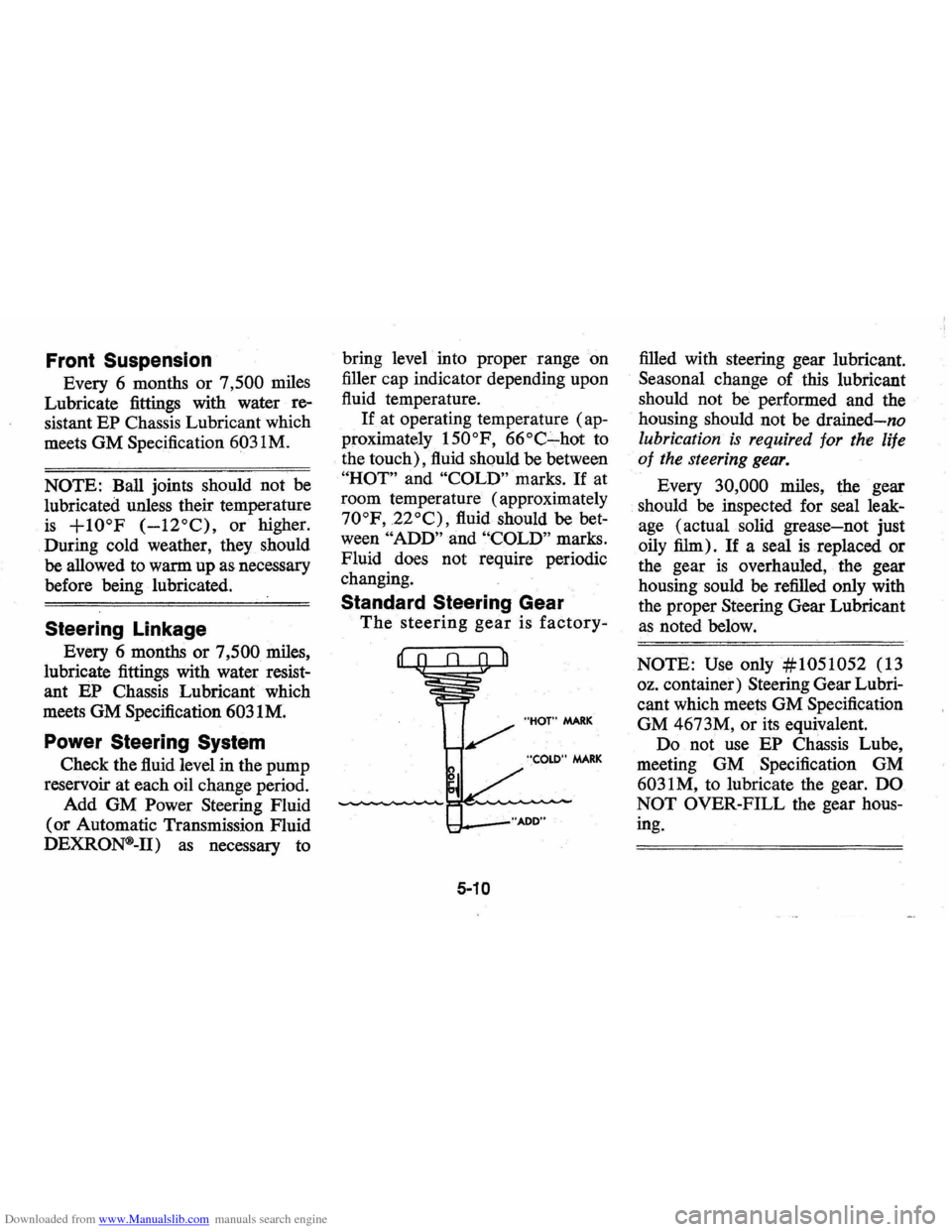
If at operating temperature (ap
proximately 150°F, 66°C-hot to
the touch), fluid should be between
"HOT" and "COLD" marks. If at
room temperature (approximately
70°F, 22°C), fluid should be bet
ween "ADD" and "COLD" marks.
Fluid does not require periodic
changing.
Standard Steering Gear
The steering gear is factory-
l-t.. __ "AOO"
5-10
filled with steering gear lubricant.
Seasonal change of this lubricant
should not be performed and the
housing should not be
drained-no
lubrication is required for the life
of the steering gear.
Every 30,000 miles, the gear
should be inspected for seal leak
age (actual solid grease-not just
oily film).
If a seal is replaced or
the gear
is overhauled, the gear
housing sould be refilled only with
the proper Steering Gear Lubricant
as noted below.
NOTE: Use only #1051052 (13
oz. container) Steering Gear
Lubri
cant which meets GM Specification
GM 4673M, or its equivalent.
Do not use
EP Chassis Lube,
meeting GM Specification GM
6031M, to lubricate the gear. DO
NOT
OVER-FILL the gear hous
ing.
Page 69 of 87
Downloaded from www.Manualslib.com manuals search engine Front Wheel Bearings
Every 30,000 miles-clean and
repack with a high melting point
wheel bearing lubricant.
Use wheel
bearing lubricant GM
Part No.
1051344 or equivalent. This
is a
premium high melting point lubri
cant. When replacement
is neces
sary specify Delco parts.
Brakes
Brake linings should be periodi
cally inspected for wear by a quali
fied technician. The frequency of
this inspection depends upon driv
ing conditions such
as traffic or
terrain, and also· the driving tech
niques of individual owners. Your
Chevrolet Dealer
is best qualified
to advise you as to how often this
inspection should be performed.
When replacement
is required,
specify GM and Delco parts.
REMINDER: The front disc
brakes have a built-in wear indica
tor that
is designed to make a high
frequency, squealing or cricket-like
warning sound when the linings are
worn to where replacement
is re
quired. The sound will occur inter
mittently or continuously when
wheels are rolling, but will dis
appear when the brake pedal
is
firmly applied. Also see the brake
checks listed in the Maintenance
Schedule folder.
5-11
Master Cylinder-Every 6 months
or
7,500 miles -Check fluid level
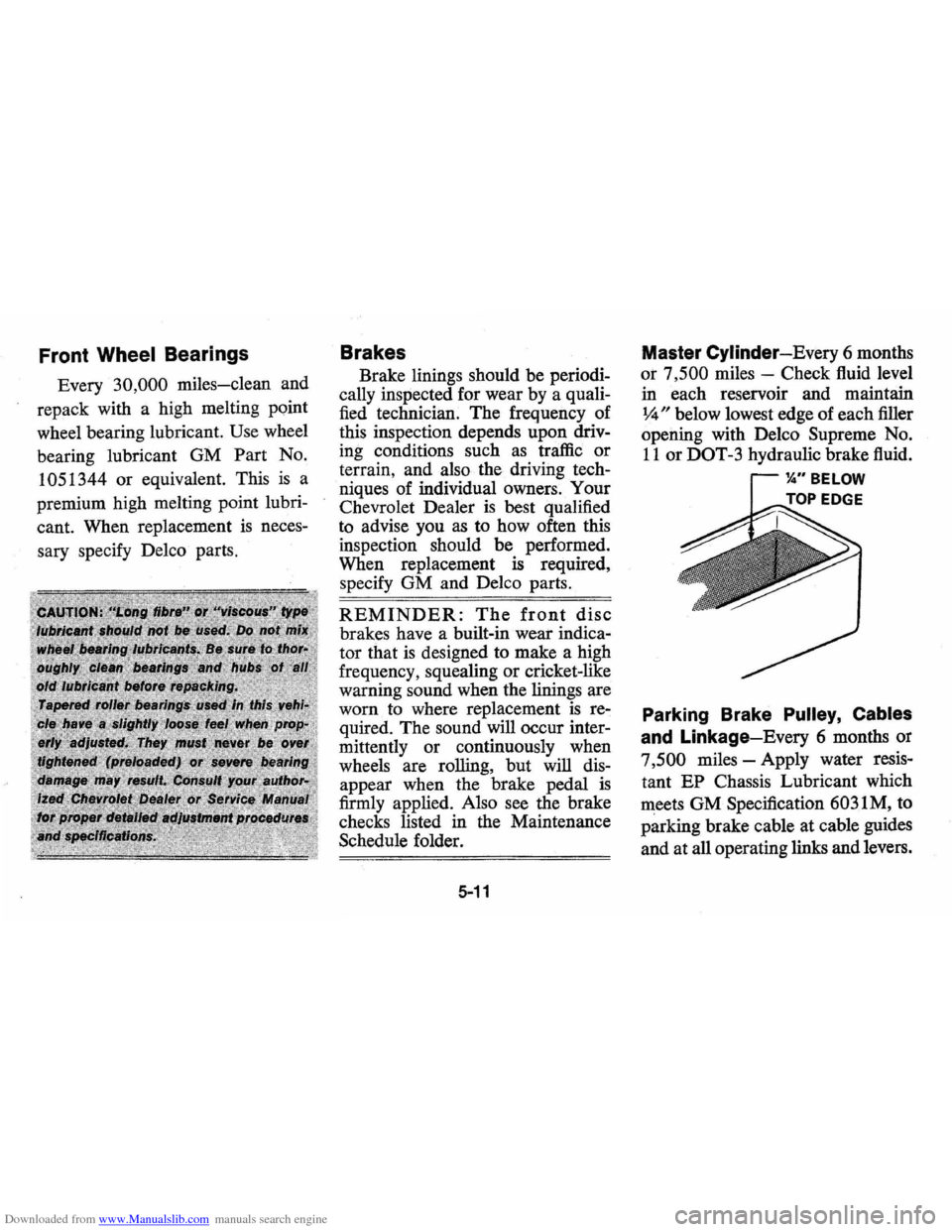
in each reservoir and maintain
~ /I below lowest edge of e.ach filler
opening with Delco
Supreme No.
11 or DOT -3 hydraulic brake fluid.
~" BELOW
TOP EDGE
Parking Brake Pulley, Cables
and Linkage-Every 6 months or
7
,500 miles -Apply water resis
tant EP Chassis Lubricant which
meets GM Specification
6031M, to
parking brake cable at cable guides
and at all operating links and levers.
Page 70 of 87
Downloaded from www.Manualslib.com manuals search engine Hood Latche$
Every 6 months or 7,500 miles,
whichever occurs first, lubricate
hood latch assembly and hood
hinge assembly
as follows:
1. Wipe off any accumulation of
dirt or contamination on latch
parts.
2 . Apply Lubriplate or equivalent
to latch pilot bolts and latch
locking plate.
.
3. Apply light engine oil to all pivot
points in release mechanism,
as
well as primary and secondary
latch mechanisms.
4. Lubricate hood hinges.
5. Make hood hinge and latch
mechanism functional check
to
assure the assembly is working
correctly .
Accelerator Linkage
Lubricate with engine oil every
15,000 miles.
Hinges
The following points should be
checked and lubricated every 6
months or
7,500 miles, whichever
occurs first:
hingeS on all doors,
fuel filler door, trunk lid, door lock
striker and door
jamb switches. '
5-12
Air Conditioning
Have your Authorized Dealer
check your Air Conditioning
sys
tem at some time during the winter
months to be sure there has been
no loss in cooling output. During
the summer , see your Authorized
Dealer immediately if you suspect
the system
is not performing as it
should.
NOTE: Your car's air condition
ing system will not operate below
ambient temperature of
300 F
( -1 0 C) , regardless of control
position.
Page 73 of 87
Downloaded from www.Manualslib.com manuals search engine comfort, the reduced tire pressures
listed on the placard may
be used
when reduced loads of 5 occupants
or less are carried. Improper tire
inflation pressures can adversely
affect tire life and vehicle perform
ance. Too
Iowan air pressure results
in increased tire flexing and heat
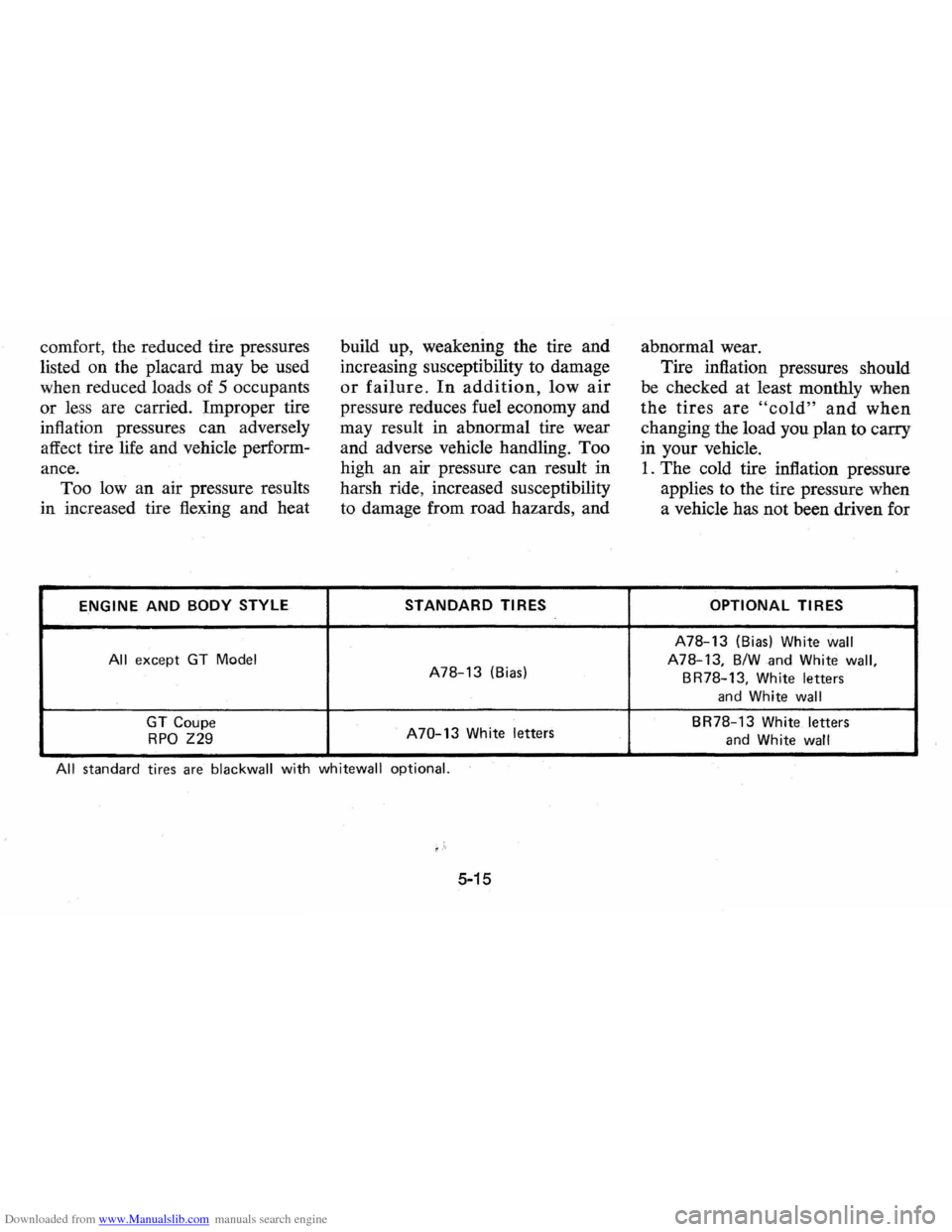
ENGINE AND BODY STYLE
All except GT Model
GT Coupe
RPO Z29
build up, weakening the tire and
increasing susceptibility to damage
or failure. In addition, low air
pressure reduces fuel economy and
may result in abnormal tire wear
and adverse vehicle handling. Too
high an air pressure can result in
harsh ride, increased susceptibility
to damage from road hazards, and
STANDARD TIRES
A78-13 (Bias)
A70-13 White letters
All standard tires are blackwall with whitewall optional.
f'"
5-15
abnormal wear.
Tire inflation pressures should
be checked at least monthly when
the tires are "cold" and when
changing the load you plan to carry
in your vehicle.
1. The cold tire inflation pressure
applies to the tire pressure when
a vehicle has not been driven for
OPTIONAL TIRES
A78-13 (Bias) White wall
A78-13, B/W and White wall,
BR78-13, White letters
and White wall
BR78-13 White letters
and White wall
Page 74 of 87
Downloaded from www.Manualslib.com manuals search engine for 3 hours or more, or driven
less than 1 mile.
2 .
It is normal for tire pressures to
increase 4-8
PSI when the tires
become hot from driving. Do not
"bleed" (reduce tire inflation
pressures) after driving your
vehicle. Bleeding serves to in
crease tire flexing and heat build
up which can result in tire dam
age and failure.
3. For sustained driving at turn
pike speeds, cold inflation
pressures should be increased 4
PSI above the recommended
cold inflation pressures on the
tire placard up to a maximum of
32
PSI for load range Btires, 36
PSI for load range C, and 40 PSI
for load range D. Sustained
speeds above 75 mph are not
recommended when the 4
PSI
adjustment would require pres
sures greater than the maximum
pressures above.
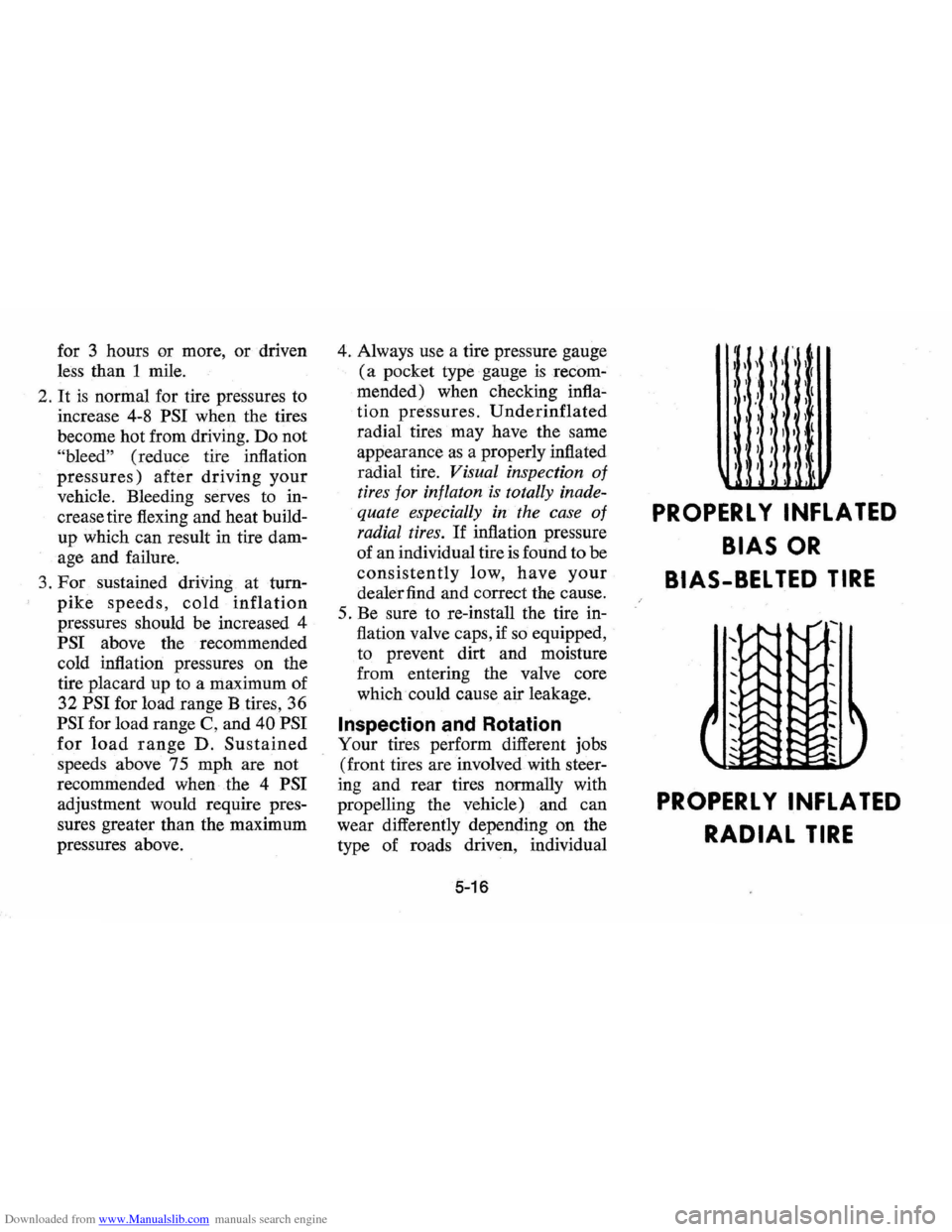
4. Always use a tire pressure gauge
(a pocket type gauge is recom
mended) when checking
infla~
tion pressures. Underinflated
radial tires may have the same
appearance
as a properly inflated
radial tire.
Visual inspection of
tires for inflaton is totally inade
quate especially in the case
of
radial tires. If inflation pressure
of an individual tire
is found to be
consistently low, have your
dealer find and correct the cause.
5. Be sure to re-install the tire in
flation valve caps, if
so equipped,
to prevent dirt and moisture
from entering the valve core
which could cause air leakage.
Inspection and Rotation
Your tires perform different jobs
(front tires are involved with steer
ing and rear tires normally with
propelling the vehicle) and can
wear differently depending on the
type of roads driven, individual
5-16
1\ II(
" I I ,t " I' ,I
I' I I j , I I I
I I , I I I I
I I I I I I
I 1
PROPERL Y INFLATED
BIAS OR
BIAS-BEL TED TIRE
PROPERL Y INFLATED
RADIAL TIRE
Page 80 of 87
Downloaded from www.Manualslib.com manuals search engine Air Cleaner
Your car receives its power from
a mixture of gasoline and air. The
air
is taken in to the system through
the air cleaner
so it's important to
replace the air cleaner at required
intervals. A dirty air cleaner re
duces engine efficiency.
Properly Tuned Engine
Overall tuning (a check on tim
ing, spark plugs, emission control
devices, etc.) can improve your
car's gas mileage. You just can't
expect an
"out-of-tune" engine to
give you good gas mileage and
cleaner air.
Excess Weight
Fuel economy is related to the
work the engine must do. The
heavier the load, the more power it
takes. Keep excess weight to a
minimum by removing any per
sonal effects or luggage from the
car or trunk when they are not
needed.
Tire Inflation
Underinfiation not only causes
needless wear of the tires, but can
also waste gasoline. It's a good
idea to check tire pressures
regularly.
Wheel Alignment
Incorrect "toe in" or "toe out" can
have the effect
of dragging your
front tires sideways and may cause
premature tire wear.
It takes power
to carry this extra load and that
takes gas from your tank.
Catalytic Converter
The catalytic converter IS an
emission control device added to
5-22
the exhaust system to reduce hy
drocarbon and carbon monoxide
pollutants from the exhaust gas
stream.
The converter contains
beads which are coated with a cata
lytic material containing platinum
and palladium.
Use of the catalytic converter
has the advantage of allowing the
engine to be re-tuned for improved
fuel economy and driveability.
The catalytic converter requires
the use
of unleaded fuel only.
Unleaded gasoline is used to re
duce combustion chamber deposits,
corrosion and
to prevent lead con
tamination of the catalyst that
would render it ineffective.
The use
of leaded fuel will cause the cata
lytic converter to
become ineffec
tive as an emission control device.
Page 85 of 87
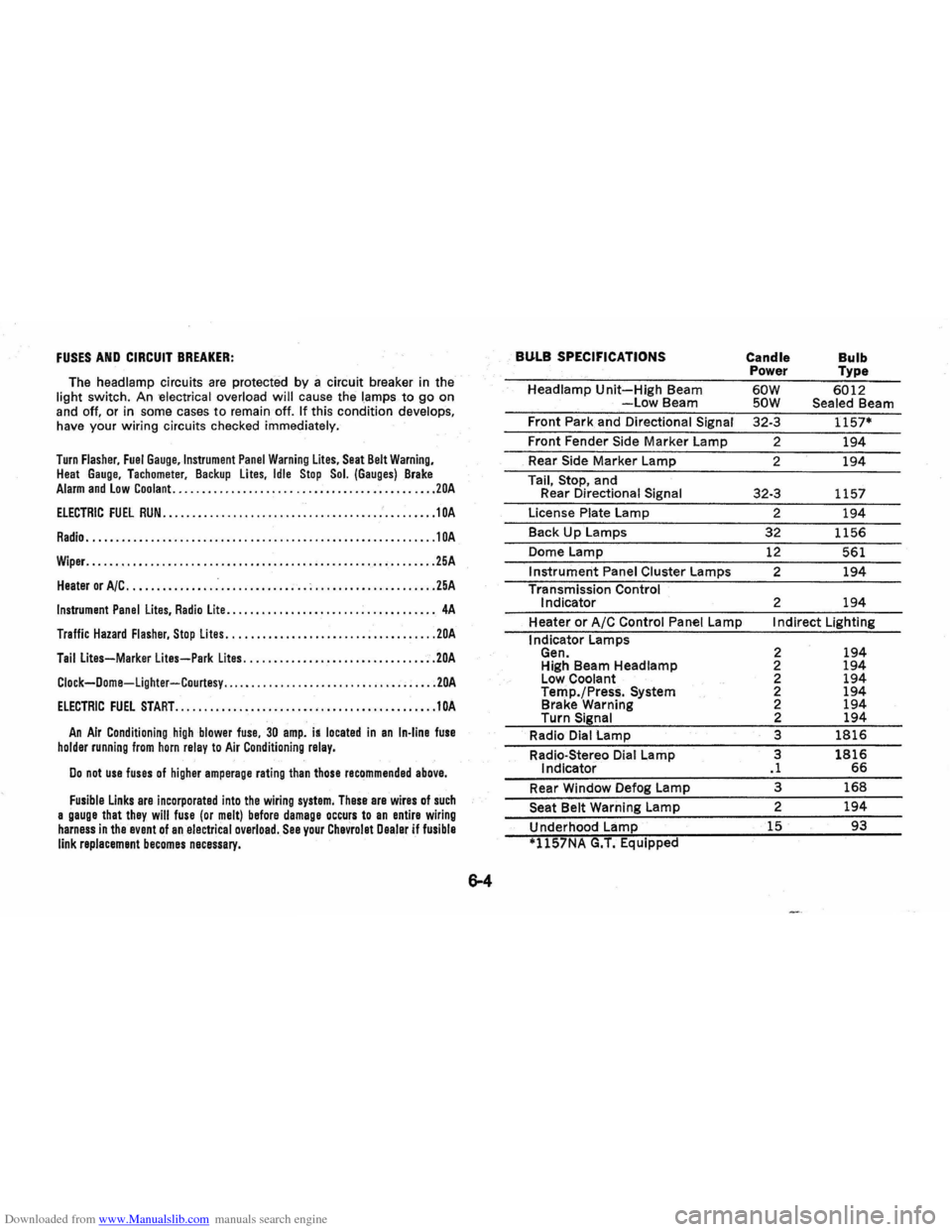
Downloaded from www.Manualslib.com manuals search engine FUSES AND CIRCUIT BREAKER:
The headlamp circuits are protected by a circuit breaker in the
light switch . An -electrical overload will cause the lamps to go on
and off. or in some cases to remain off. If this condition develops,
have your wiring circuits checked immediately.
Turn Flasher, Fuel Gauge,lnstrument Panel Warning Lites, Seat Belt Warning, Heat Gauge. Tachometer. Backup lites, Idle Stop Sol. (Gauges) Brake Alarm and Low Coolant. ............................................ 20A
ELECTRIC FUEL RUN ..................•........................•... 1 OA
Radio ............................................................ 10A
Wiper. ........................................................... 25A
Heater or A/C ............... .-............ ; .. ; ..................... 25A
Instrument Panel Lites, Radio Lite ...........•....... ................. 4A
Traffic Hazard Flasher, Stop Lites ...........•.•................•••... 20A
Tail Lites-Marker lites-Park Lites ...........•.............. .•..... 20A
Clock-Dome-Lighter-Courtesy ..... .......................... ; ..... 20A
ElECTRIC FUEL START ...•................•.•••.•......•.•.••...... 10A
An Air Conditioning high blower fuse, 30 amp. is located in an In-line fuse holder running from horn relay to Air Conditioning relay.
Do not use fuses of higher amperage rating than those recommended above.
Fusible Links are incorporated into the wiring system, These are wires of such a gauge that they will fuse (or melt) before damage occurs to an entire wiring harness in the event of an electrical overload. See your Chevrolet Dealer if fusible link replacement becomes necessary.
BULB SPECIFICATIONS
Headlamp Unit-High Beam -Low Beam
Front Park and Directional
Signal
Front Fender Side Marker Lamp
_ Rear Side Marker Lamp
Tail,
Stop, and
Rear Directional Signal
License Plate Lamp
Back
Up Lamps
Dome Lamp
Instrument Panel Cluster Lamps
Transmission Control
Indicator
Heater
or A/C Control Panel Lamp
I ndicator Lamps
Gen. High Beam Headlamp
Low Coolant
Temp./Press.
System Brake Warning
Turn Signal
Radio Dial Lamp
Radio-Stereo Dial Lamp
Indicator
Rear Window Defog Lamp
Seat Belt Warning Lamp
Underhood Lamp
*1l57NA G.T. Equipped
Candle
Bulb Power Type
60W 6012 SOW Sealed Beam
32-3
1157*
2 194
2 194
32-3 1157
2
194
32 1156
12 561
2
194
2 194
I ndirect Lighting
2
194 2 194 2 194 2 194 2 194 2 194
3 1816
3 1816 .1 66
3 168
2 194
15 93