Page 10 of 86
 an\
d hazard warning device (6),
the illumination of the following dashboard instruments is controlled by\
the exterior lighting")
With the exception of the warning lamps for engine oil pressure (2) an\
d hazard warning device (6),
the illumination of the following dashboard instruments is controlled by\
the exterior lighting switch.
These instruments do not function when the ignition is off, with the exc\
eption of the hazard warning
device (6).
1 - Speedometer: The red marks indicate maximum speed permitted in each gear.
2 - Engine oil pressure warning lamp (2 CV6 only): This lights up when the ignition is switched on
and goes out as soon as the engine is running. If it lights up when driv\
ing, stop the engine
immediately and top up the level of oil if necessary. If the lamp remain\
s alight despite the oil level
being correct, stop again and contact a Citroën dealer.
3 - Fuel gauge: Tank capacity: 4 1/2 Imp. Gal. (20 litres)
4 - Total mileage indicator
5 - Charge indicator: At normal engine running speed, the needle should remain in the white se\
ctor.
If the needle should remain in either of the red sectors, consult a Citr\
oën dealer. It is possible that,
when driving with the headlamps on, the needle may stay in the white cro\
ss-hatched zone - indication
that the battery is insufficiently charged. In normal circumstances, whe\
n driving, the generator should
charge the battery and within two hours the needle should return to the \
white zone. If this does not
occur, consult a Citroën dealer.
6 - Hazard warning lamp: Flashes throughout the operation. If it does not function, check the
direction indicators.
[Contents] [Notices] [Important Points] [Driving] [Maintenance] [Minor Repairs] [Miscellaneous Information]
Page 21 of 86
The level, visible through the transparent reservoir, must never go
below the "Danger" mark. If the level drops suddenly, consult a
Citroën dealer without delay. We recommend the "70 R 3" fluid,
distributed by TOTAL. If this product is not available, use fluids
with specification "S" or "V" : NF R 12640 or SAE J 1703 a.
4 Battery
Check the level of the electrolyte frequently, especially in Summer.
The level should be 3/8 to 3/4 in. (1 to 2 cm.) above the plates in
each of the six cells. Top up with distilled water. Never add acid.
Never bring a naked flame near a battery during checking.
5 Windscreen washer
Top up with clean water, to which may be added a product such as
"Clearalex", "Screen Clear" or "Stop-Clair" at any time, or a
solution such as "Stop-Gel" in Winter.
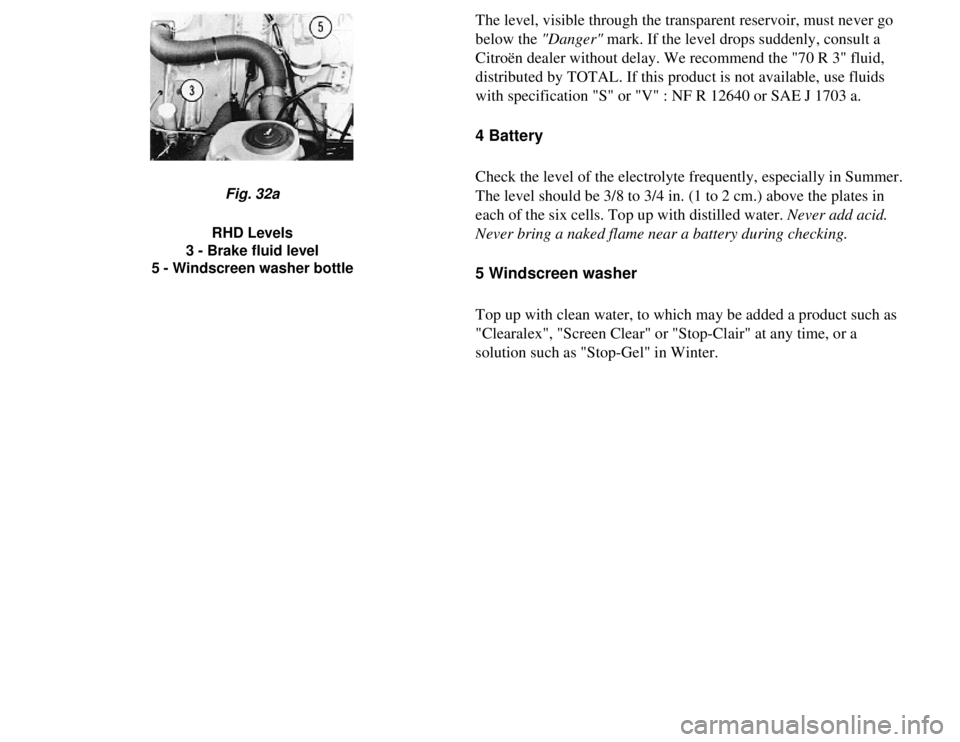
Fig. 32a
RHD Levels
3 - Brake fluid level
5 - Windscreen washer bottle
Page 22 of 86
Fig. 32b
Levels
1 - Engine oil dipstick
2 - Engine oil filler tube
3 - Brake fluid reservoir
4 - Battery
5 - Windscreen washer bottle
[Contents] [Notices] [Important Points] [Driving] [Maintenance] [Minor Repairs] [Miscellaneous Information]
Page 24 of 86
pebble road surfaces, 23 psi (1,6 bar) in front; in sandy area, 15 psi
(1 bar) at front and rear.
Do not forget to correct the pressure of the spare wheel as soon as
possible after fitting.
Tyre pressures must be checked at least once a month and before
any long journeys since safety depends on correct pressures; these
also have appreciable influence on the life of the tyres. The check
should be carried out when the tyres are cold, before they have been
heated by running: the pressure may in fact be increased by up to 7
psi (0,5 bar) on a loaded vehicle running at high speed.
Keep a check on wheel balancing, especially after a puncture.
Changing the wheels around, which evens out the wear on the five
tyres, should be frequent enough to prevent any appreciable
difference of wear between the two tyres on one axle.
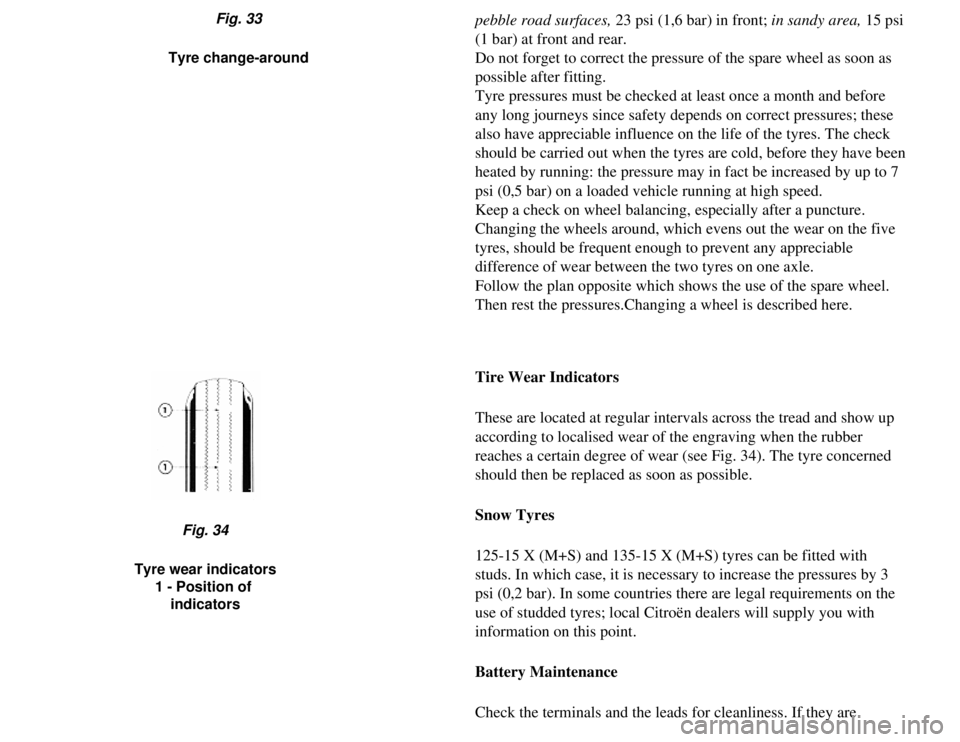
Follow the plan opposite which shows the use of the spare wheel.
Then rest the pressures.Changing a wheel is described here.Fig. 33
Tyre change-around
Tire Wear Indicators
These are located at regular intervals across the tread and show up
according to localised wear of the engraving when the rubber
reaches a certain degree of wear (see Fig. 34). The tyre concerned
should then be replaced as soon as possible.
Snow Tyres
125-15 X (M+S) and 135-15 X (M+S) tyres can be fitted with
studs. In which case, it is necessary to increase the pressures by 3
psi (0,2 bar). In some countries there are legal requirements on the
use of studded tyres; local Citroën dealers will supply you with
information on this point.
Battery Maintenance
Check the terminals and the leads for cleanliness. If they are
Fig. 34
Tyre wear indicators 1 - Position of indicators
Page 25 of 86
sulphated, unscrew them, clean them, and soak the felt insulating
washers in castor oil or in neutral vaseline oil. If the vehicle is not \
in use, recharge the battery every month.
In Winter, a correct charge protects against frost. The battery
charged normally (a density of 1.25 to 1.27) resists to -50C (-58F),\
whilst a discharged battery (density 1.07 to 1.09) may burst at -5C
(23F).
Do not disconnect the leads from the terminals when the engine
is running.
Never recharge the battery without first having disconnecting
the leads from the two terminals.
Air Filter Maintenance (Fig. 35)
Cleaning instructions are to be found on the filter cover (1).
Fig. 35
Air filter
1 - Cover
[Contents] [Notices] [Important Points] [Driving] [Maintenance] [Minor Repairs] [Miscellaneous Information]
Page 31 of 86
MINOR REPAIRS
You should consult this
section should any difficulties,
such as a puncture or a
sparking plug which needs
changing, arise.
If, however, it concerns a
malfunction indicated by one
of the instruments, you should
go
here.
MINOR REPAIRS2 CV4 - 2 CV6
Replacing a Wheel
Adjusting the Headlamps
Replacing a Bulb
Replacing a Fuse
Replacing the Battery
Page 40 of 86
MINOR REPAIRS
Replacing a Fuse, The Battery
REPLACING A FUSE
Before fitting a new fuse, it is necessary to discover the cause of the \
incident, and have it rectified.
The 8 fuses protecting the circuit (5 fuses of 16 amps and 3 of 10
amps) are found inside two boxes situated under the bonnet on the
scuttle.
Pull off the fuse box cover, and replace the fuse with one of the
same amperage.
UPPER FUSE BOX (Item A)
Fig. 45
Fuse boxes
Green marking (10 A) Yellow marking (16 A)
LH side and tail lamps
(and rear number plate lamps) Brake lamps
Interior lamp
Hazard warning device
Red marking (10 A) Blue marking (16 A)
Page 41 of 86
RH side and tail lamps
(and rear number plate lamps) Fuel gauge
Direction indicators Windscreen wipers
Alternator field feed
Charging rate indicator
Engine oil pressure warning lamp (on "2 CV 6")
LOWER FUSE BOX (Item B) Green marking (16 A) Blue marking (16 A)
RH dipped beam LH main beam
Red marking (16 A) Yellow marking (16 A)
LH dipped beam RH main beam
REPLACING THE BATTERY (Fig. 46)
Battery reference: 12 V - 125/25 Ah. CEI (or 150/30 Ah. CEI)
Disconnect the battery terminals, always beginning with the
negative one.
Unscrew the two tie-rods of the support frame then disengage the
battery by sliding it towards the front of the vehicle.
Check that the terminals are in the correct position before fitting the \
new battery.
Fig. 46
Battery
1 - Terminals 2 - Tie-rods
![CITROEN 2CV 1975 Owners Manual
Fig. 32b
Levels
1 - Engine oil dipstick
2 - Engine oil filler tube
3 - Brake fluid reservoir
4 - Battery
5 - Windscreen washer bottle
[Contents] [Notices] [Important Points] [Driving] [Maintenance] [](/manual-img/9/56684/w960_56684-21.png "CITROEN 2CV 1975 Owners Manual
Fig. 32b
Levels
1 - Engine oil dipstick
2 - Engine oil filler tube
3 - Brake fluid reservoir
4 - Battery
5 - Windscreen washer bottle
[Contents] [Notices] [Important Points] [Driving] [Maintenance] [")