1973 CHEVROLET MONTE CARLO tow
[x] Cancel search: towPage 43 of 86
Downloaded from www.Manualslib.com manuals search engine I n Case of Emergency
Four Way Hazard
Warning
Flasher
• Use the warning flasher to warn
other drivers any time your
ve
hicle becomes a traffic hazard,
day
or night.
• Avoid stopping on the roadway
if possible.
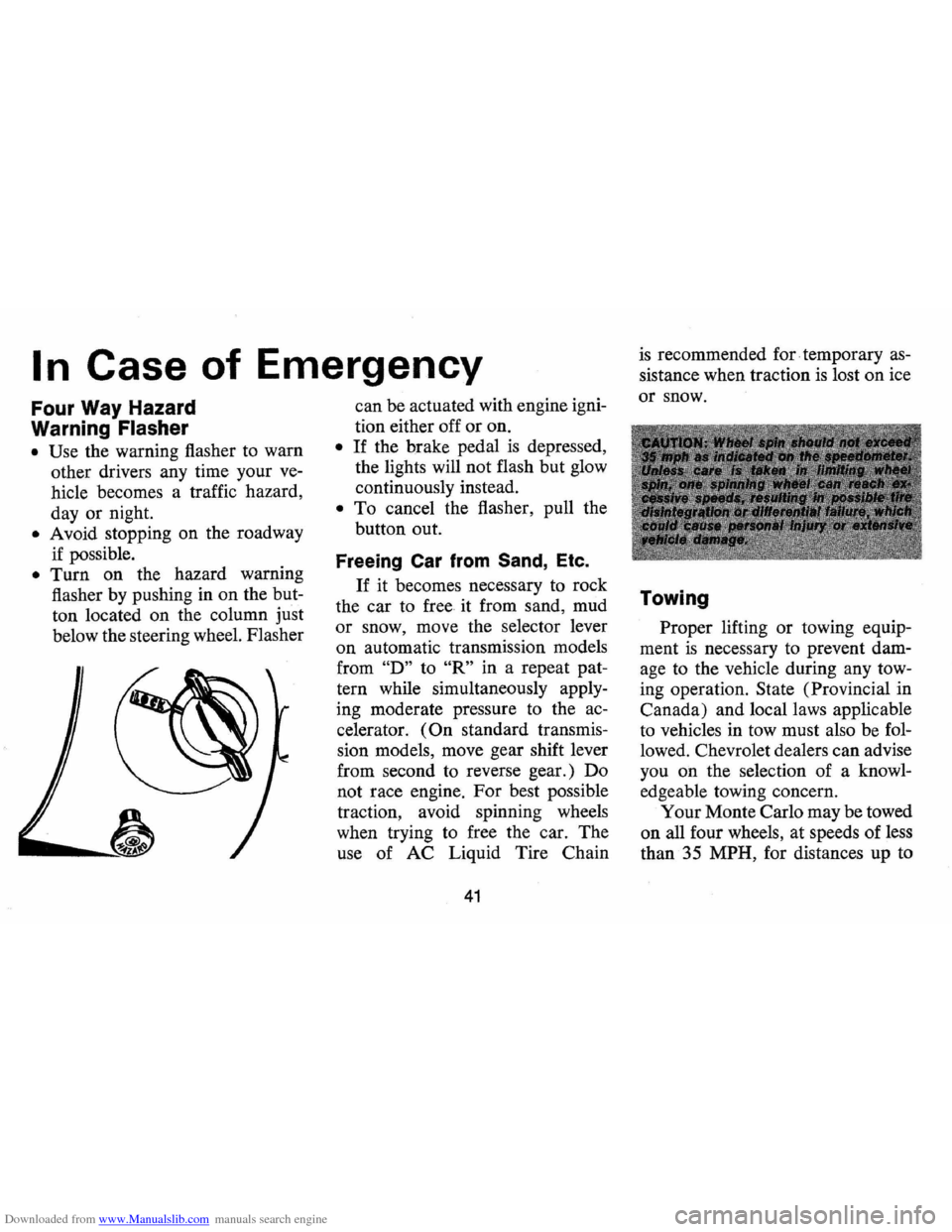
• Turn on the hazard warning
flasher by pushing in on the but
ton located on the column
just
below the steering wheel. Flasher
---~
can be actuated with engine igni
tion either off or on.
• If the brake pedal is depressed,
the lights will not flash but glow
continuously instead.
• To cancel the flasher, pull the
button out.
Freeing Car from Sand, Etc.
If it becomes necessary to rock
the car to free it from sand, mud
or snow, move the selector lever
on automatic transmission models
from
"D" to "R" in a repeat pat
tern while simultaneously apply
ing moderate pressure
to the ac
celerator.
(On standard transmis
sion models, move gear shift lever
from second to reverse gear.) Do
not race engine. For best possible
traction, avoid spinning wheels
when trying to free the car. The
use of AC Liquid Tire Chain
41
is recommended for. temporary as
sistance when traction is lost on ice
or snow.
Towing
Proper lifting or towing equip
ment
is necessary to prevent dam
age to the vehicle during any tow
ing operation.
State (Provincial in
Canada) and local laws applicable
to vehicles in tow must also be fol
lowed. Chevrolet dealers can advise
you on the selection of a knowl
edgeable towing concern.
Your Monte Carlo may be towed
on all four wheels, at speeds of less
than 35 MPH, for distances up to
Page 44 of 86
Downloaded from www.Manualslib.com manuals search engine 50 miles, provided driveline, axle
and transmission are otherwise
nor
mally operable.
Use only towing equipment spe
cifically designed for this purpose,
following the instructions of the
equipment manufacturer. Also, a
safety chain system must be used.
For such towing, the vehicle park
ing brake must be released, trans
mission must be in neutral and
igni
tion lock turned to OFF position.
Remember that power brake and
steering assists will not be available
when engine
is inoperative.
Emergency Starting
• Never tow the car to start be
cause the surge forward when
the engine starts could cause a
collision with the tow vehicle.
• Engines in vehicles with auto
matic transmissions cannot be
started
by towing or pushing
the car.
ENGINE COOLANT
• To start the car when the Ener
gizer (battery) is discharged, use
a single auxiliary battery or
Energizer of the
same nominal
voltage
(12 volts) as the dis
charged battery, with suitable
jumper cables.
• Make connections as set forth
below under
"J ump Starting
with Auxiliary (Booster)
bat
tery"
to lessen the chance of
personal injury or property
damage.
Do
not use these instructions in
connection with any vehicle having
a positive-ground electrical system
42
-either to start your vehicle or the
other
one-an explosion may result
which could cause personal injury
Page 49 of 86
Downloaded from www.Manualslib.com manuals search engine Cleaning Fabrics with
Cleaning
Fluid
This type of cleaner should be
used for cleaning stains containing
grease, oil or fats. Excess stain
should be gently scraped off with
a clean dull knife or scraper.
Use
very little cleaner, light pressure,
and clean cloths (preferably cheese
cloth). Cleaning action with
cloth should be from outside of
stain towards center and constantly
changing to a clean section of
cloth. When stain
is cleaned from
fabric, immediately wipe
area
briskly with a clean absorbent
towel or cheese cloth to help dry
area and prevent a cleaning ring.
If ring forms, immediately clean
entire area or panel section of the
trim assembly.
NOTE: Sometimes a difficult spot
may require a second application
of cleaning fluid followed immedi
ately by a soft brush to completely
remove the spot.
Cleaning Fabrics with
Detergent Foam Cleaners
This type of cleaner is excellent
for cleaning general soilage from
fabrics and for cleaning a panel
section where a minor cleaning
ring may be left from spot clean
ing. Vacuum area to remove ex
cess loose dirt. Always clean at
least a full trim panel or section
of trim. Mask adjacent trim along
stitch or weld lines. Mix detergent
type foam cleaners in strict ac
cordance with directions on label
of container.
Use foam only on a
clean sponge or soft bristle brush
-Do not wet fabric excessively or
47
rub harshly with brush. Wipe clean
with a slightly damp absorbent
towel or cloth. Immediately after
cleaning fabric, dry fabric with a
dry towel or hair dryer. Rewipe
fabric with dry absorbent towel or
cloth to restore luster of the trim
and to eliminate any dried residue.
Seat Belt Care
• Clean only with mild soap solu
tion and lukewarm water.
• Do not bleach or dye belts since
this may severely weaken belts.
Removal of Specific Stains
Candy-Chocolate, use cloth soak
ed in lukewarm water; other than
chocolate, use very hot water. Dry.
If necessary, clean lightly with
fabric cleaning fluid.
Chewing Gum-Harden gum with
ice cube and scrape off with dull
knife. Moisten with fabric cleaning
fluid and scrape again,
Page 64 of 86
Downloaded from www.Manualslib.com manuals search engine on the placard. In addition, for
those owners who prefer the
ut
most in comfort, the reduced tire
pressures listed on the placard may
be used when loads of
(5 occu
pants or less) are carried.
The use of improper tire
infla
tion pressures can adversely affect
tire life and vehicle
perforrilance:
•
Too little air pressure can result
in excessive tire heat, abnormal
tire wear, adverse vehicle
han
dling and reduced fuel economy.
• Too much air pressure can re
sult in abnormal tire wear, ad
verse vehicle ride and handling,
and increased susceptibility to
damage
by road impacts.
Tire pressures should be checked
when the tires are
"cold" at least
once a month (and preferably
oftener)
or before long trips or
when heavily loaded. The follow
ing points should be observed
when checking and setting tire
pressures:
<
1. Cold tire pressure ratings are applic
able when a vehicle has been Inoperative for 3 hours or more, or driven less
than 1 mile.
2. Tire inflation pressure may increase as much as 6 pounds per square inch (psi)
when hot (after vehicle has been driven
10 miles or at speeds of more than 60 miles per hour). Do not "bleed" or reduce pressures when tires are hot from
driving.
3. For continuous high speed operation
(over 75 mph), increase tire inflation
pressure 4 psi above the fecommended
pressures up to a maximum
of 32 psi
cold pressure for load range B tires, or 40 psi for D load range tires. Sustained
speeds above 75 mph are not recom
mended when the 4 psi adjustment
would require pressures greater than
the above maximum pressures.
4. Always use a tire pressure gauge when
checking pressures as the appearance of a tire can be deceiving. For example,
radial ply tires, in comparison with bias
ply tires at the same pressure, may have
the appearance of being under-Inflated.
62
Vehicle Loading-Do not load
your vehicle beyond the vehicle
capacity (total pounds) shown on
the tire placard. This figure
repre
sents the design capacity of the
vehicle, not merely of the tires.
When towing trailers, the
allow
able passenger and cargo load
must be reduced by an amount
equal to the trailer tongue load on
the trailer hitch.
(See "Trailer
Hauling" in Section 1 of this man
ual.) Station wagon loads should
be distributed
as far forward as
possible. Vehicles equipped with
luggage racks do not have a
vehi
cle load capacity greater than
specified on the tire placard.
Tire Wear and Rotation-Un
even or abnormal tire wear is
usually the result of incorrect in
flation pressure, improper wheel
alignment, wheels being
out-of
balance, or poor driving habits.
Page 71 of 86
Downloaded from www.Manualslib.com manuals search engine The chart on the previous page, and the information on the pages which follow, contains information designed to aid the average driver to discover, and possibly correct, conditions resulting in minor
mechanical difficulties in his cor. The chart, designed to point out
possible solutions to several of the most common automotive malfunctions and point out a logical checking sequence, will lead step by step to the most likely causes and corrective procedures. If, after making the checks and adjustments suggested,' the source of the
trouble has not been found and corrected, it is strongly recommended that an Authorized Chevrolet Dealer inspect the vehicle and make whatever repairs or adjustments are necessary.
FUEL SYSTEM AND ENGINE
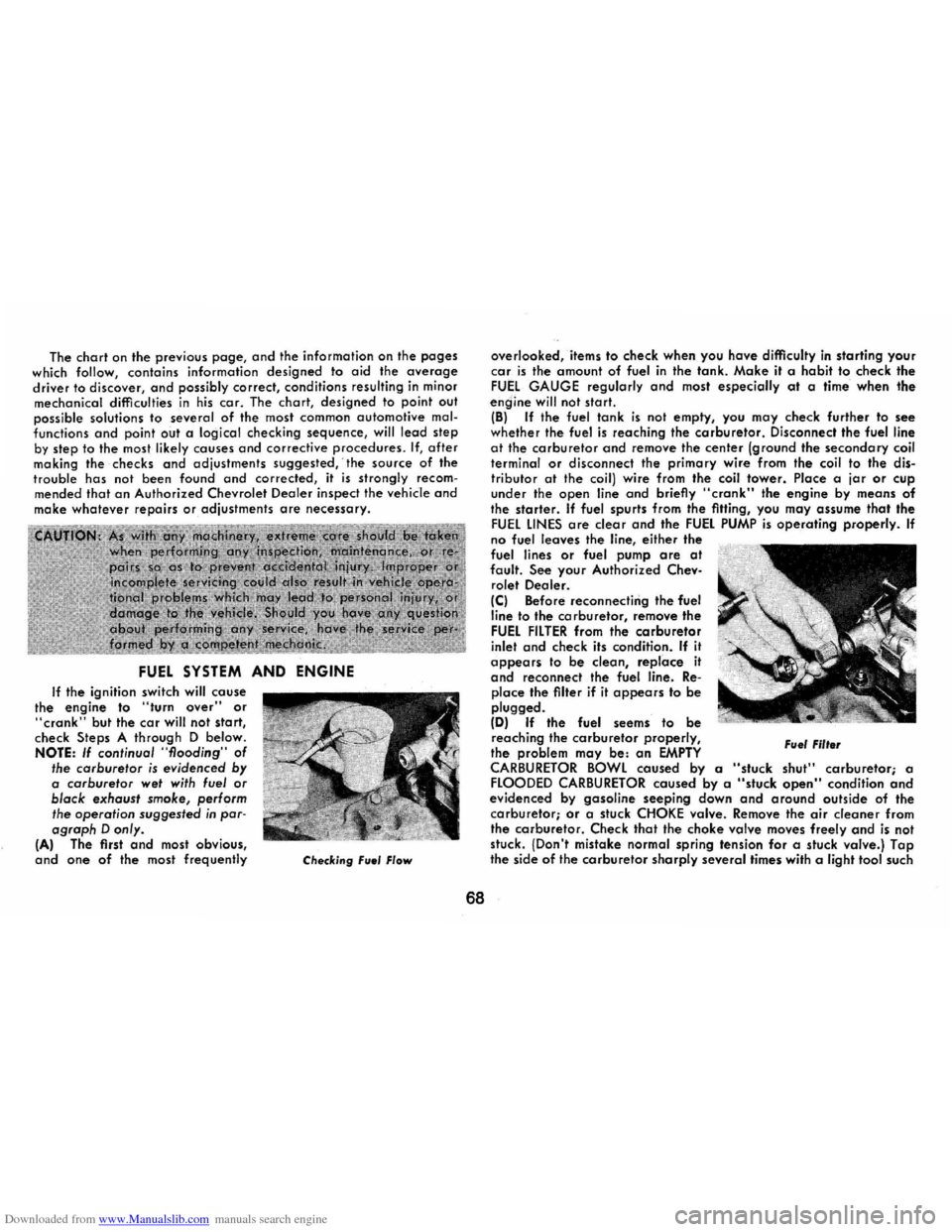
If the ignition switch will cause the engine to "turn over" or "crank" but the cor will not start,
check Steps A through D below. NOTE: If continual "f1ooding" of the carburetor is evidenced by a carburetor wet with fuel or black exhaust smoke, perform the operation suggested in paragraph 0 only. (A) The first and most obvious, and one of the most frequently Checlcing Fuel Flow
68
overlooked, items to check when you have difficulty in starting your car is the amount of fuel in the tank. Make it a habit to check the FUEL GAUGE regularly and most especially at a time' when the engine will not start. (B) If the fuel tank is not empty, you may check further to see whether the fuel is reaching the carburetor_ Disconnect the fuel line at the carburetor and remove the center (ground the secondary coil
terminal or disconnect the primary wire from the coil to the distributor at the coil) wire from the coil tower. Place a jar or cup under the open line and briefly "crank" the engine by means of the starter. If fuel spurts from the fitting, you may assume that the FUEL LINES are clear and the FUEL PUMP is operating properly. If no fuel leaves the line, either the
fuel lines or fuel pump are at fault. See your Authorized Chevrolet Dealer. (C) Before reconnecting the fuel
line to the carburetor, remove the FUEL FILTER from the carburetor inlet and check its condition. If it appears to be clean, replace it and reconnect the fuel line. Replace the filter if it appears to be plugged. (0) If the fuel seems to be reaching the carburetor properly, the problem may be: an EMPTY Fuel Filter
CARBURETOR BOWL caused by a "stuck shut" carburetor; a flOODED CARBURETOR caused by a "stuck open" condition and evidenced by gasoline seeping down and around outside of the carburetor; or a stuck CHOKE valve. Remove the air cleaner from
the carburetor. Check that the choke valve moves freely and is not
stuck. (Don't mistake normal spring tension for a stuck valve.) Tap the side of the carburetor sharply several times with a light tool such
Page 73 of 86
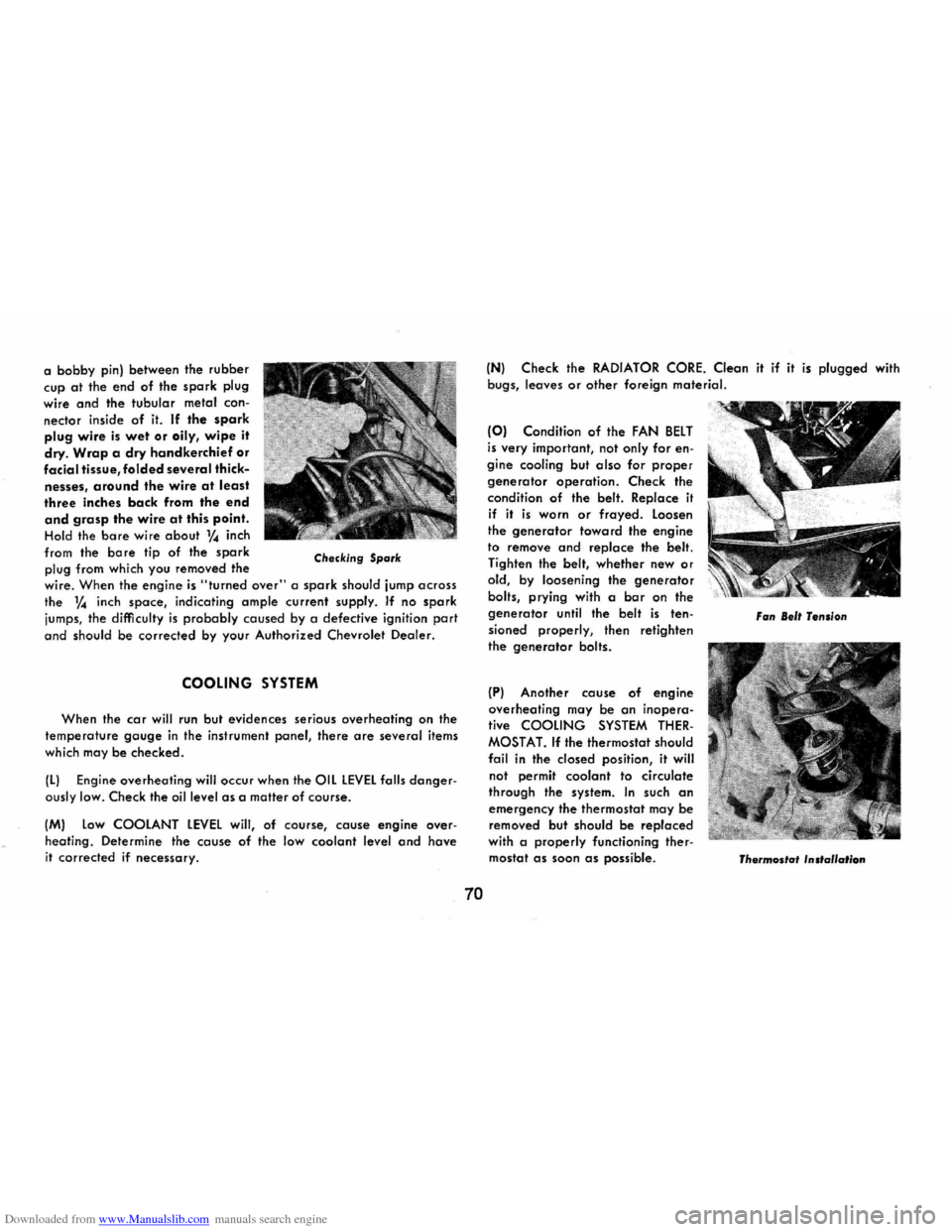
Downloaded from www.Manualslib.com manuals search engine a bobby pin) between the rubber
cup
at the end of the spark plug
wire
and the tubular metal con
nector inside
of it. If the spark plug wire is wet or oily, wipe it
dry.
Wrap a dry handkerchief or
facial tissue, folded several thick
nesses,
around the wire at least
three inches back from the end and grasp the wire at this point.
Hold the bare wire about V4 inch
from the
bore tip of the spark plug from which you removed the Checking Spark
wire. When the engine is "turned over" a spark should jump across
the 1,4 inch space, indicating ample current supply. If no spark
jumps, the difficulty is probably caused by a defective ignition part
and should be corrected by your Authorized Chevrolet Dealer.
COOLING SYSTEM
When the car will run but evidences serious overheating on the
temperature gauge in the instrument panel, there are several items
which may
be checked.
IL) Engine overheating will occur when the OIL LEVEL falls danger
ously low. Check the oil level as a mailer of course.
1M) Low COOLANT LEVEL will, of course, cause engine over
heating . Determine the
cause of the low coolant level and have it corrected if necessary.
70
IN) Check the RADIATOR CORE. Clean it if it is plugged with
bugs, leaves or other foreign material.
(0) Condition of the FAN BELT
is very important, not only for en
gine cooling but
also for proper
generator operation. Check the
condition of the belt. Replace it
if it is worn or frayed. Loosen
the generator toward the engine
to remove
and replace the belt.
Tighten the belt, whether new or
old, by loosening the generator
bolts, prying with a bar on the
generator until the belt is ten
sioned properly , then retighten
the
generator bolts.
(P) Another couse of engine
overheating may be
an inopera
tive
COOLING SYSTEM THER
MOSTAT. If the thermostat should
foil in the dosed position, it will
not permit
coolant to circulate
through the system. In such an
emergency the thermostat may be
removed but should be
replaced with a properly functioning ther
mostat as soon as possible.
Fan Belt Tension
Thermostat
'ns'alla"on
Page 79 of 86
Downloaded from www.Manualslib.com manuals search engine CHEVROLET ZONE OFFICE ADDRESSES
When calling for assistance, please ask for Customer Services Manager
Irondale, Ala. (Birmingham) 2300 Crestwood Blvd. 35210 (205) 592·7234
Los Angeles, California 1800 Avenue of the Stars 90067 (213) 553·1527
Oakland, California 10910 E. 14th st. 94600 (415) 562·0553
San Diego, California 707 Broadway 92100 (714) 234·7231
Denver, Colorado 4355 Kearney St. 80200 (303) 321·7520
Jacksonville, Florida 8206 Phillips Hwy. 32200 (904) 733·3682
Doraville, Georgia (Atlanta) 4060 Motors Industrial Way 30340 (404) 451·0171
Indianapolis, Indiana 2350 N. Shadeland Ave. 46200 (317) 356·7214
South Bend, Indiana 3002 S. Michigan St. 46614 (219) 291·5000
Oak Brook, Illinois (Chicago)
2021 Spring Road 60153 (3 .. ~2) 654·6345
Peoria, Illinois 2009 N. Knoxville 61600 (309) 688·8611
Des Moines, Iowa 818 Fifth Ave. 50300 (515) 244·3141
Lenexa, Kansas (Kansas City) 8900 Marshall Dr. 66015 (913) 888·1400
Wichita, Kansas 4921 E. 21st st. 67200 (316) 685·1311
Louisville, Kentucky 4501 Indian Trail 40200 (502) 968·6203
Harahan, La. (New Orleans)
5401 Jefferson Hwy. 70123 (504) 733·6850
Portland, Maine 150 Riverside St. 04103 (207) 773-2934
Hanover, Maryland (Baltimore) 1800 Parkway Drive 21201 (301) 796-3600
76
Westwood, Mass. (Boston) 505 Blue Hill Drive 02090 (617) 329·1057
Grand Blanc, Michigan (Flint) 5198 Territorial Road 48439 (313) 694-7000
Southfield, Michigan (Detroit) 15565 Northland Drive 48075 (313) 353·9715
Edina, Minn. (Minneapolis) 7600 Metro Blvd. 55424 (612) 941-4000
Maryland Heights, Missouri (St. Louis) 83 Progress Parkway 63043 (314) 878-4200
Omaha, Nebraska 11616 "I" Street 68100 (402) 333-4500
Englewood, N. J. (Newark) 385 Nordhoff Place 07631 (201) 567-7200
Bethpage, Long Island, N. Y. 175 Central Ave., South 11714 (516) 694·7970
Cheektowaga, N. Y. (Buffalo) 2615 Walden Ave. 14225 (716) 684-8060
Syracuse, N. Y. 107 Twin Oaks Dr. 13200 (315) 437-2861
Tarrytown, N.
Y. 371 S. Broadway 10591 (914) 631-9129
Page 81 of 86
Downloaded from www.Manualslib.com manuals search engine INDEX
Accessory Drive Belts ............ , .... 53 Accessory Position, Steering Column Lock ...................... 15 Acrylic Lacquer ..................... , 49
Adjusters, Automatic Brake. . . . . . . . . . .. 38 Air Circulation . . . . . . . . . . . . . . . . . . . . . .. 3
Air Cleaner. . . . . . . . . . . . . . . . . . . . . . . . .. 53 Air Conditioning
Operation 4 Season. . . . . . . . . . . . . . . .. 35 Maintenance. . . . . . . . . . . . . . . . . . . . . .. 57 Air Inlets, Ventilating System .......... 32 Ammeter ............................ 30 Antenna ............................. 39 Anti-freeze (See Cooling System) ........ 57 Anti-Spin Differential. . . . . . . . . . . . . . . .. 40 Anti-Theft Key Buzzer System . . . . . . . . .. 15 Anti-Theft Steering Column Lock ....... 15 Appearance Care. . . . . . . . . . . . . . . . . . . .. 46 Automatic Brake Adjusters. . . . . . . . . . .. 24 Automatic Transmissions
Fluid Check ........................ 54 Fluid Recommendations. . . . . . . . . . . .. 54 Maintenance ...................... , 54 Operation.. . . . . . . . . . . . . . . . . . . . . . . .. 17 Starter Safety Switch ............... , 15 Axle Rear
Fluid Level. . . . . . . . . . . . . . . . . . . . . . .. 53 Maintenance ...................... , 53 Backup Lights ........................ 73 Ball Joints .......................... , 55 Bassinet Placement. .. . . . . . . . . . . . . . . . .. 10 Battery
Emergency Starting. . . . . . . . . . . . . . . .. 42 Fluid Level. . . . . . . . . . . . . . . . . . . . . . .. 66
Gas Caution ...................... , 42
Specifications. . .. . . . . . . . . . . . . . . . . . .. 71 Bearings, Front Wheel. ............... , 55 Before Driving Your Monte Carlo. . .. .. 3
Belted Tires. . . . . . . . . . . . . . . . . . . . . . . . .. 62
Belts
Engine Drive ...................... , 53 Lap ............................... 6 Shoulder ...... , .. . . .. .. . . . . .. . . .. .. 8
Blower, Ventilating ................... 32 Body Identification Number. ........... 71 Brakes
Driving Through Deep Water ........ 23 Linings ............................ 56
Master Cylinder Level. . . . . . . . . . . . . .. 56
Parking Brake. . . . . . . . . . . . . . . . . . . . .. 23 Pedal Travel ...................... , 23 Power ............................. 23 Self-Adjusting.. .. .. .. .. .. .. . . . . .. .. 24 Trailer ................. ........... 11 Warning Light. .................... 27 Break-In Period
Cars Pulling Trailers. . . . . . . . . . . . . . .. 11 New Car .......................... 2
Bright Metal Cleaning ................ . "Brights" Headlamp Indicator ......... , 28 Buckles, Seat Belt. . . . . . . . . . . . . . . . . . . .. 7
Bulbs and Fuses. . . . . . . . . . . . . . . . . . . . .. 73 Bumper Jack
Operation .......................... 44 Stowage .................... ....... 44 Buzzer
Key Reminder. . . . . . . . . . . . . . . . . . . . .. 15 Cap, Filter
Engine Oil ............ Inside Back Cover
Gasoline ....................... .... 50 Radiator. . . . . . . . . . . . . . . . . . . . . . . . . .. 42
78
Capacities. . . . . . . . . . . . . . . . . . . . . . . . . .. 71 Carbon Monoxide Caution ............. 14
Cargo or Luggage Caution. . . . . . . . . . . .. 14 Carpet Care ................... , .... " 46
Carrier, Infant Safety .................. 10 Changing Wheels and Tires. . . . . . . . . . .. 43 Charging System Indicator Light. ..... " 27 Chassis Maintenance .................. 55 Child Restraint
Cars Not Equipped With
Special Child Restraints. . . . . . . . .. 10 Child Safety Seat ............... .. " 10 Infant Safety Carrier. . . . . . . . . . . . . . .. 10 Chrome Protection.. . . . . . . . . . . . . . . . . .. 49 Cigarette Ligh ter. . . . . . . . . . . . . . . . . . . .. 31 Circuit Breakers, Headlamps ......... " 73 Cleaning
Carpet Care ...................... " 46
Exterior Finish and Trim. . . . . . . . . . .. 47 Fabric and Interior Trim. . . . . . . . . . .. 46 Solvents Recommended .............. 46 Spot Removal. . . . . . . . . . . . . . . . . . . . .. 46 Vinyl Top. . . . . . . . . . . . . . . . . . . . . . . .. 49
Clock ............................... 31 Clutch Maintenance. . . . . . . . . . . . . . . . . . . . . .. 54 Pedal Adjustment. . . . . . . . . . . . . . . . . .. 23 Coat Hooks... . .. .. . . .... .. . . .... . ... 4
Cold Weather Starting ................. 16 Compartment
Glove ............................. 25 Complaint Procedure .................. 74 Conditioner, Air ... , .................. 35 Controlled Differential .............. " 40 Controls ............................. 25 Cooling System Care .............................. 57 Coolant Recommendation. . . . . . . . . .. 57