1969 FORD MUSTANG ECU
[x] Cancel search: ECUPage 5 of 413

01-01-01
01-01-01
1
I 9Y82A848000
|
Y89A848000
rMMUNTrNUMBW
I 53A
A IA I8H 34 4
^J MODEL YEAR CODE
2)
ASSEMBLY PLANT CODE
5)
BODY SERIAL CODE
T)
ENGINE CODE
T)
CONSECUTIVE UNIT
NO.
T)
BODY TYPE CODE
(7)
COLOR CODE
0 TRIM CODE
® DATE CODE
(JO) DISTRICT-SPEC. EQUIP. CODE
(lT) REAR AXLE CODE
(12) TRANSMISSION CODE
W1001-A
Fig.
1—Warranty
Plates—Passenger Cars
9Y83NI0000I
Fig. 2—Typical Vehicle Identification Number
(VIN) Tab
W
1002-Aprocarmanuals.com
Page 6 of 413

01-01-02
Vehicle Identification
01-01-02
VEHICLE WARRANTY NUMBER
The vehicle warranty number is the first line of numbers and
letters appearing on the Warranty Plates (Fig. 1). The Warranty
Plate is riveted to the left front door lock face panel. The first
number indicates the model year. The letter following the model
year number indicates the manufacturing assembly plant. The next
two numbers designate the Body Serial Code followed by a letter
expressing the Engine Code. The group of six digits remaining on
the first line indicate the Consecutive Unit Number.
VEHICLE DATA
The vehicle data appears on the second or lower line on the
Warranty Plate. The first two numbers and a letter identify the
Body Style. A letter or a number appears next indicating the
Exterior Paint Color followed by a number-letter combination
designating the Interior Trim. To the right of this code appears the
Date Code indicating the date the car was manufactured. A two-
digit number next designates the district in which the car was
ordered and may appear in conjunction with a Domestic Special
Order or Foreign Special Order number when applicable. The final
two spaces indicate the Rear Axle Ratio (numbers for regular axles,
letters for locking-types) and the Transmission type (numbers for
manual,
letters for automatic).
OFFICIAL VEHICLE IDENTIFICATION NUMBER
The official Vehicle Identification Number (VIN) for title and
registration purposes is stamped on an aluminum tab that is riveted
to the instrument panel close to the windshield on the driver's side
of the car and is visible from outside (Fig. 2).
MODEL YEAR CODE
The number 9 designates 1969.
ASSEMBLY PLANT CODES
COUGAR
Code
Letter
Code
Letter
A
B
C
D
E
F
G
H
J
K
Atlanta
L
Oakville (Canada)
N
Ontario Truck
P
Dallas
R
.,
Mahwah
S
Dearborn
T
Chicago
U
Lorain
W
Los Angeles
X
Kansas City
Y
Z
Michigan Truck
Norfolk
Twin Cities
San Jose
.
(Pilot). ...Allen Park
Metuchen
Louisville
Wayne
St. Thomas
Wixom
St. Louis
BODY SERIAL AND STYLE CODES
The two-digit numeral which follows the assembly plant code
identifies the body series. This two-digit number is used in con-
junction with the Body Style Code, in the Vehicle Data, which
consists of a two-digit number with a letter suffix. The following
chart lists the Body Serial Codes, Body Style Codes and the model.
LINCOLN CONTINENTAL
Body Body
Serial Style
Code Code Body Type
82
53A
4-Door Sedan
80
65A
2-Door
Hardtop
CONTINENTAL MARK
III
Body Body
Serial Style
Code Code Body Type
89
65A
2-Door
Hardtop
Body
Serial
Code
91
92
93
94
91
Body
Style
Code
65A
76A
65B
76B
65C
® Bench Seat
MERCURY
Body
Serial
Code
44
46
48
45
40
41
42
54
56
58
63
66
68
65
63
66
68
60
61
72
72
74
74
76
76
Body
Style
Code
54A
65A
57A
76A
53M
65M
57M
54C
65B
57B
53F
65F
57 F
76F
53C
65C
57C
63G
63H
71B
71C
71F
71G
71E
71A
©Bench Seat
Body
Type
2-Door
Hardtop©
Convertible©
2-Door
Hardtop©
Convertible®
2-Door
Hardtop®
Model
Standard
XR-7 Luxury
Standard
©Split Bench ©Bucket Seats
Body Type
4-Door Sedan©
2-Door
Hardtop-Formal®
4-Door Hardtop®
Convertible®
CANADA ONLY
4-Door Hardtop Sedan®
2-Door
Hardtop-Formal®
4-Door Hardtop®
4-Door Sedan®
2-Door
Hardtop-Formal®
4-Door Hardtop®
4-Door Hardtop Sedan®©
2-Door
Hardtop-Formal®©
4-Door Hardtop®®
Convertible®®
4-Door Hardtop Sedan©
2-Door
Hardtop-Formal©
4-Door Hardtop©
Model
Monterey
Marquis
Monterey-Custom
Marquis
Brougham (Option)
2-Door
Hardtop (Tunnel Roof)®© Marauder
2-Door
Hardtop (Tunnel Roof)®®©
4-Door 2 Seat®
4-Door 3 Seat (Side Facing)®
4-Door
2
Seat®
4-Door 3 Seat (Side Facing)®
4-Door 2 Seat®©
4-Door 3 Seat (Side Facing)®©
Monterey Wagoi
Monterey-Custom Wagon
Marquis Colony Park
©Split Bench ©Bucket Seats
METEOR (CANADA)
Body
Serial
Code
20
21
23
Body
Style
Code
54A
54B
65B
Body Type
4-Door Sedan®
4-Door Sedan®
2-Door
Hardtop-Formal®
Model
Rideau
Rideau 500
30
54C
4-Door Sedan®
35
65C
2-Door
Hardtop-Formal®
35
65E
2-Door
Hardtop-Formal{5-33)®®
33
57C
4-Door Hardtop®
34
76C
Convertible®
34
76E
Convertible (S-33)®®
Montcalm
24
65F
2-Door
Hardtop-Formal®©
27
57F
4-Door Hardtop®®
LeMoyne
28
71B
Rideau 500-6 Passenger®
29
71C
Rideau 500-Dual Face Rear®
38
71E
Mo ntcalm-6 Passenger®
39
71A
Montcalm-Dual Face Rear®
Station Wagons.
©Bench Seat ©Splite Bench ©Bucket Seatsprocarmanuals.com
Page 8 of 413

01-01-04
Vehicle Identification
01-01-04
BODY SERIAL AND STYLE CODES-(continued)
FAIRLANE
Body
Serial
Code
30
31
34
35
33
36
35
33
36
40
41
42
44
43
42
44
43
46
46
45
45
32
37
38
47
48
48
49
49
Body
Style
Code
65A
54A
54B
63B
65B
76B
63E
65E
76E
65C
54C
63F
65F
76F
63D
65D
76D
63B
63E
65A
65E
71D
71B
71E
66A
66B
66B
(Opt.)
66C
66D
©Bench Seat
Body Type
2-Door
Hardtop-formal®
4-Door
Sedan®
4-Door
Sedan®
2-Door
Hardtop—Fastback®
2-Door
Hardtop-formal®
Convertible®
2-Door
Hardtop—Fastback©
2-Door
Hardtop-Formal©
Convertible®
2-Door
Hardtop-Formal®
4-Door
Sedan®
r t
2-Door
Hardtop—FastbackCD
2-Door
Hardtop-Formal®
Convertible®
2-Door
Hardtop—Fastback®
2-Door
Hardtop-Formal®
Convertible®
2-Door
Hardtop-Fastback®
2-Door
Hardtop-Fastback®
2-Door
Hardtop-Formal®
2-Door
Hardtop-formal®
Fairlane®
Fairlane 500®
Fairlane Torino Squire®
Ranchero®
Ranchero 500®
Ranchero 500®
Ranchero®
Ranchero®
Model
Fairlane
Fairlane 500
Fairlane 500
Torino
Torino GT
Torino GT
Cobra
Station Wagons-4 Door
Ranchero
Ranchero
Ranchero GT
©Split Bench ©Bucket Seats
REAR AXLE RATIO CODES
Conventional
Limited-Slip
Ratio
1
J
2.50:1
2
K
2.75:1
3
L
2.79:1
4
M 2.801
5
N
2.83:1
6
0
3.00:1
7
P
3.10:1
8
Q
3.20:1
9
R
3.25:1
A
S
3.50:1
B
T
3.07:1
C
U
3.08:1
D
V
3.91:1
E
W
4.30:1
TRANSMISSION CODES
Code Type
1
3-Speed
Manual
5 4-Speed Manual-wide ratio (2.78 1st Gear)
6 4-Speed Manual-close ratio (2.32 1st Gear)
W Automatic (C4) (XP-3)
U Automatic (C6) (XPL)
Y Automatic (MX)
X Automatic (FMX)
Z Automatic (C6 Special) (XPL, Special)®
©For Police & trailer towing
-
Not available with bucket seats
ENGINE CODES
Code
U
6Cyl.
T
6Cyl.
2
6 Cyl.®
L 6 Cyl.
3
6 Cyl CD
V
6
Cyl."
5
.
6 Cyl CD
B .6
Cyl.
E
6
Cyl.
F
8
Cyl.
6 8 Cyl.®
D 8
Cyl.
H 8 Cyl.
M 8 Cyl.
Y 8
Cyl.
X 8 Cyl.©
S 8 Cyl.©
P 8 Cyl.®
8 Cyl.
8 Cyl.®
K 8
Cyl.
N
8
Cyl.
A 8
Cyl.
©Low Compression
©High Performance
Type
170
Cu.
In.
(IV)
200
Cu.
In.
(IV)
200
Cu.
In.
(IV)
250
Cu.
In.
(IV)
250
Cu.
In.
(IV)
240
Cu.
In.
(IV)
240
Cu.
In.
(IV)
240 Cu. In. (IV) Police
240 Cu. In. (IV) Taxi
302
Cu.
In.
(2V)
302
Cu.
In.
(2V)
302 Cu. In. (2V) Police & Taxi
351
Cu.
In.
(2V)
351
Cu.
In.
(4V)
390
Cu.
In.
(2V)
390Cu.ln.(2V)
390
Cu.
In.
(4V)
428 Cu. In. (4V) Police Interceptor
428
Cu.
In.
(4V)
CJ
428
Cu.
In.
(4V)
CJ
429
Cu.
In.
(2V)
429
Cu.
In.
(4V)
460
Cu.
In.
(4V)
©Premium Fuel ©Improved Performance
©Ram Air Induction
CONSECUTIVE UNIT NUMBER
Starting Serial Numbers—1969 Passenger Cars
100,001—Ford, Fairlane, Falcon, Mustang, Thunderbird
500,001 -Mercury, Montego,
Cougar,
Meteor
848,000—Lincoln Continental & Continental Mark
III
EXTERIOR PAINT COLOR CODES
Code
Reference
Number
Color
A
B
c
D
E
F
G
H
|
J
K
L
. .
M
N
p
Q
R
S.
.. .
T
u
v
W
X
Y
z
2.
..
3
4
6.
. .
7
8
..
1724-A
1
3059-A
3197-A
3303-A
3191-A
3065-A
. .
3203-A
..
,.2067-A
2041-A
3080-A
3204-A
3060-A
1619-A
..
921-A
3064-A
1624-A
3198-A
. .
3199-A
2008-A
1070-A
3201-A
3120-A
3061-A
. . .
3202-A
2044-A
3071-A
. .
1730-A
3230-A
.
3077-A
3193-A
3190-A
..M6J-49B..
....M6J-50B.
Black
Maroon
Dk. Ivy Green Met.
Pastel Gray
Lt. Aqua
Dk. Aqua Met. (Brt.)
Med.
Orchid Met.
Lt. Green
Med.
Lime Met.
Dk. Aqua Met.
Dk. Orchid Met.
Lt. Gray Met.
White
Platinum
Med.
Blue Met.
Med.
Blue Met.
Lt. Gold
Med.
Gold Met.
Red
Med.
Aqua Met.
Lt. Aurora Copper IVIet.
Yellow
Dk. Blue Met.
Burnt Orange Met.
Dk. Grey Met.
Lt. Ivy Yellow
Calypso Coral
Med.
Emerald Met.
Med.
Blue Met. (Brt)
Lt. Emerald Green Met.
Lt. Blue
Red Primer
Grey Primerprocarmanuals.com
Page 16 of 413

02-01-05
Brakes
02-01-05
1.
Disconnect the master cylinder
from the booster assembly and secure
away from the booster without discon-
necting the brake tubes.
2.
Reinstall the air filter assembly
on the booster if it was removed with
the master cylinder (Fig. 8).
3.
Install and tighten the master
cylinder retaining nuts to retain the
air filter assembly securely against the
booster body and to seal the booster
bellows against air leaks.
4.
Place the gauge against the
master cylinder mounting surface of
the air filter assembly.
5.
Adjust the push rod screw to
provide a slight tension against the
inner edge of the adjustment gauge
slot. (Approximately 5 pounds of ten-
sion against the push rod is required
to assure that the push rod is firmly
seated in the booster assembly.)
6. Remove the retaining nuts from
the booster master cylinder mounting
studs.
7.
Install the master cylinder on the
brake booster and tighten the retain-
ing nuts to the specified torque.
The push rod length verification of
the Bendix power brake booster
assemblies is accomplished as follows:
1.
Disconnect the master cylinder
from the booster assembly and secure
away from the booster without discon-
necting the brake tubes.
2.
Adjust the push rod screw to
provide a slight tension against the
inner edge of the adjustment gauge
slot. (Approximately 5 pounds of ten-
sion against the push rod is required
to assure that the push rod is firmly
seated in the booster assembly.) See
Figure 8.
3.
Install the master cylinder on the
brake booster and tighten the retain-
ing nuts to the specified torque.
Do not set up side forces on the
push rod as it may break the valve
plunger.
This is an approximate adjustment
only. To verify the adjustment, look
through the make-up (rear) port of the
master cylinder when installing the
master cylinder to the booster. The
master cylinder piston should not
move more than 0.015 inch as it con-
tacts the push rod. No movement
(exact contact) is ideal.
HYDRAULIC SYSTEM BLEEDING
AND CENTRALIZING OF THE
DIFFERENTIAL VALVE
When any part of the hydraulic sys-
tem has been disconnected for repair
or replacement, air may enter the sys-
tem and cause spongy pedal action.
Bleed the hydraulic system after it has
been properly connected, to be sure
that all air is expelled.
MANUAL BLEEDING
The Lincoln Continental hydraulic
brake system is to be bled only with
pressure bleeding equipment.
The primary and secondary (front
MANIFOLD CHECK VALVE-2365 19-25 IN. LB.
TIGHTEN RETAINING NUTS
TO SECURE AIR FILTER
AGAINST BOOSTER BODY
AND BELLOWS
ADJUST PUSH ROD SCREW TO
PROVIDE A SLIGHT TENSION
(APPROXIMATELY 5 LBS.)
AGAINST THE GAUGE
PUSH ROD GAUGE
and rear) hydraulic brake systems are
individual systems and are bled separ-
ately. Bleed the longest line first on
the individual system being serviced.
During the complete bleeding opera-
tion,
DO NOT allow the reservoir to
run dry. Keep the master cylinder res-
ervoirs filled with Ford Fluid—Extra
Heavy Duty — Part Number C6AZ-
19542-A (ESA-M6C 25-A). The extra
heavy duty brake fluid is colored blue
for identification purposes. Do not
mix low temperature brake fluids with
the specified fluid during the bleeding
operations. Never re-use brake fluid
which has been drained from the hy-
draulic systems.
1.
If the master cylinder is
equipped with a bleed screw, loosen
the bleed screw. Push the brake pedal
down slowly through its full travel.
Close the bleeder fitting and return
the pedal to the fully released posi-
tion. Repeat this operation until fluid
is free of air bubbles, then tighten the
bleeder screw. Do not use the second-
ary piston stop screw, located on the
bottom of the master cylinder to bleed
the brake system. Loosening or re-
moving this screw could result in dam-
age to the secondary piston or stop
screw.
2.
To bleed the secondary (rear)
brake system, position a suitable 3/8
inch box wrench (Fig. 9) on the bleed-
er fitting on the brake wheel cylinder.
Attach a rubber drain tube to the
bleeder fitting. The end of the tube
should fit snugly around the bleeder
fitting.
APPROXIMATELY 45°
PUSH ROD ADJUSTMENT-MIDLAND-ROSS
FIG. 8—Brake Booster Push Rod Measurement
PUSH ROD ADJUSTMENT-BENDIX
H1589-A
H1300-B
. 9—Wrench for Bleeding
Brake Hydraulic System
3.
Submerge the free end of the
tube in a container partially filled with
clean brake fluid, and loosen the
bleeder fitting approximately 3/4 turn.
4.
Push the brake pedal down slow-
ly through its full travel. Close the
bleeder fitting, then return the pedal
to the full-released position. Repeat
this operation until air bubbles cease
to appear at the submerged end of the
bleeder tube.
5.
When the fluid is completely free
of air bubbles, close the bleeder fitting
and remove the bleeder tube.
6. Repeat this procedure at the
brake wheel cylinder on the oppositeprocarmanuals.com
Page 26 of 413

02-02-07
Brake System
02-02-07
ANTI-SKID CONTROL SYSTEM
RELEASE PAWL CAM PIN
RELEASE PAWL CAM LEVER
RELEASE CABLE
H
1636-
A
FIG. 10—Parking Brake Control Assembly
With Manual Release—Typical
power unit with mounting bracket is
riveted to the control assembly. The
vacuum actuated piston within the
unit is connected by a rod to the
upper end of the release lever (Fig. 9).
The lower end of the release lever ex-
tends out for alternate manual release
in the event of vacuum power failure
or for optional manual release at any
time.
Hoses connect the power unit and
the engine manifold to a vacuum re-
lease valve in the transmission neutral
safety switch.
The anti-skid control system con-
sists of three major components (Fig.
39).
Mechanically driven electromag-
netic sensors at each rear wheel; an
electronic control module mounted
under the glove box; a vacuum pow-
ered actuator attached to a bracket on
the inside of the right front frame rail
under the toe board.
The sensors consist of steel rings
having teeth on their outer diameters,
pressed on each axle shaft just out-
board of the wheel bearing. The teeth
rotate past corresponding teeth on the
inside diameter of stationary steel
rings mounted in the bearing retain-
ers.
Also mounted in the retainers, are
ring-shaped permanent magnets and
coils of wire. Two wires from each
sensor connect the sensors to the con-
trol module.
The control module consists of solid
state electronic components sealed in
a container. It is connected to the sen-
sors and to a solenoid on the actuator.
The actuator is similar to a vacuum
brake booster and consists of three
parts.
A chamber divided by a vacuum
suspended diaphragm; a hydraulic cyl-
inder connected to the diaphragm; and
a solenoid connected electrically to the
control module.
IN-VEHICLE ADJUSTMENTS AND REPAIRS
After any brake service work, ob-
tain a firm brake pedal before moving
the vehicle. Riding the brake pedal
(common on left foot application)
should be avoided when driving the
vehicle.
BRAKE SHOE ADJUSTMENTS—
DRUM BRAKES
The hydraulic drum brakes are
self-adjusting and require a manual
adjustment only after the brake shoes
have been relined, replaced, or when
the length of the adjusting screw has
been changed while performing some
other service operation. The manual
adjustment is performed with the
drums removed, using the tool and the
procedure detailed below.
When adjusting the rear brake
shoes,
check the parking brake cables
for proper adjustment. Make sure that
the equalizer operates freely.
To adjust the brake shoes:
1.
Use Rotunda Tool HRE 8650,
(Fig. 11) to determine the inside diam-
eter of the drum braking surface.
2.
Reverse the tool as shown in Fig.
11 and adjust the brake shoe diameter
to fit the gauge. Hold the automatic
adjusting lever out of engagement
while rotating the adjusting screw, to
prevent burring the screw slots. Make
sure the adjusting screw rotates freely.
If necessary, lubricate the adjusting
screw threads with a thin, uniform
coating of MIC-100-A.
3.
Rotate Tool HRE 8650 around
the brake shoes to be sure of the set-
ting.
4.
Apply a small quantity of high
temperature grease to the points
where the shoes contact the backing
plate, being careful not to get the lu-
bricant on the linings.
5. Install the drums. Install Tinner-
man nuts and tighten securely.
6. Install the wheels on the drums
and tighten the nuts to specification.
7.
Complete the adjustment by
applying the brakes several times with
a minimum of 50 lbs pressure on the
pedal while backing the vehicle. After
each stop the vehicle must be moved
forward.
8. After the brake shoes have been
properly adjusted, check the operation
of the brakes by making several stops
while operating in a forward direction.
WHEEL CYLINDER REPAIR-
DRUM BRAKE
Wheel cylinders should not be di-
sassembled unless they are leaking or
unless new cups and boots are to be
installed. It is not necessary to remove
the brake cylinder from the backing
plate to disassemble, inspect, or hone
and overhaul the cylinder. Removal is
necessary only when the cylinder is
damaged or scored beyond repair.procarmanuals.com
Page 27 of 413

02-02-08
Brake System
02-02-08
Tool-HRE-8650
JUST SET TO DRUM
DIAMETER HERE . . .
FIND CORRECT BRAKE
SHOE DIAMETER HERE
H1416-A
FIG.
7
7—Adjusting Brake Shoes Using Tool HRE-8650
BOOT
BOOT
PISTON
. BLEEDER .
CYLINDER
SCREW RETURN SPRING PIST0N
H1385-B
FIG. 72—Brake Wheel Cylinder—Typical
DISASSEMBLY
1.
Remove the links and the rubber
boots from the ends of the brake cyl-
inder. Remove the pistons, cups, and
return spring from the cylinder bore
(Fig. 12).
2.
Remove the bleeder screw from
the cylinder.
INSPECTION
1.
Wash all parts in clean brake
fluid. Dry with compressed air.
2.
Replace scored pistons. Always
replace the rubber cups and dust
boots.
3.
Inspect the cylinder bore for
score marks or rust. If either condi-
tion is present the cylinder bore must
be honed. However, the cylinder
should not be honed more than 0.003
inch beyond its original diameter.
4.
Check the bleeder hole to be sure
that it is open.
ASSEMBLY
1.
Apply a light coating of heavy-
duty brake fluip! to all internal parts.
2.
Thread the bleeder screw into the
cylinder and tighten securely.
3.
Insert the return spring, cups,
and pistons into their respective posi-
tions in the cylinder bore (Fig. 12).
Place a boot over each end of the cyl-
inder. Bleed the brake system.
HYDRAULIC LINE REPAIR
Steel tubing is used throughout the
brake system with the exception of the
flexible hoses at the front wheels and
at the fear axle housing brake tube
connection (Figs. 17 thru 21).
Always bleed the applicable pri-
mary or secondary brake system after
primary or secondary brake system
hose or line replacement. Centralize
the pressure differential valve after
bleeding the system.
BRAKE TUBE
REPLACEMENT
If a section of the brake tubing be-
comes damaged, the entire section
should be replaced with tubing of the
same type, size, shape and length.
Copper tubing should not be used in a
hydraulic system. When bending
brake tubing to fit underbody or rear
axle contours, be careful not to kink
or crack the tube.
All brake tubing should be double
flared properly to provide good leak-
proof connections. Clean the brake
tubing by flushing with clean brake
fluid before installation.
When connecting a tube to a hose,
tube connector, or brake cylinder,
tighten the tube fitting nut to specified
torque with Milbar tool 1112-144 or
equivalent.
BRAKE HOSE
REPLACEMENT
A flexible brake hose should be re-
placed if it shows signs of softening,
cracking, or other damage.
When installing a new front brake
hose,
position the hose to avoid con-
tact with other chassis parts. Place a
new copper gasket over the hose fit-
ting and thread the hose assembly into
the front wheel cylinder. Engage the
opposite end of the hose to the brack-
et on the frame. Install the horsesho-
e-type retaining clip, and connect the
tube to the hose with the tube fitting
nut (Figs. 17 thru 21).
A rear brake hose should be in-
stalled so that it does not touch the
muffler outlet pipe or shock absorber.
Thread the hose into the rear brake
tube connector. Engage the front end
of the hose to the bracket on the
frame. Install the horseshoe-type re-
taining clip, and connect the tube to
the hose with the tube fitting nut.procarmanuals.com
Page 28 of 413
02-02-09
Brake System
02-02-09
REMOVAL AND INSTALLATION
FRONT BRAKE DRUM
REMOVAL
1.
Raise the vehicle until the wheel
and tire clear the floor. Remove the
wheel cover or hub cap, and remove
the wheel and tire from the drum.
2.
Remove the grease cap from the
hub.
Remove the cotter pin, nut lock,
adjusting nut, and flat washer from
the spindle. Remove the outer bearing
cone and roller assembly.
3.
Pull the drum off the wheel
spindle.
4.
If the drum will not come off,
pry the rubber cover from the brake
backing plate. Insert a narrow screw-
driver through the slot and disengage
the adjusting lever from the adjusting
screw. While holding the adjusting
lever away from the screw, back off
the adjusting screw with the brake ad-
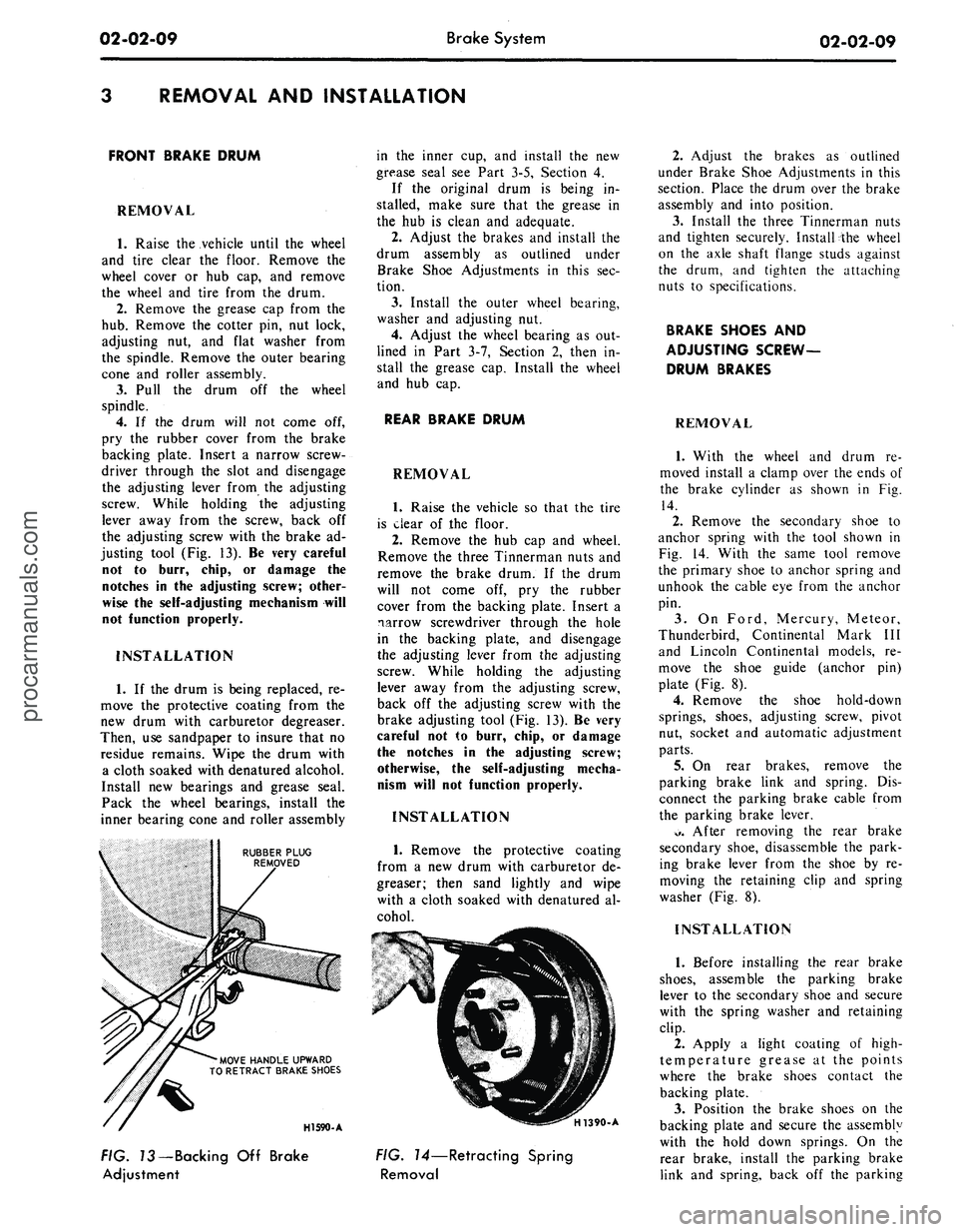
justing tool (Fig. 13). Be very careful
not to burr, chip, or damage the
notches in the adjusting screw; other-
wise the self-adjusting mechanism will
not function properly.
INSTALLATION
1.
If the drum is being replaced, re-
move the protective coating from the
new drum with carburetor degreaser.
Then, use sandpaper to insure that no
residue remains. Wipe the drum with
a cloth soaked with denatured alcohol.
Install new bearings and grease seal.
Pack the wheel bearings, install the
inner bearing cone and roller assembly
RUBBER PLUG
REMOVED
'MOVE HANDLE UPWARD
TO RETRACT BRAKE SHOES
in the inner cup, and install the new
grease seal see Part 3-5, Section 4.
If the original drum is being in-
stalled, make sure that the grease in
the hub is clean and adequate.
2.
Adjust the brakes and install the
drum assembly as outlined under
Brake Shoe Adjustments in this sec-
tion.
3.
Install the outer wheel bearing,
washer and adjusting nut.
4.
Adjust the wheel bearing as out-
lined in Part 3-7, Section 2, then in-
stall the grease cap. Install the wheel
and hub cap.
REAR BRAKE DRUM
REMOVAL
1.
Raise the vehicle so that the tire
is clear of the floor.
2.
Remove the hub cap and wheel.
Remove the three Tinnerman nuts and
remove the brake drum. If the drum
will not come off, pry the rubber
cover from the backing plate. Insert a
narrow screwdriver through the hole
in the backing plate, and disengage
the adjusting lever from the adjusting
screw. While holding the adjusting
lever away from the adjusting screw,
back off the adjusting screw with the
brake adjusting tool (Fig. 13). Be very
careful not to burr, chip, or damage
the notches in the adjusting screw;
otherwise, the self-adjusting mecha-
nism will not function properly.
INSTALLATION
1.
Remove the protective coating
from a new drum with carburetor de-
greaser; then sand lightly and wipe
with a cloth soaked with denatured al-
cohol.
HI 590-A
H1390-A
FIG. 73—Backing Off Brake
Adjustment
FIG. 14—Retracting Spring
Removal
2.
Adjust the brakes as outlined
under Brake Shoe Adjustments in this
section. Place the drum over the brake
assembly and into position.
3.
Install the three Tinnerman nuts
and tighten securely. Install the wheel
on the axle shaft flange studs against
the drum, and tighten the attaching
nuts to specifications.
BRAKE SHOES AND
ADJUSTING SCREW-
DRUM BRAKES
REMOVAL
1.
With the wheel and drum re-
moved install a clamp over the ends of
the brake cylinder as shown in Fig.
14.
2.
Remove the secondary shoe to
anchor spring with the tool shown in
Fig. 14. With the same tool remove
the primary shoe to anchor spring and
unhook the cable eye from the anchor
pin.
3.
On Ford, Mercury, Meteor,
Thunderbird, Continental Mark III
and Lincoln Continental models, re-
move the shoe guide (anchor pin)
plate (Fig. 8).
4.
Remove the shoe hold-down
springs, shoes, adjusting screw, pivot
nut, socket and automatic adjustment
parts.
5.
On rear brakes, remove the
parking brake link and spring. Dis-
connect the parking brake cable from
the parking brake lever.
*>.
After removing the rear brake
secondary shoe, disassemble the park-
ing brake lever from the shoe by re-
moving the retaining clip and spring
washer (Fig. 8).
INSTALLATION
1.
Before installing the rear brake
shoes,
assemble the parking brake
lever to the secondary shoe and secure
with the spring washer and retaining
clip.
2.
Apply a light coating of high-
temperature grease at the points
where the brake shoes contact the
backing plate.
3.
Position the brake shoes on the
backing plate and secure the assembly
with the hold down springs. On the
rear brake, install the parking brake
link and spring, back off the parkingprocarmanuals.com
Page 35 of 413
02-02-16
Brake System
02-02-16
fitting that connects the tube to the
cylinder. Do not pull the metal tube
away from the cylinder. Pulling the
tube out of the cylinder connection
will bend the metal tube and make in-
stallation difficult. The tube will sepa-
rate from the cylinder when the cylin-
der is removed from the backing
plate.
4.
On all except the front wheels on
Ford, Mercury, and Meteor models,
remove the wheel cylinder attaching
bolts and lock washers and remove the
cylinder. On the front wheel of Ford,
Mercury and Meteor models, remove
the nut and washer that attaches the
cylinder to the anchor pin. Remove
the cylinder from the anchor pin.
INSTALLATION
Wipe the end(s) of the hydraulic
line to remove any foreign matter be-
fore making connections.
1.
On all models except Ford, Mer-
cury and Meteor, to install a front
wheel cylinder, position the cylinder to
the backing plate. Install the two lock
washers and attaching bolts. Torque
them to specifications.
On Ford, Mercury and Meteor
models, to install a front wheel cylin-
der, position the cylinder on the an-
chor pin against the backing plate. In-
stall the washer and cylinder attaching
nut on the anchor pin, and torque it
to specification. Lock the washer re-
tainer securely.
2.
Install a new copper gasket over
the hose fitting. Thread the hose into
the cylinder and tighten it to specified
torque.
3.
Engage the opposite end of the
hose to the bracket on the frame. In-
stall the horseshoe-type retaining clip,
and connect the brake tube to the
hose with the tube fitting nut. Tighten
the nut to specification with tool
1112-144.
4.
To install a rear wheel cylinder,
place the rear wheel cylinder into po-
sition. Enter the tubing into the cylin-
der, and start the tube fitting nut into
the threads of the cylinder.
5.
Secure the cylinder to the back-
ing plate by installing the attaching
bolts and lock washers.
6. Tighten the tube fitting nut to
specification with tool 1112-144.
7.
Install the links in the ends of
the wheel cylinder, install the shoes
and adjuster assemblies, and adjust
the shoes as outlined in this section.
8. Adjust the brakes (Part 2-2, Sec-
tion 2). Install the brake drum and
wheel. Bleed the brakes and centralize
the differential valve as outlined in
Part 2-1, Section 2.
BRAKE BACKING PLATE
DRUM BRAKE
REMOVAL
1.
Remove the wheel and brake
drum. Disconnect the brake line from
the brake cylinder.
2.
Remove the brake shoe and ad-
juster assemblies and the wheel cylin-
der as outlined in this section. On the
rear wheels, disconnect the parking
brake lever from the cable.
3.
If the rear backing plate is being
replaced, remove the axle shaft from
the applicable rear axle as outlined in
Group 4, Part 4-2— Rear Axle, Sec-
tion 2, disengage parking brake cable
retainer from backing plate. Remove
the backing plate and gasket.
If the front backing plate is being
replaced, remove the bolts and nuts
that secure the backing plate to the
front wheel spindle and remove the
plate and gasket.
INSTALLATION
If a rear backing plate is to be re-
placed, position a new rear backing
plate and gasket on the attaching
bolts in the axle housing flange. Insert
parking brake cable into backing plate
and secure retaining fingers. Install
the rear axle shaft for applicable rear
axle.
Refer to Group 4, Part 4-2 —
Rear Axle, Section 2 for the proper
installation procedure.
1.
If the front brake backing plate
is to be replaced, position a new front
backing plate and gasket to the wheel
spindle and install the attaching bolts
and nuts.
2.
Install the wheel cylinder and
connect the brake line as outlined in
this section.
3.
Install the brake shoe and ad-
juster assemblies as outlined in this
section. On a rear brake, connect the
parking brake cable to the lever.
4.
Adjust the brake shoes (Section
2),
and install the brake drums and
wheels. Bleed the brake system and
centralize the differential valve as out-
lined in Part 2-1, Section 2.
DISC BRAKE CALIPER
ASSEMBLY
ALL MODELS EXCEPT
LINCOLN CONTINENTAL
Removal
Refer to Figs. 22 and 23.
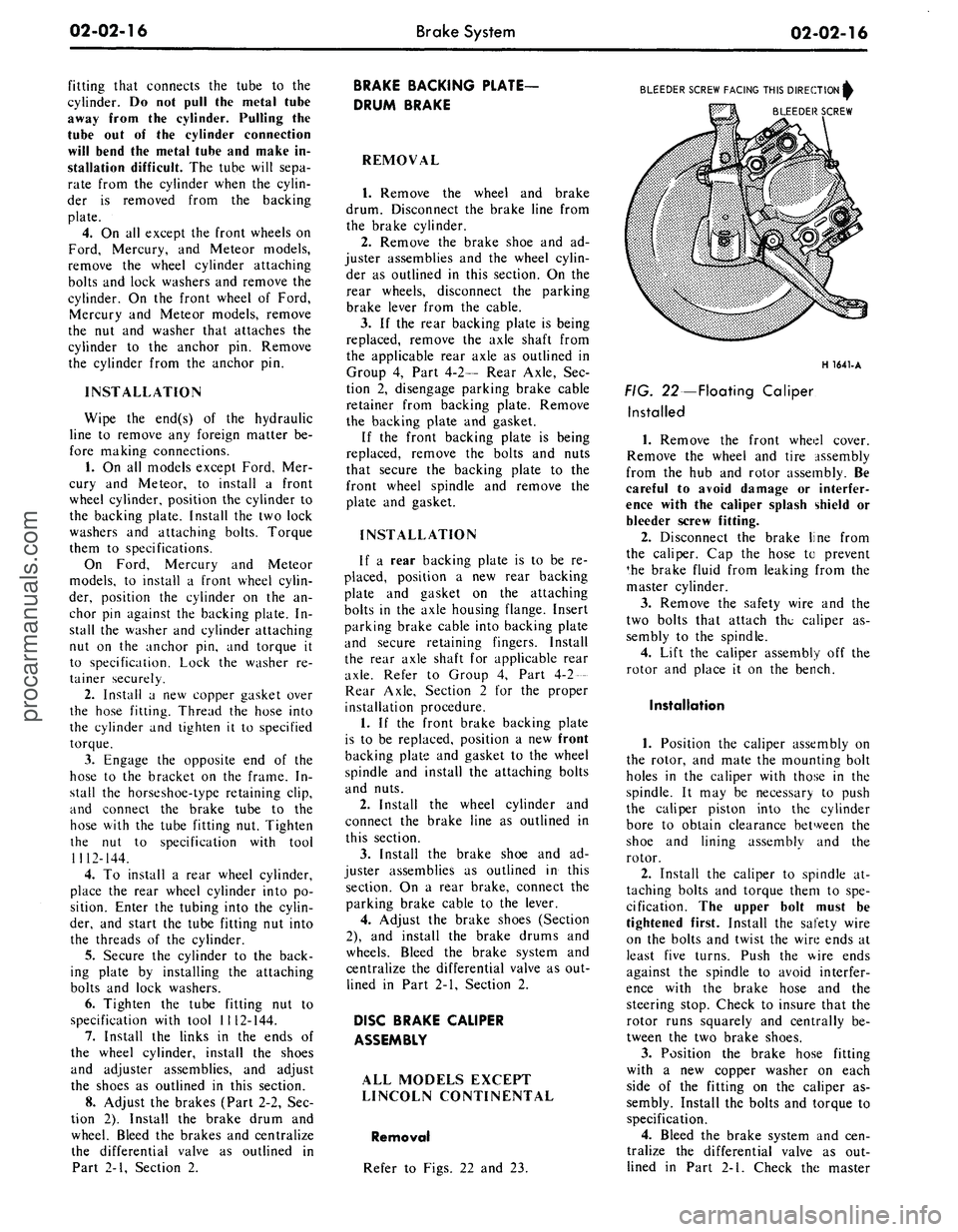
BLEEDER SCREW FACING THIS DIRECTION^
BLEEDER SCREW
H 1641-A
FIG. 22—Floating Caliper
Installed
1.
Remove the front wheel cover.
Remove the wheel and tire assembly
from the hub and rotor assembly. Be
careful to avoid damage or interfer-
ence with the caliper splash shield or
bleeder screw fitting.
2.
Disconnect the brake line from
the caliper. Cap the hose to prevent
*he brake fluid from leaking from the
master cylinder.
3.
Remove the safety wire and the
two bolts that attach the caliper as-
sembly to the spindle.
4.
Lift the caliper assembly off the
rotor and place it on the bench.
Installation
1.
Position the caliper assembly on
the rotor, and mate the mounting bolt
holes in the caliper with those in the
spindle. It may be necessary to push
the caliper piston into the cylinder
bore to obtain clearance between the
shoe and lining assembly and the
rotor.
2.
Install the caliper to spindle at-
taching bolts and torque them to spe-
cification. The upper bolt must be
tightened first. Install the safety wire
on the bolts and twist the wire ends at
least five turns. Push the wire ends
against the spindle to avoid interfer-
ence with the brake hose and the
steering stop. Check to insure that the
rotor runs squarely and centrally be-
tween the two brake shoes.
3.
Position the brake hose fitting
with a new copper washer on each
side of the fitting on the caliper as-
sembly. Install the bolts and torque to
specification.
4.
Bleed the brake system and cen-
tralize the differential valve as out-
lined in Part 2-1. Check the masterprocarmanuals.com