1969 FORD MUSTANG axle
[x] Cancel search: axlePage 205 of 413
04-02-08
Rear Axle — Removable Carrier Type
04-02-08
REMOVAL AND INSTALLATION
CARRIER ASSEMBLY
REMOVAL
1.
Raise the vehicle on a hoist and
remove the two rear wheels and tires.
2.
Remove the two brake drums (3
Tinnerman nuts at each drum) from
the axle shaft flange studs. If diffi-
culty is experienced in removing the
drums, remove the brake adjuster
knockout slug or rubber plug (if so
equipped) and back off the brake
shoes.
3.
Working through the hole pro-
vided in each axle shaft flange, re-
move the nuts that secure the rear
wheel bearing retainer plate. Pull each
axle shaft assembly out of the axle
housing using axle shaft remover,
Tool 4235-C. (Fig. 4). Care must be
exercised to prevent damage to the
production-type synthetic oil seal, if so
equipped. Any roughing or cutting of
the seal element during removal or in-
stallation can result in early seal fail-
ure.
Install a nut on one of the brake
backing plate attaching bolts to hold
the plate to the axle housing after the
shaft has been removed. Whenever a
rear axle shaft is replaced, the wheel
bearing oil seals must be replaced.
Remove the seals with tool 1175AB.
4.
Make scribe marks on the drive
shaft end yoke and the axle U-joint
flange to insure proper position at as-
sembly. Disconnect the drive shaft at
the rear axle U-joint. Hold the cups
on the spider with tape. Mark the
cups so that they will be in their orig-
inal position relative to the flange
when they are assembled. Remove the
drive shaft from the transmission ex-
tension housing. Install an oil seal re-
placer tool in the housing to prevent
transmission leakage. Refer to the
transmission group for the appropriate
tool.
5.
Clean area around carrier to
housing surfaced with a wire brush and
wipe clean, to prevent dirt entry into
the housing. Place a drain pan under
the carrier and housing, remove the
carrier attaching nuts, and drain the
axle.
Remove the carrier assembly
from the axle housing.
INSTALLATION
Synthetic production-type wheel
bearing seals must not be cleaned,
soaked or washed in cleaning solvent.
1.
Clean the axle housing and
shafts using kerosene and swabs. To
avoid contamination of the grease in
the sealed ball bearings, do not allow
any quantity of solvent directly on the
wheel bearings. Clean the mating sur-
faces of the axle housing and carrier.
2.
Position the differential carrier
on the studs in the axle housing using
a new gasket between carrier and
housing. Install the carrier-to-housing
attaching nuts, and torque them to
specifications.
3.
Remove the oil seal replacer tool
from the transmission extension hous-
ing. Position the drive shaft so that
the front U-joint slip yoke splines to
the transmission output shaft.
4.
Connect the drive shaft to the
axle U-joint flange, aligning the scribe
marks made on the drive shaft end
yoke and the axle U-joint flange dur-
ing the removal procedure. Install the
U-bolts and nuts and torque to speci-
fications.
5.
If the synthetic, production-type
wheel bearing seals were replaced with
service-type leather seals, soak the
new rear wheel bearing oil seals in
SAE 10 oil for 1/2 hour before instal-
lation. Wipe a small amount of an oil
resistant sealer on the outer edge of
each seal before it is installed. Do not
put any of the sealer on the sealing
lip.
Install the oil seals in the ends of
the rear axle housing with one of the
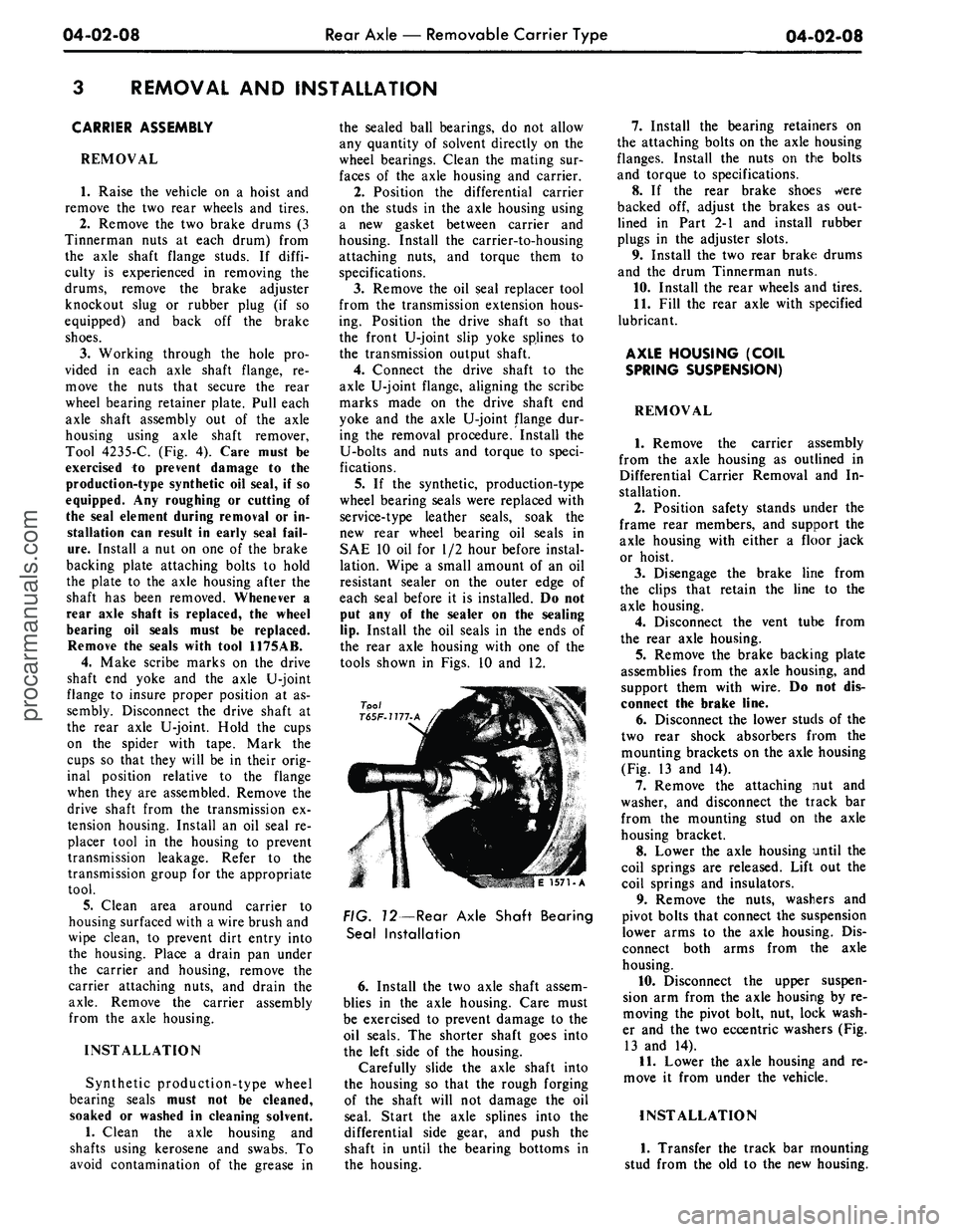
tools shown in Figs. 10 and 12.
Tool
T65F-1177.A
E 1571-A
FIG. 12—Rear Axle Shaft Bearing
Seal Installation
6. Install the two axle shaft assem-
blies in the axle housing. Care must
be exercised to prevent damage to the
oil seals. The shorter shaft goes into
the left side of the housing.
Carefully slide the axle shaft into
the housing so that the rough forging
of the shaft will not damage the oil
seal. Start the axle splines into the
differential side gear, and push the
shaft in until the bearing bottoms in
the housing.
7.
Install the bearing retainers on
the attaching bolts on the axle housing
flanges. Install the nuts on the bolts
and torque to specifications.
8. If the rear brake shoes were
backed off, adjust the brakes as out-
lined in Part 2-1 and install rubber
plugs in the adjuster slots.
9. Install the two rear brake drums
and the drum Tinnerman nuts.
10.
Install the rear wheels and tires.
11.
Fill the rear axle with specified
lubricant.
AXLE HOUSING (COIL
SPRING SUSPENSION)
REMOVAL
1.
Remove the carrier assembly
from the axle housing as outlined in
Differential Carrier Removal and In-
stallation.
2.
Position safety stands under the
frame rear members, and support the
axle housing with either a floor jack
or hoist.
3.
Disengage the brake line from
the clips that retain the line to the
axle housing.
4.
Disconnect the vent tube from
the rear axle housing.
5.
Remove the brake backing plate
assemblies from the axle housing, and
support them with wire. Do not dis-
connect the brake line.
6. Disconnect the lower studs of the
two rear shock absorbers from the
mounting brackets on the axle housing
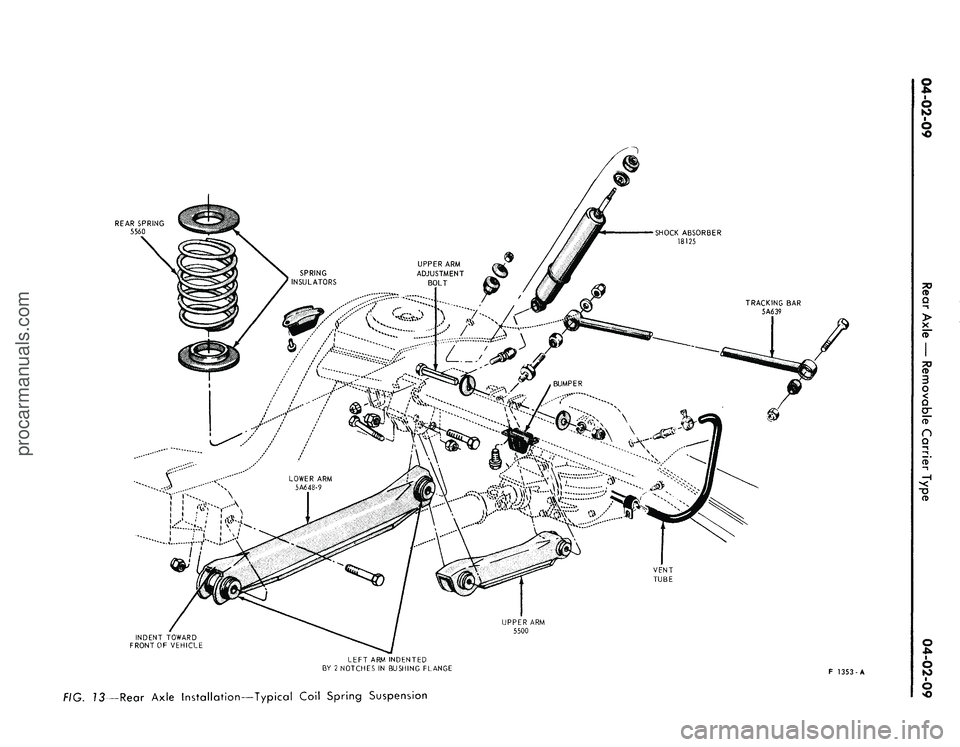
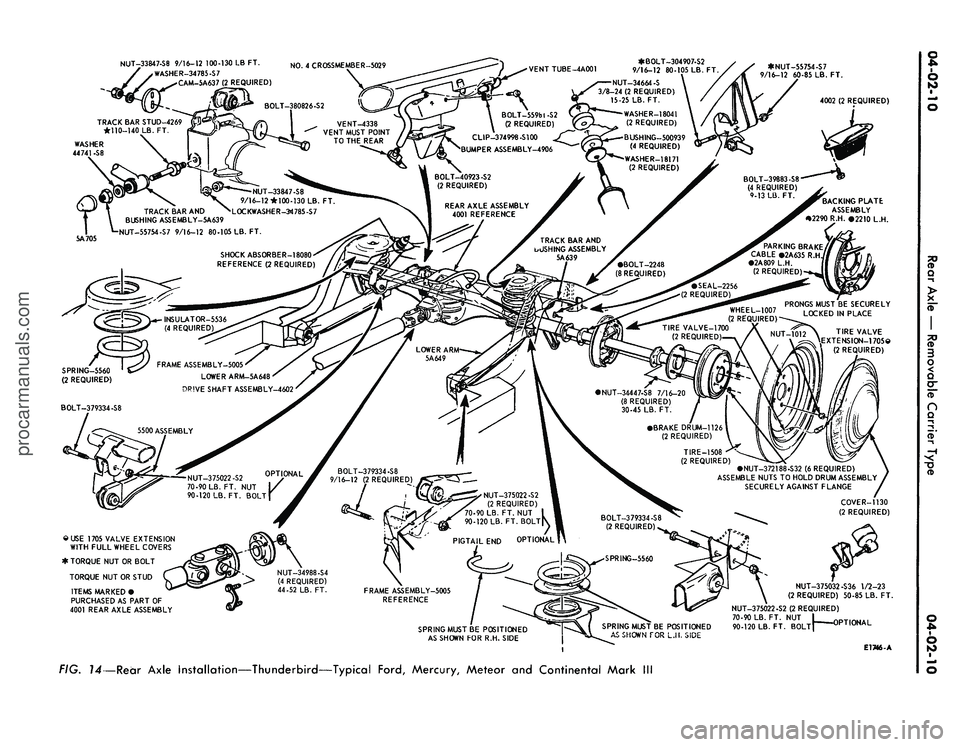
(Fig. 13 and 14).
7.
Remove the attaching nut and
washer, and disconnect the track bar
from the mounting stud on the axle
housing bracket.
8. Lower the axle housing until the
coil springs are released. Lift out the
coil springs and insulators.
9. Remove the nuts, washers and
pivot bolts that connect the suspension
lower arms to the axle housing. Dis-
connect both arms from the axle
housing.
10.
Disconnect the upper suspen-
sion arm from the axle housing by re-
moving the pivot bolt, nut, lock wash-
er and the two eccentric washers (Fig.
13 and 14).
11.
Lower the axle housing and re-
move it from under the vehicle.
INSTALLATION
1.
Transfer the track bar mounting
stud from the old to the new housing.procarmanuals.com
Page 206 of 413
REAR SPRING
5560
VENT
TUBE
INDENT TOWARD
FRONT OF VEHICLE
UPPER ARM
5500
LEFT ARM INDENTED
BY 2 NOTCHES IN BUSHING FLANGE
F 1353-A
f/Q.
J3—Rear Axle Installation—Typical Coil Spring Suspensionprocarmanuals.com
Page 207 of 413
NUT-33847-S8
9/16-12
100-130 LB FT.
*-34785-S7
-CAM-5A637 (2 REQUIRED)
• NUT-55754-S7
9/16-12
60-85 LB. FT.
4002 (2 REQUIRED)
• BOLT-304907-S2
9/16-12
80-105 LB. FT.
NO.
4 CROSSMEMBER-5029
VENT TUBE-4A001
NUT-34664-S
3/8-24
(2 REQUIRED)
15-25 LB. FT.
WASHER-18041
(2 REQUIRED)
BOLT-559bl-S2
(2 REQUIRED)
TRACK BAR STUD-4269
•110-140 LB. FT.
VENT-4338
VENT MUST POINT
TO THE REAR
CLIP-374998-S100
BUMPER ASSEMBLY-4906
BUSHING-500939
(4 REQUIRED)
WASHER-18171
(2 REQUIRED)
BOLT-40923-S2
(2 REQUIRED)
BOLT-39883-S8
(4 REQUIRED)
9-13 LB. FT.
NUT-33847-
9/16-12*100-130
LB. FT
L
OC
KWASHE R -34
785
-S 7
BACKING PLATE
ASSEMBLY
*2290 R.H. #2210 L.H.
REAR AXLE ASSEMBLY
4001 REFERENCE
TRACK BAR AND
BUSHING ASSEMBLY-5A639
NUT-55754-S7
9/16-12
80-105 LB. FT.
TRACK BAR AND
oJSHfNG ASSEMBLY
5A639
PARKING BRAKE
CABLE »2A635 R.H
•2A809 L.H.
(2 REQUIRED)
SHOCK ABSORBER-18080'
REFERENCE (2 REQUIRED)
•BOLT-2248
(8 REQUIRED)
• SEAL-2256
(2 REQUIRED)
PRONGS MUST BE SECURELY
LOCKED IN PLACE
WHEEL-1007
(2 REQUIRED)
INSULATOR-5536
(4 REQUIRED)
TIRE VALVE-1700
(2 REQUIRED
TIRE VALVE
XTENSION-1705©
(2 REQUIRED)
FRAME ASSEMBLY-5005
LOWER ARM-5A648
DRIVE SHAFT ASSEMBLY-4602
SPRING-5560
(2 REQUIRED)
• NUT-34447-S8
7/16-20
(8 REQUIRED)
30-45 LB. FT.
•BRAKE DRUM-1126
(2 REQUIRED)
TIRE-1508
(2 REQUIRED)
• NUT-372188-S32 (6 REQUIRED)
ASSEMBLE NUTS TO HOLD DRUM ASSEMBLY
SECURELY AGAINST FLANGE
BOLT-379334-S8
9/16-12
(2 REQUIRED)
NUT-375022-S2
70-90 LB. FT. NUT
90-120 LB. FT. BOLT
NUT-375022-S2
(2 REQUIRED)
-90 LB. FT. NUT
90-120 LB. FT. BOLT
BOLT-3 79334-S8
(2 REQUIRED)
NUT-34988-S4
(4 REQUIRED)
44-52 LB. FT.
FRAME ASSEMBLY-5005
REFERENCE
2
o
i
O
TO
Q
>
X
TO
O
3
n
Q
©USE 1705 VALVE EXTENSION
WITH FULL WHEEL COVERS
* TORQUE NUT OR BOLT
TORQUE NUT OR STUD
ITEMS MARKED •
PURCHASED AS PART OF
4001 REAR AXLE ASSEMBLY
NUT-375032-S36
1/2-23
(2 REQUIRED) 50-85 LB. FT.
SPRING MUST BE POSITIONED
AS SHOWN FOR R.H. SIDE
SPRING MUST BE POSITIONED
AS SHOWN FOR L.H. SiDE
NUT-375022-S2 (2 REQUIRED)
70-90 LB. FT. NUT
90-120 LB. FT. BOLTl
TIONAL
El 746-A
?
6
FIG. 14—Redr Axle Installation—Thunderbird—Typical Ford, Mercury, Meteor and Continental Markprocarmanuals.com
Page 208 of 413
04-02-11
Rear Axle — Removable Carrier Type
04-02-11
If the axle housing is new, install a
new vent. The hose attaching portion
must face toward the front of the ve-
hicle.
2.
If leather-type wheel bearing ser-
vice seals are to be installed, soak the
new rear wheel bearing oil seals in
SAE 10 oil for 1/2 hour before instal-
lation. Wipe a small amount of an oil
resistant sealer on the outer edge of
each seal before it is installed. Do not
put any of the sealer on the sealing
lip.
Install the oil seals in the ends of
the axle housing with one of the tools
shown in Fig. 10 and 12.
3.
Position the replacement axle
housing under the vehicle, and raise
the axle with a hoist or floor jack.
Connect the suspension lower arms to
their mounting brackets on the axle
housing with pivot bolts and nuts. Do
not tighten the bolts and nuts at this
point.
4.
Position the suspension upper
arm in its mounting bracket on the
axle housing, and install the adjusting
bolt, eccentric washers, lock washer
and nut. Leave the bolt and nut loose
at this point.
5.
Position the brake lines to the
axle housing, and secure with the re-
taining clips.
6. Install the brake backing plates
on the axle housing flanges.
7.
Connect the track bar to the
mounting stud, install the washer and
attaching nut, and torque to specifica-
tions.
8. Position the rear coil springs and
insulators in the pockets provided.
9. Connect the lower studs of the
two rear shock absorbers to the
mounting brackets on the axle hous-
ing. Install the attaching nuts, and
torque to specifications.
10.
Connect the vent tube to the
vent on the housing. If axle housing is
new, install a new vent.
11.
Clean the mating surfaces of
the axle housing and differential car-
rier. Position the carrier on the
mounting studs on the housing using a
new gasket between carrier and hous-
ing. Install the copper washers and the
carrier-to-housing attaching nuts, and
torque to specifications.
12.
Make sure that both the front
and rear pivot bolts of the upper and
the two lower arms are loose, and
then raise the axle assembly to con-
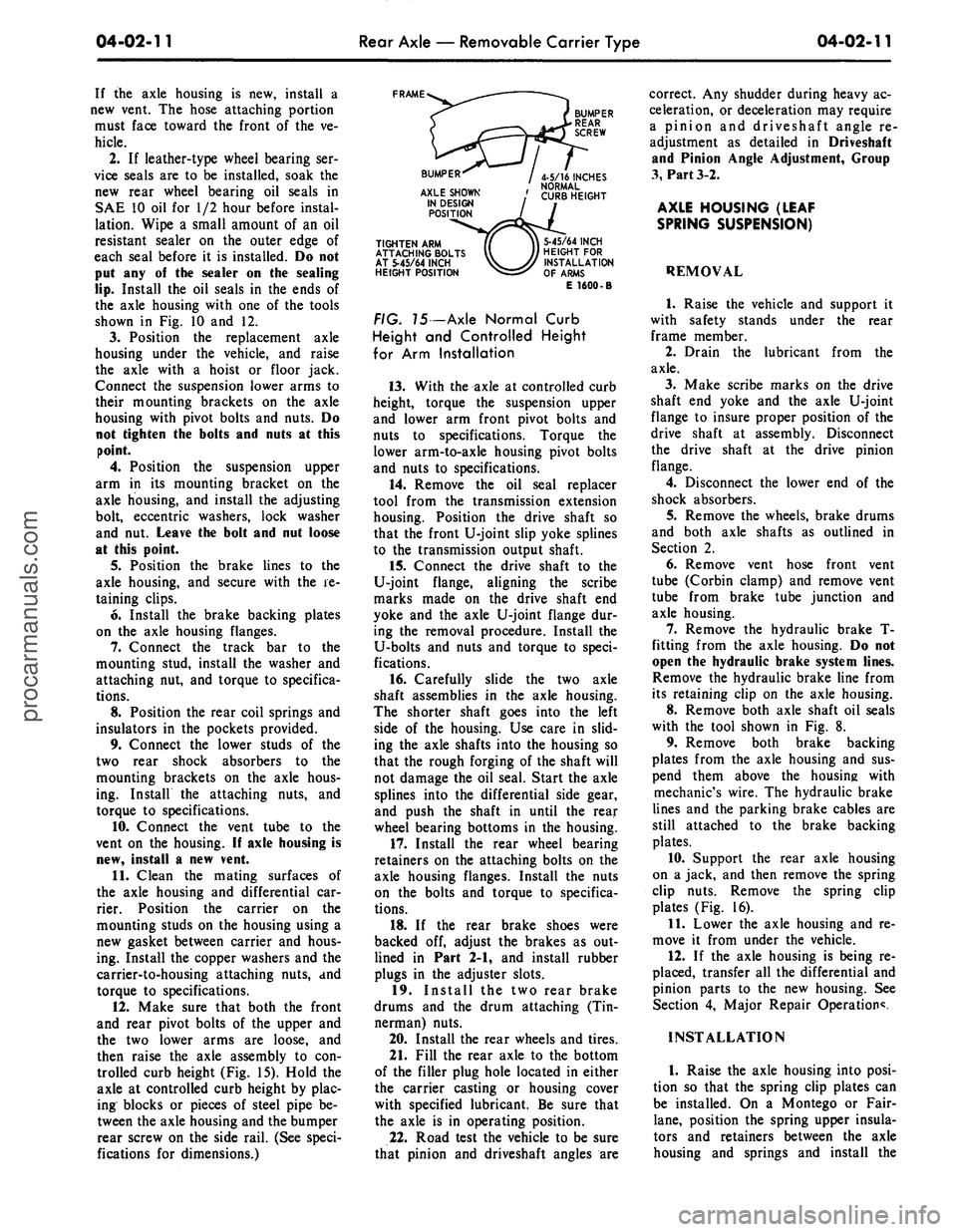
trolled curb height (Fig. 15). Hold the
axle at controlled curb height by plac-
ing blocks or pieces of steel pipe be-
tween the axle housing and the bumper
rear screw on the side rail. (See speci-
fications for dimensions.)
FRAME
TIGHTEN ARM
ATTACHING BOLTS
AT 5-45/64 INCH
HEIGHT POSITION
5-45/64 INCH
HEIGHT FOR
INSTALLATION
OF ARMS
E 1600-B
FIG. 75 -Axle Normal Curb
Height and Controlled Height
for Arm Installation
13.
With the axle at controlled curb
height, torque the suspension upper
and lower arm front pivot bolts and
nuts to specifications. Torque the
lower arm-to-axle housing pivot bolts
and nuts to specifications.
14.
Remove the oil seal replacer
tool from the transmission extension
housing. Position the drive shaft so
that the front U-joint slip yoke splines
to the transmission output shaft.
15.
Connect the drive shaft to the
U-joint flange, aligning the scribe
marks made on the drive shaft end
yoke and the axle U-joint flange dur-
ing the removal procedure. Install the
U-bolts and nuts and torque to speci-
fications.
16.
Carefully slide the two axle
shaft assemblies in the axle housing.
The shorter shaft goes into the left
side of the housing. Use care in slid-
ing the axle shafts into the housing so
that the rough forging of the shaft will
not damage the oil seal. Start the axle
splines into the differential side gear,
and push the shaft in until the rear
wheel bearing bottoms in the housing.
17.
Install the rear wheel bearing
retainers on the attaching bolts on the
axle housing flanges. Install the nuts
on the bolts and torque to specifica-
tions.
18.
If the rear brake shoes were
backed off, adjust the brakes as out-
lined in Part 2-1, and install rubber
plugs in the adjuster slots.
19.
Install the two rear brake
drums and the drum attaching (Tin-
nerman) nuts.
20.
Install the rear wheels and tires.
21.
Fill the rear axle to the bottom
of the filler plug hole located in either
the carrier casting or housing cover
with specified lubricant. Be sure that
the axle is in operating position.
22.
Road test the vehicle to be sure
that pinion and driveshaft angles are
correct. Any shudder during heavy ac-
celeration, or deceleration may require
a pinion and driveshaft angle re-
adjustment as detailed in Driveshaft
and Pinion Angle Adjustment, Group
3,
Part 3-2.
AXLE HOUSING (LEAF
SPRING SUSPENSION)
REMOVAL
1.
Raise the vehicle and support it
with safety stands under the rear
frame member.
2.
Drain the lubricant from the
axle.
3.
Make scribe marks on the drive
shaft end yoke and the axle U-joint
flange to insure proper position of the
drive shaft at assembly. Disconnect
the drive shaft at the drive pinion
flange.
4.
Disconnect the lower end of the
shock absorbers.
5.
Remove the wheels, brake drums
and both axle shafts as outlined in
Section 2.
6. Remove vent hose front vent
tube (Corbin clamp) and remove vent
tube from brake tube junction and
axle housing.
7.
Remove the hydraulic brake T-
fitting from the axle housing. Do not
open the hydraulic brake system lines.
Remove the hydraulic brake line from
its retaining clip on the axle housing.
8. Remove both axle shaft oil seals
with the tool shown in Fig. 8.
9. Remove both brake backing
plates from the axle housing and sus-
pend them above the housing with
mechanic's wire. The hydraulic brake
lines and the parking brake cables are
still attached to the brake backing
plates.
10.
Support the rear axle housing
on a jack, and then remove the spring
clip nuts. Remove the spring clip
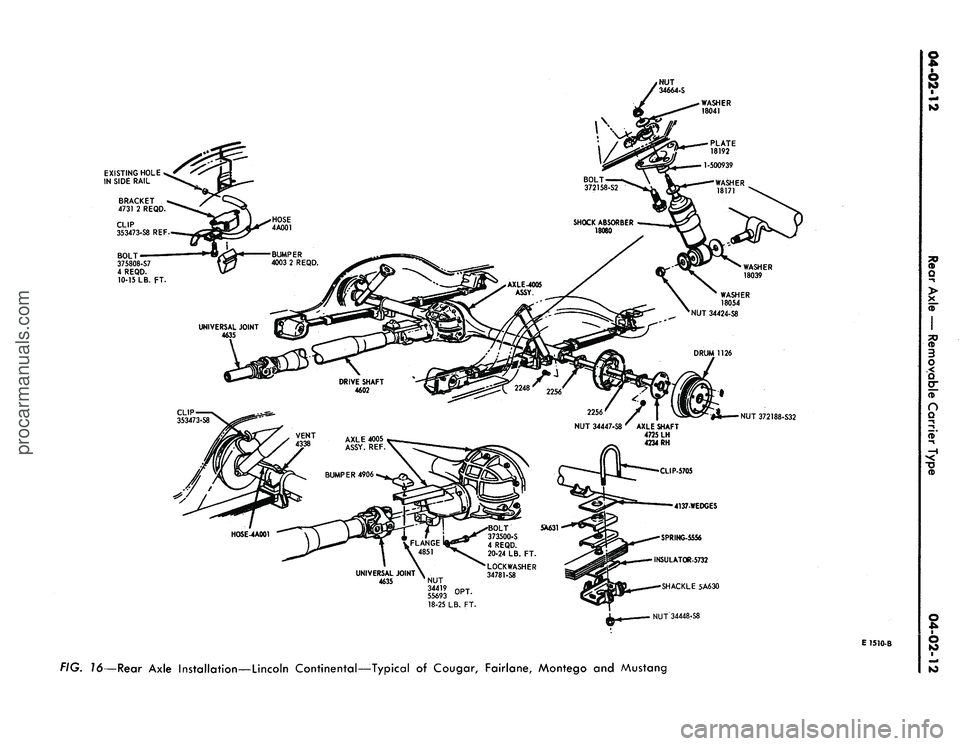
plates (Fig. 16).
11.
Lower the axle housing and re-
move it from under the vehicle.
12.
If the axle housing is being re-
placed, transfer all the differential and
pinion parts to the new housing. See
Section 4, Major Repair Operation*.
INSTALLATION
1.
Raise the axle housing into posi-
tion so that the spring clip plates can
be installed. On a Montego or Fair-
lane,
position the spring upper insula-
tors and retainers between the axle
housing and springs and install theprocarmanuals.com
Page 209 of 413
WASHER
18041
EXISTING
HOLE
IN
SIDE RAIL
#1
NUT 372188-
S32
4137-WEDGES
SPRING-5556
INSULATOR-5732
SHACKLE
5A630
NUT34448-S8
E
1510-B
FIG. 16—Rear Axle Installation—Lincoln Continental—-Typical of Cougar, Fairlane, Montego and Mustangprocarmanuals.com
Page 210 of 413
04-02-13
Rear Axle
—
Removable Carrier Type
04-02-13
lower insulators. Torque
the
spring
clip nuts
to
specification.
2.
Place
the
brake backing plates
in
their normal position
on the
axle
housing.
3.
Install
new
axle shaft
oil
seals
with
the
tool shown
in Fig. 10.
Soak
the
new
seals
in
light weight engine
oil
(SAE
10) for 1/2
hour before install-
ing them. Installation without
use of
the proper tool will distort
the
seal
and cause leakage. Coat
the
outside
edges
of the new oil
seal with
a non-
hardening type
of
sealer such
as Per-
matex
No. 2 or its
equivalent.
4.
Install
the
axle shafts, brake
drums
and
wheels
as
outlined
in Sec-
tion
2.
5.
Attach
the
hydraulic brake line
T fitting
to the
axle housing,
and se-
cure
the
hydraulic brake line
in its re-
tainer
on the
axle housing.
6. Install vent tube
to
brake tube
junction
and
install vent hose
to
vent
tube.
7.
Raise
the
axle housing
and con-
nect
the
shock absorbers.
8. Connect
the
rear
end of the
drive
shaft
to the
axle U-joint flange, align-
ing
the
scribe marks made
on the
drive shaft
end
yoke
and the
axle
U-
joint flange.
9. Fill
the
axle with
the
proper
grade
and
amount
of
lubricant.
10.
Road test
the
vehicle.
MAJOR REPAIR OPERATIONS
DISASSEMBLY
OF
DIFFERENTIAL CARRIER
CONVENTIONAL
DIFFERENTIAL
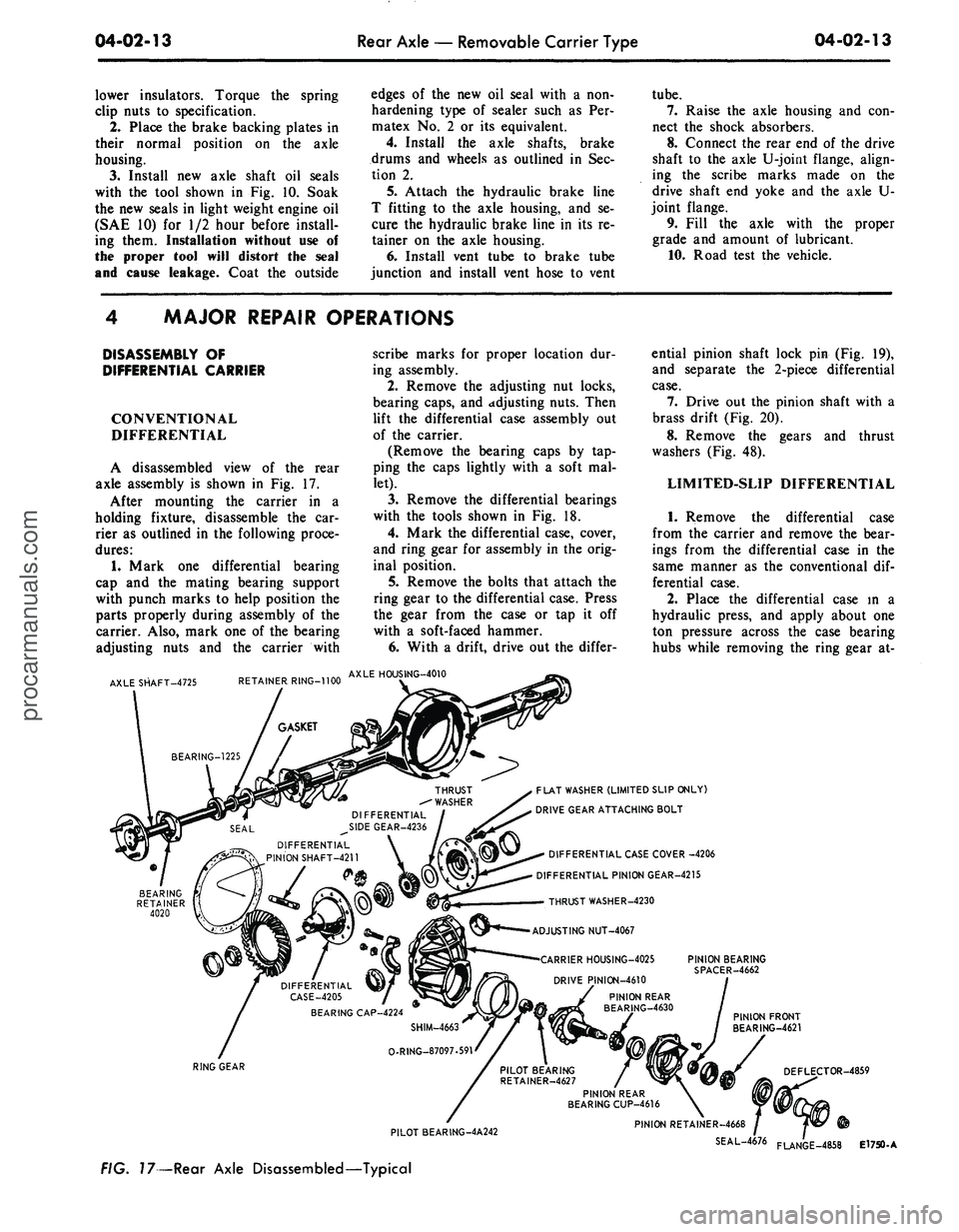
A disassembled view
of the
rear
axle assembly
is
shown
in Fig. 17.
After mounting
the
carrier
in a
holding fixture, disassemble
the car-
rier
as
outlined
in the
following proce-
dures:
1.
Mark
one
differential bearing
cap
and the
mating bearing support
with punch marks
to
help position
the
parts properly during assembly
of the
carrier. Also, mark
one of the
bearing
adjusting nuts
and the
carrier with
AXLE SHAFT-4725
RETAINER RING-1100
scribe marks
for
proper location
dur-
ing assembly.
2.
Remove
the
adjusting
nut
locks,
bearing caps,
and
adjusting nuts. Then
lift
the
differential case assembly
out
of
the
carrier.
(Remove
the
bearing caps
by tap-
ping
the
caps lightly with
a
soft
mal-
let).
3.
Remove
the
differential bearings
with
the
tools shown
in Fig. 18.
4.
Mark
the
differential case, cover,
and ring gear
for
assembly
in the
orig-
inal position.
5.
Remove
the
bolts that attach
the
ring gear
to the
differential case. Press
the gear from
the
case
or tap it off
with
a
soft-faced hammer.
6. With
a
drift, drive
out the
differ-
AXLE HOUSING-4010
DIFFERENTIAL
PINION SHAFT-4211
ential pinion shaft lock
pin (Fig. 19),
and separate
the
2-piece differential
case.
7.
Drive
out the
pinion shaft with
a
brass drift
(Fig. 20).
8. Remove
the
gears
and
thrust
washers
(Fig. 48).
LIMITED-SLIP DIFFERENTIAL
1.
Remove
the
differential case
from
the
carrier
and
remove
the
bear-
ings from
the
differential case
in the
same manner
as the
conventional
dif-
ferential case.
2.
Place
the
differential case
in a
hydraulic press,
and
apply about
one
ton pressure across
the
case bearing
hubs while removing
the
ring gear
at-
FLAT WASHER (LIMITED SLIP ONLY)
DRIVE GEAR ATTACHING BOLT
DIFFERENTIAL CASE COVER -4206
DIFFERENTIAL PINION GEAR-4215
THRUST WASHER-4230
ADJUSTING NUT-4067
CARRIER HOUSING-4025
DRIVE PINION-4610
PINION BEARING
SPACER-4662
PINION FRONT
BEARING-4621
RING GEAR
PILOT BEARING-4A242
FIG. 17—Rear Axle Disassembled—Typical
PILOT BEARING
RETAINER-4627
PINION REAR
BEARING CUP-4616
DEFLECTOR-4859
PINION RETAINER-4668
SEAL-4676
FLANGE_4858
E1750-Aprocarmanuals.com
Page 211 of 413

04-02-14
Rear Axle
—
Removable Carrier Type
04-02-14
DIFFERENTIAL
BEARING
Tool—
7
571-4220-A
T66P°4220-P
E1015-B
FIG. 18—Removing Differential
Bearing—Ford
taching bolts. Applying pressure will
contain
the
spring pressure between
the differential case
and
cover until
after
the
bolts
are
removed,
and
there-
by prevent stripping
of the
threads.
3.
Release
the
hydraulic press
ram,
and remove differential case cover.
4.
Remove
the
Belleville spring
(Fig.
54).
5.
Remove
the
steel
and the
bonded
clutch plates.
6. Remove
the
differential clutch
hub,
side gear,
and
thrust washer.
7.
Remove
the
ring gear from
the
differential case.
8. Drive
out the
differential pinion
shaft lock
pin.
9. With
a
brass drift, drive
out the
differential pinion shaft. Then remove
the pinion gears,
the
other side gear,
and thrust washers.
E 1724-A
FIG. 20—Driving
Out
Differential
Pinion Shaft
TRACTION-LOK
DIFFERENTIAL
1.
Remove
the
differential case
from
the
carrier
and
remove
the
bear-
ings from
the
differential case
in the
same manner
as the
conventional
dif-
ferential case.
2.
Remove
ten
bolts securing
the
ring gear
to the
differential case
as-
sembly.
The
ring gear must
be re-
moved
in
order
to
separate
the
case
halves.
3.
Remove
the
ring gear
by
tapping
the gear with
a
soft hammer
or
press
the gear from
the
case.
4.
Place
the
differential case
in a
press
to
load
the
bearing journals
so
that
the
pre-load
of the
springs
is ov-
ercome (approx.
1,500
lbs.).
(If a
press
is not
available,
two 7/16
inch
bolts
and
nuts
can be
used
in the
ring
gear mounting holes
(one on
each
side)
to
compress
the
case halves
to-
gether
and
overcome pre-load spring
tension.) Then, while
the
case
is
still
under pressure, loosen
the two
Allen
or Phillips head screws which hold
the
case halves together until
one or two
threads
of the
screws remain engaged.
Remove
the
case assembly from
the
press.
Tap on the
cover
to
spring
it
loose; then, remove both screws.
5.
With
the
cover facing down, lift
off
the
case. Remove
the
pre-load
spring plate
and
four pre-load springs.
6. From
the
cover remove
the
side
gear, four clutch plate
ear
guides,
clutch
hub,
friction
and
steel clutch
plates
and
shim(s).
7.
With
a
suitable drift, drive
out
the pinion shaft lock pins from
the
case.
8. With
a
brass drift, drive
out the
long pinion shaft from
the
case. Drive
from
the end
opposite
the
lock
pin
hole.
9. Remove
the two
short pinion
shafts using
a
drift, driving each shaft
from
the
center outward. Lift
out the
center block, then remove
the
pinion
gears,
thrust washers
and
side gear
and thrust washer.
10.
If the
differential bearings
are
removed,
the
bearings
can be
installed
in
one of the
following ways:
a. With
the
differential case
and
cover completely assembled.
b.
On the
case
or
cover when disas-
sembled. However, when pressing
the
bearings
on the
cover,
a
block
of
wood
or
fiber must
be
used
as
shown
in Fig.
21 in
order
to
avoid damage
to
the cover.
E 1709-A
FIG. 79—Removing Differential
Pinion Shaft Lock
Pin
DIFFERENTIAL BEARING
E1892-A
FIG. 21—Installing Differential Bearing—Traction-Lokprocarmanuals.com
Page 212 of 413
04-02-15
Rear
Axle — Removable Carrier Type
04-02-15
REMOVAL AND
DISASSEMBLY OF
DRIVE PINION AND
BEARING RETAINER
I. Turn the carrier assembly
upright and remove the pinion shaft
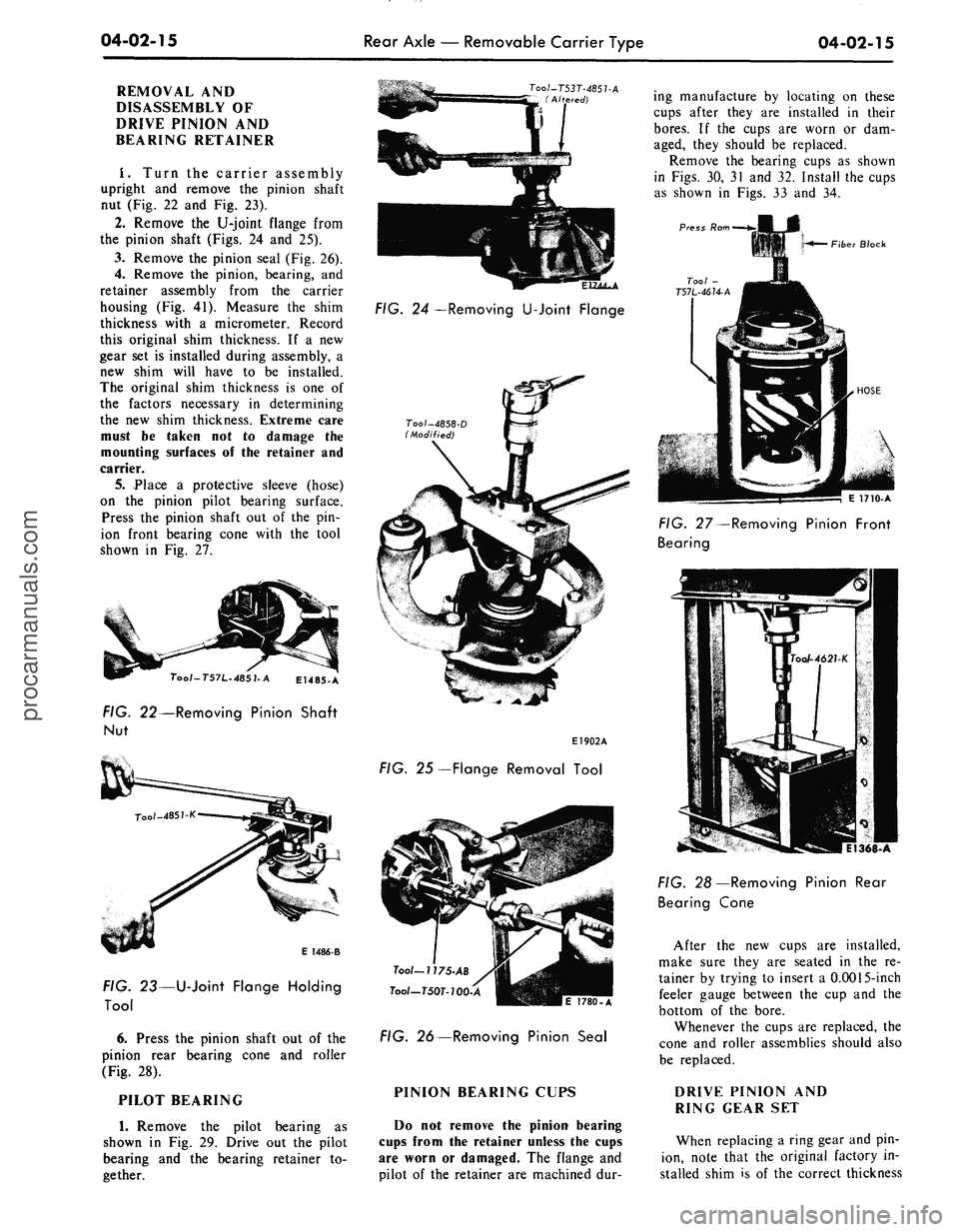
nut (Fig. 22 and Fig. 23).
2.
Remove the U-joint flange from
the pinion shaft (Figs. 24 and 25).
3.
Remove the pinion seal (Fig. 26).
4.
Remove the pinion, bearing, and
retainer assembly from the carrier
housing (Fig. 41). Measure the shim
thickness with a micrometer. Record
this original shim thickness. If a new
gear set is installed during assembly, a
new shim will have to be installed.
The original shim thickness is one of
the factors necessary in determining
the new shim thickness. Extreme care
must be taken not to damage the
mounting surfaces of the retainer and
carrier.
5. Place a protective sleeve (hose)
on the pinion pilot bearing surface.
Press the pinion shaft out of the pin-
ion front bearing cone with the tool
shown in Fig. 27.
O/-T57L-485
7-A
E1485-A
FIG.
22—Removing Pinion Shaft
Nut
E 1486-B
FIG. 23—
U-Joint Flange Holding
Tool
6. Press the pinion shaft out of the
pinion rear bearing cone and roller
(Fig. 28).
PILOT BEARING
1.
Remove the pilot bearing as
shown in Fig. 29. Drive out the pilot
bearing and the bearing retainer to-
gether.
FIG.
24 —
Removing
U-Joint Flange
E1902A
FIG.
25 —Flange Removal Tool
Tool-
7 7
75-AB
Tool—T50T-100-A
|E
1780.
A
FIG.
26—Removing Pinion Seal
PINION BEARING CUPS
Do not remove the pinion bearing
cups from the retainer unless the cups
are worn or damaged. The flange and
pilot of the retainer are machined dur-
ing manufacture by locating on these
cups after they are installed in their
bores.
If the cups are worn or dam-
aged, they should be replaced.
Remove the bearing cups as shown
in Figs. 30, 31 and 32. Install the cups
as shown in Figs. 33 and 34.
Press
Ram
Tool
-
757L-4674-A
Fiber Block
HOSE
\
1710-A
FIG.
27
Bearing
-Removing
Pinion Front
FIG.
28 —Removing Pinion Rear
Bearing
Cone
After the new cups are installed,
make sure they are seated in the re-
tainer by trying to insert a 0.0015-inch
feeler gauge between the cup and the
bottom of the bore.
Whenever the cups are replaced, the
cone and roller assemblies should also
be replaced.
DRIVE PINION AND
RING GEAR SET
When replacing a ring gear and pin-
ion, note that the original factory in-
stalled shim is of the correct thicknessprocarmanuals.com