1969 FORD MUSTANG drain bolt
[x] Cancel search: drain boltPage 226 of 413
04-03-06
Rear Axles — Integral Carrier Type
04-03-06
9. Install a new integral nut and
ivasher on the pinion shaft. (Apply a
small amount of lubricant on the
washer side of the nut.)
10.
Hold the flange with the tool
shown in Fig. 9 while the nut is being
tightened.
11.
Tighten the pinion shaft nut,
rotating the pinion occasionally to in-
sure proper bearing seating, (Fig. 6)
and take frequent preload readings
until the preload is at the original rec-
orded reading established in step 3.
12.
After original preload has been
reached, tighten the pinion nut slowly,
until an additional preload of 6 to 12
in-lbs has been added.
The preload should not exceed the
amount shown above, or bearing fail-
ure may result.
Under no circumstances should the
pinion nut be backed off to lessen pre-
load. If this is done, a new pinion
bearing spacer must be installed. (In
addition, the U-joint flange must
never be hammered on, or pneumatic-
-tools used.)
13.
Remove the oil seal replacer
tool from the transmission extension
housing. Install the front end of the
drive shaft on the transmission output
shaft.
14.
Connect the rear end of the
drive shaft to the axle U-joint flange,
aligning the scribe marks made on the
drive shaft end yoke and the axle U-
joint flange (Fig. 14).
15.
Check the lubricant level. Make
sure the axle is in running position.
Add whatever amount of specified lu-
bricant is required to reach the lower
edge of the filler plug hole, located in
the carrier casting or housing cover.
REMOVAL AND INSTALLATION
REAR AXLE HOUSING
REMOVAL
1.
Raise the vehicle and support it
with safety stands under the rear
frame member.
2.
Drain the lubricant from the
axle.
3.
Make scribe marks on the drive
shaft end yoke and the axle U-joint
flange to insure proper position of the
drive shaft at assembly (Fig. 14). Dis-
connect the drive shaft at the drive
pinion flange.
4.
Disconnect the lower end of the
shock absorbers.
5.
Remove the wheels, brake drums
and both axle shafts as outlined in the
foregoing Section 2.
6. Remove vent hose front vent
tube (Corbin clamp) and remove vent
tube from brake tube junction and
axle housing.
7.
Remove the hydraulic brake T-
fitting from the axle housing. Do not
open the hydraulic brake system lines.
Remove the hydraulic brake line from
its retaining clip on the axle housing.
8. Remove both axle shaft oil seals
with the tools shown in Fig. 8.
9. Remove both brake backing
plates from the axle housing and sus-
pend them above the housing with me-
chanic's wire. The hydraulic brake
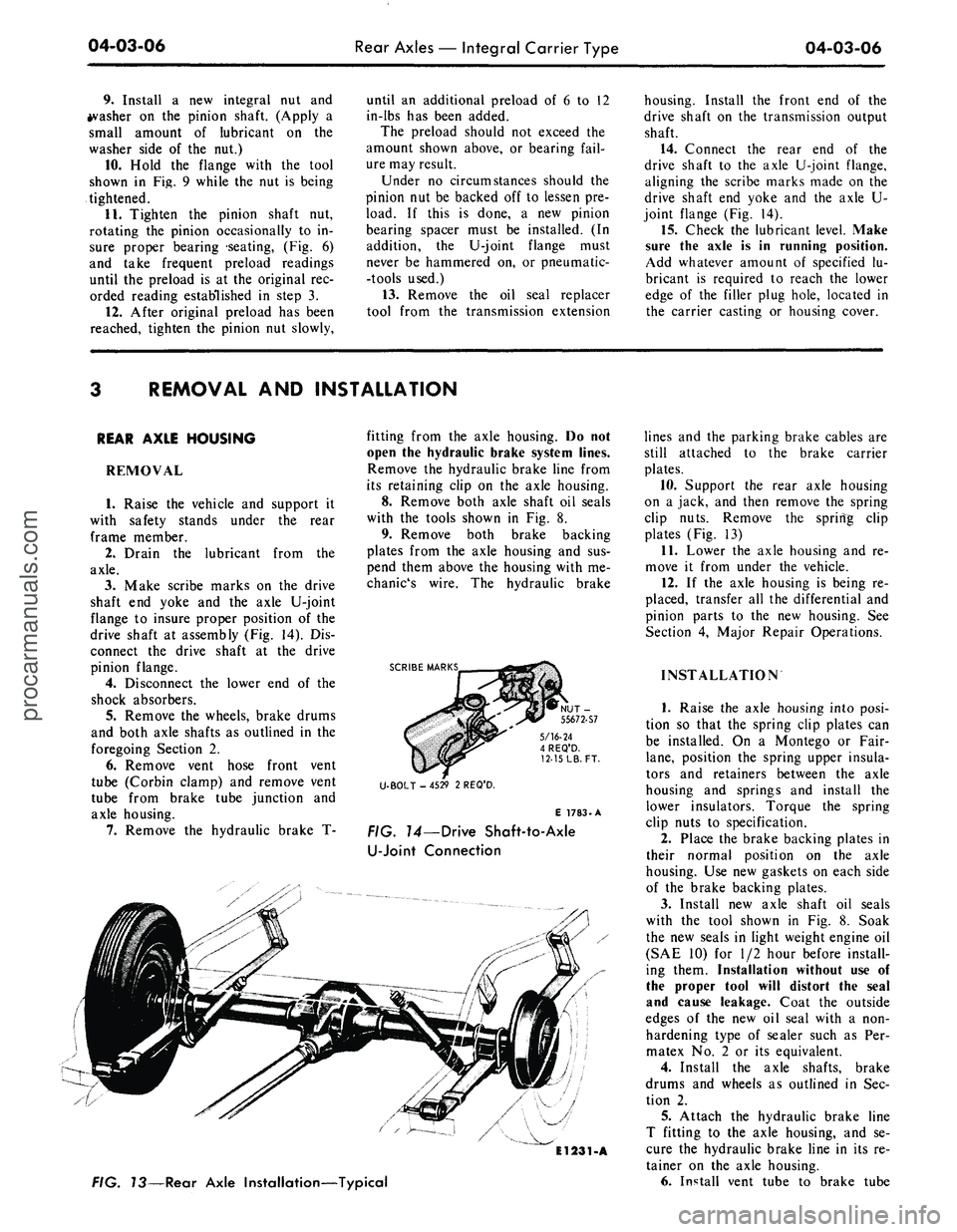
SCRIBE MARKS
5/16-24
4 REQ'D.
12-15
LB.
FT.
U-BOLT - 4529 2 REQ'D.
E 1783-A
FIG. 14—Drive Shaft-to-Axle
U-Joint
Connection
El231-A
FIG. 73—Rear Axle Installation—Typical
lines and the parking brake cables are
still attached to the brake carrier
plates.
10.
Support the rear axle housing
on a jack, and then remove the spring
clip nuts. Remove the spring clip
plates (Fig. 13)
11.
Lower the axle housing and re-
move it from under the vehicle.
12.
If the axle housing is being re-
placed, transfer all the differential and
pinion parts to the new housing. See
Section 4, Major Repair Operations.
INSTALLATION
1.
Raise the axle housing into posi-
tion so that the spring clip plates can
be installed. On a Montego or Fair-
lane,
position the spring upper insula-
tors and retainers between the axle
housing and springs and install the
lower insulators. Torque the spring
clip nuts to specification.
2.
Place the brake backing plates in
their normal position on the axle
housing. Use new gaskets on each side
of the brake backing plates.
3.
Install new axle shaft oil seals
with the tool shown in Fig. 8. Soak
the new seals in light weight engine oil
(SAE 10) for 1/2 hour before install-
ing them. Installation without use of
the proper tool will distort the seal
and cause leakage. Coat the outside
edges of the new oil seal with a non-
hardening type of sealer such as Per-
matex No. 2 or its equivalent.
4.
Install the axle shafts, brake
drums and wheels as outlined in Sec-
tion 2.
5.
Attach the hydraulic brake line
T fitting to the axle housing, and se-
cure the hydraulic brake line in its re-
tainer on the axle housing.
6. Install vent tube to brake tubeprocarmanuals.com
Page 227 of 413
04-03-07
Rear Axles — Integral Carrier Type
04-03-07
junction and install vent hose to vent
tube.
7.
Raise the axle housing and con-
nect the shock absorbers.
8. Connect the rear end of the drive
shaft to the axle U-joint flange, align-
ing the scribe marks made on the
drive shaft end yoke and the axle U-
joint flange (Fig. 14).
9. Fill the axle with the proper
grade and amount of lubricant.
10.
Road test the vehicle.
MAJOR REPAIR OPERATIONS
DISASSEMBLY
All service operations on the differ-
ential case assembly and the drive pin-
ion assembly can be performed with
the housing in the vehicle.
REMOVAL OF
DIFFERENTIAL
CASE AND DRIVE PINION
1.
Raise the vehicle and support it
on the underbody, so that the rear
axle drops down as far as the springs
and shock absorbers permit.
2.
Remove the cover from the car-
rier casting rear face, and drain the
lubricant.
3.
Perform the Inspection Before
Disassembly of Carrier in Part 4-1,
Section 3.
4.
Remove both rear wheels.
5.
Remove the brake drums.
6. Working through the hole pro-
vided in the axle shaft flange, remove
the nuts that attach the wheel bearing
retainers to the axle housing.
7.
Pull the axle shafts with the tool
shown in Fig. 2. Care must be exer-
cised to prevent damage to the oil
seals.
Install a nut on one of the brake
backing plate attaching bolts to hold
the plate to the axle housing after the
shaft has been removed. Remove both
seals with the tool shown in Fig. 8.
8. Make scribe marks on the drive
shaft end yoke and the axle U-joint
flange to insure proper position of the
drive shaft at assembly (Fig. 14). Dis-
connect the drive shaft from the axle
U-joint flange. Be careful to avoid
dropping the loose universal joint
bearing cups. Hold the cups on the
spider with tape. Mark the cups so
that they will be in their original posi-
tion in relation to the flange when
they are assembled. Remove the drive
shaft from the transmission extension
housing. Install an oil seal replacer
tool in the transmission extension
housing to prevent transmission leak-
age.
Refer to the transmission group
for the appropriate tool.
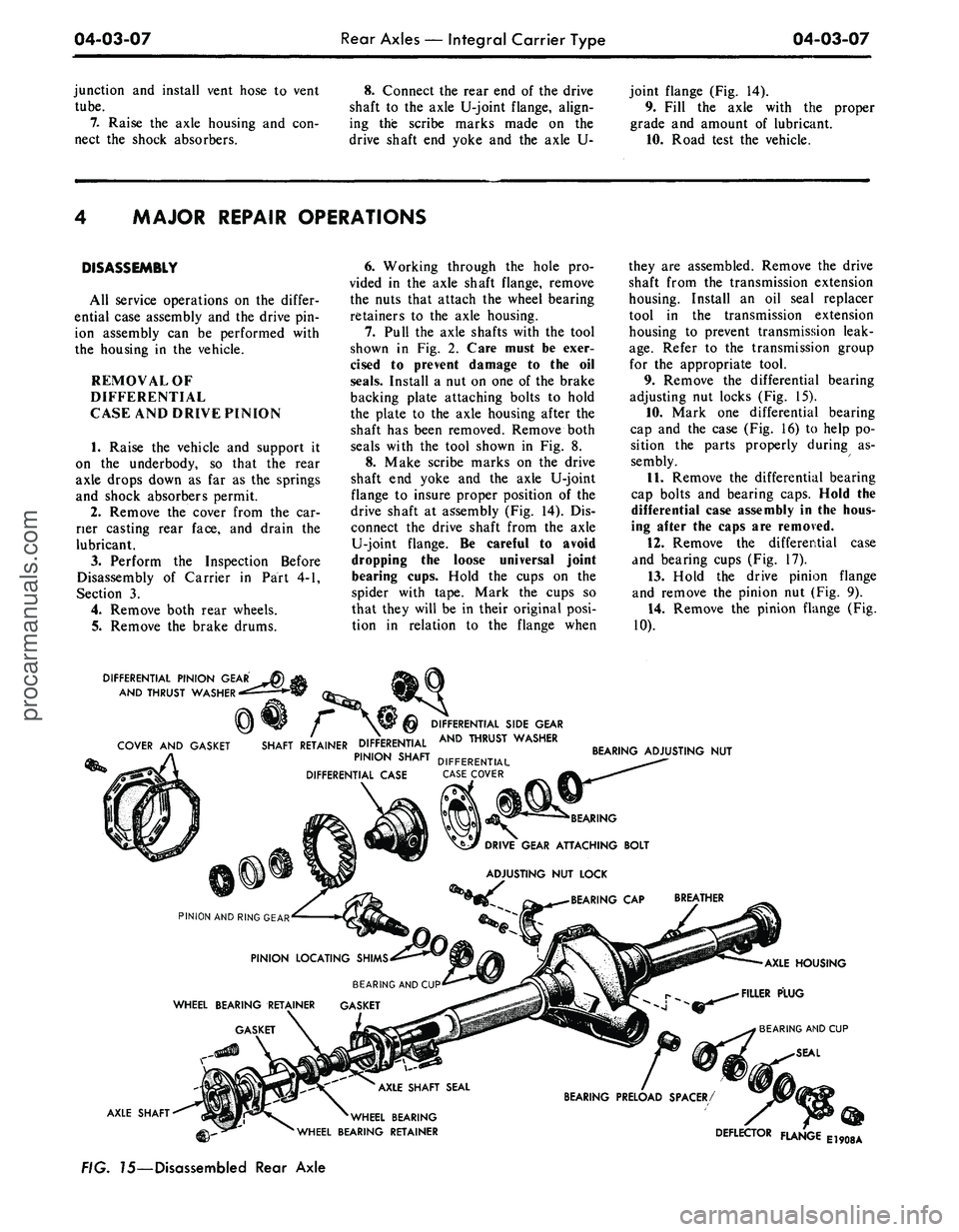
9. Remove the differential bearing
adjusting nut locks (Fig. 15).
10.
Mark one differential bearing
cap and the case (Fig. 16) to help po-
sition the parts properly during as-
sembly.
11.
Remove the differential bearing
cap bolts and bearing caps. Hold the
differential case assembly in the hous-
ing after the caps are removed.
12.
Remove the differential case
and bearing cups (Fig. 17).
13.
Hold the drive pinion flange
and remove the pinion nut (Fig. 9).
14.
Remove the pinion flange (Fig.
10).
DIFFERENTIAL PINION GEAR
AND THRUST WASHER
COVER AND GASKET
DIFFERENTIAL SIDE GEAR
AND THRUST WASHER
SHAFT RETAINER DIFFERENTIAL
PINION SHAFT DIFFERENT|AL
DIFFERENTIAL CASE CASE COVER
BEARING ADJUSTING NUT
PINION AND RING GEAR
AXLE SHAFT
BEARING
DRIVE GEAR ATTACHING BOLT
ADJUSTING NUT LOCK
BEARING CAP
PINION LOCATING SHIMS
BEARING AND CUP
WHEEL BEARING RETAINER
GASKET
BEARING AND CUP
SEAL
AXLE SHAFT SEAL
BEARING PRELOAD SPACER/
AXLE HOUSING
FILLER PLUG
'WHEEL BEARING
WHEEL BEARING RETAINER
DEFLECTOR FLANGE
E1908A
FIG. 75—Disassembled Rear Axleprocarmanuals.com
Page 233 of 413
04-04-02
Rear Axle
—
Ford Light-Duty (WER)
04-04-02
DIFFERENTIAL
PINION-4215
RING GEAR
-
4209
LEFT AXLE
SHAFT
-
4235
1
DRIVE PINION
-
4209
SEAL
-
4676
FLANGE-4851
DEFLECTOR -4859
SEAL-
1177
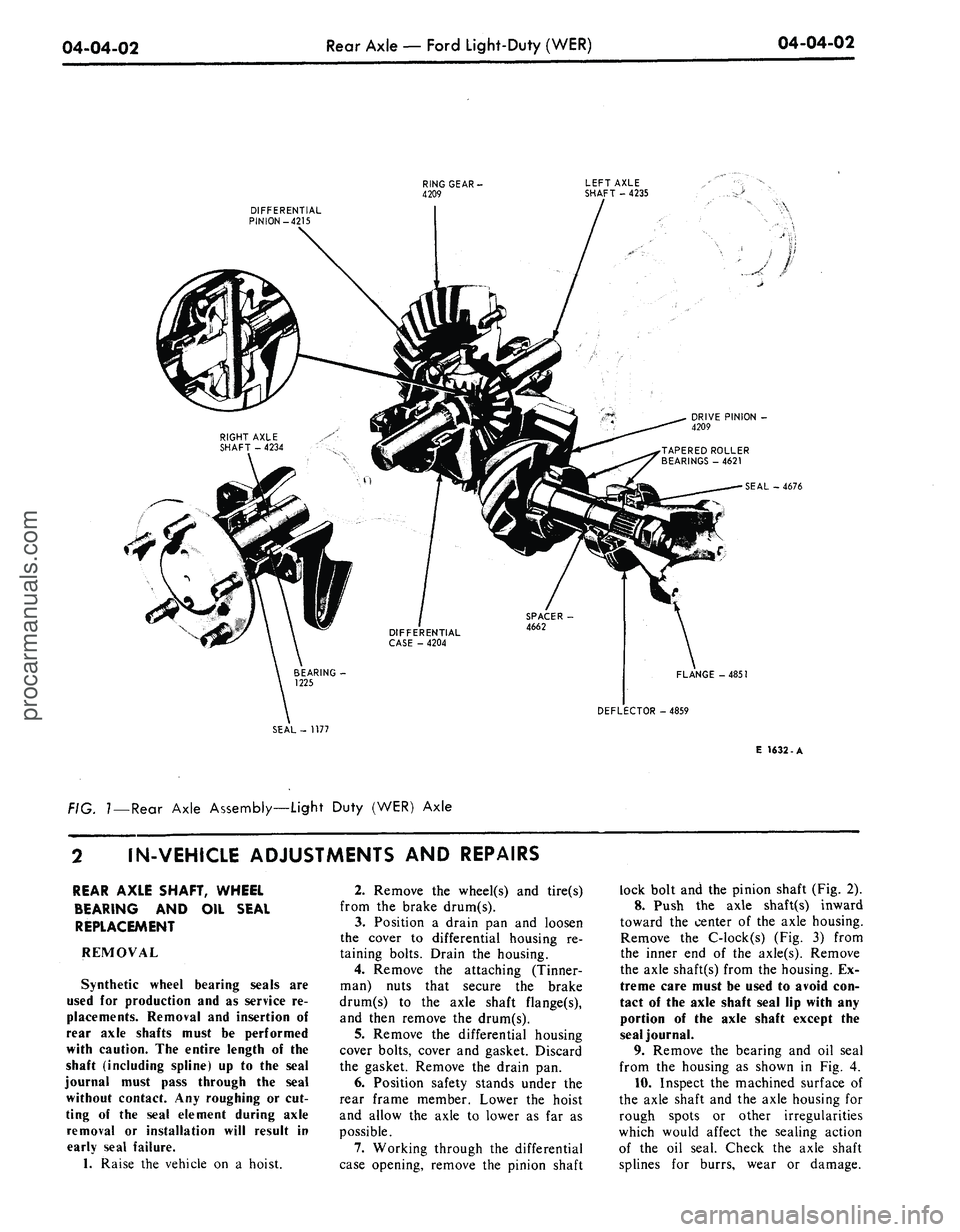
f\G.
7
—Rear Axle Assembly—Light Duty
(WER)
Axle
E 1632-A
IN-VEHICLE ADJUSTMENTS AND REPAIRS
REAR AXLE SHAFT, WHEEL
BEARING
AND OIL
SEAL
REPLACEMENT
REMOVAL
Synthetic wheel bearing seals
are
used
for
production
and as
service
re-
placements. Removal
and
insertion
of
rear axle shafts must
be
performed
with caution.
The
entire length
of the
shaft (including spline)
up to the
seal
journal must pass through
the
seal
without contact.
Any
roughing
or cut-
ting
of the
seal element during axle
removal
or
installation will result
in
early seal failure.
1.
Raise
the
vehicle
on a
hoist.
2.
Remove
the
wheel(s)
and
tire(s)
from
the
brake drum(s).
3.
Position
a
drain
pan and
loosen
the cover
to
differential housing
re-
taining bolts. Drain
the
housing.
4.
Remove
the
attaching (Tinner-
man) nuts that secure
the
brake
drum(s)
to the
axle shaft flange(s),
and then remove
the
drum(s).
5.
Remove
the
differential housing
cover bolts, cover
and
gasket. Discard
the gasket. Remove
the
drain
pan.
6. Position safety stands under
the
rear frame member. Lower
the
hoist
and allow
the
axle
to
lower
as far as
possible.
7.
Working through
the
differential
case opening, remove
the
pinion shaft
lock bolt
and the
pinion shaft
(Fig. 2).
8. Push
the
axle shaft(s) inward
toward
the
center
of the
axle housing.
Remove
the
C-lock(s)
(Fig. 3)
from
the inner
end of the
axle(s). Remove
the axle shaft(s) from
the
housing.
Ex-
treme care must
be
used
to
avoid
con-
tact
of the
axle shaft seal
lip
with
any
portion
of the
axle shaft except
the
seal journal.
9. Remove
the
bearing
and oil
seal
from
the
housing
as
shown
in Fig. 4.
10.
Inspect
the
machined surface
of
the axle shaft
and the
axle housing
for
rough spots
or
other irregularities
which would affect
the
sealing action
of
the oil
seal. Check
the
axle shaft
splines
for
burrs, wear
or
damage.procarmanuals.com
Page 235 of 413
04-04-04
Rear Axle — Ford Light-Duty (WER)
04-04-04
REMOVAL AND INSTALLATION
AXLE HOUSING
Refer to Fig. 7.
REMOVAL
1.
Raise the vehicle on a hoist.
2.
Remove the wheels and tires
from the brake drums.
3.
Position a drain pan and loosen
the rear axle cover to housing attach-
ing bolts. Drain the housing.
4.
Remove the attaching (Tinner-
man) nuts that secure the brake drums
to the axle shaft flanges, and then re-
move the drums (Fig. 7).
5.
Remove the axle housing cover
bolts,
cover and gasket. Discard the
gasket. Remove the drain pan.
6. Disconnect the drive shaft at the
drive pinion companion flange. Re-
move the drive shaft from the trans-
mission extension housing. Install an
oil seal replacer tool in the transmis-
sion housing to prevent leakage. Refer
to the transmission group for the ap-
propriate tool.
7.
Disconnect the lower end of the
shock absorbers at the mounting
brackets.
8. Disconnect the track bar from
the axle housing stud. If the axle
housing is to be replaced, transfer the
stud to the new housing.
9. Position safety stands under the
rear frame members. Lower the vehi-
cle with the hoist and allow the axle
to lower far enough to relieve rear
spring tension.
10.
Remove the pinion shaft lock
bolt and pinion shaft (Fig. 2), differ-
ential pinion gears and thrust washers.
11.
Push the axle shaft(s) inward
toward the center of the axle housing.
Remove the C-locks from the inner
ends of the axles (Fig. 3). Remove the
axle shafts from the housing. Extreme
care must be used to avoid contacting
the axle shaft seal lip with any portion
of the axle shaft other than the seal
journal.
12.
Disconnect the vent hose from
the rear vent tube and remove all
brake lines from the axle housing re-
taining clips.
13.
Remove the brake backing
plate attaching nuts and the plates
from the axle housing. Suspend the
plates above the axle housing with
mechanics wire. The hydraulic brake
lines and the parking brake cables will
remain attached to the brake backing
plates.
14.
Support the rear axle housine
on a jack.
15.
Remove the right and left rear
springs and insulators.
16.
Remove the nuts, washers and
pivot bolts that connect the suspension
lower arms to the axle housing. Dis-
connect both arms from the axle
housing.
17.
Disconnect the upper suspen-
sion arm from the axle housing by re-
moving the pivot bolt, nut, lock wash-
er and two eccentric washers.
18.
Lower the rear axle to the floor
with the jack and remove the axle
from under the vehicle.
19.
Remove the wheel bearings and
oil seals with the tool shown in Fig. 4.
20.
If the axle housing is being re-
placed, transfer all the differential and
pinion parts to the new housing. Refer
to Section 4, Major Repair Operation
for the procedure.
INSTALLATION
1.
Lightly coat the wheel bearing
rollers with axle lubricant. Install
wheel bearings in the axle housing
with the tool shown in Fig. 5. The
bearings should seat firmly against the
shoulder.
2.
Wipe all lubricant from the oil
seal bore before installing the seal. If
axle housing is being replaced, new
seals must be installed.
3.
Inspect the original seal for
nicks,
scuffs or abnormal wear, and
replace if necessary. New seals are
pre-packed with lubricant and do not
require an oil soak.
4.
Install the seal with the tool
shown in Fig. 6. Installation without
the use of the proper tool will distort
the seal and cause leakage.
5. Raise the rear axle into position
under the vehicle with a hoist or floor
jack. Connect the suspension lower
arms to their mounting brackets on
the axle housing with pivot bolts and
nuts.
Do not tighten the mounting
bolts at this point.
6. Position the suspension upper
arm in its mounting bracket on the
axle housing and install the adjusting
bolt, eccentric washers, lock washer
and nut. Do not tighten the mounting
bolt at this point.
7.
Place the rear coil springs and
insulators into position in the pockets
provided.
8. Place the brake backing plates
on the axle housing flanges, install 4
attaching bolts and nuts and torque
them to specifications.
9. Position the brake lines to the
axle housing and secure them with the
retaining clips. If the axle housing is
new, install a new vent. When install-
ing the new axle vent apply a small
amount of Locktite (C5AZ-19554-B)
to prevent oil leakage between vent
and axle housing. Connect the vent
tube to the vent.
10.
Install the pinion side gears and
thrust washer.
11.
Slide the axle shafts into place
in the axle housing. Exercise care that
splines or any portion of the axle
shafts do not damage the oil seals and
that they engage with the splines of
the differential side gears.
12.
Install the axle shaft C-lock O-
ring and C-lock on the inner end of
the shaft and push the shaft outward
so that the shaft lock seats in the
counterbore of the differential side
gear.
13.
Position the pinion differential
gears and thrust washers 180 degrees
apart to the differential side gears.
Revolve the gear assembly until the
holes in the differential case are al-
igned with the pinion gears.
14.
Position the differential pinion
shaft through the case and pinions, al-
igning the hole in the shaft with the
lock bolt hole. Install the lock bolt
and tighten it to specification.
15.
Clean the gasket mounting sur-
face of the rear axle housing and the
cover. Install a new cover gasket,
cover and the attaching bolts. Torque
the bolts to specification.
16.
Raise the rear axle on a hoist
and remove the safety stands.
17.
Connect the track bar to the
mounting stud. Install the washer and
nut. Torque the nut to specification.
18.
Connect the two rear shock ab-
sorbers to the mounting brackets on
the axle housing and torque the at-
taching nuts to specification.
19.
Make sure that both the front
and rear pivot bolts of the upper and
the two lower arms are loose, then
raise the axle assembly to the con-
trolled height (Fig. 8). Hold the axle
at the controlled height by placing
blocks or pieces of steel pipe between
the axle housing and the bumper rear
screw on the side rail.procarmanuals.com
Page 238 of 413
04-04-07
Rear Axle — Ford Light-Duty (WER)
04-04-07
RUNOUT CHECK
E 1573-A
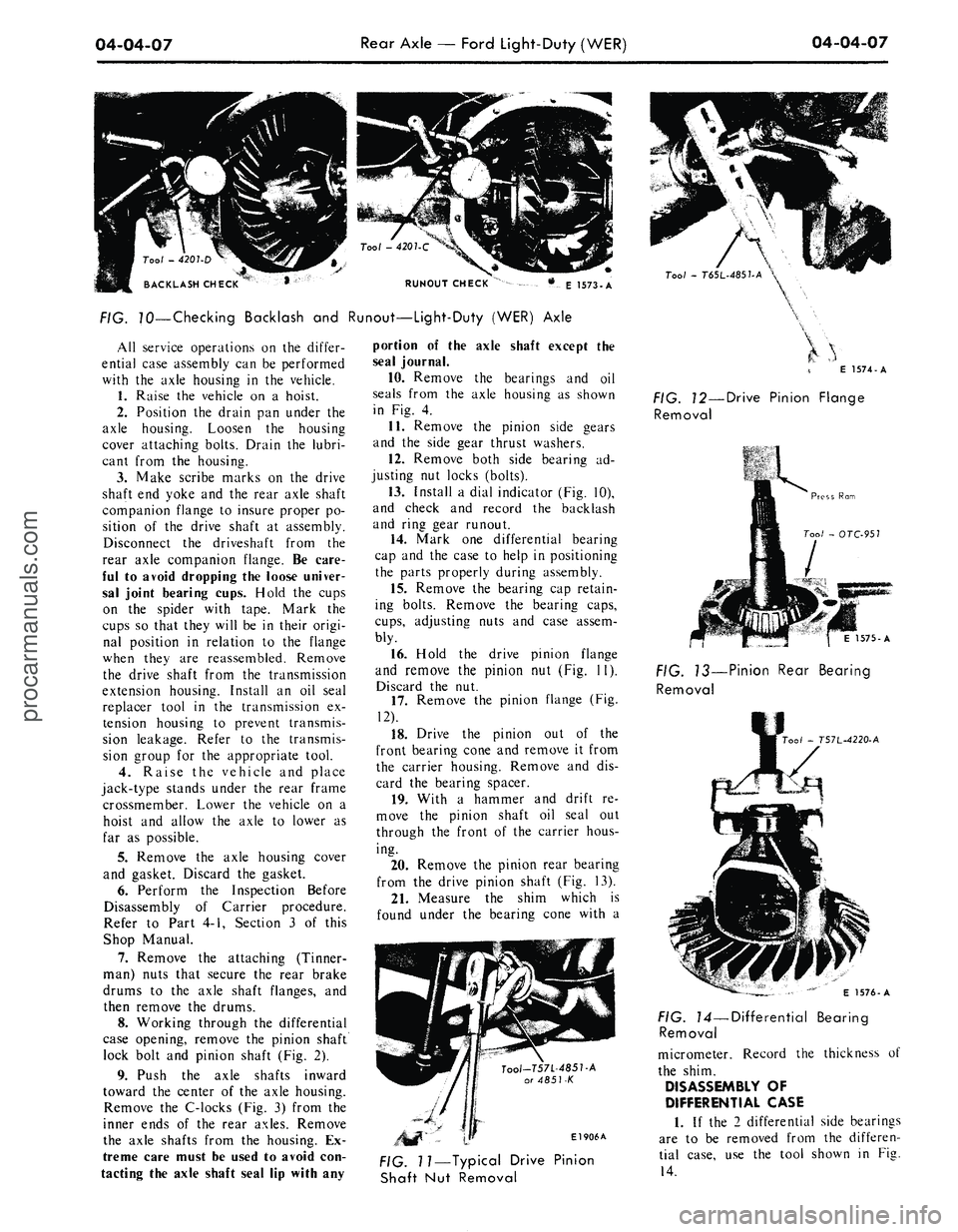
FIG. 70—Checking Backlash and Runout—Light-Duty (WER) Axle
All service operations on the differ-
ential case assembly can be performed
with the axle housing in the vehicle.
1.
Raise the vehicle on a hoist.
2.
Position the drain pan under the
axle housing. Loosen the housing
cover attaching bolts. Drain the lubri-
cant from the housing.
3.
Make scribe marks on the drive
shaft end yoke and the rear axle shaft
companion flange to insure proper po-
sition of the drive shaft at assembly.
Disconnect the driveshaft from the
rear axle companion flange. Be care-
ful to avoid dropping the loose univer-
sal joint bearing cups. Hold the cups
on the spider with tape. Mark the
cups so that they will be in their origi-
nal position in relation to the flange
when they are reassembled. Remove
the drive shaft from the transmission
extension housing. Install an oil seal
replacer tool in the transmission ex-
tension housing to prevent transmis-
sion leakage. Refer to the transmis-
sion group for the appropriate tool.
4.
Raise the vehicle and place
jack-type stands under the rear frame
crossmember. Lower the vehicle on a
hoist and allow the axle to lower as
far as possible.
5.
Remove the axle housing cover
and gasket. Discard the gasket.
6. Perform the Inspection Before
Disassembly of Carrier procedure.
Refer to Part 4-1, Section 3 of this
Shop Manual.
7.
Remove the attaching (Tinner-
man) nuts that secure the rear brake
drums to the axle shaft flanges, and
then remove the drums.
8. Working through the differential
case opening, remove the pinion shaft
lock bolt and pinion shaft (Fig. 2).
9. Push the axle shafts inward
toward the center of the axle housing.
Remove the C-locks (Fig. 3) from the
inner ends of the rear axles. Remove
the axle shafts from the housing. Ex-
treme care must be used to avoid con-
tacting the axle shaft seal lip with any
portion of the axle shaft except the
seal journal.
10.
Remove the bearings and oil
seals from the axle housing as shown
in Fig. 4.
11.
Remove the pinion side gears
and the side gear thrust washers.
12.
Remove both side bearing ad-
justing nut locks (bolts).
13.
Install a dial indicator (Fig. 10),
and check and record the backlash
and ring gear runout.
14.
Mark one differential bearing
cap and the case to help in positioning
the parts properly during assembly.
15.
Remove the bearing cap retain-
ing bolts. Remove the bearing caps,
cups,
adjusting nuts and case assem-
bly.
16.
Hold the drive pinion flange
and remove the pinion nut (Fig. 11).
Discard the nut.
17.
Remove the pinion flange (Fig.
12).
18.
Drive the pinion out of the
front bearing cone and remove it from
the carrier housing. Remove and dis-
card the bearing spacer.
19.
With a hammer and drift re-
move the pinion shaft oil seal out
through the front of the carrier hous-
ing.
20.
Remove the pinion rear bearing
from the drive pinion shaft (Fig. 13).
21.
Measure the shim which is
found under the bearing cone with a
Tool-T57L-485T-A
or 4851-K
El 906A
Tool
-
T6SL-485UA
\
E 1574-A
FIG. 12—Drive Pinion Flange
Removal
1575-A
FIG. 13—Pinion Rear Bearing
Removal
00/
- T57L-4220-A
FIG. 11—Typical Drive Pinion
Shaft Nut Removal
E 1576-A
FIG. 14—Differential Bearing
Removal
micrometer. Record the thickness of
the shim.
DISASSEMBLY OF
DIFFERENTIAL CASE
1.
If the 2 differential side bearings
are to be removed from the differen-
tial case, use the tool shown in Fig.
14.procarmanuals.com
Page 245 of 413
04-05-04
Specifications
04-05-04
ATTACHING TORQUE SPECIFICATIONS -(By Axle Ring Gear Diameter)
Description
Differential Bearing Cap Bolt- 7 1/4"
8"
All Others
Differential Bearing Adjusting
Nut Lock Bolts
Carrier
to
Housing Stud Nuts-
8", 8 3/4", 9" 8 3/8"
Pinion Retainer
to
Carrier Bolts-
8", 8 3/4", 9" 9 3/8"
Ring Gear Attaching Bolts-
7 1/4"
All Others
Differential Pinion Shaft
Lock Pin
•
8 1/2" Only
Torque Lbs.
Ft.
40-55
55-70
70-85
12-25
25-40
30-45
40-55
65-80
15-22
Description
Rear Cover Screw and Washer
Assemblies
-8
1/4" &
8
1/2
Only
Oil Filler Plug
Rear Axle Shaft Bearing Retainer
Bolt Nuts:
Falcon,
Fairlane, Montego,
Mustang and Cougar (All)
Ford & Meteor (Exc.
8 1/2" R.G.)
Mercury,
T
Bird
Lincoln Continental (All)
Brake Backing Plate Bolt Nuts-
Ford & Meteor
8
1/2" Only
Torque Lbs.
Ft.
25-35
25-50
20-40
50-75
30-55
20-40
LUBRICANT
CAPACITIES
AND CHECKING PROCEDURES®
Vehicle
Falcon,
Mustang
Cougar, Fairlane, Falcon
Montego, Mustang
Ford,
Meteor
Ford,
Meteor
Cougar, Fairlane, Falcon, Ford,
Mercury, Meteor, Montego, Mustang
Lincoln,
Thunderbird
Engine
(C.I.D.)
170,
200
250,
302
240,
302
240,
302
351,
390,
428,
429
429,
460
Axle
Ratio
All
All
2.80:1,
3.10:1
All Except
2.80:1,
3.10:1
All
All
U.S. Measure
Capacity® (Pints)
2.5
4.0
4.0
5.0
5.0
5.0©
Imperial
Capacity
CD
(Pints)
2
31/5
3 1/5
4.0
4.0
4.0©
©All limited slip and Traction-Lok axles use ESW-M2C-104-A lubricant (C6AZ-19580-C).
All conventional axles use ESW-M2C-105-A lubricant (C6AZ-19580-B).
©Approximate refill capacity-Actual lubricant capacities are determined
by
filling
to
bottom
of
filler hole.
©To check these axles, the plug should be backed
out
slowly.
If
seepage occurs around the threads, the plug should
be
turned back
in
immediately to avoid any drainage. This indicates that the specified amount
of
lubricant
is
present
in
the axle.
SPECIAL TOOLS
FORD,
MERCURY, METEOR
Ford Tool No.
T66L-4204-L
T57L-500-A
T50T-100-A
TOOL-4235-C
T00L-4621-A
TOOL-1225-D
T00L42344
TOOL-1177
TOOL-U75-AB
T57L4220-A
T00L4221-AE
T00L-4221-AF
T66P-4220-P
TOOL-4851-K
Former No.
42211 or
42211-A
6005-M
6005-MS
B-160
4235C
—
—
4234-A
4245-B
1175-AB
—
4221-AF
T57L-4851-A
4851-K
Description
Limited-Slip Differential Check
Bench Fixture
Impact Hammer
Axle Shaft Remover
Drive Pinion Bearing and
Rear Wheel Bear Replacer
Rear Wheel Bearing Remover
Rear Wheel Bearing Installer
Rear Wheel Bearing Oil Seal Installer
Rear Wheel Bearing Oil Seal Remover
Differential Bearing Remover
Differential Bearing Remover
U-Joint
Flange Holder
Ford Tool No.
T53T4851-A
T00L4858-D
T57L4614-A
T00L4621-K
T53L-200-A
T57L-4625-A or
T00L4625-K
T57L4616-A or
T00L4615-D
T58L-101-A
T55P4616-A2
T57L4621-B or
T00L4621-L
T58L4676-A
T00L4858-E
Former No.
4851-A, D
—
4614
4621-K
—
4625-K
—
—
—
—
4676-F
4858-E
Description
U-Joint
Flange Remover
U-Joint
Flange Remover
Drive Pinion Retainer Support
Pinion Rear Bearing Cone Remover
Handle Adapter
Pinion Pilot Bearing Remover and
Installer
Pinion Front Bearing Cup Remover
and Replacer
Puller Attachment—For Bearing
Cup Removal
Pinion Rear Bearing Cup Remover
and Replacer
Pinion Rear Bearing Cone Installer
Drive Pinion Oil Seal Replacer
U-Joint
Flange and Pinion Bearing
Replacerprocarmanuals.com
Page 273 of 413
06-02-04
Ford Design Three Speed Transmission
06-02-04
shift selector, remove
the
shift selector
assembly from
the
extension housing.
6.
On
Ford, Mercury
and
Meteor
vehicles disconnect
the
parking brake
cable from the equalizer lever and sep-
arate
the
lever from
the
crossmember.
7.
On
Ford, Mercury
and
Meteor
models, remove
the
bolts that secure
the extension housing
to the
engine
rear support.
8. Raise
the
rear
of
the engine high
enough
to
remove
the
weight from
the
crossmember.
9. Support
the
transmission with
a
transmission jack
and
remove
the
transmission from
the
flvwheel hous-
ing.
10.
Move
the
transmission and jack
rearward until
the
input shaft
is
clear
of
the
flywheel housing.
11.
Remove
the
transmission from
the jack
and
mount
it in a
holding
fixture.
Do
not
depress
the
clutch pedal
while
the
transmission
is
removed.
INSTALLATION
1.
Make certain that
the
machined
surfaces
of the
transmission case
and
the flywheel housing
are
free
of
dirt,
paint,
and
burrs.
2.
Install
a
guide
pin in
each lower
mounting bolt hole.
3.
Start
the
input shaft through
the
release bearing. Align
the
splines
on
the input shaft with
the
splines
in the
clutch disc. Move
the
transmission
forward
on the
guide pins until
the
input shaft pilot enters
the
bearing
or
bushing
in the
crankshaft.
If the
transmission front bearing retainer
binds
up on the
clutch release bearing
hub,
work
the
release bearing lever
until
the hub
slides onto
the
transmis-
sion front bearing retainer. Install
the
two transmission-to-flywheel housing
upper mounting bolts
and
lockwash-
ers.
Remove
the two
guide pins
and
install
the
lower mounting bolts
and
lock washers.
4.
Raise
the
rear
of the
engine high
enough
to
provide clearance
for in-
stalling
the
crossmember. Bolt
the
crossmember assembly
to the
frame
side supports.
5.
On
Ford, Mercury
and
Meteor
models, lower
the
engine until
the ex-
tension housing just contacts
the
rear
support. Align
the
bolt holes
in the
extension housing with those
in the
support. Then lower
the
engine
and
remove the jack. Install the two exten-
sion housing-to-support attaching
bolts
and
lock washers.
6.
On
Ford, Mercury
and
Meteor
models, insert
the
parking brake front
cable
in the
equalizer
and
install
the
equalizer
in the
bracket
on the
crossmember. Secure
the
parking
brake rear cable
to the
equalizer.
7.
On
vehicles equipped with
a
column-mounted gear shift selector,
secure
the
shift rods
to the
shift levers
at
the
transmission.
On
vehicles
equipped with
a
floor-mounted gear
shift selector, attach
the
shift selector
assembly
to the
extension housing.
8. Insert
the
speedometer cable
and
driven gear
in the
extension housing
and secure
it
with
a cap
screw
and
lock washer.
9. Remove
the
tool shown
in
Fig.
2,
Part 6-1, from
the
extension housing.
Align
the
reference marks
and
slide
the front universal joint yoke onto
the
output shaft
and
into
the
extension
housing. Connect
the
rear universal
joint
to the
axle pinion flange
and tor-
que
the
nuts
to
specifications.
10.
Fill
the
transmission
to the
proper level with
the
approved lubri-
cant.
11.
Adjust
the
clutch pedal free
travel
and the
shift linkage
as re-
quired.
MAJOR REPAIR OPERATIONS
DISASSEMBLY
1.
Mount
the
transmission
in a
holding fixture and drain
the
lubricant
by removing
the
drain plug,
if so
equipped,
or the
lower extension hous-
ing bolt.
2.
Remove
the cap
screws that
at-
tach
the
cover
to
the case. Remove
the
COVER
cover
and the
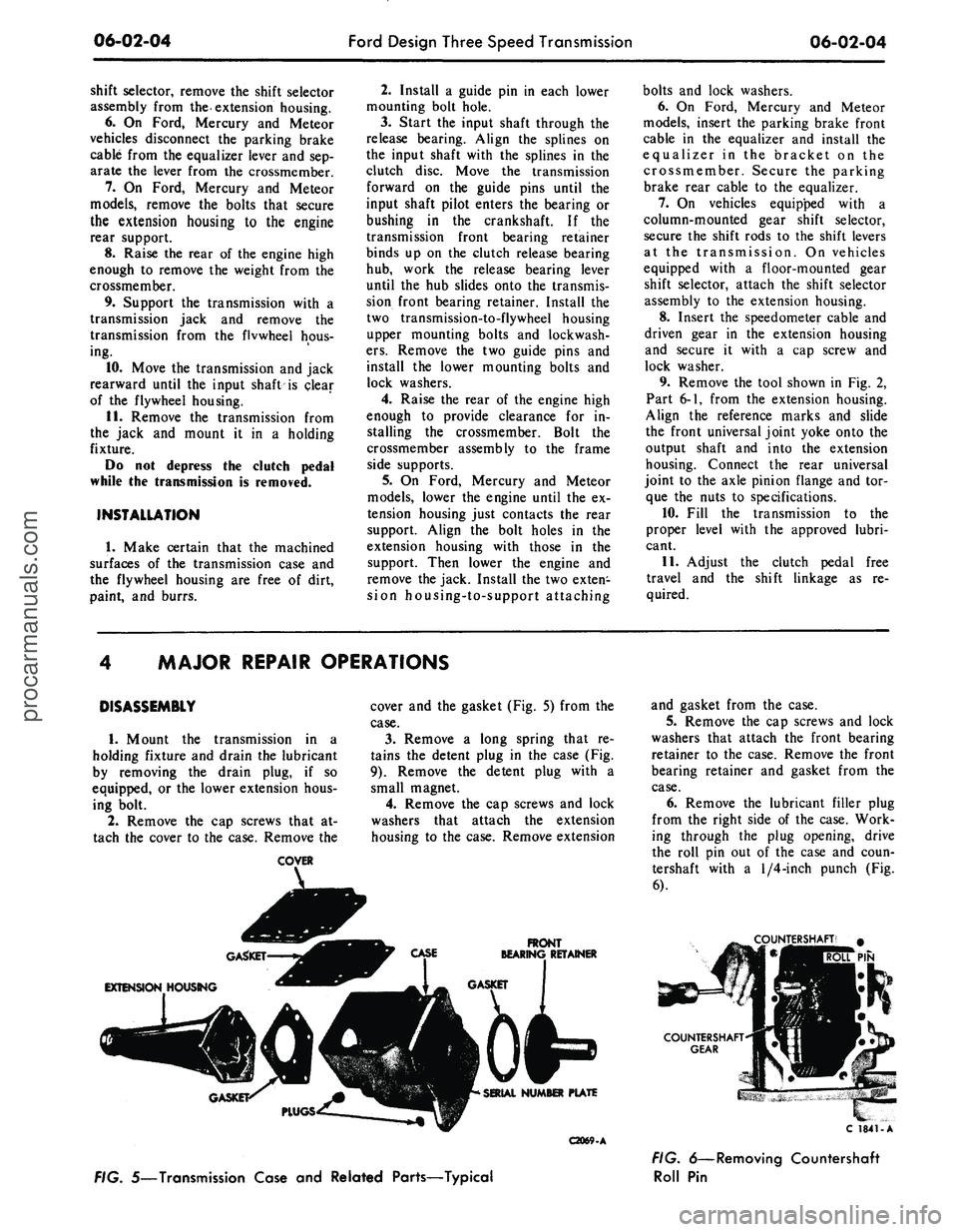
gasket (Fig.
5)
from
the
case.
3.
Remove
a
long spring that
re-
tains
the
detent plug
in the
case (Fig.
9).
Remove
the
detent plug with
a
small magnet.
4.
Remove
the cap
screws
and
lock
washers that attach
the
extension
housing
to
the case. Remove extension
FRONT
BEARING RETAINER
C2069-A
and gasket from
the
case.
5.
Remove
the cap
screws
and
lock
washers that attach
the
front bearing
retainer
to the
case. Remove
the
front
bearing retainer
and
gasket from
the
case.
6. Remove
the
lubricant filler plug
from
the
right side
of the
case. Work-
ing through
the
plug opening, drive
the roll
pin out of the
case
and
coun-
tershaft with
a
1/4-inch
punch
(Fig.
6).
TERSHAFT'
#
PIN
C 1841-A
FIG. 5—Transmission Case
and
Related Parts—Typical
FIG. 6—Removing Countershaft
Roll
Pinprocarmanuals.com
Page 282 of 413
06-03-03
Ford Design Four-Speed Transmission
06-03-03
cable from the equalizer lever and sep-
arate the lever from the crossmember.
5.
Remove the hairpin retainer se-
curing the cable to the transmission
rear support crossmember, and then
pull the cable assembly forward and
out of the crossmember.
6. Remove the retaining clip, flat
washer, and spring washer that se-
cures the shift rods to the shift levers.
7.
Remove the bolts that attach the
shift linkage control bracket to the ex-
tension housing and position the as-
sembly out of the way.
8. Support the engine with a trans-
mission jack and remove the extension
housing-to-engine rear support attach-
ing bolts.
9. Raise the rear of the engine high
enough to remove the weight from the
crossmember. Remove the bolts re-
taining the crossmember to the frame
side supports and remove the
crossmember.
10.
Support the transmission on a
jack and remove the bolts that attach
the transmission to the flywheel hous-
ing.
11.
Move the transmission and jack
rearward until the transmission input
shaft clears the flywheel housing. If
necessary, lower the engine enough to
obtain clearance for transmission re-
moval.
Do not depress the clutch pedal
while the transmission is removed.
INSTALLATION
1.
Make sure that the mounting
surface of the transmission and the
flywheel housing are free of dirt,
paint, and burrs. Install two guide
pins in the flywheel housing lower
mounting bolt holes. Move the trans-
mission forward on the guide pins
until the input shaft splines enter the
clutch hub splines and the case is posi-
tioned against the flywheel housing.
2.
Install the two upper transmis-
sion to flywheel housing, mounting
bolts snug, and then remove the two
guide pins. Install the two lower
mounting bolts. Torque all mounting
bolts to specifications.
3.
Raise the rear of the engine and
install the crossmember. Install and
torque the crossmember attaching
bolts to specifications, then lower the
engine.
4.
With the transmission extension
housing resting on the engine rear
support, install the transmission ex-
tension housing attaching bolts. Tor-
que the bolts to specifications.
5.
Position the shift linkage control
bracket to the extension housing and
install the attaching bolts.
6. Secure each shift rod to its re-
spective lever with the spring washer,
flat washer, and retaining pin.
7.
Guide the parking brake cable
assembly through the hole in the
transmission rear support crossmemb-
er. Secure the cable assembly to the
crossmember with the hair pin retain-
er.
8. Insert the parking brake front
cable in the equalizer and install the
equalizer in the bracket on the
crossmember. Secure the parking
brake rear cable to the equalizer.
9. Connect the speedometer cable
to the extension housing.
10.
Remove the extension housing
installation tool and slide the forward
end of the drive shaft over the trans-
mission output shaft. Connect the
drive shaft to the rear U-joint flange.
11.
Place both forward gear shift
levers and the reverse shift lever in the
neutral position and insert a 1/4 inch
diameter alignment tool in the shift
linkage alignment hole (Fig. 17). It
may be necessary to loosen the adjust-
ment nuts to install the alignment
tool. Adjust the linkage as necessary
and tighten the adjustment nuts to
specifications. Remove the alignment
tool.
12.
Fill the transmission to the
proper level with the specified lubri-
cant.
13.
Lower the car. Check tne shift
and crossover motion for full shift en-
gagement and smooth crossover oper-
ation.
MAJOR REPAIR OPERATIONS
DISASSEMBLY
1.
Mount the transmission in a
holding fixture and drain the lubri-
cant.
2.
Remove the cover attaching
screws from the case. Lift the cover
and gasket from the case.
3.
Remove the long spring that re-
tains the detent plug in the case (Fig.
4).
Remove the detent plug with a
small magnet.
4.
Remove the extension housing
attaching screws and lock washers.
Remove the housing and the gasket.
5.
Remove the input shaft bearing
retainer attaching screws. Slide the re-
tainer off the input shaft.
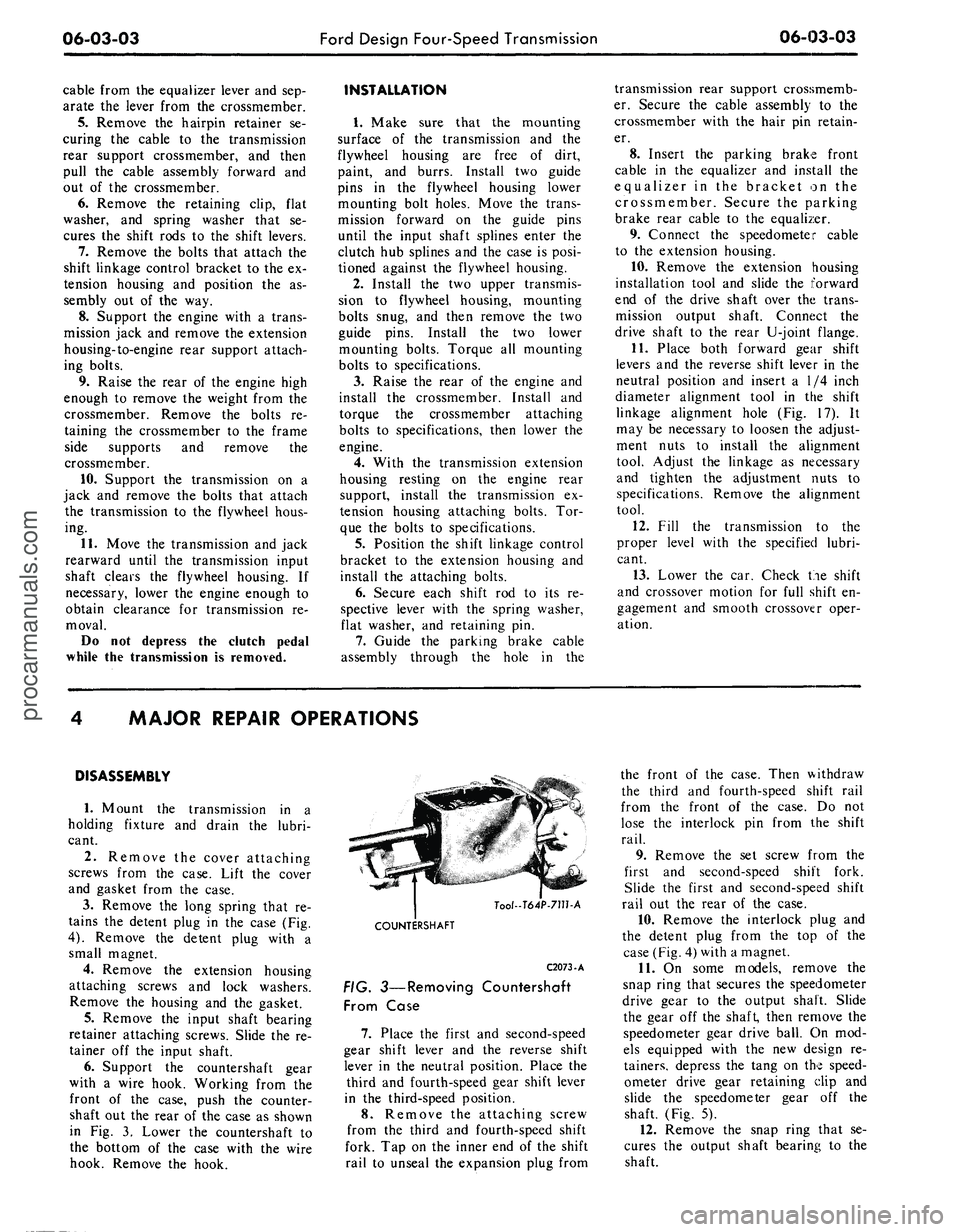
6. Support the countershaft gear
with a wire hook. Working from the
front of the case, push the counter-
shaft out the rear of the case as shown
in Fig. 3. Lower the countershaft to
the bottom of the case with the wire
hook. Remove the hook.
Tool-T64P-711hA
COUNTERSHAFT
C2073-A
FIG. 3—Removing Countershaft
From Case
7.
Place the first and second-speed
gear shift lever and the reverse shift
lever in the neutral position. Place the
third and fourth-speed gear shift lever
in the third-speed position.
8. Remove the attaching screw
from the third and fourth-speed shift
fork. Tap on the inner end of the shift
rail to unseal the expansion plug from
the front of the case. Then withdraw
the third and fourth-speed shift rail
from the front of the case. Do not
lose the interlock pin from the shift
rail.
9. Remove the set screw from the
first and second-speed shift fork.
Slide the first and second-speed shift
rail out the rear of the case.
10.
Remove the interlock plug and
the detent plug from the top of the
case (Fig. 4) with a magnet.
11.
On some models, remove the
snap ring that secures the speedometer
drive gear to the output shaft. Slide
the gear off the shaft, then remove the
speedometer gear drive ball. On mod-
els equipped with the new design re-
tainers, depress the tang on the speed-
ometer drive gear retaining clip and
slide the speedometer gear off the
shaft. (Fig. 5).
12.
Remove the snap ring that se-
cures the output shaft bearing to the
shaft.procarmanuals.com