1969 FORD MUSTANG automatic
[x] Cancel search: automaticPage 107 of 413
03-03-02
Automatic Air Leveling System
03-03-02
REMOVAL AND INSTALLATION
AIR COMPRESSOR
REMOVAL
1.
Slip the vacuum line off the in-
take fitting on the side of the com-
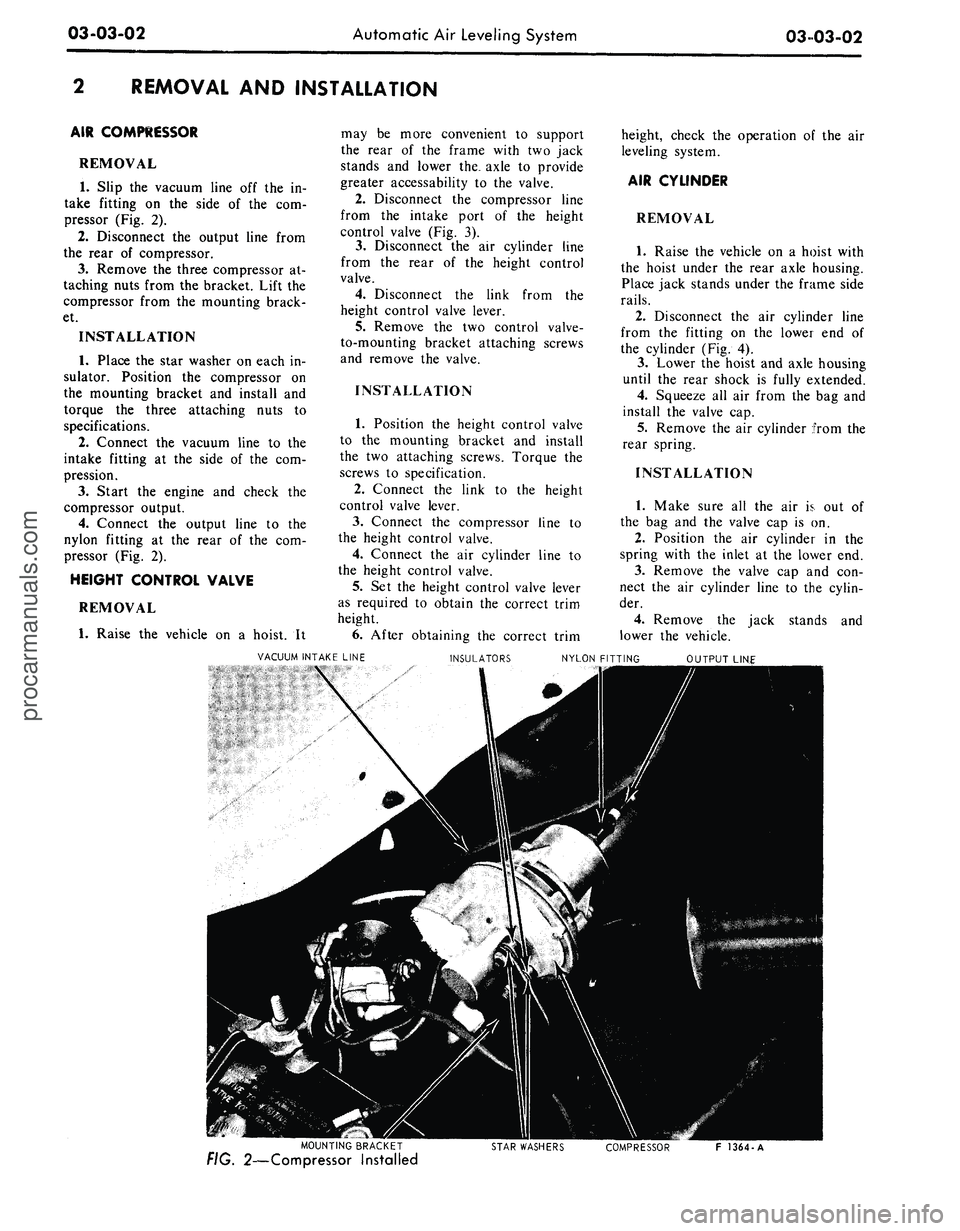
pressor (Fig. 2).
2.
Disconnect the output line from
the rear of compressor.
3.
Remove the three compressor at-
taching nuts from the bracket. Lift the
compressor from the mounting brack-
et.
INSTALLATION
1.
Place the star washer on each in-
sulator. Position the compressor on
the mounting bracket and install and
torque the three attaching nuts to
specifications.
2.
Connect the vacuum line to the
intake fitting at the side of the com-
pression.
3.
Start the engine and check the
compressor output.
4.
Connect the output line to the
nylon fitting at the rear of the com-
pressor (Fig. 2).
HEIGHT CONTROL VALVE
REMOVAL
1.
Raise the vehicle on a hoist. It
may be more convenient to support
the rear of the frame with two jack
stands and lower the, axle to provide
greater accessability to the valve.
2.
Disconnect the compressor line
from the intake port of the height
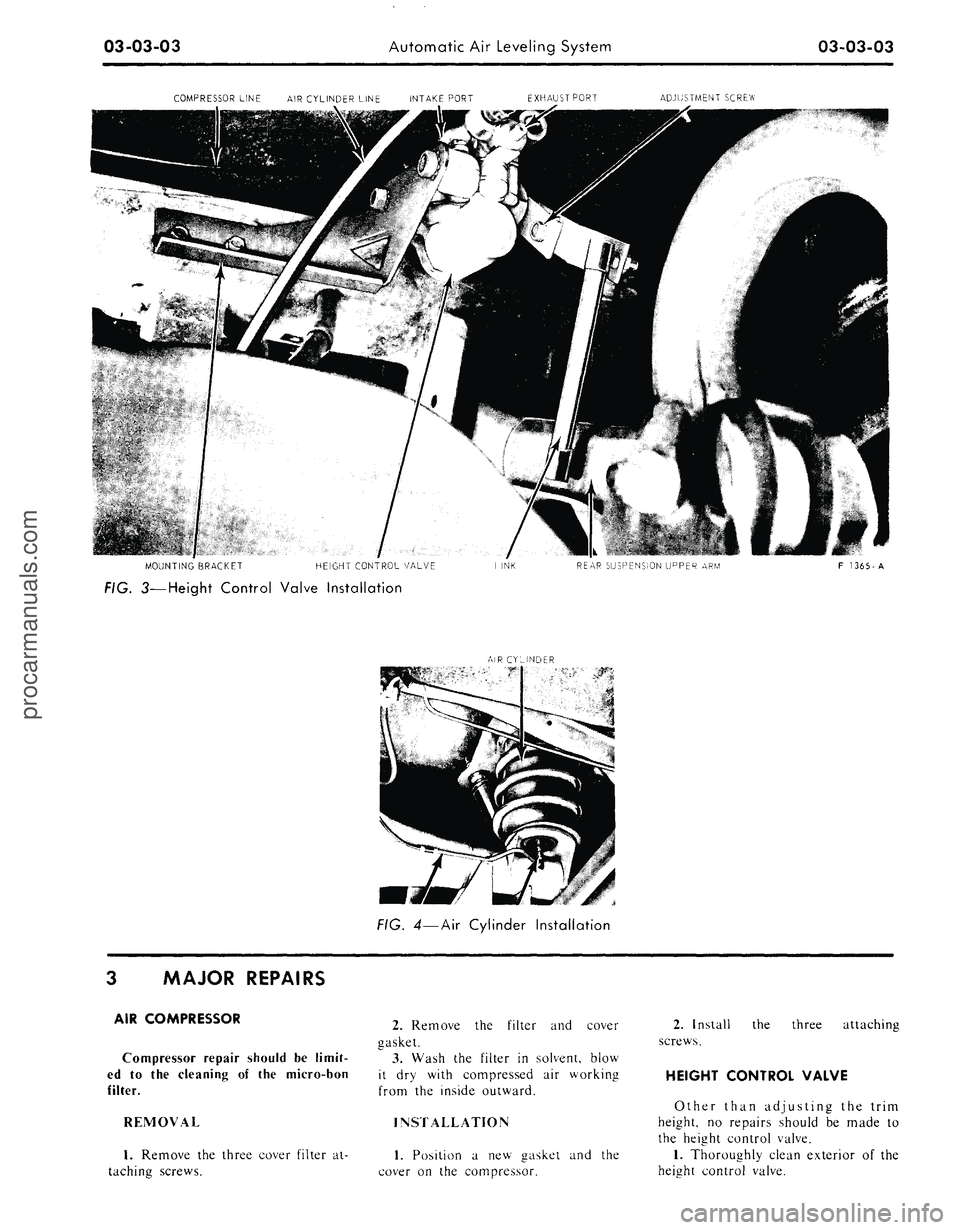
control valve (Fig. 3).
3.
Disconnect the air cylinder line
from the rear of the height control
valve.
4.
Disconnect the link from the
height control valve lever.
5.
Remove the two control valve-
to-mounting bracket attaching screws
and remove the valve.
INSTALLATION
1.
Position the height control valve
to the mounting bracket and install
the two attaching screws. Torque the
screws to specification.
2.
Connect the link to the height
control valve lever.
3.
Connect the compressor line to
the height control valve.
4.
Connect the air cylinder line to
the height control valve.
5.
Set the height control valve lever
as required to obtain the correct trim
height.
6. After obtaining the correct trim
height, check the operation of the air
leveling system.
AIR CYLINDER
REMOVAL
1.
Raise the vehicle on a hoist with
the hoist under the rear axle housing.
Place jack stands under the frame side
rails.
2.
Disconnect the air cylinder line
from the fitting on the lower end of
the cylinder (Fig. 4).
3.
Lower the hoist and axle housing
until the rear shock is fully extended.
4.
Squeeze all air from the bag and
install the valve cap.
5.
Remove the air cylinder from the
rear spring.
INSTALLATION
1.
Make sure all the air is out of
the bag and the valve cap is on.
2.
Position the air cylinder in the
spring with the inlet at the lower end.
3.
Remove the valve cap and con-
nect the air cylinder line to the cylin-
der.
4.
Remove the jack stands and
lower the vehicle.
VACUUM INTAKE LINE
INSULATORS
NYLON FITTING
MOUNTING BRACKET
FIG. 2—Compressor Installed
STAR WASHERS
COMPRESSOR
F 1364-Aprocarmanuals.com
Page 108 of 413
03-03-03
Automatic Air Leveling System
03-03-03
COMPRESSOR LINE
AIR
CYLINDER LINE INTAKE PORT EXHAUSTPORT
ADJUSTMENT SCREW
MOUNTING BRACKET
HEIGHT CONTROL VALVE
REAR SUSPENSION UPPER
ARM
FIG. 3—Height Control Valve Installation
Al R CYLINDER
F 1365-A
FIG. 4—Air Cylinder Installation
3 MAJOR REPAIRS
AIR COMPRESSOR
Compressor repair should
be
limit-
ed
to the
cleaning
of the
micro-bon
filter.
REMOVAL
1.
Remove
the
three cover filter
at-
taching screws.
2.
Remove
the
filter
and
cover
gasket.
3.
Wash
the
filter
in
solvent, blow
it
dry
with compressed
air
working
from
the
inside outward.
INSTALLATION
1.
Position
a new
gasket
and the
cover
on the
compressor.
2.
Install
the
three attaching
screws.
HEIGHT CONTROL VALVE
Other than adjusting
the
trim
height,
no
repairs should
be
made
to
the height control valve.
1.
Thoroughly clean exterior
of the
height control valve.procarmanuals.com
Page 111 of 413
03-04-02
Automatic Air Leveling System — Lincoln Continental
03-04-02
REMOVAL AND INSTALLATION
COMPRESSOR
REMOVAL
1.
Raise the front of the vehicle and
place jack stands under frame side
rails.
2.
Turn the front wheels all the way
to the right. Working from the und-
erside of the left front fender, remove
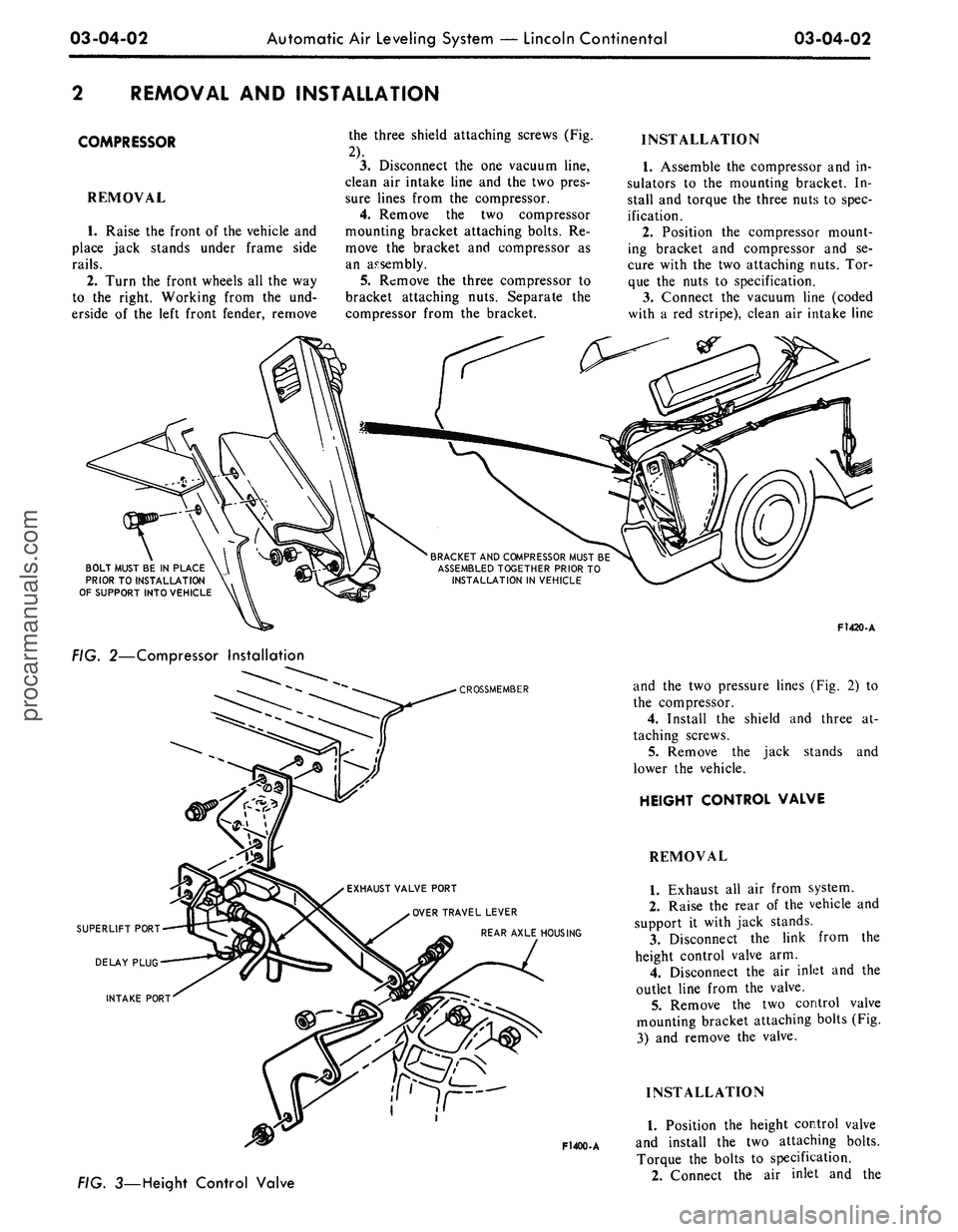
the three shield attaching screws (Fig.
2).
3.
Disconnect the one vacuum line,
clean air intake line and the two pres-
sure lines from the compressor.
4.
Remove the two compressor
mounting bracket attaching bolts. Re-
move the bracket and compressor as
an assembly.
5.
Remove the three compressor to
bracket attaching nuts. Separate the
compressor from the bracket.
INSTALLATION
1.
Assemble the compressor and in-
sulators to the mounting bracket. In-
stall and torque the three nuts to spec-
ification.
2.
Position the compressor mount-
ing bracket and compressor and se-
cure with the two attaching nuts. Tor-
que the nuts to specification.
3.
Connect the vacuum line (coded
with a red stripe), clean air intake line
BRACKET
AND
COMPRESSOR
MUST
BE
ASSEMBLED
TOGETHER
PRIOR
TO
INSTALLATION
IN
VEHICLE
BOLT MUST
BE IN
PLACE
PRIOR
TO
INSTALLATION
OF
SUPPORT
INTO
VEHICLE
FIG. 2—Compressor Installation
CROSSMEMBER
EXHAUST
VALVE PORT
OVER
TRAVEL
LEVER
REAR AXLE
HOUSING
F1400-A
3—Height Control Valve
F1420-A
and the two pressure lines (Fig. 2) to
the compressor.
4.
Install the shield and three at-
taching screws.
5.
Remove the jack stands and
lower the vehicle.
HEIGHT CONTROL VALVE
REMOVAL
1.
Exhaust all air from system.
2.
Raise the rear of the vehicle and
support it with jack stands.
3.
Disconnect the link from the
height control valve arm.
4.
Disconnect the air inlet and the
outlet line from the valve.
5.
Remove the two control valve
mounting bracket attaching bolts (Fig.
3) and remove the valve.
INSTALLATION
1.
Position the height control valve
and install the two attaching bolts.
Torque the bolts to specification.
2.
Connect the air inlet and theprocarmanuals.com
Page 112 of 413

03-04-03
Automatic Air Leveling System — Lincoln Continental
03-04-03
outlet lines to their respective parts.
3.
Adjust the trim height as de-
tailed in Section 4.
4.
Connect the link to the arm.
5.
Remove the jack stands and
lower the vehicle.
SUPER LIFT SHOCK ABSORBER
REMOVAL
1.
Raise the vehicle and place jack
stands under the axle to compress the
super lift.
2.
Loosen the air line or lines (right
super lift) slowly to release the air
from the system. Then, disconnect the
line or lines.
3.
Remove the three mounting plate
attaching screws from the upper end
of the super lift.
4.
Remove the attaching nut and
washer from the lower end of the
super lift and remove it from the vehi-
cle.
5.
Remove the nut, outer washer
and the insulator that attach the super
lift to the mounting plate. Remove the
plate, remaining insulator and washer.
INSTALLATION
1.
Position a washer, insulator,
mounting plate, insulator, washer and
nut on the stud at the upper end of
the super lift. Torque the nut to speci-
fication.
2.
Install the mounting plate, outer
insulator, washer and nut on the stud.
Torque the nut to specification.
3.
Attach the mounting plate and
shock absorber to the crossmember
with the attaching screws to specifica-
tions.
4.
Connect the lower end of the
super lift to the mounting stud with
the washers and attaching nut. Torque
the nut to specification.
5.
Connect the air line or lines
(right super lift) to the super lift.
6. Start the engine and check for
leaks.
3 IN-VEHICLE ADJUSTMENTS AND REPAIRS
REGULATOR ADJUSTMENT HEIGHT CONTROL VALVE
The regulator may be adjusted if
the regulator pressure is under 100 psi
with the reservoir pressure at a mini-
mum of 140 psi. If the regulated pres-
sure exceeds 130 psi, the regulator
must be replaced.
To adjust the regulator, remove the
boot and reposition the sleeve and re-
tainer deeper into the body of the re-
gulator, using a deep well socket (Fig.
4).
If the regulator pressure remains
under 100 psi, replace regulator.
SILICONE FLUID
REPLACEMENT
If the height control valve time
delay does not fall within specifica-
tion, the silicone fluid must be re-
placed. Then repeat the time delay
test. If delay is still not within specifi-
cations, replace the height control
valve.
1.
Remove control valve and clean
the exterior of the valve thoroughly.
2.
Position the valve with delay
plug on top. Remove delay plug and
drain silicone fluid from the chamber.
Remove the O-ring from the chamber
(Fig. 5), and discard the O-ring.
3.
Remove the cover plate retaining
ring, using snap ring pliers. Remove
the delay cover from the valve body.
Remove the O-ring from the chamber,
and discard the O-ring.
4.
Place a new O-ring over the
delay plug and install the plug. Tor-
que the plug to 20-30 in-lbs. .
5.
Pour silicone fluid into the delay
piston chamber until fluid level is 5/16
inch below the top edge of the body.
Add or remove fluid with an eye drop-
per until the proper fluid level is
reached.
6. Hold the control valve body in a
vise with the delay chamber elevated
slightly. Carefully operate the lever to
purge trapped air from the fluid.
7.
Place a new O-ring in the groove
around the delay piston bore. Install
5/16" TO
FLUID LEVEL
F 1405 A
FIG. 4—Adjusting Regulator
F1406 A
FIG. 5—Replacing Silicone Fluidprocarmanuals.com
Page 113 of 413
03-04-04 Automatic Air Leveling System — Lincoln Continental 03-04-04
the cover and secure it with a snap down. Move the overtravel lever up vehicle. If delay is not within 4-18 sec-
ring, using snap ring pliers. and down for one minute to vent air onds, recheck the fluid level in the
8. Place the control valve vertically from the delay piston pin chamber. delay chamber. If the level is within
in a vise with the delay chamber Perform a time delay check off the specifications, replace the valve.
9. Install the height control valve.procarmanuals.com
Page 122 of 413
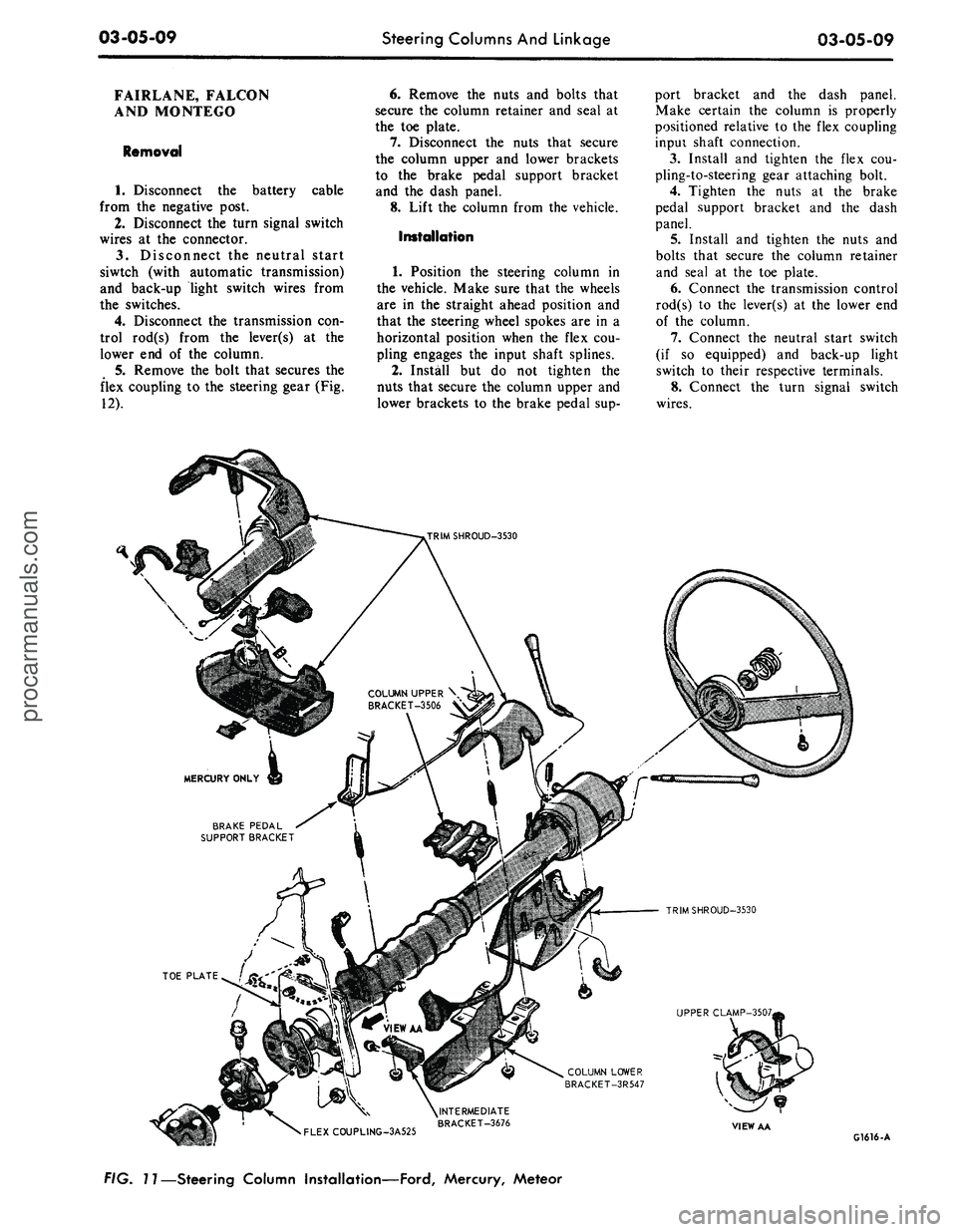
03-05-09
Steering Columns And Linkage
03-05-09
FAIRLANE, FALCON
AND MONTEGO
Removal
1.
Disconnect the battery cable
from the negative post.
2.
Disconnect the turn signal switch
wires at the connector.
3.
Disconnect the neutral start
siwtch (with automatic transmission)
and back-up light switch wires from
the switches.
4.
Disconnect the transmission con-
trol rod(s) from the lever(s) at the
lower end of the column.
5.
Remove the bolt that secures the
flex coupling to the steering gear (Fig.
12).
6. Remove the nuts and bolts that
secure the column retainer and seal at
the toe plate.
7.
Disconnect the nuts that secure
the column upper and lower brackets
to the brake pedal support bracket
and the dash panel.
8. Lift the column from the vehicle.
Installation
1.
Position the steering column in
the vehicle. Make sure that the wheels
are in the straight ahead position and
that the steering wheel spokes are in a
horizontal position when the flex cou-
pling engages the input shaft splines.
2.
Install but do not tighten the
nuts that secure the column upper and
lower brackets to the brake pedal sup-
port bracket and the dash panel.
Make certain the column is properly
positioned relative to the flex coupling
inpui shaft connection.
3.
Install and tighten the flex cou-
pling-to-steering gear attaching bolt.
4.
Tighten the nuts at the brake
pedal support bracket and the dash
panel.
5.
Install and tighten the nuts and
bolts that secure the column retainer
and seal at the toe plate.
6. Connect the transmission control
rod(s) to the lever(s) at the lower end
of the column.
7.
Connect the neutral start switch
(if so equipped) and back-up light
switch to their respective terminals.
8. Connect the turn signal switch
wires.
COLUMN UPPER \
BRACKET-3506 V
BRAKE PEDAL
SUPPORT BRACKET
TRIMSHROUD-3530
UPPER CLAMP-3507,
COLUMN LOWER
BRACKET-3R547
•
FLEXCOUPLING-3A525
^INTERMEDIATE
BRACKET-3676
VIEW AA
G1616-A
FIG. 11—Steering Column Installation—Ford, Mercury, Meteorprocarmanuals.com
Page 128 of 413

03-05-15
Steering Columns And Linkage
03-05-15
SHIFT
TUBE
STEERING
COLUMN
TUBE
SELECTOR
I
LEVER
HUB
\
CENTERING
I
WASHER
QUADRANT
BEARING
UPPER
SNAP RING
TURN SIGNAL AND
EMERGENCY FLASHER
SWITCH
PLASTIC
CONDUIT
STEERING
SHAFT
CONNECTOR
FIG. 16—Typical Stationary Steering Column Disassembled—Standard Transmission
G 1494-A
SNAP RING
STEERING WHEEL-3600
SEAL - 7C102
BEARING -3517
SNAP RING
FLANGE -3511
SELECTOR BEZEL-
LEVER- 7210 ZtL
GEAR SHIFT LEVER
(FIRST
&
REVERSE)
/
7303
/ 9
WASHER - 7242
BUSHING - 733
- 7347
UPPER CLAMP-01698
GEARSHIFT LEVER
(SECOND & THIRD) - 7302
SEAL-
LOWER CLAMP - 01699
^^r**——
FLEX JOINT - 3A525
FIG. 17—Typical Stationary Steering Column Disassembled—Automatic Transmission
G1501-Aprocarmanuals.com
Page 142 of 413
03-07-04
Ford Design Non-Integral Power Steering System
03-07-04
12.
Stop the engine, and check the
control valve and hose connections for
fluid leaks. Correct the cause of any
leaks.
13.
Check the fluid level, and refill
the reservoir if necessary.
14.
With the engine running check
the position of the steering wheel
when the front wheels are in the
straight-ahead position.Do not make
any adjustments until toe-in is
checked.
15.
Keep the engine running, and
check toe-in. If either toe-in or steer-
ing wheel position is not correct make
all necessary adjustments (Part 3-1) at
the spindle connecting rod sleeves.
16.
Check the effort to turn the
wheels in both directions. The effort
should be about equal in both direc-
tions.
POWER CYLINDER
REMOVAL
1.
Disconnect the two fluid lines
from the power cylinder and allow
them to drain into a container.
CENTER LINK
POWER CYLINDER
Tool- T64P-3590-F
G 1654-A
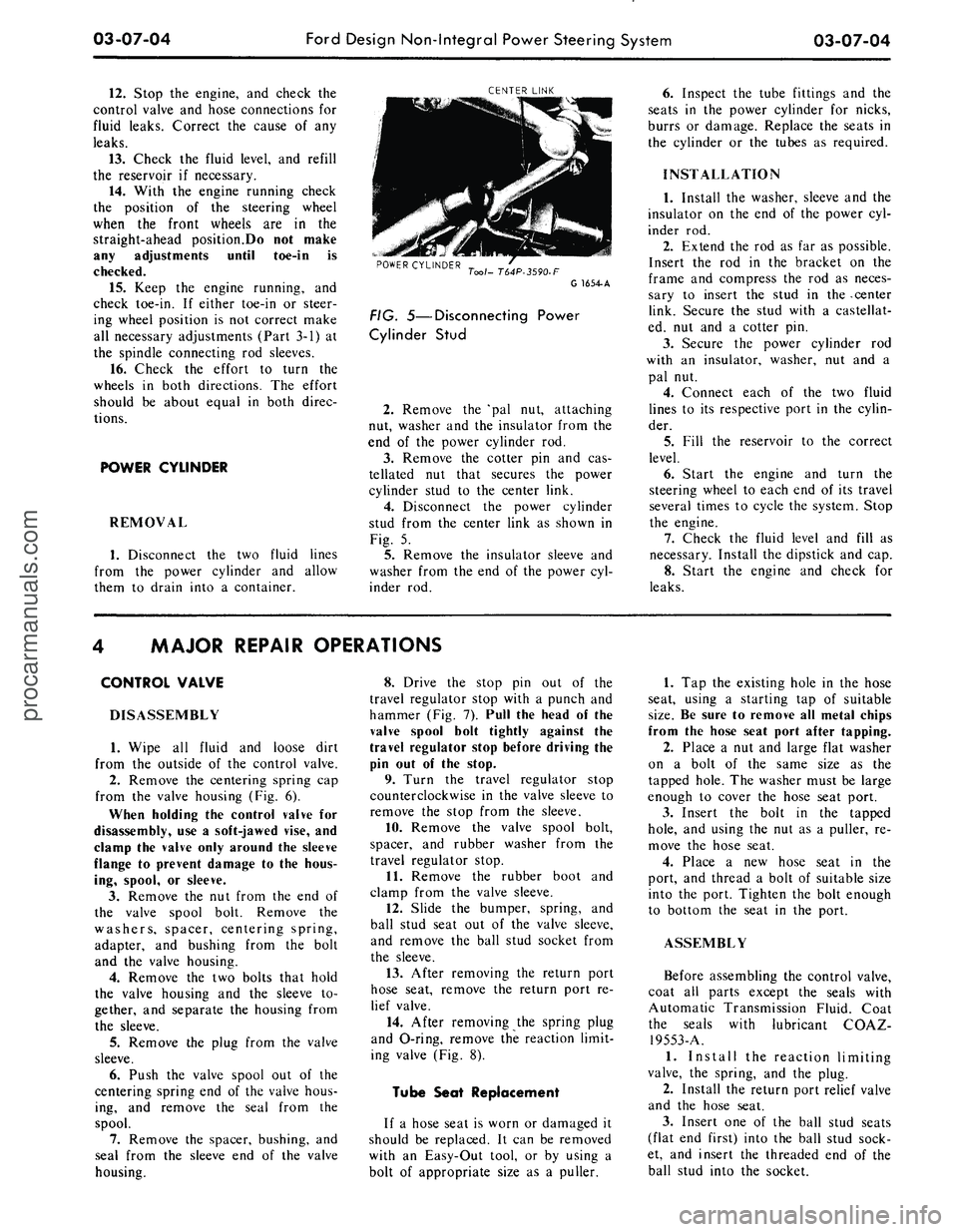
FIG. 5—Disconnecting Power
Cylinder Stud
2.
Remove the 'pal nut, attaching
nut, washer and the insulator from the
end of the power cylinder rod.
3.
Remove the cotter pin and cas-
tellated nut that secures the power
cylinder stud to the center link.
4.
Disconnect the power cylinder
stud from the center link as shown in
Fig. 5.
5.
Remove the insulator sleeve and
washer from the end of the power cyl-
inder rod.
6. Inspect the tube fittings and the
seats in the power cylinder for nicks,
burrs or damage. Replace the seats in
the cylinder or the tubes as required.
INSTALLATION
1.
Install the washer, sleeve and the
insulator on the end of the power cyl-
inder rod.
2.
Extend the rod as far as possible.
Insert the rod in the bracket on the
frame and compress the rod as neces-
sary to insert the stud in the -center
link. Secure the stud with a castellat-
ed, nut and a cotter pin.
3.
Secure the power cylinder rod
with an insulator, washer, nut and a
pal nut.
4.
Connect each of the two fluid
lines to its respective port in the cylin-
der.
5.
Fill the reservoir to the correct
level.
6. Start the engine and turn the
steering wheel to each end of its travel
several times to cycle the system. Stop
the engine.
7.
Check the fluid level and fill as
necessary. Install the dipstick and cap.
8. Start the engine and check for
leaks.
MAJOR REPAIR OPERATIONS
CONTROL VALVE
DISASSEMBLY
1.
Wipe all fluid and loose dirt
from the outside of the control valve.
2.
Remove the centering spring cap
from the valve housing (Fig. 6).
When holding the control valve for
disassembly, use a soft-jawed vise, and
clamp the valve only around the sleeve
flange to prevent damage to the hous-
ing, spool, or sleeve.
3.
Remove the nut from the end of
the valve spool bolt. Remove the
washers, spacer, centering spring,
adapter, and bushing from the bolt
and the valve housing.
4.
Remove the two bolts that hold
the valve housing and the sleeve to-
gether, and separate the housing from
the sleeve.
5.
Remove the plug from the valve
sleeve.
6. Push the valve spool out of the
centering spring end of the valve hous-
ing, and remove the seal from the
spool.
7.
Remove the spacer, bushing, and
seal from the sleeve end of the valve
housing.
8. Drive the stop pin out of the
travel regulator stop with a punch and
hammer (Fig. 7). Pull the head of the
valve spool bolt tightly against the
travel regulator stop before driving the
pin out of the stop.
9. Turn the travel regulator stop
counterclockwise in the valve sleeve to
remove the stop from the sleeve.
10.
Remove the valve spool bolt,
spacer, and rubber washer from the
travel regulator stop.
11.
Remove the rubber boot and
clamp from the valve sleeve.
12.
Slide the bumper, spring, and
ball stud seat out of the valve sleeve,
and remove the ball stud socket from
the sleeve.
13.
After removing the return port
hose seat, remove the return port re-
lief valve.
14.
After removing the spring plug
and O-ring, remove the reaction limit-
ing valve (Fig. 8).
Tube Seat Replacement
If a hose seat is worn or damaged it
should be replaced. It can be removed
with an Easy-Out tool, or by using a
bolt of appropriate size as a puller.
1.
Tap the existing hole in the hose
seat, using a starting tap of suitable
size.
Be sure to remove all metal chips
from the hose seat port after tapping.
2.
Place a nut and large flat washer
on a bolt of the same size as the
tapped hole. The washer must be large
enough to cover the hose seat port.
3.
Insert the bolt in the tapped
hole,
and using the nut as a puller, re-
move the hose seat.
4.
Place a new hose seat in the
port, and thread a bolt of suitable size
into the port. Tighten the bolt enough
to bottom the seat in the port.
ASSEMBLY
Before assembling the control valve,
coat all parts except the seals with
Automatic Transmission Fluid. Coat
the seals with lubricant COAZ-
19553-A.
1.
Install the reaction limiting
valve, the spring, and the plug.
2.
Install the return port relief valve
and the hose seat.
3.
Insert one of the ball stud seats
(flat end first) into the ball stud sock-
et, and insert the threaded end of the
ball stud into the socket.procarmanuals.com