1967 CHEVROLET CAMARO fluid rear
[x] Cancel search: fluid rearPage 76 of 659

HEATER AND AIR CONDITIONING 1A-53
Fig.
70—Wiring and Vacuum Lines—Four-Season (Camaro)
Installation
1.
Connect the expansion valve to the refrigerant pipes.
Attach the capillary bulb to the evaporator.
2.
Attach the evaporator to the- case. Attach the inlet
and outlet pipes clamps.
3.
Assemble the case halves. Insert the capillary tube
from the thermostatic switch between the fins as
shown in Figure . Attach the cover plate to the
case.
4.
Mount the unit to the dash and connect the refrigerant
lines.
5.
Evacuate and charge the system. If a new evaporator
was installed, add three fluid ounces of refrigerant
oil to the system before charging.
6. Test system operation.
Chevy II All-Weather System
Removal
Under
the Hood
1.
Purge the refrigerant from the system.
2.
Remove the refrigerant hoses from the evaporator
inlet and outlet connections extending through the
special grommet in the dash panel and into the
engine compartment.
3.
Remove the screw, nut, spacer bracket and grommet
from the outlet connection pipes.
Within the Car
4.
Remove the glove box, ash tray and ash tray
retainer.
5.
Reach through the glove box door to disconnect the
air conditioning "on" door bowden cable (fig. 75).
6. Remove the two shield attaching screws and shield
(A, fig. 76) which covers the lower right evaporator
bracket-to-blower bracket attaching screw (B, fig.
76),
then remove this screw.
7.
Behind the lower left side of ihe evaporator, remove
the evaporator bracket-to-heater distributor bracket
attaching screw (C, fig. 76).
8. Reaching through the glove box door and ash tray
openings, remove the two nuts and washers (D,
fig.
76) attaching the evaporator assembly studs to
the lower instrument panel flange and reinforcement.
9. Disconnect the drain hoses and carefully pull the
evaporator unit toward the rear of the vehicle.
10.
Disconnect wiring connectors (see fig. 77) as nec-
essary and remove the evaporator unit from the
vehicle.
Gore and/or Expansion Valve Replacement
A defective unit must be replaced since repairs should
never be made on the evaporator core. Before replacing
the core, however, check to be sure that any leaks pres-
sent are not located at the hose connections or expansion
valve connections. The following procedure assumes that
the evaporator unit has been removed from the vehicle
as outlined above.
CHEVROLET CHASSIS SERVICE MANUAL
Page 234 of 659

BRAKES
SECTION 5
CONTENTS OF THIS SECTION
Duo Servo Brakes
Disc Brakes
Page
5-1 Power Brakes
5-24 Special Tools
Page
5-31
5-32
DUO-SERVO BRAKES
INDEX
Page
General Description 5-1
Maintenance and Adjustments 5-3
Hydraulic Brake Fluid .. . 5-3
Bleeding Hydraulic System 5-3
Pressure Bleeding 5-3
Manual Bleeding 5_4
Push Rod to Main Cylinder Clearance 5-5
Hydraulic Brake Lines 5-5
Hydraulic Brake Hose 5-5
Hydraulic Brake Tubing 5-6
Brake Adjustment. .................... 5-7
Service Brake 5-7
Parking Brake 5-8
Component Replacement and Repairs 5-9
Parking Brake - Chevrolet, Chevelle and
Camaro 5^9
Pedal Assembly 5-9
Front Cable ,. . . 5-9
Center Cable 5-9
Rear Cables. . 5-9
Parking Brake - Chevy n 5-9
Lever Assembly 5-9
Idler Lever 5-11
Front Cable 5-11
Rear Cable . . ; 5-12
Parking Brake - Corvette 5-13
Lever Assembly . . . . 5-13
Front Cable 5-14
Rear Cable . . 5-14
Brake Pedal 5-15
Shoes and Linings 5-16
Organic 5-16
Metallic 5-17
Main Cylinder 5-18
Wheel Cylinders 5-21
Anchor Pin 5-22
Front Wheel 5-22
Rear Wheel 5-22
Brake Drums • 5-22
Brake Pipe Distribution and Switch Assembly . . . . . 5-23
Camaro Pressure Regulator Valve 5-23
GENERAL DESCRIPTION
All 1967 models are equipped with a new split brake
system as a safety feature. If a wheel cylinder or brake
line should fail at either the front end or rear end of
the vehicle, the operator can still bring the vehicle to
a controlled stop. The system is designed with separate
hydraulic systems for the front and rear brake using
a dual master cylinder (fig. 1). The design of the master
cylinder is similar to that used on the 1966 Corvette
in that it has two entirely separate reservoirs and outlets
in a common body casting. The front reservoir and outlet
is connected to the front wheel brakes, and the rear
reservoir and outlet is connected to the rear wheel
brakes. Two pistons within the master cylinder receive
mechanical pressure from the brake pedal push rod and
transmit it through the brake lines as hydraulic pressure
to the wheel cylinders. The filler cap is accessible from
inside the engine compartment.
A new brake pipe distribution and switch assembly
is mounted below the main cylinder. The front and rear
hydraulic brake lines are routed from the main cylinder,
through the brake pipe distribution and switch assembly,
to the front and rear brakes as shown in Figure 2. The
switch is wired electrically to the brake alarm indicator
light on the instrument panel. In the event of fluid loss
in either the front or rear brake system the indicator
on the instrument panel will illuminate red. (The indi-
cator will also' be illuminated when the parking brake is
applied.)
On Camaro models equipped with air conditioning, the
rear brake hydraulic line is routed through a pressure
regulator valve mounted on the left frame side rail
(fig. 3). The valve controls the hydraulic pressure to
the rear brakes resulting in the correct pressure balance
between the front and rear hydraulic systems.
The self-adjusting brakes (fig. 4), used on both front
and rear of all models, are the Duo-Servo single anchor
type which utilize the momentum of the vehicle to assist
in the brake application. The self-energizing or
self-
actuating force is applied to both brake shoes at each
wheel in both forward and reverse motion. The brake
shoe linings are bonded to the shoes.
Wheel cylinders are the double piston type permitting
even distribution of pressure to each brake shoe. To
keep out dust and moisture, both ejads of each wheel
cylinder are sealed with a rubber booC The wheel
cylinders have no adjustments.
The Chevrolet, Chevelle, and Camaro parking brakes
have a foot operated ratchet type pedal mounted to the
left of the steering column. A cable assembly connects
the pedal to an intermediate cable by means of an equal-
izer, where the adjustment for the parking brake is
incorporated. The intermediate cable attaches to the
CHEVROLET CHASSIS SERVICE MANUAL
Page 236 of 659

BRAKES
5-3
PRIMARY
SHOE
PAWL
WIRE LINK
OVERRIDE
LEVER
VERRIDE
SPRING
RETURN
SPRING
STAR
WHEEL
Fig.
3—Camaro
Pressure
Regulator
Valve
Fig.
4-Self-Adjusting
Brake
MAINTENANCE AND ADJUSTMENTS
In any service operation it is extremely important
that absolute cleanliness be observed. Any foreign matter
in the hydraulic system will tend to clog the lines, ruin
the rubber cups of the main and wheel cylinders and
cause inefficient operation or even failure of the braking
system. Dirt or grease on a brake lining may cause
that brake to grab first on brake application and fade
out on heavy brake application.
The split system consists basically of two separate
brake systems. When a failure is encountered on either,
the other is adequate to stop the vehicle. If one system
is not functioning, it is normal for the brake pedal lash
and pedal effort to substantially increase. This occurs
because of the design of the master cylinder which
incorporates ah actuating piston for each system. When
the rear system loses fluid and takes in air, its piston
will bottom against the front piston. When the front
system loses fluid and takes in air, its piston will
bottom on the end of the main cylinders body. The loss
of fluid in one of the systems causes an uneven hydraulic
pressure balance between the front and rear systems.
The brake pipe distribution and switch assembly, near
the main cylinder, detects the loss of pressure and il-
luminates the brake alarm indicator light on the instru-
ment panel. The pressure loss is felt at the brake pedal
by an apparent lack of brakes for most of the brake
travel and then, when failed chamber is bottomed, the
pedal will harden.
HYDRAULIC BRAKE FLUID
Use GM Hydraulic Brake Fluid, Supreme No. 11 or
equivalent when servicing brakes. This brake fluid is
satisfactory for any climate and has all the qualities
necessary for proper operation, such as a high boiling
point to prevent vapor lock and the ability to remain
fluid at low temperatures.
In the event that improper fluid has entered the system,
it will be necessary to service the system as follows:
1.
Drain the entire system.
2.
Thoroughly flush the system with clean alcohol,
188
proof,
or a hydraulic system cleaning fluid
such as "Declene".
3.
Replace all rubber parts of the system, including
brake hoses.
4.
Refill the system.
5. Bleed the system.
BLEEDING HYDRAULIC SYSTEM
The hydraulic brake system must be bled whenever
any line has been disconnected or air has in some way
entered the system. A ''spongy" pedal feeling when the
brakes are applied may indicate presence of air in the
system. The system must be absolutely free of air at
all times. Bleeding should be done on the longest line
first; the proper sequence to follow is left rear, right
rear, right front, and left front (fig. 5). Bleeding of
brake system may be performed by one of two methods—
either pressure or manual.
PRESSURE
BLEEDING
1.
Clean all dirt from top of main cylinder and remove
cylinder cover and rubber diaphragm.
2.
Reduce fluid level in main cylinder until reservoirs
are approximately half full.
NOTE:
Make sure brake fluid in bleeder equip-
ment is at operating level and that the. equipment
is capable of exerting 30 to 50 lbs. hydraulic
pressure on the brake system.
3.
Install brake bleeder adapter J-22489 (fig. 6) on
main cylinder. Connect hose from bleeder equipment
to bleeder adapter and open release valve on bleeder
equipment.
CHEVROLET CHASSIS SERVICE MANUAL
Page 249 of 659
BRAKES 5-16
6Y. Adjust clutch pedal travel as outlined in
Section 7.
SHOES AND LININGS
Organic Linings
NOTE:
If brake drums are worn severely, it
may be necessary to retract the adjusting screw.
To gain access to the adjusting screw star
wheel, knock out the lanced area in the web of
the brake drum using a chisel or similar tool.
Release the actuator from the star wheel by
lifting with a small screw driver and back off
the star wheel with a second screw driver (press
down on the handle to retract shoes).
CAUTION: After knocking out the metal, be
sure to remove it from the inside of the drum .
and clean all metal from the brake compartment.
A new hole cover must be installed when drum
is reinstalled.
Removal
1.
Raise the vehicle and plate on jack stands.
2.
Loosen check nuts at parking brake equalizer suffi-
ciently to remove, all tension from brake cable.
3.
Remove brake drums.
NOTE:
Since there are wheel cylinder piston
stops to prevent pistons from leaving cylinders,
it is not necessary to install wheel cylinder
clamps when brake shoes are removed; however,
brake pedal must not be depressed while drums
are removed.
4.
Unhook brake shoe pull back springs from anchor
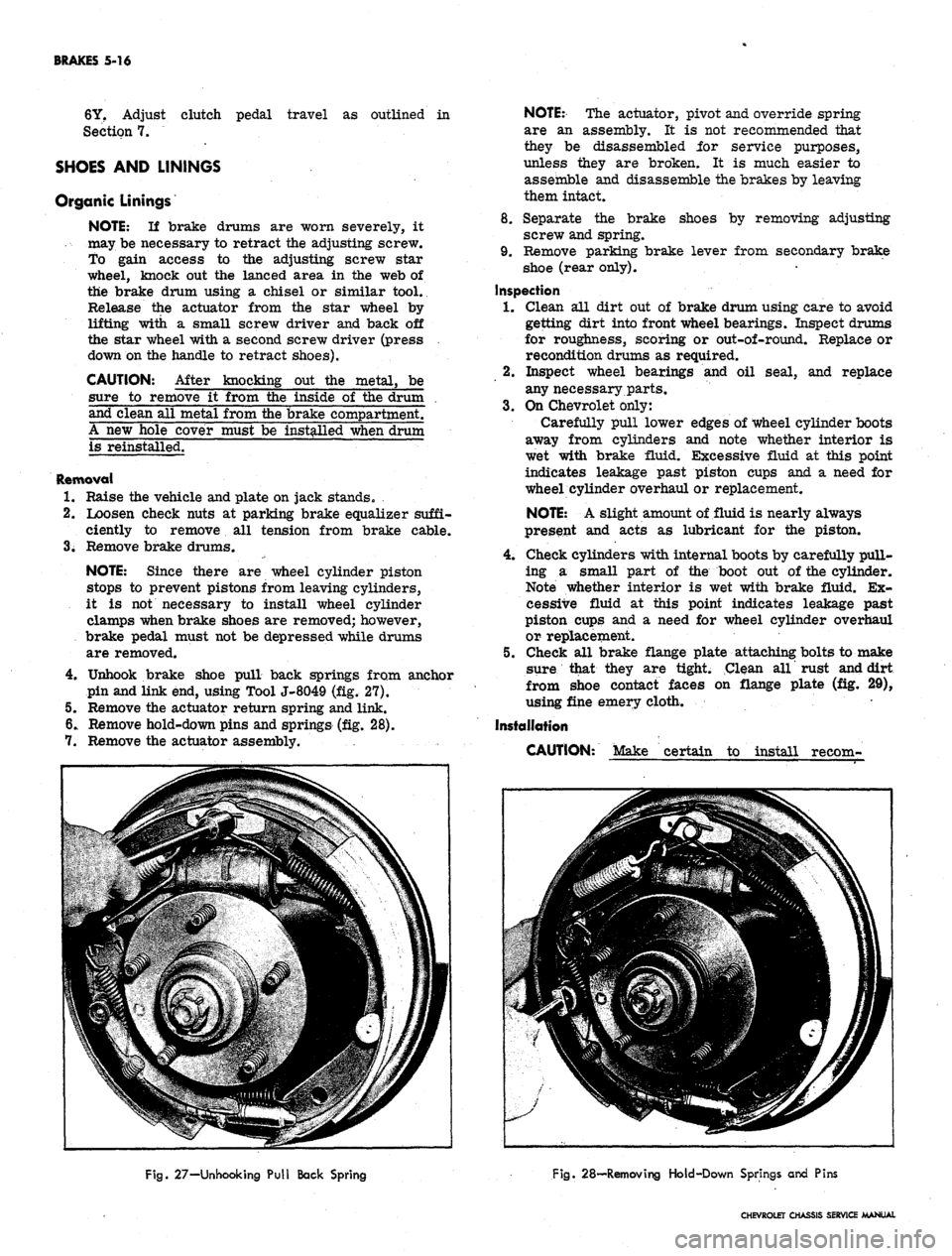
pin and link end, using Tool J-8049 (fig. 27).
5. Remove the actuator return spring and link.
6. Remove hold-down pins and springs (fig. 28).
7. Remove the actuator assembly.
NOTE:
The actuator, pivot and override spring
are an assembly. It is not recommended that
they be disassembled for service purposes,
unless they are broken. It is much easier to
assemble and disassemble the brakes by leaving
them intact.
8. Separate the brake shoes by removing adjusting
screw and spring.
9. Remove parking brake lever from secondary brake
shoe (rear only).
Inspection
1.
Clean all dirt out of brake drum using care to avoid
getting dirt into front wheel bearings. Inspect drums
for roughness, scoring or out-of-round. Replace or
recondition drums as required.
2.
Inspect wheel bearings and oil seal, and replace
any necessary parts.
3.
On Chevrolet only:
Carefully pull lower edges of wheel cylinder boots
away from cylinders and note whether interior is
wet with brake fluid. Excessive fluid at this point
indicates leakage past piston cups and a need for
wheel cylinder overhaul or replacement.
NOTE:
A slight amount of fluid is nearly always
present and acts as lubricant for the piston.
4.
Check cylinders with internal boots by carefully pull-
ing a small part of the boot out of the cylinder.
Note whether interior is wet with brake fluid. Ex-
cessive fluid at this point indicates leakage past
piston cups and a need for wheel cylinder overhaul
or replacement.
5. Check all brake flange plate attaching bolts to make
sure that they are tight. Clean all rust and dirt
from shoe contact faces on flange plate (fig. 29),
using fine emery cloth.
Installation
CAUTION: Make certain to install recom-
Fig.
27-Unhooking Pull Back Spring
Fig.
28—Removing Hold-Down Springs and Pins
CHEVROLET CHASSIS SERVICE MANUAL
Page 257 of 659

BRAKES
5-24
DISC BRAKES
INDEX
Page
General Description
. 5-24
Maintenance
and
Adjustments
5-24
Bleeding Hydraulic System
5-24
Parking Brake Adjustment
-
Corvette
5-24
Component Replacement
and
Repairs
5-25
Page
Brake Shoes
. . . . . 5-25
Brake Caliper
5-26
Brake Disc
5-29
Main Cylinder.
5-30
Parking Brake Shoes
-
Corvette
5-30
GENERAL DESCRIPTION
Four wheel disc brakes
are
standard equipment
on
the
1967
Corvette,
as in 1966. The
Corvette
may
also
be equipped with heavy duty disc brakes which include
new front calipers, shoes, linings,
and
rear pressure
regulator valve. This heavy duty option
is
used
in
conjunction with
a
vacuum power unit. Front wheel disc
brakes
are
installed
as
optional equipment
on
Chevrolet,
Chevelle, Camaro,
and
Chevy
II
models.
The disc brake,
(fig. 35),
consists
of a
fixed caliper,
rotating disc, splash shield,
and
mounting bracket.
The
caliper assembly contains four pistons and two shoe
and
lining assemblies with
the
lining riveted
to the
steel
shoes.
A
seal
and
dust boot
are
installed
on
each piston,
with
a
piston spring
in the
caliper cylinder bore beneath
each piston.
A
retaining pin extends through each caliper
half
and
both shoes
to
hold
the
shoes and linings
in
posi-
tion
in the
caliper.
On
Corvette heavy duty disc brakes,
two retaining cotter pins
are
used
at
each end
of the
caliper
to
secure
the
shoes
and
linings. Machined
sur-
faces within
the
caliper prevent
the
shoe
and
lining
assembly from rotating with
the
brake disc when pres-
sure
is
applied.
The disc, which
has a
series
of air
vent louvers
to
provide cooling,
is
mounted
on the
front wheel-hub.
The caliper straddles
the
disc and mounts
on a
mounting
bracket attached
to the
steering knuckle with
two
bolts.
The Corvette heavy duty option includes
a
pressure
regulator valve mounted
in the
rear brake line just
below
the
main cylinder. Chevrolet, Chevelle, Camaro,
and Chevy
n
models with disc brakes have
a
pressure
regulator valve mounted
in the
front brake line just
below
the
main cylinder. The valve controls
the
hydraulic
pressure
to the
front
or
rear brakes,
as
applicable,
resulting,
in the
correct pressure balance between
the
front
and
rear hydraulic systems. This valve guards
against premature .lock-up
of
front
or
rear wheels when
brakes
are
applied.
Maintenance, adjustment,
and
service operations which
are
not
included
in
this section
are the
same
as for
the Duo-Servo type brakes.
MAINTENANCE
AND
ADJUSTMENTS
BLEEDING HYDRAULIC SYSTEM
The operation
of
bleeding
the
disc brake hydraulic
system
is the
same
as for
Duo-Servo system outlined
in
the
front
of
this section. Note
the
exceptions below
and refer
to
bleeding procedures under Duo-Servo
brakes.
1.
When pressure bleeding equipment
is
used,
the
correct pressure setting
for
bleeding disc brakes
is 10-2.0
lbs. on
Corvette,
and 40 lbs. on all
other
models.
2.
The
front calipers contain
one
bleeder valve.
The
rear calipers
on
Corvette contain two bleeder valves
(one inboard
and one
outboard) which necessitates
the removal
of the
rear wheels
for
bleeding.
3.
Tapping
the
caliper with
a
rawhide mallet
as the
fluid
is
flowing
out may
assist
in
obtaining
a
good
bleeding
job.
4.
On
Chevrolet, Chevelle, Camaro
and
Chevy
II, the
spring loaded
end of the
pressure regulator valve
(fig.
36)
must
be
held (valve
in
open position) while
bleeding. This
is
done
by
depressing
and
holding
in
the
plunger
in the
end
of
the valve either
by
hand,
by taping,
or by
clamping.
PARKING BRAKE-CORVETTE
Adjustment
1.
Raise rear
end of
vehicle
and
place
on
jack stands.
2.
Remove rear wheels.
3/
Loosen brake cables
at the
equalizer until
the
park-
ing brake levers move freely
to the "off"
position
with slack
in the
cables.
4.
Turn
the
disc until
the
adjusting screw can
be
seen
through
the
hole
in the
disc.
5. Insert
an
adjusting tool
or
screw driver through
the
hole
in the
disc
and
tighten
the
adjusting screw
by
moving your hand away from
the
floor
on
both
the
left and right sides
(fig. 37).
6. Tighten until
the
disc will
not
move, then back
off
ten
(10)
notches.
7. Apply
the
parking brake four
(4)
notches from inside
the
car.
8. Tighten
the
brake cables
at the
equalizer
to
produce
a light drag with
the
wheels mounted.
9. Fully release
the
parking brake handle
and
rotate
the rear wheels.
No
drag should be evident with
the
handle released.
CHEVROLET CHASSIS SERVICE MANUAL
Page 259 of 659

BRAKES 5-26
PRESSURE
REGULATOR
VALVE
CHEVROLET
PRESSURE
REGULATOR
VALVE
CAMARO
Fig.
36—Pressure Regulator Valve—Chevrolet and Camaro Shown
install two retaining cotter pins, one at each end of
the caliper.)
8. Repeat above procedure at each wheel where shoes
are to be replaced.
9. Refill main cylinder to fluid level shown in Figure
8. If necessary, bleed brake system as outlined in
this section.
10.
Install wheels and lower vehicle.
BRAKE
CALIPER
Removal
1.
Raise vehicle and place on jackstands.
2.
Remove wheel.
3.
On front caliper, disconnect the brake hose at brake
line support bracket. On Corvette rear caliper,
disconnect the brake tubing from the inboard caliper.
Tape the open tube or line end to prevent foreign
matter from entering the system.
4.
Pull cotter pin from end of shoe assembly retaining
pin.
Remove the pin and shoe assembly from the
Fig.
37—Adjusting Parking Brake Shoes
Fig.
38—Replacing Shoe and Lining Assembly
CHEVROLET CHASSIS SERVICE MANUAL
Page 261 of 659

BRAKES 5-28
Fig.
40—Installing Piston in Caliper Bore Using
Tool J-22591
Fig.
41—Installing Boot Seal in Caliper Bore
Using Tool J-22592
5.
Check the fit of the piston in the bore using a feeler
gage.
Clearance should be as follows:
2 1/16 inch Bore .0045 to .010
1 7/8 inch Bore .0045 to .010
1 3/8 inch Bore .0035 to .009
If the bore is not damaged, and the clearance exceeds
either of the upper limits, a new piston will be required.
Assembly
1.
Assemble the seal in the groove in the piston which
is closest to the flat end of the piston. The lip on
the seal must face toward the large end of the
piston. Be sure lips are in the piston groove and do
not extend over the step in the end of the groove.
2.
Place the spring in the bottom of the piston bore.
3.
Lubricate the seal with dean brake fluid.
4.
Install the piston assembly in the bore using appli-
cable piston rign compressor Tool J-22639, 22629
or 22591 as shown in Figure 40. Use care not to
damage the seal lip as piston is pressed past the
edge of the bore. .
5.
Assemble the boot in the groove of the piston closest
to the concave end of the piston. The fold in the boot
must face toward the end of the piston with the seal
on it.
6. Depress the pistons and check that they slide
smoothly into the bore until the end of the piston is
flush with the end of the bore. If not, re check piston
assembly and location of the piston spring and the
seal.
7.
Position applicable boot seal installer Tool J-22592,
J-22628, or J-22638 over the piston and seat the
steel boot retaining ring evenly in the counterbore
as shown in Figure 41. The boot retaining ring must
be flush or below the machined face of the caliper.
Any distortion or uneven seating could allow con-
taminating and corrosive elements to enter the bore.
8. Position the t:O}> rings in the small cavities around
the brake fluid transfer holes in both ends of the
outboard caliper halves. Lubricate the hex head
. bolts with Delco Brake Lube or clip in clean brake
fluid. Fit caliper halves together and secure with
bolts.
Refer to torque specifications in rear of
manual for correct torque valves.
Installation
1.
Carefully mount the assembled caliper over the edge
of the disc. Use a putty knife to depress pistons so
that the caliper can be lowered into position on the
disc (fig. 42). Use care to prevent damage to boots
• on the edge of the disc as the caliper is mounted.
2.
Secure the caliper to the mounting bracket with two
hex head bolts. Refer to torque specifications in
rear of manual for correct torque values.
CAUTION: If replacing old shoe assemblies,
be sure to get the shoes in the same position
from which they were removed. New shoe as-
semblies have an arrow printed on the back,
showing the direction of forward disc rotation.
3.
Install the shoe and lining assemblies as outlined in
this section.
4.
On Chevrolet and Corvette front calipers, place a
new copper gasket on the male end of the front
wheel brake hose. On all models, install brake hose
in the calipers. With the wheels straight ahead,
pass the female end of the brake hose through the
support bracket.
5.
Make sure the tube seat is clean and connect the
break line tube nut to the caliper. Tighten securely.
6. Allowing the hose to seek a normal position, without
twist, insert hex of the hose fitting into the 12-point
hole in the support bracket and secure it in place
with the "V"-shaped retainer. Turn the steering
geometry from lock to lock while observing the hose.
CHEVROLET CHASSIS SERVICE MANUAL
Page 382 of 659

CLUTCH
AND
TRANSMISSIONS
7-23
Assembly (Fig.
4X)
1.
With detent spring tang projecting
up
over
the 3rd
and
4th
shifter shaft cover opening install
the
first
and second detent
cam
onto
the
detent
cam
pivot
pin.
With
the
detent spring tang projecting
up
over
the
first
and
second shifter shaft cover hole install
the
3rd
and 4th
detent
cam,
NOTE:
The 1-2
detent
cam has a
.090" greater
contour
on the
inside detent notch.
2.
3.
Install detent
cam
retaining
"C"
ring
to
pivot shaft,
and hook spring into detent
cam
notches.
Install
1-2 and 3-4
shifter shaft assemblies
in
cover
being careful
not to
damage seals. Install both shift
forks
to
shifter shaft assemblies, lifting
up on
detent
cam
to
allow forks
to
fully seat into position.
4.
Install reverse detent ball
and
spring
to
cover, then
install reverse shifter shaft assembly
to
cover.
5.
Install outer shifter levers, flat washers, lock wash-
ers
and
bolts.
Installation
1.
Shift shifter levers into neutral detent (center) posi-
tion. Position cover gasket
on
case.
2.
Carefully position side cover into place making sure
the shift forks
are
aligned with their respective
mainshaft clutch sliding sleeves.
Install cover attaching bolts
and
tighten evenly
to
specified torque.
Remove filler plug
and add
lubricant specified
in
Section
0, to
level
of
filler plug hole.
3.
4.
ALUMINUM POWERGLIDE
INDEX
Page
General
Description
7-23
Maintenance
and
Adjustments .............. 7—23
Oil
Level Check
7-23
Periodic
Oil
Change
7-24
Periodic
Low
Band Adjustment
7-24
Manual
Shift Linkage Check
and
Adjust
7-24
Floor
Shift Linkage
7-25
Floor
Mounted Control Lever
and
Bracket
Assembly
7-29
Throttle
Valve Linkage
.... 7-29
Neutral
Safety Switch
.. . 7-30
Throttle
Return Check Valve (Dashpot)
7-30
Component
Parts Replacement
7-30
Transmission
Replacement .............. 7—30
Page
Other
Service Operations
7-32
Diagnosis
7-32
Warming
Up
Transmission
7-32
Shop
Warm
Up , 7-32
Road
Warm
Up 7-32
Checking
Fluid Level
and
Condition
7-32
Manual
Linkage
7-32
Oil
Leaks
7-33
Basic
Pressure Checks
7-33
Wide
Open Throttle Upshift Pressure Check
.... 7-33
Idle
Pressure
in
Drive Range
7-33
Manual
"Low"
Range Pressure Check .......
7-33
Drive
Range Overrun (Coast) Pressure
.
.......
7-33
Powerglide
Shift Points
. . 7-35
GENERAL DESCRIPTION
The case
and
converter housing
of the two
speed alumi-
num Powerglide Transmission
is a
single case aluminum
unit. When
the
manual control
is
placed
in the
drive
po-
sition,
the
transmission automatically shifts
to low
gear
for initial vehicle movement.
As the car
gains speed
and
depending
on
load
and
throttle position,
an
automatic shift
is made
to
high gear.
A
forced downshift feature
pro-
vides
a
passing gear
by
returning
the
transmission
to low
range.
The
oil
pump assembly
is a
conventional gear type
and
the
oil
pump housing
is of the
large diameter type acting
as
the
front bulkhead
of the
transmission.
The
torque
converter
is a
conventional three element welded design
bolted
to the
engine flywheel which drives through
a
two-
speed planetary gearset.
The
high clutch assembly
is
typical
of the
designs used
in
this type transmission.
The
aluminum Powerglide uses
an
output shaft mounted
gov-
ernor which requires
a
hole through
the
output shaft.
The
reverse clutch assembly
is a
multiple disc type clutch.
The steel plates
are
splined directly
to the
case while
the
face plates
are
splined
to the
internal
or
ring gear.
The
clutch piston operates within
the
rear portion
of the
case.
The internal diameter
of the
pistoh
is
sealed to
an
integral
hub portion
of the
case rear bulkhead.
The
outside
dia-
meter
is
sealed
to a
machined portion
of the
case.
The
piston
is
hydraulically applied
and is
released
by
separate
coil springs.
The
valve body assembly
is
bolted
to the
bottom
of the
transmission case
and is
accessible
for
service
by
removing
the oil pan
assembly.
The
valve
body consists
of an
upper
and
lower body located
on
either
side
of a
transfer plate.
The
vacuum modulator
is lo-
cated
on the
left rear face
of the
transmission case.
The
modulator valve bore
is
located
in the
upper valve body.
MAINTENANCE
AND
ADJUSTMENTS
OIL LEVEL CHECK
The transmission
oil
level should
be
checked period-
ically
as
recommended
in
Section
0. Oil
should
be
added
only when level
is on or
below
the
"ADD" mark
on the dip
stick with
oil hot or at
operating temperature.
The oil
level
dip
stick
is
located
at the
right rear
of the
engine
compartment. Fill with
oil
specified
in
Section
0.
In order
to
check
oil
level accurately,
the
engine should
be idled with
the
transmission
oil hot and the
control
lever
in
neutral (N) position.
It
is
important that
the oil
level
be
maintained
no
higher than
the
"FULL" mark
on the
transmission
oil
level gauge.
DO NOT
OVERFILL,
for
when
the oil
level
CHEVROLET CHASSIS SERVICE MANUAL