1967 CHEVROLET CAMARO flat tire
[x] Cancel search: flat tirePage 213 of 659

REAR SUSPENSION AND DRIVE LINE 4-23
Fig.
62—Torque Control Arm (Corvette)
2.
Place center clamp plate in position and install four
bolts and washers. Tighten bolts and torque to
specifications.
3.
Raise spring outer end with floor jack until spring
is nearly flat and secure with chain as in Step 3-
Removal.
.4.
Lower jack, align torque control arm with spring
end and insert link bolt, rubber cushions and re-
tainers. Install castellated nut on link bolt and
tighten until cotter pin hole in bolt is visible. In-
sert new cotter pin and bend ends around.
5. Raise spring end with jack under link bolt, and re-
move chain and C clamp when loose.
6. Carefully lower jack, making sure rubber cushions
remain indexed in retainers.
7. Remove jack and repeat on opposite side. Install
wheels and tires, remove frame supports and lower
vehicle to floor.
TORQUE CONTROL ARM (Fig. 62)
Removal
1.
Disconnect spring on side torque arm is to be re-
moved. Follow Steps 1-6, Spring-Removal.
NOTE:
If vehicle is so equipped, disconnect
stabilizer rod from torque arm - refer to
"Stabilizer Rod Replacement".
2.
Remove shock absorber lower eye from strut rod
shaft.
3.
Disconnect and remove strut rod shaft and swing
strut rod down.
4.
Remove four bolts securing axle drive shaft to
spindle flange and disconnect drive shaft.
NOTE:
It may be necessary to force torque
arm outboard to provide clearance to drop drive
shaft.
5. Disconnect brake line at wheel cylinder inlet or
caliper and from torque arm. Disconnect parking
brake cable.
6. Remove torque arm pivot bolt and toe-in shims and
pull torque arm out of frame. Tape shims together
and identify for correct reinstallation.
RETAINER
RETAINER
PLATE
BUSHING
CONTROL ARM
Fig.
63—Torque Control Arm Bushing Cross-Sect ion (Corvette)
NOTE:
For service operations pertaining to
the spindle support assembly, refer to service
operations under Wheel Spindle and Support
earlier in this section.
Repairs (Fig. 63)
1.
Using 11/16" drill, drill out flared end of bushing
retainer (fig. 64).
2.
Remove special retainer plate and tap retainer out
of bushing.
3.
Remove bushings by spreading them apart with a
chisel and tap out of arm (fig. 65).
NOTE:
If bushing diameters are severely
rusted in torque arm, and arm tends to spread
during removal, clamp arm in a C-clamp to
prevent spreading.
Fig.
64—Drilling Out Retainer Flare (Corvette)
CHEVROLET CHASSIS SERVICE MANUAL
Page 214 of 659

REAR SUSPENSION AND DRIVE LINE 4-24
4
i*
5
Fig.
65—Removing Bushings (Corvette)
4.
Lightly oil new bushing diameters (not rubber por-
tion) and start bushings squarely in arm.
5. Install Tool J-7055-1 as shown in Figure 66 and
press bushings into place.
6. When bushings are fully installed, place special
plate over flared portion of new bushing retainer
and insert retainer into bushing.
7. Out of 5/8" thick steel plate 1-1/2" wide make flar-
ing tool support to the dimensions shown in Figure
67 and drill clearance holes as shown for 2
—
1/2"
bolts.
8. Place fabricated back-up plate on flared end of bush-
ing retainer and assembly Tool J-8111-23 to plate
with 2-1/2" bolts 5" long. Make sure threaded hole
in J-8111-23 is centered over unflared end of bushing
retainer and that chambered retainer plate is cen-
tered over retainer tube.
9. Lightly oil pointed end of J-8880-5 screw and thread
into J-
8111-23
until pointed "end contacts bushing
retainer. Continue threading J-8111-23 until retainer
is flared (fig. 68).
Installation
1.
Place torque arm in frame opening.
2.
Place toe-in shims in original position on both sides
of torque arm, install pivot bolt and tighten but do
not torque at this point.
Fig.
67—Flaring Tool Back-Up Plate (Corvette)
3.
Raise axle drive shaft into position and install to
drive flange. Torque bolts to specifications.
4.
Raise strut rod into position and insert strut rod
shaft so that flat lines up with flat in spindle sup-
port fork. Install nut and torque to specifications.
5. Install shock absorber lower eye and tighten nut
to specifications.
6. Connect spring end as outlined under Spring-
Bistallation, Steps 3-6'.
NOTE:
If vehicle is so equipped, connect sta-
bilizer shaft to torque arm - refer to "Sta-
bilizer Shaft Replacement".
7. Install brake disc and caliper, wheel and tire and
lower vehicle. Tighten torque arm pivot bolt. Bleed
brakes as outlined in Section 5-Brakes.
SUSPENSION CROSSMEMBER
Removal
1.
Disconnect and remove spring as outlined under
Spring-Removal.
2.
Remove differential carrier assembly as outlined
under Differential Carrier-Removal in this section.
3.
Support crossmember, remove bolts securing
crossmember isolation mounts to frame and lower
crossmember (fig. 69).
Fig.
66—Installing Bushings (Corvette)
Fig.
68—Flaring Retainer (Corvette)
CHEVROLET CHASSIS SERVICE MANUAL
Page 254 of 659
BRAKES 5-21
brake fluid. Coat the primary and secondary seals
on the secondary piston with clean brake fluid. Insert
the secondary piston spring retainer into the sec-
ondary piston spring. Place the retainer and spring
down over the end of the secondary piston until the
retainer locates inside of the lips of the primary
cup.
10.
Hold the master cylinder with the open end of the
bore down. Push the secondary piston into the bore
until the spring seats against the closed end of the
bore.
11.
Position the master cylinder in a vise with the
open end of the bore up. Coat the primary and
secondary seal on the primary piston with clean
brake fluid. Push the primary piston assembly,
spring end first, into the bore of the master cylinder*
Hold the piston down and snap the lock ring into
position in the small groove in the I.D. of the bore.
12.
Push the primary piston down to move the secondary
piston forward far enough to clear the stop screw
hole in the bottom of the front fluid reservoir. Install
the stop screw.
13.
Install reservoir diaphragm in the reservoir cover
and install the cover on the main cylinder. Push
bail wire into position to secure the reservoir cover.
Installation
1.
Assemble the push rod through the push rod retainer,
if it has been disassembled.
2.
Push the retainer over the end of the main cylinder.
Assemble new boot over push rod and press it down
over the push rod retainer. Slide new mounting
gasket into position.
3.
Secure .the main cylinder to the firewall with mount-
ing bolts.
4.
Connect the push rod clevis to the brake pedal with
pin and retainer.
5. Connect the brake lines to the main cylinder.
6. Fill the main cylinder reservoirs to the levels
shown in Figure 8. Bleed the brake system as out-
lined in this section.
7. K necessary, adjust the brake pedal free play as
outlined in this section.
WHEEL CYLINDER (Fig. 33)
The wheel cylinder boots should be removed from a
cylinder body only when they are visibly damaged or
leaking fluid. Wheel cylinders having torn, cut, or heat-
cracked boots should be completely overhauled.
Removal
1.
Raise vehicle and place on jack stands.
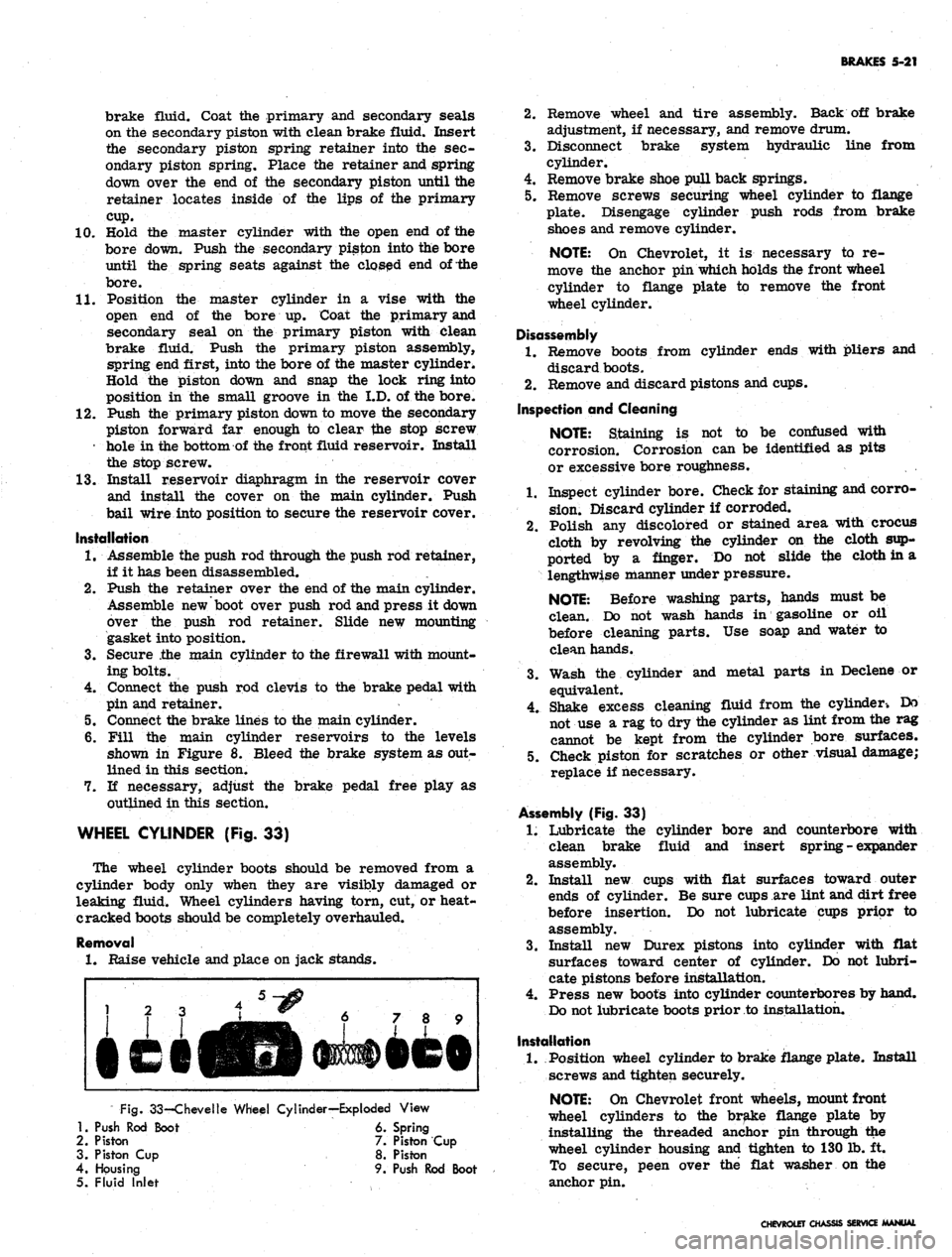
Fig.
33-Chevelle Wheel Cylinder—Exploded View
1.
Push Rod Boot 6. Spring
2.
Piston 7. Piston Cup
3. Piston Cup 8. Piston
4.
Housing 9. Push Rod Boot
5. Fluid Inlet
2.
Remove wheel and tire assembly. Back off brake
adjustment, if necessary, and remove drum.
3.
Disconnect brake system hydraulic line from
cylinder.
4.
Remove brake shoe pull back springs.
5. Remove screws securing wheel cylinder to flange
plate. Disengage cylinder push rods from brake
shoes and remove cylinder.
NOTE:
On Chevrolet, it is necessary to re-
move the anchor pin which holds the front wheel
cylinder to flange plate to remove the front
wheel cylinder.
Disassembly
1.
Remove boots from cylinder ends with pliers and
discard boots.
2.
Remove and discard pistons and cups.
Inspection and Cleaning
NOTE:
Staining is not to be confused with
corrosion. Corrosion can be identified as pits
or excessive bore roughness.
1.
Inspect cylinder bore. Check for staining and corro-
sion.
Discard cylinder if corroded.
2.
Polish any discolored or stained area with crocus
cloth by revolving the cylinder on the cloth sup-
ported by a finger. Do not slide tfce cloth in a
lengthwise manner under pressure.
NOTE:
Before washing parts, hands must be
clean. Do not wash hands in gasoline or oil
before cleaning parts. Use soap and water to
clean hands.
3.
Wash the cylinder and metal parts in Declene or
equivalent.
4.
Shake excess cleaning fluid from the cylinder-. Do
not use a rag to dry the cylinder as lint from the rag
cannot be kept from the cylinder bore surfaces.
5. Check piston for scratches or other visual damage;
replace if necessary.
Assembly (Fig. 33)
1.
Lubricate the cylinder bore and counterbore with
clean brake fluid and insert spring - expander
assembly.
2.
Install new cups with flat surfaces toward outer
ends of cylinder. Be sure cups are lint and dirt free
before insertion. Do not lubricate cups prior to
assembly.
3.
Install new Durex pistons into cylinder with flat
surfaces toward center of cylinder. Do not lubri-
cate pistons before installation.
4.
Press new boots into cylinder counterbores by hand.
Do not lubricate boots prior to installation.
Installation
1.
Position wheel cylinder to brake flange plate. Install
screws and tighten securely.
NOTE:
On Chevrolet front wheels, mount front
wheel cylinders to the brake flange plate by
installing the threaded anchor pin through the
wheel cylinder housing and tighten to 130 lb. ft.
To secure, peen over the flat washer on the
anchor pin.
CHEVROLET CHASSIS SERVICE MANUAL
Page 262 of 659

BRAKES 5-29
Fig.
42—Installing Caliper on Disc
Check that the hose does not touch other parts at
any time during suspension or geometry travel.
If contact does occur, remove the U-shaped retainer
and rotate the end of the hose in the support bracket
one or two points in a direction which will eliminate
hose contact. Reinstall the retainer and recheck
for hose contact. If it is satisfactory, place the
steel tube connector in the hose fitting and tighten
securely.
If rear brake caliper is being serviced, connect
brake line to caliper.
Bleed brakes as outlined in this section.
Install wheels and lower vehicle.
BRAKE DISC
Servicing of the disc brakes is extremely critical
due to tolerances required in machining of the brake
disc to insure proper brake operation. In manufacturing
the brake disc, tolerances of the rubbing surfaces for
flatness is .001 and for parallelism is .0005, while
lateral runout of the faces must not exceed .004 total.
The maintenance of these close controls of the shape of
the rubbing surfaces is necessary to prevent brake
roughness. In addition, the surface finish must be non-
directional and maintained at 30-50 micro-inches. This
control of the rubbing surface finish is necessary to
avoid pulls and erratic performance and promote long
lining life and equal lining wear of both left and right
brakes.
tight scoring of the disc surfaces not exceeding .015
in depth, which may result from normal use, is not
detrimental to brake operation.
When the total disc thickness is less than .965 for the
1"
thick disc or 1.215 for the 1-1/4" thick disc, it should
be replaced. Disc thicknesses less than this can permit
the shoes to come out of contact with the shoe abutments
and cause malfunction.
Because performance is not impaired by surface im-
perfection not exceeding .015 deep, refinishing of the
rubbing surface is not necessary.
Fig.
43—Dial Indicating Disc Runout
Since extremely accurate control of the finishing oper-
ation is necessary for proper performance and excess
metal removal can cause malfunction, refinishing of the
rubbing surface is not recommended.
Checking Procedure (Fig. 43)
Front
Tighten the adjusting nut of the wheel bearing until all
play has been removed. It should be just loose enough
to allow the wheel to turn. Clamp a dial indicator to the
caliper so that its button contacts the disc at a point about
1 inch from the outer edge. When the disc is turned, the
indicator reading should not exceed .002 inches. If runout
exceeds this amount the hub and disc assembly should
be replaced. Due to the close tolerances involved it is
not recommended that the front discs be machined or
serviced separately.
After checking the runout, readjust, the wheel bearings
as outlined in Section 3 of this manual.
Rear—Corvette Only
Check the rear wheel bearing end play, as outlined in
Section 4 of this manual. Then dial indicate the disc face.
If lateral runout of the disc exceeds the bearing end play
by .003 inches, the disc should be refaced (not to exceed
.040 inches) or replaced.
Removal
1.
Raise vehicle and remove wheel and tire assembly.
/ 2. Remove brake caliper as outlined in this section.
3.
Drill out the five rivets attaching the disc to the hub
or spindle.
4.
Remove brake disc from vehicle.
5. Complete the removal of the five rivets from the
hub or spindle.
Installation
1.
Install the disc to the hub or spindle aligning the lug
bolts with the holes in the disc.
CHEVROLET CHASSIS SERVICE MANUAL
Page 369 of 659

CLUTCH AND TRANSMISSIONS 7-10 ,
GENERAL DESCRIPTION
The overdrive unit is essentially a two-speed planetary-
transmission attached to the rear of a conventional three-
speed transmission. In overdrive, engine speed is ap-
proximately 30 per cent slower at a given road speed
since the drive train includes planetary gears which pro-
vide a lower overall gear ratio than that obtained in high
gear with the conventional transmission.
The electrical equipment which controls the automatic
action of the mechanical portion of the overdrive unit
consists of a solenoid, a speed-sensitive governor switch,
a relay and a kickdown switch. The circuit including this
equipment makes it possible to operate in overdrive above
a pre-set cut-in speed, or in .conventional drive at any
speed.
With the overdrive unit engaged, the transmission
should not be left in any forward gear with intent of lock-
ing the drive-line as the overrunning clutch is a free-
wheeling condition.
SERVICING THE OVERDRIVE
With the,overdrive assembly removed from the trans-
mission, service operations on the transmission proper
are the same as for the standard three-speed trans-
mission.
Repairs to the overdrive housing, output shaft, ring
gear assembly, clutch cam, roller retainer, pinion cage,
sun gear, shift rail, sun gear control plate, output shaft
bearing, oil seal, speedometer drive gear, solenoid pawl
and interlock plunger may be performed underneath the
car, if so desired, by removing the overdrive housing
without disturbing the transmission. Refer to Overhaul
Manual for Service Procedure.
If the transmission mainshaft, overdrive adapter or
transmission rear bearing which is retained in adapter
require replacement, the entire transmission and over-
drive assembly should be removed and overhauled on the
bench.
MAINTENANCE AND ADJUSTMENTS
Servicing of the overdrive governor switch and pinion,
the sun gear solenoid, oil seal and cable bracket, the out-
put shaft rear oil seal, the control shaft lever, and the
speedometer driven gear may be accomplished without
removing the overdrive from the vehicle, as discussed
in the following paragraphs:
GOVERNOR SWITCH AND PINION
To remove governor switch, disconnect wires at gover-
nor switch and screw governor
out
of housing, using Tool
J-4653 on the flat hexagonal surface of governor case.
The pinion may be separated from the governor by re-
moving the snap ring on the shaft.
SUN GEAR SOLENOID, OIL SEAL AND
CONTROL CABLE BRACKET
Remove the solenoid by taking out the two mounting
bolts and lock washers, removing
the.
cable bracket with
the lower bolt. Turn the solenoid 1/4 turn and
pull,
sole-
noid plunger out of adapter. The oil seal may be pried
out of the adapter.
CASE REAR OIL SEAL
Removal
1.
Remove propeller shaft as outlined in Section 4.
2.
Using a punch against seal in housing, pry out seal
from housing.
Installation
1.
Prelubricate between sealing lips and coat outside of
new oil seal with a suitable sealant, then start seal
into bore in overdrive housing.
2.
Using Tool J-5154 drive oil seal into counterbore.
3.
Install propeller shaft as outlined in Section 4.
CONTROL SHAFT LEVER AND/OR "O" RING
OIL SEALS
To remove- the control shaft, disconnect the cpntrol
cable, remove tapered pin and pull lever out. Replace
the two "0" ring seals on the control shaft. Insert shaft
and new "O" ring seals into housing and install tapered
pin. Connect control wire to lever.
SPEEDOMETER DRIVEN GEAR
Disconnect speedometer cable, remove lock plate to
housing bolt and lock washer and remove lock plate. In-
sert screw driver in lock plate slot in fitting and pry
fitting, gear and shaft from housing. Pry "O" ring from
groove in guide.
Install new "O" ring in groove in fitting and insert
shaft.
Hold the assembly so slot in fitting is toward lock plate
boss on housing and install in housing. Push fitting into
housing until lock plate can be inserted in groove and
attached to housing.
L
dl
ZAIR GAP
km (CHECK WITH
M*= POINTS BARELY
'A
AoWER
|^
POINT
0 ADJUST
=^ i
SUPPORT
Fig. IB - Checking Relay Air Gap
CHEVROLET CHASSIS SERVICE MANUAL
Page 371 of 659

CLUTCH AND TRANSMISSIONS 7-12
DIAGNOSIS-OVERDRIVE
MECHANICAL
Any one of the following general complaints may be due
to non-standard mechanical conditions in the overdrive
unit:
1.
Does not drive unless locked up manually.
2.
Does not engage, or lock-up does not release.
3.
Engages with a severe jolt, or noise.
4.
Free-wheels at speeds over 30 mph.
These^ troubles may be diagnosed and remedied as de-
scribed in the following paragraphs.
1.
Does not drive unless locked up manually.
a. Occasionally, the unit may not drive the car for-
ward in direct drive, unless locked up by pulling
the dash control. This may be caused by one or
more broken rollers in the roller clutch, the
remedy for which is the replacement of the entire
set of rollers.
b.
This may also be caused by sticking of the roller
retainer upon the cam. This retainer must move
freely to push the rollers into engaging position,
under the pressure of the two actuating springs.
c. Sometimes this is due to slight indentations, worn
in the cam faces by the rollers spinning, remedied
by replacement of the cam.
2.
Does not engage, or lock-up does not release
.. a. Dash control improperly connected—-Unless the
overdrive dash control wire is connected to the
lockup lever on the left side of the overdrive
housing in such a manner as to move the lever
all the way back when the dash control knob is
pushed in, it may hold the shift rail in such a po-
sition as to interlock the pawl against full engage-
ment resulting in a buzzing noise when overdrive
engagement is attempted.
To correctly make this connection, loosen bind-
ing post at lever, pull dash control knob out 1/4",
move lever all the way to the rear, and tighten
binding post.
b.
Transmission and overdrive improperly aligned—
The same symptoms as above may also result
from misalignment, at assembly, of the overdrive
housing to the transmission case, resulting in
binding of the overdrive shift rail, so that the re-
tractor spring cannot move the rail fully forward,
when the dash control knob is pushed in, and the
transmission is not in reverse. Under such con-
ditions, the unit may remain fully locked up.
To test for this, be sure that the transmission
is not in reverse; disconnect the dash control
wire from the lockup lever, and feel the lever for
free forward movement. If the lever can be
moved forward more than 1/4", it indicates that
misalignment probably exists. To correct this,
Jposen the capscrews between the overdrive hous-
ing and transmission case, and tap the adpater
plate and overdrive housing until a position is
found where the rail shifts freely; tighten cap-
screws.
c. Kickdown switch improperly adjusted—The posi-
tion of the kickdown switch should be adjusted,
by means of the two large nuts which clamp the
switch shank, so the switch plunger travels 3/16"
before the throttle lever touches its stop.
Occasionally the large nuts which clamp the
switch through the switch bracket are tightened
sufficiently to bend the switch shank, thus pre-
venting free motion of the switch stem. This may
usually be remedied by loosening the upper of the
two nuts.
d. Improper installation of solenoid—If car cannot
be rolled backward under any circumstances and
there is no relay click when the ignition is turned
on, it probably indicates that the solenoid has
been installed directly, without twisting into the
bayonet lock between solenoid stem and pawl, thus
jamming the pawl permanently into overdrive en-
gagement. If the car will occasionally roll back-
wards, but not always, (and there is no relay click
when the ignition switch is turned on) it may indi-
cate that, upon installation, the bayonet lock was
caught, and the solenoid forcibly twisted into
alignment with the attaching flange, thus shearing
off the internal keying of the solenoid. Under
these circumstances, the end of the solenoid stem
may not catch in the pawl, and upon release of the
solenoid, the pawl will not be withdrawn promptly
from engagement, but simply drift out. If the
solenoid stem end has its two flats exactly facing
the two solenoid flange holes, it will not withdraw
the pawl properly. If the stem can be rotated
when grasped by a pair of pliers, it indicates that
the internal keying has been sheared.
e. Improper positioning of blocker ring—Occasion-
ally, either in assembly at the factory, or in
service operations in the field, the internal parts
of the overdrive unit may have been rotated with
the solenoid pawl removed, causing the blocker
ring to rotate, so that its two lugs are not located
with respect to- the pawl as shown in Figure 12B.
In other words, the solid portion of the blocker
ring may be in alignment with the pawl, which will
prevent fill} engagement of the pawl with the sun
gear control plate/
To test for this condition, remove solenoid
cover, pull dash control knob out, roll car 2 ft.
forward. Push dash control in, turn ignition
switch on. Then ground the "KD" terminal of
relay, and watch movement of center stem of
solenoid. It should not move more than 1/8" when
the solenoid clicks. Then, with the relay terminal
still grounded, shift into low gear, and roll car
forward by hand. Solenoid stem should then move
an additional 3/8", as the pawl engages fully.
These two tests indicate proper blocker action.
Unless both tests are met, the blocker ring is
probably not in the correct position.
3.
Engages with a severe jolt or noise
Insufficient blocker ring friction may cause the ring
to lose its grip on the hub of the sun gear control
plate. Check the fit and tension of the ring as de-
scribed under "Cleaning and Inspection".
4.
Free-wheels at speeds over 30 MPH
If cam roller retainer spring tension is weak the unit
will free wheel at all times. Check spring action as
described under "Cleaning and Inspection".
CHEVROLET CHASSIS SERVICE MANUAL
Page 424 of 659

FUEL TANK
AND
EXHAUST SYSTEMS
8-18
CORVETTE
FUEL TANK
INDEX
Page
General Description.
. 8-18
Service Operations
8-18
Fuel Tank
8-18
Gauge Sending Unit
8-20
Fuel Lines.
8-20
GENERAL DESCRIPTION
20 GALLON TANK
Fig.
21
—Corvette Fuel Tanks
The Corvette
is
equipped with
a
standard
20
gallon
(approx.) tank
or an RPO 36
gallon (approx.) fiberglass
tank
(fig. 21). The
tanks
are
installed
at the
very rear
of
the
vehicle, convenient
for
direct fuel filling into
the
tank.
The
tanks
are
held
in
place
by
two metal straps
at-
tached individually
to a
removable
gas
tank frame
sup-
port.
Two
guides
at the end of
the straps
are
adjustable
for securing
the
straps onto
the
tank support. The tank
support
is
secured
to the
frame rail with flat washers,
lockwashers, bolts
and
nuts.
The
tanks' rest
on six
felt
anti-squeak pads.
One pad
centers
on the
rear frame
crossmember
and one at
each side
on the
same cross-
member.
At the
same rear location two pads
are
placed
on
the
tank
at the
metal support strap (rear) attachment
location
and
another anti-squeak
pad
cemented
on the
support
at
the front
of
the tank.
The fuel tanks
are
equipped with
a gas
gauge metering
unit,
a
fuel pickup, fuel strainer
and
vent line.
If it be-
comes necessary,
the
tank
can be
completely drained
by
removing
the
fuel pickup hose which
is
located
at
the
bot-
tom
of the
tank,
or
by removing the metering
for
quicker
draining.
A pressure vacuum type, positive vented design
cap,
conforming
to
I.C.C. regulations,
is
used on both regular
production
and
optional fuel tanks.
The cap is
inter-
changeable with past model tanks
for
service replace-
ment purposes.
SERVICE OPERATIONS
FUEL TANK
CAUTION:
IF THE GAS
TANK SHOULD
BE
REMOVED
AND
INSTALLED, CARE SHOULD
BE EXERCISED
TO
AVOID PUNCTURING,
DROPPING
OR
DENTING
THE GAS
TANK.
Removal
(20
Gallon Tank)
WARNING: FIRST REMOVE BATTERY
CABLE.
1.
Remove
the
spare tire from tire carrier.
2.
Remove spare tire carrier bolted attachments
and
carrier
(fig. 22).
3.
Remove
the "U"
bolt attachments
at
both rear tail
pipe
(See
Figure
23).
4.
Separate
the
exhaust system
at
the transmission sup-
port crossmember
by
loosening
the "U"
bolt nuts.
5. Remove both rear muffler brackets from
the
frame
and slide
the
muffler system rearward.
CHEVROLET CHASSIS SERVICE MANUAL
Page 465 of 659

STEERING 9-25
\
£$&+
SIGNAL SWITCH
^ ^-BEARING
UPPER FLANGE^
HOUSING
COVER
»,
ESCUTCHEON
"^^^^^fr
Fig.
51-Assembling Upper End
13.
If necessary, remove two seals from lower end I.D.
of jacket.
14.
If necessary, unwrap mesh cover from jacket.
Assembly—Standard Corvette Column (Fig. 49)
RING KIT V
INNER SEaiON-n 1
\
[1
3
^^•-
'^p|§
W- - V: -: ';'^ /
W ^-RI^G KIT
OUTER SECTION
Fig.
52—Tolerance Ring Kit—First Adjustment
14.
Touch the outer surface of the tolerance ring kit at
several locations with a hot soldering iron to melt
the threads of the inner and outer ring sections
together.
1.
4.
5.
6.
of lithium soap grease to all 15. Place turn signal switch lever in position and secure
10.
11.
12.
13.
Apply a thin coating
friction surfaces.
If seals were removed from lower end I.D. of jacket,
cement two new seals into position.
If lower bearing assembly was removed, press new
lower bearing into position at lower end of mast
jacket.
Slide thrust washer, tolerance ring kit, plunger, and
new kit spring into position from top of steering
shaft.
Install flange and flange bolt on lower end of steering
shaft.
Carefully slide steering shaft into lower end of mast
jacket.
Assemble upper bearing housing and turn signal
switch into cover and secure entire assembly to mast
jacket upper flange with three signal switch mounting
screws as shown in Figure 51.
Feed turn signal switch wires through escutcheon.
Slide escutcheon and upper assembly onto upper end
of column. Secure upper flange to column with three
mounting bolts.
Screw tolerance ring kit sections together leaving
enough inner edge exposed for later adjustment (fig.
52).
Slide wave washer, thrust washer, and "C" retaining
ring loosely into place at top of shaft.
Complete installation of "C" retaining ring using
snap ring installer Tool J-22659 as shown in Figure
50.
Be sure retaining ring is completely seated into
steering shaft groove.
Remove any remaining looseness from internal col-
umn stack-up by unscrewing inner tolerance ring kit
section; then screw inner kit section back in 1/8 to
1/4 turn. See Figure 53.
with screw. Screw hazard warning knob into position.
16.
Pull signal switch wires flat against column, install
wiring protector, and slide escutcheon into position.
17.
If mesh cover was removed, wrap mesh cover around
mesh portion of mast jacket and secure with friction
or electricians tape.
18.
Install spring and cancelling cam on end of shaft.
RING KIT
OUTER SECTION
fig.
53-Tolerance Ring Kit-Final Adjustment
CHEVROLET CHASSIS SERVICE MANUAL