1967 CHEVROLET CAMARO charging
[x] Cancel search: chargingPage 67 of 659

HEATER AND AIR CONDITIONING 1A-44
UNIVERSAL SYSTEM
EVACUATION CONNECTION
GAGE VALVE WITH
SCHRADER VALVE
& ADAPTER
(Attach
to
gage line
before attaching to
fitting).
HIGH PRESSURE
GAGE VALVE H.P.
LOW
PRESSURE
GAGE
VALVE L.P.
LOW PRESSURE
VALVE
POA
VALVE SYSTEM
ALTERNATE R-12 CANS
VACUUM PUMP
Fig.
57—Charging Schematic
CHEVROLET CHASSIS SERVICE MANUAL
Page 68 of 659

HEATER AND AIR CONDITIONING 1A-45
• A very badly leaking compressor seal.
• Collision damage to the system components.
As a quick check on compressor oil charge, with the
engine off, carefully crack open the oil drain plug on the
bottom of the compressor. If oil comes out, the com-
pressor has the required amount of oil To further check
the compressor oil charge, should the above test show
insufficient oil, it is necessary to remove the compressor
from the vehicle, drain and measure the oil.
Checking Compressor Oil Charge
1.
Run the system for 10 minutes at 500-600 engine
rpm with controls set for maximum cooling and
high blower speed.
2.
Turn off engine, discharge the system, remove
compressor from vehicle, place it in a horizontal
position with the drain plug downward. Remove the
drain plug and, tipping the compressor back and
forth and rotating the compressor shaft, drain the
oil into a clean container, measure and discard the
oiL
3.
a. If the quantity drained was 4 fluid oz. or more,
add the same amount of new refrigerant oil to
the replacement compressor.
b.
If the quantity drained was less than 4 fluid oz.,
add 6 fluid oz. of new refrigeration oil to the
replacement compressor.
c. If a new service compressor is being installed,
drain all oil from it and replace only the amount
specified in Steps 3a and 3b above.
d. If a field repaired compressor is being installed,
add an additional 1 fluid oz. to the compressor.
4.
In the event that it is not possible to idle the com-
pressor as outlined in Step 1 to effect oil return to
it, proceed as follows:
a. Remove the compressor, drain, measure and
discard the oil.
b.
If the amount drained is more than 1-1/2 fluid
oz.
and the system shows no signs of a major
leak, add the same amount to the replacement
compressor.
c. If the amount drained is less than 1-1/2 fluid oz.
and the system appears to have lost an excessive
amount of oil add 6 fluid oz. of clean refrigeration
oil to replacement compressor, 7 fluid oz. to a
repaired compressor.
If the oil contains chips or other foreign ma-
terial, replace the receiver-dehydrator and flush
or replace all component parts as necessary. Add
the full specified volume of new refrigeration oil
to the system.
5.
Add additional oil in the following amounts for any
system components being replaced.
Evaporator 3 fluid oz.
Condenser . . . . ... . . . . . . 1 fluid oz.
Receiver-Dehydrator ....... 1 fluid oz.
NOTE: When adding oil to the compressor, it
will be necessary to tilt the rear end of the
compressor up so that the oil will not run out
of the suction and discharge ports. Do not set
the compressor on the shaft end.
Adding Oil to the System
The system should be completely assembled and un-
charged before adding oil. Use only uncontaminated
refrigerant oil (525 viscosity) and add as follows:
1.
Connect the low pressure line from the gauge set
to the low pressure gauge fitting on the P.O.A.
valve (Four-Season) or low pressure fitting on the
compressor connector Mock (Universal System).
2.
Connect the high pressure line from the charging
station gauge set to the compressor muffler or high
pressure side of the connector block.
3.
Disconnect the high pressure line from the gauge set,
make certain that the line is clean, and place the
end in a graduated container.
4.
Pour enough refrigerant oil into the container so
that the required volume may be drawn into the
system by the high pressure hose.
5.
Close the high pressure valve at the gauge set,
and open the low pressure valve.
6. Operate the vacuum pump to drop the pressure within
the system and cause atmospheric pressure to force
oil through the high pressure line into the system.
When the oil level has dropped the required volume,
pull the line out of the oil container and continue
vacuum pump operation to force the oil contained
in the line into the system.
7.
Shut off the vacuum pump and connect ttye high
pressure line to the gauge set. Open the high
pressure valve and evacuate the system through
the high and low pressure sides of the system.
Complete the charging operation as outlined in Step
10 under "Evacuating and Charging System".
COMPONENT REPLACEMENT AND MINOR REPAIRS
REFRIGERANT LINE CONNECTIONS
"O"
Rings
Always replace the "O" ring when a connection has
been opened. When replacing the "O" ring, first dip it
in refrigeration oil. Always use a backing wrench on
"O"
ring fittings to prevent the pipe from twisting and
damaging the "O" ring. Do not overtighten. Correct
torque specifications are as follows:
Metal
Tube
O.D.
1/4
3/8
1/2
5/8
3/4
Thread and
Fitting
Size
7/16
5/8
3/4
7/8
1-1/16
Steel
Tubing
Torque*
13
33
33
33
33
Alum.
Tubing
Torque*
6
12
12
20
25
* Pound Feet
CHEVROLET CHASSIS SERVICE
Page 69 of 659

HEATER AND AIR CONDITIONING 1A-46
MAKE ANGULAR CUT
FOR HOSE REMOVAL
LOCATING
BEAD
SEALING
BEADS
LOCATING
BEAD
not to nick or score the sealing beads when
cutting off the hose. Cutting the hose lengthwise
may result in this problem.
Fig.
58—Hose Clamp Connections
NOTE:
Where steel to aluminum connections
are being made, use torque for aluminum tubing.
Hose Clamps (Fig. 58)
When hose clamp connections are encountered special
procedures are necessary for both installation and
removal.
Installation
1.
Coat tube and hose with refrigeration oil.
2.
Carefully insert hose over the three beads on the
fitting and down as far as the fourth, or locating,
bead. Hose must butt against this fourth bead.
CAUTION: Use no sealer of any kind.
3.
Install clamps on hose, hooking the locating arms
over the cut end of the hose.
4.
Tighten the hose clamp screw to 35-42 lb. in.
(except Corvette) 30-38 lb. in. (Corvette). DO NOT
RETORQUE.
Removal
1.
Carefully, with a sharp knife, make an angle cut in
the hose as shown in Figure 58. This should loosen
the hose so that it may be worked off the fitting.
2.
Cut off slit end of hose when reinstalling. Reinstall
as described above.
CAUTION: Use only approved refrigeration
hose. Never use heater hose. Use extreme care
REPAIR OF REFRIGERANT LEAKS
Any refrigerant leaks found in the system should be
repaired in the manner given below:
Leaks at "O" Ring Connection
1.
Check the torque on the fitting and, if too loose,
tighten to the proper torque. Always use a backing
wrench to prevent twisting and damage to the "O"
ring. Do not overtighten. Again leak test the joint.
2.
If the leak is still present, discharge the refrigerant
from the system as described under "Evacuating
and Charging Procedures."
3.
Inspect the ''O" ring and the fitting and replace if
damaged in any way. Coat the "O". ring before re-
installed with refrigerati6n oil and install carefully.
4.
Retorque the fitting, using a backing wrench, and
then add 1/2 to 1 lb. of R-12 to the system and
recheck for leaks.
CAUTION: Do not operate the system with this
small refrigerant charge.
5. Purge the system, thus removing the 1/2 to 1 lb.
installed in Step 4 above.
6. Evacuate and charge the system.
Leaks at Hose Clamp Connection
1.
Check the tightness of the clamp itself and tighten
if necessary. Recheck for leak.
2.
If leak has not been corrected discharge the system
and loosen clamp and remove hose from connection.
Inspect condition of hose and connector. Replace
scored or damaged parts.
3.
Dip end of new hose in refrigerant oil and carefully
reinstall over connector. Never push end of hose
beyond the locating bead. Properly torque the clamp.
4.
Recheck the system for leaks by installing 1/2 to 1
lb.
of R-12 into the system. Do not run compressor.
5. Purge. the system, thus removing the 1/2 to 1 lb.
installed in Step 4 above.
6. Evacuate and charge the system.
Compressor Leaks
If leaks are located around the compressor shaft seal
or shell, replacement of necessary seals should be made
as outlined under "Compressor" in the Chassis Overhaul
Shop Manual.
REFRIGERANT HOSE FAILURE
After a leak or rupture has occurred in a refrigerant
hose, or if a fitting has loosened and caused a consider-
able loss of refrigerant and oil, the entire system should
be flushed and recharged after repairs have been made.
Ji the system has been open to atmosphere for any pro-
longed period of time the receiver-dehydrator should be
replaced.
PREPARING SYSTEM FOR REPLACEMENT
OF COMPONENT PARTS
Air conditioning, like many other things, is farily
simple to service once it is understood. However, there
CHEVROLET CHASSIS SERVICE MANUAL
Page 76 of 659

HEATER AND AIR CONDITIONING 1A-53
Fig.
70—Wiring and Vacuum Lines—Four-Season (Camaro)
Installation
1.
Connect the expansion valve to the refrigerant pipes.
Attach the capillary bulb to the evaporator.
2.
Attach the evaporator to the- case. Attach the inlet
and outlet pipes clamps.
3.
Assemble the case halves. Insert the capillary tube
from the thermostatic switch between the fins as
shown in Figure . Attach the cover plate to the
case.
4.
Mount the unit to the dash and connect the refrigerant
lines.
5.
Evacuate and charge the system. If a new evaporator
was installed, add three fluid ounces of refrigerant
oil to the system before charging.
6. Test system operation.
Chevy II All-Weather System
Removal
Under
the Hood
1.
Purge the refrigerant from the system.
2.
Remove the refrigerant hoses from the evaporator
inlet and outlet connections extending through the
special grommet in the dash panel and into the
engine compartment.
3.
Remove the screw, nut, spacer bracket and grommet
from the outlet connection pipes.
Within the Car
4.
Remove the glove box, ash tray and ash tray
retainer.
5.
Reach through the glove box door to disconnect the
air conditioning "on" door bowden cable (fig. 75).
6. Remove the two shield attaching screws and shield
(A, fig. 76) which covers the lower right evaporator
bracket-to-blower bracket attaching screw (B, fig.
76),
then remove this screw.
7.
Behind the lower left side of ihe evaporator, remove
the evaporator bracket-to-heater distributor bracket
attaching screw (C, fig. 76).
8. Reaching through the glove box door and ash tray
openings, remove the two nuts and washers (D,
fig.
76) attaching the evaporator assembly studs to
the lower instrument panel flange and reinforcement.
9. Disconnect the drain hoses and carefully pull the
evaporator unit toward the rear of the vehicle.
10.
Disconnect wiring connectors (see fig. 77) as nec-
essary and remove the evaporator unit from the
vehicle.
Gore and/or Expansion Valve Replacement
A defective unit must be replaced since repairs should
never be made on the evaporator core. Before replacing
the core, however, check to be sure that any leaks pres-
sent are not located at the hose connections or expansion
valve connections. The following procedure assumes that
the evaporator unit has been removed from the vehicle
as outlined above.
CHEVROLET CHASSIS SERVICE MANUAL
Page 107 of 659

HEATER
AND AIR
CONDITIONING
1A-84
SPECIAL TOOLS
18
19 20 21 23 24
28
30
32
Fig.
120—Air Conditioning—Special Tools
1.
1A.
IB.
2.
3.
4.
5.
6.
7.
00*
9.
10.
11.
12.
13.
14.
15.
J-8393
J-22368
J-21530
J-5453
J-9459
J-5420
J-6084
J-8433
J-9395
J-6272
J-6271
J-7151
J-5421
J-5403
J-6435
J-9396
J-9397
Charging Station
Comfortron System fester
Comfortron Temperature Dial Adjuster
Goggles
90° Gauge Line Adapter
Gauge Line Adapter
Leak Detector
Puller
Puller Pilot
No.
3
Multi-Opener (3-Can)
Fitzall Valve (Single
Can)
Non-Magnetic Clutch Shims
Pocket Thermometers
(2)
#21 Snap Ring Pliers
#26 Snap Ring Pliers
Compressor Holding Fixture
Compressing Fixture
16.
J-9403
17.
J-9399
18.
J-9401
19.
J-9480
20.
J-9392
21.
J-9393
22.
J-9298
23.
J-9481
24.
J-8092
25.
J-9521
26.
J-5139
27.
J-9432
28.
J-9553
29.
J-21508
30.
J-21303
31.
J-9527
,
32.
J-9402
Clutch
Hub
Holding Tool
9/16" Thin Wall Socket
Hub
and
Drive Plate Assembly Remover
Hub
and
Drive Plate Assembly Installer
Seal Remover
Seal Seat Remover
Pulley Bearing Remover
Pulley and Bearing installer
Handle
Internal Assembly Support Block
Oil Pickup Tube Remover
Needle Bearing Installer
Seal Seat "O" Ring Remover
Seal Seat "O" Ring Installer
Shaft Seal Protector
Pressure Test Connector
Parts Tray
CHEVROLET CHASSIS SERVICE MANUAL
Page 270 of 659

ENGINE
6-5
Service Battery and Battery Cables
1.
Measure the specific gravity of the electrolyte in
each cell (fig. 6). If it is below 1.230 (corrected to
80°F.) recharge with a slow rate charger, or if de-
sired, further check battery.
2.
Connect a voltmeter across the battery terminals and
measure the terminal voltage of the battery during
cranking (disconnect the coil primary lead at the
negative terminal during this check to prevent engine
from firing). If the terminal voltage is less than 9.0
volts at room temperature, approximately 80°
±
20°
F.,
the battery should be further checked. See
Section 6Y for further tests.
3.
Inspect for signs of corrosion on battery, cables and
surrounding area, loose or broken carriers, cracked
or bulged cases,- dirt and acid, electrolyte leakage
and low electrolyte level. !Fill cells to proper level
with distilled water or water passed through a
"demineralizer".
The top of the battery should be clean and the bat-
tery hold-down bolts properly tightened. Particular
care should be taken to see that the top of the battery
is kept clean of acid film and dirt. When cleaning
batteries, wash first with a dilute ammonia or soda
solution to neutralize any acid present and then flush
off with clean water. Keep vent plugs tight so that
the neutralizing solution does not enter the cell. The
hold-down bolts should be kept tight enough to prevent
the battery from shaking around in its holder, but
they should not be tightened to the point where the
battery case will be placed under a severe strain.
To insure good contact, the battery cables should
be tight on the battery posts. Oil battery terminal
felt washer. If the battery posts or cable terminals
are corroded, the cables should be cleaned separately
with a soda solution and wire brush. After cleaning
and before installing clamps, apply a thin coating of
petrolatum to the posts and cable clamps to help
retard corrosion.
If the battery has remained undercharged, check
for loose or defective fan belt, defective Delcotron,
high resistance in the charging circuit, oxidized
regulator contact points, or a low voltage setting.
If the battery has been using too much water, the
voltage output
is-
too high.
Service Deicotron and Regulator
The Delcotron and regulator tests during tune up con-
sist of the above battery tests; the condition of the battery
indicating further tests and adjustments as outlined in
Section 6Y.
Service Belts (Fig. 7)
Inspect belt condition.
Check and adjust if necessary for correct tension of
belt, as follows:
• Using a strand tension gauge, check the belt tension.
• Adjust belt until the specified tension is reached.
(See Tune Up Chart.)
Service Manifold Heat Valve (Figs. 8 or 9)
Check manifold heat control valve for freedom of oper-
ation. If shaft is sticking, free it up with GM Manifold
Heat Control Solvent or its equivalent.
NOTE: Tap shaft end to end to help free it up.
Tighten Manifold
Tighten intake manifold bolts to specifications in the
FLAME
ARRESTOR
FLAME
ARRESTOR
NON-VENTED\
CAP
V\ VALVE
CLOSED
POSITIVE (283 & 327)
POSITIVE
(IN LINE)
POSITIVE
(327)
POSITIVE
(396 & 427)
Fig.
10 -
Crank case
Ventilation Systems
CHEVROLET CHASSIS SERVICE MANUAL
Page 326 of 659
SECTION 6Y
ENGINE ELECTRICAL
CONTENTS
OF
THIS SECTION
Page
System
6Y-19
6Y-32
6Y-34
BATTERY
INDEX
Page
General Description 6Y_i
Types of Batteries 6Y-1
Dry Charged Batteries 6Y-2
Activating Dry Charged Batteries 6Y-2
Wet Charged Batteries 6Y 2
Periodic Service 6Y-3
Common Causes of Failure 6Y-3
Delco Eye 6Y_3
Electrolyte Level
AY
3
Water Usage ] \ 6Y_3
Cleaning 6Y_4
Cables 6Y_4
Carrier and Holddown 6Y-4
Page
Safety Precautions 6Y-4
Charging Procedures . . gY_4
Slow Charging gY-4
Fast Charging . * 6Y-4
Emergency Boost Charging 6Y-4
Test Procedures QY-S
Visual Inspection 6Y-5
Instrument 6Y-5
Full Charge Hydrometer Test. 6Y-5
Specific Gravity Readings 6Y-5
Cell Comparison Test . 6Y-5
Installing Battery 6Y-5
GENERAL DESCRIPTION
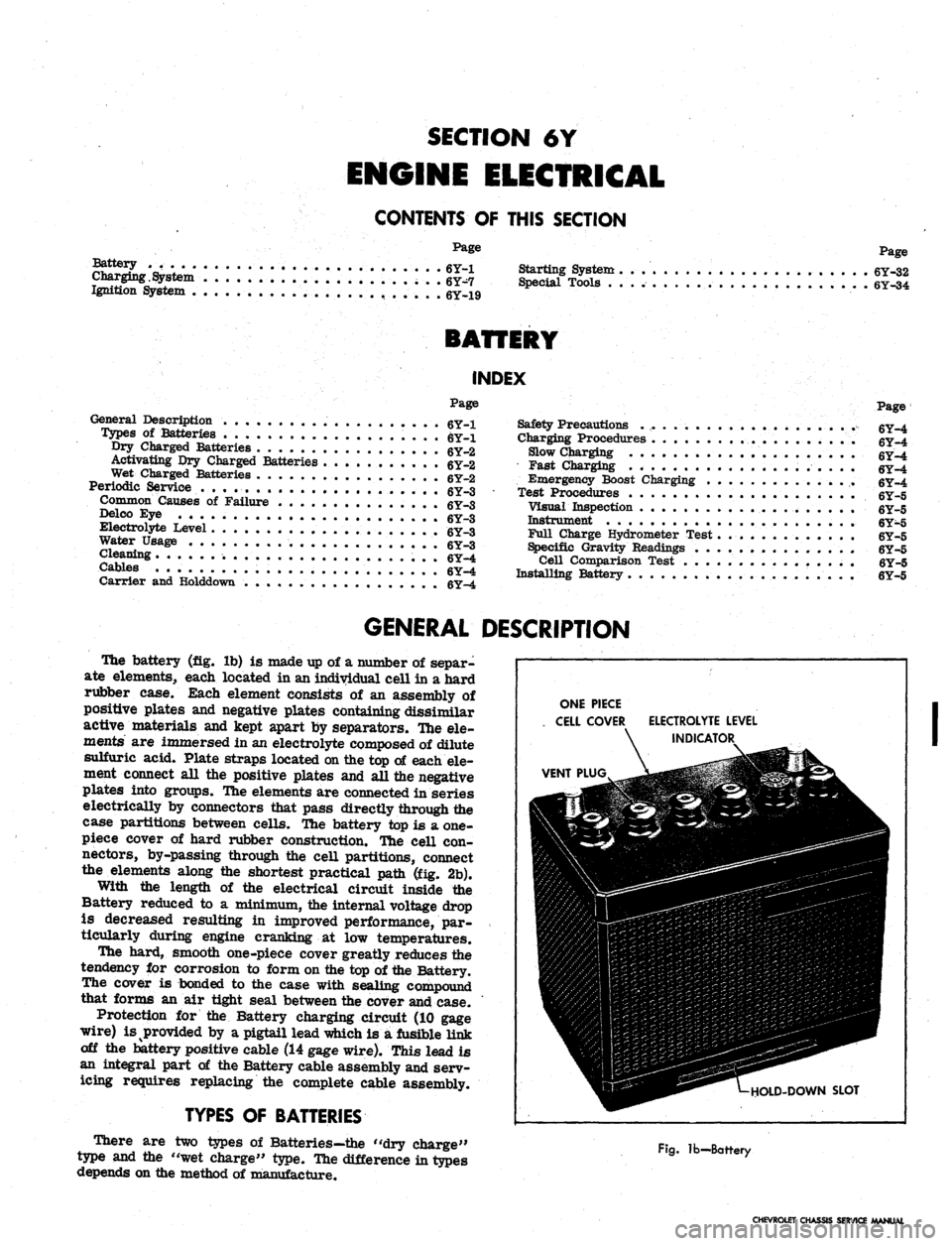
The battery (fig. lb) is made up of a number of separ-
ate elements, each located in an individual cell in a hard
rubber case. Each element consists of an assembly of
positive plates and negative plates containing dissimilar
active materials and kept apart by separators. Hie ele-
ments are immersed in an electrolyte composed of dilute
sulfuric acid. Plate straps located on the top of each ele-
ment connect all the positive plates and all the negative
plates into groups. The elements are connected in series
electrically by connectors that pass directly through the
case partitions between cells. The battery top is a one-
piece cover of hard rubber construction. Tfte cell con-
nectors, by-passing through the cell partitions, connect
the elements along the shortest practical path (fig. 2b).
With the length of the electrical circuit inside the
Battery reduced to a minimum, the internal voltage drop
is decreased resulting in improved performance, par-
ticularly during engine cranking at low temperatures.
The hard, smooth one-piece cover greatly reduces the
tendency for corrosion to form on the top of the Battery.
The cover is bonded to the case with sealing compound
that forms an air tight seal between the cover and case.
Protection for the Battery charging circuit (10 gage
wire) is provided by a pigtail lead which is a fusible Hnk
off the battery positive cable (14 gage wire). This lead is
an integral part of the Battery cable assembly and serv-
icing requires replacing the complete cable assembly.
TYPES
OF
BATTERIES
There are two types of Batteries—the "dry charge"
type and the "wet charge" type. The difference in types
depends on the method of manufacture.
ONE PIECE
CELL COVER
VENT PLUG
ELECTROLYTE LEVEL
INDICATOR
HOLD-DOWN SLOT
Fig.
lb—Battery
CHEVROLET CHASSIS SERVICE MANUAL
Page 328 of 659
ENGINE-EIECTRICAI 6Y-3
PERIODIC SERVICING
Since the Battery is a perishable item which requires
periodic servicing, a good maintenance program will
insure the longest possible Battery life.
COMMON CAUSES OF FAILURE
If the Battery tests good but fails to perform satis-
factorily in service for no apparent reason, the following
are some of the more important factors that may point to
the cause of the trouble.
1.
Vehicle accessories inadvertently left on overnight to
cause a discharged condition.
2.
Slow speed driving of short duration, to cause an
3.
undercharged condition.
A vehicle
capacity.
electrical load exceeding the generator
4.
Defect in the charging system such as high resist-
ance, slipping fan belt, faulty generator or voltage
regulator.
5. Battery abuse, including failure to keep the Battery
top clean, cable clamps and posts clean and tight,
and improper addition of water to the cells.
LEVEL INDICATOR
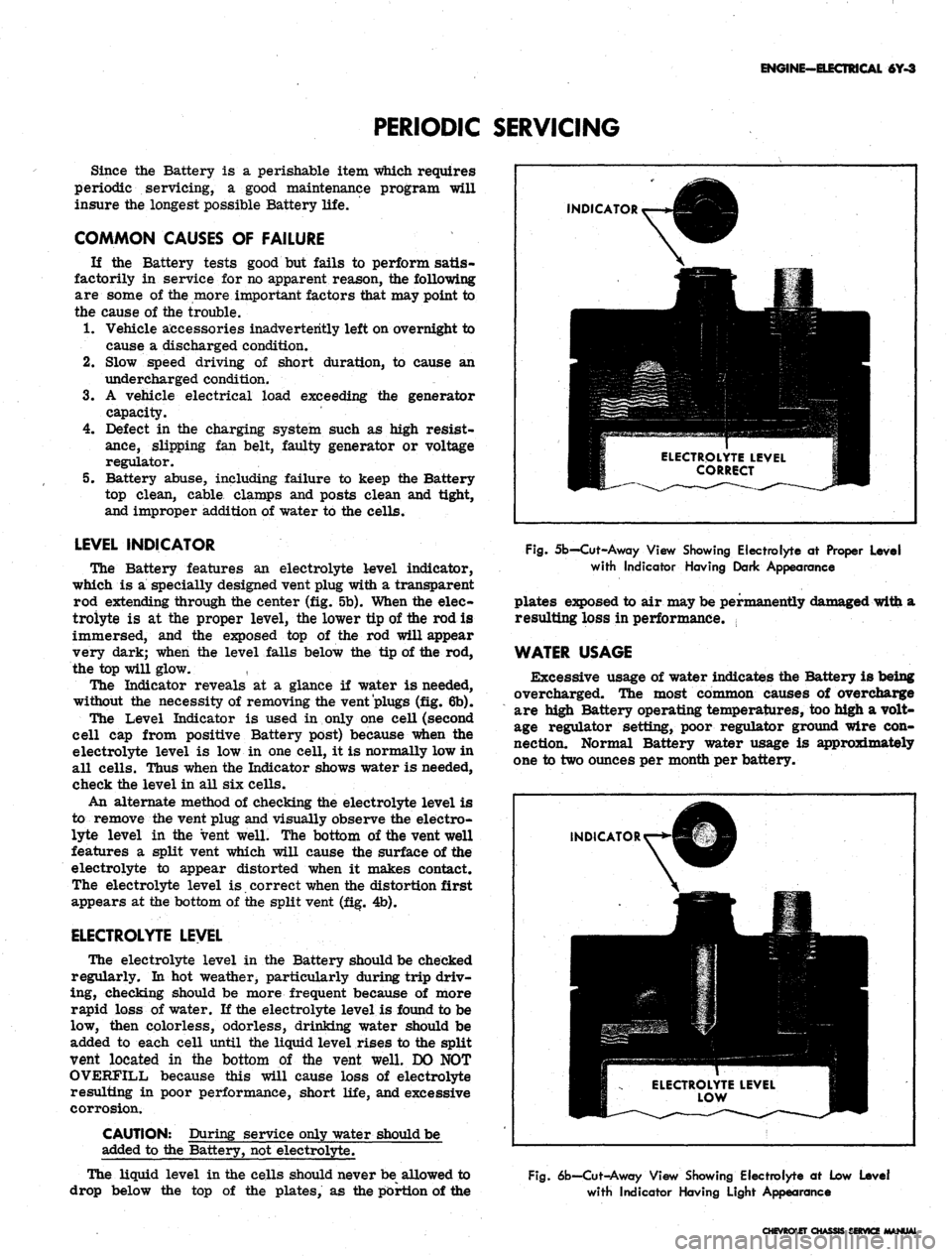
The Battery features an electrolyte level indicator,
which is a specially designed vent plug with a transparent
rod extending through the center (fig. 5b). When the elec-
trolyte is at the proper level, the lower tip of the rod is
immersed, and the exposed top of the rod will appear
very dark; when the level falls below the tip of the rod,
the top will glow. ,
The Indicator reveals at a glance if water is needed,
without the necessity of removing the vent plugs (fig. 6b).
The Level Indicator is used in only one cell (second
cell cap from positive Battery post) because when the
electrolyte level is low in one cell, it is normally low in
all cells. Thus when the Indicator shows water is needed,
check the level in all six cells.
An alternate method of checking the electrolyte level is
to remove the vent plug and visually observe the electro-
lyte level in the vent well. The bottom of the vent well
features a split vent which will cause the surface of the
electrolyte to appear distorted when it makes contact.
The electrolyte level is. correct when the distortion first
appears at the bottom of the split vent (fig. 4b).
ELECTROLYTE LEVEL
The electrolyte level in the Battery should be checked
regularly. In hot weather, particularly during trip driv-
ing, checking should be more frequent because of more
rapid loss of water. If the electrolyte level is found to be
low, then colorless, odorless, drinking water should be
added to each cell until the liquid level rises to the split
vent located in the bottom of the vent well. DO NOT
OVERFILL because this will cause loss of electrolyte
resulting in poor performance, short life, and excessive
corrosion.
CAUTION: During service only water should be
added to the Battery, not electrolyte.
The liquid level in the cells should never be allowed to
drop below the top of the plates, as the portion of the
INDICATOR
ELECTROLYTE LEVEL
CORRECT
Fig.
5b—Cut-Away View Showing Electrolyte at Proper Level
with Indicator Having Dark Appearance
plates exposed to air may be permanently damaged with a
resulting loss in performance.
WATER USAGE
Excessive usage of water indicates the Battery is being
overcharged. The most common causes of overcharge
are high Battery operating temperatures, too high a volt-
age regulator setting, poor regulator ground wire con-
nection. Normal Battery water usage is approximately
one to two ounces per month per battery.
INDICATOR
Fig.
6b—Cut-Away View Showing Electrolyte at Low Level
with Indicator Having Light Appearance
CHASSIS SBtVKZ MANUAL