1967 CHEVROLET CAMARO battery
[x] Cancel search: batteryPage 23 of 659

LUBRICATION
0-21
6
3-SPEED
4-SPEED
AUTOMATIC
10
LUBRICATE EVERY 6,000 MILES GL -Multi-purpose
or
Universal Gear Lubrincant*
-(V LUBRICATE EVERY 12,000 MILES WB-Wheel Bearing Lubricant
V/^ (Whenever Brakes
are
serviced)
AT —Automatic Transmission Fluid (Type)
BF -Brake Fluid
a
LUBRICATE EVERY 36,000 MILES
* Refill Positraction Rear Axle with
Special Lubricant Only.
CL -Chassis Lubricant
EO—Engine
Oil
Fig.
36—Lubrication Diagram—Corvette
1.
Front Suspension
2.
Steering Linkage
3. Steering Gear
4.
Air
Cleaner
5. Front Wheel
Bearings
6. Transmission
7. Rear Axle
8.
Oil
Filter
9. Battery
10.
Parking Brake
11.
Brake Master Cylinder
BODY LUBRICATION POINTS (CORVETTE)
Lubricate the following items when possible.
Hood Latch Mechanism and Hinges --Apply light engine oil
to pivot points. Don't oil lock pins or catch plates.
i
Rear Compartment Lid Release and Hinges --Apply light
engine
oil.
Side Door Hinge Pins—Apply light engine oil.
Door Lock Rotor and Striker Plate—Apply light engine oil or
stainless stick lubricant.
Lock Cylinders—Lubricate with powdered graphite.
Window Regulators and Controls and Door Lock Remote
Link —Apply light engine
oil.
Gas Tank Filler Cap Hinge—Apply light engine oil.
Weatherstrips and Rubber Bumpers —Coat lightly with
a
rubber lubricant.
CHEVROLET CHASSIS SERVICE MANUAL
Page 26 of 659
HEATER AND AIR CONDITIONING 1A-3
linkage of this lever which will provide partial airflow
only to the defroster duct and which should be used for,
all normal defogging operations.
CORVETTE
Heater components are attached to the dash panel on
the right side of the vehicle with the air inlet assembly
on the engine side and the heater and air distributor
assemblies beneath the instrument panel within the pas-
senger compartment.
The heater operates on outside air only with the blower
receiving its air flow from the cowl vent plenum
chamber.
No water valve is utilized in the system. Therefore,
water flows through the heater core constantly while
the engine is running, keeping the core at maximum
temperature at all times.
Airflow through the system is shown in Figure 1.
Controls
Two knobs control all heater operations:
The FAN-TEMP knob is rotated to turn the blower
on and off and control blower speed and is pulled out
as desired to regulate heater temperature.
The AIR-DEF knob is the air on-and-off control as
well as the defroster control.
Temperature Damper: Door
At the heart of the heater operation is the temperature
damper door. Air from the blower follows parallel paths
through the distributor duct, with one path passing
through the heater core and the other path bypassing the
core.
The temperature damper door is placed in the duct
so that, when closed, the path of the heated air leaving
the heater core is blocked while the ambient air path
remains open. Positive closing of this door when no
heat is being called for is assured by a cam assembly
at the door operating lever. As the FAN-TEMP knob
is pulled out, the damper door is opened accordingly,
allowing varying proportions of heated air to mix with
the unheated airflow, thus providing heater outlet tem-
perature control. With the knob pulled fully out the
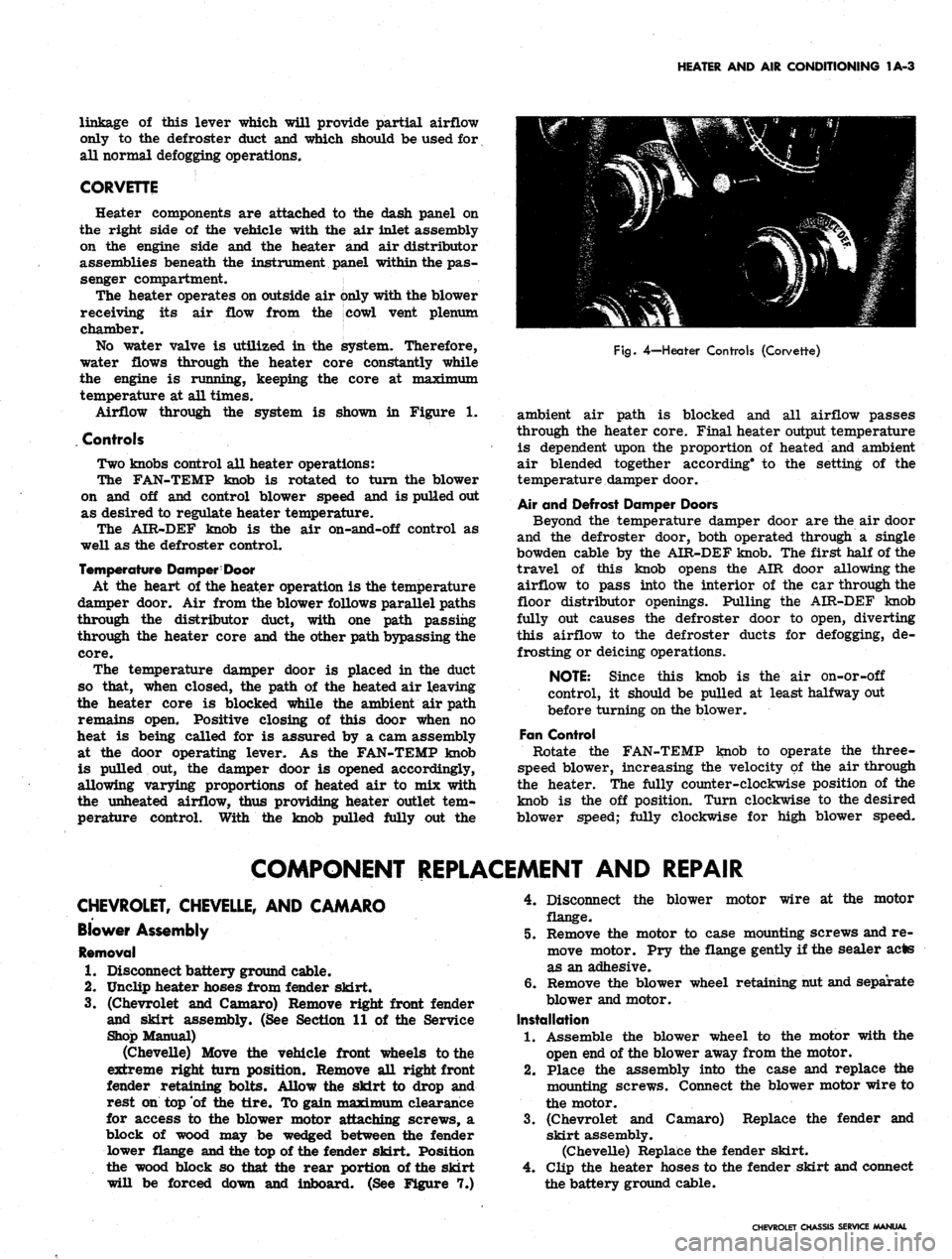
Fig.
4—Heater Controls (Corvette)
ambient air path is blocked and all airflow passes
through the heater core. Final heater output temperature
is dependent upon the proportion of heated and ambient
air blended together according* to the setting of the
temperature damper door.
Air and Defrost Damper Doors
Beyond the temperature damper door are the air door
and the defroster door, both operated through a single
bowden cable by the AIR-DEF knob. The first half of the
travel of this knob opens the AIR door allowing the
airflow to pass into the interior of the car through the
floor distributor openings. Pulling the AIR-DEF knob
fully out causes the defroster door to open, diverting
this airflow to the defroster ducts for defogging, de-
frosting or deicing operations.
NOTE: Since this knob is the air on-or-off
control, it should be pulled at least halfway out
before turning on the blower.
Fan Control
Rotate the FAN-TEMP knob to operate the three-
speed blower, increasing the velocity of the air through
the heater. The fully counter-clockwise position of the
knob is the off position. Turn clockwise to the desired
blower speed; fully clockwise for high blower speed.
COMPONENT REPLACEMENT AND REPAIR
CHEVROLET, CHEVELLE, AND CAMARO
Blower Assembly
Removal
1.
Disconnect battery ground cable.
2.
Unclip heater hoses from fender skirt.
3.
(Chevrolet and Camaro) Remove right front fender
and skirt assembly. (See Section 11 of the Service
Shop Manual)
(Chevelle) Move the vehicle front wheels to the
extreme right turn position. Remove all right front
fender retaining bolts. Allow the skirt to drop and
rest on top of the tire. To gain maximum clearance
for access to the blower motor attaching screws, a
block of wood may be wedged between the fender
lower flange and the top of the fender skirt. Position
the wood block so that the rear portion of the skirt
will be forced down and inboard. (See Figure 7.)
4.
Disconnect the blower motor wire at the motor
flange.
5.
Remove the motor to case mounting screws and re-
move motor. Pry the flange gently if the sealer acts
as an adhesive.
6. Remove the blower wheel retaining nut and separate
blower and motor.
Installation
1.
Assemble the blower wheel to the motor with the
open end of the blower away from the motor.
2.
Place the assembly into the case and replace the
mounting screws. Connect the blower motor wire to
the motor.
3.
(Chevrolet and Camaro) Replace the fender and
skirt assembly.
(Chevelle) Replace the fender skirt.
4.
Clip the heater hoses to the fender skirt and connect
the battery ground cable.
CHEVROLET CHASSIS SERVICE MANUAL
Page 29 of 659

HEATER AND AIR CONDITIONING 1A-6
CHEVROLET SHOWN AS TYPICAL
Fig.
8—Heater Hose Routing (Chevrolet Shown as Typical)
cables, defroster hoses and the
place and install all at-
4.
5.
6.
Attach all bowden
wiring connector.
Set heater assembly into
taching nuts and screws.
Attach inlet and outlet hoses.
Replace glove box and glove box door.
Refill cooling system.
Defroster Duct
Installation of the defroster duct as used in Chevy H
vehicles is illustrated in Figure 14.
Blower Motor
Replacement
1.
Remove the heater assembly from the firewall.
Remove the five screws attaching the motor and
blower to the heater assembly.
2.
Remove the retainer attaching blower to the motor
shaft.
3.
Replace blower on new motor assembly, balance and
reinstall into heater assembly.
Fan Control
Replacement
1.
Remove the screws at the dash lower edge which
retain the control assembly and lower the assembly.
2.
Disconnect the blower harness connector and remove
the switch retaining screws and switch.
3.
Install the replacement switch with the nylon bearing
inserted into the AIR - FAN lever slot.
4.
Connect the blower harness connector and remount
the control assembly in the dash.
CORVETTE
Blower Assembly
Removal
1.
Remove the radiator supply tank from its retaining
straps and move it out of the way, then disconnect
the battery positive cable.
NOTE:
It is not necessary to drain the radiator.
2.
Remove the connectors from the blower motor.
3.
Scribe or chalk a mark on the blower motor mount-
ing plate and blower assembly.
4.
Remove the five screws retaining the blower mount-
ing plate to the blower inlet assembly.
Withdraw the blower assembly from the inlet
5.
assembly.
Disassembly
Remove the blower wheel from the motor by removing
the nut and tapping the motor shaft with a soft hammer.
Installation
1.
Assemble the blower to motor and using the scribe
mark, properly position the blower assembly on the
inlet assembly and install the five screws.
2.
Replace the electrical connectors on the blower
motor.
3.
Replace the radiator supply tank and the battery
positive cable.
Blower and Air Inlet Assembly
Removal
1.
Drain the radiator.
2.
Remove the radiator supply tank from its retaining
straps and swing it out of the way.
3.
Remove the battery.
CHEVROLET CHASSIS SERVICE MANUAL
Page 31 of 659

HEATER AND AIR CONDITIONING 1A-8
Fig.
12—Control Assembly (Camaro)
3.
Replace the battery and radiator supply tank.
4.
Replace each heater hose to its proper core
connection.
5. Refill the radiator.
Defroster Duct
Figure 19 illustrates the installation of the Corvette
defroster duct.
Fig.
13—Chevy II Heater Components Removal
Fig.
U-Defroster Duct (Chevy 11)
CHEVROLET CHASSIS SERVICE MANUAL
Page 32 of 659

HEATER AND AIR CONDITIONING 1A-9
Fig.
15-Heater Control Assembly and Cables (Chevy II)
Resistor Removal
Two screws attach the resistor to the rear side of
the heater assembly.
Heater Assembly
Removal
1.
Drain the radiator.
2.
Remove the radiator supply tank from its support
Fig.
16—Heater Hose Routing (Chevy II)
straps and move it out of the way.
3.
Remove the battery.
4.
Remove the water supply hoses from the core
connections.
5. Remove the blower and air inlet assembly as de-
scribed above.
6. Remove the glove compartment and the panel on
either side of the instrument panel console as out-
lined in the Body Section of this manual.
Fig.
17—Corvette Heater and Blower Inlet Assembly
CHEVROLET CHASSIS SERVICE MANUAL
Page 33 of 659

HEATER AND AIR CONDITIONING 1A-10
PLATE RETAINERS
CORE BRACKET SCREWS
Fig.
18—Corvette Heater Core Removal
7. Place a protective covering (waterproof if possible)
over the carpeting under the heater.
8. Remove the two bowden cables from the instrument
panel and disconnect the wiring connectors from the
blower switch and from the resistor.
9. Carefully work the heater assembly out from beneath
the dash.
Core Removal
1.
Remove the heater assembly as described above.
2.
Remove the sheet metal nuts which retain the core
mounting plate to the core housing.
3.
Remove the screws attaching the core brackets to
the core mounting plate and separate the core and
plate. .
Installation
1.
Assemble the core to plate with non-hardening
sealer. Attach the core mounting screws.
2.
Attach the core and plate assembly to the case with
the two sheet metal nuts. The assembly is ready for
installation as described below.
Heater Assembly Installation
1.
Carefully position the heater assembly in place on
inner surface of dash panel, then install the blower
and air inlet assembly on heater studs extending
through to the engine side of the panel. Attach the
seven stud nuts.
2.
Install electrical connectors to the blower switch and
resistor and reinstall the bowden cables to the
instrument panel.
3.
Replace the blower electrical connectors.
4.
Replace the heater hoses. (See Figure 20)
5. Replace the battery and the radiator supply tank.
6. Refill the radiator and check for leakage.
7. Check heater operation and make control adjustments
as necessary.
8. Replace the console panels and the glove
compartment.
CHEVROLET CHASSIS SERVICE MANUAL
Page 57 of 659

HEATER AND AIR CONDITIONING 1A-34
a. Blower comes on High speed.
b.
Cold air comes from A/C outlets.
3.
Rotate Temperature Dial to 85°F.
a. Blower speed will decrease to Low speed then
increase to Medium or High.
b.
Air temperature changes from Cold to Hot and
comes out heater outlet.
4.
Move control lever to LOW Front, with Temperature
Dial at 85°F. Blower operates at Low and Medium
speeds.
5.
Move control lever to Rear, set Temperature Dial
at 65°F.
a. Blower goes to High speed and maintains high
air flow.
b.
All air comes from A/C outlets.
6. Move control lever to DE-FOG.
a. Blower is on Medium or High Speeds.
b.
Air comes from Defroster and Heater Outlets.
7.
Move control lever to DE-ICE.
a. Blower is on High Speed.
b.
Air temperature goes to warm and most of air
comes from defroster nozzle, with small amount
of air coming from heater outlet.
c. Outside air door is open - (door valve is closed
to car body).
8. Move control lever to REAR (dial at 65°). Outside
air door moves outboard. (Door valve is open to
car body).
CHEVROLET COMFORTRON TESTER
The J-22368 Automatic Temperature Control Tester
when in AUTOMATIC position, may be used to perform
Comfortron system checks without disturbing normal car
operation.
Under MANUAL control tester allows the operator to
set and hold a predetermined blower speed
and.
temper-
ature. The tester can also be used to measure external
system voltages by using the probe.
To Install the Tester
1.
Remove the three-terminal male connector from the
Amplifier on the Comfortron control head.
2.
Plug this connector into the three terminal female
connector (with yellow wire)
on
the Tester.
3.
Plug the remaining three-terminal male connector
on the Tester into the Amplifier on the control head.
4.
Attach the black ground lead to any good ground
point available in the car.
5.
Remove the large vacuum hose from Transducer and
connect it to the Tester vacuum hose nipple.
6. Connect the Tester vacuum hose (short hose) to the
Transducer.
Quick Test Procedure
With the J-22368 Tester installed as outlined above,
the following quick checks may be made to pinpoint
the cause of system malfunctions. This quick check
procedure is reproduced on the "swing out" plastic
instruction card attached to the back of the Tester.
Before performing the checking procedure, start the
engine and allow to run on fast idle until operating
temperature is reached. Then set the dash control lever
to HI-FRONT position and the dash control Temperature
Dial to 75° and proceed with the following steps:
Step
1
2
3
4
5A
5B
Tester Settings
Rocker
Switch
Manual
Manual.
Manual
Manual
Manual
Auto-
matic
Voltage
Source
Sensor
Amplifier
or
Control
Cal.
Trans-
ducer
Amplifier
or
Control
Cal.
Amplifier
or
Control
Cal.
Manual
Control
150
150
a. Max.
Heat*
b.
Max.
Cold*
a. Max.
Cold*
b.
Max.
Heat*
Set to
150 for
Comfortron
System
Same as 5A.
Allow 5 min.
for system
to stabilize
with doors
and windows
closed.
Tester Should
Indicate:
Battery Voltage
Battery Voltage
0-4 Volts
8 Volts Min.
8 Volts Min.
0-3 in. Vac.
0-4 Volts
9 in. Min. Vac.
6.5 Volts
5.5 to 7.5 Volts
To Correct Abnormal Indication:
Check fuse and wiring.
Check for open in sensor circuit.
See Service Manual:
Malfunctioning Amplifier or Temperature
Dial.
Check for open or bad ground in trans-
ducer circuit or replace transducer.
Rotate car temperature dial until meter
reads 6.5 volts. Car temperature should
'•- indicate 75°. If not, see temperature
calibration which follows.
After 5 minutes of operation check for
defective sensor.
•This setting should result in HIGH blower speed. Refer to shop manual for further operational checks.
CHEVROLET CHASSIS SERVICE MANUAL
Page 59 of 659

HEATER AND AIR CONDITIONING 1A-36
(These tests should be performed with the engine at operating temperature.)
SYSTEM CHECKS
Control
Head
Setting
High
Front
Lo
Front
Lo
Front
Hi
Front
Hi
Front
Tester Settings
Function
Manual
Manual
Manual
Manual
De-ice
65° on
Temp.
Dial
Hi
Front
Hi
Front
Hi
Front
Auto-
Matic
1 1
Auto-
matic
Manual
Manual
Manual
Control
Max.
Heat
Rotate
from
Max.
Heat to
Max.
Cold
150
Max.
Cold
Max.
Cold
Max.
Cold
Max.
Heat
Max.
Heat
Max.
Cold
Voltage
Trans-
ducer
Trans-
ducer
Ampli-
fier
Trans-
ducer
Probe
Probe
Trans-
ducer
Trans.
Tester Should
Indicate:
High Blower
Maximum Heat
Reduced Blower
Speed
Complete series of
blower changes from
Hi to Lo to Hi
again.
AMPLIFIE:
Remove conn, from c
Voltage reading she
Short this lead to grc
Voltage reading she
No voltage change in<
COMPRESSOR C
Cooling System
Operation
DE-ICE i
Assuming rest of
system is operating
normally: Max. Heat
1
to windshield.
SENSOR STR
•—
TRAtfSDtfC
0-3"
Vac. Reading
8 Volts Min.
9"
Min.
Vac.
Reading
0-4 Voltage Reading
If not, check
the following:
Fuse in Slock
In Line Fuse
High Blower
Delay Relay
Duct Delay
Thermistor
High Blower
Delay Sensor
Power Servo
Blower Switch
Resistor
Blower Motor
Wiring Harness
Blower Switch
Master Delay
Thermistor
Master Delay
Relay
Resistor
Power Servo
Blower Motor
CHECK
Resistor
I CHECK
Electrical Diagram
Probe Points:
1-2
8-9
10-21
20
18
19
*
9-46
-r
^2-3
15
16
Checked during
above procedure.
(This is a com-
plete step-by-step
high blower circuit
check which also
checks wiring
harness.)
4
5
6
L2-13
L4
""§2-15
39-46
1
16 1
14
22-40-42-44-15
.ontrol head temperature dial.
>uld be 9 volts minimum,
jund.
>uld be 0 volts,
iicates malfunctioning of amplifier.
JUTCJH CHUCK
Compressor Clutch
(Grille Temp, must
be above 40°.)
IRCUIT
Blower Switch
Master Delay
Relay
Transd
NGCl
ucer
Sensor String
2R CHECK
Transducer voltage
&t Max. Cold
position)
Transducer Ground
Hi Blower Outside
air (air door closed
to car body). Hot air
from heater outlets.
Hi Blower Recirc.
Air (air door open
to car body) cold air
from A/C outlets.
24-25-26-27-28
Voltmete
should re
ad
Battery Voltage
Battery Voltage
Battery Voltage
. Vtinimum
6
volts
Battery Voltage
Minimum
6
volts
Battery Vo]
Batterv Vo]
Ltage
Ltage
Battery Voltage
Batterv Voltage
3a
Bai
:terv Vo
tterv Vo
tage
tage
Minimum
6
volts
Batterv Voltage
Minimum
6
volts
Battery Voltage
Minimum
8
volts
Minimum 8 volts
Minimum 8 volts
Batterv Voltage
Minimum 8 volts
1 III • II »ll. —..• —•— . !!•• 1
Battery Voltage
3-23
20-10-21
38
29-30-31-32-33-
34-35-36
37-38
Defective Power Servo; Leak in Vacuum
System; Temp.; Door Link Disconnected
or Jammed; Defective Vacuum Relay
Valve
Defective Mode Door Diaphragm
Batterv Voltage
Battery Voltage
Zero Voltage
Battery Voltage
Battery Voltage
CHEVROLET CHASSIS SERVICE MANUAL