Page 32 of 52
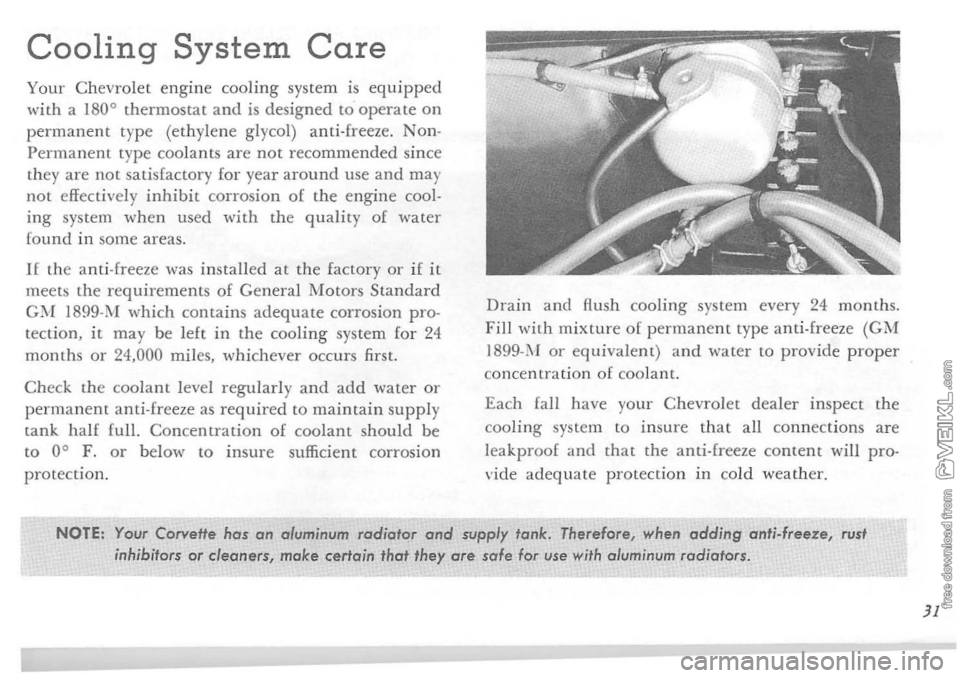
Cooling System Care
Your C hevrolet engine cooling system is equipped with a 180 0 thermostat and is designed to operate on permanent type
(ethyle n e glycol) anti·freeze. Non· Perm anent type coolants are not recommended since
t hey are not sat isfactory for year around use and may not effect ive ly inhibit corrosio n of the engine cool· ing system when used with the quality of water found in some a reas.
If the a nti·freeze was installed at the factory or if it meets the require ments of Gener a l Motors Standard GIVe 1899-1'v1 whi ch contains adequate corros ion pro
t ec tion, i t may be left in the cooling system for 24 months or 24,000 miles, which eve r occurs first.
C h eck th e
coolant leve l regularly and add water or permanent anti-f reeze as required to maintain supply tank h alf fulL Concentration of coolant should b e to 0 0 F . or b e low to insure sufficient corros ion protection.
Drain and Rush cooling system ever y 24 months. F ill with mixture o f p erma n ent type anti- fr eeze (G1\1 1899-1\'[ or equivalent) and wa te r to provide proper concentrati o n of coolant.
Each Call have your C h evrolet dealer inspect the
cooling syst e m to insure that all connections are leakproof and that the anti-freeze content will pro
vide adequate protection in cold weather.
NOTE: Your Corvette has on aluminum radiator and supply tank. Therefore, when adding anti-freeze, rust inhibitors or cleaners, make ceria in that they are sale lor use with aluminum radiators .
JI
Page 33 of 52

Check the front of the radiator core occasionally for
insects and leaves. Flush them out from the back
sid e of the radiator using a water hose and city water
pressure.
RADIATOR CAP
The Corvette cooling system is equipped with a 13 lb. pressure cap. To remove the cap, carefully turn ~ turn to allow exces s system pressure to escape, then turn the cap all the way off. If the engine is
ov erh eated, wait for several minutes before removing
the
radiator cap.
Tire
Care
To enjoy maximum service from your tires, keep
them inflated to the pressures recommended on
page
46.
Regular Corvette tires should not be used for ex
treme vehicle operation. Special purpose tires are
available,
if needed, from major tire manufacturers. DRAINING
AND FILLING
THE COOLING SYSTEM
I. Open the drain cock at the bottom of the
radiator.
2. Remove the drain plug located on each side of the engine block just above the oil pan and be· hind the spark plug wire shields. 3. Replace the engine drain plugs and close the
radiator drain cock before refilling the radiator.
4.
To refill , add coolant until supply tank remains
one -half full. Then start engine and add coolant as necessary to maintain normal one-half- full level in supply tank. Recheck when cool and fill to
normal level.
Rotate tires
as shown every
6000 miles to distribute wear
. over all five tires. This will help you to obtain maxi
mum service from your tires.
Page 44 of 52
rubber cup at the end of the
spark plug wire and the tubular metal connector inside of it. If the spark plug wire is wet or oily, wipe it
dry . Wrap a dry handker·
chief or facial tissue, folded
several thicknesses, around
the wire at least three inches
back from the end and grasp
the wire at this point. Hold the bare wire about Yi inch from the bare tip of the Checking Spork
spark plug fro m whidl you removed the wire or from any part of the engine. When the engine is "turned over" a
spark should jump ac ross the y.;, inch space , indicating ample current supply. If no spa rk jumps, th e d ifficult y is probably caused b y a defective ignition part and should be
cor rect ed b y you r Authorized Chevrolet Dealer.
COOUNG SYSTEM
'When the car will run but evidences serious overheating on the temp erature gauge in the instrument panel, there are
seve r al i tem s which may be check ed.
(L)
Engine overheating wjll occur when the OIL LEVEL falls dangerousl y l ow. Check the oil lev e l as a matter of
course.
(M) Low
WATER LEVEL will, of course, cause engi ne over
heating.
De termine the cause of the low water level and have it correc ted if necessary. (N) Check the RADIATOR CORE. Clean it if it is plugged with bugs, leaves or other foreign material.
(0) Condition o f the FAN BELT is very important, not only for engine cooling but also for proper generator operation. Check the condition of the belt. Replace it if i t is wor n or frayed. Loosen the generator bolts and move the generator toward the engine to remove and replace the belt. Tighten the belt, whethe r n ew or old ,
by loosening the generator bolts, prying with a bar on the generator until the belt is tensioned properly,
then re t ighten the generator bolts. Proper belt tension is
such that, when pressed hard at a point midway between
th e ge nerato r and fan pulleys, the belt will deflect about ~4 inch.
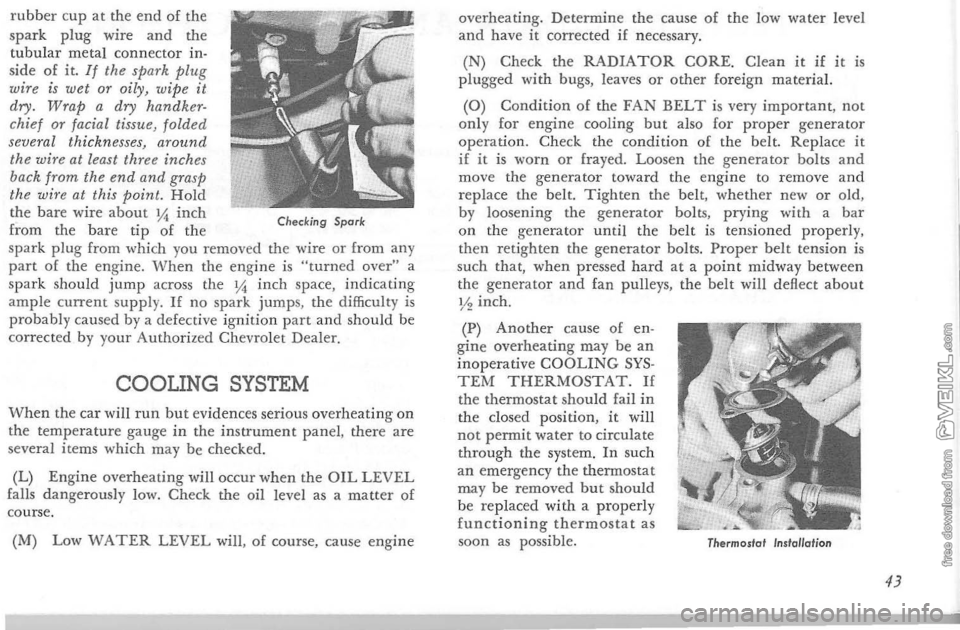
(P) Another ca use of en
gine overheating ma y be an inoperative COOLING SYSTEM THERMOSTAT. II the thermostat sh ould fail in the closed position, it will not permit wa ter to circulate through the system. In such an emergency the thermostat may be removed but should be replaced with a properly functioning thermostat as
soon as possible .
Thermostot Instal/ot;on
43