1964 CHEVROLET CORVETTE parking brake
[x] Cancel search: parking brakePage 8 of 52
Driving with the Powerg lide Transmission
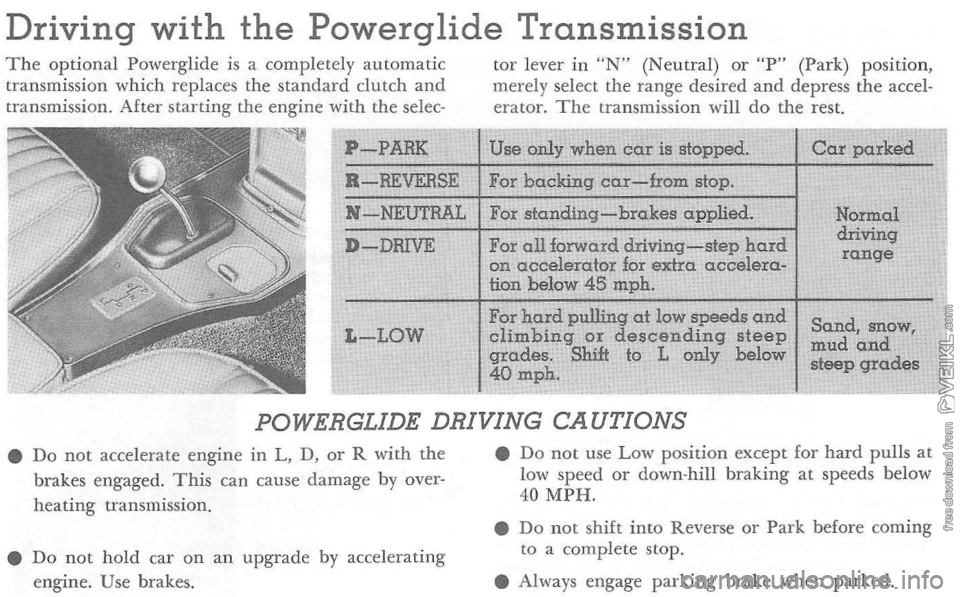
The optional Powerglide is a completely automatic transmission which replaces the standard clutch and transmission. After starting the engine with the seIce-
P-PARK R-REVERSE N-NEUTRAL
D - DRIVE
L-LOW
tor !ever in "N" (Neutral) or "P" (Park) position, merely select the range desired and depress the accelerator. The transmission will do the rest.
Use only
when car is stopped. Car parked
For backing car-from stop.
For
standing-brakes applied. Normal
For
all forward driving -step hard driving
on
accelerator for extra accelera-range
lion below 45 mph.
For
hard pulling at low speeds and Sand, snow, climbing or descending sleep mud and grades. Shift to L
only
below
steep grades 40 mph. ~I_, ~
POWERGLIDE DRIVING CAUTIONS
• Do not accelerate engine in L, D , or R with the brakes engaged. This can cause damage by overheating transmission.
•
Do not hold car on an upgrade by accelerating engine. Use brakes. •
Do not use Low position except for hard pulls at low
speed or down-hill braking at speeds below
40 MPH.
• Do not shift inw Reverse or Park before coming to a complete stop .
• Always engage
parking brake when parked.
I
J
Page 10 of 52
Downshifting with
Manual Transmission
If you wish to shift from one gear to the one imme
di ately lower in ratio, avoid dangerous ly overspeed
ing the engine by downshifting as follows:
I.
Watch the Tachometer-If your tach is orange
zoned at 5000 to 5300 rpm, you may downshift to
the next lower gear when it indicates 4000 to 4100
rpm. If your tach is red-zoned at 6300 to 6500 rpm, you may downshift to the next lower gear at 4700 to 4900 rpm.
2. Double-clutching reduces strain on engines and transmissions. The usual method of double
clutching is:
Let up on the throttle, disengage the clutch, shift
into neutral, and engage the clutch. Almost simultaneously, speed up the engine, disengage the
clutch, shift into the next lower gear and reengage the clutch while depressing the throttle.
With practice , this procedure becomes alm ost
second nature.
Driving with Positraction
The positraction rear axle will give you constant
driving force on both rear wheels, especially helpful in the winter and during other slippery driving con
ditions which might stop a conventionally equipped vehicle. During turns , the positraction axle applies
the major driving force to the inside rear wheel thus
improving stability and cornering. Normal light throttle application will supply maximum traction.
When starting with one rear wheel on an excessive ly
slippery surface, slight application of the
parking brake may be necessary momentarily to gai n maxi
mum traction.
Driving with
Metallic Brake Linings
If your Corvette is equipped with optional metallic
brake linings, you will find that somewhat mor e than
normal pedal pressure will be required to stop the car
until you have made several stops to warm up the
linings .
Page 11 of 52
10
Pushing and Towing Tips
PUSHING CAR TO START
Should it ever beco me necessary to start the engine by
pu shing the car (towing to start is not recommended as car being towed may accelerate into tow car), pro
ceed as fo llows: Turn off all e lect rical loads su ch as radio, heater
and, if possible, lights until the engine st arts.
MANUAL TRANSMISSION - T
urn ignition switch
to "on." Place shift leve r in high (3rd on 3-spee d
transmissions, 4th on four-speed) and depress clutch. When car reaches 25-30 miles per hour, slowly re
l ease clutch to sta rt e ng ine.
POWERGLlDE TRANSMISSION -
Turn ignit io n
switch to "on" and place sel ector lever in "N." W h e n
car reac hes a spee d of 25-30 mph, place th e selecto r
l ever in
A DISABLED CAR
If your Corvette must be towed, the following pre
cautions must be observed:
MANUAL TRANSMISSION
-Release parking brake
and place shift lever in neutral.
POWERGLIDE TRANSMISSION -Release
parking brake and place selector lever in "N." DO NOT TOW IN EXCESS OF 30 MPH. II the transmission is inoperative, or not operating properly, the propeller shaft must b e d isconnected or car must be
towe d with rear wheels off the ground.
TOWING WITH REAR WHEELS
RAISED-When a
vehicle is being towed on its front wheels, the steer
ing whee l shou ld be secured to maintain a straight
forward position.
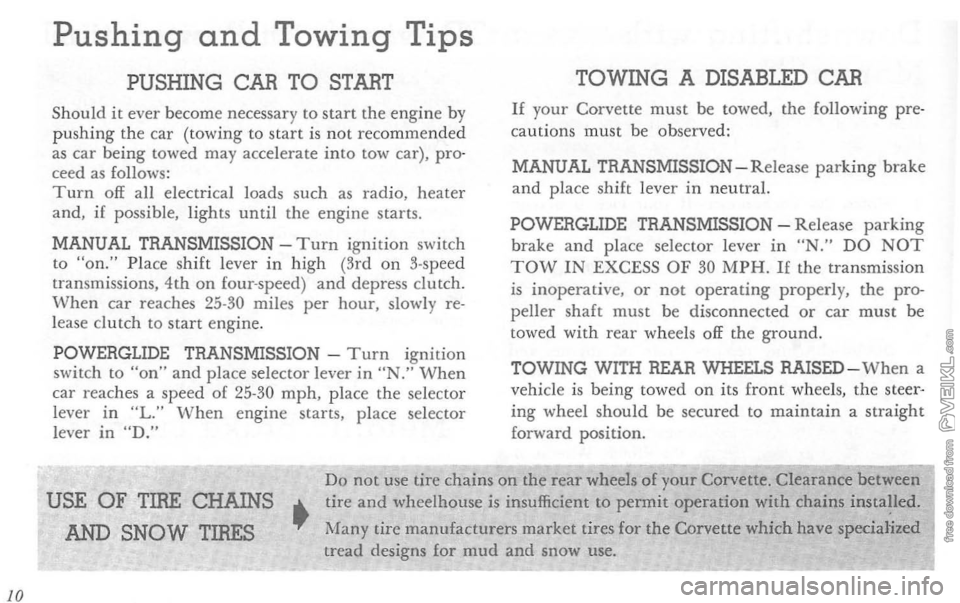
Do
not use tire chains on the rear wheels of your Corvette . Clearance between
USE OF TIRE CHAINS
AND SNOW TIRES
• tire and wheelhouse is insufficient to permit operation with chains insta!led.
Many [ire manufa cturers market tires for the Corvette which have specialized
tread designs for mud and snow use.
Page 20 of 52
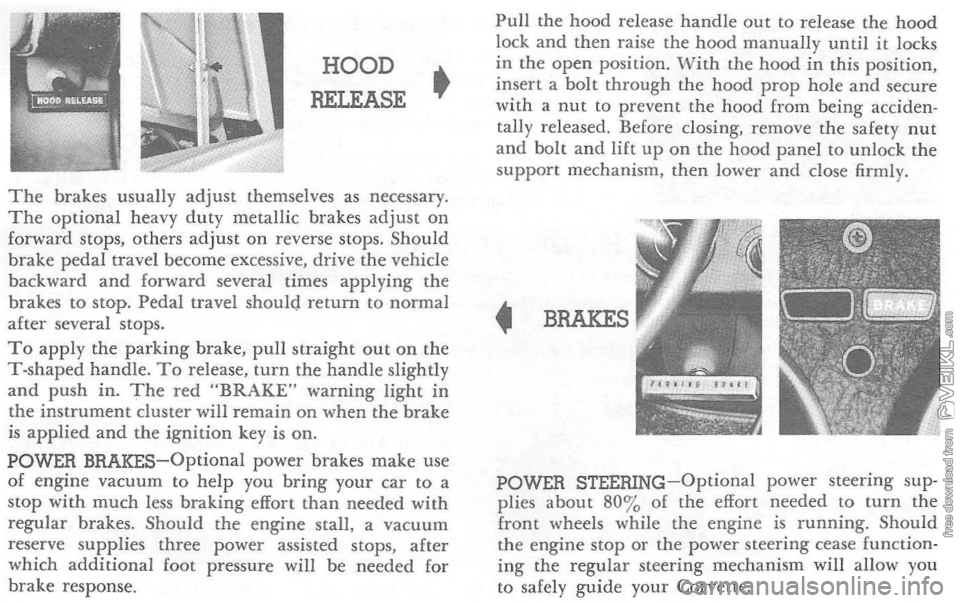
HOOD
RELEASE •
The brakes usually adjust themselves as necessary. The optional heavy duty metallic brakes adjust on forward stops, others adjust on reverse stops. Should
brake pedal travel become excessive, drive the vehicle
back ward
and forward several times applying the
brakes to stop. Pedal travel should return to normal after several stops. To apply the parking brake, pull straight out on the T-shaped handle. To release, turn the handle slightly and push in. The red "BRAKE" warning light in the instrument cluster will remain on when the brake is applied and the ignition key is on. POWER BRAKES-Optional power brakes make use of engine vacuum to help you bring your car to a stop with much less braking effort than needed with regular brakes. Should the engine stall. a vacuum
reserve supplies three power assisted stops, after
which additional foot pressure will be needed for
brake response.
Pull the hood release handle out to release the hood lock and then raise the hood manually until it locks
in the open position . With the hood in this position, insert a bolt through the hood prop hole and secure
with a nut to prevent the hood from being acciden
tally released. Before closing, remove the safety nut
and bolt and lift up on the hood panel to unlock the
support mechanism . then lower and close firmly.
• BRAKES
POWER STEERING-Optional power steering sup
plies about 80 % of the effort needed to turn the front wheels while the engine is running. Should the engine stop or the power steering cease function ing the regular steering mechanism will allow you
to safely guide your Corvette.
Page 35 of 52
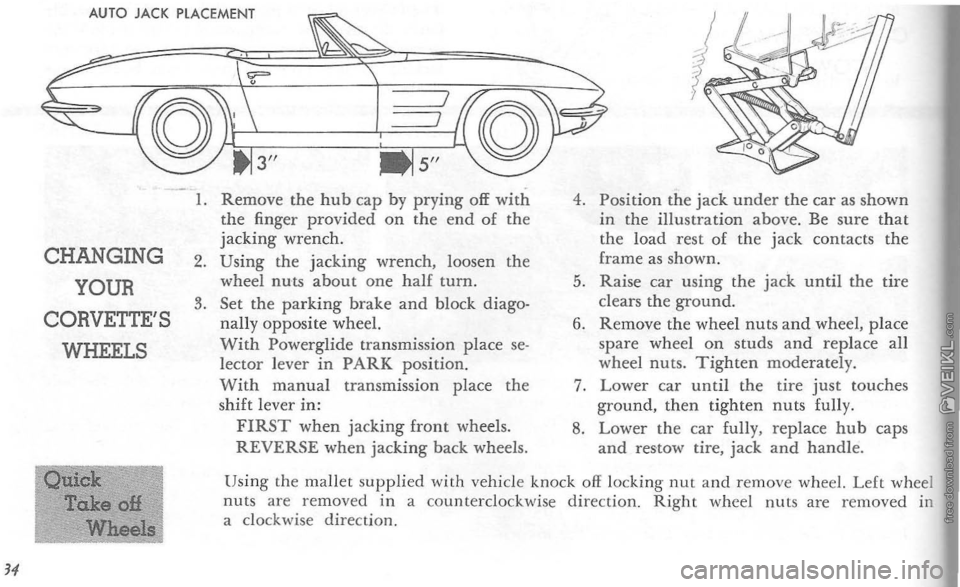
AUTO JACK PLACEMENT
CHANGING
YOUR
CORVETTE'S
WHEELS
1. Remove the hub cap by prying off with the finger provided on the end of the jacking wrench. 2. Using the jacking wrench, loosen the wheel nuts about one half turn. 3. Set the parking brake and block diago
nally opposite wheel.
With Powerglide transmission place selector lever in PARK position. With manual transmission place the
shift lever in:
FIRST when jacking front wheels. REVERSE when jacking back wheels. 4.
Position the jack under the car
as shown
in the illustration above. Be sure that
the
load rest of the jack contacts the frame as shown. 5. Raise car using the jack until the tire
clears the ground. 6. Remove the wheel nuts and wheel, place spare wheel on studs and replace all
whee l nuts. Tighten moderately. 7. Lower car until the tire just touches ground, then tighten nuts fully. 8. Lower the car fully , replace hub caps
and res-tow tire. jack and handl e .
Using the mallet supplied with vehicl e knock
off locking nut and remove wheel. Left whee l
nuts are removed in a counterclockwise direction. Right wheel nuts are removed in a clockwise direction.
Page 38 of 52

Parking Brake Cables and Linkage -Every 6,000 miles-Apply lubricant specified in Note I, page 39.
STEERING GEAR
Every 36,000
miles-Check lubricant level as follows: l. Remove the forward and the outboard cover attaching screws. 2. Inject steering gear lubricant into the forward
cover attaching screw hole until
lubricant begins
to come out of the outboard screw hole. 3. Replace both screws.
POWER STEERING PUMP
Check fluid level
in pump reservoir every 6,000 miles
or 6 months. Fill as required with Automatic Trans
mission fluid "Type A" with AQ-ATF-A mark. Oil should be at operating temperature and wheels in straight ahead position when checking or filling
operation is performed to ensure against overfilling.
FRONT SUSPENSION
Every 6,000 miles
or 6
months, lubrica te 4 fittings (2 fittings on each side), with lubricant specified in Note I, page 39. I
STEERING LINKAGE
Ev ery 6,000 miles or 6 months-lubricate fittings
shown below with lubricant specified in Note I ,
page 39.
Manual-Fitting at each tie rod end and at relay rod (5 fittings) .
Power
-Fitting at each tie rod end and at power
steering valve adapter and cylinder (6 fittings).
Page 39 of 52
38
TRANSMISSION
3-Speed and 4-Speed-Every 6,000 miles-Check at operating temperature and fill as nec essary to level
of filler plug hole with lubricant specified in Note 2, page 39.
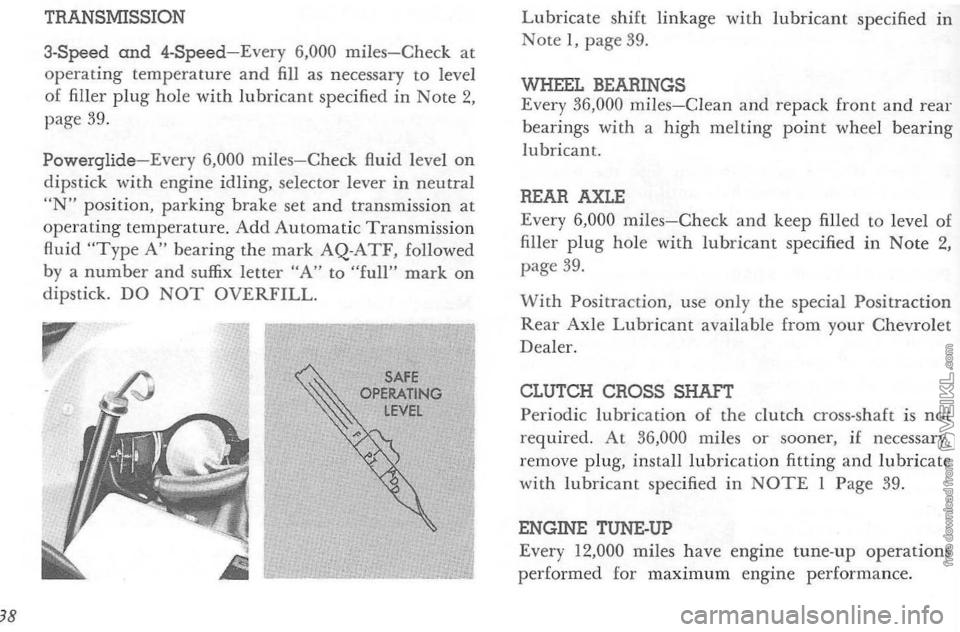
Powerglide-Every 6,000 miles-Check fluid level on dipstick with engine idling, selector lever in neutral
"N" position, parking brake set and transmission at
operat ing temp erature. Add Automa tic Transm ission
fluid
"Type A" bearing the mark AQ-ATF, followed
by a number and suffix letter "A" to "full" mark on dipstick. DO NOT OVERFILL.
Lubricate shift linkage with lubricant specifie d in Note I , page 39.
WHEEL BEARINGS
Every 36,000
miles-Clean and repack front and rear bearings with a high melting point wheel bearing lubricant.
REAR
AXLE Eve ry 6,000 miles-Check and keep filled to level of
filler plug hole with lubricant specified in Note 2, page 39.
With Positrac-tion, use only the special Positrac tion
Rear Axle Lubrica nt available from your Chevrolet
Dea ler.
CLUTCH CROSS
SHAFT Periodic lubricatio n of the clutdl cross-shaft i s not required. At 36,000 miles or sooner, if necessary,
remove plug, install lubrication fitting and lubricate
with lubricant specified in NOTE I Page 39.
ENGINE TUNE-UP
Every 12,000 miles
have engine tune-up operations performed for maximum engine performance.
Page 48 of 52
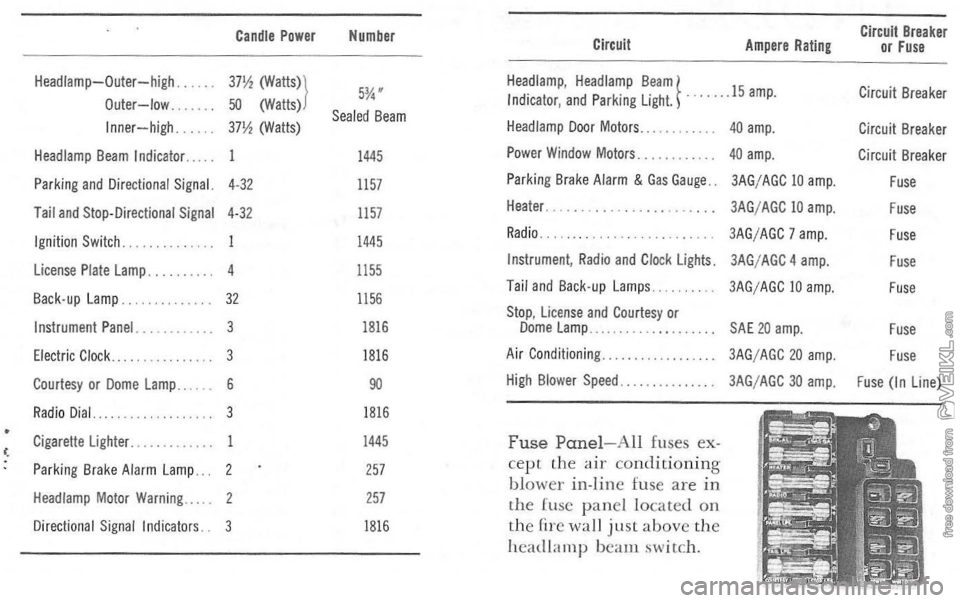
Candle Power Number Circuit Breaker Circuit Ampere Rating or Fuse
HeadJamp-Outer-high. 37\ (watts») 5%" Headlamp. Headlamp Beam} . ..... 15amp. Circuit Breaker Outer-low. 50 (Watts) Indicator. and Parking light. Sealed Beam Inner-high. 311l (Watts) Headlamp Door Motors . . 40 amp. Circuit Breaker Headlamp Beam Indicator ... 1445 Power Window Motors . . 40 amp. Circuit Breaker
Parking
and Directional Signal. 4·32 1157 Parking Brake Alarm & Gas Gauge .. 3AG/AGe 10 amp. Fuse
Tail and Stop-Directional Signal 4·32 1157 Heater .. 3AG/AGe 10 amp. Fuse
Ignition Switch. 1445 Radio. 3AG/AGe 7 amp. Fuse
license Plate lamp. 1155 Instrument, Radio and Clock Ughts. 3AG/AGe 4 amp. Fuse
Back-up lamp. 32 1156 Tail and Back-up lamps . . 3AG/AGe 10 amp. Fuse
Instrument Panel. Stop. license and Courtesy or 1816 Dome lamp .. SAE 20 amp. Fuse Electric Clock . . 1816 Air Conditioning ... 3AG/AGC 20 amp. Fuse Courtesy or Dome lamp ... 90 High Blower Speed 3AG/AGe 30 amp. Fuse (In line)
Radio Dial.. 1816
Cigarette lighter . . 1445 Fuse Panel- All fuses ex-Parking Brake Alarm lamp . . 257 cept the air conditioning b lower in-line fu se are in Headlamp Motor Warning . ... 257 lhe [usc pane l loca ted on Directional Signal Indicators. 1816 t h e {-ire wall just above the
head lamp bea m s witch.