1953 JEEP DJ wheel
[x] Cancel search: wheelPage 17 of 376
'Jeep'
UNIVERSAL SERIES SERVICE
MANUAL
B
Reinstall
the axle shafts, and
refill
the housings to
plug level using the universal joint lubricant
specified in
Lubrication
Specifications.
B-56.
Front
Axle Wheel Bearings
To
lubricate the wheel bearings, it is necessary
to remove, clean, repack, and adjust them. When
front wheel hubs and bearings are removed for
lubrication,
they should be thoroughly washed in a
suitable cleaning solvent. The bearings should be
carefully
dried and then given a thorough cleaning
and
inspection. Use a clean brush to remove all
particles
of old lubricant from bearings and hubs.
After
the bearings are cleaned, inspect them for
pitted races and rollers. Also, check the hub oil
seals.
Note:
Wheel bearing lithium base lubricants are
used at the factory for
initial
fill
of
these
bearings.
When
lithium base and sodium base lubricants are
mixed,
the result is a thinned-out mixture that
can
bleed through seals. It is therefore important
that lubricants with the correct base be used when
lubricating
the wheel bearings.
Should
leaks occur at wheel bearing seals, the leaks
may
be caused by a mixture of two
types
of
lubri
cants.
In such cases, the old lubricant should be
completely removed before new lubricant is added.
Wheel
bearings should be thoroughly cleaned,
lubricated
with lithium base and reinstalled.
Repack
the bearing
cones
and rollers with grease
and
reassemble hub in the reverse order of the
disassembly. Test the bearing adjustment as out
lined
in Section Q.
B-57.
Rear
Axle Wheel Bearings
The
Rear
wheel bearings an early models equipped
with
lubrication fittings with a vent opening
through the housings above each fitting should be
lubricated
sparingly, each
2,000
miles
[3.200
km.].
Use
a hand compressor and wheel bearing grease,
forcing
the grease through each lubrication fitting
until
it flows from the vent. Vent should be kept
clear
of obstruction or grease
will
back up into the
brakes.
Do not add grease after it flows from the
vent for it may be forced through the wheel key-
way
onto
the outside of the wheel and possibly
onto
the brake linings.
Rear
wheel bearings that do
not have lubrication fittings should be removed
each
12,000
miles
[19.200
km.] and the bearing
cleaned, inspected and repacked. Refer to proce
dure
in Par. B-56.
Note:
When servicing the Flanged Axle Unit
Bear
ing Assembly, refer to Section N, Par. N-5 for
proper
lubrication procedures.
B-58.
Propeller Shafts
and
Universal Joints
The
propeller shaft slip joints and universals should
be lubricated with a hand compressor grease gun so as to not damage the bearing seals. The units
should be lubricated with a
good
quality grease.
Refer
to the
Lubrication
Chart
for lubrication fre
quency and lubricant type and grade. B-59.
Lights
and
Controls
a.
Check
all interior and exterior lights and light
switches for proper operation, including: parking
lights, headlamps (high beam and low beam),
tail
lights, brake lights, directional lights, and in strument panel lights.
b.
Check
all instrument panel controls and
instru
ments for proper operation.
B-60.
Speedometer Cable
Remove the
speedometer
cable from its housing every
12,000
miles
[19.300
km.].
Clean
it thor
oughly and coat it with a
good
quality light graphite grease.
B-61.
Headlights
Refer
to Section H.
B-62.
Heater Controls
Apply
Lubriplate
130-A to all friction points and
pivot points on the heater controls panel unit as well as the pivot points at the dashpot. Apply
a
few drops of penetrating oil all along the Bowden
cable.
This
oil
will
penetrate into the center wire.
B-63.
Windshield Wiper and
Washer Controls
Lubricate
the friction points and the pivot points
on the windshield wiper transmission and linkage
arms
with a slight amount of
Lubriplate
130-A.
B-64.
Rotate Tires
Refer
to Section Q for the correct method of rotat ing the tires.
B-65.
Body Lube Points
•
Refer to Par. B-66 through B-68.
B-66.
Hood Hinge Pivot Points
Lubricate
the frictional points of the hood hinge
pivot points with a few drops of light-weight
engine
oil.
B-67.
Glove Compartment Door Latch
Sparingly
wipe
Lubriplate
130-A on the
glove
com
partment door latch.
B-68.
Tailgate Hinges
Lubricate
the friction points of the tailgate hinges
with
a few drops of light-weight
engine
oil.
B-69.
LUBRICATION
OF
OPTIONAL EQUIPMENT
B-70.
Pintle Hook
When
lubricating the vehicle, place a few drops of oil on the pintle hook and safety latch pivot pins.
B-7!.
Centrifugal Governor
Check
the oil level in the governor housing at each
vehicle lubrication. Use the same seasonal grade
oil
as is used in the
engine
and change oil at each
engine
oil change. Do not
fill
the housing above
the level indicating plug opening. Keep the vent
in
the filler plug open at all times. 17
Page 34 of 376
TUNE-UP
C-29.
SERVICE
DIAGNOSIS
POOR
FUEL ECONOMY Ignition Timing Slow or Spark Advance Stuck
Carburetor
Float High
Accelerator Pump Not Properly Adjusted High Fuel Pump Pressure
Fuel
Leakage
Leaky
Fuel Pump Diaphragm Loose Engine Mounting Causing High Fuel Level in Carburetor
Low
Compression
Valves Sticking
Spark
Plugs Bad
Spark
Plug Cables Bad
Weak
Coil
or Condenser Improper Valve Tappet Clearance
Carburetor
Air Cleaner Dirty
High Oil Level in Air Cleaner Dragging Brakes
Front
Wheels Out of Alignment
Tires
Improperly Inflated Inaccurate Odometer
Faulty
Fuel Tank Cap
Clogged
Muffler or Bent Exhaust Pipe Sticking Exhaust Manifold Valve
LACK
OF POWER
Low
Compression Ignition System (Timing Late)
Improper Functioning Carburetor
or Fuel Pump
Fuel
Lines
Clogged
Air
Cleaner Restricted Engine Temperature High Improper Tappet Clearance
Sticking Valves
Valve Timing Late
Leaky
Gaskets
Muffler
Clogged
Bent Exhaust Pipe Sticking Exhaust Manifold Valve —
Dauntless V-6 Engine
LOW
COMPRESSION
Leaky
Valves Poor Piston Ring Seal Sticking Valves
Valve Spring Weak or Broken
Cylinder
Scored or Worn
Tappet Clearance Incorrect Piston Clearance too Large
Leaky
Cylinder Head Gasket
BURNED
VALVES AND SEATS Sticking Valves or too Loose in Guides
Improper Timing
Excessive Carbon Around Valve Head and Seat Overheating
Valve Spring Weak or Broken
Valve Tappet Sticking
Valve Tappet Clearance Incorrect
Clogged
Exhaust System
Defective
Valve
Lifter
— Hydraulic
VALVES
STICKING
Warped Valve Improper Tappet Clearance Carbonized or Scored Valve
Stems
Insufficient Clearance Valve Stem to Guide
Weak or Broken Valve Spring Valve Spring Cocked Contaminated Oil
OVERHEATING
Inoperative Cooling System
Theromstat Inoperative Improper Ignition Timing
Improper Valve Timing
Excessive Carbon Accumulation
Fan
Belt too Loose
Clogged
Muffler or Bent Exhaust Pipe
Oil
System Failure Scored or Leaky Piston Rings
Sticking Exhaust Manifold Valve — Dauntless V-6 Engine
POPPING-SPITTING-DETONATION
Improper Ignition Improper Carburetion
Excessive Carbon
Deposit
in
Combustion Chambers
Poor Valve Seating Sticking Valves
Broken Valve Spring Tappets Adjusted too Close
Spark
Plug Electrodes Burned
Water or Dirt in Fuel
Clogged
Lines Improper Valve Timing
Clogged
Fuel Filter Sticking Exhaust Manifold Valve —
Dauntless V-6 Engine
EXCESSIVE
OIL CONSUMPTION Piston Rings Stuck in Grooves, Worn or Broken Piston Rings Improperly Fitted or Weak Piston Ring Oil Return
Holes
Clogged
Excessive Clearance, Main and
Connecting Rod Bearings
Oil
Leaks at Gaskets or Oil Seals
Excessive Clearance, Valve Stem
to Valve Guide (Intake)
Cylinder
Bores Scored, Out-of-
Round or Tapered
Too Much Clearance, Piston to Cylinder Bore
Misaligned Connecting Rods
High Road
Speeds
or Temperature
Crankcase
Ventilator Not Operating
BEARING
FAILURE
Crankshaft
Bearing Journal Out-of-Round
Crankshaft
Bearing Journal Rough
Lack
of Oil
Oil
Leakage
Dirty
Oil
Low
Oil Pressure or Oil Pump Failure
Drilled
Passages
in Crankcase or Crankshaft
Clogged
Oil
Screen Dirty
Connecting Rod Bent 34
Page 37 of 376

'Jeep9
UNIVERSAL SERIES SERVICE
MANUAL
D HURRICANE
F4
ENGINE
Contents
SUBJECT
PAR.
GENERAL...
D-l Description D-2
Engine
Ground Strap D-4
Engine
Mountings D-3
ENGINE REMOVAL
D-5
ENGINE DISASSEMBLY
D-6
Camshaft
.......
D-28
Clutch
D-24
Crankshaft.
D-26
Crankshaft
Pulley. D-l2
Cylinder
Head. .D-17
Distributor.
.D-13
Exhaust
Manifold D-8
Exhaust
Valves and Springs D-2
7
Flywheel.
. D-25
Front
End Plate D-23
Oil
Filler
Tube D-9
Oil
Gallery Plugs D-30
Oil
Pan. . ...D-19
Oil
Pump D-l4
Piston and Connecting Rods. . . D-20
Ream
Cylinder Bore Ridges. D-l8
Rocker
Arm Assemblies D-l6 Thermostat D-ll
Timing
Gear
Cover . . D-21
Timing
Gears D-22
Valve
Tappets D-29
Ventilation Valve D-l5
Water
Outlet Fitting D-10
Water
Pump D-7
ENGINE INSPECTION
AND
REPAIR.
.D-31
Camshaft
and Bearings. D-51
Camshaft
End-Play
. . .D-53
Camshaft
Front Bearing Replacement..... D-52
Checking
Connecting Rod
Crank
Pins D-42
Checking
Crankshaft Alignment .
.
D-40
Checking
Main Bearing Journals. D-41
Cleaning.
. D-33 Connecting Rod Bearing Inspection D-48
Connecting Rod Bearings D-47 Connecting Rod Side Play D-50
Core
Hole Expansion Plug D-72
Crankshaft
.
.
D-38, 39
Crankshaft
Main Bearing Inspection D-44
Crankshaft
Main Bearings D-43
Crankshaft
Rear
Bearing Seal D-63
Cylinder
Block D-32
Cylinder
Bores D-35
Cylinder
Head. . . D-73
Exhaust
Valve Seat Insert Replacement. .
.
D-60
Fitting
Crankshaft Main Bearings
Using
Plastigage
D-45
Fitting
Crankshaft Main Bearings
Using
Shim Stock D-46
Floating
Oil Intake D-64
Flywheel.
. . .D-67
Flywheel
Housing D-71
SUBJECT
FAR.
Flywheel
Inspection. D-6 8
Flywheel
Pilot Bushing D-70 Inspection D-3 4
Inspection of Valves, Springs and Guides. .D-57
Installing
Connecting Rod Bearings....... D-49
Oil
Pan D-66
Oil
Pump D-65
Piston Ring Application
Chart
D-3 7
Pistons, Rings, and Connecting Rods..... D-36
Refacing
Valves
.
D-58
Ring
Gear
Replacement D-69
Rocker
Arm Shaft Disassembly. D-75, 76
Rocker
Arm Shaft Reassembly.
.
D-77
Rocker
Arms D-74
Tappets and Cover. . D-62
Timing
Gears and Cover D-54, 55
Valve
Guide Replacement D-61
Valve
Seat Inspection and Refacing D-59
Valve,
Springs and Guides D-56
ENGINE REASSEMBLY
D-78
Camshaft
and
Thrust
Plate .D-81
Camshaft
Timing
Gear
D-91
Check
Crankshaft
End-Play.
............D-83
Clutch.
...D-89
Crankshaft
and Bearings................ D-82
Crankshaft
Pulley D-96
Crankshaft
Rear
Bearing Seal.. .
.
D-85
Crankshaft
Timing
Gear
D-84
Cylinder
Head D-98
Distributor
D-l
00
Flywheel
®. . .. D-87
Flywheel
Housing D-88
Front
End Plate D-86
Manifold.......
D-101
Oil
Filler
Tube D-102
Oil
Gallery Plug. D-79
Oil
Pan. D-97
Oil
Pump D-93
Pistons and Connecting Rods D-95
Rocker
Arm Assembly D-99
Spark
Plugs. .D-100
Tappets D-80
Timing
Gear
Cover D-94
Timing
Gear
Oil Jet D-92
Valves
and Springs ... D-90
Water
Outlet Fitting D-104
Water
Pump D-103
ENGINE INSTALLATION.
............D-105
FINAL IN-VEHICLE
ADJUSTMENTS.
.D-106
Check
Valve Timing . . D-109
Crankcase
Ventilation Valve. D-l 10
Oil
Filter
, . .
...D-lll
Valve
Adjustment D-107
Valve
Adjustment Procedure D-l08
SERVICE
DIAGNOSIS
D-112
SPECIFICATIONS D-l
13 37
Page 40 of 376

D
HURRICANE
F4
ENGINE ®
® ® ® ®
®
® @> ® ® ®® ® (§) 11759
FIG.
D-2—HURRICANE F4-ENGINE
—
SIDE SECTIONAL VIEW
1— Fan
2— Water Pump
3— Pipe Plug
4— Water Outlet Fitting 5— Thermostat
6— Piston
7— Rocker Shaft Bracket
8— Rocker Arm Shaft
9— Rocker Shaft Spring
10—
Spark
Plug
11— Rocker Shaft Lock Screw
12—
Exhaust
Valve 13— Intake Valve
14— Intake Valve Spring
15— Intake Valve Guide
16— Rocker Arm
17— Intake Tappet Adjusting Screw
18— Rocker Arm Cover 19—
Oil
Line
20—
Cylinder
Head
21— Intake Valve Push Rod
22—
Exhaust
Valve Guide
23—
Exhaust
Manifold
24—
Exhaust
Valve Spring
25—
Cylinder
Block
26— Piston Pin 27—
Exhaust
Tappet Adjusting Screw 28—
Engine
Rear
Plate
29— Camshaft
30— Flywheel 31—
Crankshaft
Rear Bearing Seal
32—
Crankshaft
Rear Bearing
33— Intake Valve Tappet
34—
Crankshaft
35—
Crankshaft
Bearing Dowel
36—
Oil
Float Support
37—
Oil
Float
38—
Crankshaft
Center Bearing
39— Connecting Rod Bearing
40—
Oil
Pan
41— Connecting Rod
42—
Crankshaft
Front Bearing
43— Engine Front Plate
44—
Crankshaft
Gear
45—
Crankshaft
Oil Seal
46— Drive Pulley
47—
Crankshaft
Gear Spacer 48—
Oil
Jet
49— Bolt 50— Camshaft Gear Thrust Plate Spacer
51—
Camshaft Thrust Plate
52— Camshaft Gear
53— Fan-and-Generator Belt 40
Page 41 of 376
'Jeep*
UNIVERSAL SERIES
SERVICE
MANUAL
D
insulator
mountings attached to the frame side
rail
brackets. The
rear
of the engine-transmission
assembly is supported by a rubber insulator
mounting under the
rear
of the transmission on
the frame center cross member.
This
cross member
is bolted to the frame side
rails
so that it can be
dropped when removing the transmission or engine-
transmission
assembly. The rubber insulators allow
free side and vertical oscillation to effectively
neutralize
engine
vibration at the source.
The
rubber
insulator mountings should be inspected
for separation and deterioration by jacking the
power plant away from the frame, near the sup
ports. Vibration cannot be effectively absorbed by
separated or worn insulators. They should be re placed if faulty.
D-4.
Engine
Ground
Strap
To
be sure of an
effective
ground for the electrical
circuits,
a ground strap bridges the right front
engine
support to the chassis. The connections of this strap must be kept clean and tight for proper
operation of the electrical system.
D-5. ENGINE REMOVAL
Should
the
engine
require overhauling, it is neces
sary
to remove it from the vehicle. The following procedure covers removal of the
engine
only.
The
engine, transmission and transfer case may be
removed as a unit by removing (in addition to the following procedure) the radiator guard and the
access plates in the floor pan.
a.
Drain
the cooling system by opening the
drain
cocks at the
bottom
of the radiator and lower right
side of the cylinder block.
b.
Disconnect the battery at the positive terminal
to avoid the possibility of short
circuit.
c. Remove the air cleaner horn from the carburetor
and
disconnect the breather
hose
at the oil filler
pipe.
d.
Disconnect the carburetor choke and throttle controls by loosening the clamp
bolts
and set
screws.
e. Disconnect the fuel-tank-to-fuel-pump line at the fuel pump by unscrewing the connecting nut.
f- Plug the fuel line to prevent fuel leakage.
g. Remove the radiator and radiator grille support
rods.
h. Remove the upper and lower radiator
hoses
by
loosening the
hose
clamps and slipping the clamps
back
on the
hose.
If so equipped, remove the heater
hoses
(one to the water pump, one to the
rear
of
the cylinder head) in the same manner.
i.
Remove the four
bolts
from the fan hub and re
move
the fan hub and fan blades.
j.
Remove the four radiator attaching screws. Re
move
the radiator and shroud as one unit, k. Remove the starting motor cables. Remove the
starting
motor.
I.
Disconnect the wires from the alternator or
generator. Disconnect the ignition
primary
wire
at the ignition coil.
NOTE:
ON
ENGINES EQUIPPED WITH EX
HAUST
EMISSION CONTROL, REMOVE THE
AIR
PUMP,
AIR
DISTRIBUTION
MANI
FOLD,
AND
ANTI-BACKFIRE (DIVERTER)
VALVE.
SEE SECTION
Fl
FOR PROCEDURE.
m.
Disconnect the oil pressure and temperature
sending unit wires at the units.
n.
Disconnect the exhaust pipe at the exhaust
manifold by removing the stud nuts.
o.
Disconnect the
spark
plug cables at the plugs
and
remove the cable bracket from the rocker arm cover stud.
p.
Remove the rocker arm cover by removing the
attaching stud nuts.
q.
Attach a lifting bracket to the
engine
using
existing head bolt locations. Be sure the
bolts
selected
will
hold the
engine
with the weight
balanced.
Attach lifting bracket to a boom hoist,
or
other lifting device, and take up all slack,
r.
Remove the two nuts and
bolts
from each front
engine
support. Disconnect the
engine
ground strap.
Remove the
engine
supports.
Lower
the
engine
slightly to permit access to the two top
bolts
on
the flywheel housing.
s. Remove the
bolts
which attach the flywheel
housing to the engine.
t.
Pull
the
engine
forward, or
roll
the vehicle back
wards,
until the clutch clears the flywheel housing.
Lift
the
engine
from the vehicle.
D-6. ENGINE DISASSEMBLY
Engine
disassembly is presented in the sequence to be followed when the
engine
is to be completely
overhauled after removal from the vehicle. Some
of the operations of the procedure are also ap
plicable
separately with the
engine
in the vehicle,
provided
that wherever necessary the part of the
engine
to be worked on is first made accessible by
removal
of
engine
accessories or other parts.
When
the disassembly operations are performed
with
the
engine
out of the vehicle, it is assumed,
in
this procedure, that all of the accessories have been removed
prior
to starting the disassembly
and
the oil has been drained.
In
addition to the instructions covering operations
for disassembling the
engine
out of the vehicle,
special
instructions are given to cover different
operations required when disassembly is
done
with the
engine
installed.
During
disassembly operations, the
engine
should
be mounted in a suitable
engine
repair
stand. Where
practicable,
modify or adapt an existing repair
stand
as necessary to accommodate the engine. If
an
engine
repair stand is not used, take care to
perform
disassembly operations in a manner that
will
protect personnel against an accident and the
engine
and its parts against damage.
NOTE:
If the
engine
is being disassembled because
of possible valve failure, check the valve tappet
clearance
before disassembly. Improper valve
clearance
could be the possible cause of valve
failure,
indicating a need for more frequent valve
checks and adjustments. 41
Page 43 of 376
'Jeep*
UNIVERSAL SERIES SERVICE
MANUAL
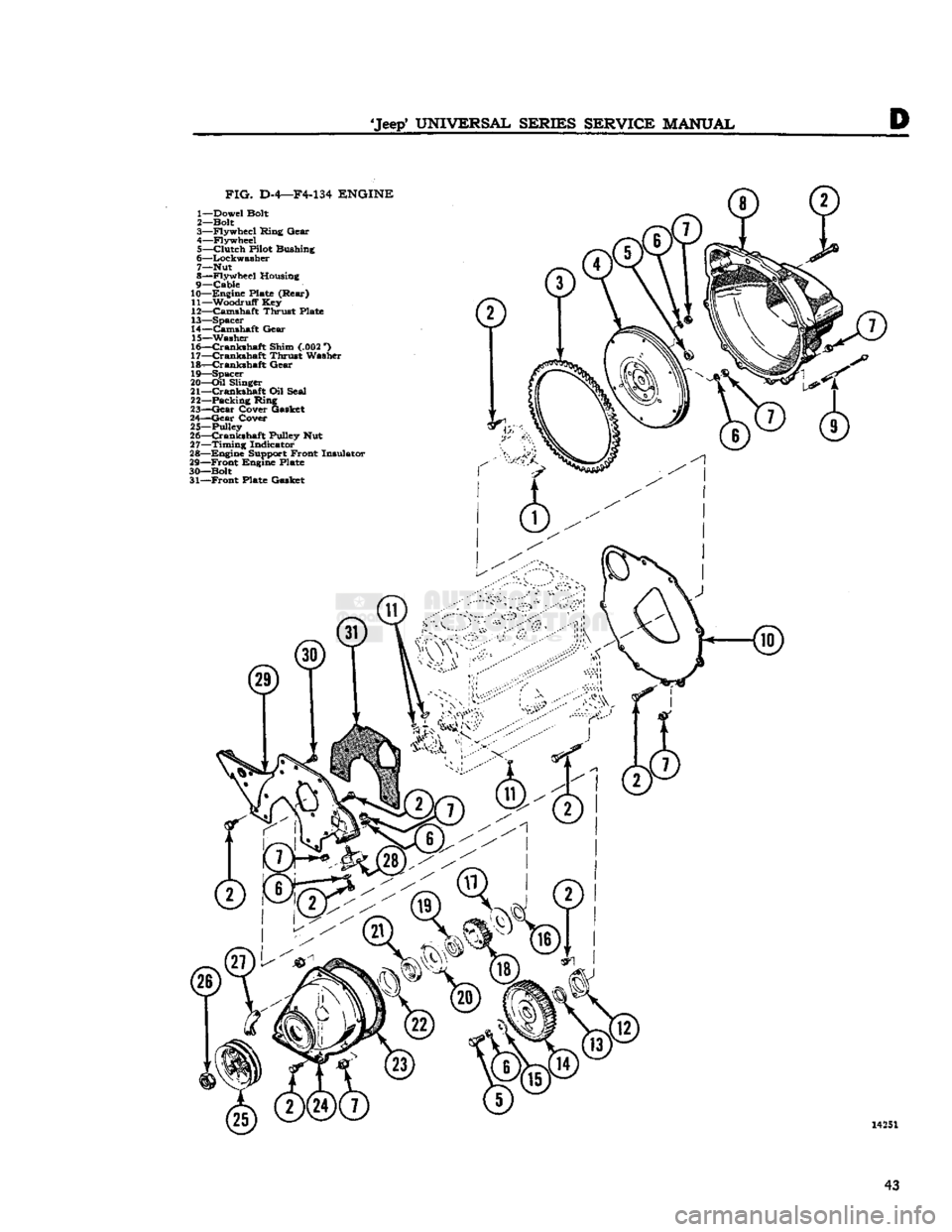
FIG.
D-4—F4-134
ENGINE
1— Dowel Bolt
2— Bolt
3— Flywheel Ring Gear
4— Flywheel 5—
Clutch
Pilot Bushing
6— Lockwasher
7— Nut
8— Flywheel Housing
9—
Cable
10— Engine Plate (Rear)
11— Woodruff Key
12— Camshaft Thrust Plate
13— Spacer
14— Camshaft Gear
15— Washer
16—
Crankshaft
Shim (.002 *)
17—
Crankshaft
Thrust Washer
18—
Crankshaft
Gear
19— Spacer
20—
Oil
Slinger
21—
Crankshaft
Oil Seal
22— Packing Ring
23—
Gear
Cover Gasket
24—
Gear
Cover
25—Pulley
26—
Crankshaft
Pulley Nut
27—
Timing
Indicator
28— Engine Support Front Insulator
29—
Front
Engine Plate
30— Bolt 31—
Front
Plate Gasket 14251
43
Page 44 of 376

D
HURRICANE
F4
ENGINE
Note:
Check
the condition of the rubber O-rings.
Defective O-rings could be the major cause of oil
leakage into cylinders. Always discard and replace
all
O-rings removed as only new O-rings should be installed at reassembly.
D-18.
Ream
Cylinder
Bore Ridges
To
prevent breaking the piston lands, the ridge
at the top of each cylinder bore must be removed
first.
To remove this ridge, use a cylinder ridge
reamer,
as shown in Fig. D-3 following the instruc
tions furnished by the reamer manufacturer. Use
care
not to cut below the top of the upper ring
travel
in the bore. Keep each piston top covered
with
an oil-soaked cloth to prevent cuttings from
falling
into the cylinder.
Note:
This
operation should be performed at this
time before the
engine
is rotated for the sequence
steps
following.
D-19.
Remove Oil Pan
Rotate the
engine
to the upside down position.
Remove the screws and lockwashers that attach
the oil pan to the cylinder block. Remove the oil
pan
and gasket.
Discard
the gasket.
D-20.
Remove Piston and Connecting
Rod
Assemblies
Remove the stamped locking nuts from the lower
end of each connecting rod bearing bolt. Remove
the connecting rod nuts. Remove the bearing cap evenly. Push the connecting rod and piston as
sembly out of the cylinder block with the handle end of a hammer until the piston rings are free from
the cylinder bore. Remove the piston and connecting rod assembly
from
the top of the cylinder block. Reassemble the
connecting rod bearing cap with the bearings in
place in the rod from which it was removed. Rotate
the crankshaft and follow the same procedure until
all
the piston and connecting rod assemblies are
removed.
Pistons and connecting rod assemblies may be removed for repair with the
engine
in the vehicle after draining the cooling system, removing the
oil
pan and the cylinder head, and reaming the ridges as previously described.
D-21.
Remove
Timing
Gear
Cover
Remove the bolts, nuts, and lockwashers, that at
tach
the timing gear cover to the engine. Remove
the cover, timing pointer, and cover gasket.
Dis
card
the gasket. Remove the crankshaft oil seal
from
the timing gear cover and discard the seal. Remove the oil slinger and spacer from the
crank
shaft.
D-22.
Remove
Timing
Gears
Use puller W-172 for pulling both the crankshaft
and
the camshaft gears.
With
the threaded cap-
screws supplied, adapt the puller to the crankshaft
FIG.
D-5—PULLING TIMING GEARS
1—
Puller
W-172 2—
Camshaft
Gear
gear and
pull
the gear.
With
the special hook-type
puller
bolts
that fit behind the camshaft gear
flange,
pull
the camshaft gear. Remove the Wood
ruff
Keys.
D-23.
Remove
Front
End Plate
Remove the screws and lockwashers that attach the
front end plate to the cylinder block. Remove the
front end plate and gasket.
Discard
the gasket.
D-24. Remove
Clutch
Remove four
bolts
and lockwashers diagonally
opposite
that attach the clutch assembly to the
flywheel, leaving two
opposed
bolts
to be
loosened
alternately until the clutch spring pressure is re
lieved.
Then,
support the clutch assembly with
one hand while removing the two remaining bolts.
For
information on disassembly, inspection, repair
and
assembly of the clutch refer to Section I. In
structions for removing the clutch when the
engine
is in the vehicle are also given in Section I.
D-25.
Remove Flywheel
The
flywheel is attached to the crankshaft with two tapered dowel
bolts
and four special bolts.
Remove
these
attaching parts. Use a pry bar be tween the flywheel and the back of the
engine
and
carefully
loosen
the flywheel from the crankshaft.
If
the flywheel is to be removed with the
engine
in
the vehicle, the transmission and clutch must
first be removed as detailed in Section I.
D-26.
Remove
Crankshaft
Slide
the crankshaft thrust washer and all end-play
adjusting
shims off the front end of the crankshaft.
Pull
the two pieces of
rear
main bearing cap packing out of position
between
the side of the bearing cap
and
the cylinder block.
Note
the marks on the bearing caps and cylinder
block for bearing number and position. 44
Page 45 of 376
'Jeep'
UNIVERSAL SERIES SERVICE
MANUAL
D
Remove the screws and lockwashers that attach
the main bearing caps to the cylinder block. Use
a
lifting bar beneath the ends of each bearing cap.
Be
careful not to exert too much pressure to cause
damage to the cap or
dowels
and pry the caps free.
CAUTION:
If main bearing caps are not removed
carefully
by raising both sides of each cap evenly
until
free of the dowels, the
dowels
may be bent.
A
bent main bearing cap dowel can cause misalign ment of the cap and resultant
rapid
bearing wear
necessitating replacement. Therefore, remove each
main
bearing cap carefully. If there is reason to
believe any of the
dowels
have been bent during
the bearing cap removal, remove them and install
new
dowels
as detailed in Par. D-34c.
Remove the upper
half
of the
rear
main bearing
oil
seal from the cylinder block and the lower
half
from
the oil seal
groove
in the
rear
main bearing
cap.
Install
the main bearing caps and bearings on
the cylinder block in their original positions.
Note;
Removal of the crankshaft may be ac
complished only with the
engine
out of the vehicle.
D-27.
Remove
Exhaust
Valves and Springs
Access to the valve chamber is obtained by re moving the attaching parts and the valve spring
cover and gasket from the cylinder block. Use cloths
to block off the three
holes
in the exhaust valve
chamber to prevent the valve retaining locks falling
into the crankcase, should they be accidentally dropped.
With
a valve
/
spring compressor, compress the valve springs on
those
valves which are in the
closed position (valve seated against cylinder
block).
Remove the exhaust valve spring retainer
locks,
the exhaust valve spring retainer, and the exhaust valve spring. Close the other valves by
rotating the camshaft and repeat the above opera
tion for the other valves in the same manner.
Lift
out all the exhaust valves and tag or place them in
a
rack
to indicate the location where each was removed from the cylinder block. If a valve sticks in
the guide and cannot be easily lifted out,
pull
the valve upward as far as possible and remove the
spring.
Lower
the valve and remove any carbon
deposits
from the valve stem.
This
will
permit re moval of the valve.
For
intake valve and spring removal, see
Par.
D-l7.
D-28.
Remove Camshaft
a.
Push the intake and exhaust valve tappets into the cylinder block as far as possible so the ends of
the tappets are not in contact with the camshaft. b. Secure each tappet in the raised position by in
stalling a common clip-type clothes pin on the
shank
of each tappet or tie them up in the valve
chamber.
c. Remove the camshaft thrust plate attaching
screws.
Remove the camshaft thrust plate and
spacer.
d.
Pull
the camshaft forward out of the cylinder
block using care to prevent damage to the cam
shaft bearing surfaces.
D-29.
Remove Valve Tappets
Remove the intake and exhaust valve tappets from
the
bottom
or crankshaft side of the cylinder block
after the camshaft has been removed. Tag each
tappet or place them in a marked
rack
so they may be reassembled in their original positions.
D-30.
Remove Oil
Gallery
Plugs
Remove the plug at each end of the oil gallery in the cylinder block.
This
operation is only applicable
when the
engine
is out of the vehicle and
will
allow access to the oil gallery so it may be cleaned.
D-31. ENGINE INSPECTION
AND
REPAIR
The
inspection and repair procedures detailed here
in
are recommended to be followed when a com
plete
engine
overhaul is to be made with the
engine
out of the vehicle. These instructions can generally be applied individually with the
engine
in the
vehicle. Wherever the procedure differs due to
the
engine
being in the vehicle, the necessary
special
instructions are provided. Inspection and
repair
instructions are included to cover the
cylinder
block, cylinder head, crankshaft and bearings, connecting rods and bearings, oil pump, valves and tappets, pistons and rings, flywheel,
timing gears, and the camshaft and bearings. In addition, fitting operations for
these
engine
com
ponents
are included.
Important:
Before the inspection and repair pro
cedures listed below are begun, the
engine
serial
number must be checked for the presence of
code
letters denoting undersize bearings or oversize
pistons. Refer to Par. D-2.
D-32.
Cylinder
Block
The
cylinder block must be thoroughly cleaned, inspected and repaired as detailed in the following
paragraphs.
D-33.
Cleaning
The
cylinder block may be steam cleaned or cleaned
with
a suitable solvent. A scraper is recommended
to remove
hard
deposits, except on highly finished surfaces. Special attention must be directed to the
cleaning of the oil passages, valve chamber,
crank
case, and cylinder walls to remove all sludge,
dirt
and
carbon deposits. After cleaning, use air pressure to dry the block thoroughly.
D-34. Inspection
Examine
the cylinder block for minute cracks and
fractures.
Rusted valve springs or evidence of rust
in
the valve chamber or the cylinder walls is a
good
indication of a possible
crack
in the block,
a.
Examine all machined surfaces of the cylinder block for
burrs
and scores.
Check
for cylinder block
distortion by placing a straight
edge
along the
length of the cylinder head surface of the block.
With
a feeler
gauge,
check for clearance
between
the straight
edge
and the block, particularly be
tween adjacent cylinders. Maximum permissible
out of line for service is .010"
[0,254
mm.] over the
full
length of the block. 45