1953 JEEP CJ fuel filter
[x] Cancel search: fuel filterPage 127 of 376

'Jeep'
UNIVERSAL
SERIES
SERVICE
MANUAL
E
E-47.
Reassembly
•
Refer to Fig. E-29.
Install
the valve gaskets, valves, valve retainer and
secure them with the valve retainer screws. Make
sure that the inlet and
outlet
valves are in their proper positions. Place the diaphragm spring re
tainer in position on the diaphragm
pull
rod
and
install diaphragm spring. Position the
dia
phragm assembly in pump
body
and attach the
cover to pump body, with file marks aligned, with
the six attaching screws. Do not draw the screws
up tight.
Install
rocker arm spring, rocker arm
pin
washers, rocker arm and rocker arm pin.
With
rocker
arm positioned on the diaphragm rod, draw
the six pump
body
screws up evenly and securely.
Install
the filter screen, cork gasket and sediment
bowl and secure them firmly with the thumb screw
on the bowl clamp.
E-48.
Vacuum
Pump
The
double-action fuel pump resembles two single-
action pumps placed one
above
the other. A single
fuel pump rocker arm actuates the two separate diaphragms. One diaphragm is part of the fuel
delivery pump and operates as described in Par.
E-45.
The other diaphragm is part of the vacuum
pump and operates as described here.
As
the actuating lever forces the diaphragm upward against spring pressure, air is forced through the
outlet
port
into
the
engine's
intake manifold. On
the return stroke, spring pressure forces the
dia
phragm downward, creating a
partial
vacuum and
opening the inlet valve. In this manner, air is pumped out of the windshield wiper motor and
into
the intake manifold. When the wiper motor is shut off, manifold vacuum holds the diaphragm against its spring so that the
full
motion of the actuating
lever is not accompanied by a
complete
up-and-
down motion of the diaphragm.
When
the windshield wiper motor is turned on, but manifold vacuum is greater than the vacuum
created by the
booster
pump, air
flows
from the
wiper motor through both valves of the vacuum
booster.
As manifold vacuum drops off as a result
of the
engine
operating under low
speed
and high load, the vacuum created by the vacuum
booster
will
be greater than
engine
intake manifold vacuum
and
the pump
will
operate the wiper motor when the wiper control switch is turned on.
•
Refer to Fig. E-29. Remove the
eight
cover attaching screws and
lockwashers, and remove the cover, diaphragm
spring
and spring seat. Detach the diaphragm rod
from the rocker arm and remove the diaphragm.
The
valve assemblies are pressed
into
the cover
and
body
and lightly staked. They may be removed
with the point of a knife blade. If installing new valves be sure the inlet and
outlet
valves are
correctly positioned and stake them lightly with
a
small punch.
Assemble the vacuum pump in the reverse order
of disassembly, drawing the cover attaching screws up evenly and tightly.
E-49.
Fuel
Pump
Testing
Four
tests
are presented in following paragraphs to
test
for proper operation of the fuel pump. In addi
tion, check the following:
a.
Check
for secure mounting of the fuel pump.
The
rocker arm may be working the entire pump
up and down, rather than just the pump
dia
phragms.
b. Remove and clean the fuel sediment bowl.
c.
Check
all fuel lines.
E-50.
Volume
Check
To
measure fuel pump capacity (amount of fuel
delivered in a given time) disconnect the pump-to-
carburetor
line at the carburetor end. Place the
open
end of the line in a suitable container.
Start
the
engine
and operate at normal idle speed.
Delivery
should be one quart U.S. [1 ltr.] within
one minute.
E-51.
Pressure
Check
To
measure fuel pump pressure (force of fuel de
livery)
disconnect the pump-to-carburetor line
at the carburetor end. Plug a pressure
gauge
and T-fitting
into
the
open
end of this line and
into
the
carburetor.
Start
the
engine
and operate at normal
idle speed. Pressure should be 2J4 to 3% psi.
[0,716
a
0,264
kg-cm2] at 1800 rpm. and at 16"
[406 mm.]
above
the
outlet.
E-52.
Vacuum
Check
To
measure fuel pump vacuum (pull of. the pump
at the inlet side) disconnect the pump-to-fuel-tank
line at the fuel pump. Attach a vacuum
gauge
to the fuel pump inlet.
Start
the
engine,
accelerate to
specified speed, and hold this
engine
speed
while
taking a
gauge
reading. Permissible
gauge
reading
is 8* [203 mm.] of mercury [Hg] at 1200 rpm. and
10j^'
[267 mm.] at 1800 rpm.
E-53.
Vacuum
Booster
Check
To
test
the condition of the vacuum
booster
pump,
disconnect both inlet and
outlet
lines at the pump.
Attach
a vacuum
gauge
to the windshield wiper
connection at the pump.
Start
the
engine,
accelerate
to
2000
rpm., and hold this
engine
speed
while taking a
gauge
reading. Permissible
gauge
reading
is 10* to 14" [254 a 356 cm.] of mercury [Hg].
E-54.'
FUEL
PUMP
(SINGLE-ACTION)
—
HURRICANE
F4
ENGINE
•
Early
Models.
Vehicles with electric windshield wiper motors are
equipped with a single-action fuel pump (Fig.
E-30).
The fuel pump cam lever is activated by an eccentric on the
engine
camshaft. When the
car
buretor float
needle
valve closes, accumulation of
fuel in the pump
extends
the diaphragm spring.
This
action causes the rocker arm linkage to be
come
inoperative until the pressure on the
dia
phragm and spring is reduced. The fuel pump dis
charge pressure is thus controlled by the diaphragm
spring.
This
provides a steady supply of fuel to the
carburetor
at a fairly constant pressure. 127
Page 129 of 376
'Jeep9
UNIVERSAL
SERIES
SERVICE
MANUAL
E-59.
Fuel
Pump Installation
a.
Make certain mating surfaces of fuel pump and
engine
cylinder case are clean. Cement a new gasket
to mounting
flange
of fuel pump.
b. Position fuel pump on cylinder block, so that
cam
lever of pump rests on fuel pump cam of cam
shaft. Secure pump to block with two cap screws
and
lock washers.
c. Connect intake and
outlet
fuel lines to fuel
pump.
E-60.
FUEL
PUMP
(SINGLE-ACTION)
—
HURRICANE
F4
ENGINE
•
Late
Models.
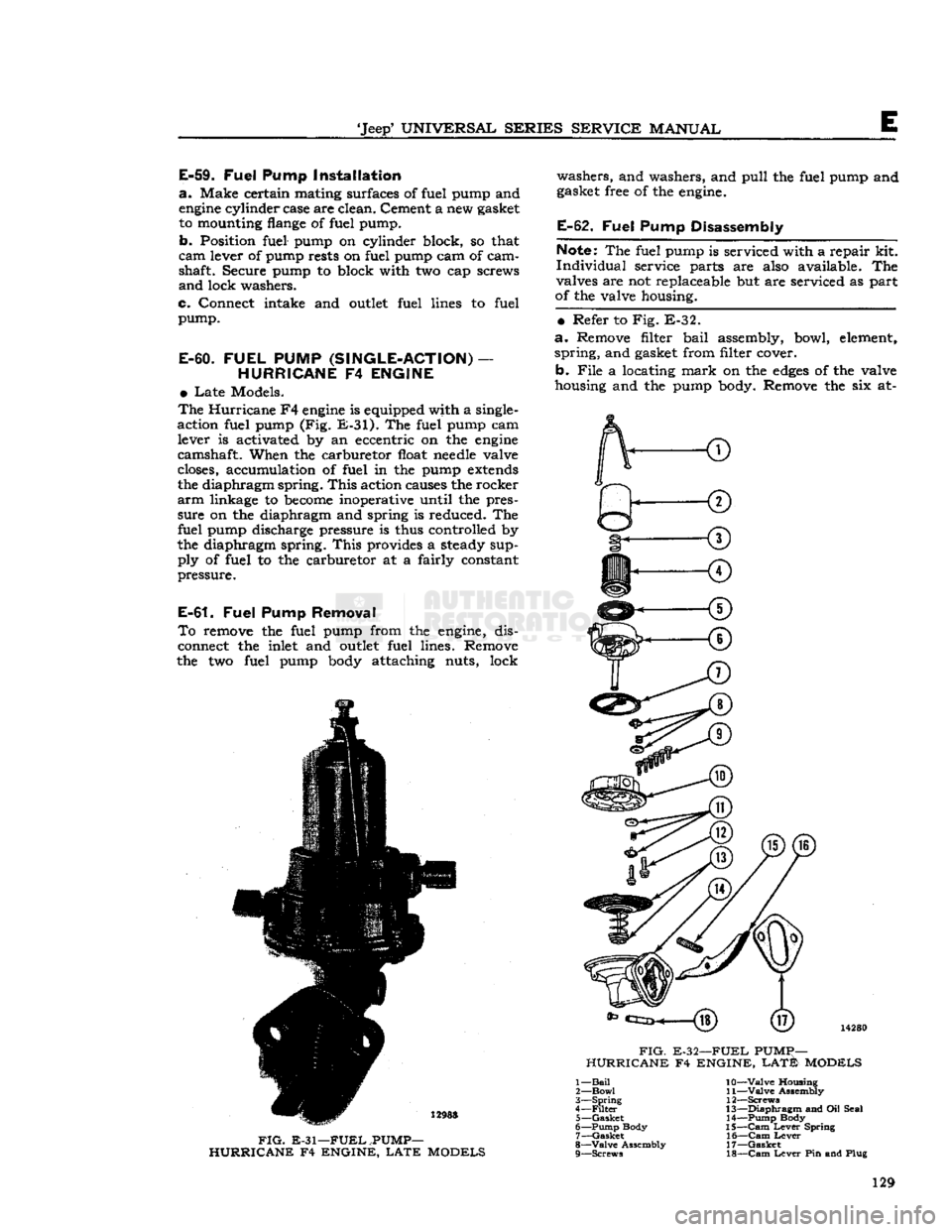
The
Hurricane F4
engine
is equipped with a single-
action fuel pump (Fig.
E-31).
The fuel pump cam lever is activated by an eccentric on the
engine
camshaft. When the carburetor float
needle
valve
closes, accumulation of fuel in the pump
extends
the diaphragm spring.
This
action causes the rocker
arm
linkage to
become
inoperative until the pres
sure on the diaphragm and spring is reduced. The fuel pump discharge pressure is thus controlled by
the diaphragm spring.
This
provides a steady sup ply of fuel to the carburetor at a fairly constant
pressure.
E-61.
Fuel
Pump Removal
To
remove the fuel pump from the
engine,
dis
connect the inlet and
outlet
fuel lines. Remove
the two fuel pump
body
attaching nuts, lock washers, and washers, and pull the fuel pump and
gasket free of the
engine.
E-62.
Fuel
Pump Disassembly
Note:
The fuel pump is serviced with a repair kit.
Individual
service parts are also available. The
valves are not replaceable but are serviced as part
of the valve housing.
•
Refer to Fig. E-32.
a.
Remove filter bail assembly, bowl,
element,
spring,
and gasket from filter cover. b.
File
a locating
mark
on the
edges
of the valve
housing and the pump body. Remove the six at-
14280
FIG.
E-32—FUEL
PUMp—
HURRICANE F4 ENGINE,
LATE
MODELS
12988
FIG.
E-31—FUEL
.PUMP-
HURRICANE F4 ENGINE,
LATE
MODELS 1—
Bail
2—
Bowl
3—
Spring
4—
Filter
5—
Gasket
6— Pump Body 7—
Gasket
8—
Valve
Assembly 9— Screws 10—
Valve
Housing
11—
Valve
Assembly
12— Screws
13—
Diaphragm
and Oil Seal 14— Pump Body
15—
Cam
Lever
Spring 16—
Cam
Lever
17—
Gasket
18—
Cam
Lever
Pin and Plug 129
Page 130 of 376

E
FUEL
SYSTEM
taching screws and valve housing from the fuel
pump body.
c.
Remove the two screws in the valve housing
and
separate the filter cover and air
dome
dia
phragm.
d.
Remove the cam lever return spring, plug,
cam
lever pin, and cam lever from the pump body.
Tap
the cam lever pin out of body, using a drift
inserted through the small
hole
in the pump body.
e. Remove diaphragm from pump body.
f. Under normal service, the pump may be cleaned without further disassembly.
Note:
The oil seal (at top of spring in diaphragm
assembly) seals the spring side of the fuel
dia
phragm
from the crankcase. Any deposit, in
excess
of a few drops, of oil on the diaphragm indicates leakage past the oil seal. Be sure the seat for the
seal
in the pump body is clean and smooth.
E-63.
Fuel
Pump Cleaning and Inspection
Caution:
Do not immerse valves or diaphragm
in
cleaning solvent; wipe clean.
Clean
all metal parts of the fuel pump in solvent.
Brush
with a stiff-bristled
brush.
Dry with com
pressed
air.
Check
all parts to see that they are not
cracked
or broken and that the screw threads are
not damaged.
E-64.
Fuel
Pump Reassembly
•
Refer to Fig. E-32.
a.
Assemble the valve housing and filter cover, using a new air
dome
diaphragm. The opening
in
the air
dome
diaphragm is located over the
intake
valve. The filter cover is positioned cor
rectly
when the inlet passage in the cover aligns
with
the inlet valve. Tighten the attaching screws
alternately and securely.
b.
Lubricate
diaphragm assembly shaft, around
oil
seal, with
engine
oil. Position diaphragm as sembly on valve housing and thread all the attach ing screws through diaphragm.
(This
helps avoid
damage to the screw
holes
in diaphragm.)
c.
Place diaphragm assembly and valve housing
in
position on pump body (align marks made
before disassembly).
First
start all screws one
or
two threads; then tighten the screws alternately
and
securely.
d.
Lubricate
forked end of cam lever, pin bore
of body, and corresponding
hole
in lever, and the
pin
itself with
engine
oil.
Note:
Forked
end of lever
goes
around diaphragm
shaft. Be sure
loose
bumper washer on diaphragm shaft is on top of lever and
between
lever and fixed
washer
on shaft.
e.
Install
lever and pin. To install pin, use a drift
and
tap pin into the
hole
in the body until it hits
the
stop
on the
bottom
of the hole;
move
the lever while tapping, to align
hole
in lever with the pin;
then install plug.
Install
lever return spring.
f.
Install
a new filter bowl gasket in filter cover.
Place
bail
assembly in ears on cover and swing
to one side.
Install
spring and new filter element in
bowl and install bowl on pump. Position
bail
as
sembly under bowl; tighten retainer screw.
Caution:
Do not overtighten screw.
E-65.
Fuel
Pump Installation
a.
Make certain mating surfaces of fuel pump and
engine
cylinder case are clean. Cement a new gasket to mounting flange of fuel pump.
b.
Position fuel pump on cylinder block, so that
cam
lever of pump rests on fuel pump cam of cam
shaft. Secure pump to block with two cap screws
and
lock washers. Torque
bolts
13 to 17 lb-ft. [1,8
a
2,3 kg-m.].
c.
Connect intake and
outlet
fuel lines to fuel
pump.
E-66.
Fuel
Pump Testing
Whenever
the fuel pump is to be checked for pres
sure
or volume, follow the procedure outline in
Par.
C-23 of this manual.
Fuel
pump pressure is
important
for low pressure
will
seriously affect en
gine
operation and high pressure can cause exces
sive fuel consumption and flooding of the carbure
tor.
Should there be any doubt of normal opera
tion, check the procedure as outlined in Par. C-23.
In
addition to proper fuel pressure, volume of the
pump is also important. When testing for proper
pump pressure, be certain to also
test
for volume
as the pump may build up sufficient pressure, but
fail
to produce sufficient volume.
E-67. FUEL
PUMP
—
DAUNTLESS
V-6
ENGINE
Jeep vehicles equipped with the Dauntless V6-225
engine
have a special fuel pump which has a metering
outlet
for a vapor return system. Any
vapor
which forms is returned to the fuel tank
along with hot fuel through a separate line along
side the fuel supply line.
This
greatly reduces any
FIG.
E-33—FUEL PUMP—DAUNTLESS V-6 ENGINE
1
—Fuel
Outlet 2—Vapor
Return
3—Fuel
Inlet
130
Page 131 of 376
'Jeep'
UNIVERSAL SERIES SERVICE
MANUAL
E
possibility of vapor lock by keeping cool fuel from
the tank constantly circulating through the fuel
pump.
Fuel
pump pressure at carburetor (inlet) on Daunt
less
V6-225
engine
should be 3% lbs.
[0,264
kgm-cm2] minimum at idle with the vapor return
hose
squeezed off. With the vapor return
hose
open
pump pressure should be 2j^ lbs. [0,176 kg-cm2]
minimum.
The
Dauntless V-6
engine
is equipped with a sealed
unit,
non-repairable, single-action fuel pump (Fig.
E-33).
Note:
All Dauntless V-6
engines
are equipped with
a
throw-away can-type gasoline filter installed in
the fuel line
between
the fuel pump and the
car
buretor.
This
unit must be replaced every
12,000
miles
[19.200
km.] of vehicle operation.
E-68.
Fuel
Pump Removal
To
remove the fuel pump from the Dauntless V-6
engine, disconnect the fuel inlet, fuel
outlet
and fuel return lines from the pump. Remove the two
fuel pump body attaching cap screws and lock
washers.
Pull
the fuel filter bracket free and remove the pump and gasket. Discard pump and gasket.
Install
new pump in reverse procedure of removal.
E-69.
AIR
CLEANER
Servicing
of the air cleaner is properly taken care of as part of the periodic lubrication and servicing of the vehicle. For this reason, air cleaner servicing
information is given in the Lubrication Section.
Refer
to and follow the instructions given there.
E-70. ACCELERATOR LINKAGE
The
accelerator linkage is properly adjusted when
the vehicle leaves the factory. However, in time
components parts
will
become
worn and require re
adjustment to maintain a smooth even control of
engine
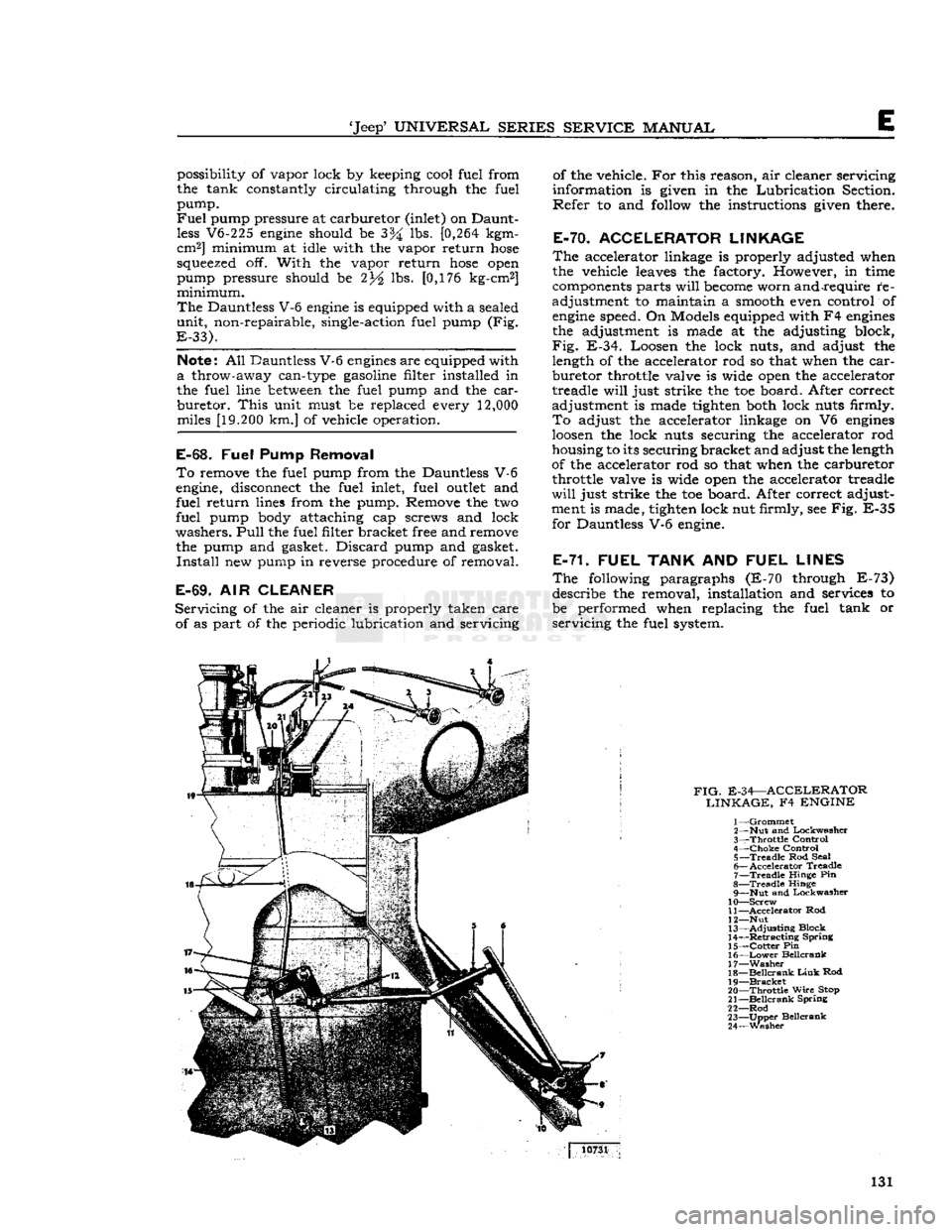
speed. On Models equipped with F4
engines
the adjustment is made at the adjusting block,
Fig.
E-34. Loosen the lock nuts, and adjust the length of the accelerator rod so that when the
car
buretor throttle valve is wide open the accelerator
treadle
will
just strike the toe board. After correct
adjustment is made tighten both lock nuts firmly.
To
adjust the accelerator linkage on V6
engines
loosen
the lock nuts securing the accelerator rod
housing to its securing bracket and adjust the length
of the accelerator rod so that when the carburetor throttle valve is wide open the accelerator treadle
will
just strike the toe board. After correct adjust
ment is made, tighten lock nut firmly, see Fig. E-35 for Dauntless V-6 engine.
E-71. FUEL
TANK
AND
FUEL LINES
The
following paragraphs (E-70 through E-73) describe the removal, installation and services to
be performed when replacing the fuel tank or
servicing
the fuel system.
FIG.
E-34—ACCELERATOR LINKAGE,
F4
ENGINE
1—
Grommet
2— Nut and Lockwasher
3—
Throttle
Control
4—
Choke
Control 5—
Treadle
Rod Seal
6—
Accelerator
Treadle
7—
Treadle
Hinge Pin
8—
Treadle
Hinge 9— Nut and Lockwasher
10—
Screw
11—
Accelerator
Rod
12— Nut
13—
Adjusting
Block
14—
Retracting
Spring
15—
Cotter
Pin
16—
Lower
Beilcrank
17—
Washer
18—
Beilcrank
Link
Rod
19—
Bracket
20—
Throttle
Wire
Stop
21—
Beilcrank
Spring
22—
Rod
23—
Upper
Beilcrank
24—
Wesher
10731
131
Page 133 of 376

'Jeep'
UNIVERSAL
SERIES
SERVICE
MANUAL
E
portant that
these
lines are not accidentally re
versed.
When
installing the fuel tank on late model vehicles, position the tank
between
the frame
rail
to allow space to connect the fuel line(s), vent
hose
and
sending unit wire. After connecting
these
items, align and secure tank to frame brackets.
Position filler
hose
on tank filler neck and tighten
hose
clamp.
Fill
tank with fuel and check for leaks.
When
installing the fuel tank on early model vehicles, reverse the order of removal as given in
Par.
E-73.
E-75.
Fuel
Tank
Cap
A
surge pressure type fuel tank filler cap is used on
all
models.
This
is necessary to prevent fuel leakage
from
the cap vent opening when the vehicle is on a
side slope. Two spring loaded relief valves which
open when venting is required are built into the
cap.
Should the pressure valve
fail
to open, pressure
in
the tank may force fuel by the carburetor inlet
valve causing flooding.
Failure
of the vacuum valve may prevent flow of fuel to the carburetor. Should
the valves
fail
to vent install a new cap.
Note:
Vehicles having a
Fuel
Evaporative
Emis
sion System are equipped with a non-vent sealed gas cap. The sealed cap is designed to allow no
vapors to discharge to the atmosphere. No other type of cap is to be used on vehicles having this
type system.
E-76.
Fuel
Gauge Float Unit
The
fuel tank
gauge
float unit is mounted in the top
of the fuel tank and consists of a housing enclosing
a
rheostat that is actuated by the float arm, and a
float
which
moves
with the fuel level in the tank.
On
V-6 and current production F4
engine
equipped vehicles, the fuel
outlet
pipe is integral with the
float
unit.
The fuel
outlet
pipe has a mesh filter on the inner end.
Note:
Under no circumstances should a fuel tank
gauge
be installed without a mesh filter element.
The
filter,
outlet
pipe, and float unit are locked as
an
assembly to the top of the fuel tank. To remove,
turn
the lock plate that secures the float unit
assembly.
E-77.
Fuel
Lines
Check
lines and connections occasionally for leaks,
and
for severe kinks that might restrict the flow of
fuel. If an excessive amount of
dirt
is found in the
carburetor
or fuel pump, the fuel tank should be
drained
and the fuel lines blown out with com
pressed air.
All
rubber fuel lines and their respective clamps should be checked occasionally to be certain they
are
correctly positioned and not leaking. 133
Page 136 of 376
E
FUEL
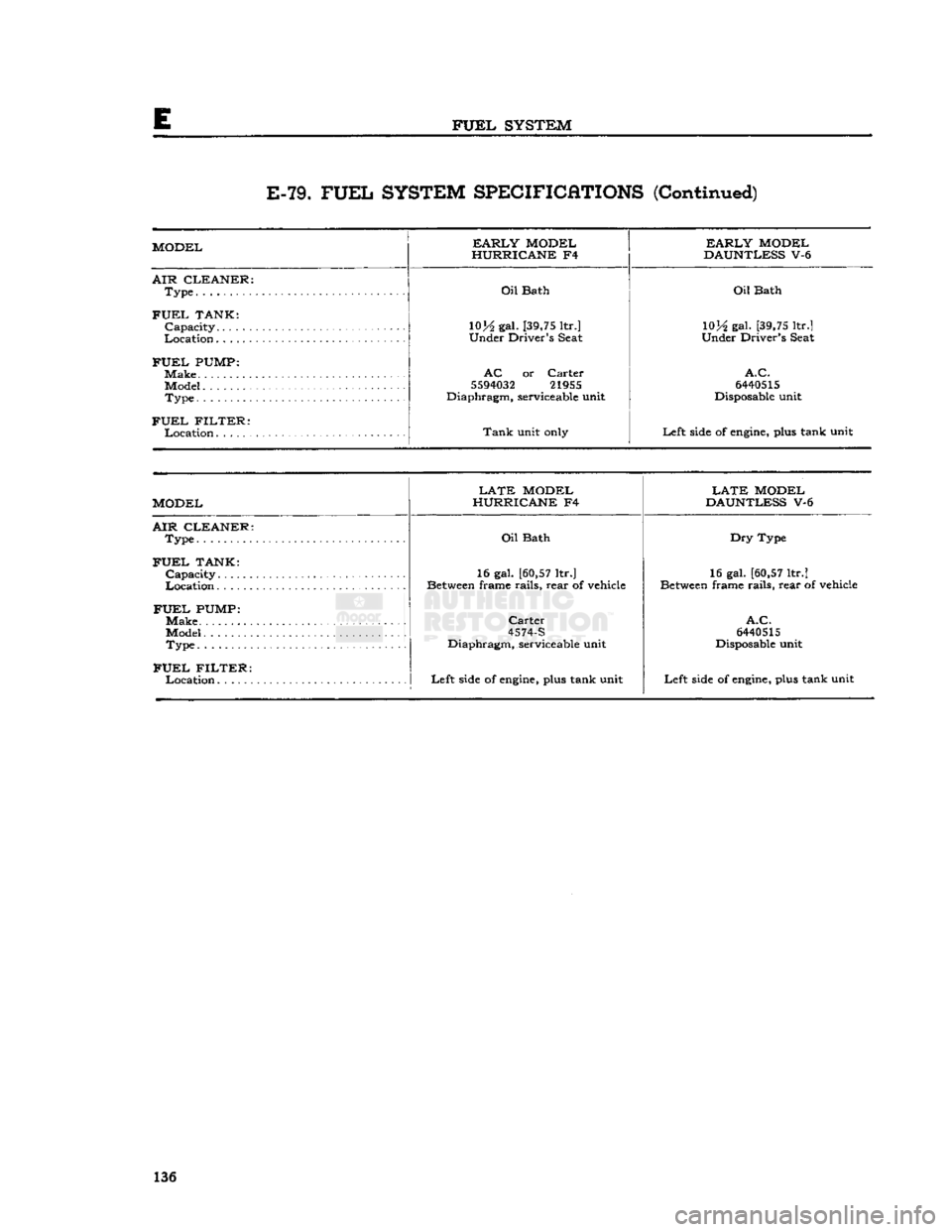
SYSTEM E-79.
FUEL
SYSTEM SPECIFICATIONS
(Continued)
MODEL
EARLY
MODEL
HURRICANE
F4
EARLY
MODEL
DAUNTLESS
V-6
AIR CLEANER:
Type
Oil
Bath
Oil
Bath
FUEL
TANK: 10H
gal. [39,75 ltr.]
10lA
gal. [39,75 ltr.]
Location
Under
Driver's Seat
Under
Driver's Seat
FUEL
PUMP:
AC
or
Carter
A.C.
Model
5594032
21955
6440515
Type..
Diaphragm,
serviceable unit
Disposable unit
FUEL
FILTER:
Tank
unit only
Left
side of engine, plus tank unit
MODEL
LATE
MODEL
HURRICANE
F4
LATE
MODEL
DAUNTLESS
V-6
AIR CLEANER:
Type...
Oil
Bath
Dry
Type
FUEL
TANK:
Capacity
16 gal. [60,57 ltr.]
16 gal. [60,57 ltr.]
Between frame
rails,
rear
of vehicle Between frame
rails,
rear
of vehicle
FUEL
PUMP:
Make.
Carter
A.C.
Model.
. 4574-S
6440515
Type
Diaphragm,
serviceable unit
Disposable unit
FUEL
FILTER:
Left
side of engine, plus tank unit
Left
side of engine, plus tank unit 136
Page 145 of 376

'Jeep'
UNIVERSAL
SERIES SERVICE
MANUAL
Fl
b. Connect tachometer to
engine.
c.
Warm
up
engine
and stabilize temperatures.
d.
Adjust
engine
idle to
speed
desired, using throt
tle idle
speed
adjusting screw.
e.
Carburetors without Idle
Limiter
Cap turn idle mixture screws out (counterclockwise) until a
loss
of
engine
speed
is indicated; then, slowly turn mix
ture screw in (clockwise-leaner) until maximum
speed
(RPM) is reached. Continue turning in (clockwise) until
speed
begins
to drop; turn mixture
adjustment back out (counterclockwise-richer) un
til
maximum
speed
is just regained at a "lean as
possible" mixture adjustment.
Fl-14.
Distributor
Check
the distributor number for proper appli
cation.
Check
the distributor cam dwell angle and
point condition and adjust to specifications or re place as required. (Specifications listed at the end
of this section)
Check
ignition timing and set at
0°
or
TDC.
Fl-15.
Anti-iackfire
Diverter Valve
The
anti-backfire valve remains closed
except
when
the throttle is closed rapidly from an
open
position.
To
check the valve for proper operation, accelerate
the
engine
in neutral, allowing the throttle to
close
rapidly.
The valve is operating satisfactorily when
no exhaust system backfire occurs. A further check
to determine whether the valve is functioning can be made by removing from the anti-backfire valve
the large
hose
Which
connects to the check valve.
Accelerate the
engine
to allow the throttle to
close
rapidly.
The valve is operating satisfactorily if a
momentary interruption of rushing air is audible.
Fl-16.
Check Valve
The
check valve prevents the reverse flow of ex
haust
gases
to the pump in the
event
the pump
should, for any reason,
become
inoperative or should exhaust pressure ever
exceed
pump pressure.
To
check this valve for proper operation, remove the air supply
hose
from the pump at the
distri
bution manifold.
With
the
engine
running, listen for exhaust leakage at the check valve which is
connected to the distribution manifold.
Fl-17.
Air
Pump
Check
for proper drive belt tension with belt tension
gauge
W-283. The belt strand tension should be
50-60
pounds on a belt with previous service, meas
ured
on the
longest
accessible span
between
two pulleys. When installing a new belt, adjust the
tension to
60-80
pounds tension. DO NOT PRY
ON
THE DIE
CAST
PUMP
HOUSING.
To
check the pump for proper operation, remove the air
outlet
hose
at the pump.
With
the
engine
running,
air discharge should be
felt
at the pump
outlet
opening. The pump
outlet
air pressure, as determined by the relief valve, is preset and is not
adjustable.
The
air pump
rear
cover assembly, housing the pressed in inlet and discharge tubes, and the pres
sure relief valve are the only pump
components
recommended for service replacement. These parts
are
to be replaced only when damaged as a result
of handling or in the
event
the relief valve was
tampered with.
Fl-18.
Carburetor
Air
Cleaner
Every
6000
miles
[9,600
km.] clean the inside
sur
face at the sump and
refill
to indicated oil level with
SAE
40 or 50
engine
oil
above
32 F; SAE 20
below
32 F. Wash filter
element
in kerosene and
drain.
Reassemble the air cleaner.
More
frequent cleaning and replacement is advis able when the car is operated in dusty areas or on
unpaved roads. Accumulated dirt restricts air flow,
reducing fuel
economy
and performance.
Fl-19.
REMOVAL
PROCEDURES
The
following paragraphs
give
the procedures for removing the major units of the Exhaust Emission
Control
System and the required equipment
needed.
Fl-20.
Air
Pump
Loosen
the air pump adjusting strap to facilitate
drive
belt removal. Remove the air pump air dis
charge hose(s) and air filter attachment. Separate
the air pump from its mounting bracket. At time of installation, torque tighten the air pump mounting
bolts
to
30-40
lbs-ft. [4,15 a 5,53 kg-m.]. Adjust
the belt strand tension to
50-60
pounds on a belt
with previous service and
60-80
pounds on a new
belt.
Fl-21.
Anti-Backfire
Diverter Valve
The
anti-backfire diverter valve removal requires disconnecting the
hoses
and bracket to
engine
at
taching screws.
Fl-22.
Air
Distribution
Manifold
and
Injection Tubes
In
order to remove the air distribution manifold
without bending the tubing, which could result in
fractures
or leakage, it is necessary to remove the
exhaust manifold as an assembly from the
engine.
After
the exhaust manifold assembly is removed
from
the
engine,
place the manifold in a vise and
loosen
the air distribution manifold
tube
retaining nuts at each cylinder exhaust port. Tap the injec
tion
tubes
lightly to allow the air distribution mani
fold to be pulled away partially from the exhaust manifold. The stainless steel injection
tubes
in the
exhaust manifold may have
become
partially fused
to the air distribution manifold and, therefore, may
require
application of heat to the joint in order to
separate. While applying heat to the joint, rotate
the injection
tubes
with pliers being careful not to
damage the
tubes
by applying excessive force.
At
time of installation, the air injection
tubes
must
be positioned into the exhaust manifold prior to
placing the exhaust manifold assembly on the en gine.
Note:
Two different length injection
tubes
are used.
The
shorter length injection
tubes
must be inserted into cylinders 1 and 4. 145
Page 155 of 376

'Jeep'
UNIVERSAL
SERIES
SERVICE
MANUAL
F2
14043
FIG.
F2-6—REPLACING VACUUM MOTOR ASSEMBLY
A—Drill
VW
Hole
B—Sensor
Unit
Replacement Position
1—
Motor
3—Sensor
Unit
2—
Spot
Welds
4—Retaining
Strap
•e.
Drill
a
%j
inch [2,78 mm.] hole in snorkel tube
at
point
"A"
as shown in Fig.
F2-6.
f.
Use the motor strap retainer and the
sheet
metal
screw
provided in the motor replacement kit to secure the retainer and motor to the snorkel tube.
g. Make sure the screw
does
not interfere with the
operation of the damper assembly. Shorten screw
if
required.
F2-9.
Replacement
of Air
Cleaner Sensor
a.
Remove two sensor retaining clips by
prying.
See
Fig.
F2-7.
b.
Pull
vacuum
hoses
from sensor.
c.
Note
carefully the installed position of the sensor so that you can install new sensor in same position.
Then
remove sensor.
d.
Install
sensor and gasket assembly in air cleaner
m
same position as noted in
step
c.
This
is to eliminate the possibility of interference with the air
filter
element.
e.
Install
sensor retaining
clip,
meanwhile support
ing
sensor at B around the outside rim to prevent 14042
FIG.
F2-7—REPLACING SENSOR ASSEMBLY
1—Sensor
Retaining
Clip
damage to the temperature sensing spring. See
Fig.
F2-7.
f.
Reinstall
vacuum hoses.
F2-10.
AIR
PUMP
The
air injection pump is a positive displacement
vane type which is permanently lubricated and
requires
no periodic maintenance.
The
pump contains an integral relief valve which
controls the
air
supplied to the
engine
exhaust ports
during
high speed operation to limit maximum exhaust system temperatures.
F2-11.
AIR
FILTER
The
air injection system draws clean air from the
carburetor
air filter through an inlet hose, into the
air
pump and from the pump through two
outlets
(one for each cylinder head).
F2-12.
AIR
DELIVERY MANIFOLD
The
air delivery manifolds constructed of cold
rolled
steel with a zinc plating, distribute the air
from
the pump to each of the air delivery tubes in
a
uniform manner.
Two
check valves are included to prevent the
reverse
flow of exhaust
gases
to the pump should
the pump drive
fail.
This
reverse flow would dam
age the air pump and connecting hose.
F2-13.
AIR
INJECTION TUBES
The
air injection tubes of stainless steel are in serted into machined
bosses
of the cylinder head.
The
tubes project into the exhaust ports directing
air
into the vicinity of the exhaust valve stem.
F2-14.
ANTI-BACKFIRE VALVE
The
anti-backfire valve is used to provide a "gulp" of air into the
engine
induction system during
rapid
throttle opening and subsequent closure.
During
rapid
throttle closure, the valve
opens
for approxi
mately one (1) second and bleeds air into the
intake
manifold through a fitting in the carburetor.
Its
function is to bleed an adequate amount of
air
below the carburetor throttle plate to compen sate for the
overrich
fuel mixture normally inducted
into the combustion chamber during
rapid
throttle
closure.
Filtered
air from the pump is provided to the
anti-backfire
valve by means of a connecting hose.
An
exhaust system backfire
will
result if the valve
fails
to function properly.
F2-15.
ENGINE COMPONENTS
The
following item varies in design or specifications
from
those
on vehicles not equipped with the Ex
haust
Emission
Control
System.
F2-16.
Carburetor
Check
carburetor number for proper application. Specifications are listed in this section.
Proper
carburetor idle mixture adjustment is im perative for
best
exhaust emission control.
The
idle adjustment should be made with the en
gine
at normal operating temperature, lights and accessories off and the air cleaner in place.
Adjust
155