Page 291 of 386

Sometimes irregular tire wear canbe corrected by rotating the tires.
USING SNOW CHAINS
WARNING: Wheels and tires mustbe the same size, load index and speedrating as those originally fitted on thevehicle. Use of any other tire or wheelcan affect the safety and performanceof your vehicle. Additionally, the use ofnon-recommended tires and wheels cancause steering, suspension, axle, transfercase or power transfer unit failure.Follow the recommended tire inflationpressures found on the SafetyCompliance Certification label, or theTire Label on the B-Pillar or the edge ofthe driver door. Failure to follow thisinstruction could result in loss of vehiclecontrol, vehicle rollover, or personal injuryor death.
The tires on your vehicle have all-weathertreads to provide traction in rain and snow.However, in some climates, you may needto use snow tires and cables. If you needto use cables, it is recommended that steelwheels (of the same size andspecifications) be used, as cables may chipaluminum wheels.
Note:The suspension insulation andbumpers help prevent vehicle damage. Donot remove these components from yourvehicle when using snow tires and chains.
Follow these guidelines when using snowtires and chains:
•If possible, avoid fully loading yourvehicle.
•Install chains securely, verifying thatthe chains do not touch any wiring,brake lines or fuel lines.
•Drive cautiously. If you hear the chainsrub or bang against your vehicle, stopand retighten the chains. If this doesnot work, remove the chains to preventdamage to your vehicle.
•Remove the snow chains when theyare no longer needed. Do not use snowchains on dry roads.
Please contact your upfitter for approvedsnow chain types/sizes and otherrecommendations for snow chain use.
CHANGING A ROAD WHEEL
If you get a flat tire while driving, do notapply the brake heavily. Instead, graduallydecrease your speed. Hold the steeringwheel firmly and slowly move to a safeplace on the side of the road.
Tire Change Procedure
WARNING: To help prevent yourvehicle from moving when changing awheel, shift the transmission into park(P), set the parking brake and use anappropriate block or wheel chock tosecure the wheel diagonally opposite tothe wheel being changed. For example,when changing the front left wheel,place an appropriate block or wheelchock on the right rear wheel.
WARNING: Do not get under avehicle that is supported by a jack.
WARNING: Never place anythingbetween the vehicle jack and yourvehicle.
WARNING: Never place anythingbetween the vehicle jack and the ground.
287
2024 F-650/750 (TBC) , enUSA, Edition date: 202210, First-PrintingWheels and Tires
Page 292 of 386

WARNING: Do not attempt tochange a tire on the side of the vehicleclose to moving traffic. Pull far enoughoff the road to not obstruct the flow oftraffic and avoid the danger of being hitwhen operating the jack or changing thewheel.
Note:Passengers should not remain in thevehicle when the vehicle is being jacked.
Park on a level surface, set the parkingbrake and activate the hazard flashers.
1.Turn the engine off and block the wheelthat is diagonally opposite of the flattire using a wheel chock.
2.Loosen each wheel lug nut ½ turncounterclockwise, but do not removethem until the wheel is raised off theground.
3.Replace the flat tire with the spare tire,making sure the valve stem is facingoutward on all front and inboard rearwheels. If you are replacing theoutboard wheel, the valve stem mustbe facing inward. Reinstall the lug nutsuntil the wheel is snug against the hub.Do not fully tighten the lug nuts untilthe wheel has been lowered.
4.Lower the wheel and fully tighten thelug nuts in the order shown below. SeeTechnical Specifications (page 289).
5.Unblock the wheels.
8-lug nut torque sequence.
10-lug nut torque sequence.
288
2024 F-650/750 (TBC) , enUSA, Edition date: 202210, First-PrintingWheels and TiresE142551 13427658E161441 12345678910E169375
Page 293 of 386

TECHNICAL SPECIFICATIONS
Wheel Lug Nut Torque Specifications
WARNING: When you install a wheel, always remove any corrosion, dirt or foreignmaterials present on the mounting surfaces of the wheel or the surface of the wheelhub, brake drum or brake disc that contacts the wheel. Make sure to secure any fastenersthat attach the rotor to the hub so they do not interfere with the mounting surfaces ofthe wheel. Installing wheels without correct metal-to-metal contact at the wheelmounting surfaces can cause the wheel nuts to loosen and the wheel to come off whileyour vehicle is in motion, resulting in loss of vehicle control, personal injury or death.
lb.ft (Nm)1Bolt size
450–500 lb.ft (610–678 Nm)M22 x 1.5
1 Torque specifications are for nut and bolt threads free of dirt and rust. Use only Fordrecommended replacement fasteners.
On vehicles equipped with single rear wheels, retighten the lug nuts to the specified torqueat 100 mi (160 km) after any wheel disturbance (such as tire rotation, changing a flat tire,wheel removal).
On vehicles equipped with dual rear wheels, retighten the lug nuts to the specified torqueat 100 mi (160 km) and again at 500 mi (800 km) of new vehicle operation and afterany wheel disturbance (such as tire rotation, changing a flat tire, wheel removal).
It is important to follow the proper wheel mounting and lug nut torque procedures.
On all two-piece flat wheel nuts,apply one drop of motor oilbetween the flat washer and thenut. Do not apply motor oil to thewheel nut threads or the wheelstud threads.
289
2024 F-650/750 (TBC) , enUSA, Edition date: 202210, First-PrintingWheels and TiresE161443
Page 295 of 386
ENGINE SPECIFICATIONS - 6.7L DIESEL
6.7L V8 Diesel EngineEngine
406 in³ (6,651 cm³)Displacement.
Ultra Low Sulfur Diesel up to B20Required fuel.
1-3-7-2-6-5-4-8Firing order.
15.2:1Compression ratio.
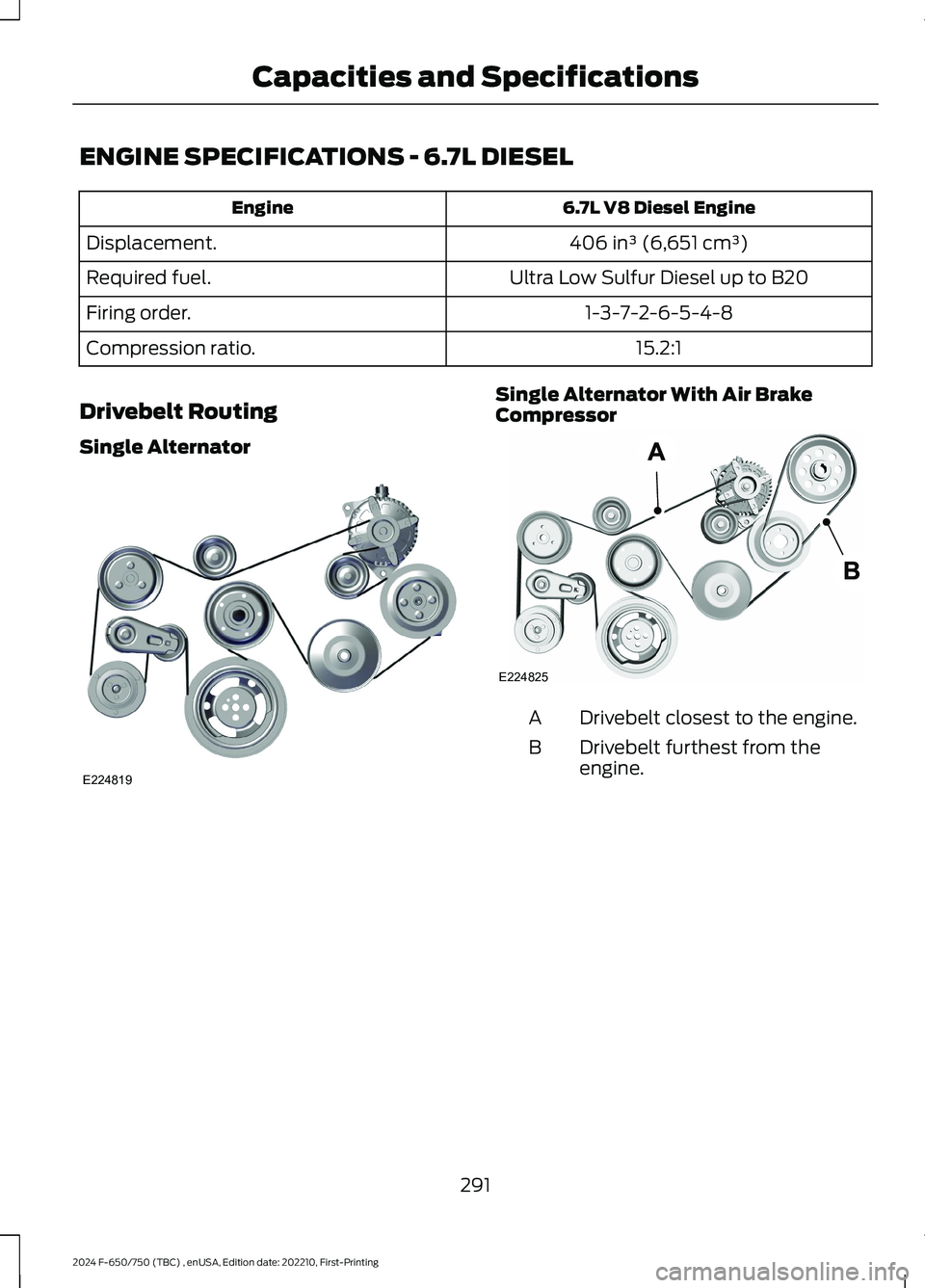
Drivebelt Routing
Single Alternator
Single Alternator With Air BrakeCompressor
Drivebelt closest to the engine.A
Drivebelt furthest from theengine.B
291
2024 F-650/750 (TBC) , enUSA, Edition date: 202210, First-PrintingCapacities and SpecificationsE224819 E224825
Page 296 of 386
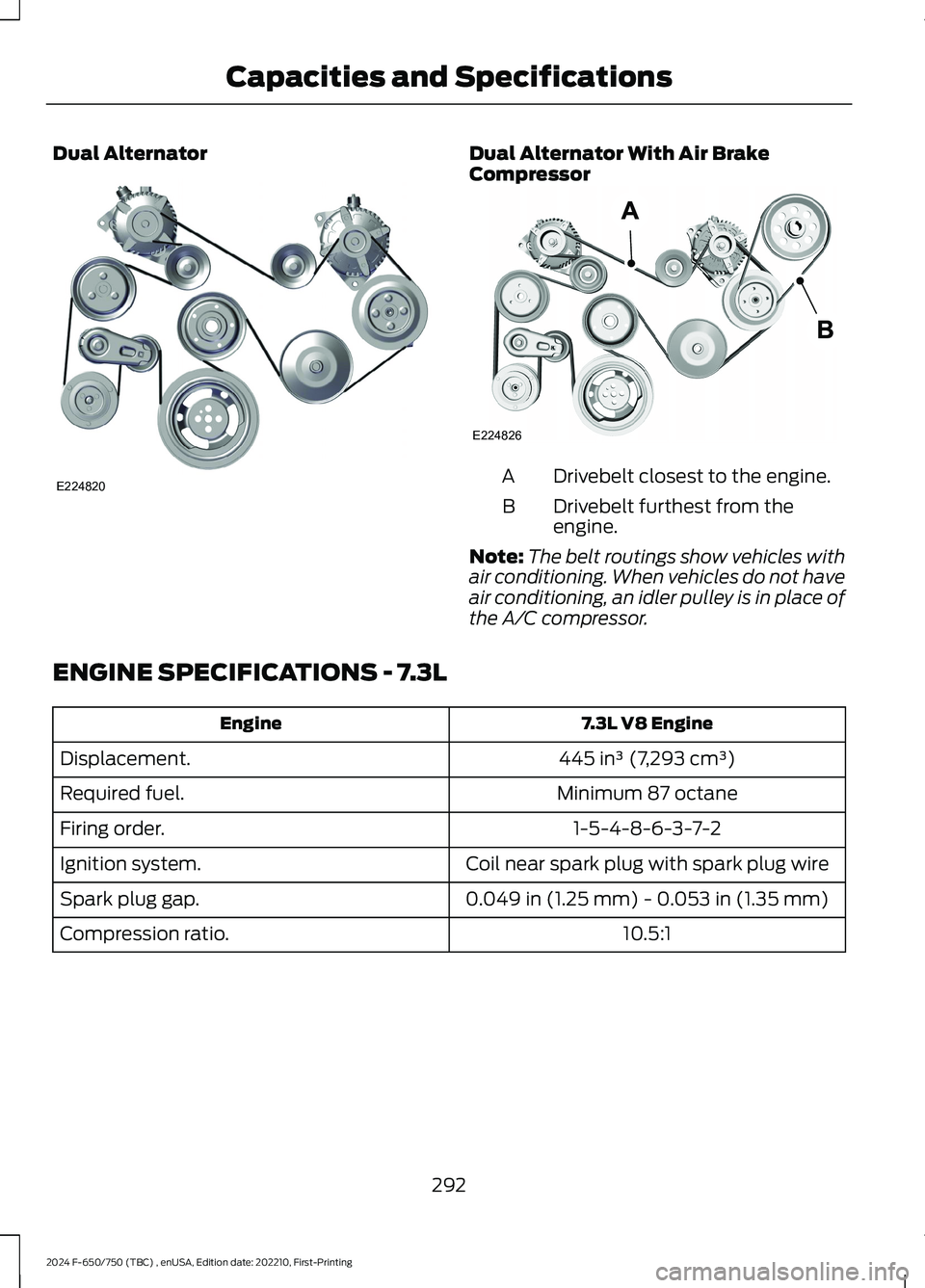
Dual AlternatorDual Alternator With Air BrakeCompressor
Drivebelt closest to the engine.A
Drivebelt furthest from theengine.B
Note:The belt routings show vehicles withair conditioning. When vehicles do not haveair conditioning, an idler pulley is in place ofthe A/C compressor.
ENGINE SPECIFICATIONS - 7.3L
7.3L V8 EngineEngine
445 in³ (7,293 cm³)Displacement.
Minimum 87 octaneRequired fuel.
1-5-4-8-6-3-7-2Firing order.
Coil near spark plug with spark plug wireIgnition system.
0.049 in (1.25 mm) - 0.053 in (1.35 mm)Spark plug gap.
10.5:1Compression ratio.
292
2024 F-650/750 (TBC) , enUSA, Edition date: 202210, First-PrintingCapacities and SpecificationsE224820 E224826
Page 300 of 386

BULB SPECIFICATION CHART
Replacement bulbs are specified in thechart below. Headlamp bulbs must bemarked with an authorized “D.O.T.” for
North America and an “E” for Europe toensure lamp performance, light brightnessand pattern and safe visibility. The correctbulbs will not damage the lamp assemblyor void the lamp assembly warranty andwill provide quality bulb illumination time.
Trade nameNumber of BulbsFunction
H13/90082Headlamps
W5W2Side marker lamp - front
3157NA2Park/Turn lamp- front
31572Tail/stop/turn/side marker
31572Reverse
31571License plate lamp
9121High-mount brake lamp
12V6W2Map lamp
5783Dome/reading lamps
28252Interior visor lamp
28252Mirror turn signal
28252Mirror clearance lamp
1945Front clearance lamps andfront identification lamps
Note:To replace instrument panel lights,see an authorized dealer.
ENGINE OIL CAPACITY AND
SPECIFICATION - 6.7L DIESEL
Use oil that meets the definedspecification and viscosity grade.
If you do not use oil that meets the definedspecification and viscosity grade, it couldresult in:
•Component damage that your vehiclewarranty does not cover.
•Longer engine cranking periods.
•Increased emission levels.
•Reduced vehicle performance.
•Reduced fuel economy.
296
2024 F-650/750 (TBC) , enUSA, Edition date: 202210, First-PrintingCapacities and Specifications
Page 313 of 386
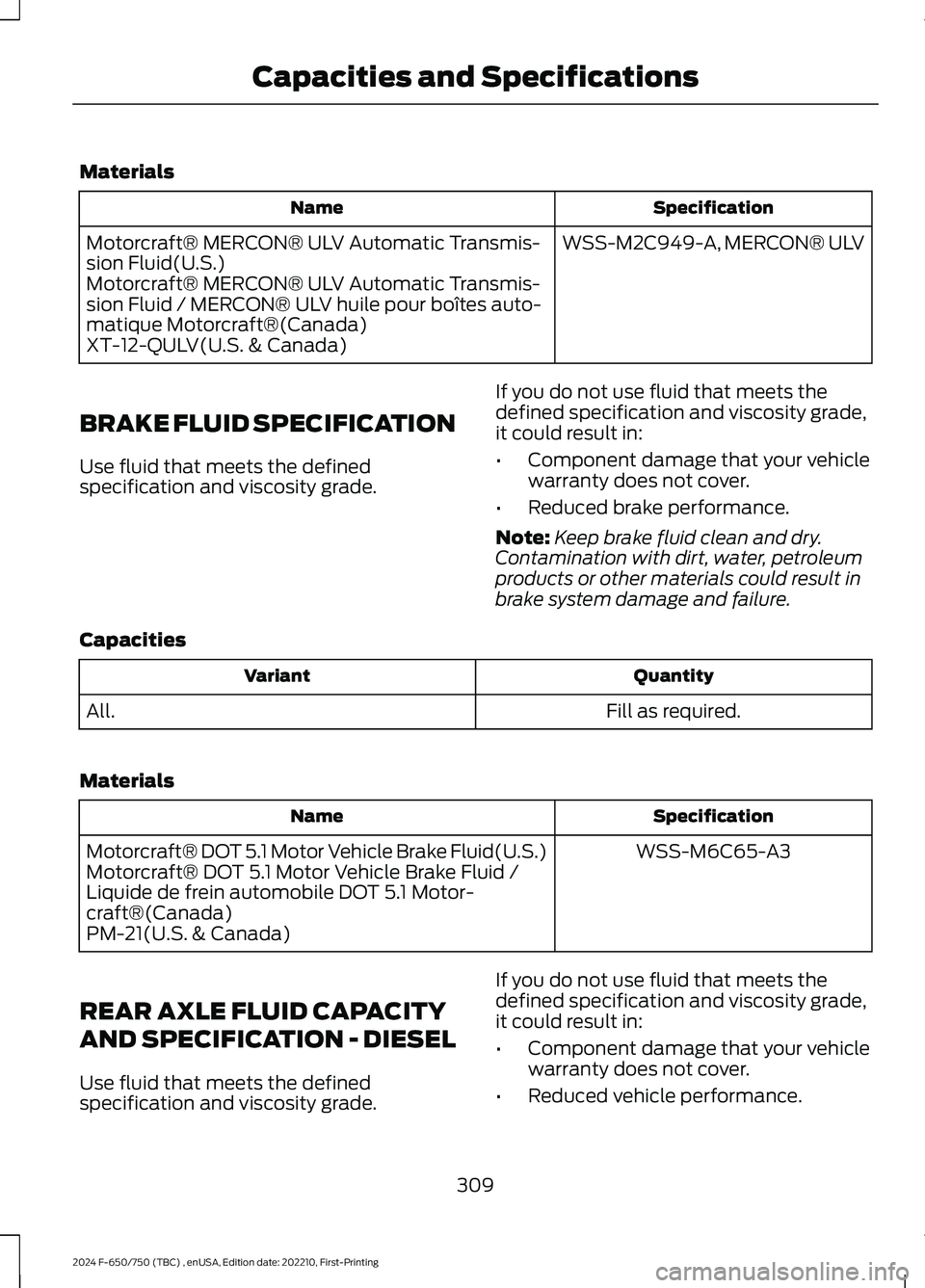
Materials
SpecificationName
WSS-M2C949-A, MERCON® ULVMotorcraft® MERCON® ULV Automatic Transmis-sion Fluid(U.S.)Motorcraft® MERCON® ULV Automatic Transmis-sion Fluid / MERCON® ULV huile pour boîtes auto-matique Motorcraft®(Canada)XT-12-QULV(U.S. & Canada)
BRAKE FLUID SPECIFICATION
Use fluid that meets the definedspecification and viscosity grade.
If you do not use fluid that meets thedefined specification and viscosity grade,it could result in:
•Component damage that your vehiclewarranty does not cover.
•Reduced brake performance.
Note:Keep brake fluid clean and dry.Contamination with dirt, water, petroleumproducts or other materials could result inbrake system damage and failure.
Capacities
QuantityVariant
Fill as required.All.
Materials
SpecificationName
WSS-M6C65-A3Motorcraft® DOT 5.1 Motor Vehicle Brake Fluid(U.S.)Motorcraft® DOT 5.1 Motor Vehicle Brake Fluid /Liquide de frein automobile DOT 5.1 Motor-craft®(Canada)PM-21(U.S. & Canada)
REAR AXLE FLUID CAPACITY
AND SPECIFICATION - DIESEL
Use fluid that meets the definedspecification and viscosity grade.
If you do not use fluid that meets thedefined specification and viscosity grade,it could result in:
•Component damage that your vehiclewarranty does not cover.
•Reduced vehicle performance.
309
2024 F-650/750 (TBC) , enUSA, Edition date: 202210, First-PrintingCapacities and Specifications
Page 316 of 386
HYDRAULIC POWER
STEERING FLUID CAPACITY
AND SPECIFICATION
Use oil and fluid that meets the definedspecification and viscosity grade.
If you do not use oil and fluid that meetsthe defined specification and viscositygrade, it could result in:
•Component damage that your vehiclewarranty does not cover.
•Longer engine cranking periods.
•Increased emission levels.
•Reduced engine performance.
•Reduced fuel economy.
•Reduced brake performance.
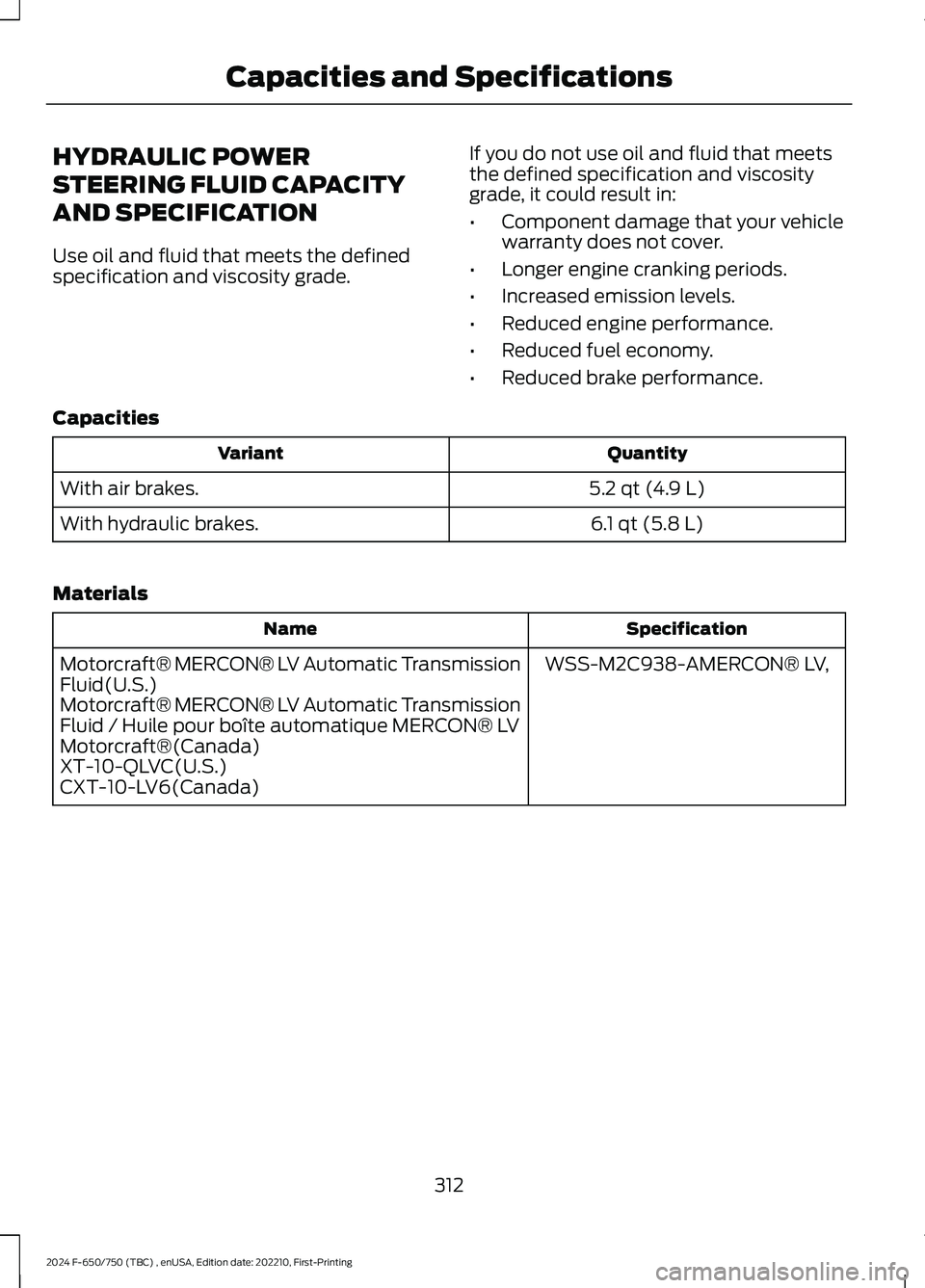
Capacities
QuantityVariant
5.2 qt (4.9 L)With air brakes.
6.1 qt (5.8 L)With hydraulic brakes.
Materials
SpecificationName
WSS-M2C938-AMERCON® LV,Motorcraft® MERCON® LV Automatic TransmissionFluid(U.S.)Motorcraft® MERCON® LV Automatic TransmissionFluid / Huile pour boîte automatique MERCON® LVMotorcraft®(Canada)XT-10-QLVC(U.S.)CXT-10-LV6(Canada)
312
2024 F-650/750 (TBC) , enUSA, Edition date: 202210, First-PrintingCapacities and Specifications