2024 FORD E SERIES wheel
[x] Cancel search: wheelPage 210 of 303

WARNING: When inflatingthe tire for mounting pressuresup to 20 psi (1.38 bar) greaterthan the maximum pressure onthe tire sidewall, the followingprecautions must be taken toprotect the person mounting thetire:
•Make sure that you have thecorrect tire and wheel size.
•Lubricate the tire bead andwheel bead seat area again.
•Stand at a minimum of 12 ft(3.6 m) away from the wheeland tire assembly.
•Use both eye and earprotection.
Important: Remember to replacethe wheel valve stems when theroad tires are replaced on yourvehicle
The two front tires or two rear tiresshould generally be replaced as apair.
The tire pressure sensors mountedin the wheels are not designed tobe used in aftermarket wheels.
The use of wheels or tires not
recommended by Ford MotorCompany may affect theoperation of your tire pressuremonitoring system.
If the tire pressure monitoringsystem indicator is flashing, thesystem is malfunctioning. Yourreplacement tire might beincompatible with your tirepressure monitoring system, orsome component of the systemmay be damaged.
Replacing a Tire That isGreenhouse Gas Certified
The tires installed on this vehicleat the factory as originalequipment are certified forGreenhouse Gas and FuelEfficiency regulations.Replacement tires must be ofequal or lower rolling resistancelevel (TRRL or Crr). Consult withyour tire supplier(s) forappropriate replacement tires.
Safety Practices
WARNING: If your vehicleis stuck in snow, mud or sand, donot rapidly spin the tires;spinning the tires can tear thetire and cause an explosion. Atire can explode in as little asthree to five seconds.
WARNING: Do not spin thewheels at over 34 mph(55 km/h). The tires may fail andinjure a passenger or bystander.
206
2024 E-Series (TE4) Canada/United States of America, enUSA, Edition date: 202210, First-PrintingWheels and Tires
Page 211 of 303

HIGH SPEED DRIVING CAN BEDANGEROUS
Correct inflation pressure isespecially important. However, athigh speeds, even with the correctinflation pressure, a road hazardfor example is more difficult toavoid and if contact is made, hasa greater chance of causing tiredamage than at a lower speed.Moreover, driving at high speedreduces the reaction timeavailable to avoid accidents andbring your vehicle to a safe stop.
If you see any damage to a tire orwheel, replace it with the spare atonce and visit a participating TireRetailer.
Exceeding the maximum speedsshown on the following page foreach type of tire will cause the tireto build up excessive heat whichcan cause tire damage that couldresult in sudden tire destructionand rapid air loss. Failure tocontrol a vehicle when one ormore tires experience a sudden airloss can lead to an accident.
In any case, you should notexceed reasonable speeds asindicated by the legal limitsand driving conditions.
DO NOT OVERLOAD: DRIVINGON ANY OVERLOADED TIRE ISDANGEROUS
The maximum load rating of yourtires is molded on the tire sidewall.Do not exceed this rating. Followthe loading instructions of themanufacturer of your vehicle andthis will ensure that your tires arenot overloaded. Tires which areloaded beyond their maximumallowable loads for the particularapplication will build up excessiveheat that may result in sudden tiredestruction. Do not exceed thegross axle weight rating for anyaxle on your vehicle.
TIRE ALTERATIONS
Do not make or allow to be made
any alterations on your tires.Alterations may prevent properperformance, leading to tiredamage which can result in anaccident. Tires which becomeunserviceable due to alterationssuch as truing, whitewall inlays,addition of balancing or sealantliquids, or the use of tire dressingcontaining petroleum distillatesare excluded from warrantycoverage.
207
2024 E-Series (TE4) Canada/United States of America, enUSA, Edition date: 202210, First-PrintingWheels and Tires
Page 212 of 303

REPAIRS - WHEREVERPOSSIBLE, SEE YOUR TIRERETAILER AT ONCE
If any tire sustains a puncture,have the tire demounted andthoroughly inspected by a tireretailer for possible damage thatmay have occurred. A tread areapuncture in any passenger or lighttruck tire can be repaired providedthat the puncture hole is not morethan 1/4” in diameter, not morethan one radial cable per casingply is damaged, and the tire hasnot been damaged further by thepuncturing object or by runningunderinflated. Tire puncturesconsistent with these guidelinesshould only be repaired byfollowing the US TireManufacturers Association(USTMA) recommended repairprocedures. Plug-only repairsdone on-the-wheel are consideredimproper and therefore, notrecommended. Such repairs arenot reliable and may cause furtherdamage to the tire.
STORAGE
Tires contain waxes andemollients to protect their outersurfaces from ozone and weatherchecking. As the tire rolls andflexes, the waxes and emollientscontinually migrate to the surface,replenishing this protectionthroughout the normal use of thetire. Consequently, when tires situnused for long periods of time (amonth or more) their surfaces
become dry and more susceptibleto ozone and weather checkingand the casing becomessusceptible to flat spotting.Forthis reason, tires should alwaysbe stored in a cool, dry, clean,indoor environment. If storageis for one month or more,eliminate the weight from thetires by raising the vehicle or byremoving the tires from thevehicle. Failure to store tires inaccordance with theseinstructions could result indamage to your tires orpremature aging of the tiresand sudden tire failure.
When tires are stored, be sure theyare placed away from sources ofheat and ozone such as directsunlight, hot pipes and electricgenerators. Be sure that surfaceson which tires are stored are cleanand free from grease, gasoline orother substances, which coulddeteriorate the rubber. Failure tostore tires in accordance withthese instructions could result indamage to your tires or prematureaging of the tires and sudden tirefailure.
208
2024 E-Series (TE4) Canada/United States of America, enUSA, Edition date: 202210, First-PrintingWheels and Tires
Page 213 of 303

FOLLOW THESE MOUNTINGRECOMMENDATIONS
Tire changing can be dangerousand must be done byprofessionally trained personsusing proper tools andprocedures as specified by theUS Tire ManufacturersAssociation (USTMA). Singleor dual assemblies must becompletely deflated beforedemounting.
Your tires should be mounted onwheels of correct size and typeand which are in good, cleancondition. Wheels that are bent,chipped, rusted (steel wheels) orcorroded (alloy wheels) maycause tire damage. The inside ofthe tire must be free from foreignmaterial. Have your retailer checkthe wheels before mounting newtires. Mismatched tires and rimscan explode during mounting.Also, mismatched tires and rimscan result in dangerous tire failureon the road. If a tire is mounted byerror on the wrong-sized rim, donot remount it on the proper rim -scrap it. It may have beendamaged internally (which is notexternally visible) by having beendangerously stretched and couldfail on the highway.
Old valves may leak. When newtubeless tires are mounted,have new valves of the correcttype installed. Tubeless tiresmust only be mounted onwheels designed for tubelesstires i.e., wheels which havesafety humps or ledges.
It is recommended that you haveyour tires and wheels balanced.Tires and wheels, which are notbalanced, may cause steeringdifficulties, a bumpy ride, andirregular tire wear.
Be sure that all your valveshave suitable valve caps. Thevalve cap is the primary sealagainst air loss.
TEMPORARY SPARE TIRES
When using any temporary sparetire, be sure to follow the vehiclemanufacturer’s instructions.
REMEMBER... TO AVOIDDAMAGE TO YOUR TIRES ANDPOSSIBLE ACCIDENT:
•CHECK TIRE PRESSURE ATLEAST ONCE EACH MONTHWHEN TIRES ARE COLD ANDBEFORE LONG TRIPS.
•DO NOTUNDERINFLATE/OVERINFLATE.
•DO NOT OVERLOAD.
•DRIVE AT MODERATESPEEDS, OBSERVE LEGALLIMITS.
209
2024 E-Series (TE4) Canada/United States of America, enUSA, Edition date: 202210, First-PrintingWheels and Tires
Page 214 of 303

•AVOID DRIVING OVERPOTHOLES, OBSTACLES,CURBS OR EDGES OFPAVEMENT.
•AVOID EXCESSIVE WHEELSPINNING.
•IF YOU SEE ANY DAMAGE TOA TIRE, REPLACE WITH THESPARE AND VISIT ANYAUTHORIZED RETAILER ATONCE.
•IF YOU HAVE ANYQUESTIONS, CONTACT YOURAUTHORIZED RETAILER.
Driving habits have a great dealto do with your tire mileage andsafety.
*Observe posted speed limits
*Avoid fast starts, stops and turns
*Avoid potholes and objects onthe road
*Do not run over curbs or hit thetire against a curb when parking
Highway Hazards
No matter how carefully you drivethere’s always the possibility thatyou may eventually have a flat tireon the highway. Drive slowly to theclosest safe area out of traffic.This may further damage the flattire, but your safety is moreimportant.
If you feel a sudden vibration orride disturbance when driving, oryou suspect your tire or vehiclehas been damaged, immediatelyreduce your speed. Drive withcaution until you can safely pulloff the road. Stop and inspect thetires for damage. If a tire isunder-inflated or damaged,deflate it, remove wheel andreplace it with your spare tire andwheel. If you cannot detect acause, have the vehicle towed tothe nearest repair facility or tiredealer to have the vehicleinspected.
Tire and Wheel Alignment
A bad jolt from hitting a curb orpothole can cause the front endof your vehicle to become
misaligned or cause damage toyour tires. If your vehicle seems topull to one side when you’redriving, the wheels may be out ofalignment. Have an authorizeddealer check the wheel alignmentperiodically.
Wheel misalignment in the frontor the rear can cause uneven andrapid treadwear of your tires andshould be corrected by anauthorized dealer. Front-wheeldrive vehicles and those with anindependent rear suspension mayrequire alignment of all fourwheels.
The tires should also be balancedperiodically. An unbalanced tireand wheel assembly may result inirregular tire wear.
210
2024 E-Series (TE4) Canada/United States of America, enUSA, Edition date: 202210, First-PrintingWheels and Tires
Page 215 of 303

Tire Rotation
WARNING: If the tire labelshows different tire pressures forthe front and rear tires and thevehicle has a tire pressuremonitoring system, then youneed to update the settings forthe system sensors. Alwaysperform the system resetprocedure after tire rotation. Ifyou do not reset the system, itmay not provide a low tirepressure warning whennecessary.
Note:If your tires show unevenwear ask an authorized dealer tocheck for and correct any wheelmisalignment, tire imbalance ormechanical problem involvedbefore tire rotation.
Note:Your vehicle may beequipped with a dissimilar sparewheel and tire assembly. Adissimilar spare wheel and tireassembly is defined as a sparewheel and tire assembly that isdifferent in brand, size orappearance from the road tires andwheels. If you have a dissimilarspare wheel and tire assembly it isintended for temporary use onlyand should not be used in a tirerotation.
Note:After having your tiresrotated, inflation pressure must bechecked and adjusted to the
vehicle requirements.
Rotating your tires at therecommended interval (asindicated in the ScheduledMaintenance chapter) helps yourtires wear more evenly, providingbetter tire performance and longertire life. Sometime irregular tirewear can be corrected by rotatingthe tires.
Rear-wheel drive vehicles andfour-wheel drive vehicles (fronttires at left of diagram).
211
2024 E-Series (TE4) Canada/United States of America, enUSA, Edition date: 202210, First-PrintingWheels and TiresE142548
Page 216 of 303
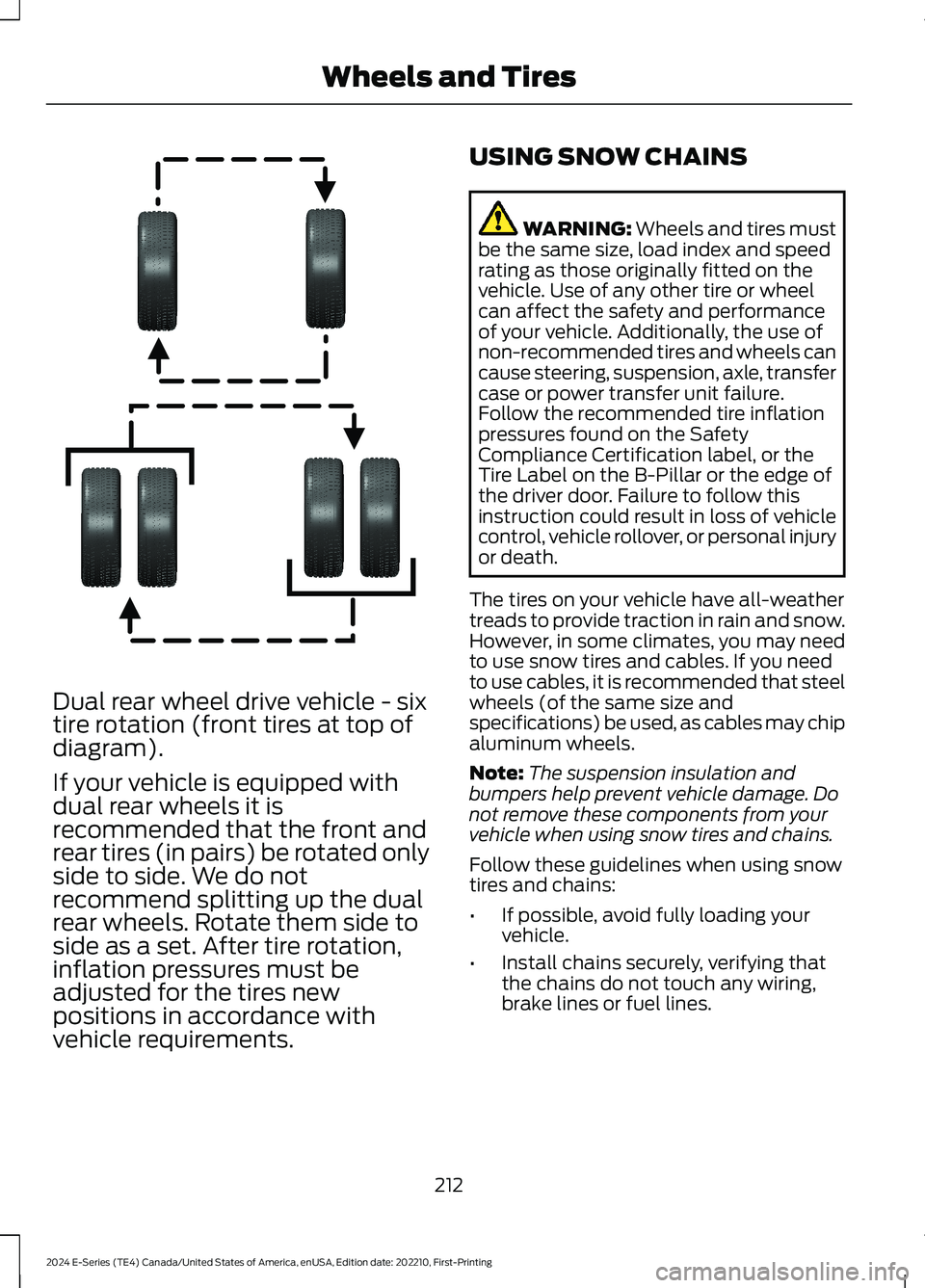
Dual rear wheel drive vehicle - sixtire rotation (front tires at top ofdiagram).
If your vehicle is equipped withdual rear wheels it isrecommended that the front andrear tires (in pairs) be rotated onlyside to side. We do notrecommend splitting up the dualrear wheels. Rotate them side toside as a set. After tire rotation,inflation pressures must beadjusted for the tires newpositions in accordance withvehicle requirements.
USING SNOW CHAINS
WARNING: Wheels and tires mustbe the same size, load index and speedrating as those originally fitted on thevehicle. Use of any other tire or wheelcan affect the safety and performanceof your vehicle. Additionally, the use ofnon-recommended tires and wheels cancause steering, suspension, axle, transfercase or power transfer unit failure.Follow the recommended tire inflationpressures found on the SafetyCompliance Certification label, or theTire Label on the B-Pillar or the edge ofthe driver door. Failure to follow thisinstruction could result in loss of vehiclecontrol, vehicle rollover, or personal injuryor death.
The tires on your vehicle have all-weathertreads to provide traction in rain and snow.However, in some climates, you may needto use snow tires and cables. If you needto use cables, it is recommended that steelwheels (of the same size andspecifications) be used, as cables may chipaluminum wheels.
Note:The suspension insulation andbumpers help prevent vehicle damage. Donot remove these components from yourvehicle when using snow tires and chains.
Follow these guidelines when using snowtires and chains:
•If possible, avoid fully loading yourvehicle.
•Install chains securely, verifying thatthe chains do not touch any wiring,brake lines or fuel lines.
212
2024 E-Series (TE4) Canada/United States of America, enUSA, Edition date: 202210, First-PrintingWheels and TiresE166988
Page 217 of 303

•Drive cautiously. If you hear the chainsrub or bang against your vehicle, stopand retighten the chains. If this doesnot work, remove the chains to preventdamage to your vehicle.
•Remove the snow chains when theyare no longer needed. Do not use snowchains on dry roads.
Please contact your upfitter for approvedsnow chain types/sizes and otherrecommendations for snow chain use.
TIRE PRESSURE MONITORING
SYSTEM (IF EQUIPPED)
WARNING: The tire pressuremonitoring system is not a substitute formanually checking tire pressures. Youshould periodically check tire pressuresusing a pressure gauge. Failure tocorrectly maintain tire pressures couldincrease the risk of tire failure, loss ofcontrol, vehicle rollover and personalinjury.
WARNING: Changes ormodifications not expressively approvedby the party responsible for compliancecould void the user's authority to operatethe equipment. The term "IC:" before theradio certification number only signifiesthat Industry Canada technicalspecifications were met.
This device complies with Part 15 of theFCC Rules and with License exempt RSSStandards of Industry Canada. Operationis subject to the following two conditions:
1.This device may not cause harmfulinterference.
2.This device must accept anyinterference received, includinginterference that may cause undesiredoperation.
Each tire, including the spare, ifprovided, should be checkedmonthly when cold and inflatedto the inflation pressure recommended bythe vehicle manufacturer on the vehicleplacard or tire inflation pressure label. Ifyour vehicle has tires of a different sizethan the size indicated on the vehicleplacard or tire inflation pressure label, youshould determine the proper tire inflationpressure for those tires.
As an added safety feature, your vehiclehas been equipped with a Tire PressureMonitoring System (TPMS) thatilluminates a low tire pressure telltalewhen one or more of your tires issignificantly under-inflated. Accordingly,when the low tire pressure telltaleilluminates, you should stop and checkyour tires as soon as possible, and inflatethem to the proper pressure. Driving on asignificantly under-inflated tire causes thetire to overheat and can lead to tire failure.Under-inflation also reduces fuel efficiencyand tire tread life, and may affect thevehicle’s handling and stopping ability.
Please note that the TPMS is not asubstitute for proper tire maintenance, andit is the driver's responsibility to maintaincorrect tire pressure, even if under-inflationhas not reached the level to triggerillumination of the TPMS low tire pressuretelltale.
Your vehicle has a TPMS malfunctionindicator to indicate when the system isnot operating properly. The TPMSmalfunction indicator is combined with thelow tire pressure telltale. When the systemdetects a malfunction, the telltale flashesfor approximately one minute and thenremains continuously illuminated. Thissequence continues upon subsequentvehicle start-ups as long as themalfunction exists.
213
2024 E-Series (TE4) Canada/United States of America, enUSA, Edition date: 202210, First-PrintingWheels and TiresE139232