2024 CHEVROLET CORVETTE engine coolant
[x] Cancel search: engine coolantPage 260 of 362
Chevrolet Corvette Owner Manual (GMNA-Localizing-U.S./Canada/Mexico-
17272984) - 2024 - CRC - 2/20/23
Vehicle Care 259
How to Add Coolant to the Coolant
Surge Tank
{Warning
Spilling coolant on hot engine parts can
burn you. Coolant contains ethylene
glycol and it will burn if the engine parts
are hot enough.
{Warning
Steam and scalding liquids from a hot
cooling system are under pressure.
Turning the pressure cap, even a little,
can cause them to come out at high
speed and you could be burned. Never
turn the cap when the cooling system,
including the pressure cap, is hot. Wait
for the cooling system and pressure cap
to cool.
If coolant is needed, be sure the cooling
system is cool, then add the proper
DEX-COOL coolant mixture directly to the
surge tank. 1. Open the Hatch/Trunk. See
Hatch (Trunk)
0 20.
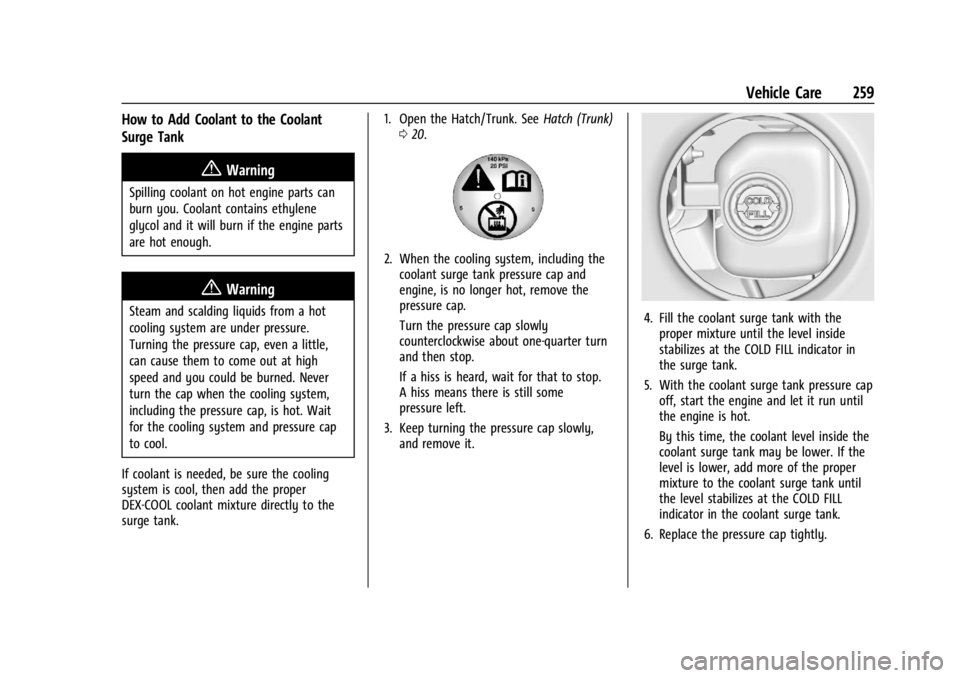
2. When the cooling system, including the
coolant surge tank pressure cap and
engine, is no longer hot, remove the
pressure cap.
Turn the pressure cap slowly
counterclockwise about one-quarter turn
and then stop.
If a hiss is heard, wait for that to stop.
A hiss means there is still some
pressure left.
3. Keep turning the pressure cap slowly, and remove it.
4. Fill the coolant surge tank with theproper mixture until the level inside
stabilizes at the COLD FILL indicator in
the surge tank.
5. With the coolant surge tank pressure cap off, start the engine and let it run until
the engine is hot.
By this time, the coolant level inside the
coolant surge tank may be lower. If the
level is lower, add more of the proper
mixture to the coolant surge tank until
the level stabilizes at the COLD FILL
indicator in the coolant surge tank.
6. Replace the pressure cap tightly.
Page 261 of 362
Chevrolet Corvette Owner Manual (GMNA-Localizing-U.S./Canada/Mexico-
17272984) - 2024 - CRC - 2/20/23
260 Vehicle Care
7. Verify coolant level after the engine isshut off and the coolant is cold.
If necessary, repeat coolant fill procedure
Steps 3−7.
If the coolant still is not at the proper
level when the system cools down again,
see your dealer.
Caution
If the pressure cap is not tightly installed,
coolant loss and engine damage may
occur. Be sure the cap is properly and
tightly secured.
Cooling System (Electrified
Propulsion)
The E-Ray is equipped with Electrified
Propulsion and cooling systems for the
Traction Power Inverter Module (TPIM) and
the High Voltage Battery located in the
Engine Compartment, see Engine
Compartment Overview 0238. The TPIM and
the high voltage battery cooling system
reservoirs have tamper- resistant pressure
caps. The coolant should only be serviced by
a qualified technician.
Power Electronic/Traction Power Inverter
Module (TPIM) Cooling System
The Power Electronic Cooling System
reservoir is located in under the front hood.
Rechargeable Energy Storage System
(RESS)/High Voltage Battery Cooling
System
The High Voltage Battery Cooling System
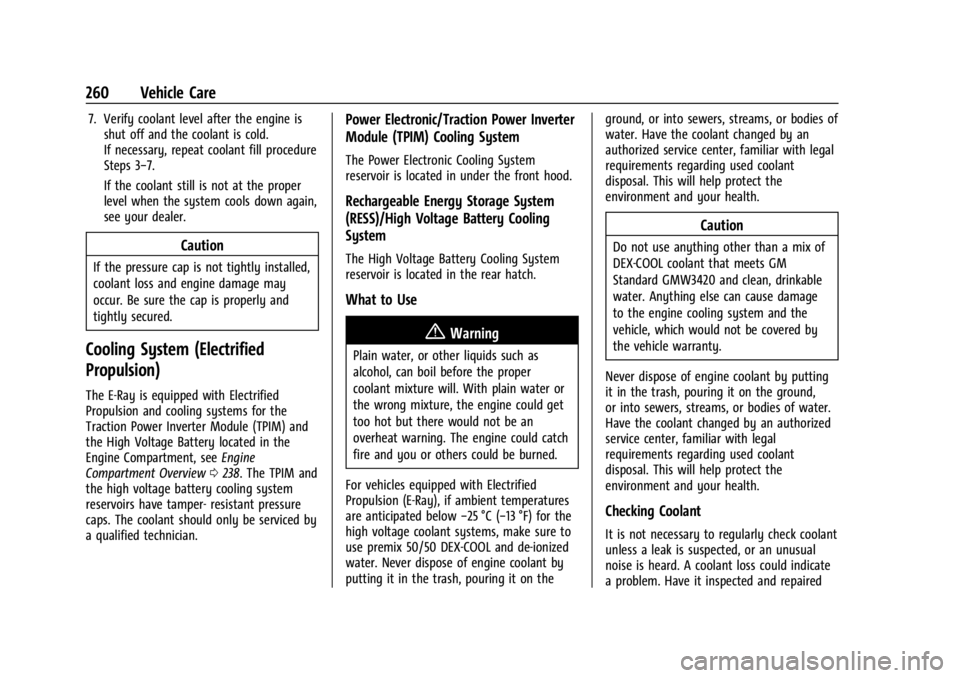
reservoir is located in the rear hatch.
What to Use
{Warning
Plain water, or other liquids such as
alcohol, can boil before the proper
coolant mixture will. With plain water or
the wrong mixture, the engine could get
too hot but there would not be an
overheat warning. The engine could catch
fire and you or others could be burned.
For vehicles equipped with Electrified
Propulsion (E-Ray), if ambient temperatures
are anticipated below −25 °C (−13 °F) for the
high voltage coolant systems, make sure to
use premix 50/50 DEX-COOL and de-ionized
water. Never dispose of engine coolant by
putting it in the trash, pouring it on the ground, or into sewers, streams, or bodies of
water. Have the coolant changed by an
authorized service center, familiar with legal
requirements regarding used coolant
disposal. This will help protect the
environment and your health.
Caution
Do not use anything other than a mix of
DEX-COOL coolant that meets GM
Standard GMW3420 and clean, drinkable
water. Anything else can cause damage
to the engine cooling system and the
vehicle, which would not be covered by
the vehicle warranty.
Never dispose of engine coolant by putting
it in the trash, pouring it on the ground,
or into sewers, streams, or bodies of water.
Have the coolant changed by an authorized
service center, familiar with legal
requirements regarding used coolant
disposal. This will help protect the
environment and your health.
Checking Coolant
It is not necessary to regularly check coolant
unless a leak is suspected, or an unusual
noise is heard. A coolant loss could indicate
a problem. Have it inspected and repaired
Page 262 of 362
Chevrolet Corvette Owner Manual (GMNA-Localizing-U.S./Canada/Mexico-
17272984) - 2024 - CRC - 2/20/23
Vehicle Care 261
by your dealer. The high voltage cooling
system reservoirs have tamper- resistant
pressure caps. The coolant should only be
serviced by a qualified technician.
Engine Overheating
The vehicle has several indicators to warn of
engine overheating.
There is an engine coolant temperature
gauge on the instrument cluster. SeeEngine
Coolant Temperature Gauge 087. The
vehicle may also display a message on the
Driver Information Center (DIC).
If the decision is made not to lift the hatch
but to get service help right away, see
Roadside Assistance Program 0332.
If the decision is made to lift the hatch,
make sure the vehicle is parked on a level
surface.
Then check to see if the engine cooling fans
are running. There are two cooling fans
located in the front (one at each corner) and
two cooling fans in the rear (one on each
side of the engine). If the engine is
overheating, the fans should be running.
If they are not, do not continue to run the
engine, and have the vehicle serviced.
Caution
Do not run the engine if there is a leak
in the engine cooling system. This can
cause a loss of all coolant and can
damage the system and vehicle. Have
any leaks fixed right away.
If Steam Is Coming from the Engine
{Warning
Steam and scalding liquids from a hot
cooling system are under pressure.
Turning the pressure cap, even a little,
can cause them to come out at high
speed and you could be burned. Never
turn the cap when the cooling system,
including the pressure cap, is hot. Wait
for the cooling system and pressure cap
to cool.
If Steam Is Coming from the Engine
Compartment with no Overheat Warning
Water from rain and car washes could enter
the engine compartment and contact hot
surfaces. If steam is coming from the engine
compartment with no accompanying
overheat warning, no service is needed.
If No Steam Is Coming from the Engine
If an engine overheat warning is displayed
but no steam can be seen or heard, the
problem may not be too serious. Sometimes
the engine can get a little too hot when the
vehicle:
.Climbs a long hill on a hot day.
.Stops after high-speed driving.
.Idles for long periods in traffic.
If the overheat warning is displayed with no
sign of steam: 1. Turn the air conditioning off.
2. Turn the heater on to the highest temperature and to the highest fan
speed. Open the windows as necessary.
3. When it is safe to do so, pull off the road, shift to P (Park) or N (Neutral), and
let the engine idle.
If the engine coolant temperature gauge is
no longer in the shaded area or an overheat
warning no longer displays, the vehicle can
be driven. Continue to drive the vehicle
slowly for about 10 minutes. Keep a safe
vehicle distance from the vehicle in front.
If the warning does not come back on,
Page 263 of 362
Chevrolet Corvette Owner Manual (GMNA-Localizing-U.S./Canada/Mexico-
17272984) - 2024 - CRC - 2/20/23
262 Vehicle Care
continue to drive normally and have the
cooling system checked for proper fill and
function.
If the warning continues, pull over safely,
and park the vehicle right away.
If there is no sign of steam, idle the engine
for three minutes while parked. If the
warning is still displayed, turn off the
engine until it cools down.
Washer Fluid
What to Use
When the vehicle needs windshield washer
fluid, be sure to read the manufacturer
instructions before use. If the vehicle will be
operating in an area where the temperature
may fall below freezing, use a fluid that has
sufficient protection against freezing.
Adding Washer Fluid
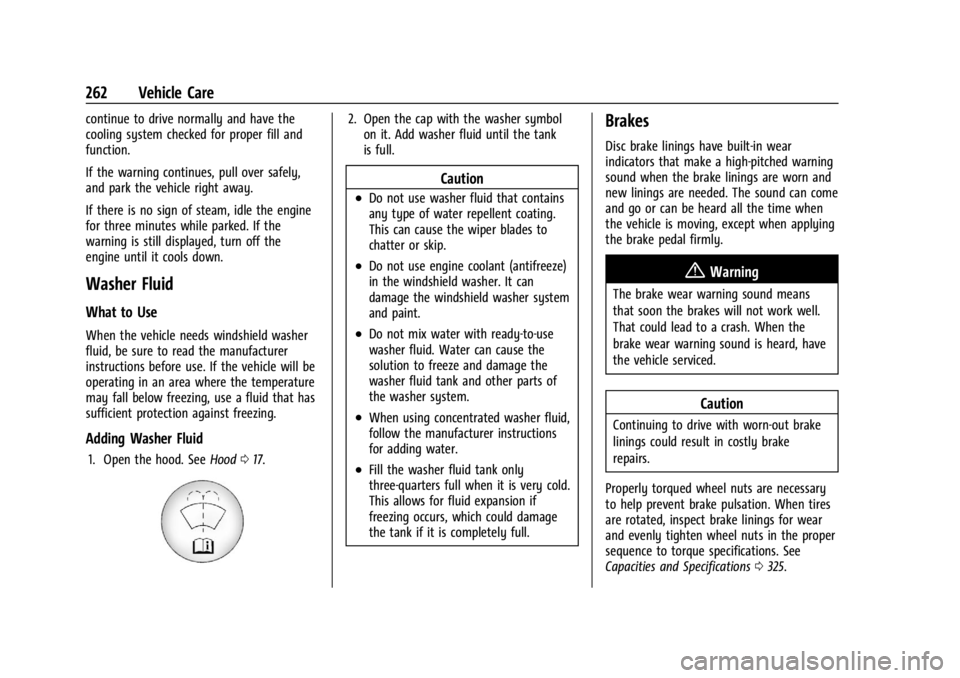
1. Open the hood. SeeHood017.
2. Open the cap with the washer symbol
on it. Add washer fluid until the tank
is full.
Caution
.Do not use washer fluid that contains
any type of water repellent coating.
This can cause the wiper blades to
chatter or skip.
.Do not use engine coolant (antifreeze)
in the windshield washer. It can
damage the windshield washer system
and paint.
.Do not mix water with ready-to-use
washer fluid. Water can cause the
solution to freeze and damage the
washer fluid tank and other parts of
the washer system.
.When using concentrated washer fluid,
follow the manufacturer instructions
for adding water.
.Fill the washer fluid tank only
three-quarters full when it is very cold.
This allows for fluid expansion if
freezing occurs, which could damage
the tank if it is completely full.
Brakes
Disc brake linings have built-in wear
indicators that make a high-pitched warning
sound when the brake linings are worn and
new linings are needed. The sound can come
and go or can be heard all the time when
the vehicle is moving, except when applying
the brake pedal firmly.
{Warning
The brake wear warning sound means
that soon the brakes will not work well.
That could lead to a crash. When the
brake wear warning sound is heard, have
the vehicle serviced.
Caution
Continuing to drive with worn-out brake
linings could result in costly brake
repairs.
Properly torqued wheel nuts are necessary
to help prevent brake pulsation. When tires
are rotated, inspect brake linings for wear
and evenly tighten wheel nuts in the proper
sequence to torque specifications. See
Capacities and Specifications 0325.
Page 279 of 362

Chevrolet Corvette Owner Manual (GMNA-Localizing-U.S./Canada/Mexico-
17272984) - 2024 - CRC - 2/20/23
278 Vehicle Care
FusesUsage
20 Sensing and Diagnostic Module/Inside Rear
View Mirror
21 Exhaust Valve Solenoid
22 Fuel Pump/Fuel Tank Zone Module 1
23 Tonneau Left
24 Tonneau Right 25 Convertible Top Right
26 Convertible Top Left 27 Electronic Suspension Control
28 Scavenge Coolant Pump Motor
29 CGM
30 O2 Sensor 31 O2 Sensor/Engine Oil/ Canister Purge/Active
Fuel Management
32 Ignition Even
33 Ignition Odd
34 Engine Control Module 1 Fuses
Usage
35 Engine Control Module/ Mass Air Flow Sensor/
O2 Sensor/Air
Conditioning
36 Power Front Closure Module/Front Camera
Module
37 Canister Vent
38 Latch Control Module
39 Right Window Switch/ Door Lock
40 Left Window Switch/ Door Lock
41 Pedestrian Friendly Alert Module/High
Voltage System Lock
Out Switch
42 Engine Control Module 2
43 Charged Air Cooler
44 Air Conditioning Compressor
45 Transmission Control Module
46 – Fuses
Usage
47 DC/DC Battery 1
48 DC/DC Battery 2
49 Auxiliary Cooling Fan Right
50 Virtual Key Back up Module
51 Starter Pinion
52 Auxiliary Pump
53 Starter Solenoid
54 Auxiliary Cooling Fan Left
55 Automatic Leveling Control
56 Energy Storage Coolant Pump/Power Electronics
Coolant Pump
57 Rear Window Defogger
58 –
59 Left/Right Window
60 Passenger Power Seat 61 Driver Power Seat
Page 318 of 362

Chevrolet Corvette Owner Manual (GMNA-Localizing-U.S./Canada/Mexico-
17272984) - 2024 - CRC - 2/20/23
Service and Maintenance 317
.When the REPLACE AT NEXT OIL CHANGE
message displays, the engine air filter
should be replaced at the next engine oil
change. When the REPLACE ENGINE AIR
FILTER SOON message displays, the
engine air filter should be replaced at the
earliest convenience. Reset the engine air
filter life system after the engine air filter
is replaced. SeeEngine Air Filter Life
System 0254.
.The initial transmission external canister
filter change must be performed at
12 000 km (7,500 mi). This service can be
complex. See your dealer.
Caution
The transmission external canister filter
must be changed at 12 000 km
(7,500 mile) during the break-in period.
Failure to replace the external canister
filter can cause damage to the
transmission and potentially void any
warranty.
Every 36 000 km (22,500 mi)
.Replace the passenger compartment air
filter. Or every 24 months, whichever
comes first. More frequent passenger
compartment air filter replacement may be needed if driving in areas with heavy
traffic, poor air quality, high dust levels,
or environmental allergens. Passenger
compartment air filter replacement may
also be needed if there is reduced airflow,
window fogging, or odors. Your GM
dealer can help determine when to
replace the filter.
.Change the dual clutch transmission
external canister filter. Check the
transmission fluid life percentage.
If the percentage is less than 10%, replace
the fluid and external canister filter.
Change the external canister filter every
36 000 km (22,500 mi) thereafter. This
service can be complex. See your dealer.
Every 72 000 km (45,000 mi)
.Change the transmission fluid and
external canister filter. Change the
external canister filter every 36 000 km
(22,500 mi) thereafter. This service can be
complex. See your dealer.
Or when the CHANGE TRANSMISSION
FLUID SOON message displays, change the
fluid and external canister filter within
the next 1 000 km (620 mi). Failure to
change the transmission fluid at required
intervals can lead to reduced transmission
performance. The transmission fluid must be changed at least every three years and
the Fluid Life System must be reset. Your
dealer has trained service technicians who
will change the fluid and reset the
system. If the system is ever reset
accidentally, the fluid must be changed at
72 000 km (45,000 mi) since the last fluid
change. See
Dual Clutch Transmission
Fluid Life System 0253.
Every 156 000 km (97,500 mi)
.Replace spark plugs. Inspect spark plug
wires and/or boots.
Every 161 000 km (100,000 mi)
.Replace hood and/or body lift support gas
struts. Or every 10 years, whichever
comes first. See Gas Strut(s)0270.
Every 240 000 km (150,000 mi)
.Drain and fill engine cooling system. Or
every six years, whichever comes first.
See Cooling System (Engine) 0257 or
Cooling System (Electrified Propulsion)
0 260.
.Drain and fill power electronic cooling
system and rechargeable energy storage
system coolant (E-Ray). Or every five
years, whichever comes first.
Page 321 of 362
Chevrolet Corvette Owner Manual (GMNA-Localizing-U.S./Canada/Mexico-
17272984) - 2024 - CRC - 2/20/23
320 Service and Maintenance
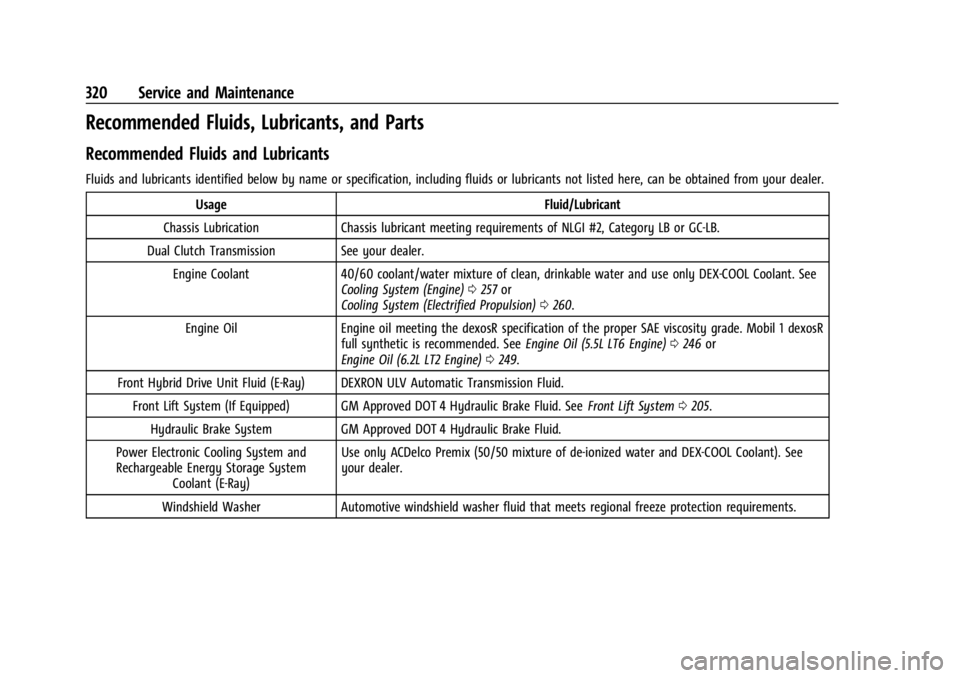
Recommended Fluids, Lubricants, and Parts
Recommended Fluids and Lubricants
Fluids and lubricants identified below by name or specification, including fluids or lubricants not listed here, can be obtained from your dealer.Usage Fluid/Lubricant
Chassis Lubrication Chassis lubricant meeting requirements of NLGI #2, Category LB or GC-LB.
Dual Clutch Transmission See your dealer. Engine Coolant 40/60 coolant/water mixture of clean, drinkable water and use only DEX-COOL Coolant. See Cooling System (Engine)0257 or
Cooling System (Electrified Propulsion) 0260.
Engine Oil Engine oil meeting the dexosR specification of the proper SAE viscosity grade. Mobil 1 dexosR full synthetic is recommended. See Engine Oil (5.5L LT6 Engine)0246 or
Engine Oil (6.2L LT2 Engine) 0249.
Front Hybrid Drive Unit Fluid (E-Ray) DEXRON ULV Automatic Transmission Fluid. Front Lift System (If Equipped) GM Approved DOT 4 Hydraulic Brake Fluid. See Front Lift System0205.
Hydraulic Brake System GM Approved DOT 4 Hydraulic Brake Fluid.
Power Electronic Cooling System and
Rechargeable Energy Storage System Coolant (E-Ray) Use only ACDelco Premix (50/50 mixture of de-ionized water and DEX-COOL Coolant). See
your dealer.
Windshield Washer Automotive windshield washer fluid that meets regional freeze protection requirements.
Page 352 of 362

Chevrolet Corvette Owner Manual (GMNA-Localizing-U.S./Canada/Mexico-
17272984) - 2024 - CRC - 2/20/23
Index 351
Child RestraintsInfants and Young Children . . . . . . . . . . . . . 63
Lower Anchors and Tethers for
Children . . . . . . . . . . . . . . . . . . . . . . . . . . . . . . . 67
Older Children . . . . . . . . . . . . . . . . . . . . . . . . . . 62
Securing . . . . . . . . . . . . . . . . . . . . . . . . . . . . . . . . 67
Systems . . . . . . . . . . . . . . . . . . . . . . . . . . . . . . . . 65
Circuit Breakers . . . . . . . . . . . . . . . . . . . . . . . . . . 273
Cleaning Exterior Care . . . . . . . . . . . . . . . . . . . . . . . . . . . 306
Interior Care . . . . . . . . . . . . . . . . . . . . . . . . . . . . 311
Climate Control Systems Dual Automatic . . . . . . . . . . . . . . . . . . . . . . . . 150
Clock . . . . . . . . . . . . . . . . . . . . . . . . . . . . . . . . . . . . . 76
Cluster, Instrument . . . . . . . . . . . . . . . . . . . . . . . .81
Collision Alert Forward (FCA) System . . . . . . . . . . . . . . . . . 218
Collision Damage Repair . . . . . . . . . . . . . . . . . 335
Compartment Underhood . . . . . . . . . . . . . . . . . . . . . . . . . . . . 235
Compartments
Storage . . . . . . . . . . . . . . . . . . . . . . . . . . . . . . . . . . 71
Compass . . . . . . . . . . . . . . . . . . . . . . . . . . . . . . . . . . 76
Competition Oriented Tires . . . . . . . . . . . . . . .281
Composite Materials . . . . . . . . . . . . . . . . . . . . . . 177
Connected Services Connections . . . . . . . . . . . . . . . . . . . . . . . . . . . 346
Diagnostics . . . . . . . . . . . . . . . . . . . . . . . . . . . . 348 Connected Services (cont'd)
Navigation . . . . . . . . . . . . . . . . . . . . . . . . . . . . . 346
Connections Connected Services . . . . . . . . . . . . . . . . . . . . 346
Control Hill Rollback . . . . . . . . . . . . . . . . . . . . . . . . . . . 196
Traction and Electronic Stability . . . . . . . 194
Control of a Vehicle . . . . . . . . . . . . . . . . . . . . . . 157
Controls Steering Wheel . . . . . . . . . . . . . . . . . . . . . . . . . 119
Convenience Net . . . . . . . . . . . . . . . . . . . . . . . . . . .73
Convertible Top . . . . . . . . . . . . . . . . . . . . . . . . . . . 34
Convex Mirrors . . . . . . . . . . . . . . . . . . . . . . . . . . . 24
Coolant Engine Temperature Gauge . . . . . . . . . . . . . 87
Engine Temperature Warning Light . . . . . 96
Cooling . . . . . . . . . . . . . . . . . . . . . . . . . . . . . . . . . . 150
Cooling System . . . . . . . . . . . . . . . . . . . . . 257, 260
Courtesy Lamps . . . . . . . . . . . . . . . . . . . . . . . . . . . 113
Courtesy Transportation Program . . . . . . . . 334
Cruise Control . . . . . . . . . . . . . . . . . . . . . . . . . . . . 212 Light . . . . . . . . . . . . . . . . . . . . . . . . . . . . . . . . . . . . 99
Cupholders . . . . . . . . . . . . . . . . . . . . . . . . . . . . . . . . 71
Customer Assistance Offices . . . . . . . . . . . . . . . . . . . . . . . . . . . . . . . . . 331
Text Telephone (TTY) Users . . . . . . . . . . . . 331
Customer Information Publications Ordering Information . . . . . 337 Customer Satisfaction Procedure . . . . . . . . . 329
Cybersecurity . . . . . . . . . . . . . . . . . . . . . . . . . . . . 339
D
Damage Repair, Collision . . . . . . . . . . . . . . . . . 335
Danger, Warning, and Caution . . . . . . . . . . . . . .2
Dashboard . . . . . . . . . . . . . . . . . . . . . . . . . . . . . . . . . 4
Data Collection
Infotainment System . . . . . . . . . . . . . . . . . . 340
OnStar . . . . . . . . . . . . . . . . . . . . . . . . . . . . . . . . . 340
Data Recorder Performance . . . . . . . . . . . . . . . . . . . . . . . . . . . 130
Data Recorders, Event . . . . . . . . . . . . . . . . . . . 339
Daytime Running Lamps (DRL) . . . . . . . . . . . . 111
Defensive Driving . . . . . . . . . . . . . . . . . . . . . . . . . 157
Delayed Locking . . . . . . . . . . . . . . . . . . . . . . . . . . .16
Destination . . . . . . . . . . . . . . . . . . . . . . . . . . . . . . . 127
Diagnostics Connected Services . . . . . . . . . . . . . . . . . . . . 348
Differential, Limited-Slip . . . . . . . . . . . . . . . . . . 211
Disabled Vehicle Transporting . . . . . . . . . . . . . . . . . . . . . . . . . . . 303
Distracted Driving . . . . . . . . . . . . . . . . . . . . . . . . . . . . . . . . 156
Distracted Driving . . . . . . . . . . . . . . . . . . . . . . . . 156
Diversity Antenna System . . . . . . . . . . . . . . . .124
Door Ajar Light . . . . . . . . . . . . . . . . . . . . . . . . . . . . . . . 99