Page 42 of 698

40
Owners Manual_Europe_M52N75_en
1-1. For safe use
“PASSENGER AIR BAG” indicator
Airbag sensor assembly
The main SRS airbag system components are shown above. The SRS air-
bag system is controlled by the airbag sensor assembly. As the airbags
deploy, a chemical reaction in the inflators quickly fills the airbags with non-
toxic gas to help restrain the motion of the occupants.
■If the SRS airbags deploy (inflate)
●Slight abrasions, burns, bruising etc., may be sustained from SRS airbags,
due to the extremely high speed deployment (inflation) by hot gases.
●A loud noise and white powder will be emitted.
●Parts of the airbag module (steering wheel hub, airbag cover and inflator) as well as the front seats, parts of the
front and rear pillars, and roof side rails, may be hot for several minutes.
The airbag itself may also be hot.
●The windshield may crack.
●The hybrid system will be stopped and fuel supply to the engine will be
stopped. ( P.82)
●The brakes and stop lights will be con-
trolled automatically. ( P.329)
●The interior lights will turn on automat-
ically. ( P.351)
●The emergency flashers will turn on
automatically. ( P.426)
●Vehicles with eCall: If any of the fol-
lowing situations occur, the system is
designed to send an emergency call* to the eCall control center, notifying
them of the vehicle’s location (without needing to push the “SOS” button) and an agent will attempt to speak
with the occupants to ascertain the level of emergency and assistance required. If the occupants are unable
to communicate, the agent automati- cally treats the call as an emergency and helps to dispatch the necessary
emergency services. ( P.65) • An SRS airbag is deployed.
• A seat belt pretensioner is activated. • The vehicle is involved in a severe rear-end collision.*: In some cases, the call cannot be
made. ( P. 6 6 )
■SRS airbag deployment conditions
(SRS front airbags)
●The SRS front airbags will deploy in
the event of an impact that exceeds the set threshold level (the level of force corresponding to an approxi-
mately 20 - 30 km/h [12 - 18 mph] frontal collision with a fixed wall that does not move or deform).
However, this threshold velocity will be
considerably higher in the following situ-
ations:
• If the vehicle strikes an object, such as a parked vehicle or sign pole, which can move or deform on impact
• If the vehicle is involved in an under- ride collision, such as a collision in which the front of the vehicle “under-
rides”, or goes under, the bed of a truck
●Depending on the type of collision, it is possible that only the seat belt pretensioners will activate.
■SRS airbag deployment conditions
(SRS side and curtain shield air- bags and SRS front seat center air-bags)
●The SRS side and curtain shield air-bags and SRS front seat center air-
bags will deploy in the event of an impact that exceeds the set threshold level (the level of force corresponding
to the impact force produced by an approximately 1500 kg [3300 lb.] vehi-
Page 47 of 698

45
1
Owners Manual_Europe_M52N75_en
1-1. For safe use
For safety and security
WARNING
●Do not use seat accessories which cover the parts where the SRS side
airbags and SRS front seat center airbags inflate as they may interfere with inflation of the SRS airbags.
Such accessories may prevent the SRS side airbags and SRS front seat center airbags from activating
correctly, disable the system or cause the SRS side airbags and SRS front seat center airbags to
inflate accidentally, resulting in death or serious injury.
●Do not strike or apply significant levels of force to the area of the SRS airbag components or the
front doors. Doing so can cause the SRS air-bags to malfunction.
●Do not touch any of the component parts immediately after the SRS air-
bags have deployed (inflated) as they may be hot.
●If breathing becomes difficult after the SRS airbags have deployed, open a door or window to allow
fresh air in, or leave the vehicle if it is safe to do so. Wash off any resi-due as soon as possible to prevent
skin irritation.
●If the areas where the SRS airbags
are stored, such as the steering wheel pad and front and rear pillar garnishes, are damaged or
cracked, have them replaced by any authorized Toyota retailer or Toyota authorized repairer, or any
reliable repairer.
■Modification and disposal of SRS airbag system components
Do not dispose of your vehicle or per-
form any of the following modifica- tions without consulting your Toyota retailer or Toyota authorized repairer,
or any reliable repairer. The SRS air- bags may malfunction or deploy (inflate) accidentally, causing death or
serious injury.
●Installation, removal, disassembly
and repair of the SRS airbags
●Repairs, modifications, removal or
replacement of the steering wheel, instrument panel, dashboard, seats or seat upholstery, front, side and
rear pillars, roof side rails, front door panels, front door trims or front door speakers
●Modifications to the front door panel (such as making a hole in it)
●Repairs or modifications of the front fender, front bumper, or side of the
occupant compartment
●Installation of a grille guard (bull
bars, kangaroo bar, etc.), snow plows or winches
●Modifications to the vehicle’s sus-pension system
●Installation of electronic devices such as mobile two-way radios (RF-transmitter) and CD players
Page 54 of 698
52
Owners Manual_Europe_M52N75_en
1-2. Child safety
WARNING
WARNING
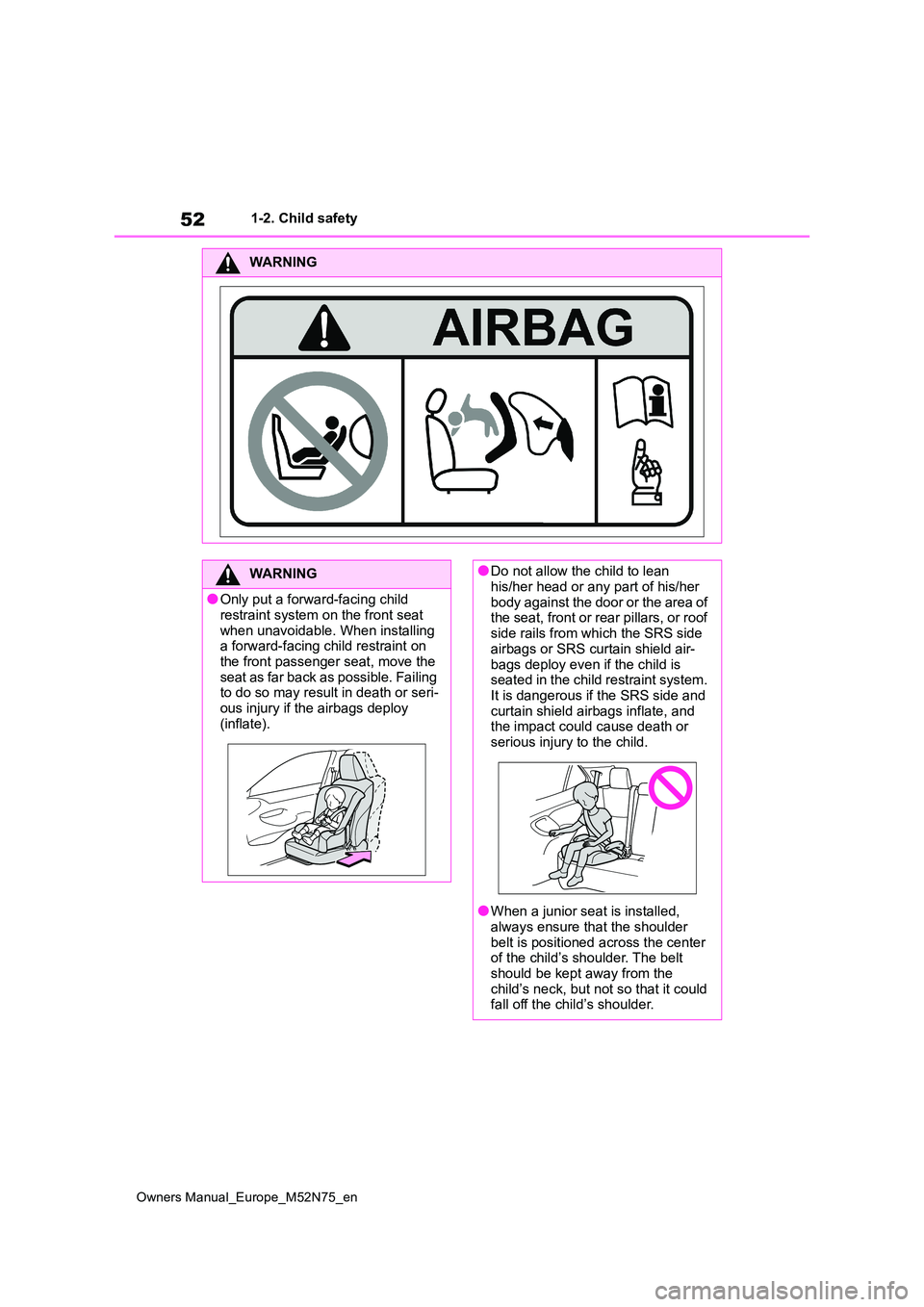
●Only put a forward-facing child restraint system on the front seat
when unavoidable. When installing a forward-facing child restraint on the front passenger seat, move the
seat as far back as possible. Failing to do so may result in death or seri-ous injury if the airbags deploy
(inflate).
●Do not allow the child to lean
his/her head or any part of his/her body against the door or the area of the seat, front or rear pillars, or roof
side rails from which the SRS side airbags or SRS curtain shield air-
bags deploy even if the child is seated in the child restraint system. It is dangerous if the SRS side and
curtain shield airbags inflate, and the impact could cause death or serious injury to the child.
●When a junior seat is installed, always ensure that the shoulder
belt is positioned across the center of the child’s shoulder. The belt should be kept away from the
child’s neck, but not so that it could fall off the child’s shoulder.