2023 TOYOTA YARIS CROSS heating
[x] Cancel search: heatingPage 205 of 698

203
4
Owners Manual_Europe_M52N75_en
4-2. Driving procedures
Driving
Turn the brake hold system on
The brake hold standby indicator
( gr e e n) co me s o n. W hi l e t he sy st e m
is holding the brake, the brake hold
operated indicator (yellow) comes
on.
■Brake hold system operating con-
ditions
The brake hold system cannot be turned on in the following conditions:
●The driver’s door is not closed.
●The driver is not wearing the seat belt.
●The parking brake is engaged.
If any of the conditions above are
WARNING
■When parking the vehicle
Do not leave a child in the vehicle
alone. The parking brake may be released unintentionally and there is the danger of the vehicle moving that
may lead to an accident resulting in death or serious injury.
■Parking brake switch
Do not set any objects near the park- ing brake switch.
Objects may interfere with the switch and may lead the parking brake to unexpectedly operate.
NOTICE
■When parking the vehicle
Before you leave the vehicle, set the
parking brake, shift the shift lever to P and make sure that the vehicle does not move.
■When the system malfunctions
Stop the vehicle in a safe place and
check the warning messages.
■When the parking brake cannot be released due to a malfunction
Driving the vehicle with the parking
brake set will lead to brake compo- nents overheating, which may affect braking performance and increase
brake wear.
Have the vehicle inspected by any authorized Toyota retailer or Toyota
authorized repairer, or any reliable repairer immediately if this occurs.
Brake Hold
The brake hold system keeps
the brake applied when the
shift lever is in D, B or N with
the system on and the brake
pedal has been depressed to
stop the vehicle. The system
releases the brake when the
accelerator pedal is depressed
with the shift lever in D or B to
allow smooth start off.
Enabling the system
Page 333 of 698

331
4
Owners Manual_Europe_M52N75_en
4-5. Using the driving support systems
Driving
occur when the above systems are
operating. None of these indicates that a malfunction has occurred.• Vibrations may be felt through the
vehicle body and steering. • A motor sound may be heard also after the vehicle comes to a stop.
■ECB operating sound
ECB operating sound may be heard in the following cases, but it does not indi-cate that a malfunction has occurred.
●Operating sound heard from the engine compartment when the brake
pedal is operated.
●Motor sound of the brake system
heard from the front part of the vehicle when the driver’s door is opened.
●Operating sound heard from the engine compartment when one or two minutes passed after the stop of the
hybrid system.
■Active Cornering Assist operation sounds and vibrations
When the Active Cornering Assist is
operated, operation sounds and vibra- tions may be generated from the brake system, but this is not a malfunction.
■EPS operation sound
When the steering wheel is operated, a motor sound (whirring sound) may be heard. This does not indicate a malfunc-
tion.
■Automatic reactivation of TRC and VSC systems
After turning the TRC and VSC systems
off, the systems will be automatically re- enabled in the following situations:
●When the power switch is turned off
●If only the TRC system is turned off,
the TRC will turn on when vehicle speed increases.If both the TRC and VSC systems are
turned off, automatic re-enabling will not occur when vehicle speed increases.
■Operating conditions of Active Cor-
nering Assist
The system operates when the following occurs.
●TRC/VSC can operate
●The driver is attempting to accelerate while turning
●The system detects that the vehicle is drifting to the outer side
●The brake pedal is released
■Reduced effectiveness of the EPS system
The effectiveness of the EPS system is
reduced to prevent the system from overheating when there is frequent steering input over an extended period
of time. The steering wheel may feel heavy as a result. Should this occur, refrain from excessive steering input or
stop the vehicle and turn the hybrid sys- tem off. The EPS system should return to normal within 10 minutes.
■Operating conditions of emergency
brake signal
When the following conditions are met, the emergency brake signal will oper-
ates:
●The emergency flashers are off
●Actual vehicle speed is over 55 km/h (35 mph)
●The system judges from the vehicle deceleration that it is a sudden brak-
ing operation.
■Automatic system cancelation of emergency brake signal
The emergency brake signal will be can-
celed in any of the following situations:
●The emergency flashers are turned
on.
●The system judges from the vehicle
deceleration that is not a sudden brak- ing operation.
■Secondary Collision Brake operat-ing cancelation
The system operates when the SRS air- bag sensor detects a collision while the
Page 334 of 698
332
Owners Manual_Europe_M52N75_en
4-5. Using the driving support systems
vehicle is in motion.
However, the system does not operate when components are damaged.
■Secondary Collision Brake auto-matic cancelation
The system is automatically canceled in any of the following situations.
●The vehicle speed drops approxi-
mately 0 km/h (0 mph)
●A certain amount of time elapses
during operation
●The accelerator pedal is depressed a
large amount
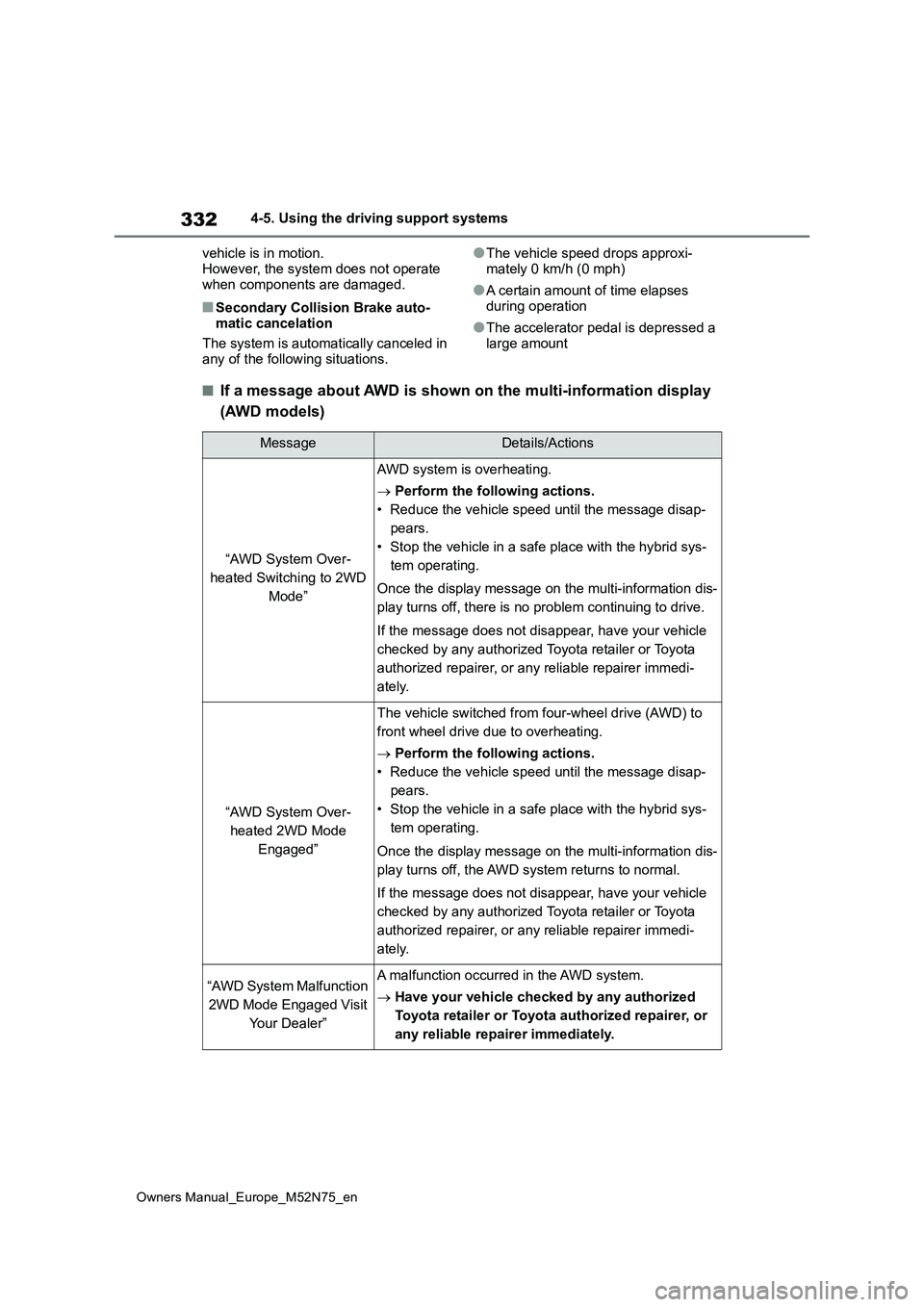
■If a message about AWD is shown on the multi-information displa y
(AWD models)
MessageDetails/Actions
“AWD System Over-
heated Switching to 2WD
Mode”
AWD system is overheating.
Perform the following actions.
• Reduce the vehicle speed until the message disap-
pears.
• Stop the vehicle in a safe place with the hybrid sys-
tem operating.
Once the display message on the multi-information dis-
play turns off, there is no problem continuing to drive.
If the message does not disappear, have your vehicle
checked by any authorized Toyota retailer or Toyota
authorized repairer, or any reliable repairer immedi-
ately.
“AWD System Over-
heated 2WD Mode
Engaged”
The vehicle switched from four-wheel drive (AWD) to
front wheel drive due to overheating.
Perform the following actions.
• Reduce the vehicle speed until the message disap-
pears.
• Stop the vehicle in a safe place with the hybrid sys-
tem operating.
Once the display message on the multi-information dis-
play turns off, the AWD system returns to normal.
If the message does not disappear, have your vehicle
checked by any authorized Toyota retailer or Toyota
authorized repairer, or any reliable repairer immedi-
ately.
“AWD System Malfunction
2WD Mode Engaged Visit
Your Dealer”
A malfunction occurred in the AWD system.
Have your vehicle checked by any authorized
Toyota retailer or Toyota authorized repairer, or
any reliable repairer immediately.
Page 337 of 698

335
4
Owners Manual_Europe_M52N75_en
4-6. Driving tips
Driving
4-6.Driving tips
When using Eco drive mode, the
torque corresponding to the accel-
erator pedal depression amount
can be generated more smoothly
than it is in normal conditions. In
addition, the operation of the air
conditioning system (heating/cool-
ing) will be minimized, improving
the fuel economy. ( P. 3 2 2 )
The Eco-friendly driving is possible
by keeping the indicate of Hybrid
System Indicator within Eco area.
( P.96, 102)
Shift the shift lever to D when
stopped at a traffic light, or driving
in heavy traffic etc. Shift the shift
lever to P when parking. When
using the N, there is no positive
effect on fuel consumption. In the
N, the gasoline engine operates but
electricity cannot be generated.
Also, when using the air condition-
ing system, etc., the hybrid battery
(traction battery) power is con-
sumed.
Drive your vehicle smoothly.
Avoid abrupt acceleration and
deceleration. Gradual accelera-
tion and deceleration will make
more effective use of the electric
motor (traction motor) without
having to use gasoline engine
power.
Avoid repeated acceleration.
Repeated acceleration con-
sumes hybrid battery (traction
battery) power, resulting in poor
fuel consumption. Battery power
can be restored by driving with
the accelerator pedal slightly
released.
Make sure to operate the brakes
gently and in a timely manner. A
greater amount of electrical energy
can be regenerated when slowing
down.
Repeated acceleration and decel-
eration, as well as long waits at traf-
fic lights, will lead to bad fuel
economy. Check traffic reports
before leaving and avoid delays as
much as possible. When driving in
Hybrid electric vehicle
driving tips
For economical and ecological
driving, pay attention to the fol-
lowing points:
Using Eco drive mode
Use of Hybrid System Indi-
cator
Shift lever operation
Accelerator pedal/brake
pedal operation
When braking
Delays
Page 347 of 698
345
5
Owners Manual_Europe_M52N75_en
5-1. Using the air conditioning system and defogger
Interior features
windshield effectively.
●If you turn “A/C” off, the windows may fog up more easily.
●The windows may fog up if the recir-culated air mode is used.
■When driving on dusty roads
Close all windows. If dust thrown up by the vehicle is still drawn into the vehicle after closing the windows, it is recom-
mended that the air intake mode be set to outside air mode and the fan speed to any setting except off.
■Outside/recirculated air mode
●Setting to the recirculated air mode temporarily is recommended in pre-
venting dirty air from entering the vehicle interior and helping to cool the vehicle when the outside air tempera-
ture is high.
●Outside/recirculated air mode may
automatically switch depending on the temperature setting or the inside tem-perature.
■Operation of the air conditioning
system in Eco drive mode
●In Eco drive mode, the air conditioning
system is controlled as follows to pri- oritize fuel efficiency:• Engine speed and compressor opera-
tion controlled to restrict heating/cool- ing capacity• Fan speed restricted when automatic
mode is selected
●To improve air conditioning perfor-
mance, perform the following opera- tions:• Adjust the fan speed
• Turn off Eco drive mode ( P.322)
●Even when the drive mode is set to
Eco drive mode, the air conditioning eco mode can be turned off by press-ing the “FAST/ECO” switch. ( P.344)
■When the outside temperature falls
to nearly 0°C (32°F)
The dehumidification function may not operate even when “A/C” switch is
pressed.
■Ventilation and air conditioning
odors
●To let fresh air in, set the air condition-
ing system to the outside air mode.
●During use, various odors from inside
and outside the vehicle may enter into and accumulate in the air conditioning system. This may then cause odor to
be emitted from the vents.
●To reduce potential odors from occur-
ring: • It is recommended that the air condi-tioning system be set to outside air
mode prior to turning the vehicle off. • The start timing of the blower may be delayed for a short period of time
immediately after the air conditioning system is started in automatic mode.
●When parking, the system automati-cally switches to outside air mode to encourage better air circulation
throughout the vehicle, helping to reduce odors that occur when starting the vehicle.
■nanoe™ X system (if equipped)*1, 2
This vehicle incorporates a biocidal product.
Ionised air generated by a device incor- porated in the vehicle purifies the air in the cabin by suppressing bacteria.
Active substance: Free radicals gener- ated in situ from ambient air or water.
nanoe™ helps to provide purified air by
emitting electrically charged water parti- cles through the front vent on the pas-senger side (left-hand drive vehicles) or
driver side (right-hand drive vehicles).*3
●When the fan is turned on and
nanoe™ X on the option control screen is selected, the nanoe™ X system is activated.
●When the fan is operated in the follow-ing conditions, system performance
will be maximized. If the following con- ditions are not met, performance will be limited.
• Air conditioner vent opening blows to the upper body, blows to the lower body and feet or feet.
Page 351 of 698
349
5
Owners Manual_Europe_M52N75_en
5-1. Using the air conditioning system and defogger
Interior features
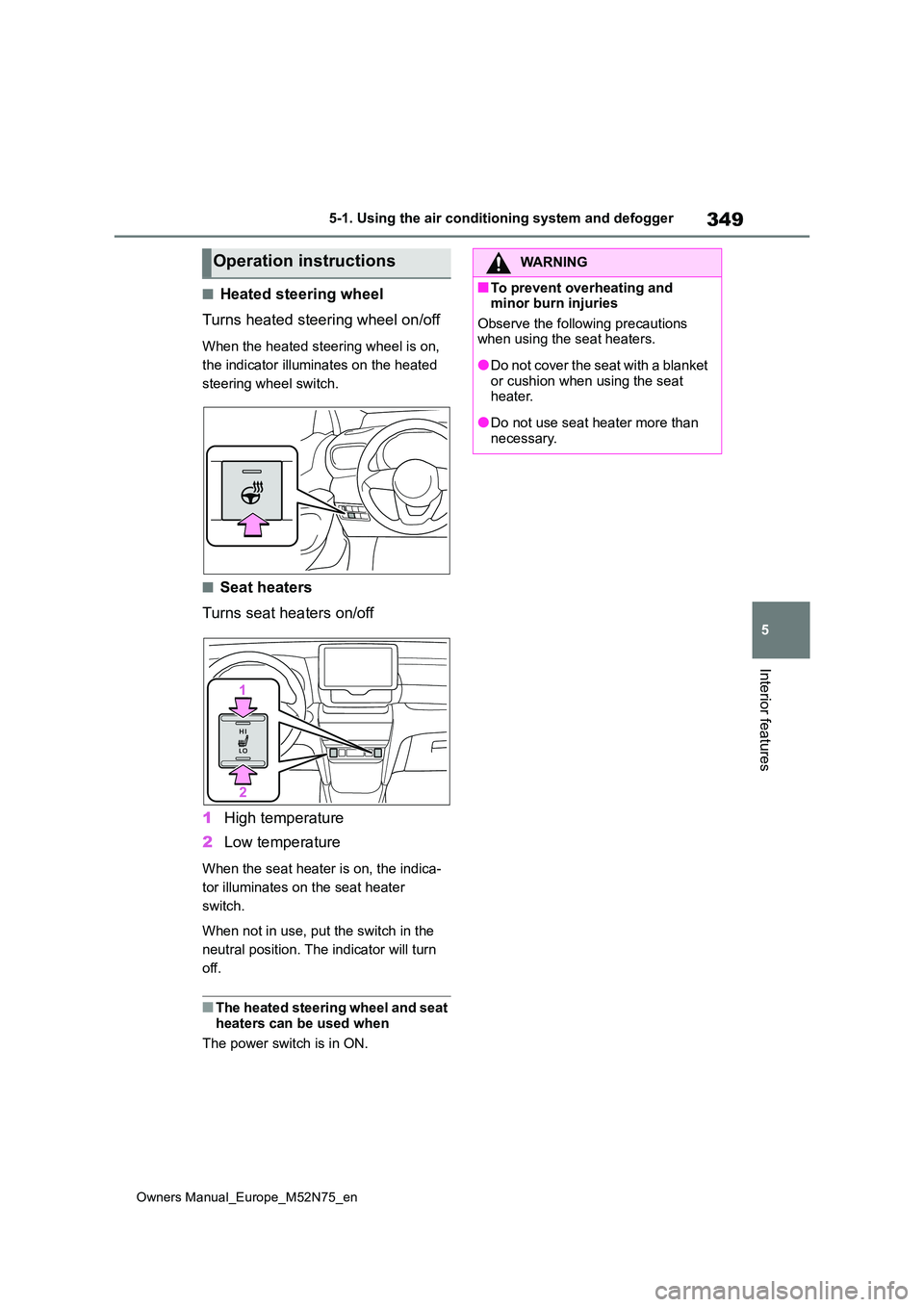
■Heated steering wheel
Turns heated steering wheel on/off
When the heated steering wheel is on,
the indicator illuminates on the heated
steering wheel switch.
■Seat heaters
Turns seat heaters on/off
1 High temperature
2 Low temperature
When the seat heater is on, the indica-
tor illuminates on the seat heater
switch.
When not in use, put the switch in the
neutral position. The indicator will turn
off.
■The heated steering wheel and seat heaters can be used when
The power switch is in ON.
Operation instructionsWARNING
■To prevent overheating and minor burn injuries
Observe the following precautions when using the seat heaters.
●Do not cover the seat with a blanket or cushion when using the seat heater.
●Do not use seat heater more than necessary.
Page 479 of 698
477
7
Owners Manual_Europe_M52N75_en
7-2. Steps to take in an emergency
When trouble arises
If the engine coolant temperature
gauge enters the red zone or
“Engine Coolant Temp High Stop
in a Safe Place See Owner’s
Manual” is shown on the multi-
information display
1 Stop the vehicle in a safe place
and turn off the air conditioning
system, and then stop the hybrid
system.
2 If you see steam: Carefully lift
the hood after the steam sub-
sides.
If you do not see steam: Care-
fully lift the hood.
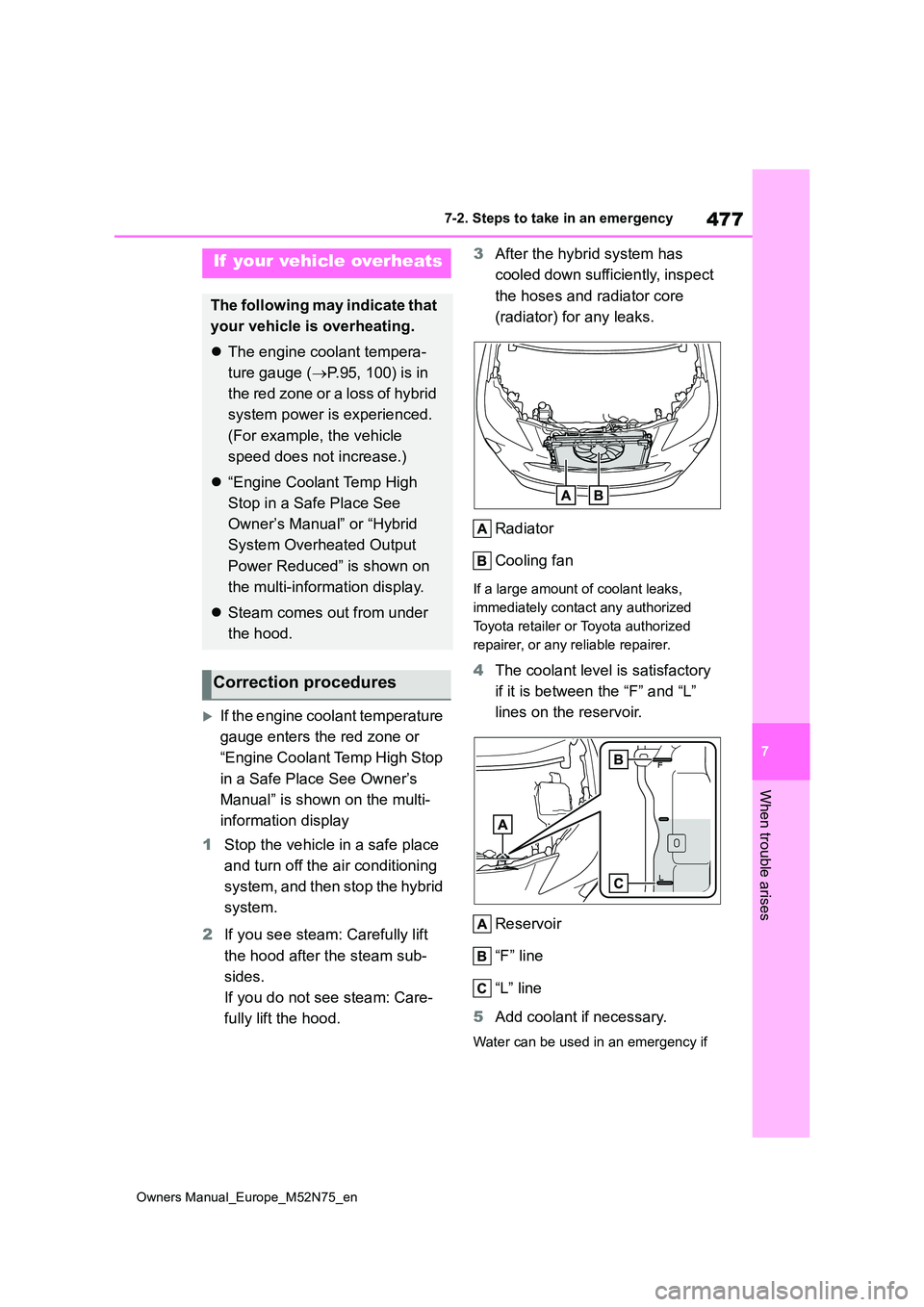
3 After the hybrid system has
cooled down sufficiently, inspect
the hoses and radiator core
(radiator) for any leaks.
Radiator
Cooling fan
If a large amount of coolant leaks,
immediately contact any authorized
Toyota retailer or Toyota authorized
repairer, or any reliable repairer.
4 The coolant level is satisfactory
if it is between the “F” and “L”
lines on the reservoir.
Reservoir
“F” line
“L” line
5 Add coolant if necessary.
Water can be used in an emergency if
If your vehicle overheats
The following may indicate that
your vehicle is overheating.
The engine coolant tempera-
ture gauge ( P.95, 100) is in
the red zone or a loss of hybrid
system power is experienced.
(For example, the vehicle
speed does not increase.)
“Engine Coolant Temp High
Stop in a Safe Place See
Owner’s Manual” or “Hybrid
System Overheated Output
Power Reduced” is shown on
the multi-information display.
Steam comes out from under
the hood.
Correction procedures
Page 514 of 698

512
Owners Manual_Europe_M52N75_en
Alphabetical Index
Battery (traction battery)................ 79
Blind Spot Monitor (BSM) ............ 270
Enabling/disabling the Blind Spot
Monitor..................................... 272
Bottle holders ............................... 353
Brake
Brake hold .................................. 203
Emergency brake signal ............ 329
Fluid ........................................... 490
Parking brake ............................. 200
Regenerative braking ................... 76
Warning light .............................. 435
Brake assist .................................. 328
Break-in tips .................................. 176
Brightness control
Instrument panel light control99, 105
BSM (Blind Spot Monitor) ............ 270
Enabling/disabling the Blind Spot
Monitor..................................... 272
C
Care ....................................... 368, 371
Aluminum wheels ....................... 368
Exterior....................................... 368
Interior ........................................ 371
Seat belts ................................... 371
Chains ........................................... 338
Child restraint system .................... 49
Points to remember...................... 49
Riding with children ...................... 48
Child safety ..................................... 48
12-volt battery precautions. 389, 475
Airbag precautions ....................... 43
Back door precautions ............... 139
Child restraint system .................. 49
Heated steering wheel and seat
heater precautions ................... 348
How your child should wear the seat
belt ............................................. 36
Installing child restraints ............... 49
Power window lock switch.......... 171
Power window precautions ........ 170
Rear door child-protectors.......... 139
Seat belt precautions ................... 48
Child-protectors ............................ 139
Cleaning................................. 368, 371
Aluminum wheels .......................368
Exterior ....................................... 368
Interior ........................................371
Radar sensor.............................. 227
Seat belts ...................................371
Clock ..................95, 98, 100, 104, 105
Coat hooks .................................... 365
Condenser ..................................... 387
Console box .................................. 354
Consumption screen .................... 123
Cooling system .............................385
Engine overheating .................... 477
Hybrid system overheating......... 477
Cruise control
Dynamic radar cruise control with
full-speed range .......................252
Cup holders ...................................353
Current fuel consumption .... 107, 114
Curtain shield airbags ....................38
Customizable features ................. 494
D
Daytime running light system ..... 206
Deck board .................................... 355
Defogger
Outside rear view mirrors ........... 344
Rear window .............................. 344
Windshield.................................. 344
Dimensions ...................................484