Page 496 of 574

4988-1. Specifications
If fuel containing MMT is used, your
emission control system may be
adversely affected.
The malfunction indicator lamp on
the instrument cluster may come on.
If this happens, contact your Toyota
dealer for service.
■If your engine knocks
●Consult your Toyota dealer.
●You may occasionally notice light
knocking for a short time while
accelerating or driving uphill. This
is normal and there is no need for
concern.
NOTICE
■Notice on fuel quality
●Do not use impro per fuels. If
improper fuels are used, the
engine will be damaged.
●Do not use leaded gasoline.
Leaded gasoline can cause
damage to your vehicle’s three-
way catalytic converters caus-
ing the emission control system
to malfunction.
●Do not use gasohol other than
the type previously stated.
Other gasohol may cause fuel
system damage or vehicle per-
formance problems.
●Using unleaded gasoline with
an octane number or rating
lower than the l evel previously
stated will cause persistent
heavy knocking.
At worst, this will lead to engine
damage.
■Fuel-related poor driveability
If poor driveability (poor hot start-
ing, vaporization, engine knock-
ing, etc.) is encountered after
using a different type of fuel, dis-
continue the use of that type of
fuel.
■When refueling with gasohol
Take care not to spill gasohol. It
can damage your vehicle’s paint.
Page 501 of 574

5038-1. Specifications
8
Vehicle specifications
■Temperature A, B, C
The temperature grades are A
(the highest), B, and C, repre-
senting the tire’s resistance to
the generation of heat and its
ability to dissipate heat when
tested under controlled condi-
tions on a specified indoor labo-
ratory test wheel.
Sustained high temperature can
cause the material of the tire to
degenerate and reduce tire life, and
excessive temperature can lead to
sudden tire failure.
Grade C corresponds to a level of performance which all passenger
car tires must meet under the Fed-
eral Motor Vehicle Safety Standard
No. 109.
Grades B and A represent higher
levels of performance on the labo-
ratory test wheel than the minimum
required by law.
Warning: The temperature grades
of a tire assume tha
t it is properly
inflated and not overloaded.
Excessive speed, underinflation, or
excessive loading, either sepa-
rately or in combination, can cause
heat buildup and possible tire fail-
ure.
Glossary of tire terminology
Tire related termMeaning
Cold tire inflation pres-
sureTire pressure when the vehicle has been parked
for three hours or more, or has not been driven
more than 1 mile or 1.5 km under that condition
Maximum inflation pres-
sureThe maximum cold inflated pressure to which a
tire may be inflated, shown on the sidewall of
the tire
Recommended inflation
pressureCold tire inflation pressure recommended by a
manufacturer
Accessory weight
The combined weight (in excess of those stan-
dard items which may be replaced) of transmis-
sion, power steering, power brakes, power
windows, power seats, radio and heater, to the
extent that these items are available as factory-
installed equipment (whether installed or not)
Curb weight
The weight of a motor vehicle with standard
equipment, including th e maximum capacity of
fuel, oil and coolant, and if so equipped, air con-
ditioning and additional weight optional engine
Page 508 of 574

5108-2. Customization
detailed settings, press and
hold and display the set-
ting screen.
The method of performing detailed
setting differs for each screen.
Please refer to the advice sentence
displayed on the screen.
To go back to the previous screen
or exit the customize mode, press
.
■When customizing using the
navigation/multimedia system
or multi-information display
Stop the vehicle i n a safe place,
apply the parking brake, and shift
the shift lever to P. Also, to prevent
battery discharge, leave the engine
running while custo mizing the fea-
tures.
Some function settings are changed simultaneously with other fu nc-
tions being customized. Contact y our Toyota dealer for further
details.
Vehicles with navigation system or multimedia system: Settings
that can be changed using the navigation system or multimedia s ys-
tem
Settings that can be changed using the multi-information displa y
Settings that can be changed by your Toyota dealer
Definition of symbols: O = Available, – =Not available
■Alarm*( P.71)
*: For Canada
WARNING
■During customization
As the engine needs to be operat-
ing during customization, ensure
that the vehicle is parked in a
place with adequate ventilation. In
a closed area such as a garage,
exhaust gases in cluding harmful
carbon monoxide (CO) may col-
lect and enter the vehicle. This
may lead to death or a serious
health hazard.
NOTICE
■During customization
To prevent battery discharge,
ensure that the engine is running
while customizing features.
Customizable Features
FunctionDefault settingCustomized setting
Activates the alarm when the
doors are unlocked using the
mechanical key
OnOff––O
A
B
C
ABC
Page 517 of 574

5198-2. Customization
8
Vehicle specifications
■PCS (Pre-Collision System) (P.239)
*: The system is automatically enabl ed each time the engine switch is
turned to ON.
■LTA (Lane Tracing Assist) ( P.250)
■RSA (Road Sign Assist)* ( P.261)
*: If equipped
■BSM (Blind Spot Monitor)* ( P.275)
FunctionCustomized setting
PCS (Pre-Collision System)*On, Off–O–
Adjust alert timingEarly, Middle, Late–O–
FunctionCustomized setting
Lane centering functionOn, Off–O–
Alert sensitivityHigh, Standard–O–
Vehicle sway warning func-
tionOn, Off–O–
Vehicle sway warning sensi-
tivityHigh, Standard, Low–O–
FunctionCustomized setting
RSA (Road Sign Assist)On, Off–O–
Excess speed notification
methodNo notification, Display only,
Display and buzzer–O–
Excess speed notification
level1 mph (2 km/h), 3 mph (5 km/h), 5 mph (10km/h)–O–
Other notifications method
(No-entry notification)No notification, Display only, Display and buzzer–O–
FunctionDefault settingCustomized setting
BSM (Blind Spot Monitor)OnOff–O–
Outside rear view mirror indi-
cator brightnessBrightDim–O–
ABC
ABC
ABC
ABC
Page 519 of 574
5218-2. Customization
8
Vehicle specifications
■PKSB (Parking Support Brake)* ( P.294)
*: If equipped
■Stop & Start system* ( P.304)
*: If equipped
■Automatic air conditioning system* ( P.338)
*: If equipped
■Illumination ( P.348)
FunctionDefault settingCustomized
setting
PKSB (Parking Support
Brake) functionOnOff–O–
FunctionDefault settingCustomized setting
Change the Stop & Start sys-
tem duration when the A/C is
on
StandardExtended–O–
FunctionDefault settingCustomized setting
A/C Auto switch operationOnOffO–O
Switching to t he outside air
mode when the vehicle is
parked
OnOff––O
FunctionDefault settingCustomized setting
Time elapsed before the inte-
rior lights turn off15 seconds
Off
O–O7.5 seconds
30 seconds
Operation after the engine
switch is turned offOnOff––O
Operation when the doors
are unlockedOnOff––O
ABC
ABC
ABC
ABC
Page 538 of 574
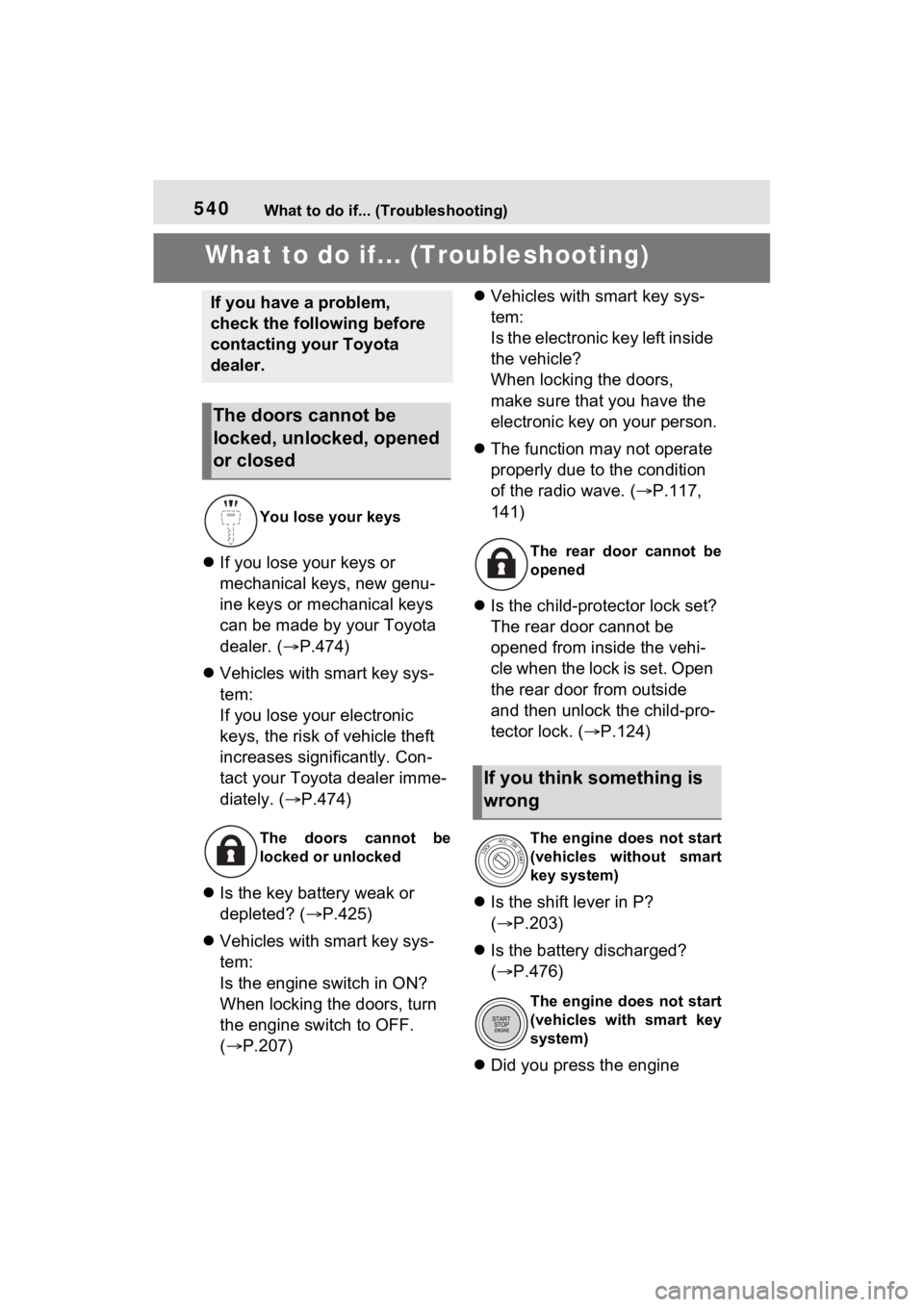
540What to do if... (Troubleshooting)
1-1.What to do if... (Troubleshooting)What to do if... (Troubleshooting)
If you lose your keys or
mechanical keys, new genu-
ine keys or mechanical keys
can be made by your Toyota
dealer. ( P.474)
Vehicles with smart key sys-
tem:
If you lose your electronic
keys, the risk of vehicle theft
increases significantly. Con-
tact your Toyota dealer imme-
diately. ( P.474)
Is the key battery weak or
depleted? ( P.425)
Vehicles with smart key sys-
tem:
Is the engine switch in ON?
When locking the doors, turn
the engine switch to OFF.
( P.207)
Vehicles with smart key sys-
tem:
Is the electronic key left inside
the vehicle?
When locking the doors,
make sure that you have the
electronic key on your person.
The function may not operate
properly due to the condition
of the radio wave. ( P.117,
141)
Is the child-protector lock set?
The rear door cannot be
opened from inside the vehi-
cle when the lock is set. Open
the rear door from outside
and then unlock the child-pro-
tector lock. ( P.124)
Is the shift lever in P?
( P.203)
Is the battery discharged?
( P.476)
Did you press the engine
If you have a problem,
check the following before
contacting your Toyota
dealer.
The doors cannot be
locked, unlocked, opened
or closed
You lose your keys
The doors cannot be
locked or unlocked
The rear door cannot be
opened
If you think something is
wrong
The engine does not start
(vehicles without smart
key system)
The engine does not start
(vehicles with smart key
system)
Page 539 of 574

541What to do if... (Troubleshooting)
switch while firmly depress-
ing the brake pedal?
(P.204)
Is the shift lever in P?
( P.204)
Is the electronic key any-
where detectable inside the
vehicle? ( P.140)
Is the electronic key battery
weak or depleted?
In this case, the engine can
be started in a temporary
way. ( P.475)
Is the battery discharged?
( P.476)
Is the engine switch in ON?
If you cannot release the shift
lever by depressing the brake
pedal with the engine switch
in ON ( P.210)
It is locked to prevent theft of
the vehicle if the key is
removed from the engine
switch. ( P.203)
Is the window lock switch
pressed?
The power window except for
the one at the driver’s seat
cannot be operated if the win-
dow lock switch is pressed.
( P.169)
The auto power off function
will be operated if the vehicle
is left in ACC or ON (the
engine is not running) for a
period of time. ( P.207)
The seat belt reminder light is
flashing
Are the driver and the passengers
wearing the seat belts? (
P.455,
456
)
The parking brake indicator is
on
Is the parking br ake released?
(
P.213)
Depending on the situation,
other types of warning buzzer
may also sound. ( P.449, 459)
The shift lever cannot be
shifted from P even if you
depress the brake pedal
The steering wheel can-
not be turned after the
engine is stopped (vehi-
cles without smart key
system)
The windows do not open
or close by operating the
power window switches
The engine switch is
turned off automatically
(vehicles with smart key
system)
A warning buzzer sounds
during driving
Page 540 of 574
542What to do if... (Troubleshooting)
Did anyone inside the vehicle
open a door during setting the
alarm?
The sensor detects it and the
alarm sounds. ( P.71)
To stop the alarm, turn the engine
switch to ON or start the engine.
Is the message displayed on
the multi-information display?
Check the message on the
multi-information display.
( P.459)
When a warning light turns on
or a warning message is dis-
played, refer to P.449, 459.
Stop the vehicle in a safe
place and replace the flat tire
with the spare tire. ( P.463)
Try the procedure for when
the vehicle becomes stuck in
mud, dirt, or snow. ( P.482)
An alarm is activated and
the horn sounds (if
equipped)
A warning buzzer sounds
when leaving the vehicle
A warning light turns on
or a warning message is
displayed
When a problem has
occurred
If you have a flat tire
The vehicle becomes
stuck

