2023 TOYOTA RAV4 HYBRID hybrid system warning light
[x] Cancel search: hybrid system warning lightPage 2 of 586

2TABLE OF CONTENTS
For your information...................6
Reading this manual ................ 11
How to search .......................... 12
Pictorial index .......................... 14
1-1. For safe use Before driving ................... 26
For safe driving ................ 27
Seat belts ......................... 29
SRS airbags ..................... 33
Front passenger occupant classification system ...... 43
Exhaust gas precautions.. 48
1-2. Child safety Riding with children .......... 49
Child restraint systems..... 50
1-3. Emergency assistance Safety Connect ................ 65
1-4. Hybrid system Hybrid system features .... 70
Hybrid system precautions ....................................... 75
1-5. Theft deterrent system Immobilizer system .......... 80
Alarm................................ 81
2-1. Instrument cluster Warning lights and indicators....................................... 86
Gauges and meters (with 7- inch multi-information dis-
play) ............................... 93Gauges and meters (with
12.3-inch multi-information
display) ........................... 99
Multi-information display (with 7-inch multi-informa-
tion display) ................. 105
Multi-information display (with 12.3-inch multi-infor-
mation display) ............ 115
Energy monitor/consumption screen.......................... 125
3-1. Key information Keys .............................. 130
3-2. Opening, closing and lock- ing the doors
Side doors ..................... 135
Back door ...................... 141
Smart key system .......... 155
3-3. Adjusting the seats Front seats .................... 160
Rear seats ..................... 161
Driving position memory 163
Head restraints .............. 166
3-4. Adjusting the steering wheel and mirrors
Steering wheel............... 169
Inside rear view mirror ... 170
Digital Rear-view Mirror . 172
Outside rear view mirrors .................................... 181
3-5. Opening, closing the win- dows and moon roof
Power windows ............. 183
Moon roof ...................... 186
1For safety and security
2
Vehicle status
information and
indicators
3Before driving
Page 5 of 586

5TABLE OF CONTENTS
1
2
3
4
5
6
7
8
9
If a warning light turns on or a warning buzzer sounds.................................... 456
If a warning message is dis- played.......................... 466
If you have a flat tire...... 471
If the hybrid system will not start ............................. 480
If you lose your keys ..... 481
If the fuel filler door cannot be opened ................... 482
If the electronic key does not operate properly (vehicles
with smart key system) 483
If the 12-volt battery is dis- charged ....................... 485
If your vehicle overheats 490
If the vehicle becomes stuck .................................... 493
8-1. Specifications Maintenance data (fuel, oil level, etc.) .................... 496
Fuel information ............ 505
Tire information ............. 507
8-2. Customization Customizable features .. 517
8-3. Initialization Items to initialize ........... 531
9-1. For owners Reporting safety defects for U.S. owners................. 534Reporting safet
y defects for
Canadian owners ........ 535
Seat belt instructions for Canadian owners (in
French) ........................ 535
SRS airbag instructions for Canadian owners (in
French) ........................ 537
Headlight aim instructions for Canadian owners (in
French) ........................ 544
What to do if... (Trouble- shooting) ..................... 548
Alphabetical Index ........ 551
8Vehicle specifications
9For owners
Index
Page 17 of 586

17Pictorial index
■Instrument panel
Power switch ................................................... ...........P.217, 219
Starting the hybrid system/chan ging the modes ..P.217, 219, 222
Emergency stop of the hybrid system ............................ ......P.449
When the hybrid system will not start .......................... ........P.480
Warning messages
*1............................................................P.4 66
Shift lever.................................................... ........................P.226
Changing the shift position.................................... ...............P.227
Precautions against towing ..................................................P.451
When the shift lever does not move............................. ........P.228
Meters ......................................................... ....................P.93, 99
Reading the meters/adjusting the instrument panel light ............................................................... ........................P.97, 104
Warning lights/indicator lights ................................ ................P.86
When the warning lights come on ................................ ........P.456
Multi-information display . .........................................P.105, 115
Display ........................................................ .................P.105, 115
A
B
C
D
Page 27 of 586

271-1. For safe use
1
For safety and security
Adjust the angle of the seat-
back so that you are sitting
straight up and so that you do
not have to lean forward to
steer. (P.160)
Adjust the seat so that you
can depress the pedals fully
and so that your arms bend
slightly at the elbow when
gripping the steering wheel.
( P.160)
Lock the head restraint in
place with the center of the
head restraint closest to the
top of your ears. ( P.166)
Wear the seat belt correctly.
( P.30)
WARNING
■Before driving
●Check that the floor mat is
securely fixed in the correct
place with all the provided
retaining hooks (clips). Be espe-
cially careful to perform this
check after cleaning the floor.
●With the hybrid system stopped
and the shift lever in P, fully
depress each pedal to the floor
to make sure it does not inter-
fere with the floor mat.
For safe driving
For safe driving, adjust the
seat and mirror to an appro-
priate position before driv-
ing.
Correct driving posture
A
B
C
D
Page 35 of 586

351-1. For safe use
1
For safety and security
Front passenger occupant classification system (ECU and sen-
sors)
Knee airbag
SRS warning light
Airbag sensor assembly
Your vehicle is equipped with ADVANCED AIRBAGS designed
based on the US motor vehicle safety standards (FMVSS208). The
airbag sensor assembly (ECU) cont rols airbag deployment based on
information obtained from the sensors etc. shown in the system
components diagram above. This in formation includes crash sever-
ity and occupant information. As the airbags deploy, a chemical
reaction in the inflators quickly fills the airbags with non-toxic gas to
help restrain the motion of the occupants.
■If the SRS airbags deploy
(inflate)
●Slight abrasions, burns, bruising
etc., may be sustained from SRS
airbags, due to the extremely high
speed deployment (inflation) by
hot gases.
●A loud noise and white powder will
be emitted.
●Parts of the airbag module (steer-
ing wheel hub, airbag cover and
inflator) as well as the front seats,
parts of the front and rear pillars,
and roof side rails, may be hot for
several minutes. T he airbag itself
may also be hot.
●The windshield may crack.
●The hybrid system will be stopped
and fuel supply to the engine will
be stopped. ( P.79)
●The brakes and st op lights will be
controlled automatically.
( P.327)
●The interior lights will turn on auto-
matically. ( P.352)
●The emergency flashers will turn
on automatically. ( P.448)
●For Safety Connect subscribers, if
any of the followin g situations occur, the system is designed to
send an emergency call to the
response center, notifying them of
the vehicle’s location (without
needing to push the “SOS” button)
and an agent will attempt to speak
with the occupants to ascertain
the level of emergency and assis-
tance required. If the occupants
are unable to communicate, the
agent automatically treats the call
as an emergency and helps to dis-
patch the necessary emergency
services. (
P.65)
• An SRS airbag is deployed.
• A seat belt pretensioner is acti- vated.
• The vehicle is involved in a severe rear-end collision.
■SRS airbag deployment condi-
tions (SRS front airbags)
●The SRS front airbags will deploy
in the event of an impact that
exceeds the set threshold level
(the level of forc e corresponding
to an approximately 12 - 18 mph
[20 - 30 km/h] frontal collision with
a fixed wall that does not move or
deform).
However, this threshold velocity will
be considerably higher in the follow-
ing situations:
N
O
P
Q
Page 48 of 586
481-1. For safe use
Exhaust gas precau-
tions
Harmful substance to the
human body is included in
exhaust gases if inhaled.
WARNING
Exhaust gases contain harmful
carbon monoxide (CO), which is
colorless and odorless. Observe
the following precautions.
Failure to do so may cause
exhaust gases to enter the vehicle
and may lead to an accident
caused by light-headedness, or
may lead to death or a serious
health hazard.
■Important points while driving
●Keep the back door closed.
●If you smell exhaust gases in
the vehicle even when the back
door is closed, open the side
windows and have the vehicle
inspected at your Toyota dealer
as soon as possible.
■When parking
●If the vehicle is in a poorly venti-
lated area or a closed area,
such as a garage, stop the
hybrid system.
●Do not leave the vehicle with
the hybrid system operating for
a long time.
If such a situation cannot be
avoided, park the vehicle in an
open space and ensure that
exhaust fumes do not enter the
vehicle interior.
●Do not leave the hybrid system
operating in an area with snow
build-up, or where it is snowing.
If snowbanks build up around
the vehicle while the hybrid sys-
tem is operating, exhaust gases
may collect and enter the vehi-
cle.
■Exhaust pipe
The exhaust system needs to be
checked periodically. If there is a
hole or crack caused by corro-
sion, damage to a joint or abnor-
mal exhaust noise, be sure to
have the vehicle inspected and
repaired by your Toyota dealer.
Page 76 of 586
761-4. Hybrid system
■Running out of fuel
When the vehicle has run out of fuel
and the hybrid system cannot be
started, refuel th e vehicle with at
least enough gasoline to make the
low fuel level warning light ( P.462)
go off. If there is only a small
amount of fuel, th e hybrid system
may not be able to start. (The stan-
dard amount of fuel is about 2.3 gal.
[8.8 L, 1.9 Imp.gal.], when the vehi-
cle is on a level su rface. This value
may vary when the vehicle is on a
slope. Add extra fuel when the vehi-
cle is inclined.)
■Electromagnetic waves
●High voltage parts and cables on
Hybrid Electric Vehicles incorpo-
rate electromagnetic shielding,
and therefore emi t approximately
the same amount of electromag-
netic waves as conventional gaso-
line powered vehicles or home
electronic appliances.
●Your vehicle may cause sound
interference in so me third party-
produced radio parts.
■Hybrid battery (tr action battery)
The hybrid battery (traction battery)
has a limited service life. The lifes-
pan of the hybrid battery (traction
battery) can change in accordance
with driving style and driving condi-
tions.
■Starting the hybrid system in an
extremely cold environment
When the hybrid battery (traction
battery) is extremely cold (below
approximately -22°F [-30°C]) under
the influence of t he outside tem-
perature, it may no t be possible to
start the hybrid system. In this case,
try to start the hybrid system again
after the temperature of the hybrid
battery increases due to the outside
temperature increase etc.
WARNING
■High voltage precautions
This vehicle has high voltage DC
and AC systems as well as a 12-
volt system. DC and AC high volt-
age is very dangerous and can
cause severe burns and electric
shock that may result in death or
serious injury.
●Never touch, disassemble,
remove or replace the high volt-
age parts, cables or their con-
nectors.
●The hybrid system will become
hot after starting as the system
uses high voltage. Be careful of
both the high voltage and the
high temperature, and always
obey the warning labels
attached to the vehicle.
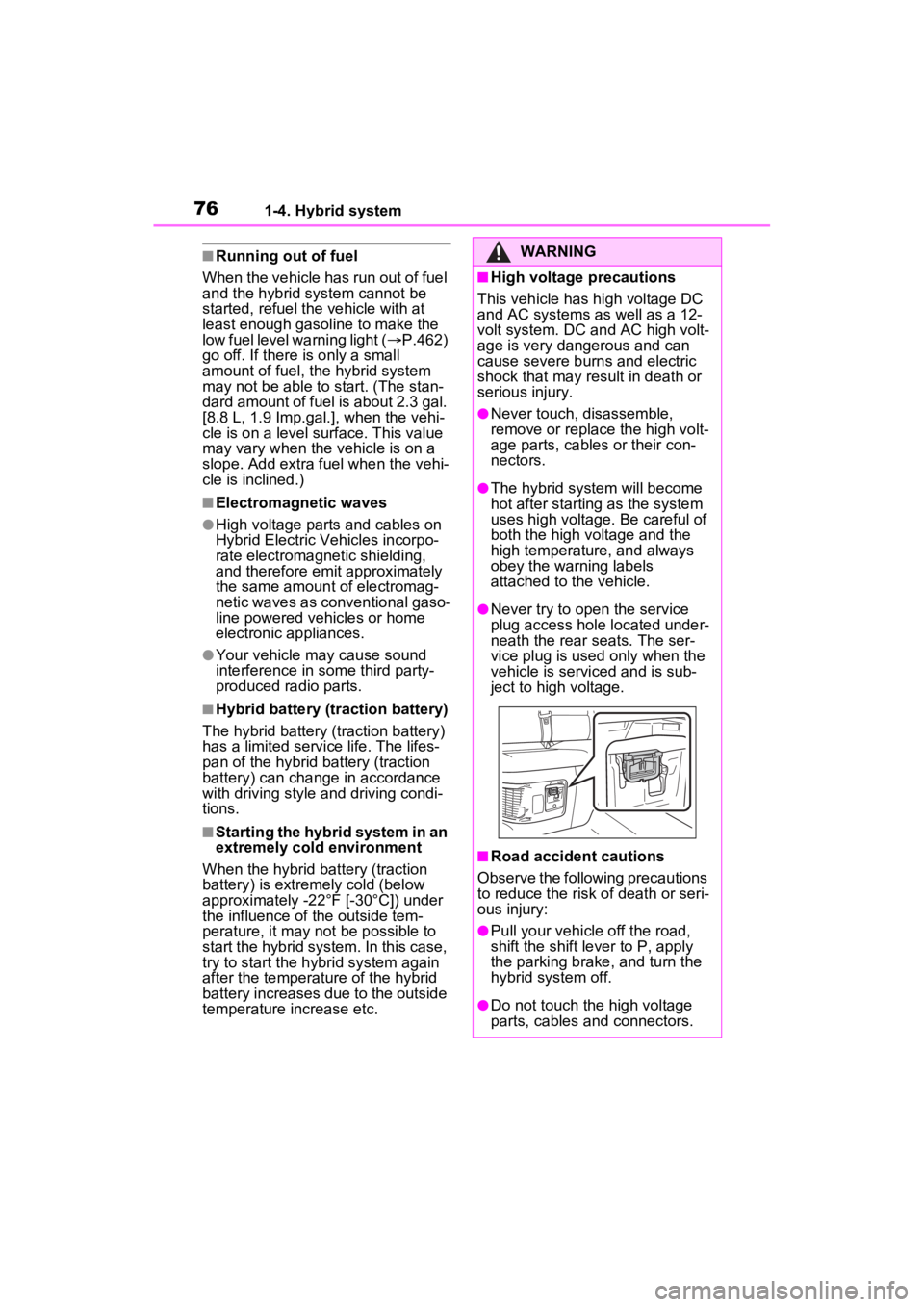
●Never try to open the service
plug access hole located under-
neath the rear seats. The ser-
vice plug is used only when the
vehicle is serviced and is sub-
ject to high voltage.
■Road accident cautions
Observe the following precautions
to reduce the risk of death or seri-
ous injury:
●Pull your vehicle off the road,
shift the shift le ver to P, apply
the parking brake, and turn the
hybrid system off.
●Do not touch the high voltage
parts, cables and connectors.
Page 79 of 586
791-4. Hybrid system
1
For safety and security
When a certain level of impact is
detected by the impact sensor,
the emergency shut off system
blocks the high voltage current
and stops the fuel pump to mini-
mize the risk of electrocution
and fuel leakage. If the emer-
gency shut off system activates,
your vehicle will not restart. To
restart the hybrid system, con-
tact your Toyota dealer.
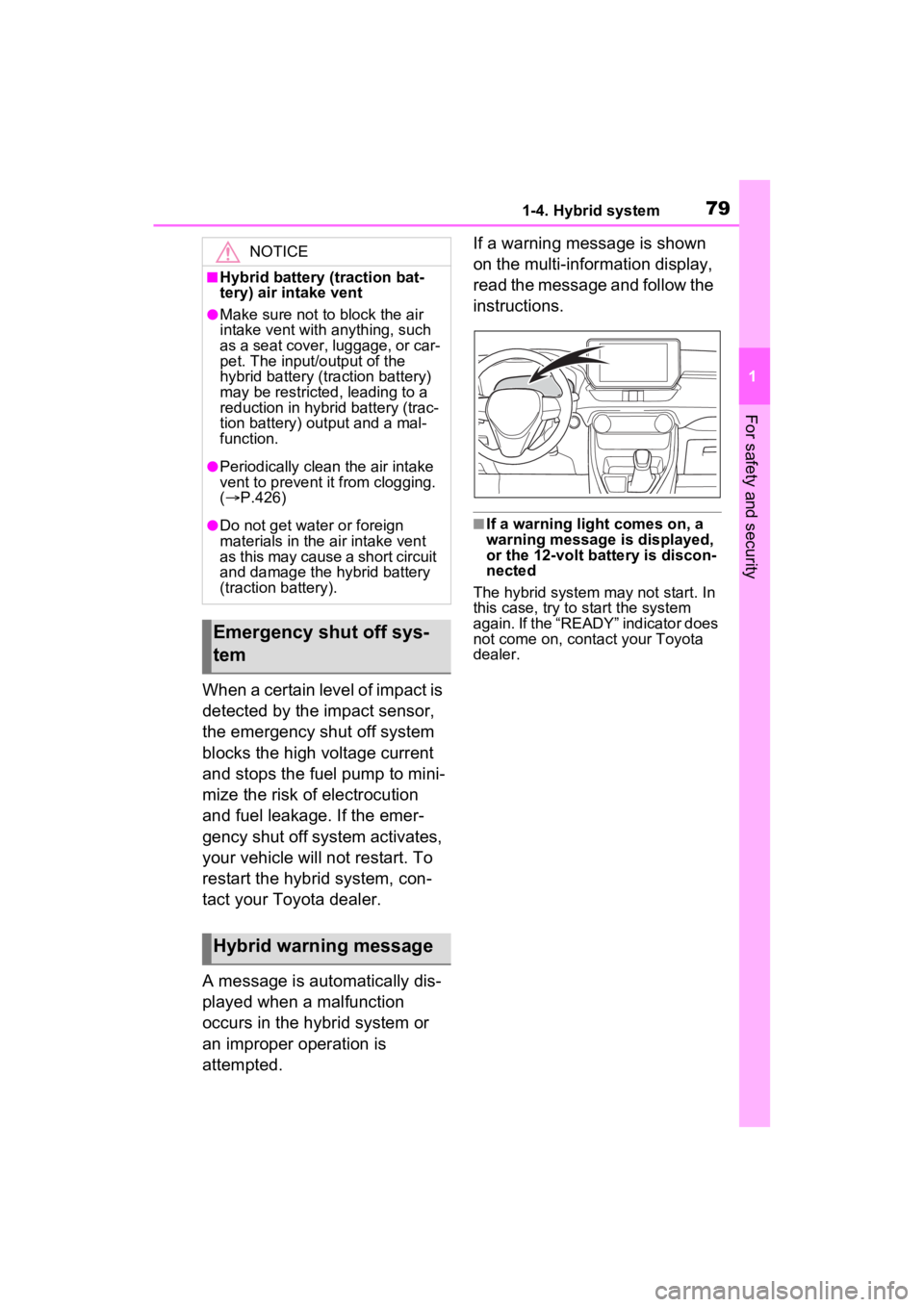
A message is automatically dis-
played when a malfunction
occurs in the hybrid system or
an improper operation is
attempted.If a warning message is shown
on the multi-information display,
read the message and follow the
instructions.
■If a warning light comes on, a
warning message
is displayed,
or the 12-volt battery is discon-
nected
The hybrid system may not start. In
this case, try to start the system
again. If the “READY” indicator does
not come on, contact your Toyota
dealer.
NOTICE
■Hybrid battery (traction bat-
tery) air intake vent
●Make sure not to block the air
intake vent with anything, such
as a seat cover, luggage, or car-
pet. The input/output of the
hybrid battery (traction battery)
may be restricted, leading to a
reduction in hybrid battery (trac-
tion battery) output and a mal-
function.
●Periodically clean the air intake
vent to prevent it from clogging.
( P.426)
●Do not get water or foreign
materials in the air intake vent
as this may cause a short circuit
and damage the hybrid battery
(traction battery).
Emergency shut off sys-
tem
Hybrid warning message