2023 TOYOTA PRIUS display
[x] Cancel search: displayPage 550 of 770

5486-3. Do-it-yourself maintenance
PRIUS_OM_OM47F32E_(EE)
■Scheduled maintenance of the air intake vent is necessary when
In some situations such as when the vehicle is used frequently or in heavy
traffic or dusty areas, the air intake vent may need to be cleaned more regu-
larly. For details, refer to the “Toyota Service Booklet” or “Toyota Warranty
Booklet”.
■ Cleaning the air intake vent
● Dust in the air intake vent may interfere with the cooling of the hybrid battery
(traction battery). If charging/dischargi ng of the hybrid battery (traction bat-
tery) becomes limited, the distance that the vehicle can be driven using the
electric motor (traction motor) may be reduced and the fuel economy may
be reduced. Inspect and clean the air intake vent periodically.
● Improper handling of the air intake vent cover and filter may result in dam-
age to them. If you have any concerns about cleaning the filter, contact any
authorized Toyota retailer or Toyota authorized repairer, or any reliable
repairer.
■ If “Maintenance Required for Traction Battery Cooling Parts See Owner's
Manual” is shown on the multi-information display
● If this warning message is shown on the multi-information display, remove
the air intake vent cover and clean the filter. ( P. 545)
● After cleaning the air intake vent, start the hybrid system and check that the
warning message is no longer shown.
It may take approximately 20 minutes after the hybrid system is started until
the warning message disappears. If the warning message does not disap-
pear, have the vehicle inspected by any authorized Toyota retailer or Toyota
authorized repairer, or any reliable repairer.
WARNING
■ When cleaning the air intake vent
● Do not use water or other liquids to clean the air intake vent. If water is
applied to the hybrid battery (traction battery) or other components, a mal-
function or fire may occur.
● Before cleaning the air intake vent, make sure to turn the power switch off
to stop the hybrid system.
■ When removing the air intake vent cover
Do not touch the service plug located near the air intake vent. ( P. 87)
Page 551 of 770
5496-3. Do-it-yourself maintenance
PRIUS_OM_OM47F32E_(EE)
6
Maintenance and care
NOTICE
■When cleaning the air intake vent
■ To prevent damage to the vehicle
● Do not allow water or foreign matter to enter the air intake vent when the
cover is removed.
● Carefully handle the removed filter so that it will not be damaged. If the fil-
ter is damaged, have it replaced with a new filter by any authorized Toyota
retailer or Toyota authorized repairer, or any reliable repairer.
● Make sure to reinstall the filter and cover to their original positions after
cleaning.
● Do not install anything to the air intake vent other than the exclusive filter
for this vehicle or use the vehicle without the filter installed.
■ If “Maintenance Required for Traction Battery Cooling Parts See
Owner's Manual” is shown on the multi-information display
If the vehicle is continuously driven with the warning message (indicating
that charging/discharging of the hybrid battery [traction battery] may
become limited) displayed, the hybrid battery (traction battery) may mal-
function. If the warning message is shown, clean the air intake vent immedi-
ately.
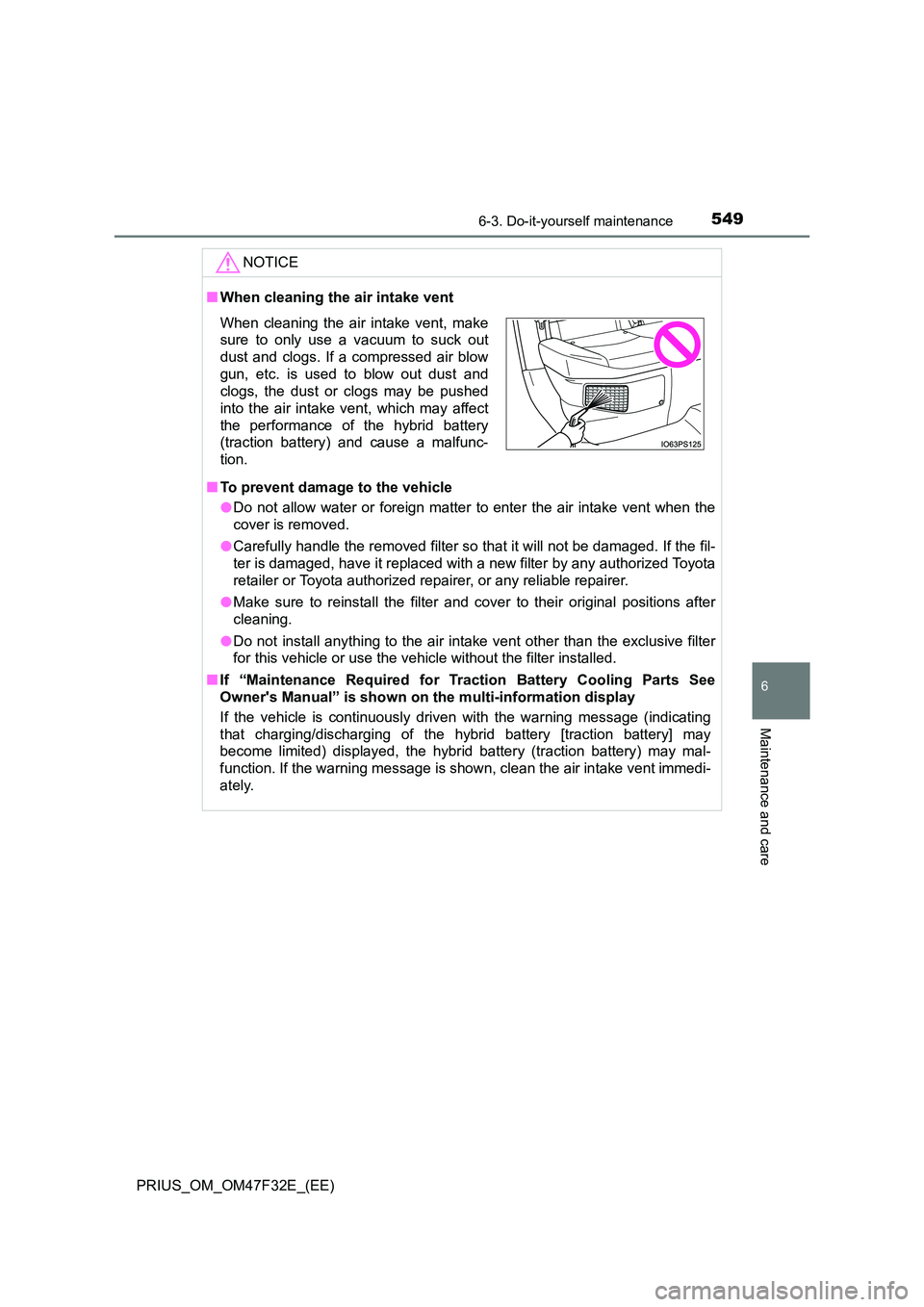
When cleaning the air intake vent, make
sure to only use a vacuum to suck out
dust and clogs. If a compressed air blow
gun, etc. is used to blow out dust and
clogs, the dust or clogs may be pushed
into the air intake vent, which may affect
the performance of the hybrid battery
(traction battery) and cause a malfunc-
tion.
Page 569 of 770
567
7When trouble arises
PRIUS_OM_OM47F32E_(EE)
7-1. Essential information
Emergency flashers ........... 568
If your vehicle has to
be stopped in an
emergency ....................... 569
If the vehicle is submerged
or water on the road is
rising ................................ 570
7-2. Steps to take in an
emergency
If your vehicle needs
to be towed ...................... 572
If you think something is
wrong ............................... 579
If a warning light turns on
or a warning buzzer
sounds ............................. 580
If a warning message is
displayed ......................... 589
If you have a flat tire
(vehicles without
spare tire) ........................ 598
If you have a flat tire
(vehicles with
spare tire) ........................ 618
If the hybrid system will
not start............................ 634
If the electronic key does
not operate properly ........ 636
If the 12-volt battery is
discharged ....................... 639
If your vehicle
overheats ......................... 645
If the vehicle becomes
stuck ................................ 650
Page 574 of 770
5727-2. Steps to take in an emergency
PRIUS_OM_OM47F32E_(EE)
If your vehicle needs to be towed
In the following situations, it is not possible to be towed by another
vehicle using cables or chains, as the front wheels may be locked due
to the parking lock. Contact any authorized Toyota retailer or Toyota
authorized repairer, or any reliable repairer or commercial towing ser-
vice.
● There is a malfunction in the shift control system. (P. 247, 597)
● There is a malfunction in the immobilizer system. (P. 9 1 )
● There is a malfunction in the smart entry & start system. (P. 636)
● The 12-volt battery is discharged. (P. 639)
The following may indicate a problem with your hybrid transmission.
Contact any authorized Toyota retailer or Toyota authorized repairer,
or any reliable repairer or commercial towing service before towing.
● The hybrid system warning message is displayed and the vehicle
does not move.
● The vehicle makes an abnormal sound.
If towing is necessary, we recommend having your vehicle
towed by any authorized Toyota retailer or Toyota authorized
repairer, or any reliable repairer or commercial towing service,
using a wheel-lift type truck or flatbed truck.
Use a safety chain system for all towing, and abide by all state/
provincial and local laws.
Situations when it is not possible to be towed by another vehicle
Situations when it is necessary to contact dealers before towing
Page 584 of 770
5827-2. Steps to take in an emergency
PRIUS_OM_OM47F32E_(EE)
(Flashes or illumi- nates)(If equipped)
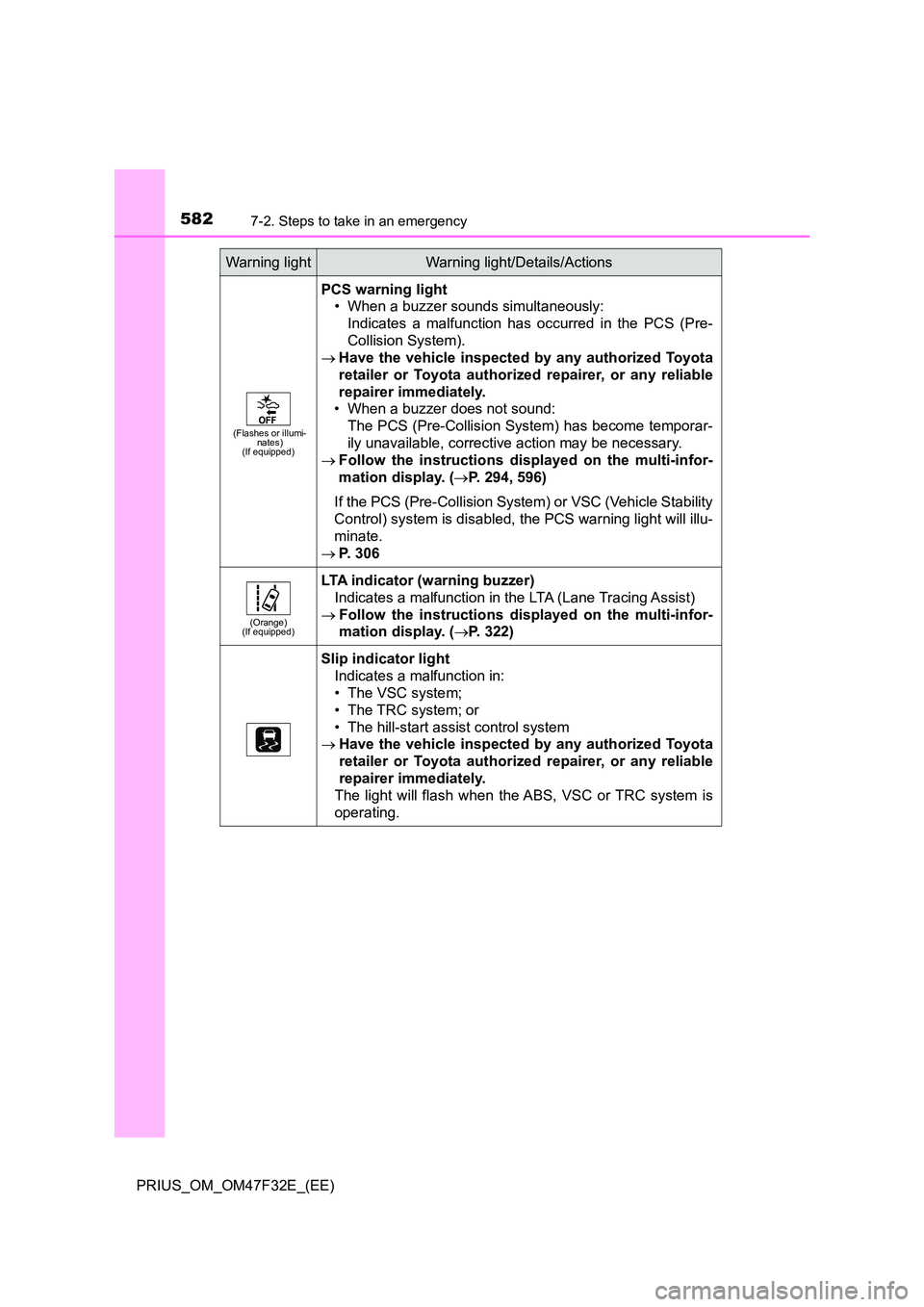
PCS warning light
• When a buzzer sounds simultaneously:
Indicates a malfunction has occurred in the PCS (Pre-
Collision System).
Have the vehicle inspected by any authorized Toyota
retailer or Toyota authorized repairer, or any reliable
repairer immediately.
• When a buzzer does not sound:
The PCS (Pre-Collision System) has become temporar-
ily unavailable, corrective action may be necessary.
Follow the instructions displayed on the multi-infor-
mation display. ( P. 294, 596)
If the PCS (Pre-Collision System) or VSC (Vehicle Stability
Control) system is disabled, the PCS warning light will illu-
minate.
P. 306
(Orange) (If equipped)
LTA indicator (warning buzzer)
Indicates a malfunction in the LTA (Lane Tracing Assist)
Follow the instructions displayed on the multi-infor-
mation display. ( P. 322)
Slip indicator light
Indicates a malfunction in:
• The VSC system;
• The TRC system; or
• The hill-start assist control system
Have the vehicle inspected by any authorized Toyota
retailer or Toyota authorized repairer, or any reliable
repairer immediately.
The light will flash when the ABS, VSC or TRC system is
operating.
Warning lightWarning light/Details/Actions
Page 587 of 770
5857-2. Steps to take in an emergency
PRIUS_OM_OM47F32E_(EE)
7
When trouble arises
*1: Brake system warning buzzer:
When there is a possible problem that could affect braking performance,
the warning light will come on and a warning buzzer will sound.
*2: Low engine oil pressure warning buzzer:
A buzzer also sounds continuously for approximately 30 seconds at maxi-
mum in addition to the low engine oil pressure warning light when the
“READY” indicator is illuminated.
*3: Open door warning buzzer:
The open door warning buzzer sounds to alert one or more of the doors is
not fully closed (with the vehicle having reached a speed of 5 km/h
[3 mph]).
*4: Driver’s and front passenger’s seat belt warning buzzer:
The driver’s and front passenger’s seat belt warning buzzer sounds to alert
the driver and front passenger that his or her seat belt is not fastened. If
the seat belt is unfastened, the buzzer sounds intermittently for a certain
period of time after the vehicle reaches a certain speed.
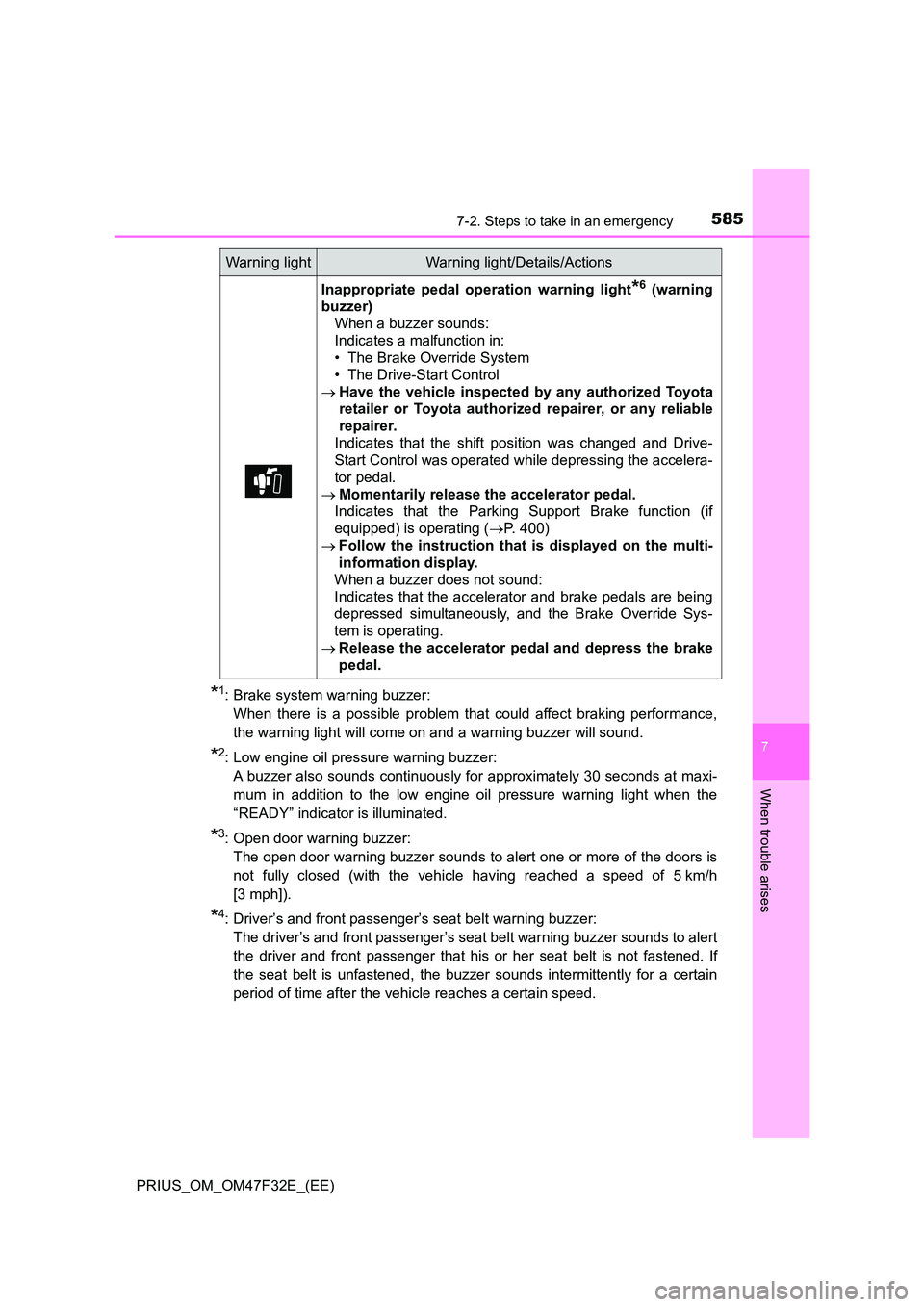
Inappropriate pedal operation warning light*6 (warning
buzzer)
When a buzzer sounds:
Indicates a malfunction in:
• The Brake Override System
• The Drive-Start Control
Have the vehicle inspected by any authorized Toyota
retailer or Toyota authorized repairer, or any reliable
repairer.
Indicates that the shift position was changed and Drive-
Start Control was operated while depressing the accelera-
tor pedal.
Momentarily release the accelerator pedal.
Indicates that the Parking Support Brake function (if
equipped) is operating ( P. 400)
Follow the instruction that is displayed on the multi-
information display.
When a buzzer does not sound:
Indicates that the accelerator and brake pedals are being
depressed simultaneously, and the Brake Override Sys-
tem is operating.
Release the accelerator pedal and depress the brake
pedal.
Warning lightWarning light/Details/Actions
Page 588 of 770

5867-2. Steps to take in an emergency
PRIUS_OM_OM47F32E_(EE)
*5: Rear passengers’ seat belt warning buzzer:
The rear passengers’ seat belt warning buzzer sounds to alert the rear
passenger that his or her seat belt is not fastened. If the seat belt is unfas-
tened, the buzzer sounds intermittently for a certain period of time, after
the seat belt is fastened and unfastened and the vehicle reaches a certain
speed.
*6: This symbol is displayed on the multi-information display.
■ Front passenger detection sensor, seat belt reminder and warning
buzzer
● If luggage is placed on the front passenger seat, the front passenger detec-
tion sensor may cause the warning light to flash and the warning buzzer to
sound even if a passenger is not sitting in the seat.
● If a cushion is placed on the seat, the sensor may not detect a passenger,
and the warning light may not operate properly.
■ Electric power steering system warning light (warning buzzer)
When the 12-volt battery charge becomes insufficient or the voltage tempo-
rarily drops, the electric power steering system warning light may come on
and the warning buzzer may sound.
■ If the malfunction indicator lamp comes on while driving
For some models, the malfunction indicator lamp will come on if the fuel tank
becomes completely empty. If the fuel tank is empty, refuel the vehicle imme-
diately. The malfunction indicator lamp will go off after several trips.
If the malfunction indicator lamp does not go off, contact any authorized
Toyota retailer or Toyota authorized repai rer, or any reliable repairer as soon
as possible.
■ When the tire pressure warning light comes on (if equipped)
Inspect the appearance of the tire to check that the tire is not punctured.
If the tire is punctured: P. 598, 618
If the tire is not punctured:
Carry out the following procedure after the tire temperature has lowered suffi-
ciently.
● Check the tire inflation pressure and adjust to the appropriate level.
● If the warning light does not go out even after several minutes, check that
the tire inflation pressure is at the specified level and carry out initialization.
( P. 531)
The warning light may come on again if the above operations are conducted
without first allowing the tire temperature to lower sufficiently.
Page 591 of 770
5897-2. Steps to take in an emergency
PRIUS_OM_OM47F32E_(EE)
7
When trouble arises
If a war ning message is displayed
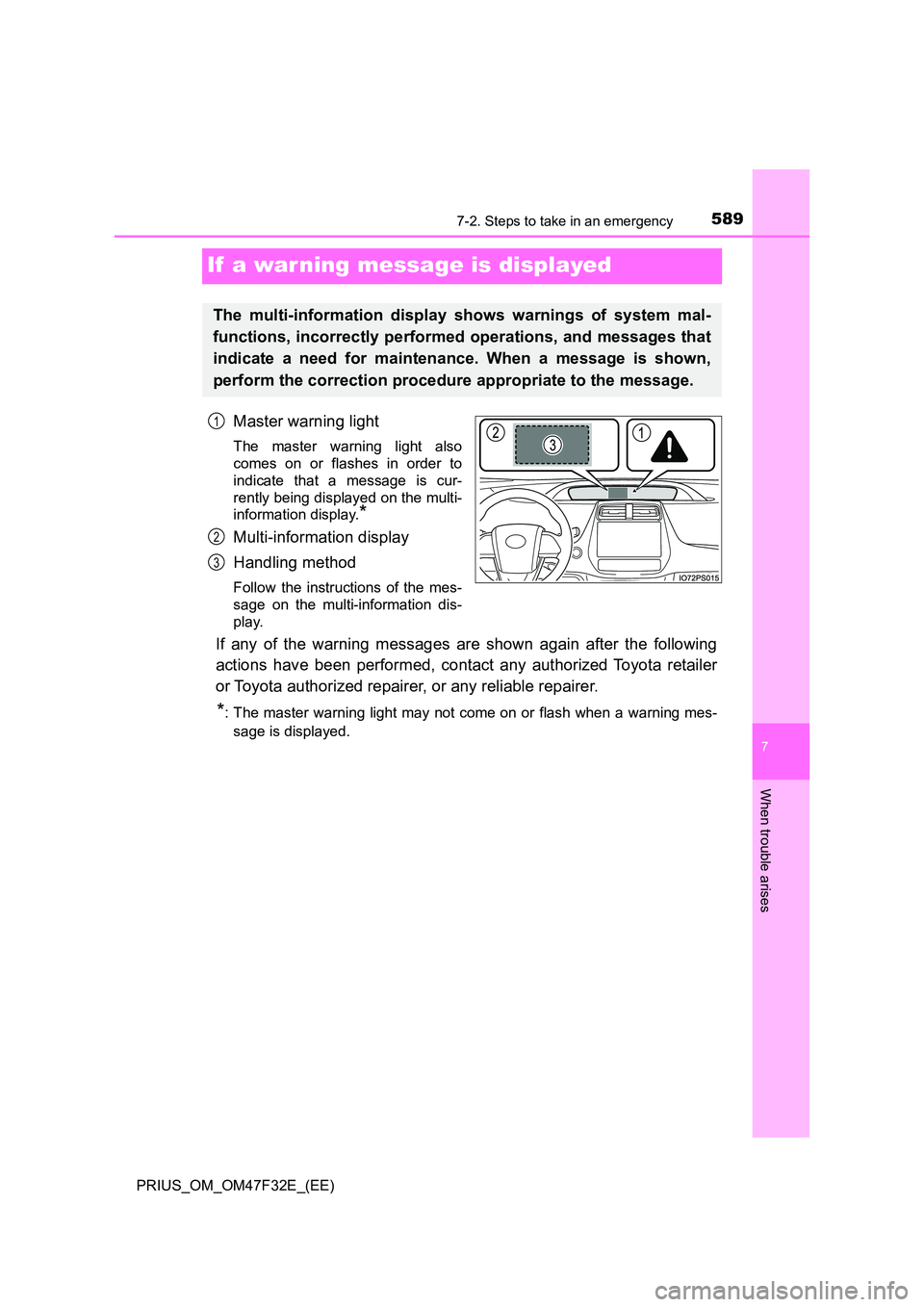
Master warning light
The master warning light also
comes on or flashes in order to
indicate that a message is cur-
rently being displayed on the multi-
information display.*
Multi-information display
Handling method
Follow the instructions of the mes-
sage on the multi-information dis-
play.
If any of the warning messages are shown again after the following
actions have been performed, contact any authorized Toyota retailer
or Toyota authorized repairer, or any reliable repairer.
*: The master warning light may not come on or flash when a warning mes-
sage is displayed.
The multi-information display shows warnings of system mal-
functions, incorrectly performed operations, and messages that
indicate a need for maintenance. When a message is shown,
perform the correction procedure appropriate to the message.
1
2
3