2023 TOYOTA GR YARIS airbag
[x] Cancel search: airbagPage 45 of 470
43
1
Owner's Manual_Europe_M52P63_en
1-2. Child safety
For safety and security
1-2.Child sa fety
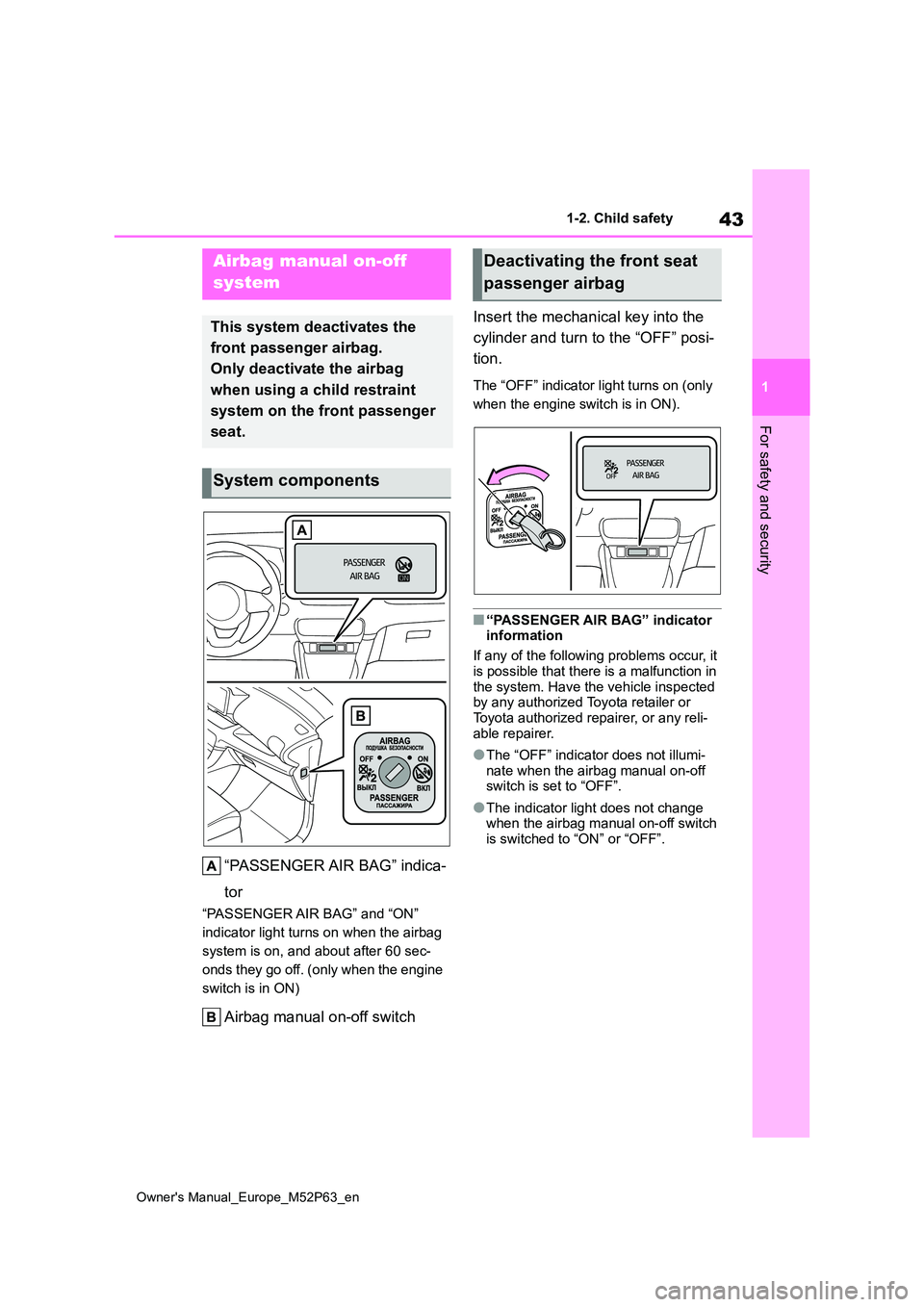
“PASSENGER AIR BAG” indica-
tor
“PASSENGER AIR BAG” and “ON”
indicator light turns on when the airbag
system is on, and about after 60 sec-
onds they go off. (only when the engine
switch is in ON)
Airbag manual on-off switch
Insert the mechanical key into the
cylinder and turn to the “OFF” posi-
tion.
The “OFF” indicator light turns on (only
when the engine switch is in ON).
■“PASSENGER AIR BAG” indicator information
If any of the following problems occur, it
is possible that there is a malfunction in the system. Have the vehicle inspected by any authorized Toyota retailer or
Toyota authorized repairer, or any reli- able repairer.
●The “OFF” indicator does not illumi-nate when the airbag manual on-off switch is set to “OFF”.
●The indicator light does not change when the airbag manual on-off switch
is switched to “ON” or “OFF”.
Airbag manual on-off
system
This system deactivates the
front passenger airbag.
Only deactivate the airbag
when using a child restraint
system on the front passenger
seat.
System components
Deactivating the front seat
passenger airbag
Page 46 of 470
44
Owner's Manual_Europe_M52P63_en
1-2. Child safety
WARNING
■When installing a child restraint system
For safety reasons, always install a child restraint system in a rear seat. In the event that the rear seat cannot be
used, the front seat can be used as long as the airbag manual on-off sys-tem is set to “OFF”.
If the airbag manual on-off system is left on, the strong impact of the airbag deployment (inflation) may cause
serious injury or even death.
■When a child restraint system is
not installed on the front passen- ger seat
Ensure that the airbag manual on-off
system is set to “ON”. If it is left off, the airbag may not deploy in the event of an accident,
which may result in serious injury or even death.
Riding with children
Observe the following precau-
tions when children are in the
vehicle.
Use a child restraint system
appropriate for the child, until
the child becomes large
enough to properly wear the
vehicle’s seat belt.
It is recommended that chil-
dren sit in the rear seats to
avoid accidental contact with
the shift lever, wiper switch,
etc.
Use the window lock switch to
avoid children opening the
door while driving or operating
the power window accidentally.
( P.124)
Do not let small children oper-
ate equipment which may
catch or pinch body parts,
such as the power window,
hood, back door, seats, etc.
WARNING
■When children are in the vehicle
Never leave children unattended in
the vehicle, and never allow children to have or use the key.
Children may be able to start the vehi-
cle or shift the vehicle into neutral. There is also a danger that children may injure themselves by playing with
the windows or other features of the vehicle. In addition, heat build-up or extremely cold temperatures inside
the vehicle can be fatal to children.
Page 49 of 470
47
1
Owner's Manual_Europe_M52P63_en
1-2. Child safety
For safety and security
achieved.
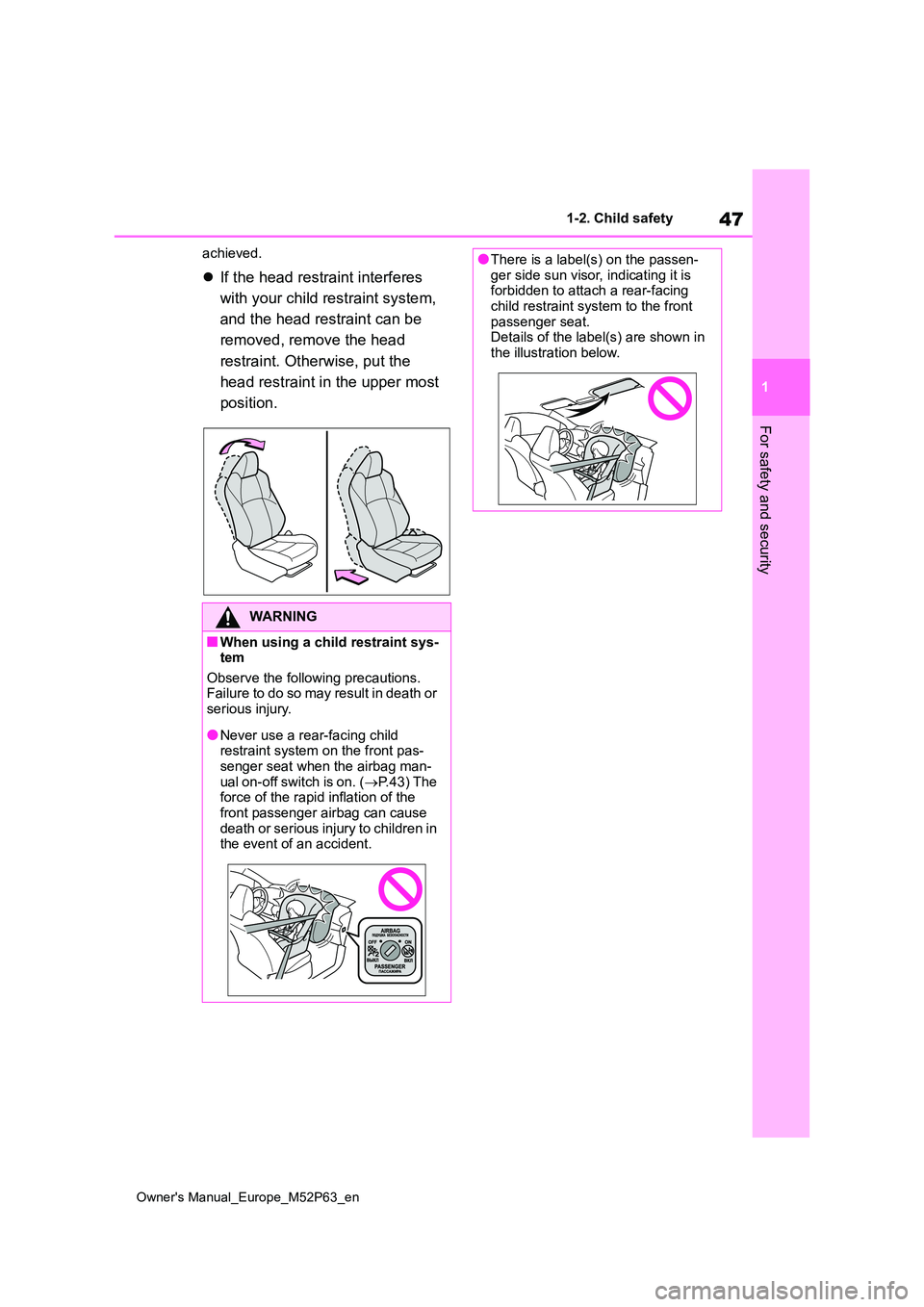
If the head restraint interferes
with your child restraint system,
and the head restraint can be
removed, remove the head
restraint. Otherwise, put the
head restraint in the upper most
position.
WARNING
■When using a child restraint sys- tem
Observe the following precautions. Failure to do so may result in death or serious injury.
●Never use a rear-facing child restraint system on the front pas-
senger seat when the airbag man- ual on-off switch is on. ( P.43) The force of the rapid inflation of the
front passenger airbag can cause death or serious injury to children in the event of an accident.
●There is a label(s) on the passen-ger side sun visor, indicating it is forbidden to attach a rear-facing
child restraint system to the front passenger seat.Details of the label(s) are shown in
the illustration below.
Page 50 of 470
48
Owner's Manual_Europe_M52P63_en
1-2. Child safety
WARNING
WARNING
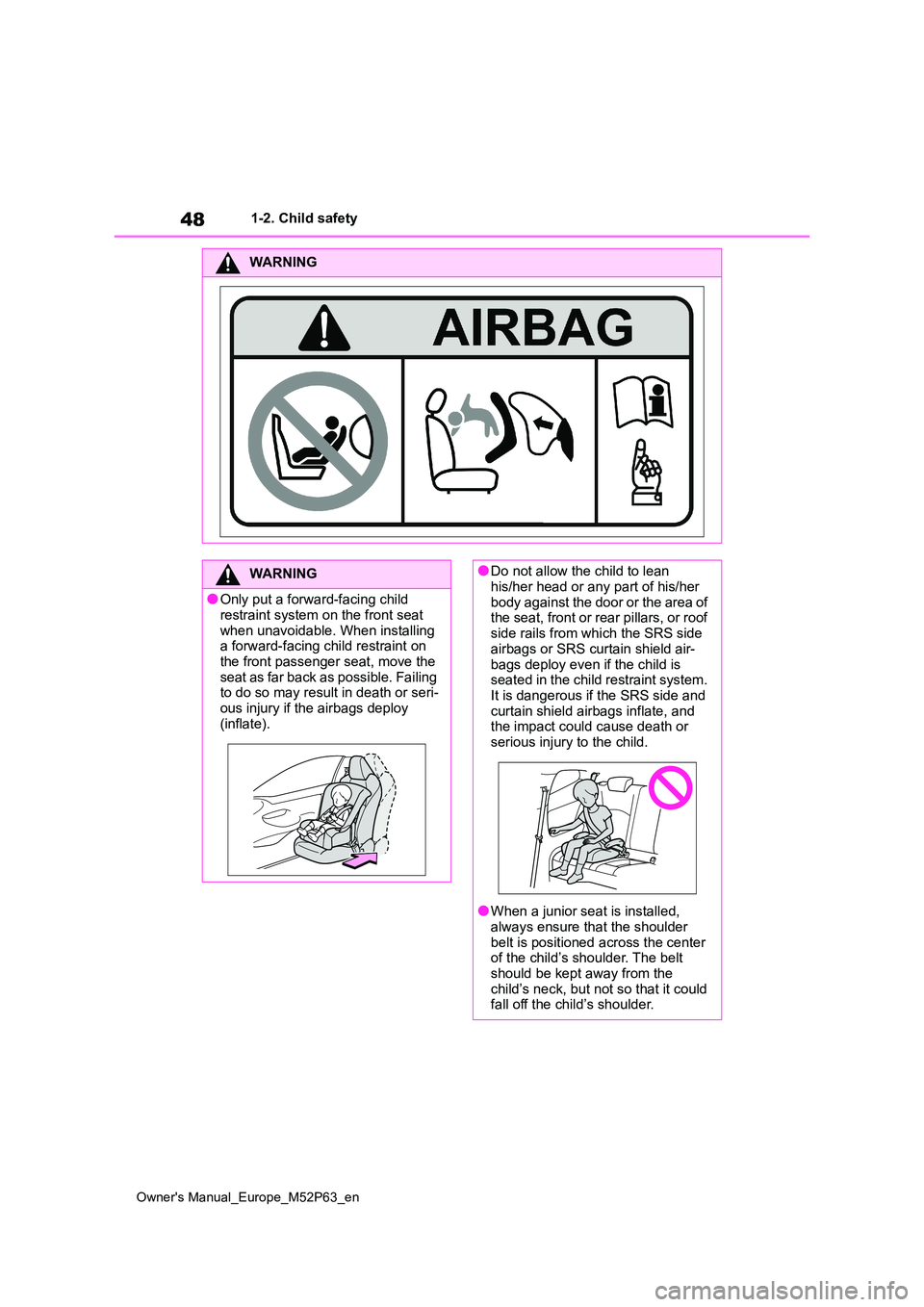
●Only put a forward-facing child restraint system on the front seat
when unavoidable. When installing a forward-facing child restraint on the front passenger seat, move the
seat as far back as possible. Failing to do so may result in death or seri-ous injury if the airbags deploy
(inflate).
●Do not allow the child to lean
his/her head or any part of his/her body against the door or the area of the seat, front or rear pillars, or roof
side rails from which the SRS side airbags or SRS curtain shield air-
bags deploy even if the child is seated in the child restraint system. It is dangerous if the SRS side and
curtain shield airbags inflate, and the impact could cause death or serious injury to the child.
●When a junior seat is installed, always ensure that the shoulder
belt is positioned across the center of the child’s shoulder. The belt should be kept away from the
child’s neck, but not so that it could fall off the child’s shoulder.
Page 53 of 470
51
1
Owner's Manual_Europe_M52P63_en
1-2. Child safety
For safety and security
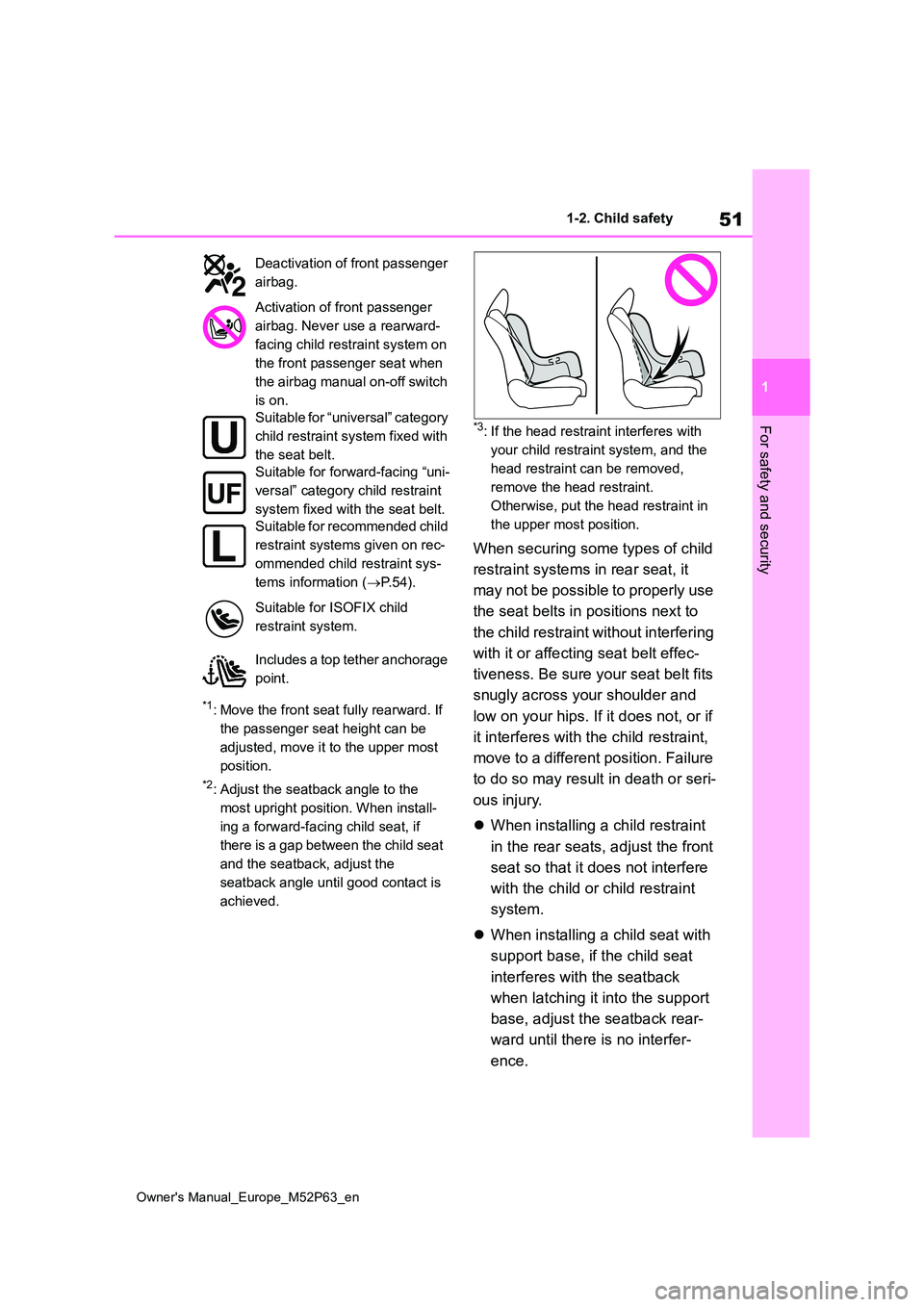
*1: Move the front seat fully rearward. If
the passenger seat height can be
adjusted, move it to the upper most
position.
*2: Adjust the seatback angle to the
most upright position. When install-
ing a forward-facing child seat, if
there is a gap between the child seat
and the seatback, adjust the
seatback angle until good contact is
achieved.
*3: If the head restraint interferes with
your child restraint system, and the
head restraint can be removed,
remove the head restraint.
Otherwise, put the head restraint in
the upper most position.
When securing some types of child
restraint systems in rear seat, it
may not be possible to properly use
the seat belts in positions next to
the child restraint without interfering
with it or affecting seat belt effec-
tiveness. Be sure your seat belt fits
snugly across your shoulder and
low on your hips. If it does not, or if
it interferes with the child restraint,
move to a different position. Failure
to do so may result in death or seri-
ous injury.
When installing a child restraint
in the rear seats, adjust the front
seat so that it does not interfere
with the child or child restraint
system.
When installing a child seat with
support base, if the child seat
interferes with the seatback
when latching it into the support
base, adjust the seatback rear-
ward until there is no interfer-
ence.
Deactivation of front passenger
airbag.
Activation of front passenger
airbag. Never use a rearward-
facing child restraint system on
the front passenger seat when
the airbag manual on-off switch
is on.
Suitable for “universal” category
child restraint system fixed with
the seat belt.
Suitable for forward-facing “uni-
versal” category child restraint
system fixed with the seat belt.
Suitable for recommended child
restraint systems given on rec-
ommended child restraint sys-
tems information ( P. 5 4 ) .
Suitable for ISOFIX child
restraint system.
Includes a top tether anchorage
point.
Page 54 of 470
52
Owner's Manual_Europe_M52P63_en
1-2. Child safety
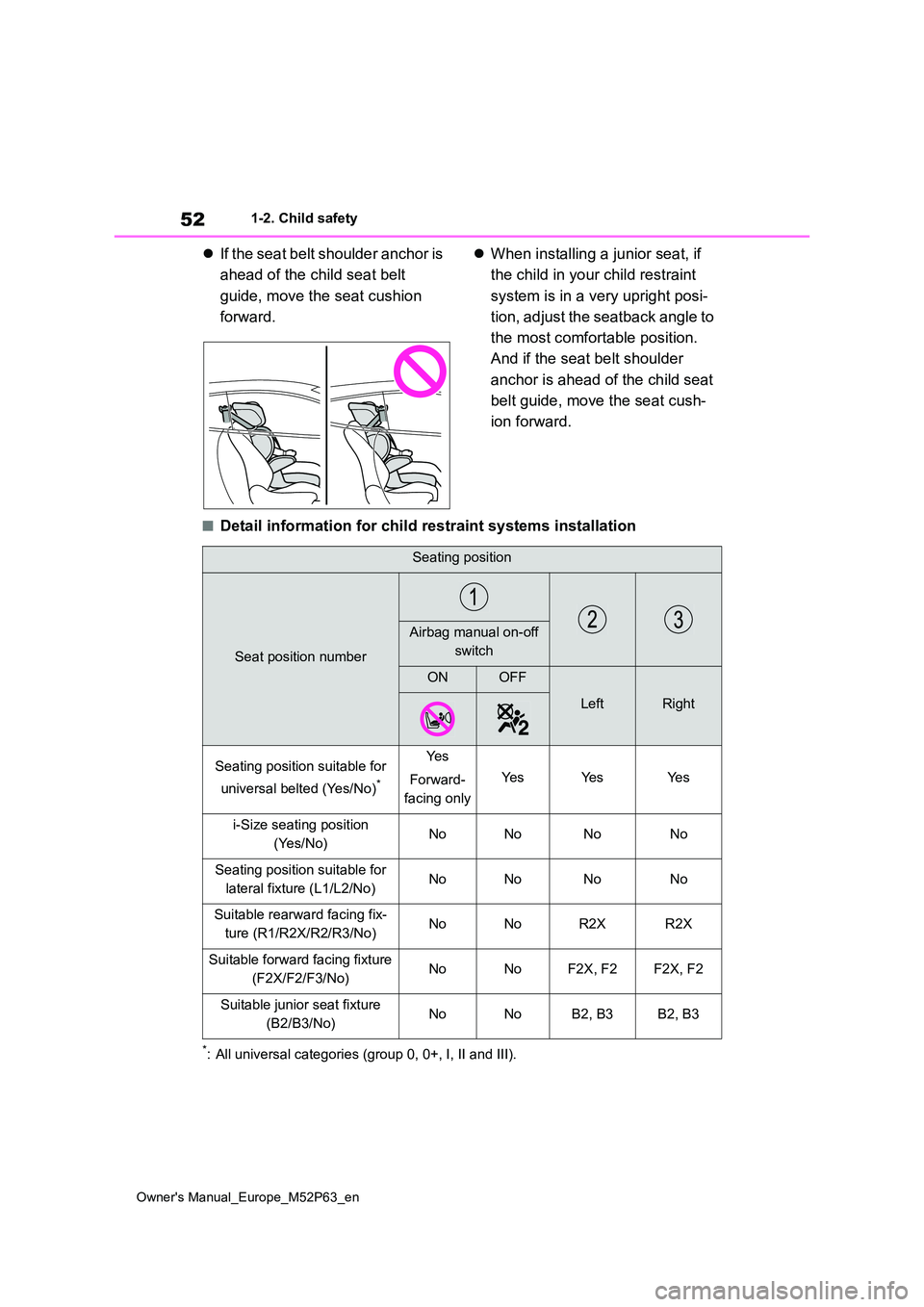
If the seat belt shoulder anchor is
ahead of the child seat belt
guide, move the seat cushion
forward.
When installing a junior seat, if
the child in your child restraint
system is in a very upright posi-
tion, adjust the seatback angle to
the most comfortable position.
And if the seat belt shoulder
anchor is ahead of the child seat
belt guide, move the seat cush-
ion forward.
■Detail information for child r estraint systems installation
*: All universal categories (group 0, 0+, I, II and III).
Seating position
Seat position number
Airbag manual on-off
switch
ONOFF
LeftRight
Seating position suitable for
universal belted (Yes/No)*
Ye s
Forward-
facing only
Ye sYe sYe s
i-Size seating position
(Yes/No)NoNoNoNo
Seating position suitable for
lateral fixture (L1/L2/No)NoNoNoNo
Suitable rearward facing fix-
ture (R1/R2X/R2/R3/No)NoNoR2XR2X
Suitable forward facing fixture
(F2X/F2/F3/No)NoNoF2X, F2F2X, F2
Suitable junior seat fixture
(B2/B3/No)NoNoB2, B3B2, B3
Page 62 of 470
60
Owner's Manual_Europe_M52P63_en
1-3. Emergency assistance
1-3.Emerg ency as sista nce
*1: If equipped
*2: Operates within the eCall coverage.
The system name differs depending
on the country.
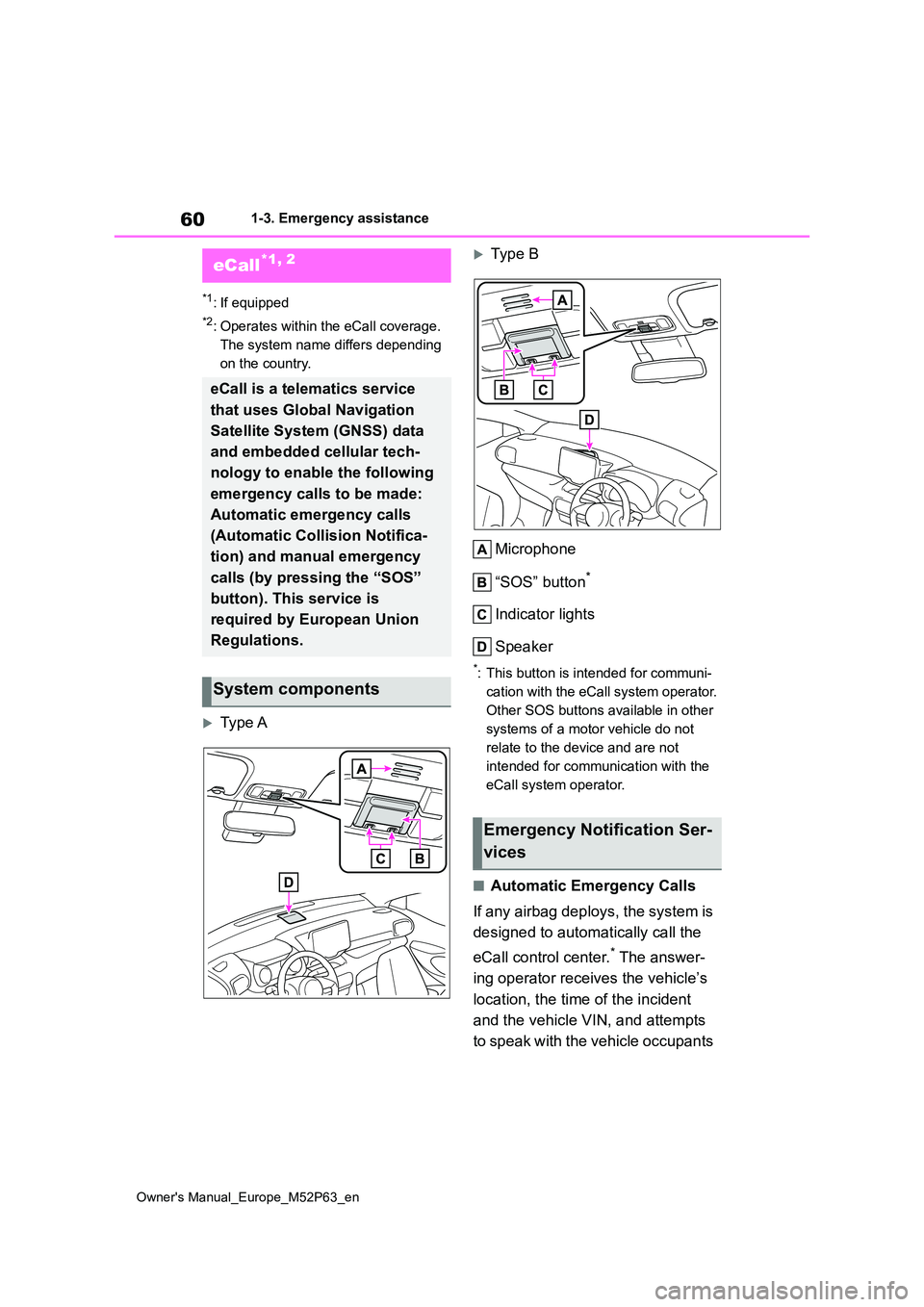
Type A
Typ e B
Microphone
“SOS” button*
Indicator lights
Speaker
*: This button is intended for communi-
cation with the eCall system operator.
Other SOS buttons available in other
systems of a motor vehicle do not
relate to the device and are not
intended for communication with the
eCall system operator.
■Automatic Emergency Calls
If any airbag deploys, the system is
designed to automatically call the
eCall control center.* The answer-
ing operator receives the vehicle’s
location, the time of the incident
and the vehicle VIN, and attempts
to speak with the vehicle occupants
eCall*1, 2
eCall is a telematics service
that uses Global Navigation
Satellite System (GNSS) data
and embedded cellular tech-
nology to enable the following
emergency calls to be made:
Automatic emergency calls
(Automatic Collision Notifica-
tion) and manual emergency
calls (by pressing the “SOS”
button). This service is
required by European Union
Regulations.
System components
Emergency Notification Ser-
vices
Page 64 of 470
62
Owner's Manual_Europe_M52P63_en
1-3. Emergency assistance
WARNING
■When the Emergency Call may not be made
●It may not be possible to make Emergency Calls in any of the fol-lowing situations. In such cases,
report to emergency services pro- vider (112 system etc.) by other means such as nearby public
phones.
• Even when the vehicle is in the cel-
lular phone service area, it may be difficult to connect to the eCall con-trol center if the reception is poor or
the line is busy. In such cases, even though the system attempts to con-nect to the eCall control center, you
may not be able to connect to the eCall control center to make Emer-gency Calls and contact emergency
services.
• When the vehicle is out of the cellu-
lar phone service area, the Emer- gency Calls cannot be made.
• When any related equipment (such as the “SOS” button panel, indicator lights, microphone, speaker, DCM,
antenna, or any wires connecting the equipment) is malfunctioning, damaged or broken, the Emer-
gency Call cannot be made.
• During an Emergency Call, the sys-
tem makes repeated attempts to connect to the eCall control center. However, if it cannot connect to the
eCall control center due to poor radio wave reception, the system may not be able to connect to the
cellular network and the call may finish without connecting. The red indicator light will blink for approxi-
mately 30 seconds to indicate this disconnection.
●If t he b at t er y ’s vo lt a g e d ec r ea se s o r there is a disconnection, the system may not be able to connect to the
eCall control center.
●The Emergency Call system might not work outside of EU area, depending on the available infra-
structure in the country.
■When the Emergency Call sys-
tem is replaced with a new one
The Emergency Call system should be registered. Contact any authorized
Toyota retailer or Toyota authorized repairer, or any reliable repairer.
■For your safety
●Please drive safely.The function of this system is to
assist you in making the Emer- gency Call in case of accidents such as traffic accidents or sudden
medical emergencies, and it does not protect the driver or passengers in any way. Please drive safely and
fasten your seatbelts at all times for your safety.
●In case of an emergency, make lives the top priority.
●If you smell anything burning or other unusual smells, leave the vehicle and evacuate to a safe area
immediately.
●If the airbags deploy when the sys-
tem is operating normally, the sys- tem makes emergency call. The system also makes emergency call
when the vehicle is struck from the r e a r o r r ol l s ov er, ev e n i f t h e a ir b a gs do not deploy.
●For safety, do not make the Emer-gency Call while driving.
Making calls during driving may cause mishandling of the steering wheel, which may lead to unex-
pected accidents. Stop the vehicle and confirm the safety of your surroundings before
making the Emergency Call.