2023 TOYOTA 86 hood open
[x] Cancel search: hood openPage 13 of 449

13Pictorial index
Refueling method ................................................................. P.167
Fuel type/fuel tan k capacity ................................... .............. P.381
Tires.......................................................... ........................... P.312
Tire size/inflation pressure ................................... ................ P.386
Winter tires/tire chain ........................................ ................... P.266
Checking/rotation/tire pressur e warning system ..................P.312
Coping with flat tires......................................... .................... P.358
Hood ........................................................... ......................... P.302
Opening ............................................................................... P.302
Engine oil ..................................................... ........................ P.382
Coping with overheating ...................................................... P.375
Warning messages ............................................... ............... P.357
Headlights..................................................... ...................... P.158
Parking lights/dayt ime running lights .......................... .... P.158
Turn signal lights ............................................. .................. P.155
Side marker lights ............................................. ................. P.158
Stop lights/tail light s/side marker lights/
turn signal lights ........................................................ P.155, 158
License plate lights........................................... ................. P.158
Back up light
Shifting the shift lever to R ........................................... P.150, 153
Light bulbs of the exterior lights for driving
(Replacing method: P.333, Watts: P.387)
Page 81 of 449

811-4. Theft deterrent system
1
For safety and security
■Items to check before lock-
ing the vehicle
To prevent unexpected trigger-
ing of the alarm and vehicle
theft, make sure of the following:
Nobody is in the vehicle.
The windows are closed
before the alarm is set.
No valuables or other per-
sonal items are left in the
vehicle.
■Setting
Close the doors, trunk and hood, and lock both side doors
using the entry function or wire-
less remote control. The system
will set automatically after 30
seconds.
The indicator light changes from
being on to flashing when the sys-
tem is set.
■Canceling or stopping
Do one of the following to deac-
tivate or stop the alarms:
Unlock the doors or open the
trunk using the entry function
or wireless remote control.
Turn the engine switch to
ACC or ON, or start the
engine.
1 Check that both side doors
and the trunk are closed.
2 Turn the engine switch to
ON.
3 Open the driver’s door while
pressing and holding on
the door lock switch and con-
tinue to press for approxi-
Alarm
The alarm’s default setting
is set to off. To use the
alarm, perform the activat-
ing the alarm system proce-
dures.
The alarm uses light and
sound to give an alert when
an intrusion is detected.
The alarm is triggered in the
following situations when
the alarm is set:
A locked door or trunk is
unlocked or opened in any
way other than using the
entry function or wireless
remote control.
The hood is opened.
Setting/canceling/stop-
ping the alarm system
Activating/deactivating
the alarm system
Page 82 of 449
821-4. Theft deterrent system
mately 10 seconds after the
driver’s door has opened.
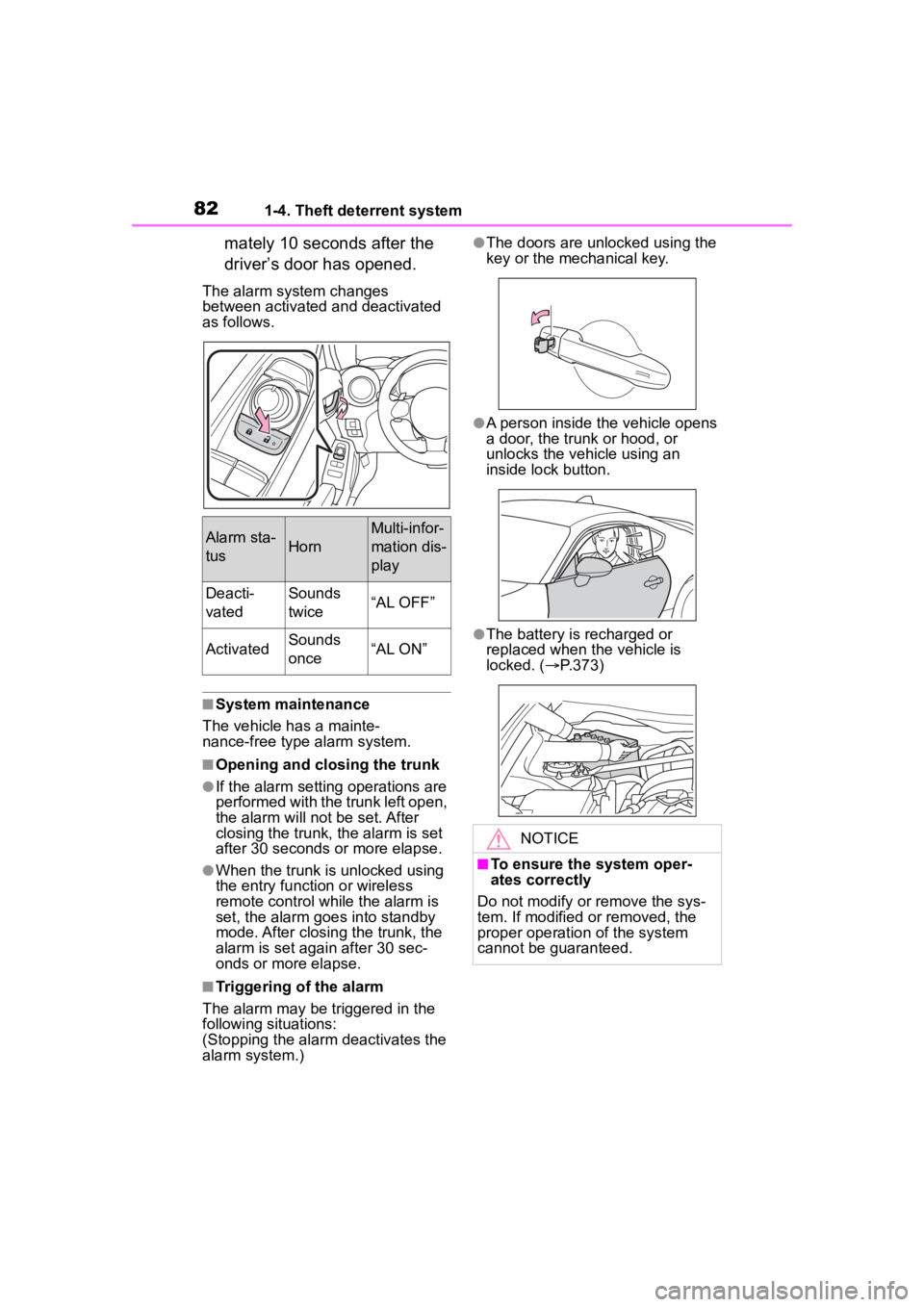
The alarm system changes
between activated and deactivated
as follows.
■System maintenance
The vehicle has a mainte-
nance-free type alarm system.
■Opening and closing the trunk
●If the alarm setting operations are
performed with the trunk left open,
the alarm will not be set. After
closing the trunk, the alarm is set
after 30 seconds or more elapse.
●When the trunk is unlocked using
the entry function or wireless
remote control while the alarm is
set, the alarm goes into standby
mode. After closing the trunk, the
alarm is set again after 30 sec-
onds or more elapse.
■Triggering of the alarm
The alarm may be triggered in the
following situations:
(Stopping the alarm deactivates the
alarm system.)
●The doors are unlocked using the
key or the mechanical key.
●A person inside the vehicle opens
a door, the trunk or hood, or
unlocks the vehicle using an
inside lock button.
●The battery is recharged or
replaced when the vehicle is
locked. ( P.373)
Alarm sta-
tusHorn
Multi-infor-
mation dis-
play
Deacti-
vatedSounds
twice“AL OFF”
ActivatedSounds
once“AL ON”
NOTICE
■To ensure the system oper-
ates correctly
Do not modify or remove the sys-
tem. If modified or removed, the
proper operation of the system
cannot be guaranteed.
Page 302 of 449
3026-3. Do-it-yourself maintenance
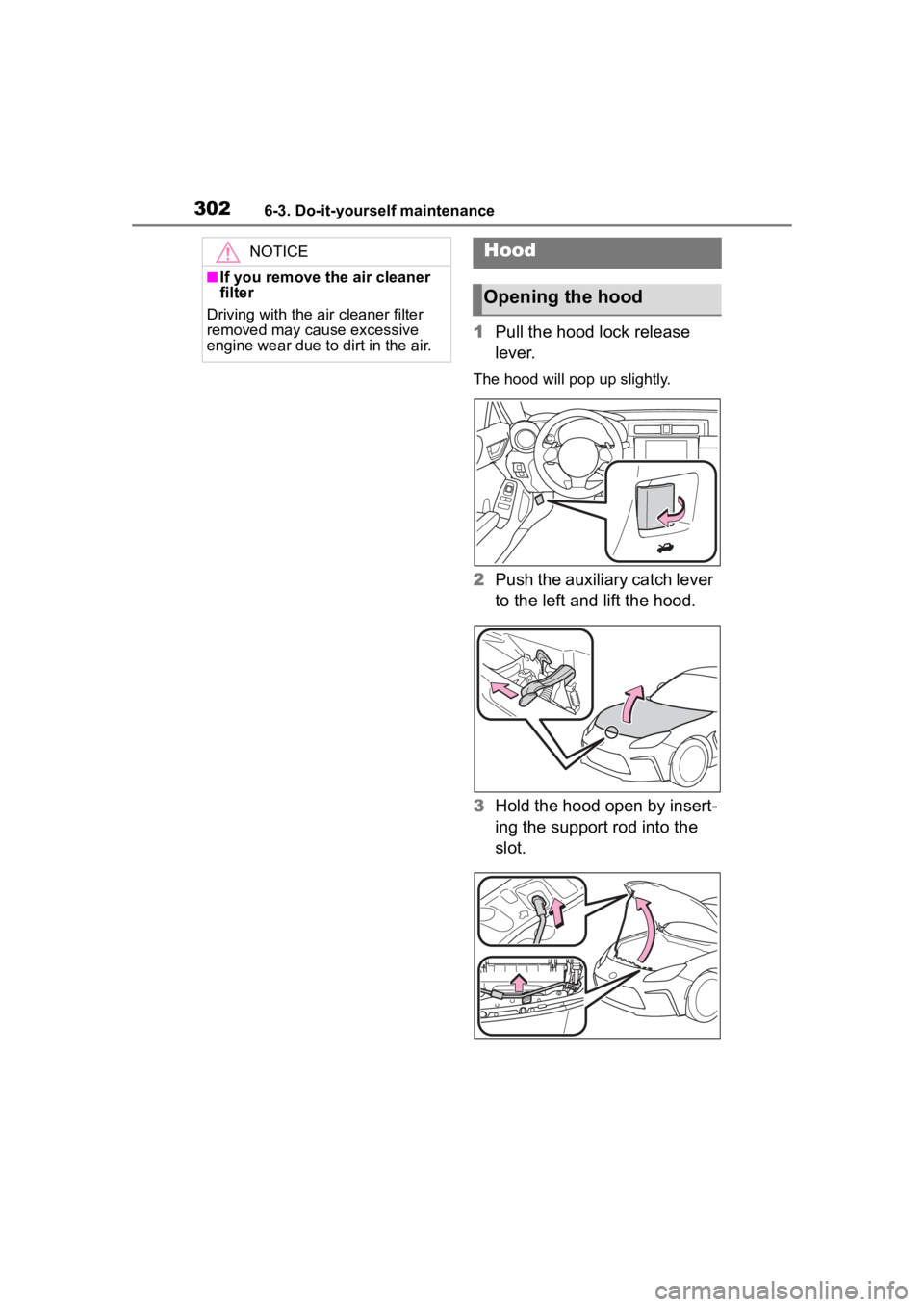
1Pull the hood lock release
lever.
The hood will pop up slightly.
2Push the auxiliary catch lever
to the left and lift the hood.
3 Hold the hood open by insert-
ing the support rod into the
slot.
NOTICE
■If you remove th e air cleaner
filter
Driving with the air cleaner filter
removed may cause excessive
engine wear due to dirt in the air.
Hood
Opening the hood
Page 303 of 449
3036-3. Do-it-yourself maintenance
6
Maintenance and care
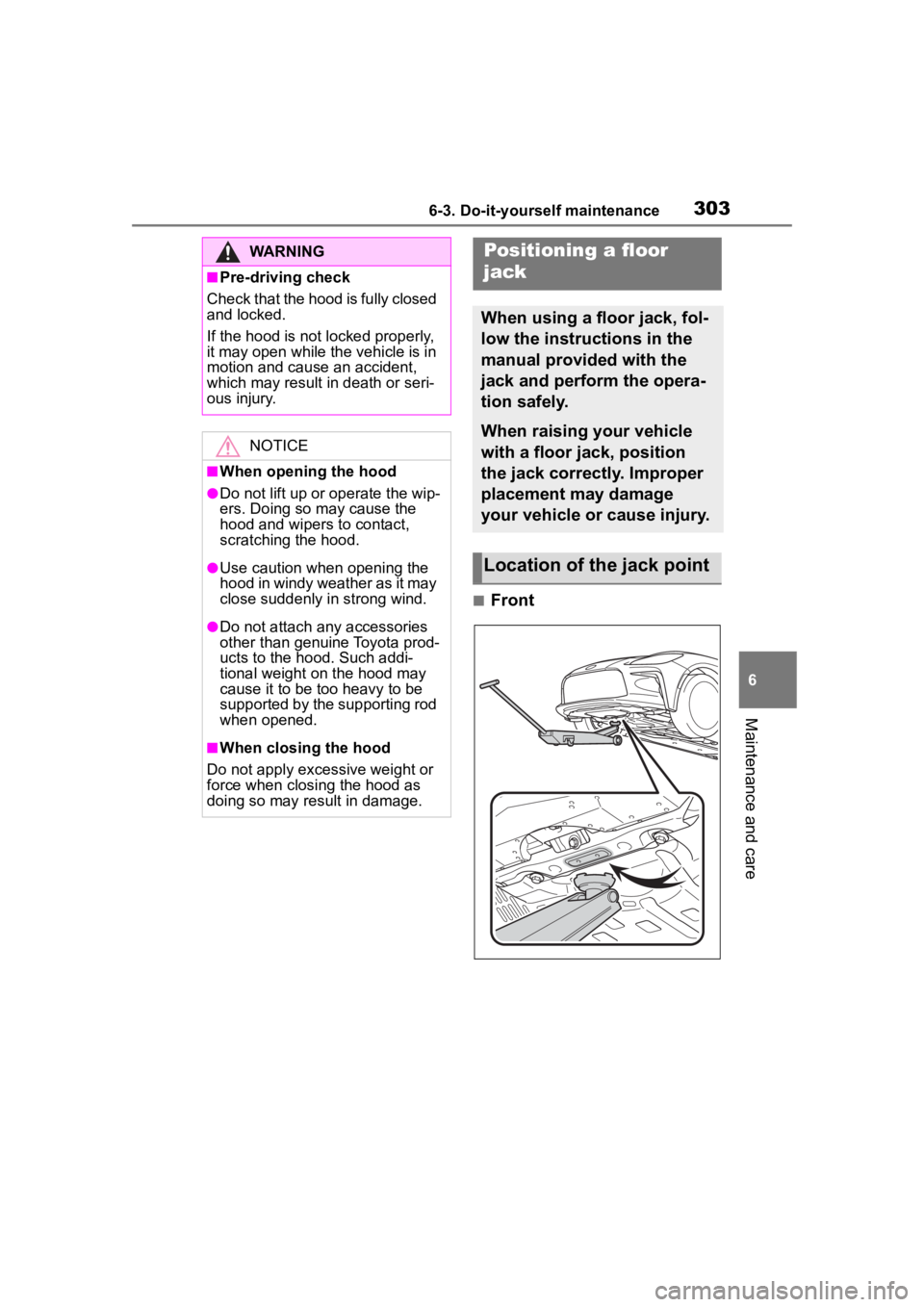
■Front
WARNING
■Pre-driving check
Check that the hood is fully closed
and locked.
If the hood is not locked properly,
it may open while the vehicle is in
motion and cause an accident,
which may result in death or seri-
ous injury.
NOTICE
■When opening the hood
●Do not lift up or operate the wip-
ers. Doing so may cause the
hood and wipers to contact,
scratching the hood.
●Use caution when opening the
hood in windy weather as it may
close suddenly in strong wind.
●Do not attach any accessories
other than genuine Toyota prod-
ucts to the hood. Such addi-
tional weight on the hood may
cause it to be too heavy to be
supported by the supporting rod
when opened.
■When closing the hood
Do not apply excessive weight or
force when closing the hood as
doing so may result in damage.
Positioning a floor
jack
When using a floor jack, fol-
low the instructions in the
manual provided with the
jack and perform the opera-
tion safely.
When raising your vehicle
with a floor jack, position
the jack correctly. Improper
placement may damage
your vehicle or cause injury.
Location of the jack point
Page 372 of 449
3727-2. Steps to take in an emergency
If you have a set of jumper (or
booster) cables and a second
vehicle with a 12-volt battery,
you can jump start your vehicle by following the steps below.
1
Confirm that the electronic
key is being carried.
When connecting the jumper (or
booster) cables, depending on the
situation, the alarm may activate
and doors locked.
2Open the hood. ( P.302)
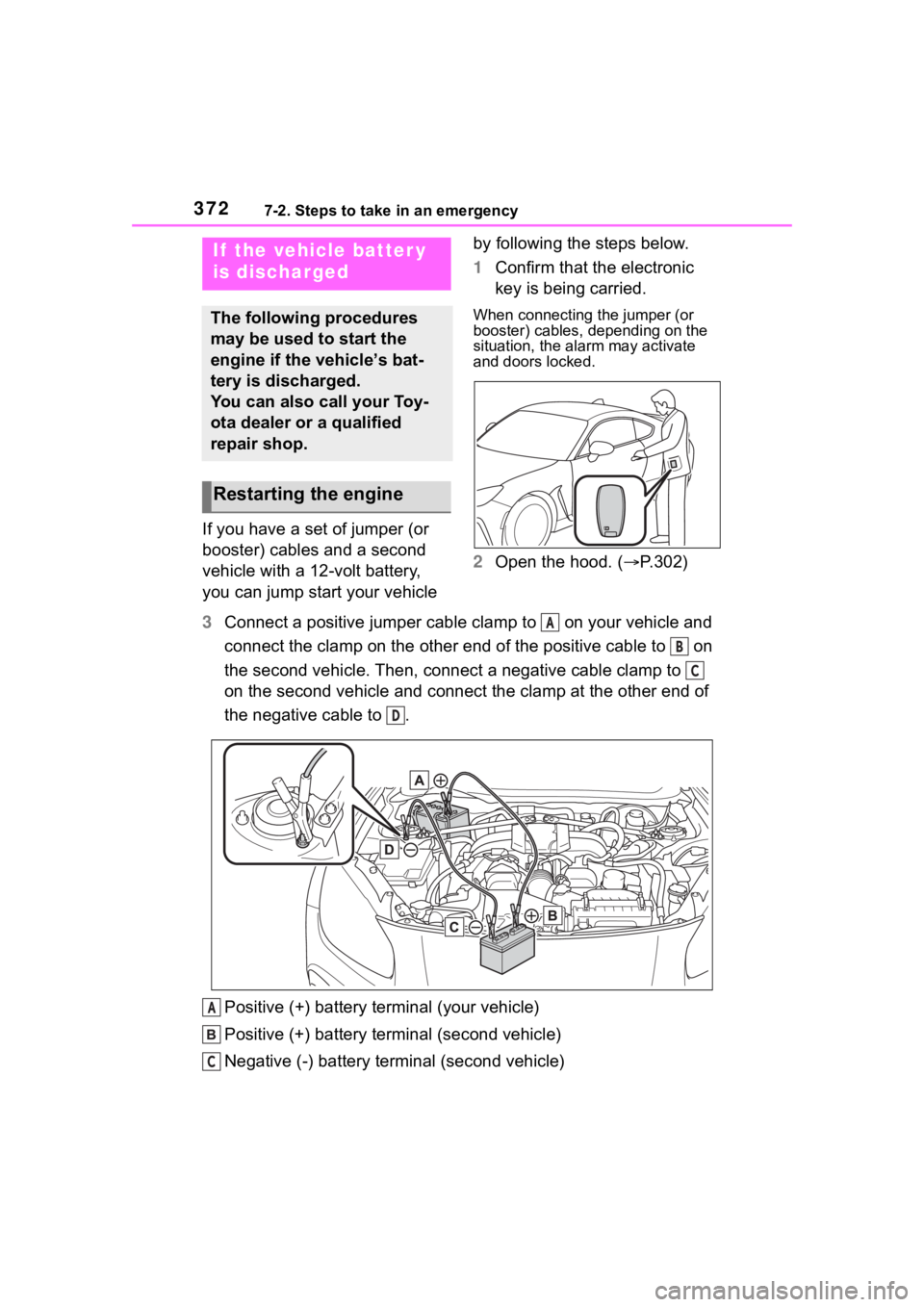
3 Connect a positive jumper cable clamp to on your vehicle and
connect the clamp on the other end of the positive cable to on
the second vehicle. Then, connect a negative cable clamp to
on the second vehicle and connect the clamp at the other end of
the negative cable to .
Positive (+) battery terminal (your vehicle)
Positive (+) battery terminal (second vehicle)
Negative (-) battery term inal (second vehicle)
If the vehicle batter y
is discharged
The following procedures
may be used to start the
engine if the vehicle’s bat-
tery is discharged.
You can also call your Toy-
ota dealer or a qualified
repair shop.
Restarting the engine
A
B
C
D
A
C
Page 376 of 449
3767-2. Steps to take in an emergency
able.
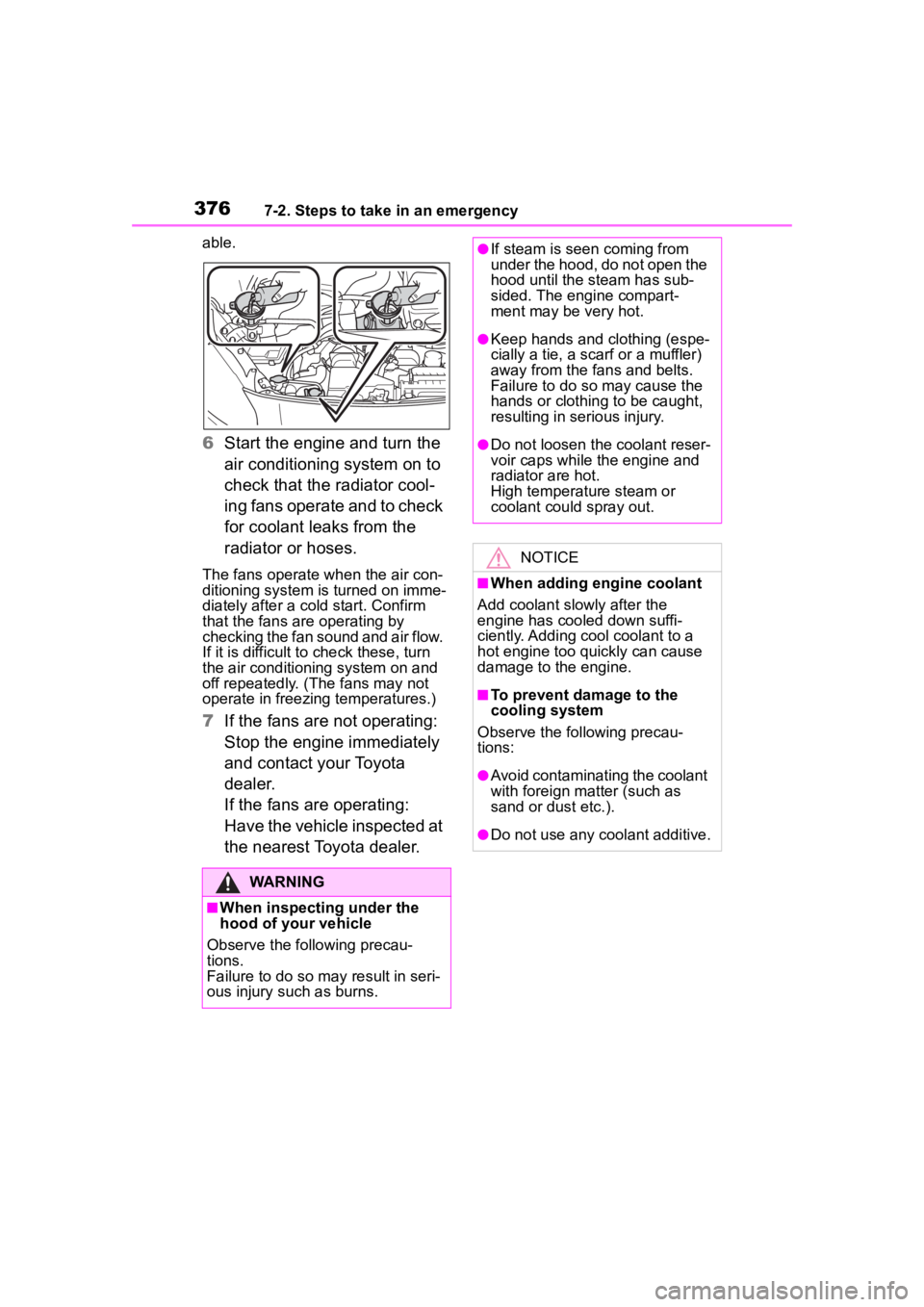
6Start the engine and turn the
air conditioning system on to
check that the radiator cool-
ing fans operate and to check
for coolant leaks from the
radiator or hoses.
The fans operate w hen the air con-
ditioning system is turned on imme-
diately after a cold start. Confirm
that the fans are operating by
checking the fan sound and air flow.
If it is difficult to check these, turn
the air conditioning system on and
off repeatedly. (The fans may not
operate in freezing temperatures.)
7 If the fans are not operating:
Stop the engine immediately
and contact your Toyota
dealer.
If the fans are operating:
Have the vehicle inspected at
the nearest Toyota dealer.
WARNING
■When inspecting under the
hood of your vehicle
Observe the following precau-
tions.
Failure to do so may result in seri-
ous injury such as burns.
●If steam is seen coming from
under the hood, do not open the
hood until the steam has sub-
sided. The engine compart-
ment may be very hot.
●Keep hands and clothing (espe-
cially a tie, a sca rf or a muffler)
away from the fans and belts.
Failure to do so may cause the
hands or clothing to be caught,
resulting in serious injury.
●Do not loosen the coolant reser-
voir caps while the engine and
radiator are hot.
High temperature steam or
coolant could spray out.
NOTICE
■When adding engine coolant
Add coolant slowly after the
engine has cooled down suffi-
ciently. Adding cool coolant to a
hot engine too quickly can cause
damage to the engine.
■To prevent damage to the
cooling system
Observe the following precau-
tions:
●Avoid contaminating the coolant
with foreign matter (such as
sand or dust etc.).
●Do not use any coolant additive.
Page 431 of 449

431Alphabetical Index
Electric Power Steering (EPS)............................................... 262Warning light ........................ 350
Electronic key ......................... 102 Battery-saving fun ction......... 112
If the electronic key does not operate properly ................. 370
Replacing the battery ........... 328
Emergency flashers ............... 338
Emergency tire puncture ....... 358
Emergency, in case of If a warning buzzer sounds .. 348
If a warning light turns on ..... 348
If a warning message is dis-played................................. 357
If the battery is discharged ... 372
If the electronic key does not operate properly ................. 370
If the engin e will not start ..... 367
If the fuel filler door cannot be opened ............................... 369
If the vehicle is submerged or water on the road is rising .. 339
If you have a flat tire ............. 358
If you lose your keys ............ 369
If you think something is wrong ........................................... 346
If your vehicle becomes stuck ........................................... 377
If your vehicle has to be stopped in an emergency................. 338
If your vehicle needs to be towed ........................................... 341
If your vehicle overheats ...... 375
Engine ACCESSORY mode ............. 147
Compartment ....................... 305
Engine switch ....................... 145
Fuel pump shut off system ... 347
Hood..................................... 302
How to start the engine ........ 145
Identification number ............ 381 If the engine will not start......367
If your vehicle has to be stopped
in an emergency .................338
Ignition switch (engine switch) ...........................................145
Overheating ..........................375
Tachometer.............................88
Engine coolant Capacity ...............................383
Checking ..............................307
Preparing and checking before winter ..................................266
Engine coolant temperature gauge .......................................88
Engine immobilizer system .....80
Engine oil Capacity ...............................382
Checking ..............................305
Preparing and checking before winter ..................................266
Warning light.........................349
Engine oil temperature gauge .94
Engine switch .........................145 Auto power off fun ction .........148
Changing the engine switch modes.................................147
If your vehicle has to be stopped in an emergency .................338
EPS (Electric Po wer Steering)
...............................................262 Warning light.........................350
Event data recorder (EDR) .........7
EyeSight ..................................170 Adaptive Cruise Control .......190
Conventional Cruise Control 207
Lane Departure Warning ......220
Lane Sway Warning .............222
Lead Vehicle Start Alert ........224
Malfunction ...........................228
Pre-Collision Braking System...........................................179