2023 TOYOTA 4RUNNER flat tire
[x] Cancel search: flat tirePage 475 of 608
4757-2. Steps to take in an emergency
7
When trouble arises
4RUNNER (U)
●Fluid leaks un der the vehicle.
(Water dripping from the air conditioning a fter use is normal.)
● Flat-looking tires or uneven tire wear
● Engine coolant temperature gauge needle continually points high er
than normal.
● Changes in exhaust sound
● Excessive tire squeal when cornering
● Strange noises related to the suspension system
● Pinging or other noises related to the engine
● Engine missing, stumb ling or running roughly
● Appreciable loss of power
● Vehicle pulls heavily to one side when braking
● Vehicle pulls heavily to one s ide when driving on a level road
● Loss of brake effectiveness, spongy feeling, pedal almost touch es
the floor
If you think something is wrong
If you notice any of the followi ng symptoms, your vehicle proba -
bly needs adjustment or repair. Contact your Toyota dealer as
soon as possible.
Visible symptoms
Audible symptoms
Operational symptoms
Page 481 of 608
4817-2. Steps to take in an emergency
7
When trouble arises
4RUNNER (U)
(Flashes or
illuminates)
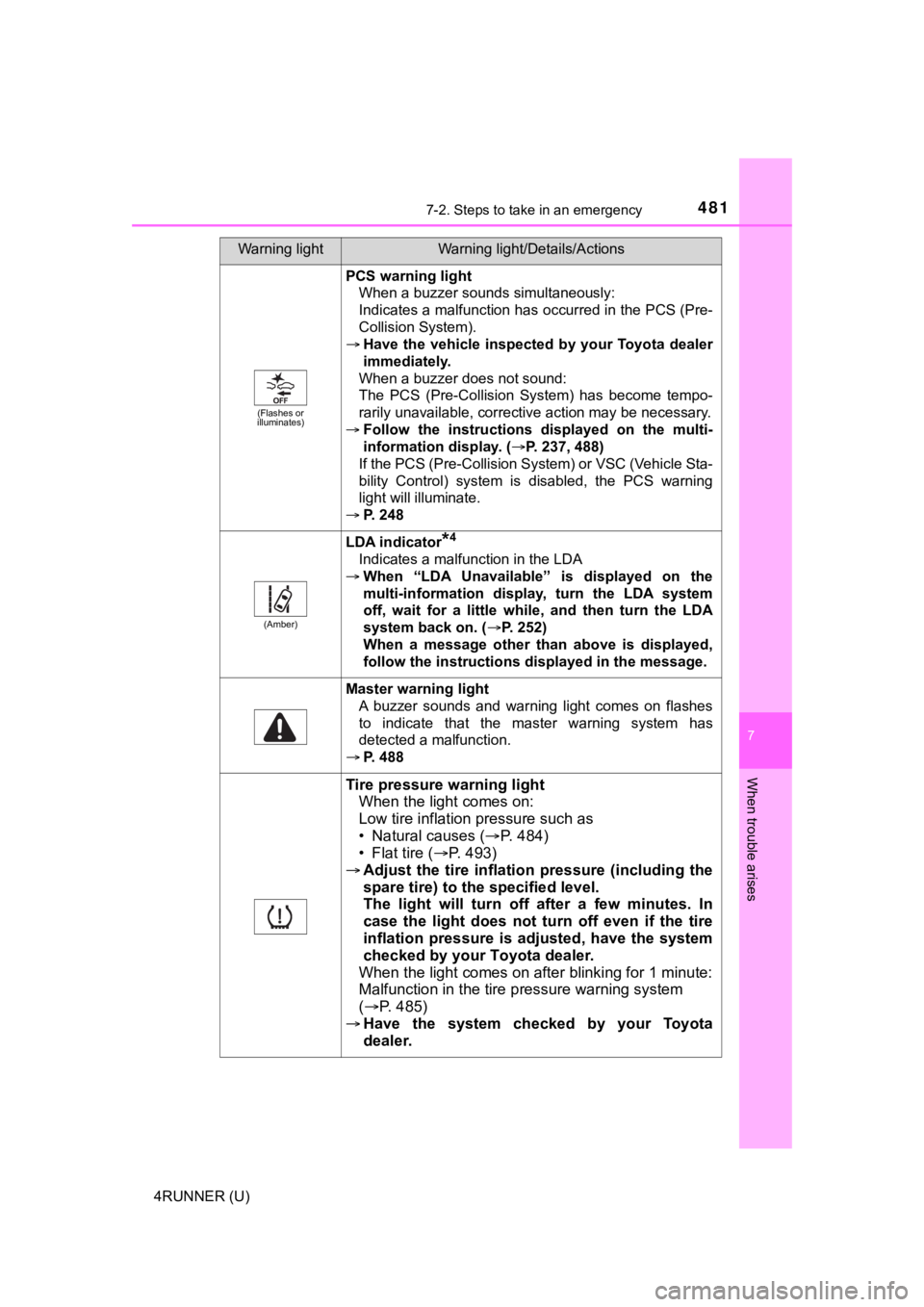
PCS warning light
When a buzzer sounds simultaneously:
Indicates a malfunction has occurred in the PCS (Pre-
Collision System).
Have the vehicle inspected by your Toyota dealer
immediately.
When a buzzer does not sound:
The PCS (Pre-Collision System) has become tempo-
rarily unavailable, corrective action may be necessary.
Follow the instructions displayed on the multi-
information display. ( P. 237, 488)
If the PCS (Pre-Collision System) or VSC (Vehicle Sta-
bility Control) system is disabled, the PCS warning
light will illuminate.
P. 248
(Amber)
LDA indicator*4
Indicates a malfunction in the LDA
When “LDA Unavailable” is displayed on the
multi-information display, turn the LDA system
off, wait for a little while, and then turn the LDA
system back on. ( P. 252)
When a message other than above is displayed,
follow the instructions displayed in the message.
Master warning light
A buzzer sounds and warning light comes on flashes
to indicate that the master warning system has
detected a malfunction.
P. 488
Tire pressure warning light
When the light comes on:
Low tire inflation pressure such as
• Natural causes ( P. 4 8 4 )
• Flat tire ( P. 493)
Adjust the tire inflation pressure (including the
spare tire) to the specified level.
The light will turn off after a few minutes. In
case the light does not turn off even if the tire
inflation pressure is adjusted, have the system
checked by your Toyota dealer.
When the light comes on after blinking for 1 minute:
Malfunction in the tire p ressure warning system
( P. 4 8 5 )
Have the system checked by your Toyota
dealer.
Warning lightWarning light/Details/Actions
Page 484 of 608

4847-2. Steps to take in an emergency
4RUNNER (U)■
When the tire pressure warning light comes on
Inspect the appearance of the ti
re to check that the tire is not punctured.
If the tire is punctured: P. 493
If the tire is not punctured:
Carry out the following procedure after the tire temperature has lowered
sufficiently.
●Check the tire inflation pressure and adjust to the appropriate level.
●If the warning light does not go out even after several minutes , check
that the tire inflation pressure is at the specified level and carry out ini-
tialization. ( P. 4 2 9 )
The warning light may come on again if the above operations are con-
ducted without first allowing t he tire temperature to lower suf ficiently.
■The tire pressure warning light may come on due to natural caus es
The tire pressure warning light may come on due to natural caus es such
as natural air leaks and tire inflation pressure changes caused by tem-
perature. In this case, adjusting the tire inflation pressure w ill turn off the
warning light (afte r a few minutes).
■When a tire is replace d with a spare tire
Vehicles without P245/60R20 tires
The spare tire is not equipped with a tire pressure warning val ve and
transmitter. If a tire goes flat, the tire pressure warning lig ht will not turn off
even though the flat tire has been replaced with the spare tire . Replace
the spare tire with the repaired tire and adjust the tire infla tion pressure.
The tire press ure warning light will go off after a few minutes.
Vehicles with P245/60R20 tires
The spare tire is also equipped with a tire pressure warning va lve and
transmitter. The tire pressure warning light will turn on if the tire inflation
pressure of the spare tire is low. If a tire goes flat, the tire pressure warn-
ing light will not turn off even though the flat tire has been replaced with
the spare tire. Replace the spar e tire with the repaired tire and adjust the
tire inflation pressure. The t ire pressure warning light will go off after a few
minutes.
Page 485 of 608

4857-2. Steps to take in an emergency
7
When trouble arises
4RUNNER (U)■
If the tire pressure warning system is not functioning
The tire pressure warning syst
em will be disabled in the follow ing condi-
tions:
(When the condition becomes normal, the system will work properly.)
●If tires not equipped with tire pressure warning valves and tra nsmitters
are used
●If the ID code on the tire pressure warning valves and transmit ters is not
registered in the tire pr essure warning computer
●If the tire inflation pressure is 73 psi (500 kPa, 5.1 kgf/cm2 or bar) or
higher
The tire pressure warning system may be disabled in the followi ng condi-
tions:
(When the condition becomes normal, the system will work properly.)
●If electronic devices or facilitie s using similar radio wave frequencies are
nearby
●If a radio set at a similar frequency is in use in the vehicle
●If a window tint that affects the radio wave signals is installed
●If there is a lot of snow or ice on the vehicle, particularly around the
wheels or wheel housings
●If non-genuine Toyota wheels are used (Even if you use Toyota wheels,
the tire pressure warning system may not work properly with som e types
of tires.)
●If tire chains are used
●Vehicles with P245/60R20 tires: If the spare tire is in a locat ion subject
to poor radio wave signal reception
●Vehicles with P245/60R20 tires : If a large metallic object whic h can
interfere with signal reception is put in the luggage compartme nt
■If the tire pressure warning light frequently comes on after bl inking
for 1 minute
If the tire pressure warning light frequently comes on after bl inking for 1
minute when the engine switch is turned on, have it checked by your
Toyota dealer.
■ Customization that can be configured at Toyota dealer
The vehicle speed linked seat belt reminder buzzer can be disab led.
(Customizable features P. 549) However, Toyota recommends that the seat
belt reminder buzzer be operational to alert the driver and fro nt passenger
when seat belts are not fastened.
Page 486 of 608
4867-2. Steps to take in an emergency
4RUNNER (U)
WARNING
■If the tire pressure warning light comes on
Be sure to observe the following precautions. Failure to do so could
cause a loss of vehicle control and result in death or serious injury.
●Stop your vehicle in a safe place as soon as possible. Adjust the tire
inflation pressure immediately.
●If the tire pressure warning light comes on even after tire inf lation pres-
sure adjustment, it is probable that you have a flat tire. Chec k the tires.
If a tire is flat, change it with the spare tire and have the flat tire
repaired by the nearest Toyota dealer.
●Avoid abrupt maneuvering and braking. If the vehicle tires dete riorate,
you could lose control of the steering wheel or the brakes.
■If a blowout or sudden air leakage should occur
The tire pressure warning system may not activate immediately.
■Maintenance of the tires
Each tire, including the spare (if provided), should be checked monthly
when cold and inflated to the inflation pressure recommended by the
vehicle manufacturer on the vehicle placard or tire inflation p ressure
label (tire and load information label). (If your vehicle has t ires of a dif-
ferent size than the size indicated on the vehicle placard or t ire inflation
pressure label [tire and load information label], you should de termine
the proper tire inflation p ressure for those tires.)
As an added safety feature, your vehicle has been equipped with a tire
pressure monitoring system (TPMS -tire pressure warning system) that
illuminates a low tire pressure telltale (tire pressure warning light) when
one or more of your tires is significantly under-inflated. Acco rdingly,
when the low tire pressure telltale (tire pressure warning ligh t) illumi-
nates, you should stop and check your tires as soon as possible , and
inflate them to the proper pressure. Driving on a significantly under-
inflated tire causes the tire to overheat and can lead to tire failure.
Under-inflation also reduces fuel efficiency and tire tread lif e, and may
affect the vehicle’s handling and stopping ability.
Please note that the TPMS (tire pressure warning system) is not a sub-
stitute for proper tire maintenance, and it is the driver’s res ponsibility to
maintain correct tire pressure, even if under-inflation has not reached
the level to trigger illumination of the TPMS low tire pressure telltale (tire pressure warning light).
Page 493 of 608
4937-2. Steps to take in an emergency
7
When trouble arises
4RUNNER (U)
●Phillips screwdriver
● Stop the vehicle in a safe place on a hard, flat surface.
● Set the parking brake.
● Shift the shift lever to P.
● Stop the engine.
● Turn on the emergency flashers. ( P. 466)
If you have a flat tire
Your vehicle is equipped with a spare tire. The flat tire can be
replaced with the spare tire.
For details about tires: P. 4 2 7
WARNING
■If you have a flat tire
Do not continue driving with a flat tire.
Driving even a short distance wit h a flat tire can damage the tire and the
wheel beyond repair, which cou ld result in an accident.
You will need the following item:
Before jacking up the vehicle
Page 495 of 608

4957-2. Steps to take in an emergency
7
When trouble arises
4RUNNER (U)
WARNING
■Using the tire jack
Improper use of the tire jack may cause the vehicle to suddenly fall off
the jack, leading to death or serious injury.
●Do not use the tire jack for any purpose other than replacing t ires or
installing and removing tire chains.
●Only use the tire jack that comes with this vehicle for replacing a flat
tire.
Do not use it on other vehicles, and do not use other tire jacks for
replacing tires on this vehicle.
●Always check that the tire jack is securely set to the jack poi nt.
●Do not put any part of your body under the vehicle while it is supported
by the jack.
●Do not start or run the engine while your vehicle is supported by the
jack.
●Do not raise the vehicle w hile someone is inside.
●When raising the vehicle, do not put an object on or under the jack.
●Do not raise the vehicle to a height greater than that required to
replace the tire.
●Use a jack stand if it is necessary to get under the vehicle.
Vehicles with Automatic running boards
●Observe the following precautions. Failure to do so may result in seri-
ous injury:
• When jacking up the vehicle, always turn the Automatic running boards switch off.
• When jacking up the vehicle, do not use an Automatic running b oard
as a jack point. The Automatic running board may break, causing
injuries.
Take particular care when lowering the vehicle to ensure that n o one
working on or near the vehicle may be injured.
■Using the jack handle/wheel nu t wrench (used with jack handle)
Tighten all the jack handle bolts securely to prevent the extension parts
from coming apart unexpectedly.
Page 500 of 608
5007-2. Steps to take in an emergency
4RUNNER (U)
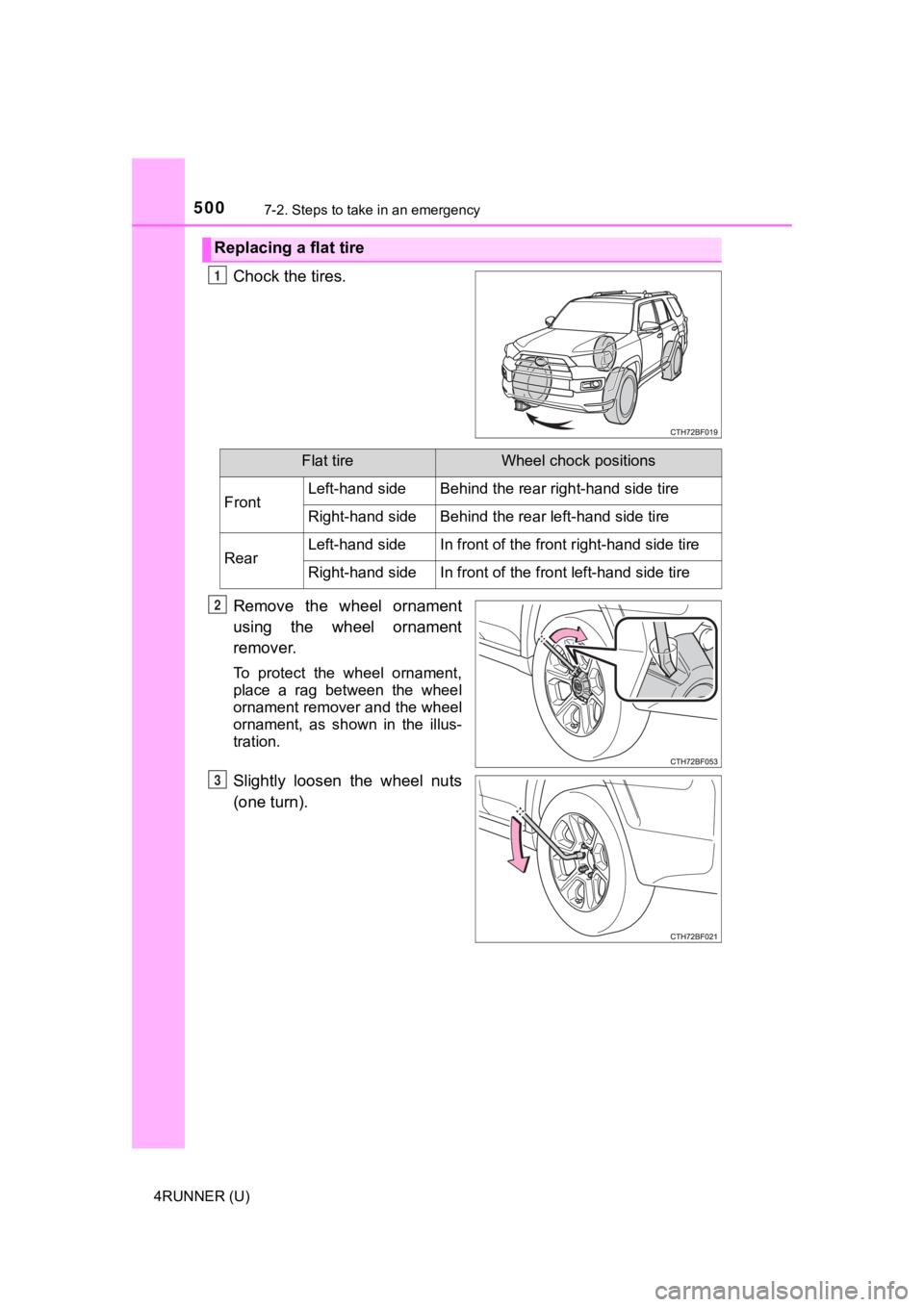
Chock the tires.
Remove the wheel ornament
using the wheel ornament
remover.
To protect the wheel ornament,
place a rag between the wheel
ornament remover and the wheel
ornament, as shown in the illus-
tration.
Slightly loosen the wheel nuts
(one turn).
Replacing a flat tire
1
Flat tireWheel chock positions
FrontLeft-hand sideBehind the rear right-hand side tire
Right-hand sideBehind the rear left-hand side tire
RearLeft-hand sideIn front of the front right-hand side tire
Right-hand sideIn front of the front left-hand side tire
2
3