2023 SUBARU BRZ ignition
[x] Cancel search: ignitionPage 236 of 432

Starting and Stopping Engine
230On rare occasions, it may be difficult
to start the engine depending on the
fuel and the usage condition (repeated
driving of a distance in which the
engine has not warmed up suffi-
ciently). In such a case, it is recom-
mended that you change to a different
brand of fuel.
On rare occasions, transient
knocking may be heard from the
engine when the accelerator is oper-
ated rapidly such as a rapid start-up
and a rapid acceleration. This is not a
malfunction.
The engine starts more easily when
the headlights, air conditioner and rear
window defogger are turned off.■ Starting Engine
NOTEWhen pressing the push-button
ignition switch while depressing the
clutch pedal (MT models) or the brake
pedal (AT models): - The engine starter operates for a
maximum of 10 seconds and after
starting the engine, the starter stops
automatically.
- The engine can be started
regardless of the power status.
If the engine does not start, check
the security indicator light. Then press
the push-button ignition switch
without depressing the clutch pedal
(MT models) or the brake pedal (AT
models) to switch the power to “OFF”. - If the light had illuminated, try to
start the engine again.
- If the light had been off, press the
push-button ignition switch while
depressing the clutch pedal (MT
models) or the brake pedal (AT
models) more forcefully.
The engine start procedures may
not function depending on the radio
wave conditions around the vehicle. In
such a case, refer to "Starting Engine"
P326.
If the vehicle battery is discharged,
the steering cannot be unlocked.
Charge the battery.
WARNING
There are some general precau-
tions when starting the engine.
Carefully read the precautions
described in "General Precau-
tions When Starting Engine"
P229. If the steering lock cannot be
released after the engine has
started, never drive the vehicle.
The steering is still locked, and it
may result in an accident.
CAUTION
If a system malfunction warning
message is displayed on the
combination meter, there may be
a malfunction with the vehicle.
Contact a SUBARU dealer imme-
diately. If a steering lock warning
message is displayed on the
combination me ter after the
engine has started, it means that
the steering is still locked. While
moving the steering wheel right
and left, depress the brake pedal,
and press the push-button igni-
tion switch. Do not continue pressing the
push-button ignition switch for
more than 10 seconds. Doing so
could cause a malfunction. If the
engine does not start, stop
pressing the push -button ignition
switch. Instead, press the push-
button ignition switch without
depressing the clutch pedal (MT
models) or the brake pedal (AT
models) to switch the power
status to “OFF”. Wait 10 seconds,
and then press the push-button
ignition switch to start the
engine.
BRZ_U.book 230 ページ 2022年3月29日 火曜日 午後3時59分
Page 237 of 432
Starting and Stopping Engine
231
Starting and Operating7
– CONTINUED –
After the engine starts, the engine
speed will be kept high.
Do not shift the select lever (AT
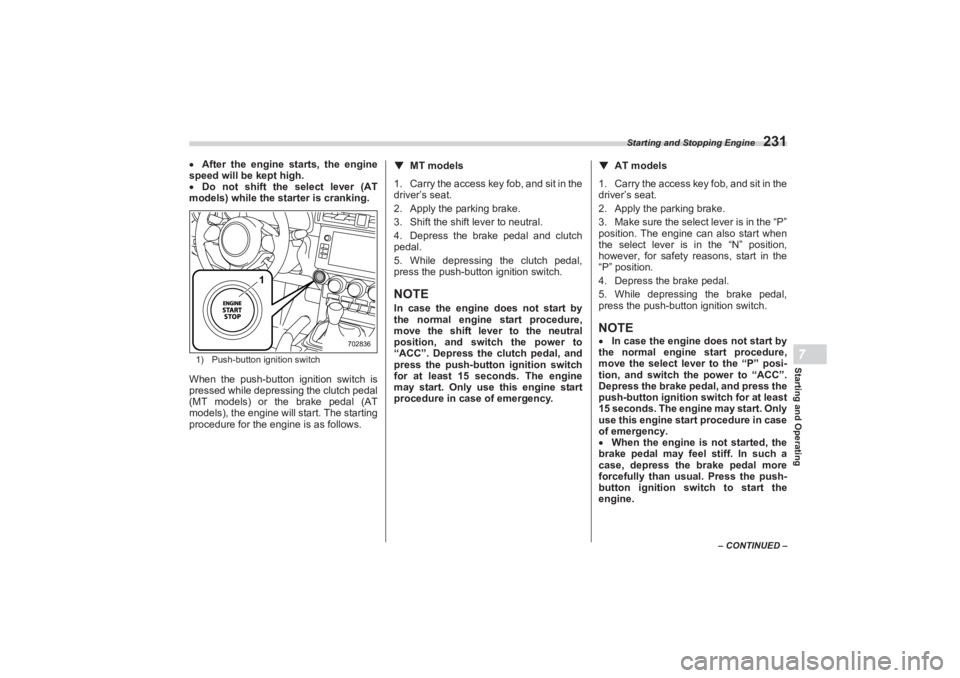
models) while the starter is cranking.1) Push-button ignition switchWhen the push-button ignition switch is
pressed while depressing the clutch pedal
(MT models) or the brake pedal (AT
models), the engine will start. The starting
procedure for the engine is as follows.
▼ MT models
1. Carry the access key fob, and sit in the
driver’s seat.
2. Apply the parking brake.
3. Shift the shift lever to neutral.
4. Depress the brake pedal and clutch
pedal.
5. While depressing the clutch pedal,
press the push-button ignition switch.NOTEIn case the engine does not start by
the normal engine start procedure,
move the shift lever to the neutral
position, and switch the power to
“ACC”. Depress the clutch pedal, and
press the push-butto n ignition switch
for at least 15 seconds. The engine
may start. Only use this engine start
procedure in case of emergency. ▼
AT models
1. Carry the access key fob, and sit in the
driver’s seat.
2. Apply the parking brake.
3. Make sure the select lever is in the “P”
position. The engine can also start when
the select lever is in the “N” position,
however, for safety reasons, start in the
“P” position.
4. Depress the brake pedal.
5. While depressing the brake pedal,
press the push-button ignition switch.NOTE In case the engine does not start by
the normal engine start procedure,
move the select lever to the “P” posi-
tion, and switch th e power to “ACC”.
Depress the brake pedal, and press the
push-button ignition switch for at least
15 seconds. The engine may start. Only
use this engine start procedure in case
of emergency.
When the engine is not started, the
brake pedal may feel stiff. In such a
case, depress the brake pedal more
forcefully than usual. Press the push-
button ignition switch to start the
engine.
1
702836
BRZ_U.book 231 ページ 2022年3月29日 火曜日 午後3時59分
Page 238 of 432
Starting and Stopping Engine
232■Stopping Engine1. Stop the vehicle completely.
2. Move the shift lever to neutral (MT
models) or select leve r to the “P” position
(AT models).
3. Press the push-button ignition switch.
The engine will stop, and the power will be
switched off.
NOTEAlthough you can stop the engine by
operating the push -button ignition
switch, do not stop the engine during
driving except in an emergency.■ When Access Key Fob Does
Not Operate ProperlyRefer to "Access Key Fob – If Access Key
Fob Does Not Operate Properly" P325.■ Steering LockAfter stopping the engine and any door is
opened, the steering wheel will be locked
due to the steering lock function.
When the engine is restarted, the steering
lock will be automatically released.
WARNING
Do not touch the push-button
ignition switch during driving.
When the push-button ignition
switch is operated as follows, the
engine will stop.–The switch is pressed and held
for 2 seconds or longer.–The switch is pressed briefly 3
times or more in succession.When the engine stops, the brake
booster will not function. A
greater foot pressure will be
required on the brake pedal.The power steering system will
not operate either. A greater
force will be required to steer,
and it may result in an accident.
If the engine stops during driving,
do not operate the push-button
ignition switch or open any of the
doors until the vehicle is stopped
in a safe location. It is dangerous
because the steering lock may be
activated. Stop the vehicle in a
safe place, and contact a
SUBARU dealer immediately.
CAUTION
For AT models:Do not stop the engine while the
select lever is in a position other
than the “P” position. If the engine is stopped while the
select lever is in a position other
than the “P” position, the power
will be in “ACC”. If the vehicle is
left in this cond ition, the battery
may be discharged.
BRZ_U.book 232 ページ 2022年3月29日 火曜日 午後3時59分
Page 239 of 432
Manual Transmission
233
Starting and Operating7
– CONTINUED –
▼When the steering lock cannot be
released1) Push-button ignition switchWhen you cannot restart the engine due
to the steering lock, check the status of
operation indicator and perform the
following steps.
▽How to released steering lock
1. Check that the shift lever is set in
neutral (MT models) or select lever is set
in the “P” position (AT models).
2. Depress the brake pedal and keep it.
3. Press the push-button ignition switch
while turning the steering wheel left and
right. ▽
When the display of warning
messages
There may be a malfunction in the
steering lock function. Immediately
contact your nearest SUBARU dealer.
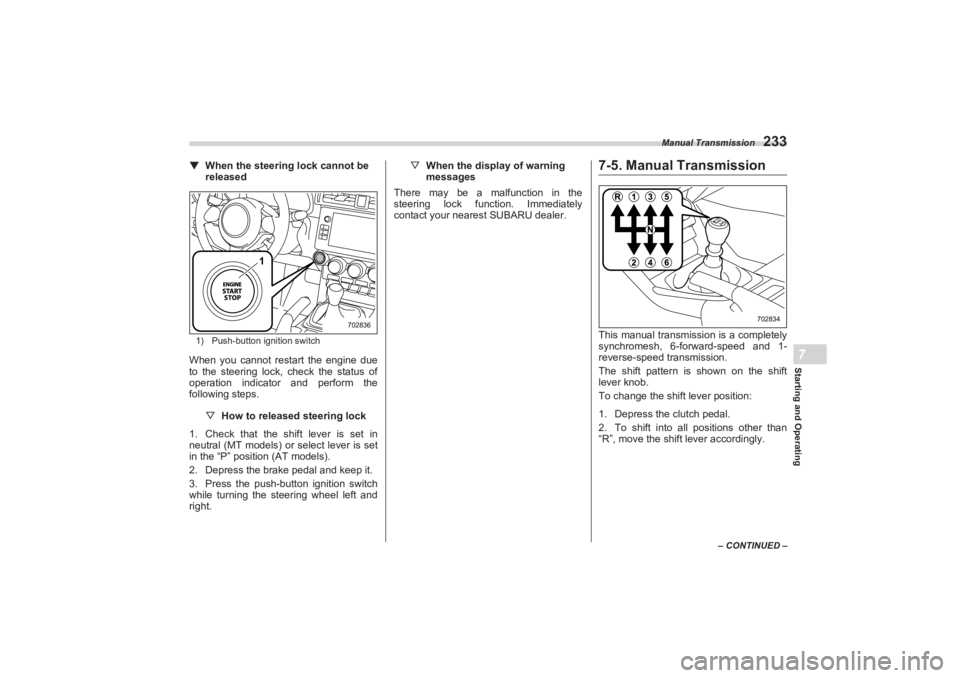
7-5. Manual TransmissionThis manual transmission is a completely
synchromesh, 6-forward-speed and 1-
reverse-speed transmission.
The shift pattern is shown on the shift
lever knob.
To change the shift lever position:
1. Depress the clutch pedal.
2. To shift into all positions other than
“R”, move the shi ft lever accordingly.
1
702836
702834
BRZ_U.book 233 ページ 2022年3月29日 火曜日 午後3時59分
Page 242 of 432
Automatic Transmission
236NOTEWhen the engine coolant tempera-
ture is still low, the transmission will
shift at higher engine speeds than
when the coolant temperature is suffi-
ciently high in order to shorten the
warm-up time and improve driveability.
The gearshift timing will automatically shift to the normal
timing after the
engine has warmed up.
Immediately after transmission fluid
is replaced, you may feel that the trans-
mission operation is somewhat
unusual. This results from invalidation
of data which the on-board computer
has collected and stored in memory to
allow the transmission to shift at the
most appropriate times for the current
condition of your vehicle. Optimized
shifting will be restored as the vehicle
continues to be driven for a while.
Place the shift boot to the original
position after it is lifted. If the shift lever
is operated with the shift boot in the
rolled up position, the shift boot may
have tension and it may disturb the
shift lever operation.
When the vehicle is idling at high
rpm in order to warm up, and the
vehicle is on a slippery road, the trans-
mission may automatically shift to 2nd
gear for stopping and starting off.
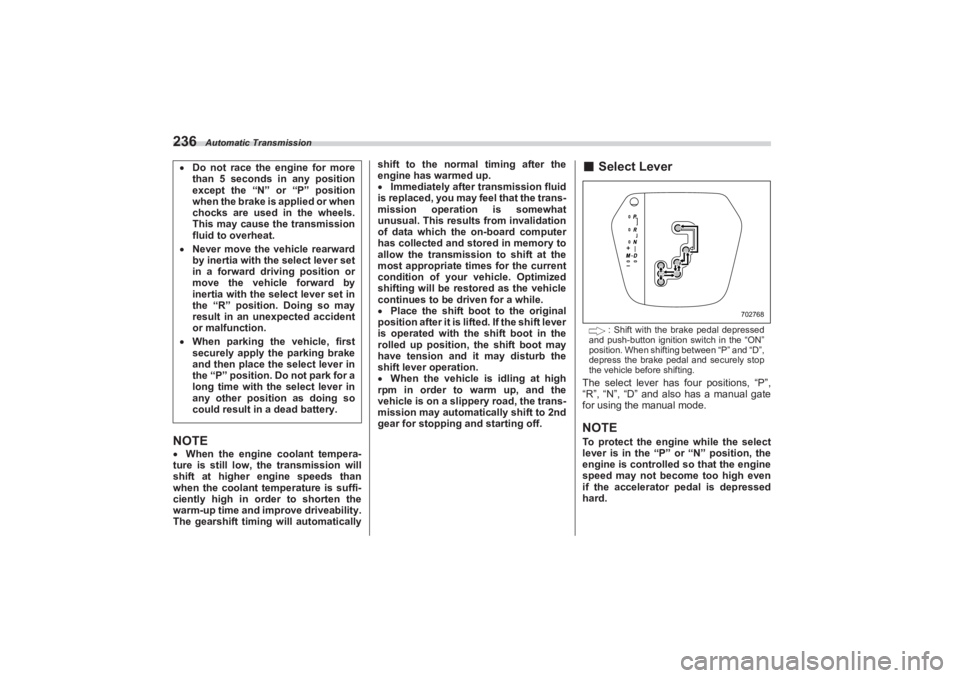
■ Select Lever
: Shift with the brake pedal depressed
and push-button ignition switch in the “ON”
position. When shifting between “P” and “D”,
depress the brake pedal and securely stop
the vehicle before shifting.
The select lever has four positions, “P”,
“R”, “N”, “D” and also has a manual gate
for using the manual mode.NOTETo protect the engine while the select
lever is in the “P” or “N” position, the
engine is controlled so that the engine
speed may not become too high even
if the accelerator pedal is depressed
hard.
Do not race the engine for more
than 5 seconds in any position
except the “N” or “P” position
when the brake is applied or when
chocks are used in the wheels.
This may cause the transmission
fluid to overheat. Never move the vehicle rearward
by inertia with the select lever set
in a forward driving position or
move the vehicle forward by
inertia with the select lever set in
the “R” position. Doing so may
result in an unexpected accident
or malfunction. When parking the vehicle, first
securely apply the parking brake
and then place the select lever in
the “P” position. Do not park for a
long time with the select lever in
any other position as doing so
could result in a dead battery.
702768
BRZ_U.book 236 ページ 2022年3月29日 火曜日 午後3時59分
Page 244 of 432
Automatic Transmission
238When driving uphill, prevents unneces-
sary upshifting and downshifting.
When driving downhill, downshifting is
performed at engine speeds higher than
usual.
When driving on curves, prevents
upshifting even when accelerating.
When the brake pedal is depressed
firmly, downshifting is automatically
performed, fully utilizing engine braking.
When the accelerator pedal is
suddenly released, prevents upshifting.NOTEAdaptive control operates automati-
cally when the select lever is in the “D”
position. The function is canceled
when the paddle shift levers are oper-
ated or the select lever is shifted to the
“M” position.■ Shift Lock FunctionThe shift lock function helps prevent the
improper operation of the select lever.
The select lever cannot be operated
unless the ignition switch is turned to the
“ON” position and the brake pedal is
depressed.
The select lever cannot be moved from
the “P” position to any other position
before the brake pedal is depressed. Depress the brake pedal first, and then
operate the select lever.
Only the “P” position allows you to turn
the push-button ignition switch to the
“OFF” position.
▼ Shift lock release
If the select lever cannot be operated, turn
the ignition switch back to the “ON” posi-
tion then move the select lever to the “P”
position with the brake pedal depressed.
If the select lever does not move after
performing the above procedure, refer to
"Shift lock release using the shift lock
release portion" P238. ▼
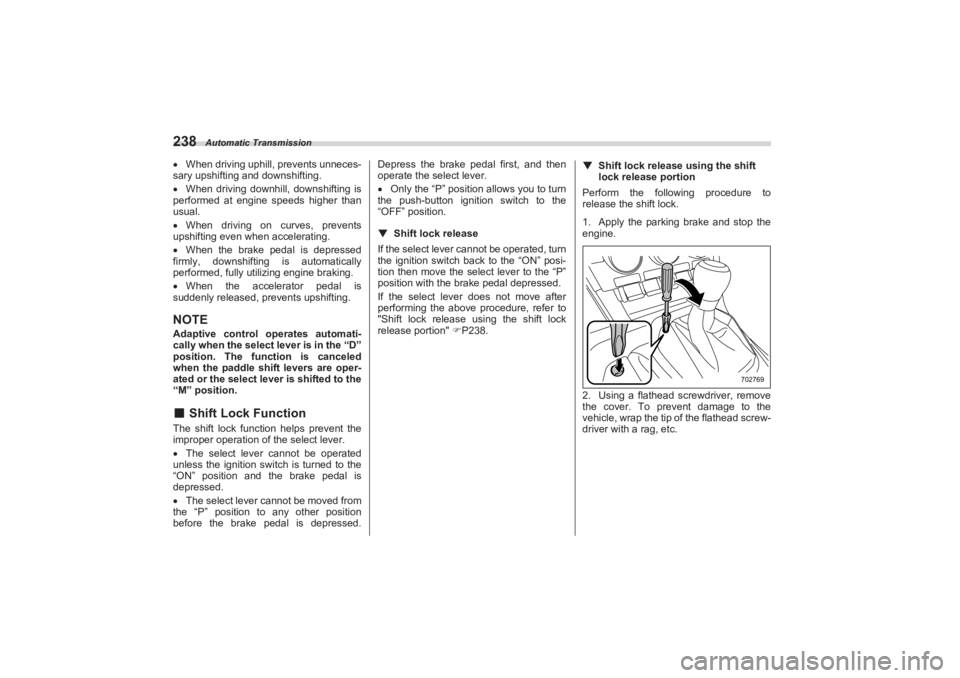
Shift lock release using the shift
lock release portion
Perform the following procedure to
release the shift lock.
1. Apply the parking brake and stop the
engine.
2. Using a flathead screwdriver, remove
the cover. To prevent damage to the
vehicle, wrap the tip of the flathead screw-
driver with a rag, etc.
702769
BRZ_U.book 238 ページ 2022年3月29日 火曜日 午後3時59分
Page 248 of 432
Active Sound Control
242NOTEIn the following situations, the driving
mode will automatically change to nor-
mal mode:
When the engine is turned off after
driving in Sport mode or Snow mode.
When adaptive cruise control/cruise
control is activated while driving in
Sport mode.
If a malfunction occurs in the engine
or automatic transmission electrical
control system while Sport mode or
Snow mode is selected.
When in Sport mode and the idling
speed is high during warm-up or when
the road surface is slippery and stop-
ping/starting off is automatically
performed in second gear.
7-8. Active Sound ControlThe active sound control provides
dynamic engine sounds. When driving
with Sport mode selected, the engine
sounds will be particularly loud.NOTEThe operational/non-operational set-
ting of the Active Sound Control can
be changed by a SUBARU dealer. Con-
tact your SUBARU dealer for details.
When the driving mode is changed,
the sound of the active sound control
will be stopped for approximately 1
second, this is not a malfunction.
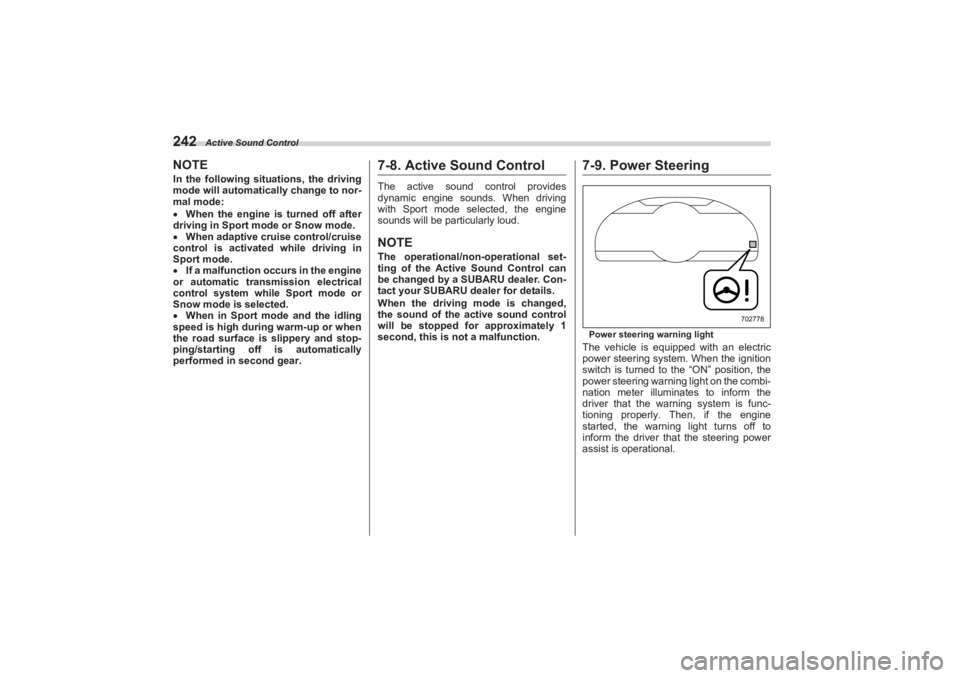
7-9. Power SteeringPower steering warning lightThe vehicle is equipped with an electric
power steering system. When the ignition
switch is turned to the “ON” position, the
power steering warning light on the combi-
nation meter illuminates to inform the
driver that the warn ing system is func-
tioning properly. Then, if the engine
started, the warni ng light turns off to
inform the driver that the steering power
assist is operational.
702778
BRZ_U.book 242 ページ 2022年3月29日 火曜日 午後3時59分
Page 250 of 432
Braking
244▼Braking when a tire is punctured
Do not depress the brake pedal suddenly
when a tire is punctured. This could cause
a loss of control of the vehicle. Keep
driving straight ahead while gradually
reducing speed. Then slowly pull off the
road to a safe place.■ Brake System▼ Two separate circuits
Your vehicle has a dual circuit brake
system. Each circuit works diagonally
across the vehicle. If one circuit of the
brake system should fail, the other half of
the system still works. If one circuit fails,
the brake pedal will go down much closer
to the floor than usual and you will need to
press it down much harder. And a much
longer distance will be needed to stop the
vehicle.
▼ Brake booster
The brake booster uses vacuum pump
system to assist brakin g force. Do not turn
off the engine while driving because that
will turn off the brake booster, resulting in
poor braking power.
The brakes will continue to work even
when the brake booster completely stops
functioning. If this happens, however, you
will have to depress the pedal much harder than normal and the braking
distance will increase.
▼ Supplemental booster function
when vacuum pressure fails
While the ignition switch is turned “ON”
and the engine is running, the supple-
mental booster function operates when
the brake booster performance is
decreased due to insufficient vacuum
boost.
When the brake pedal is depressed while
the supplemental booster function is oper-
ating, an operation sound and brake pedal
vibration may be generated. This is not a
malfunction.
▼ Brake assist system
Brake assist is a driver assistance system.
It assists the brake power when the driver
cannot depress the brake pedal strongly
and the brake power is insufficient.
Brake assist generates the brake power
according to the speed at which the driver
depresses the brake pedal.NOTEWhen you depress the brake pedal
strongly or suddenly, the following
phenomena occur. However, even
though these occur, they do not indi-
cate any malfunctions, and the brake
assist system is operating properly.
You might feel that the brake pedal
is applied by lighter force and gener-
ates a greater braking force.
You might hear the sound of ABS
operating from the engine compart-
ment.
WARNING
Do not be overconfident about the
brake assist. It is not a system that
brings more braking ability to the
vehicle beyond its braking capabil-
ity. Always use the utmost care
when driving regarding vehicle
speed and safe distance.
CAUTION
When you need to brake suddenly,
continue depressing the brake
pedal strongly to bring the effect of
the brake assist.
BRZ_U.book 244 ページ 2022年3月29日 火曜日 午後3時59分