2023 NISSAN PATHFINDER door
[x] Cancel search: doorPage 6 of 665

Genuine NISSAN accessory roof rack attach-
ments may be available through a NISSAN
dealer. It is recommended that you visit a
NISSAN dealer for additional information.
The service load capacity for the tubular
roof rack is 220 lbs. (100 kg.).
Be careful that your vehicle does not exceed
the Gross Vehicle Weight Rating (GVWR) or its
Gross Axle Weight Rating (GAWR front and
rear).
For additional information regarding GVWR
and GAWR, refer to:
• F.M.V.S.S. or C.V.M.S.S. certification label
(located on the driver’s door pillar).
TIRE CHAINS
WARNING
Do not use tire chains with vehicles
equipped with 265/60R18 size tires.
Use of tire chains on this tire size would
cause damage to the suspension com-
ponents or the vehicle’s body compo-
nents. This damage could cause you to
lose control of the vehicle, leading to an
accident resulting in possible injury or
death.Use of tire chains may be prohibited ac-
cording to location. Check the local laws
before installing tire chains. When installing
tire chains, make sure they are the proper
size for the tires on your vehicle and are
installed according to the chain manufac-
turer's suggestions.Use only SAE class “S”
chains.Class “S” chains are used on ve-
hicles with restricted tire to vehicle clear-
ance. Vehicles that can use Class “S” chains
are designed to meet the minimum clear-
ances between the tire and the closest
vehicle suspension or body component re-
quired to accommodate the use of a win-
ter traction device (tire chains or cables).
The minimum clearances are determined
using the factory equipped tire size. Other
types may damage your vehicle. Use chain
tensioners when recommended by the
tire chain manufacturer to ensure a tight
fit. Loose end links of the tire chain must
be secured or removed to prevent the
possibility of whipping action damage to
the fenders or underbody. If possible, avoid
fully loading your vehicle when using tire
chains. In addition, drive at a reduced speed.
Otherwise, your vehicle may be damaged
and/or vehicle handling and performance
may be adversely affected.
Do not use tire chains on dry roads. Driving
with chains in such conditions can cause
damage to the various mechanisms of the
vehicle due to some overstress.
OFF-ROAD MODE (for Rock Creek)
When the shif t lever is out of the R (Reverse)
position, selecting the Drive Mode Selector
(SAND or MUD/RUT) affects the Intelligent
Around View® Monitor display as follows:
1. Selecting the Drive Mode Selector (SAND
or MUD/RUT) position will activate the
Intelligent Around View® Monitor. The
front view/front-side view split screen
will be displayed.
2. When the vehicle is shif ted to the Drive
Mode Selector (SAND or MUD/RUT) posi-
tion with the bird’s-eye view displayed,
the passenger side of the display will
change to the front-side view.
When in the off-road mode, the Intelligent
Around View® Monitor will not return to the
previous screen.
The screen displayed on the Intelligent
Around View® Monitor will automatically re-
turn to the previous screen 3 minutes af ter
the vehicle was shif ted out of the Drive
Mode Selector (SAND or MUD/RUT) position.
Page 16 of 665

1. Front view camera (if so equipped)(P. 4-10)
2. Engine hood (P. 3-23) 3. Wiper and washer switch (P. 2-78)
4. Windshield-washer fluid (P. 8-11)
5. Power windows (P. 2-117)6. Door locks (P. 3-5)
NISSAN Intelligent Key® system (P. 3-7)
Keys (P. 3-2)
7. Mirrors (P. 3-38) Side view camera (if so equipped)
(P. 4-10)
8. Tire pressure (P. 8-28) Flat tire (P. 6-3)
Tire chains (P. 8-38)
9. Front sonar sensors (if so equipped)
(P. 5-183)
10. Replacing bulbs (P. 8-26) Headlight and turn signal switch
(P. 2-82)
LED Daytime Running Lights (DRL)
system (P. 2-87)
11. Fog light switch (if so equipped) (P. 2-89)
Refer to the page number indicated in
parentheses for operating details.
LII2668
EXTERIOR FRONT
Illustrated table of contents0-3
Page 17 of 665

1. Rear window wiper and washer switch(P. 2-81)
2. Lif tgate release (P. 3-29) 3. Rearview camera (P. 4-3, 4-10)
4. Towing (P. 10-20)
5. Rear sonar sensors (P. 5-183)
6. Replacing bulbs (P. 8-26)7. Fuel-filler door (P. 3-31)
Fuel recommendation (P. 10-4)
8. Child safety rear door lock (P. 3-7)
Refer to the page number indicated in
parentheses for operating details.
LII2669
EXTERIOR REAR
0-4Illustrated table of contents
Page 47 of 665
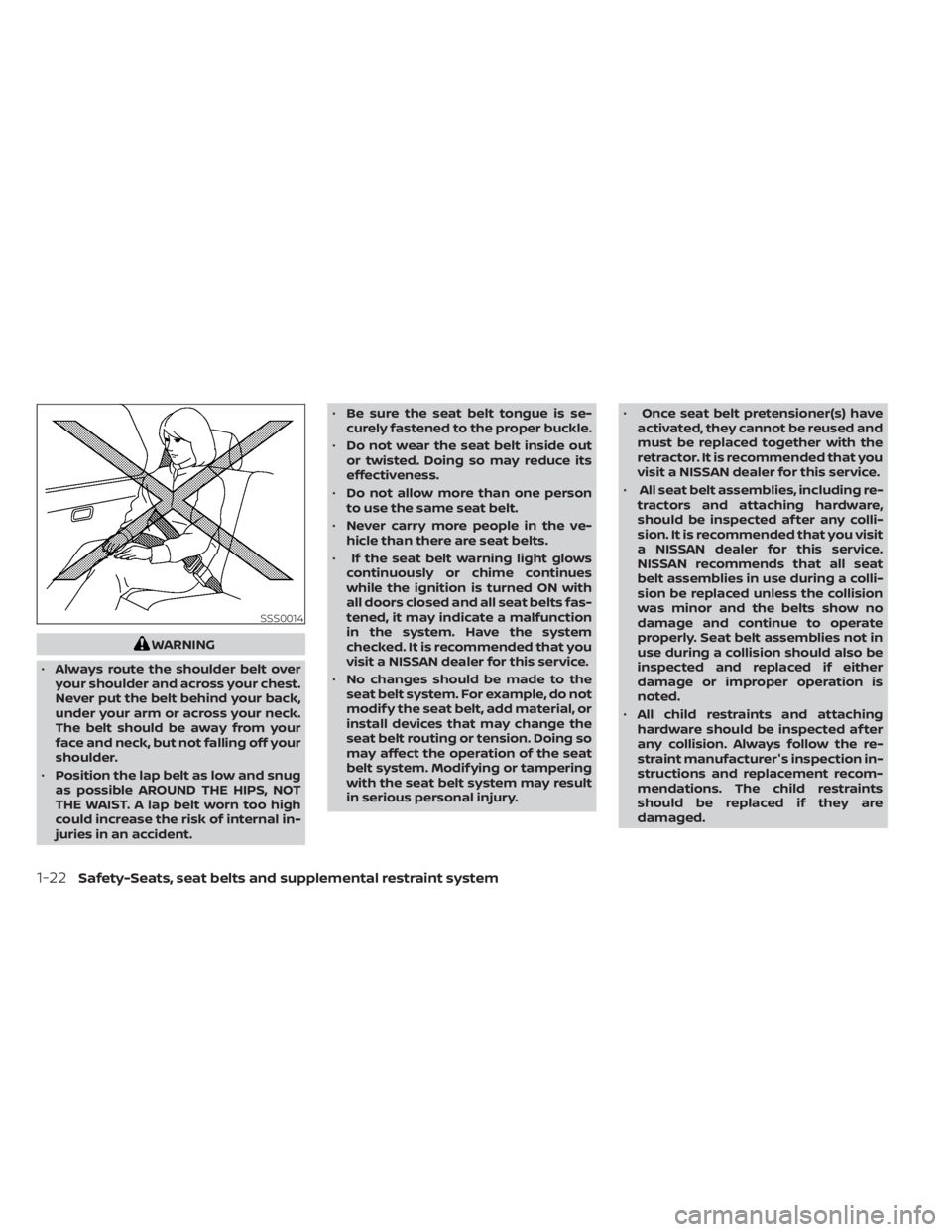
WARNING
• Always route the shoulder belt over
your shoulder and across your chest.
Never put the belt behind your back,
under your arm or across your neck.
The belt should be away from your
face and neck, but not falling off your
shoulder.
• Position the lap belt as low and snug
as possible AROUND THE HIPS, NOT
THE WAIST. A lap belt worn too high
could increase the risk of internal in-
juries in an accident. •
Be sure the seat belt tongue is se-
curely fastened to the proper buckle.
• Do not wear the seat belt inside out
or twisted. Doing so may reduce its
effectiveness.
• Do not allow more than one person
to use the same seat belt.
• Never carry more people in the ve-
hicle than there are seat belts.
• If the seat belt warning light glows
continuously or chime continues
while the ignition is turned ON with
all doors closed and all seat belts fas-
tened, it may indicate a malfunction
in the system. Have the system
checked. It is recommended that you
visit a NISSAN dealer for this service.
• No changes should be made to the
seat belt system. For example, do not
modif y the seat belt, add material, or
install devices that may change the
seat belt routing or tension. Doing so
may affect the operation of the seat
belt system. Modif ying or tampering
with the seat belt system may result
in serious personal injury. •
Once seat belt pretensioner(s) have
activated, they cannot be reused and
must be replaced together with the
retractor. It is recommended that you
visit a NISSAN dealer for this service.
• All seat belt assemblies, including re-
tractors and attaching hardware,
should be inspected af ter any colli-
sion. It is recommended that you visit
a NISSAN dealer for this service.
NISSAN recommends that all seat
belt assemblies in use during a colli-
sion be replaced unless the collision
was minor and the belts show no
damage and continue to operate
properly. Seat belt assemblies not in
use during a collision should also be
inspected and replaced if either
damage or improper operation is
noted.
• All child restraints and attaching
hardware should be inspected af ter
any collision. Always follow the re-
straint manufacturer's inspection in-
structions and replacement recom-
mendations. The child restraints
should be replaced if they are
damaged.
SSS0014
1-22Safety-Seats, seat belts and supplemental restraint system
Page 48 of 665
SEAT BELT WARNING LIGHT AND
CHIME
The light and chime remind you to fasten
the driver, front passenger and rear pas-
senger seat belts. A visual and audible alert
will operate in the following conditions:
• If the driver seat belt is not fastened.
• The front passenger’s seat belt is not fas-tened and the seat is occupied by a pas-
senger for 7 seconds af ter the ignition
switch is placed in the ON position. • The front passenger’s seat belt is not fas-
tened and objects or external force on
the passenger seat change the seat belt
reminder classification to “occupied”.
• Any rear passenger seat belt is operated from fastened to unfastened.
For additional information, see:
• “Seat belt warning light and chime” (P. 2-16).
• “Rear seat belt warning” (P. 2-42 or 2-69).
The below situations could result in the
seat belt warning function operating, even
with no occupant present in the front pas-
senger seat:
• Heavy objects placed on the seat.
• Someone pushing or pulling on the front passenger seat.
• An object placed under the front passen- ger seat.
• An object placed between the seat cush- ion and center console or between the
seat cushion and the door.
• An object hanging on the seat or placed in the seatback pocket.
• A child restraint or other object pressing against the rear of the seatback. The rear seat belt reminder may operate if
the rear seat belts are used without
occupants.
PREGNANT WOMEN
NISSAN recommends that pregnant
women use seat belts. The seat belt should
be worn snug and always position the lap
belt as low as possible around the hips, not
the waist. Place the shoulder belt over your
shoulder and across your chest. Never run
the lap/shoulder belt over your abdominal
area. Contact your doctor for specific
recommendations.
INJURED PERSONS
NISSAN recommends that injured persons
use seat belts. Check with your doctor for
specific recommendations.
LRS0786
Safety-Seats, seat belts and supplemental restraint system1-23
Page 85 of 665

Front seat-mounted side-impact
supplemental air bag system
This system can help cushion the impact
force to the chest area of the driver and
front passenger in certain side-impact col-
lisions. The side air bags are designed to
inflate on the side where the vehicle is
impacted.
2nd row outboard seat-mounted side-
impact supplemental air bag system
This system can help cushion the impact
force to the chest area of the 2nd row out-
board seat passengers in certain side-
impact collisions. The side air bags are de-
signed to inflate on the side where the
vehicle is impacted.
Front central seat-mounted side-impact
supplemental air bag (if so equipped)
This system can help cushion the impact
force to the head area of the driver and
front passenger in certain side-impact and
rollover collisions. In a side-impact, this air
bag is designed to inflate during a vehicle
impact from either side.Roof-mounted curtain side-impact and
rollover supplemental air bag system
This system can help cushion the impact
force to the head of occupants in front and
rear outboard seating positions in certain
side-impact collisions. The curtain air bags
are designed to inflate on the side where
the vehicle is impacted. In a rollover, the
curtain air bags are designed to inflate and
remain inflated for a short time.
Driver and front passenger supplemen-
tal knee air bags
This system can help cushion the impact
force to the driver’s and front passenger’s
knees in certain collisions.
The SRS is designed to
supplementthe
crash protection provided by the driver and
front passenger and rear outboard seat
belts and is not a substitute for them. Seat
belts should always be correctly worn and
the occupant seated a suitable distance
away from the steering wheel, instrument
panel and door finishers. For additional in-
formation, see “Seat belts” (P. 1-20). The supplemental air bags operate only
when the ignition switch is placed in the
ON position.
Af ter placing the ignition switch in the
ON position, the supplemental air bag
warning light illuminates. The supple-
mental air bag warning light will turn off
af ter about 7 seconds if the system is
operational.
1-60Safety-Seats, seat belts and supplemental restraint system
Page 90 of 665
WARNING
Front, front central and rear outboard
seat-mounted side-impact supple-
mental air bags and roof-mounted cur-
tain side-impact and rollover supple-
mental air bags:
• The side air bags and curtain air bags
ordinarily will not inflate in the event
of a frontal impact, rear impact, or
lower severity side collision. Always
wear your seat belts to help reduce
the risk or severity of injury in various
kinds of accidents.
WARNING
• The seat belts, the side air bags and
curtain air bags are most effective
when you are sitting well back and
upright in the seat with both feet on
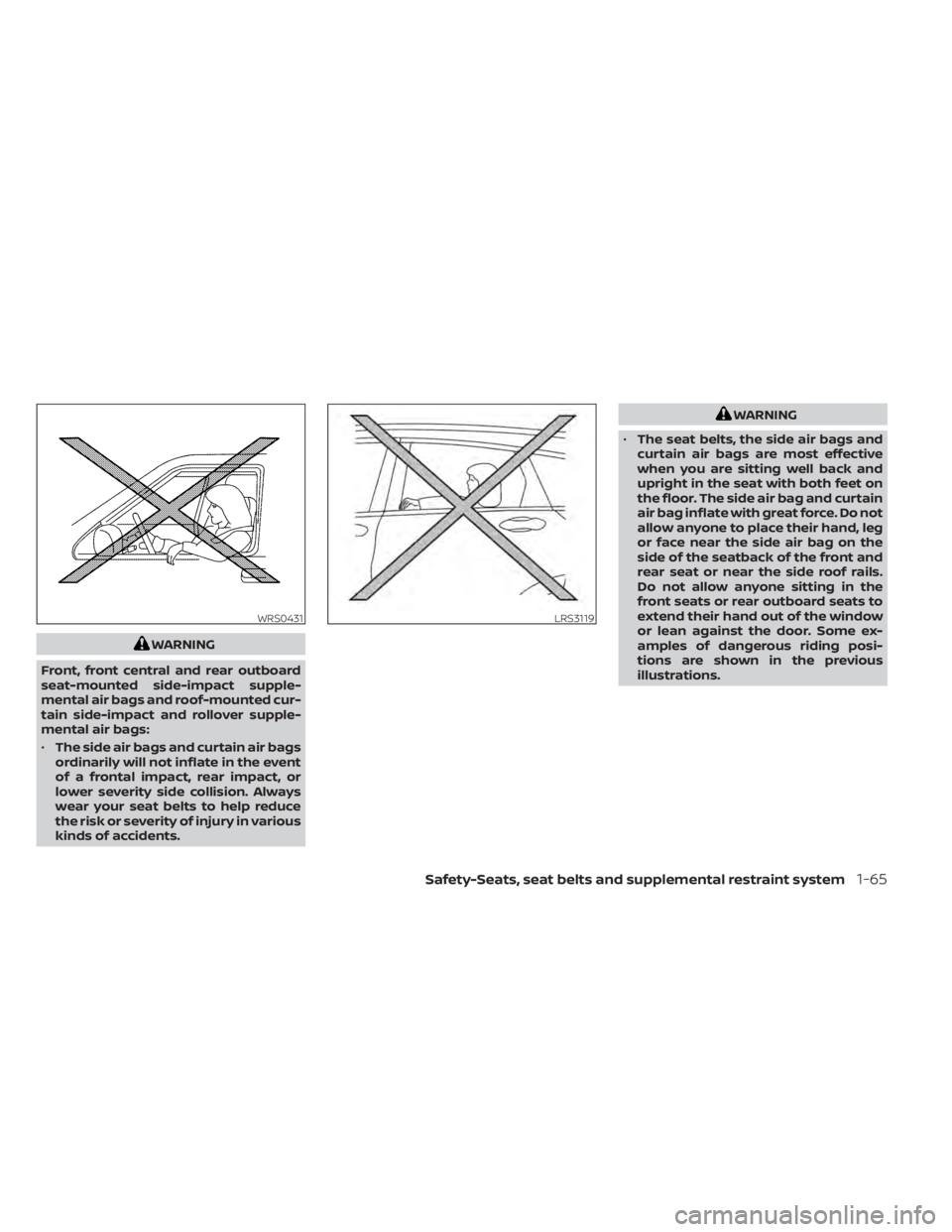
the floor. The side air bag and curtain
air bag inflate with great force. Do not
allow anyone to place their hand, leg
or face near the side air bag on the
side of the seatback of the front and
rear seat or near the side roof rails.
Do not allow anyone sitting in the
front seats or rear outboard seats to
extend their hand out of the window
or lean against the door. Some ex-
amples of dangerous riding posi-
tions are shown in the previous
illustrations.
WRS0431LRS3119
Safety-Seats, seat belts and supplemental restraint system1-65
Page 93 of 665

14. Satellite sensors (driver’s side shown;passenger side similar)
15. Front central seat-mounted side- impact supplemental air bag (if so
equipped)
16. Pressure sensors in door (driver’s side shown; front passenger side similar)
17. Driver and front passenger supplemen- tal knee air bags
18. Crash zone sensor
WARNING
To ensure proper operation of the pas-
senger’s NISSAN Advanced Air Bag Sys-
tem, please observe the following
items.
• Do not allow a passenger in the 2nd
row captain’s chair or 2nd row bench
seats to push or pull on the seatback
pocket.
• Do not place heavy loads heavier
than 9.1 lbs. (4 kg) on the seatback,
head restraint/headrest or in the
seatback pocket. •
Make sure that there is nothing
pressing against the rear of the seat-
back, such as a child restraint in-
stalled in the rear seat or an object
stored on the floor.
• Make sure that there is no object
placed under the front passenger
seat.
• Make sure that there is no object
placed between the seat cushion and
center console or between the seat
cushion and the door.
• If a forward-facing child restraint is
installed in the front passenger seat,
do not position the front passenger
seat so the child restraint contacts
the instrument panel. If the child re-
straint does contact the instrument
panel, the system may determine the
seat is occupied and the passenger
air bag may deploy in a collision. Also
the front passenger air bag status
light may not illuminate. For addi-
tional information about installing
and using child restraints, see “Child
restraints” (P. 1-33).
• Confirm the operating condition with
the front passenger air bag status
light. •
If you notice that the front passenger
air bag status light is not operating
as described in this section, get the
occupant classification system
checked. It is recommended that you
visit a NISSAN dealer for this service.
• Until you have confirmed with a
dealer that your passenger seat oc-
cupant classification system is work-
ing properly, position the occupants
in the rear seating positions.
• Do not position the front passenger
seat so it contacts the rear seat. If the
front seat does contact the rear seat,
the air bag system may determine a
sensor malfunction has occurred
and the front passenger air bag sta-
tus light may illuminate and the
supplemental air bag warning light
may flash.
This vehicle is equipped with the NISSAN
Advanced Air Bag System for the driver and
front passenger seats. This system is de-
signed to meet certification requirements
under U.S. regulations. It is also permitted in
Canada. However, all of the information,
cautions and warnings in this manual
still apply and must be followed.
1-68Safety-Seats, seat belts and supplemental restraint system