2023 NISSAN MURANO oil pan
[x] Cancel search: oil panPage 238 of 518
OPERATING TIPS
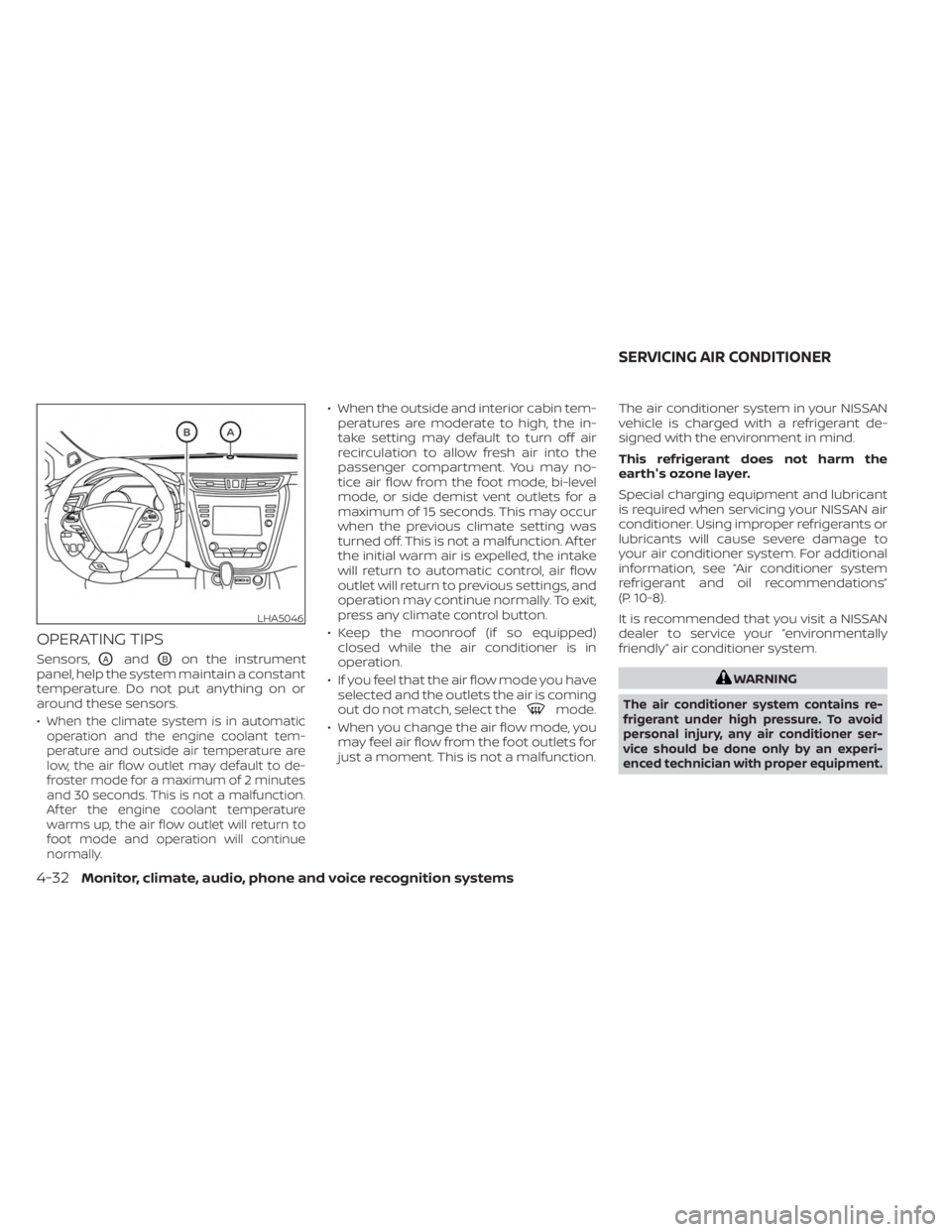
Sensors,OAandOBon the instrument
panel, help the system maintain a constant
temperature. Do not put anything on or
around these sensors.
•
When the climate system is in automatic
operation and the engine coolant tem-
perature and outside air temperature are
low, the air flow outlet may default to de-
froster mode for a maximum of 2 minutes
and 30 seconds. This is not a malfunction.
Af ter the engine coolant temperature
warms up, the air flow outlet will return to
foot mode and operation will continue
normally.
• When the outside and interior cabin tem- peratures are moderate to high, the in-
take setting may default to turn off air
recirculation to allow fresh air into the
passenger compartment. You may no-
tice air flow from the foot mode, bi-level
mode, or side demist vent outlets for a
maximum of 15 seconds. This may occur
when the previous climate setting was
turned off. This is not a malfunction. Af ter
the initial warm air is expelled, the intake
will return to automatic control, air flow
outlet will return to previous settings, and
operation may continue normally. To exit,
press any climate control button.
• Keep the moonroof (if so equipped) closed while the air conditioner is in
operation.
• If you feel that the air flow mode you have selected and the outlets the air is coming
out do not match, select the
mode.
• When you change the air flow mode, you may feel air flow from the foot outlets for
just a moment. This is not a malfunction. The air conditioner system in your NISSAN
vehicle is charged with a refrigerant de-
signed with the environment in mind.
This refrigerant does not harm the
earth's ozone layer.
Special charging equipment and lubricant
is required when servicing your NISSAN air
conditioner. Using improper refrigerants or
lubricants will cause severe damage to
your air conditioner system. For additional
information, see “Air conditioner system
refrigerant and oil recommendations”
(P. 10-8).
It is recommended that you visit a NISSAN
dealer to service your “environmentally
friendly” air conditioner system.
WARNING
The air conditioner system contains re-
frigerant under high pressure. To avoid
personal injury, any air conditioner ser-
vice should be done only by an experi-
enced technician with proper equipment.
LHA5046
SERVICING AIR CONDITIONER
4-32Monitor, climate, audio, phone and voice recognition systems
Page 392 of 518
TIRE DRESSINGS
NISSAN does not recommend the use of
tire dressings. Tire manufacturers apply a
coating to the tires to help reduce discolor-
ation of the rubber. If a tire dressing is ap-
plied to the tires, it may react with the coat-
ing and form a compound. This compound
may come off the tire while driving and
stain the vehicle paint.
If you choose to use a tire dressing, take the
following precautions:
• Use a water-based tire dressing. Thecoating on the tire dissolves more easily
than with an oil-based tire dressing.
• Apply a light coat of tire dressing to help prevent it from entering the tire tread/
grooves (where it would be difficult to
remove).
• Wipe off excess tire dressing using a dry towel. Make sure the tire dressing is com-
pletely removed from the tire tread/
grooves.
•
Allow the tire dressing to dry as recom-
mended by the tire dressing manufacturer.
Occasionally remove loose dust from the
interior trim, plastic parts and seats using a
vacuum cleaner or sof t bristled brush. Wipe
the vinyl and leather (if so equipped) sur-
faces with a clean, sof t cloth dampened in
mild soap solution, then wipe clean with a
dry, sof t cloth.
Regular care and cleaning is required in
order to maintain the appearance of the
leather (if so equipped).
Before using any fabric protector, read the
manufacturer's recommendations. Some
fabric protectors contain chemicals that
may stain or bleach the seat material.
Use a cloth dampened only with water to
clean the meter and gauge lens.
WARNING
Do not use water or acidic cleaners (hot
steam cleaners) on the seat. This can
damage the seat or occupant classifi-
cation sensor. This can also affect the
operation of the air bag system and re-
sult in serious personal injury.
CAUTION
• Never use benzine, thinner or any
similar material.
• Small dirt particles can be abrasive
and damaging to leather surfaces
and should be removed promptly.
Do not use saddle soap, car waxes,
polishes, oils, cleaning fluids, sol-
vents, detergents or ammonia-
based cleaners as they may damage
the leather's natural finish.
• Never use fabric protectors unless
recommended by the manufacturer.
• Do not use glass or plastic cleaner on
meter or gauge lens covers. It may
damage the lens cover.
• Never use chloride solutions for
cleaning aluminum decoratives (if so
equipped), damage may occur.
CLEANING INTERIOR
7-4Appearance and care
Page 402 of 518
CHECKING ENGINE OIL LEVEL
1. Park the vehicle on a level surface andapply the parking brake.
2. Start the engine and let it idle until it reaches operating temperature.
3. Turn off the engine. Wait more than 10
minutes for the oil to drain back into
the oil pan.
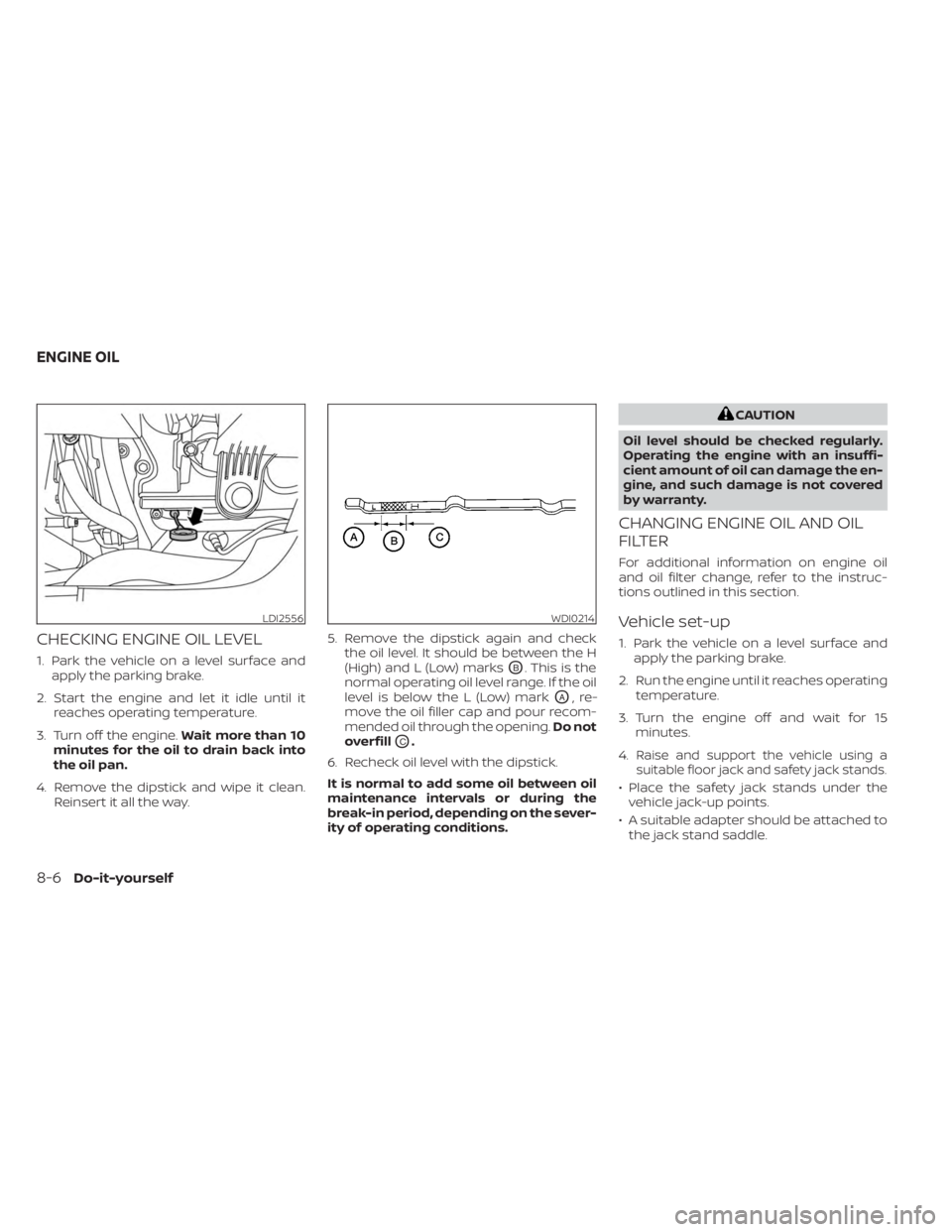
4. Remove the dipstick and wipe it clean. Reinsert it all the way. 5. Remove the dipstick again and check
the oil level. It should be between the H
(High) and L (Low) marksOB. This is the
normal operating oil level range. If the oil
level is below the L (Low) mark
OA,re-
move the oil filler cap and pour recom-
mended oil through the opening. Do not
overfill
OC.
6. Recheck oil level with the dipstick.
It is normal to add some oil between oil
maintenance intervals or during the
break-in period, depending on the sever-
ity of operating conditions.
CAUTION
Oil level should be checked regularly.
Operating the engine with an insuffi-
cient amount of oil can damage the en-
gine, and such damage is not covered
by warranty.
CHANGING ENGINE OIL AND OIL
FILTER
For additional information on engine oil
and oil filter change, refer to the instruc-
tions outlined in this section.
Vehicle set-up
1. Park the vehicle on a level surface and apply the parking brake.
2. Run the engine until it reaches operating temperature.
3. Turn the engine off and wait for 15 minutes.
4.
Raise and support the vehicle using a
suitable floor jack and safety jack stands.
• Place the safety jack stands under the vehicle jack-up points.
• A suitable adapter should be attached to the jack stand saddle.
LDI2556WDI0214
ENGINE OIL
8-6Do-it-yourself
Page 405 of 518
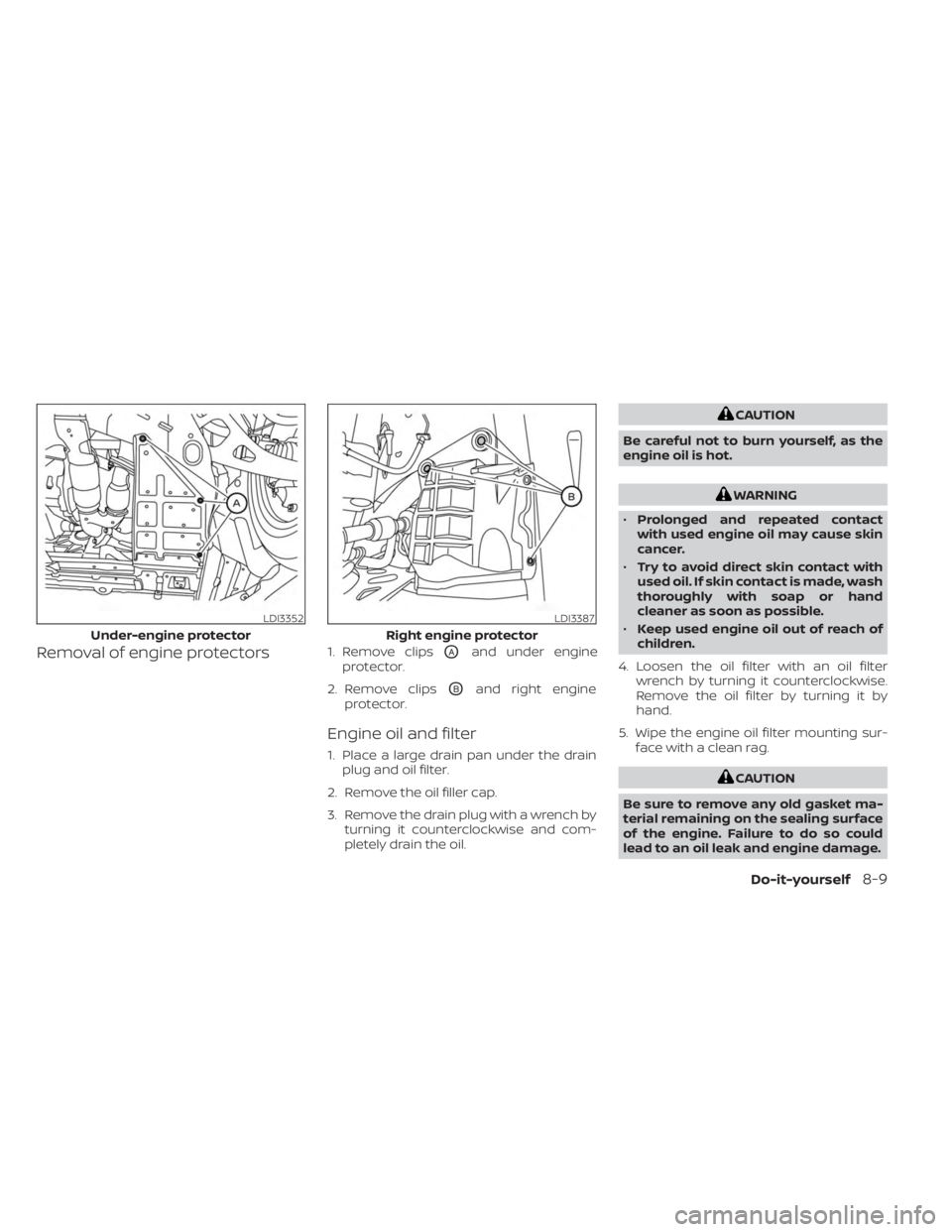
Removal of engine protectors1. Remove clipsOAand under engine
protector.
2. Remove clips
OBand right engine
protector.
Engine oil and filter
1. Place a large drain pan under the drain plug and oil filter.
2. Remove the oil filler cap.
3. Remove the drain plug with a wrench by turning it counterclockwise and com-
pletely drain the oil.
CAUTION
Be careful not to burn yourself, as the
engine oil is hot.
WARNING
• Prolonged and repeated contact
with used engine oil may cause skin
cancer.
• Try to avoid direct skin contact with
used oil. If skin contact is made, wash
thoroughly with soap or hand
cleaner as soon as possible.
• Keep used engine oil out of reach of
children.
4. Loosen the oil filter with an oil filter wrench by turning it counterclockwise.
Remove the oil filter by turning it by
hand.
5. Wipe the engine oil filter mounting sur- face with a clean rag.
CAUTION
Be sure to remove any old gasket ma-
terial remaining on the sealing surface
of the engine. Failure to do so could
lead to an oil leak and engine damage.
LDI3352
Under-engine protector
LDI3387
Right engine protector
Do-it-yourself8-9
Page 440 of 518
Continuously Variable Transmission
(CVT) P (Park) position mechanism:On a
fairly steep hill check that the vehicle is held
securely with the shif t lever in the P (Park)
position without applying any brakes.
Parking brake: Check the parking brake
operation regularly. The vehicle should be
securely held on a fairly steep hill with only
the parking brake applied. If the parking
brake needs adjustment, it is recom-
mended that you visit a NISSAN dealer for
this service.
Seats: Check seat position controls such
as seat adjusters, seatback recliner, etc., to
ensure they operate smoothly and all
latches lock securely in every position.
Check that the head restraints/headrests
move up and down smoothly and the locks
(if so equipped) hold securely in all latched
positions.
Seat belts: Check that all parts of the seat
belt system (for example, buckles, anchors,
adjusters and retractors) operate properly
and smoothly, and are installed securely.
Check the belt webbing for cuts, fraying,
wear or damage.
Steering wheel: Check for changes in the
steering system, such as excessive free
play, hard steering or strange noises. Warning lights and chimes:
Make sure all
warning lights and chimes are operating
properly.
Windshield defroster: Check that the air
comes out of the defroster outlets properly
and in sufficient quantity when operating
the heater or air conditioner.
Windshield wiper and washer*: Check
that the wipers and washer operate prop-
erly and that the wipers do not streak.
Under the hood and vehicle
The maintenance items listed here should
be checked periodically (for example, each
time you check the engine oil or refuel).
Battery* (for maintenance free batter-
ies): This vehicle is equipped with a sealed
maintenance free battery. It is recom-
mended that you visit a NISSAN dealer for
service.
NOTE:
Care should be taken to avoid situations
that can lead to potential battery dis-
charge and potential no-start conditions
such as:
1. Installation or extended use of elec- tronic accessories that consume bat-
tery power when the engine is not
running (Phone chargers, GPS, DVD
players, etc.).
2. Vehicle is not driven regularly and/or only driven short distances.
In these cases, the battery may need to
be charged to maintain battery health.
Brake fluid level*: Make sure that the brake
fluid level is between the MAX and MIN lines
on the reservoir.
Engine coolant level*: Check the coolant
level when the engine is cold.
Engine drive belt*: Make sure the drive
belts are not frayed, worn, cracked or oily.
Engine oil level*: Check the level af ter
parking the vehicle on a level spot and
turning off the engine. Wait more than 15
minutes for the oil to drain back into the oil
pan.
9-4Maintenance and schedules
Page 441 of 518
Engine valve clearance*:Inspect if valve
noise increases.
Exhaust system: Make sure there are no
loose supports, cracks or holes. If the
sound of the exhaust seems unusual or
there is a smell of exhaust fumes, immedi-
ately have the exhaust system inspected. It
is recommended that you visit a NISSAN
dealer for this service. For additional infor-
mation, see “Exhaust gas (carbon monox-
ide)” (P. 5-4).
Fluid leaks: Check under the vehicle for
fuel, oil, water or other fluid leaks af ter the
vehicle has been parked for a while. Water
dripping from the air conditioner af ter use
is normal. If you should notice any leaks or if
fuel fumes are evident, check for the cause
and have it corrected immediately.
Power steering fluid level* and lines:
Check the level when the fluid is cold, with
the engine off. Check the lines for proper
attachment, leaks, cracks, etc.
Radiator and hoses: Check the front of the
radiator and clean off any dirt, insects,
leaves, etc., that may have accumulated.
Make sure the hoses have no cracks, defor-
mation, rot or loose connections. Underbody:
The underbody is frequently
exposed to corrosive substances such as
those used on icy roads or to control dust. It
is very important to remove these sub-
stances, otherwise rust may form on the
floor pan, frame, fuel lines and around the
exhaust system. At the end of winter, the
underbody should be thoroughly flushed
with plain water, being careful to clean
those areas where mud and dirt may accu-
mulate. For additional information, see
“Cleaning exterior” (P. 7-2).
Windshield-washer fluid*: Check that
there is adequate fluid in the reservoir. The following descriptions are provided to
give you a better understanding of the
scheduled maintenance items that should
be regularly checked or replaced. The
maintenance schedule indicates at which
mileage/time intervals each item requires
service.
In addition to scheduled maintenance,
your vehicle requires that some items be
checked during normal day-to-day opera-
tion. For additional information, see “Gen-
eral maintenance” (P. 9-2).
Items marked with
“*”are recommended
by NISSAN for reliable vehicle operation.
You are not required to perform mainte-
nance on these items in order to maintain
the warranties which come with your
NISSAN. Other maintenance items and in-
tervals are required.
When applicable, additional information
can be found in the “Do-it-yourself ” section
of this manual.
EXPLANATION OF SCHEDULED
MAINTENANCE ITEMS
Maintenance and schedules9-5
Page 503 of 518
11 Index
A
Air bag (See supplemental restraint
system)........................ .1-48
Air bag system ....................1-56
Front (See supplemental front impact air
bag system) ...................1-56
Air bag warning labels ..............1-69
Air bag warning light, supplemental . . . .1-70
Airbagwarninglight.............. .1-70
Air cleaner housing filter .............8-17
Air cleaner .......................8-17
Air conditioner ....................4-30
Air conditioner operation ..........4-30
Air conditioner specification label . . .10-13
Air conditioner system refrigerant and oil
recommendations ...............10-8
Air conditioner system refrigerant
recommendations ...............10-8
Heater and air conditioner (automatic)
(if so equipped) .................4-29
Heater and air conditioner controls . .4-30
Servicing air conditioner ..........4-32
Alarm system (See vehicle security
system) .........................2-32
All-Wheel Drive ...................5 -117
Anchor point locations ..............1-32
Antenna ........................4-33
Anti-lock brake warning light .........2-10
Anti-lock Braking System (ABS) .......5-121
Antifreeze .......................5-131 Armrests........................
.1-6
Autolightswitch ..................2-39
Automatic anti-glare inside mirror .....3-34
Automatic door locks ...............3-6
Automatic Emergency Braking (AEB) with
Pedestrian Detection ..............5-88
Automatic Emergency Braking (AEB) . . .2-12
Automatic.......................2-66 Automatic power window switch . . .2-66
AWD...........................5 -117
B
Battery replacement...............8-23
Keyfob.......................8-23
NISSAN Intelligent Key® ...........8-24
Battery.........................5-131 Charge warning light .............2-10
Before starting the engine ...........5-16
Belt(Seedrivebelt) ................8-16
Blind Spot Warning (BSW) ............5-39
Booster seats ................... .1-44
Brake Assist .....................5-123
Brakefluid.......................8-11
Brake system ....................5-121
Brake..........................5-121 Anti-lock Braking System (ABS) .....5-121
Brakefluid.....................8-11
Brakelight(Seestoplight).........8-26
Brake system ..................5-121 Brakewarninglight..............2-10
Brakewearindicators ........2
-17, 8-20
Self-adjustingbrakes ............8-20
Brakes .........................8-20
Break-in schedule .................5-115
Brightness control .................2-43
Instrument panel ...............2-43
Bulb check/instrument panel ........2-10
Bulb replacement .................8-26
C
C.M.V.S.S. certification label ..........10-12
Capacities and recommended
fuel/lubricants....................10-2
Car phone or CB radio ..............4-33
Cargo (See vehicle loading
information).....................10-15
Cargoareastoragebin .............2-61
Check tire pressure ................2-29
Child restraint with top tether strap . . . .1-31
Childrestraints .................. .1-24
LATCH (Lower Anchors and Tethers for
CHildren)System................1-28
Precautions on child
restraints..............1-34, 1-40, 1-45
Top tether strap anchor point
locations..................... .1-32
Child safety rear door lock ............3-7
Cleaningexteriorandinterior .........7-2
Page 504 of 518
Coat hooks.......................2-62
Coldweatherdriving...............5-131
Console box ......................2-59
Console light ......................2-70
Continuously Variable Transmission
(CVT) ............................5-19
Continuously Variable Transmission (CVT)
fluid ..........................8-10
Driving with Continuously Variable
Transmission (CVT) ...............5-19
Controls.........................4-30 Heater and air conditioner controls. . .4-30
Coolant..........................10-2 Capacities and recommended
fuel/lubricants ..................10-2
Changing engine coolant ...........8-5
Checking engine coolant level .......8-5
Engine coolant temperature gauge . . .2-6
Corrosionprotection.................7-7
Cruisecontrol.....................5-56
Cupholders......................2-60
D
Daytime Running Light System ........2-43
Defrosterswitch...................2-37 Rear window and outside mirror defroster
switch.........................2-37
Dimensions and weights ............10-10
Dimmer switch for instrument panel . . .2-43
Door locks ........................3-5
Drivebelt ........................8-16
Drivingthevehicle..................5-18 Driving..........................5
-131
Cold weather driving .............5-131
Driving with Continuously Variable
Transmission (CVT) ...............5-19
Precautions when starting and
driving......................5-4,5-11
Dynamic driver assistance switch ......2-50
E
Eco Drive Report....................2-8
Economy - fuel ...................5 -116
Emergency call (SOS) button ..........2-51
Emergency engine shutoff ...........5-15
Emission control information label .....10-12
Emission control system warranty . . . .10-30
Engine coolant temperature gauge .....2-6
Engine ..........................5-16
Before starting the engine ..........5-16
Capacities and recommended
fuel/lubricants ..................10-2
Changing engine coolant ...........8-5
Changing engine oil filter ...........8-6
Changing engine oil ...............8-6
Checking engine coolant level .......8-5
Checking engine oil level ...........8-6
Engine compartment check
locations .......................8-3
Engine coolant temperature gauge . . .2-6
Engine cooling system .............8-4
Engine oil and oil filter
recommendation ................10-7
Engine oil pressure warning light .....2-11Engine oil viscosity
...............10-7
Engine oil .......................8-6
Engine serial number .............10-12
Engine specifications .............10-9
Starting the engine ...............5-17
EventDatarecorders...............10-32
Exhaust gas (Carbon monoxide) ........5-4
Explanation of maintenance items ......9-2
Explanation of scheduled maintenance
items........................... .9-5
Extended storage switch ............2-55
Eyeglasscase.....................2-59
F
F.M.V.S.S. certification label ...........10-12
Flashers (See hazard warning flasher
switch)...........................6-2
Flattire...........................6-3
Floor mat positioning aid .............7-6
Fluid ............................8-11 Brakefluid......................8-11
Capacities and recommended
fuel/lubricants ..................10-2
Continuously Variable Transmission (CVT)
fluid ..........................8-10
Engine coolant ...................8-4
Engine oil .......................8-6
Powersteeringfluid...............8-11
Windshield-washer fluid ...........8-12
Foglightswitch ...................2-44
Front air bag system (See supplemental
restraintsystem)...................1-56
11-2