Page 81 of 612
To start normal charging
NOTE:
Charging timer, remote charge (models
with navigation system) and immediate
charge can be performed in the normal
charge mode. For additional informa-
tion, see “Charging methods” (P. CH-43)
1. Push the P (Park) position switch to placethe vehicle in the P (Park) position and
apply the parking brake. 2. When charging the Li-ion battery, place
the power switch in the OFF position.
When the power switch is in the ON po-
sition, the Li-ion battery will not start
charging.
3. Open the charge port lid. For additional information, see “Charge port lid”
(P. 3-20).
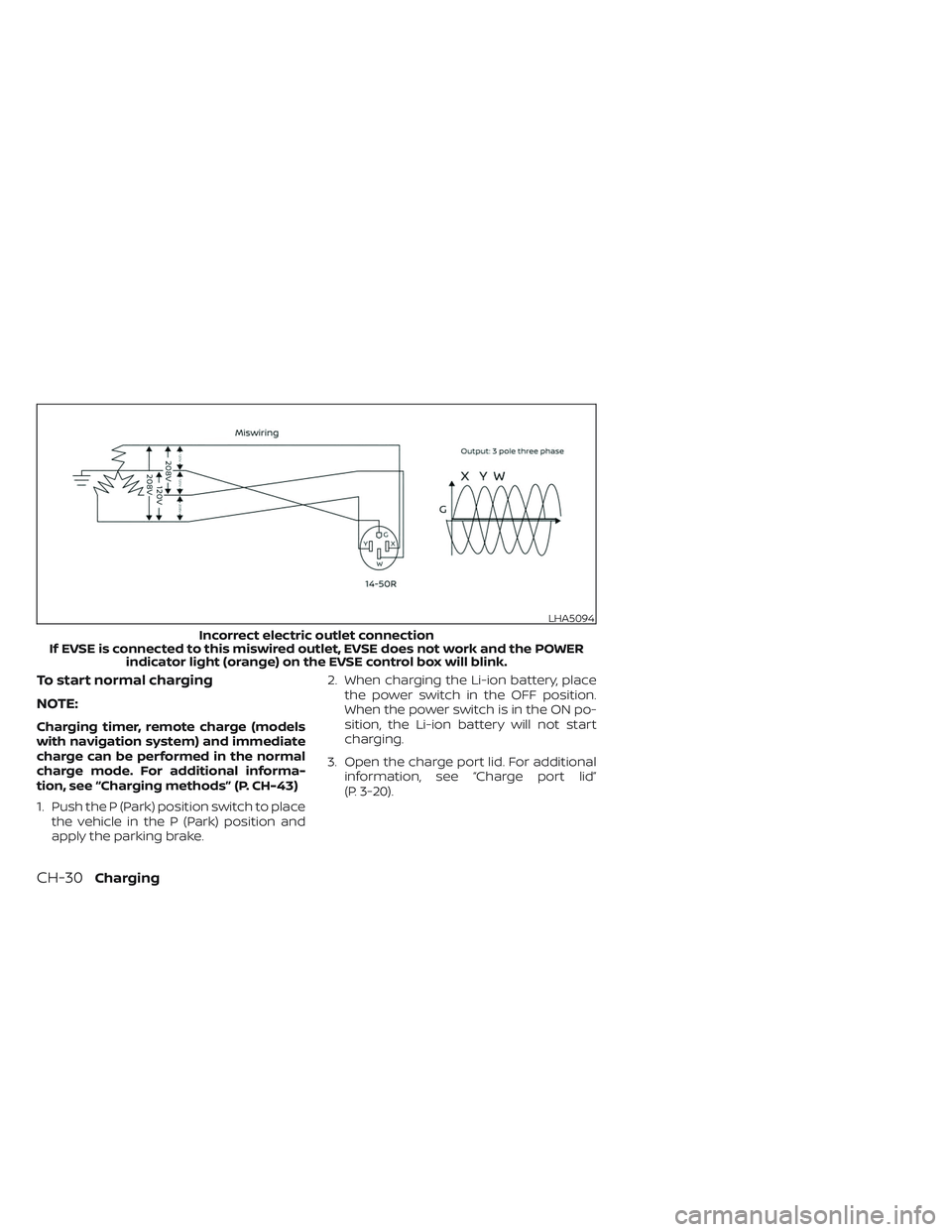
LHA5094
Incorrect electric outlet connection
If EVSE is connected to this miswired outlet, EVSE does not work and the POWER indicator light (orange) on the EVSE control box will blink.
CH-30Charging
Page 87 of 612
To start charging:
1. Push the P (Park) position switch to placethe vehicle in the P (Park) position and
apply the parking brake.
2. When charging the Li-ion battery, place the power switch in the OFF position.
When the power switch is in the ON po-
sition, the Li-ion battery will not start
charging.
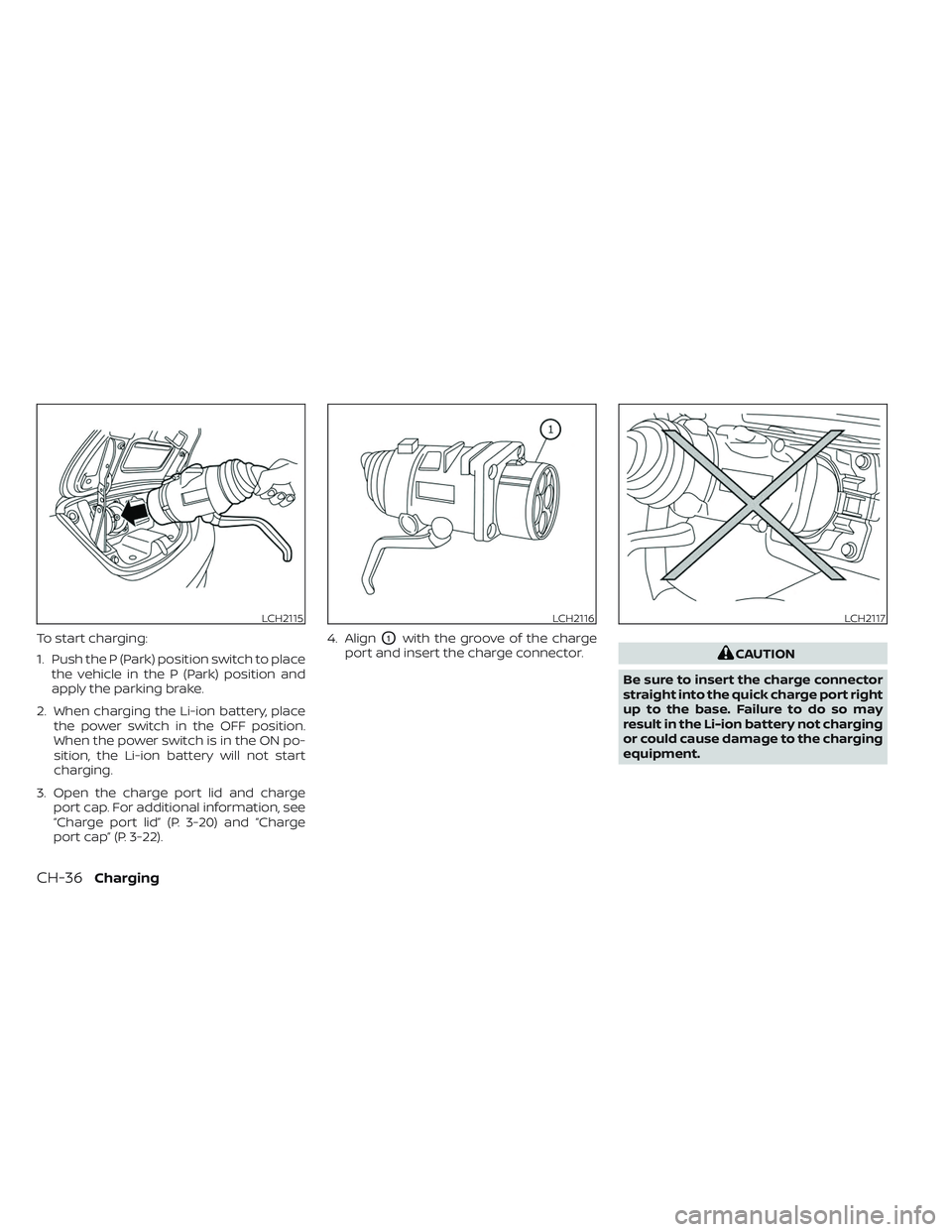
3. Open the charge port lid and charge port cap. For additional information, see
“Charge port lid” (P. 3-20) and “Charge
port cap” (P. 3-22). 4. AlignO1with the groove of the charge
port and insert the charge connector.
CAUTION
Be sure to insert the charge connector
straight into the quick charge port right
up to the base. Failure to do so may
result in the Li-ion battery not charging
or could cause damage to the charging
equipment.
LCH2115LCH2116LCH2117
CH-36Charging
Page 90 of 612
To start charging/discharging:
1. Push the P (Park) position switch to placethe vehicle in the P (Park) position and
apply the parking brake.
2. When charging/discharging the Li-ion battery, place the power switch in the
OFF position. When the power switch is
in the ON position, the Li-ion battery will
not start charging/discharging.
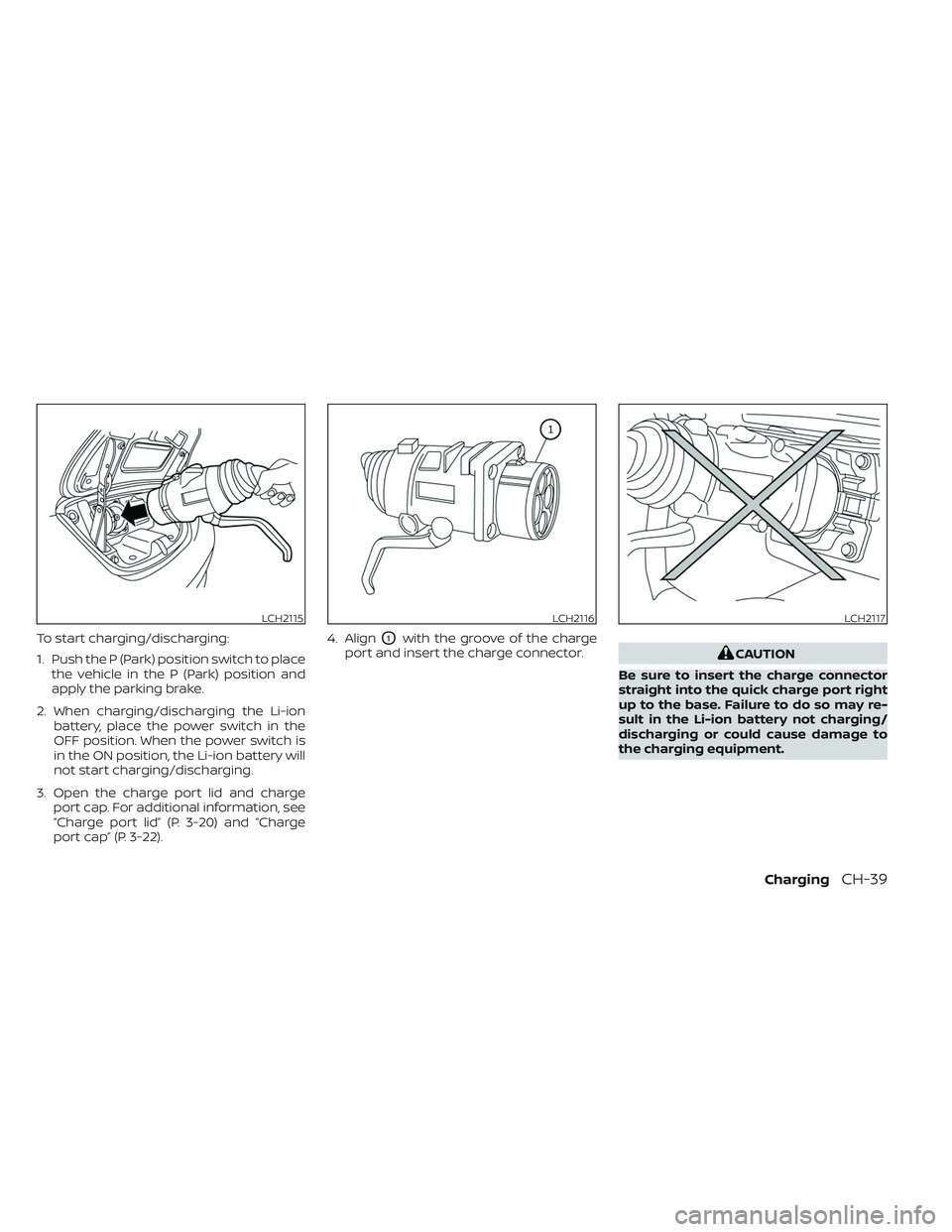
3. Open the charge port lid and charge port cap. For additional information, see
“Charge port lid” (P. 3-20) and “Charge
port cap” (P. 3-22). 4. AlignO1with the groove of the charge
port and insert the charge connector.
CAUTION
Be sure to insert the charge connector
straight into the quick charge port right
up to the base. Failure to do so may re-
sult in the Li-ion battery not charging/
discharging or could cause damage to
the charging equipment.
LCH2115LCH2116LCH2117
ChargingCH-39
Page 179 of 612
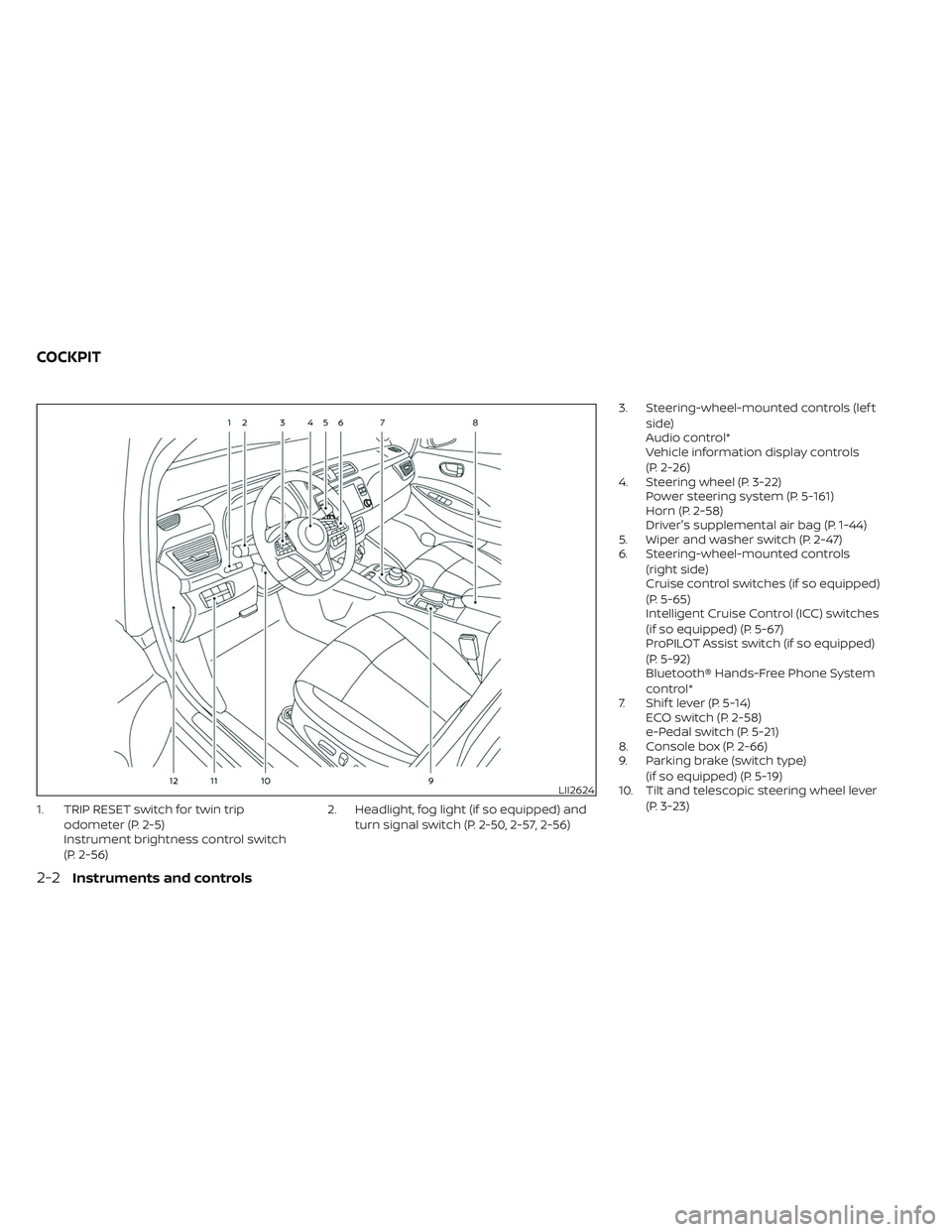
1. TRIP RESET switch for twin tripodometer (P. 2-5)
Instrument brightness control switch
(P. 2-56) 2. Headlight, fog light (if so equipped) and
turn signal switch (P. 2-50, 2-57, 2-56) 3. Steering-wheel-mounted controls (lef t
side)
Audio control*
Vehicle information display controls
(P. 2-26)
4. Steering wheel (P. 3-22) Power steering system (P. 5-161)
Horn (P. 2-58)
Driver's supplemental air bag (P. 1-44)
5. Wiper and washer switch (P. 2-47)
6. Steering-wheel-mounted controls
(right side)
Cruise control switches (if so equipped)
(P. 5-65)
Intelligent Cruise Control (ICC) switches
(if so equipped) (P. 5-67)
ProPILOT Assist switch (if so equipped)
(P. 5-92)
Bluetooth® Hands-Free Phone System
control*
7. Shif t lever (P. 5-14) ECO switch (P. 2-58)
e-Pedal switch (P. 5-21)
8. Console box (P. 2-66)
9. Parking brake (switch type)
(if so equipped) (P. 5-19)
10. Tilt and telescopic steering wheel lever
(P. 3-23)
LII2624
COCKPIT
2-2Instruments and controls
Page 184 of 612
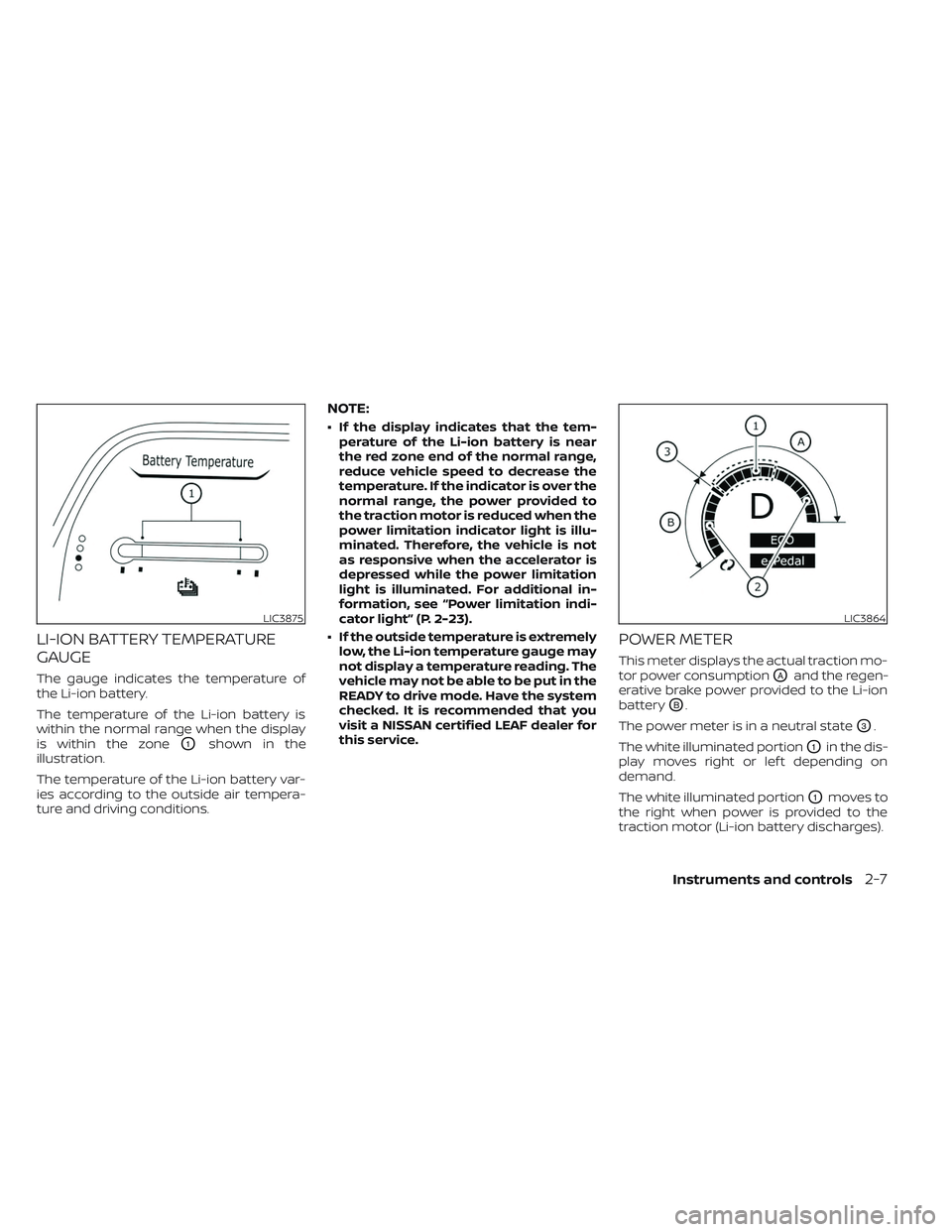
LI-ION BATTERY TEMPERATURE
GAUGE
The gauge indicates the temperature of
the Li-ion battery.
The temperature of the Li-ion battery is
within the normal range when the display
is within the zone
O1shown in the
illustration.
The temperature of the Li-ion battery var-
ies according to the outside air tempera-
ture and driving conditions.
NOTE:
• If the display indicates that the tem- perature of the Li-ion battery is near
the red zone end of the normal range,
reduce vehicle speed to decrease the
temperature. If the indicator is over the
normal range, the power provided to
the traction motor is reduced when the
power limitation indicator light is illu-
minated. Therefore, the vehicle is not
as responsive when the accelerator is
depressed while the power limitation
light is illuminated. For additional in-
formation, see “Power limitation indi-
cator light” (P. 2-23).
• If the outside temperature is extremely low, the Li-ion temperature gauge may
not display a temperature reading. The
vehicle may not be able to be put in the
READY to drive mode. Have the system
checked. It is recommended that you
visit a NISSAN certified LEAF dealer for
this service.
POWER METER
This meter displays the actual traction mo-
tor power consumption
OAand the regen-
erative brake power provided to the Li-ion
battery
OB.
The power meter is in a neutral state
O3.
The white illuminated portion
O1in the dis-
play moves right or lef t depending on
demand.
The white illuminated portion
O1moves to
the right when power is provided to the
traction motor (Li-ion battery discharges).
LIC3875LIC3864
Instruments and controls2-7
Page 185 of 612
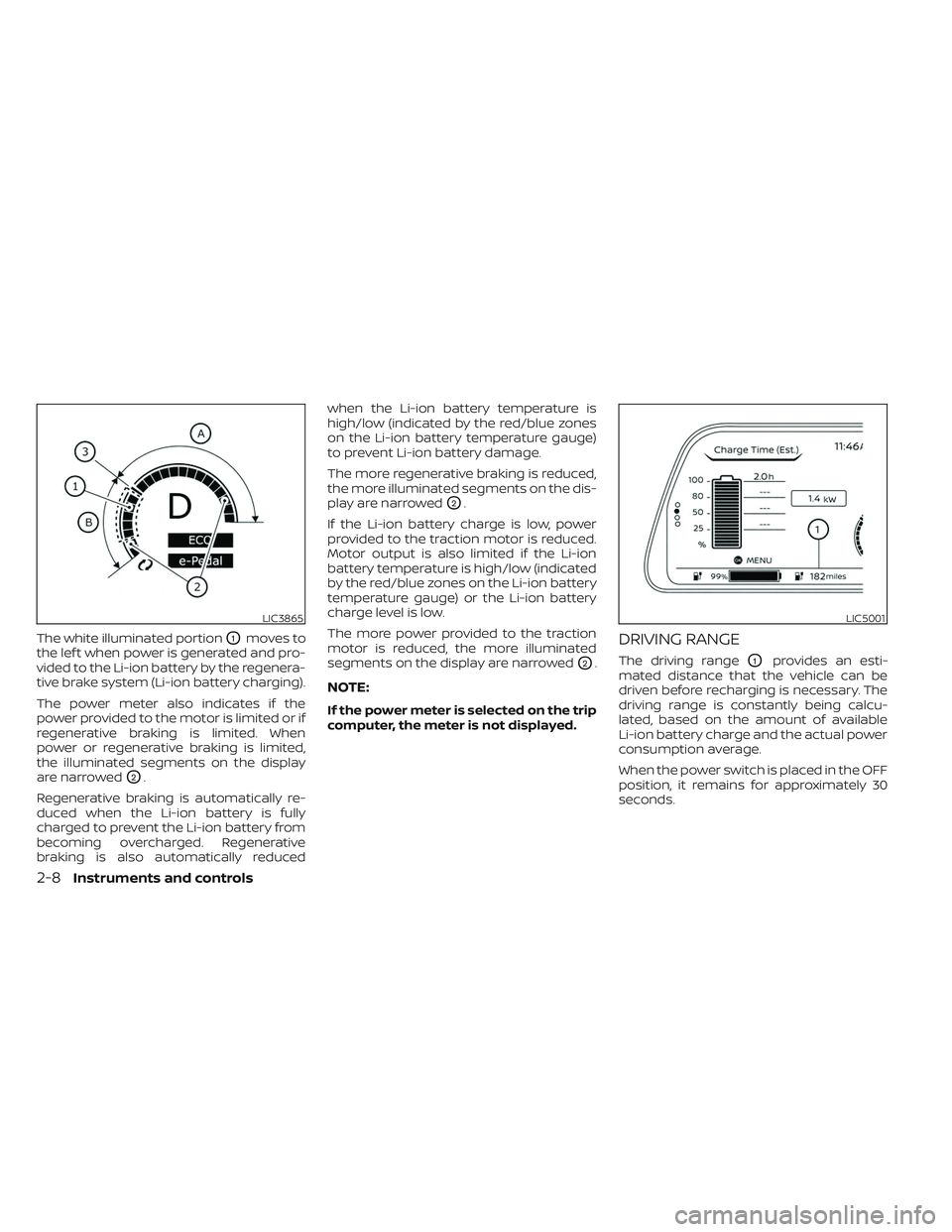
The white illuminated portionO1moves to
the lef t when power is generated and pro-
vided to the Li-ion battery by the regenera-
tive brake system (Li-ion battery charging).
The power meter also indicates if the
power provided to the motor is limited or if
regenerative braking is limited. When
power or regenerative braking is limited,
the illuminated segments on the display
are narrowed
O2.
Regenerative braking is automatically re-
duced when the Li-ion battery is fully
charged to prevent the Li-ion battery from
becoming overcharged. Regenerative
braking is also automatically reduced when the Li-ion battery temperature is
high/low (indicated by the red/blue zones
on the Li-ion battery temperature gauge)
to prevent Li-ion battery damage.
The more regenerative braking is reduced,
the more illuminated segments on the dis-
play are narrowed
O2.
If the Li-ion battery charge is low, power
provided to the traction motor is reduced.
Motor output is also limited if the Li-ion
battery temperature is high/low (indicated
by the red/blue zones on the Li-ion battery
temperature gauge) or the Li-ion battery
charge level is low.
The more power provided to the traction
motor is reduced, the more illuminated
segments on the display are narrowed
O2.
NOTE:
If the power meter is selected on the trip
computer, the meter is not displayed.
DRIVING RANGE
The driving rangeO1provides an esti-
mated distance that the vehicle can be
driven before recharging is necessary. The
driving range is constantly being calcu-
lated, based on the amount of available
Li-ion battery charge and the actual power
consumption average.
When the power switch is placed in the OFF
position, it remains for approximately 30
seconds.
LIC3865LIC5001
2-8Instruments and controls
Page 191 of 612
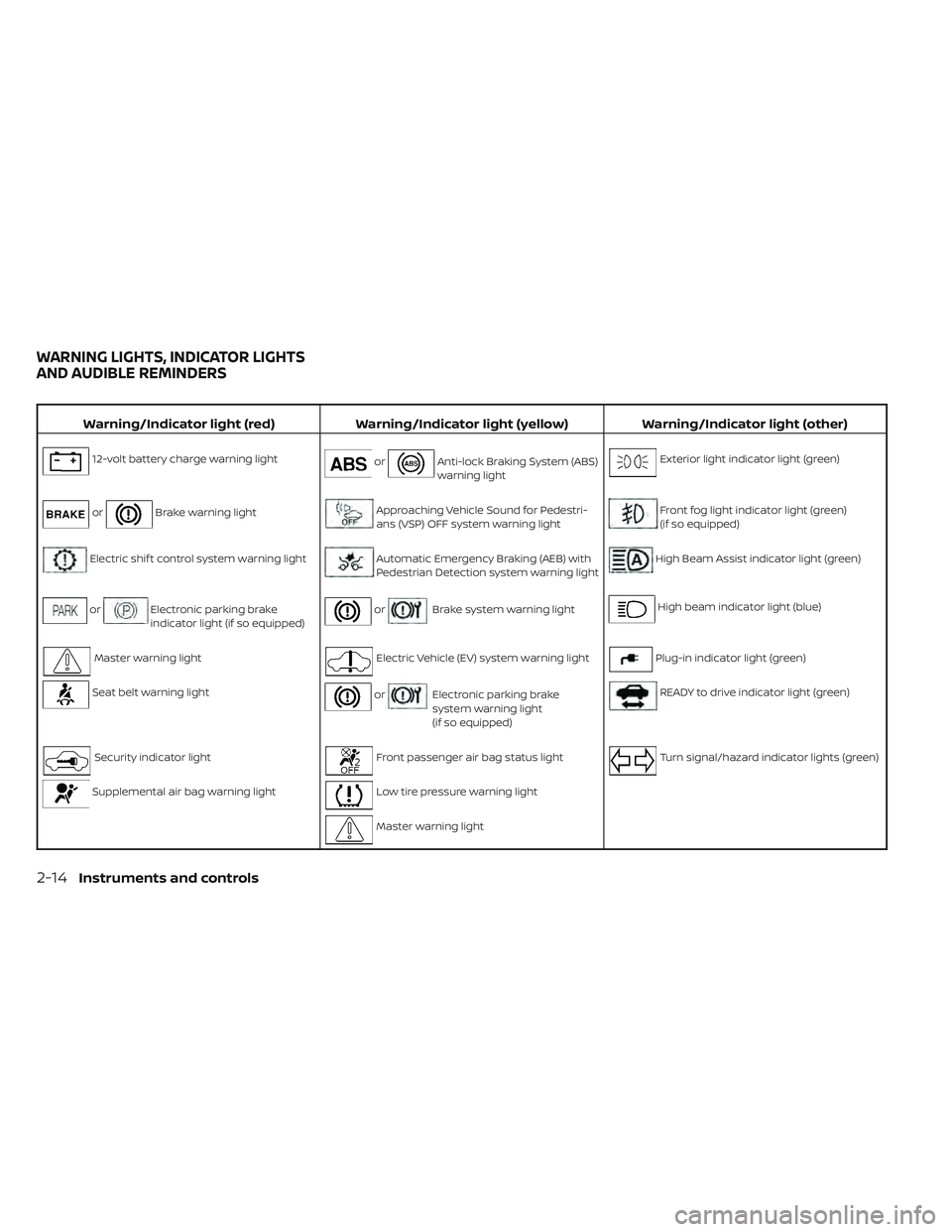
Warning/Indicator light (red)Warning/Indicator light (yellow) Warning/Indicator light (other)
12-volt battery charge warning lightorAnti-lock Braking System (ABS)
warning lightExterior light indicator light (green)
orBrake warning lightApproaching Vehicle Sound for Pedestri-
ans (VSP) OFF system warning lightFront fog light indicator light (green)
(if so equipped)
Electric shif t control system warning lightAutomatic Emergency Braking (AEB) with
Pedestrian Detection system warning lightHigh Beam Assist indicator light (green)
orElectronic parking brake
indicator light (if so equipped)orBrake system warning lightHigh beam indicator light (blue)
Master warning lightElectric Vehicle (EV) system warning lightPlug-in indicator light (green)
Seat belt warning lightorElectronic parking brake
system warning light
(if so equipped)READY to drive indicator light (green)
Security indicator lightFront passenger air bag status lightTurn signal/hazard indicator lights (green)
Supplemental air bag warning lightLow tire pressure warning light
Master warning light
WARNING LIGHTS, INDICATOR LIGHTS
AND AUDIBLE REMINDERS
2-14Instruments and controls
Page 193 of 612
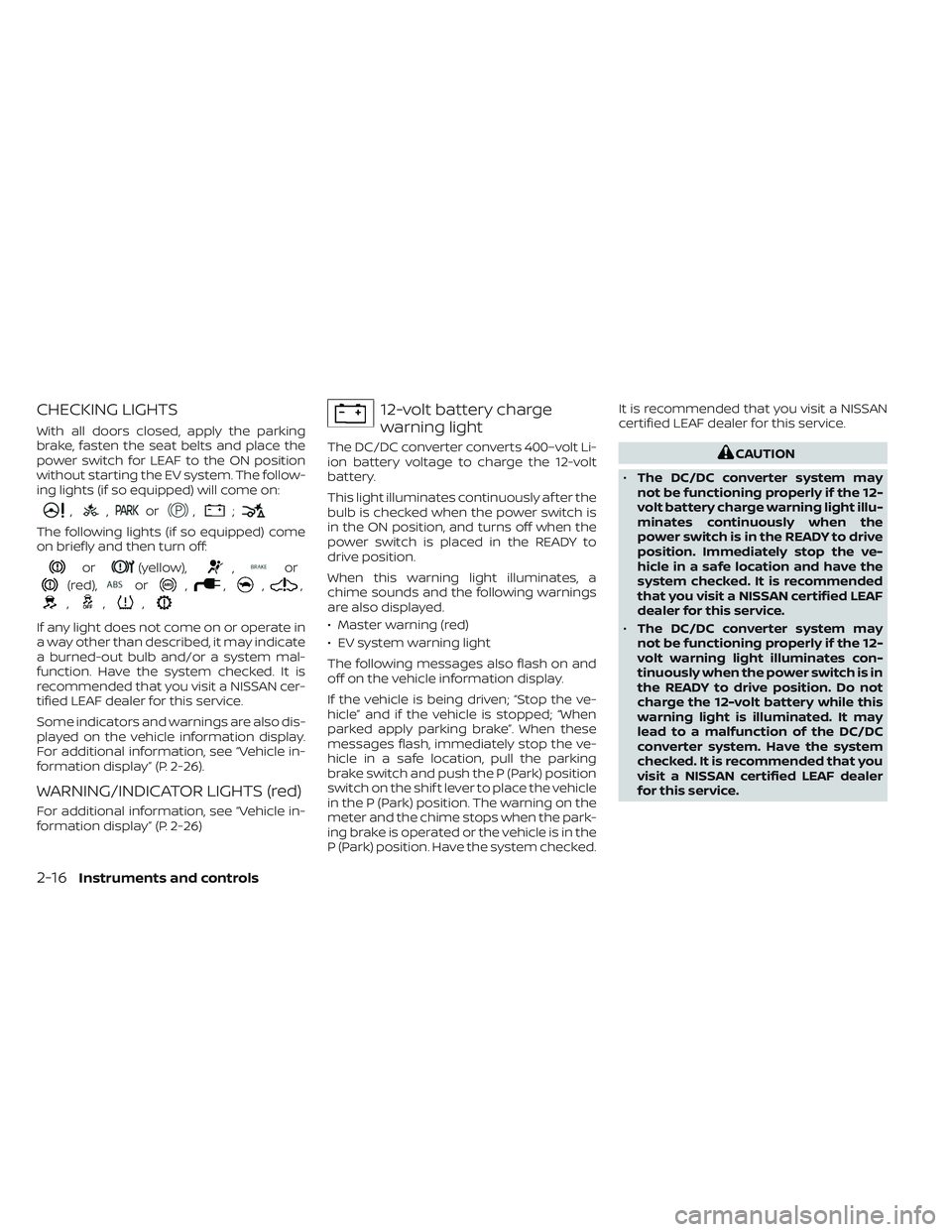
CHECKING LIGHTS
With all doors closed, apply the parking
brake, fasten the seat belts and place the
power switch for LEAF to the ON position
without starting the EV system. The follow-
ing lights (if so equipped) will come on:
,,or,;
The following lights (if so equipped) come
on briefly and then turn off:
or(yellow),,or
(red),or,,,,
,,,
If any light does not come on or operate in
a way other than described, it may indicate
a burned-out bulb and/or a system mal-
function. Have the system checked. It is
recommended that you visit a NISSAN cer-
tified LEAF dealer for this service.
Some indicators and warnings are also dis-
played on the vehicle information display.
For additional information, see “Vehicle in-
formation display” (P. 2-26).
WARNING/INDICATOR LIGHTS (red)
For additional information, see “Vehicle in-
formation display” (P. 2-26)
12-volt battery charge
warning light
The DC/DC converter converts 400–volt Li-
ion battery voltage to charge the 12-volt
battery.
This light illuminates continuously af ter the
bulb is checked when the power switch is
in the ON position, and turns off when the
power switch is placed in the READY to
drive position.
When this warning light illuminates, a
chime sounds and the following warnings
are also displayed.
• Master warning (red)
• EV system warning light
The following messages also flash on and
off on the vehicle information display.
If the vehicle is being driven; “Stop the ve-
hicle” and if the vehicle is stopped; “When
parked apply parking brake”. When these
messages flash, immediately stop the ve-
hicle in a safe location, pull the parking
brake switch and push the P (Park) position
switch on the shif t lever to place the vehicle
in the P (Park) position. The warning on the
meter and the chime stops when the park-
ing brake is operated or the vehicle is in the
P (Park) position. Have the system checked.It is recommended that you visit a NISSAN
certified LEAF dealer for this service.CAUTION
• The DC/DC converter system may
not be functioning properly if the 12-
volt battery charge warning light illu-
minates continuously when the
power switch is in the READY to drive
position. Immediately stop the ve-
hicle in a safe location and have the
system checked. It is recommended
that you visit a NISSAN certified LEAF
dealer for this service.
• The DC/DC converter system may
not be functioning properly if the 12-
volt warning light illuminates con-
tinuously when the power switch is in
the READY to drive position. Do not
charge the 12-volt battery while this
warning light is illuminated. It may
lead to a malfunction of the DC/DC
converter system. Have the system
checked. It is recommended that you
visit a NISSAN certified LEAF dealer
for this service.
2-16Instruments and controls