2023 NISSAN LEAF ad blue
[x] Cancel search: ad bluePage 422 of 612
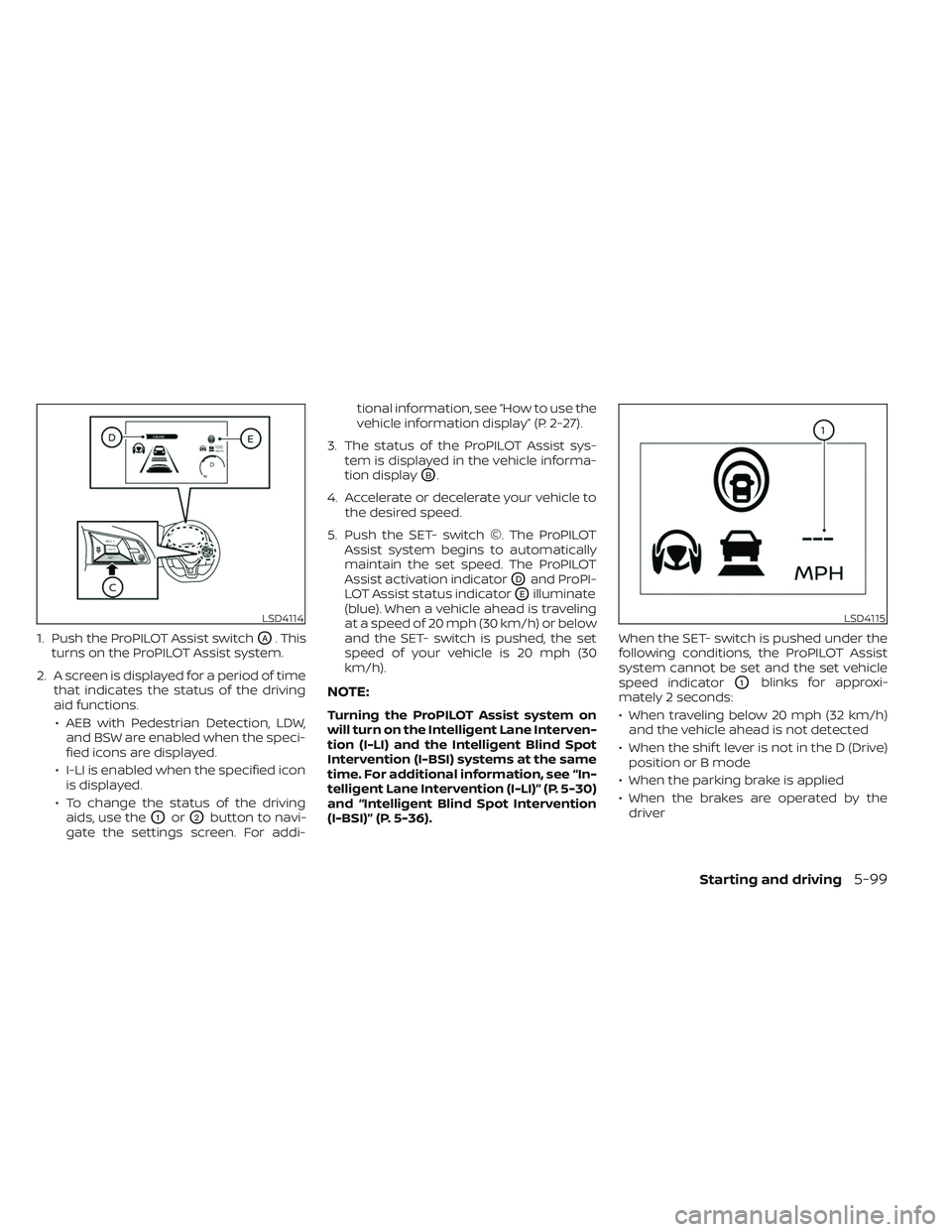
1. Push the ProPILOT Assist switchOA. This
turns on the ProPILOT Assist system.
2. A screen is displayed for a period of time that indicates the status of the driving
aid functions.
• AEB with Pedestrian Detection, LDW, and BSW are enabled when the speci-
fied icons are displayed.
• I-LI is enabled when the specified icon is displayed.
• To change the status of the driving aids, use the
O1orO2button to navi-
gate the settings screen. For addi- tional information, see “How to use the
vehicle information display” (P. 2-27).
3. The status of the ProPILOT Assist sys- tem is displayed in the vehicle informa-
tion display
OB.
4. Accelerate or decelerate your vehicle to the desired speed.
5. Push the SET- switch ©. The ProPILOT Assist system begins to automatically
maintain the set speed. The ProPILOT
Assist activation indicator
ODand ProPI-
LOT Assist status indicator
OEilluminate
(blue). When a vehicle ahead is traveling
at a speed of 20 mph (30 km/h) or below
and the SET- switch is pushed, the set
speed of your vehicle is 20 mph (30
km/h).
NOTE:
Turning the ProPILOT Assist system on
will turn on the Intelligent Lane Interven-
tion (I-LI) and the Intelligent Blind Spot
Intervention (I-BSI) systems at the same
time. For additional information, see “In-
telligent Lane Intervention (I-LI)” (P. 5-30)
and “Intelligent Blind Spot Intervention
(I-BSI)” (P. 5-36). When the SET- switch is pushed under the
following conditions, the ProPILOT Assist
system cannot be set and the set vehicle
speed indicator
O1blinks for approxi-
mately 2 seconds:
• When traveling below 20 mph (32 km/h) and the vehicle ahead is not detected
• When the shif t lever is not in the D (Drive) position or B mode
• When the parking brake is applied
• When the brakes are operated by the driver
LSD4114LSD4115
Starting and driving5-99
Page 485 of 612
When you put the shif t lever in the B mode
and take your foot off the accelerator
pedal, more regenerative brake is applied
than in the D (Drive) position. However, dur-
ing high-speed driving you may feel that
regenerative brake provides less decelera-
tion than the engine braking in an ordinary
vehicle. This is normal.
Less deceleration is provided by the regen-
erative brake system when the Li-ion bat-
tery is fully charged. Regenerative brake is
automatically reduced when the Li-ion
battery is fully charged to prevent the Li-ion
battery from becoming overcharged. Re-
generative brake is also automatically re-
duced when the battery temperature is
high/low (indicated by the red/blue zones
on the battery temperature gauge) to pre-
vent Li-ion battery damage.
The brake pedal should be used to slow or
stop the vehicle depending on traffic or
road conditions. The vehicle brakes are not
affected by regenerative brake system
operation.NOTE:
• When applying the regenerativebrakes, you may hear a sound coming
from the regenerative brake system.
This is a normal operating characteris-
tic of an EV.
• If the power switch position is in a po- sition other than ON or READY to drive,
you can stop the vehicle by depressing
the brake pedal. However, greater foot
pressure on the brake pedal will be re-
quired to stop the vehicle, and the
stopping distance will be longer.
• When depressing the brake pedal, the brake pedal feel will not be smooth or
may change when the cooperative re-
generative brake system activates.
However, the electronically controlled
brake system is operating normally
and this does not indicate a
malfunction.
Using the brakes
Avoid resting your foot on the brake pedal
while driving. This will cause overheating of
the brakes, wearing out of the brake pads
and shoes faster, and will reduce driving
range. To help reduce brake wear, and to prevent
the brakes from overheating, reduce speed
and select B mode before going down a
slope or long grade. Overheated brakes
may reduce braking performance and
could result in loss of vehicle control.
WARNING
• While driving on a slippery surface,
be careful when braking or accelerat-
ing. Abrupt braking or accelerating
could cause the wheels to skid, which
could result in an accident.
• If the brake pedal is depressed with
the EV system OFF, you may feel an
increased brake pedal effort and a
decreased pedal stroke. If the BRAKE
warning light does not illuminate
and the brake pedal feels like it has
returned to its normal state af ter the
EV system is started, this indicates
that there is no malfunction and the
vehicle can be operated normally.
Wet brakes
When the vehicle is washed or driven
through water, the brakes may get wet. As
a result, the braking distance will be longer
and the vehicle may pull to one side during
braking.
5-162Starting and driving
Page 528 of 612
The cooling system is filled at the factory
with a pre-diluted mixture of 50% Genuine
NISSAN Long Life Antifreeze/Coolant (blue)
and 50% water to provide year-round anti-
freeze and coolant protection. The anti-
freeze solution contains rust and corrosion
inhibitors. Additional cooling system addi-
tives are not necessary.
WARNING
• Never remove the coolant reservoir
cap when the motor compartment is
hot. Wait until the motor compart-
ment cools down.
• The coolant reservoir is equipped
with a pressure type coolant reser-
voir cap. To prevent damage to the
motor compartment, use only a
Genuine NISSAN coolant reservoir
cap.
CAUTION
• Never use any additives in the cool-
ant such as radiator sealer in the
cooling system. This may cause
damage to electrical equipment
such as the motor and inverter. •
When adding or replacing coolant, be
sure to use only a Genuine NISSAN
Long Life Antifreeze/Coolant (blue)
or equivalent. Genuine NISSAN Long
Life Antifreeze/Coolant (blue) is pre-
diluted to provide antifreeze protec-
tion to −34°F (−37°C) . If additional
freeze protection is needed due to
the weather conditions where you
operate your vehicle, add Genuine
NISSAN Long Life Antifreeze/Coolant
(blue) concentrate following the di-
rections on the container. If an
equivalent coolant other than
Genuine NISSAN Long Life
Antifreeze/Coolant (blue) is used, fol-
low the coolant manufacturer's in-
structions to maintain minimum an-
tifreeze protection to −34°F (−37°C).
The use of other types of coolant so-
lutions other than Genuine NISSAN
Long Life Antifreeze/Coolant (blue)
or equivalent may damage the cool-
ing system. •
The life expectancy of the factory-fill
coolant is 125,000 miles (200,000
km) or 15 years. Mixing any other type
of coolant other than Genuine
NISSAN Long Life Antifreeze/Coolant
(blue)(or equivalent coolant), includ-
ing Genuine NISSAN Long Life
Antifreeze/Coolant (green), or the
use of non-distilled water may re-
duce the life expectancy of the
factory-filled coolant. For additional
information, refer to the “Mainte-
nance and schedules” section of this
manual.
COOLING SYSTEM
Do-it yourself8-5
Page 566 of 612
Radiator and hoses:Check the front of the
radiator and clean off any dirt, insects,
leaves, etc., that may have accumulated.
Make sure the hoses have no cracks, defor-
mation, rot or loose connections.
Underbody: The underbody is frequently
exposed to corrosive substances such as
those used on icy roads or to control dust. It
is very important to remove these sub-
stances, otherwise rust will form on the
floor pan and frame. At the end of winter,
the underbody should be thoroughly
flushed with plain water, being careful to
clean those areas where mud and dirt may
accumulate. For additional information,
see “Cleaning exterior” (P. 7-2).
Windshield-washer fluid*: Check that
there is an adequate amount of fluid in the
reservoir. The following descriptions are provided to
give you a better understanding of the
scheduled maintenance items that should
be regularly checked or replaced. The
maintenance schedule indicates at which
mileage/time intervals each item requires
service.
In addition to scheduled maintenance,
your vehicle requires that some items be
checked during normal day-to-day opera-
tion. For additional information, see “Gen-
eral maintenance” (P. 9-2).
Items marked with
“*”are recommended
by NISSAN for reliable vehicle operation.
You are not required to perform mainte-
nance on these items in order to maintain
the warranties which come with your
NISSAN. Other maintenance items and in-
tervals are required.
When applicable, additional information
can be found in the “Do-it-yourself ” section
of this manual.
EXPLANATION OF SCHEDULED
MAINTENANCE ITEMS
EV System Charging Port*: Check the
charging port for any signs of contamina-
tion, dust, sand etc. Charging Port Sealing Cap*:
Use only
compressed air with proper eye protection
to clean any contamination from the seal-
ing cap.
Coolant: Replace coolant at the interval
specified below. When adding or replacing
coolant, be sure to use only Genuine
NISSAN Long Life Antifreeze/Coolant (Blue)
or equivalent with the proper mixture. (Re-
fer to the Owner’s Manual to determine the
proper mixture for your area.) The recom-
mended service interval of the factory fill
coolant is 125,000 miles (200,000 km) or 15
years, whichever comes first. Subsequent
replacement of Genuine NISSAN Long Life
Antifreeze/Coolant (Blue) should occur ev-
ery 75,000 miles (120,000 km) or 5 years,
whichever comes first.
NOTE:
Mixing any other type of coolant or the
use of nondistilled water will reduce the
recommended service interval of the
coolant.
EXPLANATION OF SCHEDULED
MAINTENANCE ITEMS
Maintenance and schedules9-5
Page 579 of 612
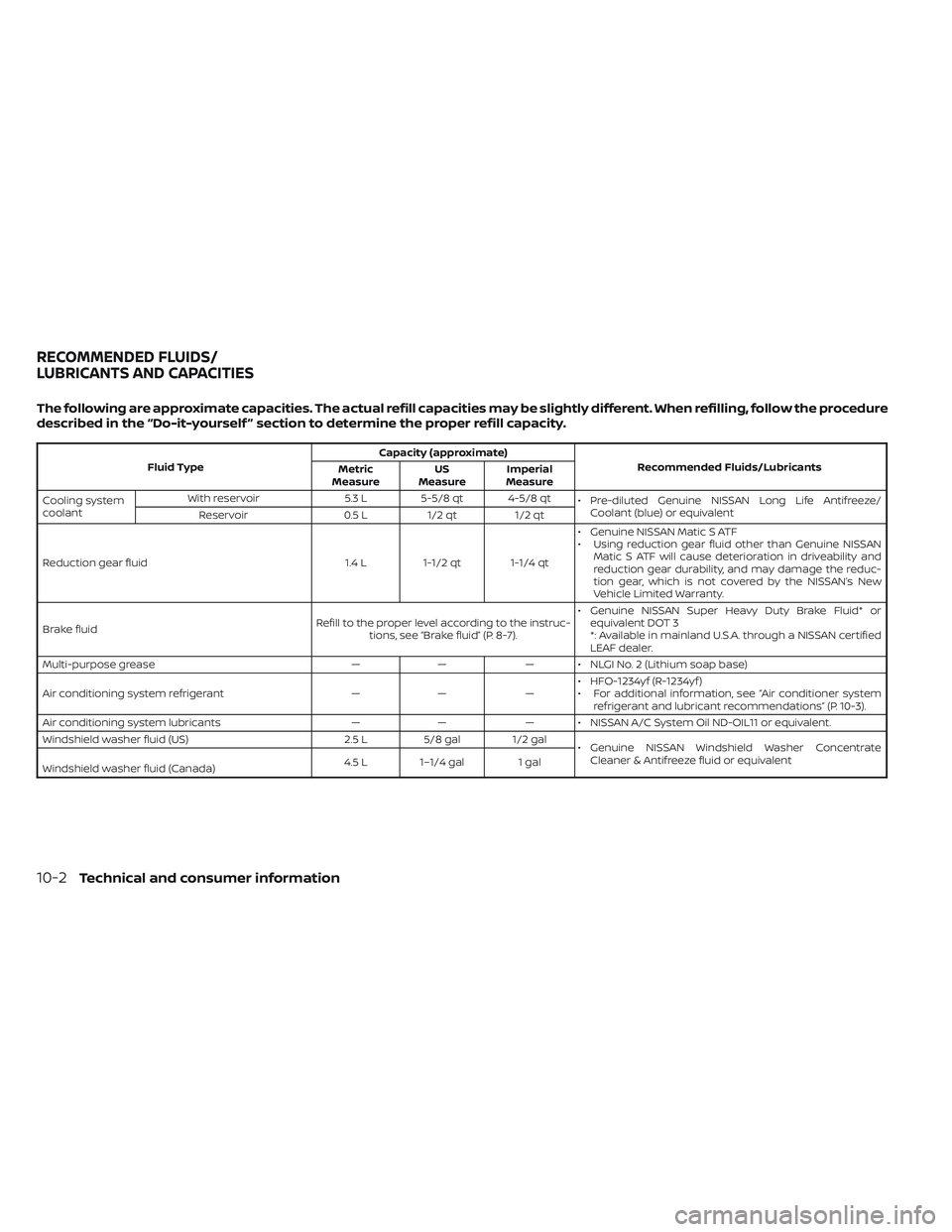
The following are approximate capacities. The actual refill capacities may be slightly different. When refilling, follow the procedure
described in the “Do-it-yourself ” section to determine the proper refill capacity.
Fluid TypeCapacity (approximate)
Recommended Fluids/Lubricants
Metric
Measure US
Measure Imperial
Measure
Cooling system
coolant With reservoir
5.3 L 5-5/8 qt 4-5/8 qt
• Pre-diluted Genuine NISSAN Long Life Antifreeze/
Coolant (blue) or equivalent
Reservoir 0.5 L1/2 qt 1/2 qt
Reduction gear fluid 1.4 L1-1/2 qt 1-1/4 qt • Genuine NISSAN Matic S ATF
• Using reduction gear fluid other than Genuine NISSAN
Matic S ATF will cause deterioration in driveability and
reduction gear durability, and may damage the reduc-
tion gear, which is not covered by the NISSAN’s New
Vehicle Limited Warranty.
Brake fluid Refill to the proper level according to the instruc-
tions, see “Brake fluid” (P. 8-7). • Genuine NISSAN Super Heavy Duty Brake Fluid* or
equivalent DOT 3
*: Available in mainland U.S.A. through a NISSAN certified
LEAF dealer.
Multi-purpose grease —— — • NLGI No. 2 (Lithium soap base)
Air conditioning system refrigerant —— —• HFO-1234yf (R-1234yf )
• For additional information, see “Air conditioner system
refrigerant and lubricant recommendations” (P. 10-3).
Air conditioning system lubricants —— — • NISSAN A/C System Oil ND-OIL11 or equivalent.
Windshield washer fluid (US) 2.5 L5/8 gal 1/2 gal
• Genuine NISSAN Windshield Washer Concentrate
Cleaner & Antifreeze fluid or equivalent
Windshield washer fluid (Canada) 4.5 L 1–1/4 gal 1 gal
RECOMMENDED FLUIDS/
LUBRICANTS AND CAPACITIES
10-2Technical and consumer information