2023 NISSAN KICKS fog light
[x] Cancel search: fog lightPage 381 of 558
AEB WITH PEDESTRIAN
DETECTION SYSTEM LIMITATIONS
WARNING
Listed below are the system limitations for
the AEB with Pedestrian Detection sys-
tem. Failure to operate the vehicle in ac-
cordance with these system limitations
could result in serious injury or death.
•The AEB with Pedestrian Detection
system cannot detect all vehicles or
pedestrians under all conditions.
•
The AEB with Pedestrian Detection
system does not detect the following:
– Pedestrians that are small (for ex- ample, children), in a sitting posi-
tion, operating toys/skateboards,
on scooters or in wheelchairs, or
not in an upright standing or
walking position.
– Animals of any size.
–
Obstacles (for example, cargo or
debris) on the roadway or roadside.
– Oncoming or crossing vehicles.
–Vehicles where the tires are difficult
to see or the shape of the rear of the
vehicle is unclear or obstructed.
– Parked vehicles. •
The AEB with Pedestrian Detection
system has some performance limi-
tations.
– If a stationary vehicle is in the
vehicle’s path, the system will not
function when the vehicle ap-
proaches the stationary vehicle
at speeds over approximately
50 mph (80 km/h).
– Pedestrian detection will not
function when the vehicle is
driven at speeds over approxi-
mately 37 mph (60 km/h) or below
approximately 6 mph (10km/h).
• For pedestrians, the AEB with Pedes-
trian Detection system will not issue
the first warning.
• The AEB with Pedestrian Detection
system may not function properly
or detect a vehicle or pedestrians
ahead in the following conditions:
– In poor visibility conditions (such
as rain, snow, fog, dust storms,
sand storms, smoke, and road
spray from other vehicles).
–
If dirt, ice, snow, fog or other mate-
rial is covering the radar sensor
area or camera area of windshield.
– If a strong light (for example, sun-
light or high beams) enters the
front camera or a sudden change
in brightness occurs (for example,
entering a tunnel or driving in
lightning).
– In dark or dimly lit conditions,
such as at night or in tunnels, in-
cluding cases where your vehi-
cle’s headlights are off or dim, or
the tail lights of the vehicle ahead
are off.
– When the direction of the camera
is misaligned.
– When driving on a steep downhill
slope, on roads with sharp curves,
and/or bumpy or dirt roads.
– If there is interference by other ra-
dar sources.
– When your vehicle’s position or
movement is changed quickly or
significantly (for example, lane
change, turning vehicle, abrupt
steering, sudden acceleration or
deceleration).
Starting and driving5-103
Page 399 of 558
SYSTEM TEMPORARILY
UNAVAILABLE
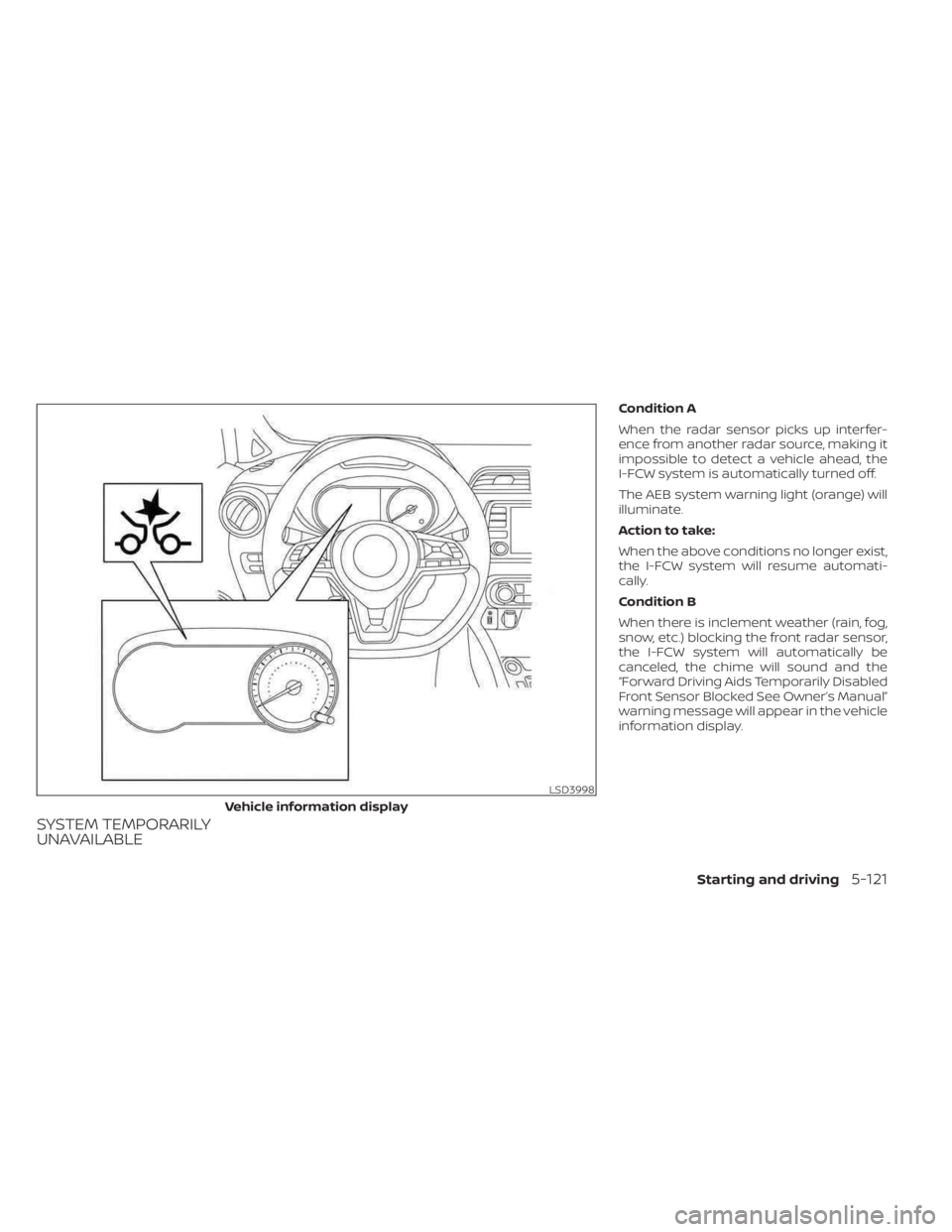
Condition A
When the radar sensor picks up interfer-
ence from another radar source, making it
impossible to detect a vehicle ahead, the
I-FCW system is automatically turned off.
The AEB system warning light (orange) will
illuminate.
Action to take:
When the above conditions no longer exist,
the I-FCW system will resume automati-
cally.
Condition B
When there is inclement weather (rain, fog,
snow, etc.) blocking the front radar sensor,
the I-FCW system will automatically be
canceled, the chime will sound and the
“Forward Driving Aids Temporarily Disabled
Front Sensor Blocked See Owner’s Manual”
warning message will appear in the vehicle
information display.
LSD3998
Vehicle information display
Starting and driving5-121
Page 451 of 558
8 Do-it-yourself
Maintenance precautions.......................8-2
Engine compartment check locations ...........8-3
Engine cooling system ..........................8-4
Checking engine coolant level ................8-5
Changing engine coolant ....................8-5
Engine oil .......................................8-5
Checking engine oil level .....................8-5
Changing engine oil and oil filter ..............8-6
Continuously Variable Transmission (CVT)
fluid .............................................8-9
Brake fluid .......................................8-9
Windshield-washer fluid ........................8-10
Windshield-washer fluid reservoir ...........8-10
Battery.......................................... 8-11
Jump starting ............................... 8-12
Variable voltage control system ................8-13
Drive belt ....................................... 8-13
Spark plugs .................................... 8-14
Replacing spark plugs ....................... 8-14
Air cleaner ..................................... 8-15
In-cabin microfilter .......................... 8-15Windshield wiper blades
........................8-16
Cleaning .................................... 8-16
Replacing ................................... 8-16
Brakes ......................................... 8-17
Fuses .......................................... 8-18
Engine compartment .......................8-18
Passenger compartment ...................8-20
Passenger compartment
(with electronic parking brake) ..............8-21
Battery replacement ........................... 8-22
NISSAN Intelligent Key® ......................8-23
Lights .......................................... 8-24
Headlights .................................. 8-24
Fog lights (if so equipped) ...................8-25
Exterior and interior lights ...................8-26
Wheels and tires ............................... 8-28
Tire pressure ................................ 8-28
Tire labeling ................................. 8-32
Types of tires ................................ 8-35
Tir
e chains .................................. 8-36
Changing wheels and tires ..................8-37
Page 475 of 558
•Do not leave the headlight assembly
open without a bulb installed for a
long period of time. Dust, moisture,
smoke, etc. entering the headlight
body may affect bulb performance.
Remove the bulb from the headlight
assembly just before a replacement
bulb is installed.
• Only touch the base when handling
the bulb. Never touch the glass enve-
lope. Touching the glass could sig-
nificantly affect bulb life and/or
headlight performance.
• High pressure halogen gas is sealed
inside the halogen bulb. The bulb
may break if the glass envelope is
scratched or the bulb is dropped.
• Use the same number and wattage
as shown in the chart.
Fog may temporarily form inside the lens
of the exterior lights in the rain or in a car
wash. A temperature difference between
the inside and the outside of the lens
causes the fog. This is not a malfunction. If
large drops of water collect inside the lens,
it is recommended that you visit a NISSAN
dealer for this service.Replacing the LED headlight bulb
(if so equipped)
If LED headlight bulb replacement is re-
quired, it is recommended that you visit a
NISSAN dealer for this service.
FOG LIGHTS (if so equipped)
For additional information on fog light bulb
replacement, refer to the instructions out-
lined in this section.
Replacing the LED fog light bulb
If LED fog light bulb replacement is re-
quired, it is recommended that you visit a
NISSAN dealer for this service.
Do-it-yourself8-25
Page 476 of 558
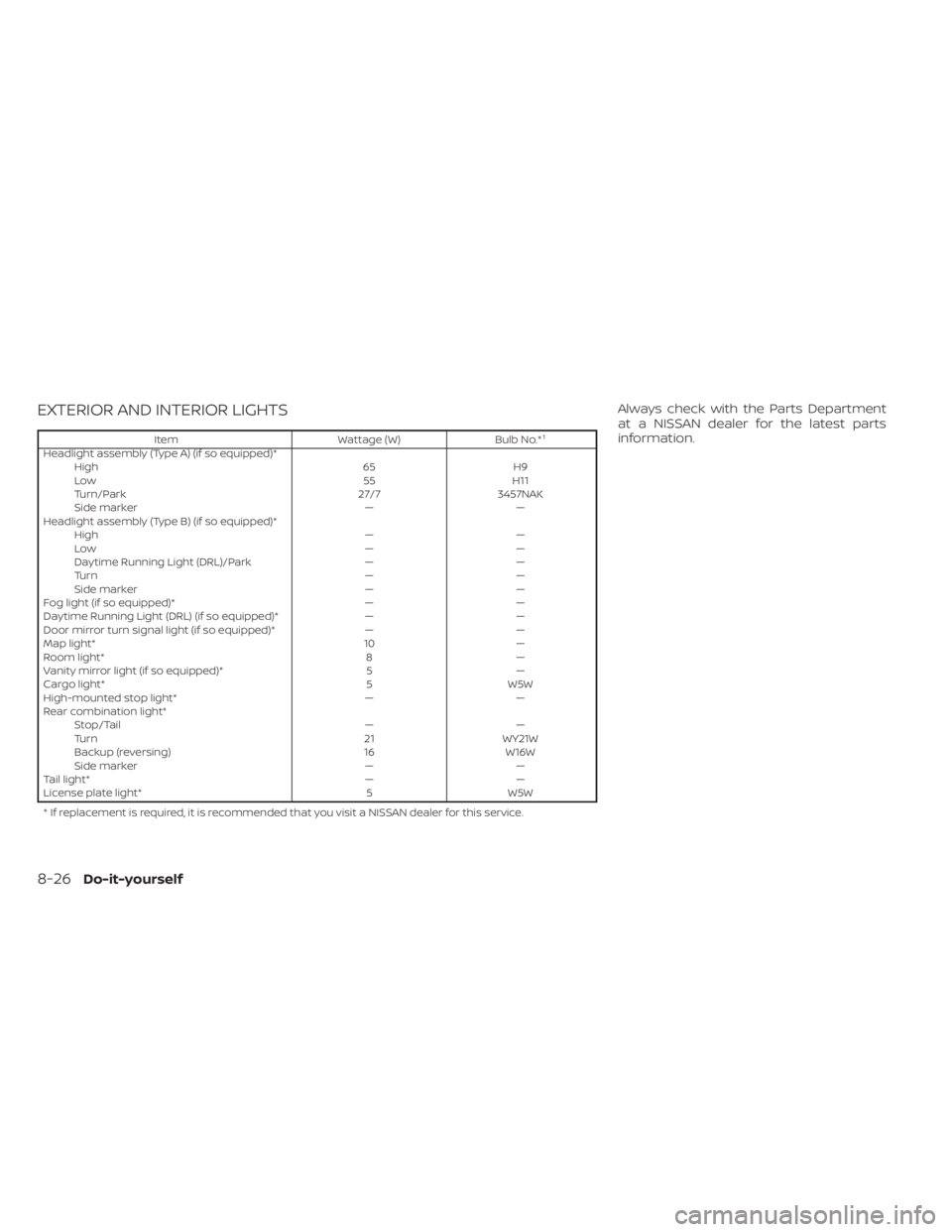
EXTERIOR AND INTERIOR LIGHTS
ItemWattage (W)Bulb No.*¹
Headlight assembly (Type A) (if so equipped)* High 65H9
Low 55H11
Turn/Park 27/73457NAK
Side marker ——
Headlight assembly (Type B) (if so equipped)* High ——
Low ——
Daytime Running Light (DRL)/Park ——
Tu r n ——
Side marker ——
Fog light (if so equipped)* ——
Daytime Running Light (DRL) (if so equipped)* ——
Door mirror turn signal light (if so equipped)* ——
Map light* 10—
Room light* 8—
Vanity mirror light (if so equipped)* 5—
Cargo light* 5W5W
High-mounted stop light* ——
Rear combination light* Stop/Tail ——
Turn 21WY21W
Backup (reversing) 16W16W
Side marker ——
Tail light* ——
License plate light* 5W5W
* If replacement is required, it is recommended that you visit a NISSAN dealer for this service.
Always check with the Parts Department
at a NISSAN dealer for the latest parts
information.
8-26Do-it-yourself
Page 477 of 558
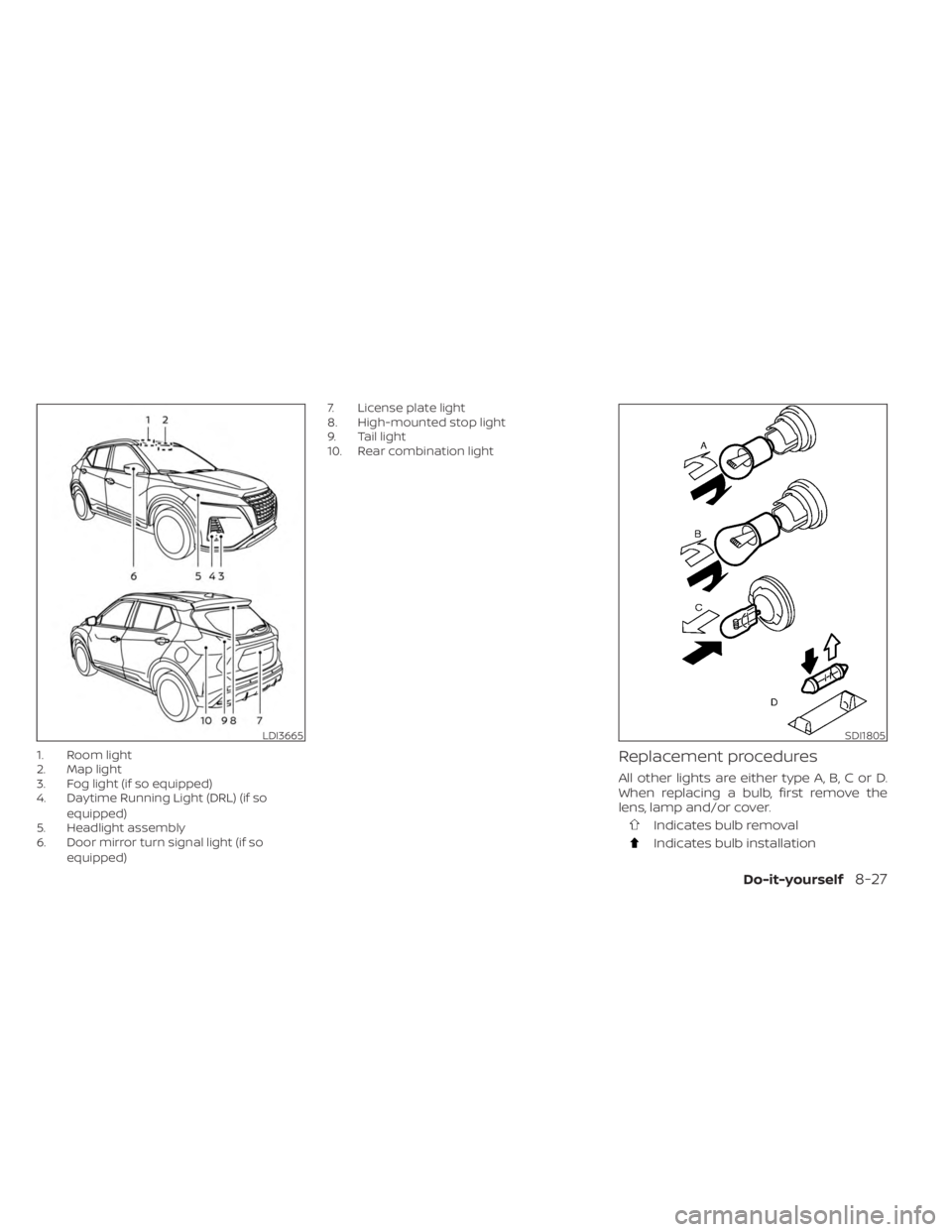
1. Room light
2. Map light
3. Fog light (if so equipped)
4. Daytime Running Light (DRL) (if soequipped)
5. Headlight assembly
6. Door mirror turn signal light (if so
equipped) 7. License plate light
8. High-mounted stop light
9. Tail light
10. Rear combination lightReplacement procedures
All other lights are either type A, B, C or D.
When replacing a bulb, first remove the
lens, lamp and/or cover.
Indicates bulb removal
Indicates bulb installation
LDI3665SDI1805
Do-it-yourself8-27
Page 549 of 558
Engine oil and oil filter
recommendation.............10-6Engine oil pressure warning light. . . .2-14Engine oil viscosity.............10-6Engine serial number...........10-11Engine specifications...........10-8Starting the engine............5-15Engine Block Heater.............5-146Event Data recorders............10-23Exhaust gas (Carbon monoxide)......5-4Explanation of maintenance items.....9-2Explanation of scheduled maintenance
items.......................9-5Extended storage switch..........2-60
F
F.M.V.S.S. certification label.........10-11Flashers (See hazard warning flasher
switch)......................6-2Flat tire...................6-3, 6-4Floor mat positioning aid...........7-5Fluid
Brake fluid................. .8-9Capacities and recommended
fuel/lubricants...............10-2Continuously Variable Transmission (CVT)
fluid..................... .8-9Engine coolant................8-4Engine oil...................8-5Windshield-washer fluid.........8-10Fog light switch................2-51
Forward Driving Aids
System Temporarily
Unavailable
. .2-37, 5-73, 5-94, 5-106, 5-121Front air bag system
(See supplemental restraint system). . .1-49Front seats....................1-2Front-door pocket...............2-61FuelCapacities and recommended
fuel/lubricants
...............10-2Fuel economy...............5-129Fuel gauge..................2-7Fuel octane rating.............10-5Fuel recommendation..........10-3Fuel-filler door lock opener lever. . . .3-25Fuel efficient driving tips..........5-128Fuel gauge....................2-7Fuel-filler door.................3-25Fuses.......................8-18Fusible links...............8-19,8-22
G
GaugeFuel gauge..................2-7Speedometer..............2-5, 2-6Tachometer..................2-7Trip odometer.............2-5, 2-6General maintenance.............9-2Glove box................... .2-63Grocery hooks.................2-66
H
Hands-free phone system, Bluetooth®. . .4-66Hazard warning flasher switch........6-2Head restraints.................1-5Headlight and turn signal switch.....2-44Headlight control switch..........2-44Headlights...................8-24Heated mirrors................3-30Heated seat switches............2-52Heated steering wheel switch.......2-53Heater
Heater and air conditioner........4-40Heater and air conditioner controls. . .4-41Heater operation..........4-34, 4-41Hill start assist system...........5-139Hood.......................3-21HookLuggage hook...............2-65Horn...................... .2-51
I
Ignition switch
Push-button ignition switch.......5-11Immobilizer system..........2-40, 5-14Important vehicle information label. . .10-11In-cabin microfilter..............8-15Increasing fuel economy..........5-129IndicatorNISSAN Intelligent Key® battery
discharge indicator
............5-13Inside automatic anti-glare mirror. . . .3-29
11-3
Page 550 of 558
Instrument brightness control.......2-50Instrument panel.............0-6, 2-2Instrument panel dimmer switch.....2-50Intelligent Around View® Monitor......4-16Intelligent Cruise Control..........5-58Intelligent Driver Alertness (I-DA).....5-125Intelligent Engine Brake (I-EB).......5-138Intelligent Forward Collision Warning
(I-FCW).....................5-110Intelligent Key systemKey operating range............3-7Key operation................3-9Mechanical key................3-3Remote keyless entry operation. . . .3-12Troubleshooting guide..........3-15Warning signals...............3-15Intelligent Trace Control (I-TC).......5-137Interior light...................2-74iPod® Player................. .4-56ISOFIX child restraints.............1-21
J
Jump starting..............6-10,8-12
K
Key.........................3-2Key fob battery replacement........8-22Keyless entry
With Intelligent Key system
(See Intelligent Key system)
.......3-12
KeysNISSAN Intelligent Key®...........3-6NISSAN Vehicle Immobilizer System
keys..................... .3-3
L
Labels
Air conditioner specification label. . .10-12Emission control information label. .10-11Engine serial number...........10-11F.M.V.S.S. certification label........10-11Tire and Loading Information label. .10-12Vehicle identification number (VIN)
plate.................... .10-10Warning labels (for SRS)..........1-62Lane Departure Warning (LDW).......5-28Lane Departure Warning (LDW) switch. .2-54LATCH (Lower Anchors and Tethers for
CHildren) System................1-21Launch bar menu................4-7License plate
Installing the license plate........10-13Lif tgate.....................3-22LightAir bag warning light........1-63, 2-15Brake light (See stop light)........8-26Bulb check/instrument panel......2-13Bulb replacement.............8-26Charge warning light...........2-14Exterior and Interior lights........8-26Fog light switch...............2-51Fog lights..................8-25
Headlight and turn signal switch. . . .2-44Headlight control switch.........2-44Headlights..................8-24Interior light.................2-74Light bulbs.................8-24Low tire pressure warning light.....2-18Low windshield-washer fluid warning
light......................2-19Luggage compartment lights......2-76Personal lights...............2-75Security indicator light..........2-15Lights......................8-24Map lights..................2-75LockChild safety rear door lock.........3-6Door locks................. .3-4Fuel-filler door lock opener lever. . . .3-25Power door locks..............3-5Low fuel warning light. .2-15, 2-17, 2-20, 2-33Low tire pressure warning light.......2-18Low windshield-washer fluid warning
light........................2-19Luggage (See vehicle loading
information)..................10-14Luggage compartment lights.......2-76Luggage hook.................2-65Luggage rack (see roof rack). . . .2-67, 2-68
M
Maintenance
General maintenance...........9-2Inside the vehicle..............9-3
11-4