2023 NISSAN FRONTIER oil level
[x] Cancel search: oil levelPage 455 of 572

CAUTION
Do not spill fluids on engine cover. This
could damage the engine cover. If flu-
ids are spilled, immediately clean sur-
face with a neutral detergent. Do not
use an organic solvent such as brake
cleaner.
For additional information about drain and
refill capacity, see “Recommended fluids/
lubricants and capacities” (P. 10-2). The
drain and refill capacity depends on the oil
temperature and drain time. Use these
specifications for reference only. Always
use the dipstick to determine the proper
amount of oil in the engine.
10. Start the engine and check for leakage around the drain plug and the oil filter.
Correct as required. Turn the engine off
and wait more than 15 minutes. Check
the oil level with the dipstick. Add en-
gine oil if necessary.Af ter the operation
1. Reinstall engine protectors in reverse or-der of removal.
2. Lower the vehicle carefully to the ground.
3. Reset the oil and oil filter maintenance reminder. For additional information,
see “Vehicle information display” (P. 2-22).
• Dispose of waste oil and filter properly.
• Check your local regulations. When checking or replacement is required,
it is recommended that you visit a NISSAN
dealer for this service.
CAUTION
• NISSAN recommends using Genuine
NISSAN Matic P ATF. Do not mix with
other fluids.
• Do not use CVT fluid or manual trans-
mission fluid in this transmission.
Damage caused by the use of fluids
other than as recommended is not
covered under NISSAN’s New Vehicle
Limited Warranty.
• Using fluids that are not equivalent
to Genuine NISSAN Matic P ATF may
also damage the transmission. Dam-
age caused by the use of fluids other
than as recommended is not covered
under NISSAN’s New Vehicle Limited
Warranty.
AUTOMATIC TRANSMISSION FLUID
(ATF)
Do-it-yourself8-13
Page 492 of 572
Brake pedal:Check the pedal for smooth
operation. If the brake pedal suddenly goes
down further than normal, the pedal feels
spongy or the vehicle seems to take longer
to stop, have your vehicle checked imme-
diately. It is recommended that you visit a
NISSAN dealer for this service. Keep the
floor mat away from the pedal.
Brakes: Check that the brakes do not pull
the vehicle to one side when applied.
Parking brake: Check the parking brake
operation regularly. The vehicle should be
securely held on a fairly steep hill with only
the parking brake applied. If the parking
brake needs adjustment, it is recom-
mended that you visit a NISSAN dealer for
this service.
Seats: Check seat position controls such
as seat adjusters, seatback recliner, etc., to
ensure they operate smoothly and all
latches lock securely in every position.
Check that the head restraints/headrests
move up and down smoothly and the locks
(if so equipped) hold securely in all latched
positions.
Seat belts: Check that all parts of the seat
belt system (for example, buckles, anchors,
adjusters and retractors) operate properly
and smoothly, and are installed securely. Check the belt webbing for cuts, fraying,
wear or damage.
Steering wheel:
Check for changes in the
steering system, such as excessive free
play, hard steering or strange noises.
Warning lights and chimes: Make sure all
warning lights and chimes are operating
properly.
Windshield defroster: Check that the air
comes out of the defroster outlets properly
and in sufficient quantity when operating
the heater or air conditioner.
Windshield wiper and washer*: Check
that the wipers and washer operate prop-
erly and that the wipers do not streak.
Under the hood and vehicle
The maintenance items listed here should
be checked periodically (for example, each
time you check the engine oil or refuel).
Battery (for maintenance free batter-
ies)*: This vehicle is equipped with a sealed
maintenance free battery. It is recom-
mended that you visit a NISSAN dealer for
service.
NOTE:
Care should be taken to avoid situations
that can lead to potential battery dis-
charge and potential no-start conditions
such as:
1. Installation or extended use of elec- tronic accessories that consume bat-
tery power when the engine is not
running (Phone chargers, GPS, DVD
players, etc.).
2. Vehicle is not driven regularly and/or only driven short distances.
In these cases, the battery may need to
be charged to maintain battery health.
Brake fluid level*: Make sure that the fluid
level is between the MAX and MIN lines on
the reservoir.
Engine coolant level*: Check the coolant
level when the engine is cold.
Engine drive belts*: Check engine drive
belts for wear, fraying or cracking and for
proper tension. Replace any damaged
drive belts.
9-4Maintenance and schedules
Page 493 of 572
Engine oil level*:Check the level af ter
parking the vehicle on a level spot and
turning off the engine. Wait more than 15
minutes for the oil to drain back into the oil
pan.
Exhaust system: Make sure there are no
loose supports, cracks or holes. If the
sound of the exhaust seems unusual or
there is a smell of exhaust fumes, immedi-
ately have the exhaust system inspected. It
is recommended that you visit a NISSAN
dealer for this service. For additional infor-
mation, see “Exhaust gas (carbon monox-
ide)” (P. 5-4).
Fluid leaks: Check under the vehicle for
fuel, oil, water or other fluid leaks af ter the
vehicle has been parked for a while. Water
dripping from the air conditioner af ter use
is normal. If you should notice any leaks or if
fuel fumes are evident, check for the cause
and have it corrected immediately.
Power steering fluid level* and lines:
Check the level when the fluid is cold, with
the engine off. Check the lines for proper
attachment, leaks, cracks, etc. Radiator and hoses:
Check the front of the
radiator and clean off any dirt, insects,
leaves, etc., that may have accumulated.
Make sure the hoses have no cracks, defor-
mation, rot or loose connections.
Underbody: The underbody is frequently
exposed to corrosive substances such as
those used on icy roads or to control dust. It
is very important to remove these sub-
stances, otherwise rust may form on the
floor pan, frame, fuel lines and around the
exhaust system. At the end of winter, the
underbody should be thoroughly flushed
with plain water, being careful to clean
those areas where mud and dirt may accu-
mulate. For additional information, see
“Cleaning exterior” (P. 7-2 ).
Windshield-washer fluid*: Check that
there is adequate fluid in the reservoir. The following descriptions are provided to
give you a better understanding of the
scheduled maintenance items that should
be regularly checked or replaced. The
maintenance schedule indicates at which
mileage/time intervals each item requires
service.
In addition to scheduled maintenance,
your vehicle requires that some items be
checked during normal day-to-day opera-
tion. For additional information, see “Gen-
eral maintenance” (P. 9-2).
Items marked with
“*”are recommended
by NISSAN for reliable vehicle operation.
You are not required to perform mainte-
nance on these items in order to maintain
the warranties which come with your
NISSAN. Other maintenance items and in-
tervals are required.
When applicable, additional information
can be found in the “Do-it-yourself ” section
of this manual.
EXPLANATION OF SCHEDULED
MAINTENANCE ITEMS
Maintenance and schedules9-5
Page 516 of 572
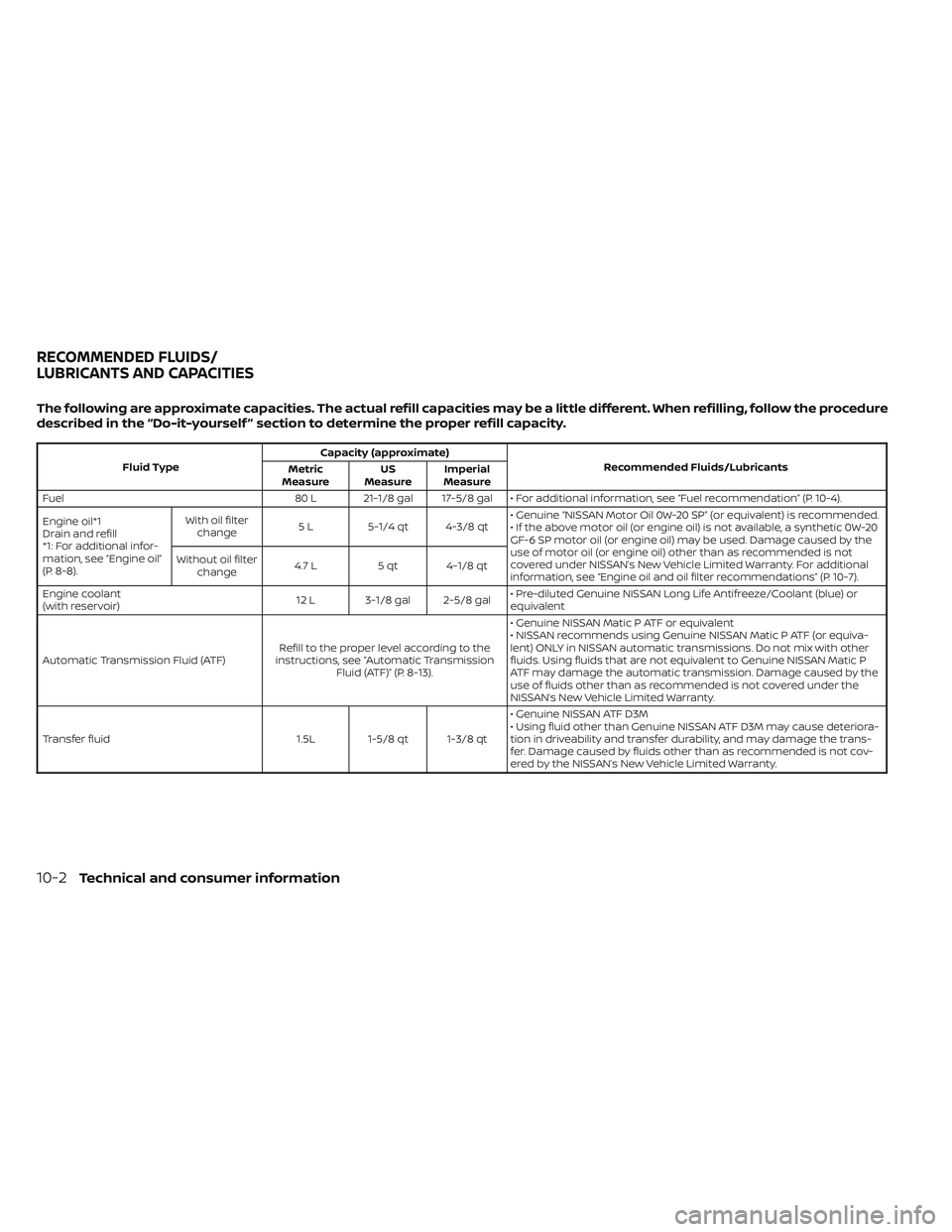
The following are approximate capacities. The actual refill capacities may be a little different. When refilling, follow the procedure
described in the “Do-it-yourself ” section to determine the proper refill capacity.
Fluid TypeCapacity (approximate)
Recommended Fluids/Lubricants
Metric
Measure US
Measure Imperial
Measure
Fuel 80 L 21-1/8 gal 17-5/8 gal • For additional information, see “Fuel recommendation” (P. 10-4).
Engine oil*1
Drain and refill
*1: For additional infor-
mation, see “Engine oil”
(P. 8-8). With oil filter
change 5 L
5-1/4 qt 4-3/8 qt • Genuine “NISSAN Motor Oil 0W-20 SP” (or equivalent) is recommended.
• If the above motor oil (or engine oil) is not available, a synthetic 0W-20
GF-6 SP motor oil (or engine oil) may be used. Damage caused by the
use of motor oil (or engine oil) other than as recommended is not
covered under NISSAN’s New Vehicle Limited Warranty. For additional
information, see “Engine oil and oil filter recommendations” (P. 10-7).
Without oil filter
change 4.7 L
5 qt 4-1/8 qt
Engine coolant
(with reservoir) 12 L 3-1/8 gal 2-5/8 gal• Pre-diluted Genuine NISSAN Long Life Antifreeze/Coolant (blue) or
equivalent
Automatic Transmission Fluid (ATF) Refill to the proper level according to the
instructions, see “Automatic Transmission Fluid (ATF)” (P. 8-13). • Genuine NISSAN Matic P ATF or equivalent
• NISSAN recommends using Genuine NISSAN Matic P ATF (or equiva-
lent) ONLY in NISSAN automatic transmissions. Do not mix with other
fluids. Using fluids that are not equivalent to Genuine NISSAN Matic P
ATF may damage the automatic transmission. Damage caused by the
use of fluids other than as recommended is not covered under the
NISSAN’s New Vehicle Limited Warranty.
Transfer fluid 1.5L 1-5/8 qt 1-3/8 qt• Genuine NISSAN ATF D3M
• Using fluid other than Genuine NISSAN ATF D3M may cause deteriora-
tion in driveability and transfer durability, and may damage the trans-
fer. Damage caused by fluids other than as recommended is not cov-
ered by the NISSAN’s New Vehicle Limited Warranty.
RECOMMENDED FLUIDS/
LUBRICANTS AND CAPACITIES
10-2Technical and consumer information
Page 517 of 572
Fluid TypeCapacity (approximate)
Recommended Fluids/Lubricants
Metric
Measure US
Measure Imperial
Measure
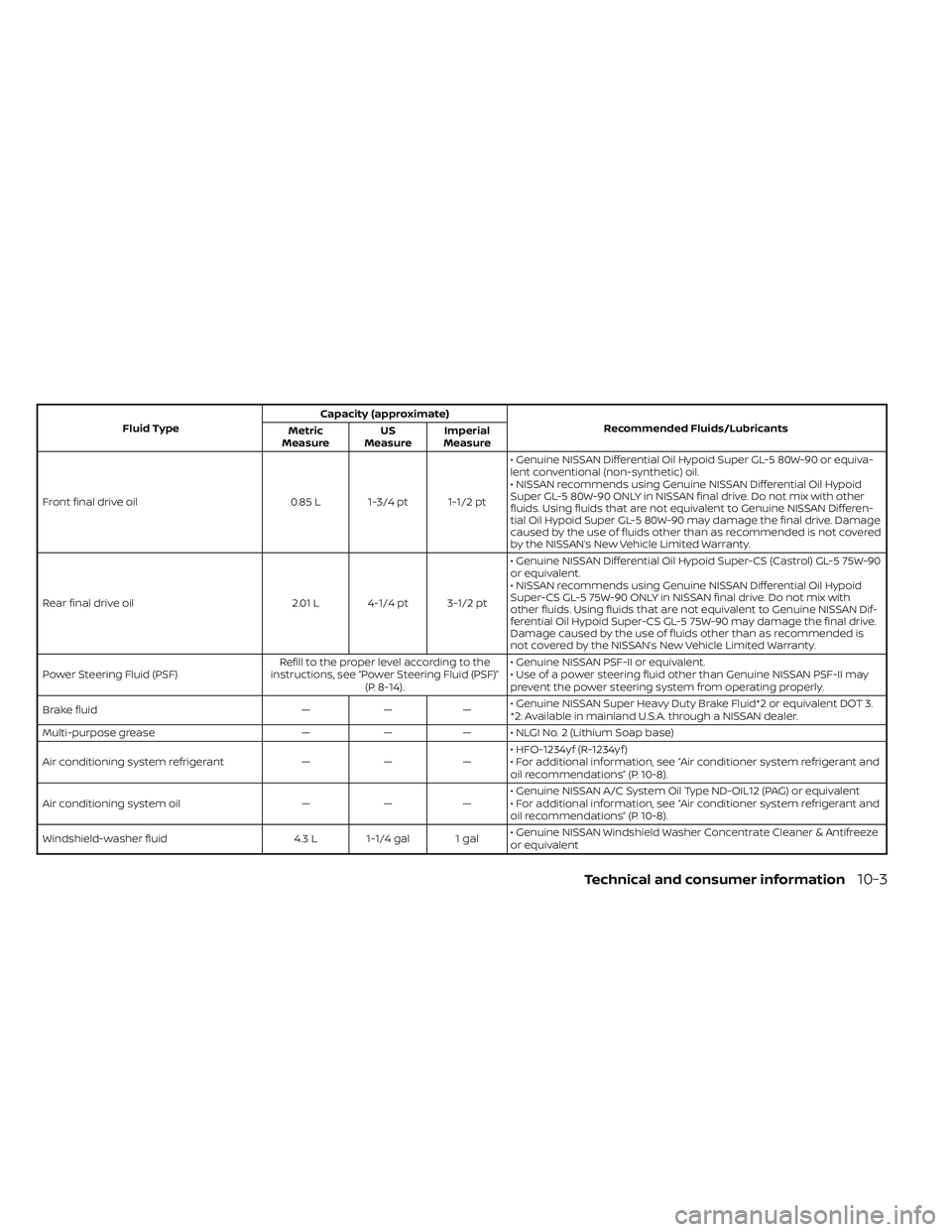
Front final drive oil 0.85 L 1-3/4 pt 1-1/2 pt• Genuine NISSAN Differential Oil Hypoid Super GL-5 80W-90 or equiva-
lent conventional (non-synthetic) oil.
• NISSAN recommends using Genuine NISSAN Differential Oil Hypoid
Super GL-5 80W-90 ONLY in NISSAN final drive. Do not mix with other
fluids. Using fluids that are not equivalent to Genuine NISSAN Differen-
tial Oil Hypoid Super GL-5 80W-90 may damage the final drive. Damage
caused by the use of fluids other than as recommended is not covered
by the NISSAN’s New Vehicle Limited Warranty.
Rear final drive oil 2.01 L 4-1/4 pt 3-1/2 pt• Genuine NISSAN Differential Oil Hypoid Super-CS (Castrol) GL-5 75W-90
or equivalent.
• NISSAN recommends using Genuine NISSAN Differential Oil Hypoid
Super-CS GL-5 75W-90 ONLY in NISSAN final drive. Do not mix with
other fluids. Using fluids that are not equivalent to Genuine NISSAN Dif-
ferential Oil Hypoid Super-CS GL-5 75W-90 may damage the final drive.
Damage caused by the use of fluids other than as recommended is
not covered by the NISSAN’s New Vehicle Limited Warranty.
Power Steering Fluid (PSF) Refill to the proper level according to the
instructions, see “Power Steering Fluid (PSF)” (P. 8-14). • Genuine NISSAN PSF-II or equivalent.
• Use of a power steering fluid other than Genuine NISSAN PSF-II may
prevent the power steering system from operating properly.
Brake fluid ———• Genuine NISSAN Super Heavy Duty Brake Fluid*2 or equivalent DOT 3.
*2: Available in mainland U.S.A. through a NISSAN dealer.
Multi-purpose grease ——— • NLGI No. 2 (Lithium Soap base)
Air conditioning system refrigerant ———• HFO-1234yf (R-1234yf )
• For additional information, see “Air conditioner system refrigerant and
oil recommendations” (P. 10-8).
Air conditioning system oil ———• Genuine NISSAN A/C System Oil Type ND-OIL12 (PAG) or equivalent
• For additional information, see “Air conditioner system refrigerant and
oil recommendations” (P. 10-8).
Windshield-washer fluid 4.3 L 1-1/4 gal 1 gal• Genuine NISSAN Windshield Washer Concentrate Cleaner & Antifreeze
or equivalent
Technical and consumer information10-3
Page 553 of 572

• Crosswinds and rough roads will ad-versely affect vehicle/trailer handling,
possibly causing vehicle sway. When be-
ing passed by larger vehicles, be pre-
pared for possible changes in crosswinds
that could affect vehicle handling.
Do the following if the trailer begins to
sway:
1. Take your foot off the accelerator pedal to allow the vehicle to coast and steer as
straight ahead as the road conditions
allow. This combination will help stabilize
the vehicle
– Do not correct trailer sway by steering or applying the brakes.
2. When the trailer sway stops, gently apply the brakes and pull to the side of the
road in a safe area.
3. Try to rearrange the trailer load so it is balanced as described in this section.
• Be careful when passing other vehicles. Passing while towing a trailer requires
considerably more distance than normal
passing. Remember, the length of the
trailer must also pass the other vehicle
before you can safely change lanes. • Downshif t the transmission to a lower
gear for engine braking when driving
down steep or long hills. This will help
slow the vehicle without applying the
brakes.
• Avoid holding the brake pedal down too long or too frequently. This could cause
the brakes to overheat, resulting in re-
duced braking efficiency.
• Increase your following distance to allow for greater stopping distances while tow-
ing a trailer. Anticipate stops and brake
gradually.
• NISSAN recommends that the cruise control not be used while towing a trailer.
• Some states or provinces have specific regulations and speed limits for vehicles
that are towing trailers. Obey the local
speed limits.
• Check your hitch, trailer wiring harness connections, and trailer wheel lug nuts
af ter 50 miles (80 km) of travel and at
every break.
• When launching a boat, don't allow the water level to go over the exhaust tail
pipe or rear bumper.
• Make sure you disconnect the trailer lights before backing the trailer into the
water or the trailer lights may burn out. When towing a trailer, final drive gear oil
should be replaced and transmission oil/
fluid should be changed more fre-
quently. For additional information, refer
to the “Do-it-yourself ” section in this
manual.
Tow mode (if so equipped)
Using tow mode is recommended when
pulling a heavy trailer or hauling a heavy
load. Press the TOW MODE switch to acti-
vate tow mode. The indicator light on the
TOW MODE switch illuminates when tow
mode is selected. Press the TOW MODE
switch again to turn tow mode off. Tow
mode is automatically canceled when the
ignition switch is turned off.
Tow mode includes the following features:
• Grade logic — Adjusts transmission shif ts
when pulling a trailer or hauling a load up
a grade.
• Downhill Speed Control (DSC) — auto- matically downshif ts when driving down
a grade with a trailer or heavy load to help
control vehicle speed.
Technical and consumer information10-39
Page 560 of 572

Check tire pressure..........2-34, 2-36Child restraint with top tether strap. . . .1-31Child restraints.......1-23,1-24,1-26,1-28Precautions on child
restraints.........1-38, 1-41, 1-54, 1-64Top tether strap anchor point
locations...................1-31Child safety rear door lock..........3-7Cleaning exterior and interior......7-2,7-4Cold weather driving............5-134Console box..................2-72Controls
Heater and air conditioner controls. .4-39Heater and air conditioner controls
(manual)...................4-29CoolantCapacities and recommended
fuel/lubricants
...............10-2Changing engine coolant.........8-7Checking engine coolant level......8-7Engine coolant temperature gauge. . .2-6Corrosion protection..............7-7Cruise control..............5-50, 5-51Cup holders...................2-73Curtain side-impact and rollover air
bag....................... .1-86
D
Daytime Running Light System......2-48Daytime Running Lights (DRL) system. .2-48Dimensions and weights..........10-11Dimmer switch for instrument panel. . .2-49
Door locks....................3-4Drive belt....................8-19Driving
Cold weather driving...........5-134Driving with automatic transmission.5-19Precautions when starting and
driving................. .5-4, 5-11Driving the vehicle...............5-18
E
Eco Drive Report................2-9Economy - fuel................5-109Electronic locking rear differential (E-Lock)
system.....................5-115Electronic locking rear differential (E-Lock)
system switch.................2-55Emergency call (SOS) button........2-58Emergency engine shutoff.......5-15,6-2Emission control information label. . . .10-13Emission control system warranty. . . .10-42Engine
Before starting the engine........5-17Capacities and recommended
fuel/lubricants...............10-2Changing engine coolant.........8-7Changing engine oil............8-8Changing engine oil filter.........8-8Checking engine coolant level......8-7Checking engine oil level.........8-8Engine coolant temperature gauge. . .2-6Engine cooling system...........8-6Engine oil.................. .8-8
Engine oil and oil filter
recommendation.............10-7Engine oil pressure gauge.........2-8Engine oil pressure warning light. . . .2-15Engine oil viscosity.............10-7Engine serial number..........10-12Engine specifications...........10-9Engine Block Heater.............5-135Engine coolant temperature gauge. . . .2-6Engine oil pressure gauge..........2-8Event Data recorders............10-44Exhaust gas (Carbon monoxide)......5-4Explanation of maintenance items.....9-2Explanation of scheduled maintenance
items...................... .9-5Extended storage switch..........2-66Eyeglass case.................2-72
F
Flashers (See hazard warning flasher
switch)......................6-2Flat tire......................6-3Floor mat positioning aid...........7-6Fluid
Brake fluid..................8-14Capacities and recommended
fuel/lubricants...............10-2Engine coolant................8-6Engine oil.................. .8-8Power steering fluid............8-14Windshield-washer fluid.........8-15Fog light switch................2-49
11-2
Page 563 of 572
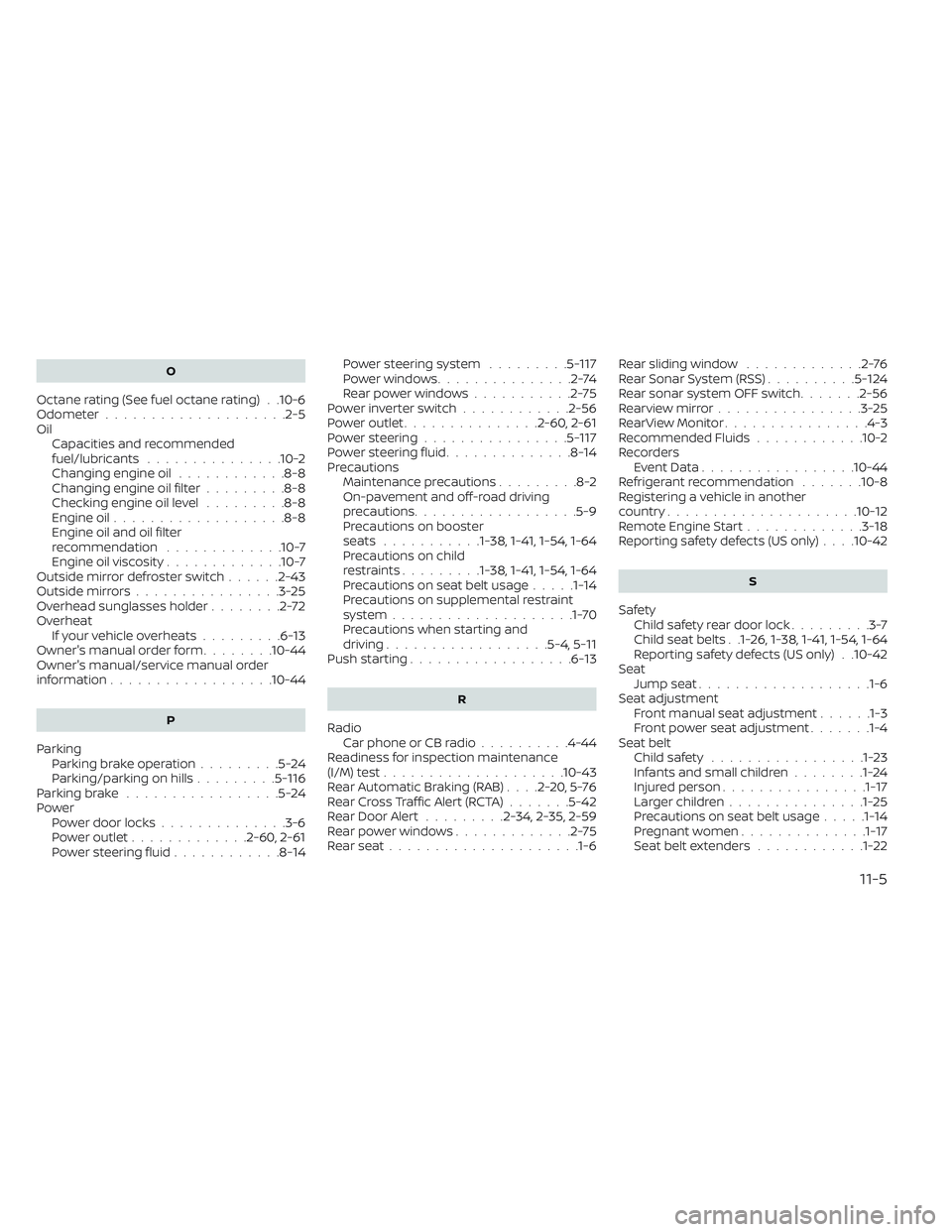
O
Octane rating (See fuel octane rating). .10-6Odometer....................2-5Oil
Capacities and recommended
fuel/lubricants
...............10-2Changing engine oil............8-8Changing engine oil filter.........8-8Checking engine oil level.........8-8Engine oil.................. .8-8Engine oil and oil filter
recommendation.............10-7Engine oil viscosity.............10-7Outside mirror defroster switch......2-43Outside mirrors................3-25Overhead sunglasses holder........2-72Overheat
If your vehicle overheats.........6-13Owner's manual order form........10-44Owner's manual/service manual order
information................. .10-44
P
Parking
Parking brake operation.........5-24Parking/parking on hills.........5-116Parking brake.................5-24PowerPower door locks..............3-6Power outlet.............2-60, 2-61Power steering fluid............8-14
Power steering system.........5-117Power windows...............2-74Rear power windows...........2-75Power inverter switch............2-56Power outlet...............2-60, 2-61Power steering................5-117Power steering fluid..............8-14PrecautionsMaintenance precautions.........8-2On-pavement and off-road driving
precautions................. .5-9Precautions on booster
seats...........1-38, 1-41, 1-54, 1-64Precautions on child
restraints.........1-38, 1-41, 1-54, 1-64Precautions on seat belt usage.....1-14Precautions on supplemental restraint
system....................1-70Precautions when starting and
driving..................5-4, 5-11Push starting..................6-13
R
Radio
Car phone or CB radio..........4-44Readiness for inspection maintenance
(I/M) test................... .10-43Rear Automatic Braking (RAB). . . .2-20, 5-76Rear Cross Traffic Alert (RCTA).......5-42Rear Door Alert.........2-34, 2-35, 2-59Rear power windows.............2-75Rear seat.................... .1-6
Rear sliding window.............2-76Rear Sonar System (RSS)..........5-124Rear sonar system OFF switch.......2-56Rearview mirror................3-25RearView Monitor................4-3Recommended Fluids............10-2Recorders
Event Data................ .10-44Refrigerant recommendation.......10-8Registering a vehicle in another
country.................... .10-12Remote Engine Start.............3-18Reporting safety defects (US only). . . .10-42
S
Safety
Child safety rear door lock.........3-7Child seat belts. .1-26, 1-38, 1-41, 1-54, 1-64Reporting safety defects (US only). .10-42SeatJump seat.................. .1-6Seat adjustment
Front manual seat adjustment......1-3Front power seat adjustment.......1-4Seat beltChild safety.................1-23Infants and small children........1-24Injured person................1-17Larger children...............1-25Precautions on seat belt usage.....1-14Pregnant women..............1-17Seat belt extenders............1-22
11-5