2023 JEEP WAGONEER outlet
[x] Cancel search: outletPage 110 of 396

108GETTING TO KNOW YOUR INSTRUMENT PANEL
When load reduction is activated, the message “Battery
Saver On” or “Battery Saver Mode” will appear in the
instrument cluster.
These messages indicate the vehicle battery has a low
state of charge and continues to lose electrical charge at
a rate that the charging system cannot sustain.
NOTE:
The charging system is independent from load reduc -
tion. The charging system performs a diagnostic on the
charging system continuously.
If the Battery Charge Warning Light is on it may indicate
a problem with the charging system
Úpage 109.
The electrical loads that may be switched off (if equipped),
and vehicle functions which can be affected by load
reduction:
Heated Seat/Vented Seats/Heated Wheel
Rear Defroster And Heated Mirrors
HVAC System
115 Volt AC Power Inverter System
Audio and Telematics System
Loss of the battery charge may indicate one or more of the
following conditions:
The charging system cannot deliver enough electrical
power to the vehicle system because the electrical
loads are larger than the capability of the charging
system. The charging system is still functioning
properly.
Turning on all possible vehicle electrical loads (e.g.
HVAC to max settings, exterior and interior lights, over -
loaded power outlets +12 Volt, 115 Volt AC, USB ports)
during certain driving conditions (city driving, towing,
frequent stopping, etc.).
Installing options like additional lights, upfitter elec -
trical accessories, audio systems, alarms and similar
devices.
Unusual driving cycles (short trips separated by long
parking periods).
The vehicle was parked for an extended period of time
(weeks, months).
The battery was recently replaced and was not charged
completely.
The battery was discharged by an electrical load left on
when the vehicle was parked.
The battery was used for an extended period with the
engine not running to supply radio, lights, chargers,
+12 Volt portable appliances like vacuum cleaners,
game consoles and similar devices.
What to do when an electrical load reduction action
message is present (“Battery Saver On” or “Battery Saver
Mode”)
During a trip:
Reduce power to unnecessary loads if possible:
Turn off redundant lights (interior or exterior)
Check what may be plugged in to power outlets
+12 Volt, 115 Volt AC, USB ports
Check HVAC settings (blower, temperature)
Check the audio settings (volume) After a trip:
Check if any aftermarket equipment was installed
(additional lights, upfitter electrical accessories, audio
systems, alarms) and review specifications if any (load
and Ignition Off Draw currents).
Evaluate the latest driving cycles (distance, driving
time and parking time).
The vehicle should have service performed if the
message is still present during consecutive trips, and if
the evaluation and driving pattern of the vehicle did not
help to identify the cause.WARNING LIGHTS AND MESSAGES
The warning/indicator lights will illuminate in the
instrument panel together with a dedicated message and/
or acoustic signal when applicable. These indications are
indicative and precautionary and as such must not be
considered as exhaustive and/or alternative to the
information contained in the Owner’s Manual, which you
are advised to read carefully in all cases. Always refer to
the information in this chapter in the event of a failure
indication. All active telltales will display first if applicable.
The system check menu may appear different based upon
equipment options and current vehicle status. Some
telltales are optional and may not appear.
23_WS_OM_EN_USC_t.book Page 108
Page 124 of 396

122STARTING AND OPERATING
COLD WEATHER OPERATION
(B
ELOW –22°F OR −30°C)
To ensure reliable starting at these temperatures, use of
an externally powered electric engine block heater
(available from an authorized dealer) is recommended.
AFTER STARTING
The idle speed is controlled automatically, and it will
decrease as the engine warms up.
TURBOCHARGER “COOL DOWN” —
3.0L E
NGINE ONLY
The 3.0L engine is equipped with an after-run pump to
cool the turbocharger after the engine is shut off.
Depending on the type of driving and the amount of cargo,
the pump will run for up to 20 minutes after the engine
has been shut off to circulate coolant through the
turbocharger. Although the pump is rubber-mounted for
quiet operation, it is normal to hear it running during this
time.
ENGINE BLOCK HEATER — IF EQUIPPED
The engine block heater warms the engine, and permits
quicker starts in cold weather. Connect the cord to a
standard 110-115 Volt AC electrical outlet with a
grounded, three-wire extension cord.
The engine block heater must be plugged in at least one
hour to have an adequate warming effect on the engine. The engine block heater cord is coiled and strapped right
behind the engine air cleaner filter assembly from the
manufacturer.
ENGINE BREAK-IN RECOMMENDATIONS
An initial break-in period is recommended for the
powertrain (engine, transmission, axle, etc.) in your
vehicle. Adhering to the following guidelines will contribute
to improved longevity, fuel economy, and performance.
Drive moderately during the first 100 miles (160 km).
After that, for the first 500 miles (800 km), avoid long
periods at constant speed. Varying speed, engine RPM,
and throttle position is desirable.
Avoid high performance, severe off-road, and towing for
the first 500 miles (800 km).
NOTE:A new engine may consume some oil during its first few
thousand miles (km) of operation. This should be
considered a normal part of the break-in and not inter -
preted as a problem. For engines not equipped with an oil
level sensor, please check your oil level frequently during
the break-in period. Add manufacturer-approved oil as
required
Úpage 376.
PARKING BRAKE
ELECTRIC PARK BRAKE (EPB)
Your vehicle is equipped with an EPB that offers simple
operation, and some additional features that make the
parking brake more convenient and useful.
The parking brake is primarily intended to prevent the
vehicle from rolling while parked. Before leaving the
vehicle, make sure that the parking brake is applied. Also,
be certain to leave the transmission in PARK.
You can engage the parking brake in two ways:
Manually, by applying the EPB switch.
Automatically, by enabling the Auto Park Brake feature
in the customer programmable features section of the
Uconnect settings.
WARNING!
Remember to disconnect the engine block heater cord
before driving. Damage to the 110-115 Volt electrical
cord could cause electrocution.
CAUTION!
Never use Non-Detergent Oil or Straight Mineral Oil in
the engine or damage may result. ONLY USE OILS THAT
ARE API APPROVED
Úpage 376.
23_WS_OM_EN_USC_t.book Page 122
Page 237 of 396
MULTIMEDIA235
LEGAL & COMPLIANCE
To access Legal and Compliance information about Rear Seat Entertainment with Fire TV built-in from the rear screens, follow these steps:
1. Push the Gear/Settings button on the Voice Remote with Alexa or tap the screen.
2. Select the Gear/Settings icon on the screen.
3. Select “Settings” on the screen.
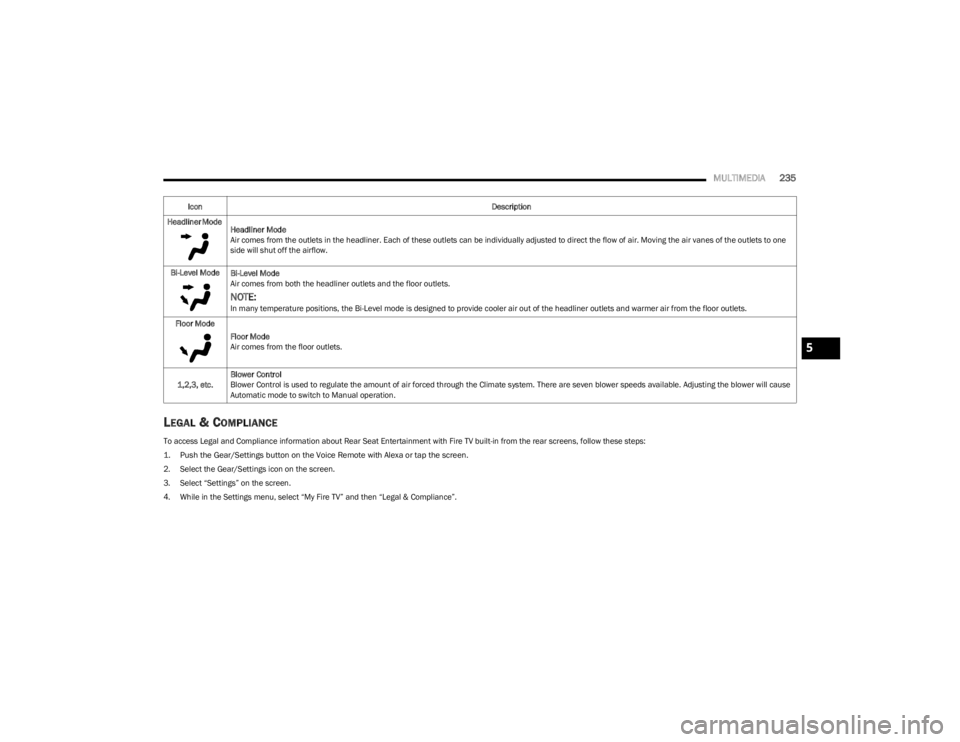
4. While in the Settings menu, select “My Fire TV” and then “Legal & Compliance”.Headliner Mode
Headliner Mode
Air comes from the outlets in the headliner. Each of these outlets can be individually adjusted to direct the flow of air. Moving the air vanes of the outlets to one
side will shut off the airflow.
Bi-Level Mode Bi-Level Mode
Air comes from both the headliner outlets and the floor outlets.
NOTE:In many temperature positions, the Bi-Level mode is designed to provide cooler air out of the headliner outlets and warmer air from the floor outlets.
Floor Mode Floor Mode
Air comes from the floor outlets.
1,2,3, etc. Blower Control
Blower Control is used to regulate the amount of air forced through the Climate system. There are seven blower speeds available. Adjusting the blower will cause
Automatic mode to switch to Manual operation.
Icon
Description
5
23_WS_OM_EN_USC_t.book Page 235
Page 304 of 396

302IN CASE OF EMERGENCY
3. Disconnect the positive (+) end of the jumper cable
from the positive (+) post of the booster battery.
4. Disconnect the opposite end of the positive (+)
jumper cable from the positive (+) post of the
discharged vehicle.
5. Reinstall the protective cover over the positive (+)
post of the discharged vehicle.
If frequent jump starting is required to start your vehicle
have the battery and charging system tested at an
authorized dealer.
REFUELING IN EMERGENCY
The vehicle is equipped with a refueling funnel for a
Cap-Less Fuel System, which is located with the jack and
tools
Úpage 294. If refueling is necessary, while using an
approved gas can, please insert the refueling funnel into
the filler neck opening.
NOTE:In certain cold conditions, ice may prevent the fuel door
from opening. If this occurs, lightly push around the
perimeter of the fuel door to break the ice buildup and
re-release the fuel door by pushing on the rear outer edge
near the center to unlatch. Do not pry on the door.
Refueling Funnel Location
Emergency Gas Can Refueling
Most gas cans will not open the flapper doors. A funnel is
provided to allow emergency refueling with a gas can.
See the following steps for refueling:
1. Retrieve funnel from the rear cargo storage area.
2. Insert funnel into same filler pipe opening as the fuel nozzle.
Inserting Funnel
3. Ensure funnel is inserted fully to hold flapper doors open.
4. Pour fuel into funnel opening.
5. Remove funnel from filler pipe, clean off prior to putting back in the spare tire storage area.
CAUTION!
Accessories plugged into the vehicle power outlets draw
power from the vehicle’s battery, even when not in use
(i.e., cellular devices, etc.). Eventually, if plugged in long
enough without engine operation, the vehicle’s battery
will discharge sufficiently to degrade battery life and/or
prevent the engine from starting.
CAUTION!
To avoid fuel spillage and overfilling, do not “top off” the
fuel tank after filling.
23_WS_OM_EN_USC_t.book Page 302
Page 333 of 396

SERVICING AND MAINTENANCE331
FUSES
General Information
The fuses protect electrical systems against excessive
current.
When a device does not work, you must check the fuse
element inside the blade fuse for a break/melt.
Also, please be aware that using power outlets for
extended periods of time with the engine off may result in
vehicle battery discharge.
Blade Fuses
Underhood Fuses
The Power Distribution Center (PDC) is located on the
passenger side of the engine compartment, behind the
headlamp. This center contains cartridge fuses, micro
fuses, relays, and circuit breakers. A description of each
fuse and component may be stamped on the inside cover,
otherwise the cavity number of each fuse is stamped on
the inside cover that corresponds to the following chart.
WARNING!
When replacing a blown fuse, always use an appro -
priate replacement fuse with the same amp rating as
the original fuse. Never replace a fuse with another
fuse of higher amp rating. The use of a fuse with a
rating other than indicated may result in a dangerous
electrical system overload. If a properly rated fuse
continues to blow, it indicates a problem in the circuit
that must be corrected. Never replace a blown fuse
with metal wires or any other material. Do not place
a fuse inside a circuit breaker cavity or vice versa.
Failure to use proper fuses may result in serious
personal injury, fire and/or property damage.
Before replacing a fuse, make sure that the ignition
is off and that all the other services are switched off
and/or disengaged.
If the replaced fuse blows again, contact an autho -
rized dealer.
If a general protection fuse for safety systems (air
bag system, braking system), power unit systems
(engine system, transmission system) or steering
system blows, contact an authorized dealer.
1 — Fuse Element
2 — Blade Fuse with a good/functional fuse element
3 — Blade fuse with a bad/not functional fuse element
(blown fuse)
CAUTION!
When installing the Power Distribution Center cover, it is
important to ensure the cover is properly positioned
and fully latched. Failure to do so may allow water to get
into the Power Distribution Center and possibly result in
an electrical system failure.
8
23_WS_OM_EN_USC_t.book Page 331
Page 348 of 396

346SERVICING AND MAINTENANCE
F41 ––Spare
F42A –10 Amp RedRSE Video USB Console Frt/Port Media Hub FPDM
F42B ––Spare
F43 ––Spare
F44A –20 Amp Yellow 12 Volt Power Outlet Cargo Area (Ign)
F44B –20 Amp Yellow 12 Volt Power Outlet Cargo Area (Battery)
F45 –20 Amp Yellow MOD CRSM (Heated Seat RR RT)
F46 30 Amp Pink –Folding Seat Module 3rd Row Feed #1 *
F47 ––Spare
F48 ––Spare
F49 ––Spare
F50 –15 Amp BlueSeat Massage Driver Mod (SSMD) / Seat Massage Passenger Mod
(SSMP) *
F51 ––Spare
F52 –20 Amp Yellow MOD CRSM (Heat Seat RR LT) *
F53 30 Amp Pink –Electronic Limited Slip Differential (ELSD) Rear #1 *
F54 ––Spare
F55 30 Amp Pink –Folding Seat Modules 3rd Row Feed #2 *
F56 ––Spare
F57 –10 Amp RedMod HVAC RR / Mod Occupant Classic / CVPAM / Mod Parktronics /
ITCM
F58 –15 Amp Blue3rd Row Additional USB charge (Only LT - RT) / Port Pwr USB Console
UBS (CH Only)
Cavity
Cartridge Fuse Micro Fuse Description
* If Equipped
23_WS_OM_EN_USC_t.book Page 346
Page 350 of 396

348SERVICING AND MAINTENANCE
F81 –20 Amp Yellow Module Seat Heater Frt (PASS) *
F82 –10 Amp RedAnimation Lighting RR / Air Compressor (Tire Inflator) / Animation
Lighting Liftgate Taillamp
F83 ––Spare
F84 ––Spare
F85 ––Spare
F86 –15 Amp BlueLumbar Support Driver & Passenger SW *
F87 ––Spare
F88 20 Amp Blue –MOD Door MUX Driver Rear - Smart Motor
CB1 –20 Amp BluePower Outlet RR
CavityCartridge Fuse Micro Fuse Description
* If Equipped
23_WS_OM_EN_USC_t.book Page 348
Page 385 of 396

383
INDEX
AAbout Your Brakes ....................................................... 371
Active Driving Assist System ....................................... 148
Active Lane Management System .............................. 167
Adaptive Cruise Control (ACC)
(Cruise Control) ................................................... 137
, 139
Adding Engine Coolant (Antifreeze) ............................ 327
Adding Fuel................................................................... 177
Additives, Fuel .............................................................. 373
Adjust Down...........................................................................39
Forward ...................................................................... 39
Rearward ....................................................................39
Up................................................................................ 39
Adjustable Pedals ...........................................................49
Air Bag Air Bag Operation.................................................... 266
Air Bag Warning Light .................................... 265
, 267
Driver Knee Air Bag ................................................ 270
Enhanced Accident Response ...................... 273
, 308
Event Data Recorder (EDR).................................... 308 Front Air Bag ........................................................... 267
If Deployment Occurs ............................................. 273
Knee Impact Bolsters ............................................. 270
Maintaining Your Air Bag System .......................... 274
Maintenance ........................................................... 274
Redundant Air Bag Warning Light ......................... 265
Side Air Bags ........................................................... 270
Transporting Pets.................................................... 287 Air Bag Light ........................................................ 265
, 287
Air Cleaner, Engine (Engine Air Cleaner Filter) ...........319
Air Conditioner Maintenance ....................................... 320
Air Conditioner Refrigerant ................................ 320
, 321
Air Conditioner System ................................................. 320
Air Conditioning Rear ............................................................................ 69
Air Conditioning Filter ............................................72
, 320
Air Conditioning System .......................................... 64, 71
Air Conditioning, Operating Tips .................................... 71
Air Filter ......................................................................... 319
Air Pressure Tires.......................................................................... 357
Alarm Arm The System.................................................. 24
, 25
Disarm The System ................................................... 24
Panic........................................................................... 17
Rearm The System .................................................... 25
Security Alarm.......................................................... 111
Alarm System Security Alarm..................................................... 24
, 25
Alterations/Modifications Vehicle........................................................................ 10
Amazon FireTV .................................................... 228
, 232
Amazon FireTV Built-in ................................................. 228
Antifreeze (Engine Coolant) ............................... 326
, 375
Disposal ...................................................................327 Anti-Lock Brake System (ABS) ..................................... 239
Anti-Lock Warning Light ............................................... 111
Apps .............................................................................. 226
Arming System
Security Alarm ........................................................... 24
Assist, Hill Start ............................................................ 244
Audio Systems (Radio) ................................................. 196
Auto Down Power Windows ........................................... 82
Auto Hold ................................................... 115
, 116, 124
Automatic Folding Mirrors ............................................. 52
Automatic Headlights ..................................................... 58
Automatic High Beams .................................................. 58
Automatic Tailgate Release ........................................... 87
Automatic Temperature Control (ATC) .......................... 71 Automatic Transmission ..................................... 119
, 126
Adding Fluid ............................................................. 329
Fluid And Filter Change........................................... 329
Fluid Change ........................................................... 329
Fluid Level Check .................................................... 329
Fluid Type .......................................................329
, 377
Special Additives ..................................................... 329
Automatic Transmission Limp Home Mode ............... 128
AutoPark ....................................................................... 120
AUX Port .......................................................................... 76
Auxiliary Driving Systems ............................................. 247
Auxiliary Electrical Outlet (Power Outlet) ...................... 79
Auxiliary Power Outlet .................................................... 79
Axle Fluid....................................................................... 377
11
23_WS_OM_EN_USC_t.book Page 383