2023 JEEP RENEGADE battery
[x] Cancel search: batteryPage 285 of 364

IN CASE OF EMERGENCY 283
(Continued)
TOWING A DISABLED VEHICLE
This section describes procedures for towing a
disabled vehicle using a commercial towing
service. Proper towing or lifting equipment is required to
preve
n
t damage to your vehicle. Use only tow bars
and other equipment designed for this purpose,
following equipment manufacturer’s instructions.
Use of safety chains is mandatory. Attach a tow bar
or other towing device to main structural members
of the vehicle, not to fascia/bumpers or associated
brackets. State and local laws regarding vehicles
under tow must be observed.
NOTE:
Vehicles with a discharged battery or total elec -
trical failure when the Electric Park Brake (EPB)
is en g
aged, will need a wheel dolly or jack to
raise the rear wheels off the ground when
moving the vehicle onto a flatbed.
You must ensure that the Auto Park Brake
feature is disabled before towing this vehicle, to
avoid inadvertent Electric Park Brake engage -
ment. The Auto Park Brake feature is enabled or
disab l
ed via the customer programmable
features in the Uconnect Settings.
If you must use the accessories (wipers,
defros t
ers, etc.) while being towed, the ignition
must be in the ON/RUN position, not the ACC
position.
If the vehicle's battery is discharged, instructions
on shif
ting the automatic transmission out of PARK
(P) in order to move the vehicle Ú page 281.
WARNING!
Fast spinning tires can be dangerous. Forces
generated by excessive wheel speeds may
cause damage, or even failure, of the axle and
tires. A tire could explode and injure someone.
Do not spin your vehicle's wheels faster than
30
mph (48 km/h) or for longer than 30 sec-
onds c on
tinuously without stopping when you
are stuck and do not let anyone near a spinning
wheel, no matter what the speed.
CAUTION!
Racing the engine or spinning the wheels may
lead to transmission overheating and failure.
Allow the engine to idle with the transmission
in NEUTRAL for at least one minute after every
five rocking-motion cycles. This will minimize
overheating and reduce the risk of clutch or
transmission failure during prolonged efforts
to free a stuck vehicle.
When “rocking” a stuck vehicle by shifting
between DRIVE/SECOND gear and REVERSE,
do not spin the wheels faster than 15 mph
(24 km/
h), or drivetrain damage may result.
Revving the engine or spinning the wheels too
fast may lead to transmission overheating and
failure. It can also damage the tires. Do not spin
the wheels above 30 mph (48 km/h) while in
gear (
no transmission shifting occurring).
Towing
Condit i
on Wheels
Off T h
e
Ground Front-
Wheel
D
rive
(FWD) Four-
Wheel D
rive
(4WD)
Flat Tow NONENOT
ALLOWED N
O
T
ALLOWED
Dol
ly Tow REAR
NOT
ALLOWED N
O
T
ALLOWED
FR
ONT OK NOT
ALLOWED
O n
Trailer ALLBEST
METHOD O
K
CAUTION!
7
Page 289 of 364

SERVICING AND MAINTENANCE 287
MAINTENANCE PLAN
NOTE:
Using white lithium grease, lubricate the door hinge roller pivot joints twice a year to prevent premature wear.
At Every Oil Change Interval As Indicated By Oil Change Indicator System:
Change oil and filter.
Inspect battery and clean and tighten terminals as required.
Inspect the CV/Universal joints.
Inspect brake pads, shoes, rotors, drums, and hoses.
Inspect engine cooling system protection and hoses.
Rotate the tires at the first sign of irregular wear, even if it occurs before the oil indicator system turns on.
Inspect exhaust system.
Inspect engine air cleaner filter if using in dusty or off-road conditions.
8
Page 290 of 364

288 SERVICING AND MAINTENANCE
Mileage or time passed
(whichever comes first)
10,000
20,000
30,000
40,000
50,000
60,000
70,000
80,000
90,000
100,000
110,000
120,000
130,000
140,000
150,000
Or Years: 12345678910 1112131415
Or Kilometers:
16,000
32,000
48,000
64,000
80,000
96,000
112,000
128,000
144,000
160,000
176,000
192,000
208,000
224,000
240,000
Replace the Uconnect box (telematics
box) battery (if equipped).1
• ••
Check tire condition/wear and adjust
press u
re, if necessary, check Tire
Service Kit expiration date (if
equipped). •
••••••••••••••
Check operation of lighting system
(head l
amps, direction indicators,
hazard warning lights, luggage
compartment, passenger
compartment, glove compartment,
instrument panel warning lights, etc.). •
••••••••••••••
Check and, if necessary, top up fluid
l evel
s
(brakes/hydraulic clutch,
windshield washer, engine coolant,
etc.).
2
• ••••••••••••••
Check engine control system operation
(via d
iagnostic tool). •
••••••••••••••
Page 293 of 364
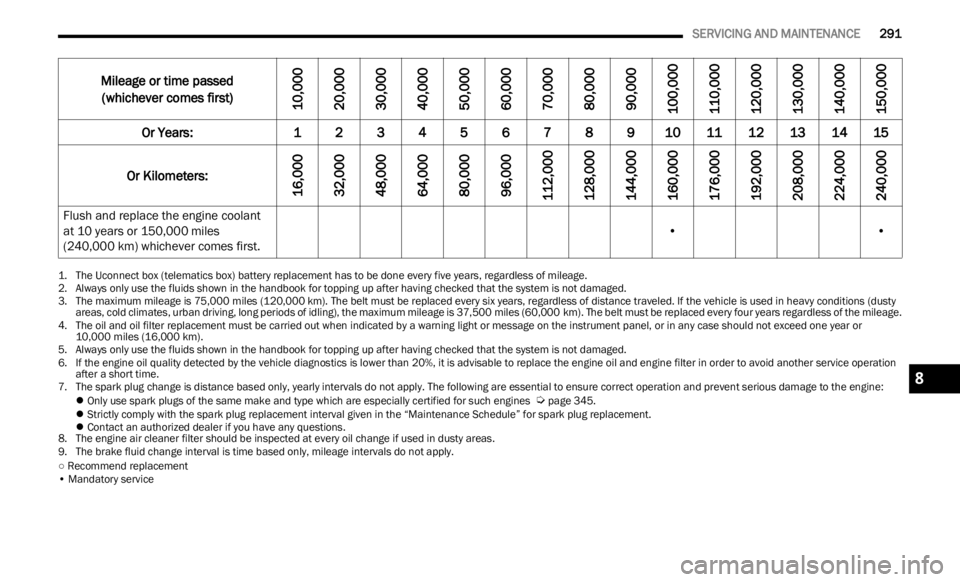
SERVICING AND MAINTENANCE 291
○ Recommend replacement
• Mandatory service
Flush and replace the engine coolant
at 10 years or 150,000 miles
(240,000 km) whichever comes first. •
•
1. The Uconnect box (telematics box) battery replacement has to be done every five years, regardless of mileage.2. Always only use the fluids shown in the handbook for topping up after having checked that the system is not damaged.
3. The maximum mileage is 75,000 mile s (120,000 km). The belt must be replaced every six years, regardless of distance traveled. If the vehicle is used in heavy conditions (dusty
areas,
cold climates, urban driving, long periods of idling), the maximum mileage is 37,500 miles (60,000 km). The belt must be replaced every four years regardless of the mileage.
4. The oil and oil filter replacement must be carried out when indicated by a warning light or message on the instrument panel, or in any case should not exceed one year or
10,0 0
0 miles (16,000 km).
5. Always only use the fluids shown in the handbook for topping up after having checked that the system is not damaged.
6. If
the engine oil quality detected by the vehicle diagnostics is lower than 20%, it is advisable to replace the engine oil and engine filter in order to avoid another service operation
afte r
a short time.
7. The spark plug change is distance based only, yearly intervals do not apply. The following are essential to ensure correct operation and prevent serious damage to the engine:
Only use spark plugs of the same make and type which are especially certified for such engines
Ú page 345 .
Strictly comply with the spark plug replacement interval given in the “Maintenance Schedule” for spark plug replacement.
Contact an authorized dealer if you have any questions.
8. Th e
engine air cleaner filter should be inspected at every oil change if used in dusty areas.
9. The brake fluid change interval is time based only, mileage intervals do not apply.
Mileage or time passed
(whichever comes first)
10,000
20,000
30,000
40,000
50,000
60,000
70,000
80,000
90,000
100,000
110,000
120,000
130,000
140,000
150,000
Or Years: 1 2 3 4 5 6 7 8 9 10 11 12 13 14 15
Or Kilometers:
16,000
32,000
48,000
64,000
80,000
96,000
112,000
128,000
144,000
160,000
176,000
192,000
208,000
224,000
240,000
8
Page 295 of 364

SERVICING AND MAINTENANCE 293
ENGINE COMPARTMENT
1.3L TURBO ENGINE
1 — Oil Fill Cap/Engine Oil Dipstick 5 — Power Distribution Center (Fuses)
2 — Engine Air Cleaner Filter (Located Under Engine Cover) 6 — Engine Coolant Pressure Cap
3 — Brake Fluid Reservoir Cap 7 — Washer Fluid Reservoir Cap
4 — Battery
8
Page 296 of 364

294 SERVICING AND MAINTENANCE
CHECKING OIL LEVEL
To ensure proper engine lubrication, the engine oil
must be maintained at the correct level. Check the
oil level at regular intervals, such as every fuel
stop. The best time to check the engine oil level is
about five minutes after a fully warmed up engine
is shut off.
Checking the oil while the vehicle is on level ground
will i
mprove the accuracy of the oil level readings.
Engine Oil Cap/Dipstick Installation — 1.3L Turbo
Engine
I
nstall the oil cap/dipstick aligning arrow on the
cap wi
th arrow on the engine cover.
Oil Cap
There are four possible dipstick types:
Crosshatched zone.
Crosshatched zone marked SAFE.
Crosshatched zone marked with MIN at the low
end of the range and MAX at the high end of the
range.
Crosshatched zone marked with dimples at the
MIN and the MAX ends of the range.
NOTE:
Always maintain the oil level within the crosshatch
marki n
gs on the dipstick.
Adding 1 quart (1.0 liter) of oil when the reading is
at the
low end of the dipstick range will raise the oil
level to the high end of the range marking.
ADDING WASHER FLUID
The windshield washer fluid reservoir is located in
the engine compartment, and the fluid level should
be checked at regular intervals. Fill the reservoir
with windshield washer solvent (not engine
coolant/ antifreeze) Ú page 293.
MAINTENANCE-FREE BATTERY
Your vehicle is equipped with a maintenance-free
battery. You will never have to add water, and
periodic maintenance is not required.
1 — Oil Cap/Dipstick Arrow
2 — Engine Cover Arrow
CAUTION!
Overfilling or underfilling the crankcase will
cause aeration or loss of oil pressure. This could
damage your engine.
WARNING!
Commercially available windshield washer
solvents are flammable. They could ignite and
burn you. Care must be exercised when filling or
working around the washer solution.
WARNING!
Battery fluid is a corrosive acid solution and
can burn or even blind you. Do not allow
battery fluid to contact your eyes, skin, or
clothing. Do not lean over a battery when
attaching clamps. If acid splashes in eyes or
on skin, flush the area immediately with large
amounts of water Ú page 279.
Battery gas is flammable and explosive. Keep
flame or sparks away from the battery. Do not
use a booster battery or any other booster
source with an output greater than 12 Volts. Do
not allow cable clamps to touch each other.
Battery posts, terminals, and related accesso -
ries contain lead and lead compounds. Wash
h a n
d s
after handling.
Page 297 of 364

SERVICING AND MAINTENANCE 295
PRESSURE WASHING
Cleaning the engine compartment with a high
pressure washer is not recommended.
VEHICLE MAINTENANCE
An authorized dealer has the qualified service
personnel, special tools, and equipment to
perform all service operations in an expert
manner. Service Manuals are available which
include detailed service information for your
vehicle. Refer to these Service Manuals before
attempting any procedure yourself.
NOTE:
Intentional tampering with emissions control
syste m
s may void your warranty and could result in
civil penalties being assessed against you.
ENGINE OIL
Engine Oil Selection
For engine oil selection Ú page 345.
American Petroleum Institute (API)
Approved Engine Oil
These symbols mean that the oil has been certified
by the API. The manufacturer only recommends API
trademark oils.
The API Starburst trademark certifies
0W-20, 0W-30 and 5W-30 engine oils.
The API Donut trademark certifies 0W-40
and 5W-40 engine oil.
Synthetic Engine Oils
Your engine was designed for synthetic engine oils,
only use synthetic API approved engine oils.
Synthetic engine oils which do not have both the
correct
API trademark and the correct SAE viscosity
grade numbers should not be used.
CAUTION!
It is essential when replacing the cables on
the battery that the positive cable is attached
to the positive post and the negative cable is
attached to the negative post. Battery posts
are marked positive (+) and negative (-) and
are identified on the battery case. Cable
clamps should be tight on the terminal posts
and free of corrosion.
If a “fast charger” is used while the battery is
in the vehicle, disconnect both vehicle battery
cables before connecting the charger to the
battery. Do not use a “fast charger” to provide
starting voltage.
CAUTION!
Precautions have been taken to safeguard all
parts and connections however, the pressures
generated by these machines is such that
complete protection against water ingress
cannot be guaranteed.
WARNING!
You can be badly injured working on or around a
motor vehicle. Only do service work for which
you have the knowledge and the proper
equipment. If you have any doubt about your
ability to perform a service job, take your vehicle
to a competent mechanic.
CAUTION!
Do not use chemical flushes in your engine oil as
the chemicals can damage your engine. Such
damage is not covered by the New Vehicle
Limited Warranty.
8
Page 306 of 364

304 SERVICING AND MAINTENANCE
The fuses protect electrical systems against
excessive current.
When a device does not work, you must check the
electr
ical circuit inside the fuse for a break/melt.
Also please be aware that using power outlets for
extend
ed periods of time with the engine off may
result in vehicle battery discharge.
Blade Fuses
Access To The Fuses
The fuses are grouped into four controllers located
in the engine compartment, under the instrument
panel and on the inside of the left side cargo trim
panel.If the replaced fuse blows again, contact an
authorized dealer.
If a general protection fuse for safety systems
(air bag system, braking system), power unit
systems (engine system, gearbox system) or
steering system blows, contact an authorized
dealer.
WARNING!
1 — Fuse Element
2 — Blade Fuse with a good/functional fuse
element
3 — Blade fuse with a bad/not functional fuse
element (blown fuse)