2023 JEEP CHEROKEE wheel
[x] Cancel search: wheelPage 200 of 276

198IN CASE OF EMERGENCY
SEALING A TIRE WITH TIRE SERVICE KIT
(A) Whenever You Stop To Use Tire Service
Kit:
1. Pull over to a safe location and turn on the vehicle’s
Hazard Warning Flashers.
2. Verify that the valve stem (on the wheel with the deflated tire) is in a position that is near to the
ground. This will allow the Tire Service Kit Hoses and to reach the valve stem and keep the Tire Service Kit
flat on the ground. This will provide the best
positioning of the kit when injecting the sealant into
the deflated tire and running the air pump. Move the
vehicle as necessary to place the valve stem in this
position before proceeding.
3. Place the transmission in PARK (P) (auto transmission) or in Gear (manual transmission) and
place the ignition in the OFF position.
4. Apply the parking brake.
(B) Setting Up To Use Tire Service Kit:
1. Push in the Mode Select Knob and turn to the Sealant Mode position.
2. Uncoil the Sealant Hose and then remove the cap from the fitting at the end of the hose.
3. Place the Tire Service Kit flat on the ground next to the deflated tire.
4. Remove the cap from the valve stem and then screw the fitting at the end of the Sealant Hose onto the
valve stem.
5. Uncoil the Power Plug and insert the plug into the vehicle’s 12 Volt power outlet.
NOTE:Do not remove foreign objects (e.g., screws or nails) from
the tire.
(C) Injecting Tire Service Kit Sealant Into
The Deflated Tire:
Always start the engine before turning ON the Tire
Service Kit.
NOTE:Manual transmission vehicles must have the parking
brake engaged and the gear selector in NEUTRAL.
After pushing the Power Button, the sealant (white
fluid) will flow from the Sealant Bottle through the
Sealant Hose and into the tire.
NOTE:Sealant may leak out through the puncture in the tire.
If the sealant (white fluid) does not flow within
0 – 10 seconds through the Sealant Hose:
1. Push the Power Button to turn Off the Tire Service
Kit. Disconnect the Sealant Hose from the valve
stem. Make sure the valve stem is free of debris.
Reconnect the Sealant Hose to the valve stem.
Check that the Mode Select Knob is in the Sealant
Mode position and not Air Mode. Push the Power
Button to turn On the Tire Service Kit.
2. Connect the Power Plug to a different 12 Volt power outlet in your vehicle or another vehicle, if available.
Make sure the engine is running before turning ON
the Tire Service Kit.
3. The Sealant Bottle may be empty due to previous use. Call for assistance.
NOTE:If the Mode Select Knob is on Air Mode and the pump is
operating, air will dispense from the Air Pump Hose only,
not the Sealant Hose.
A loose Tire Service Kit thrown forward in a collision
or hard stop could endanger the occupants of the
vehicle. Always stow the Tire Service Kit in the place
provided. Failure to follow these warnings can result
in injuries that are serious or fatal to you, your
passengers, and others around you.
Take care not to allow the contents of Tire Service Kit
to come in contact with hair, eyes, or clothing. Tire
Service Kit sealant is harmful if inhaled, swallowed,
or absorbed through the skin. It causes skin, eye, and
respiratory irritation. Flush immediately with plenty of
water if there is any contact with eyes or skin. Change
clothing as soon as possible, if there is any contact
with clothing.
Tire Service Kit Sealant solution contains latex. In
case of an allergic reaction or rash, consult a physi -
cian immediately. Keep Tire Service Kit out of reach
of children. If swallowed, rinse mouth immediately
with plenty of water and drink plenty of water. Do not
induce vomiting! Consult a physician immediately.
WARNING!
23_KL_OM_EN_USC_t.book Page 198
Page 206 of 276

204IN CASE OF EMERGENCY
6. Move the gear selector to the NEUTRAL (N) position.
7. The vehicle may then be started in NEUTRAL (N).
8. Reinstall the gear selector boot.
FREEING A STUCK VEHICLE
If your vehicle becomes stuck in mud, sand or snow, it can
often be moved using a rocking motion. Turn the steering
wheel right and left to clear the area around the front
wheels. Push and hold the lock button on the gear
selector. Then shift back and forth between DRIVE (D) and
REVERSE (R), while gently pressing the accelerator.
NOTE:Shifts between DRIVE (D) and REVERSE (R) can only be
achieved at wheel speeds of 5 mph (8 km/h) or less.
Whenever the transmission remains in NEUTRAL (N) for
more than two seconds, you must press the brake pedal
to engage DRIVE (D) or REVERSE (R). Use the least amount of accelerator pedal pressure that
will maintain the rocking motion without spinning the
wheels or racing the engine.NOTE:Push the ESC OFF button (if necessary), to place the Elec
-
tronic Stability Control (ESC) system in “Partial Off” mode,
before rocking the vehicle
Úpage 145. Once the vehicle
has been freed, push the ESC OFF button again to restore
“ESC On” mode.
WARNING!
Fast spinning tires can be dangerous. Forces generated
by excessive wheel speeds may cause damage, or even
failure, of the axle and tires. A tire could explode and
injure someone. Do not spin your vehicle's wheels
faster than 30 mph (48 km/h) or for longer than 30
seconds continuously without stopping when you are
stuck and do not let anyone near a spinning wheel, no
matter what the speed.
CAUTION!
Racing the engine or spinning the wheels may lead to
transmission overheating and failure. Allow the
engine to idle with the transmission in NEUTRAL for
at least one minute after every five rocking-motion
cycles. This will minimize overheating and reduce the
risk of clutch or transmission failure during
prolonged efforts to free a stuck vehicle.
When “rocking” a stuck vehicle by shifting between
DRIVE and REVERSE, do not spin the wheels faster
than 15 mph (24 km/h), or drivetrain damage may
result.
Revving the engine or spinning the wheels too fast
may lead to transmission overheating and failure. It
can also damage the tires. Do not spin the wheels
above 30 mph (48 km/h) while in gear (no transmis -
sion shifting occurring).
23_KL_OM_EN_USC_t.book Page 204
Page 207 of 276

IN CASE OF EMERGENCY205
TOWING A DISABLED VEHICLE
This section describes procedures for towing a disabled vehicle using a commercial towing service.
If the transmission and drivetrain are operable, disabled 4x4 vehicles may also be towed
Úpage 120.
Proper towing or lifting equipment is required to prevent
damage to your vehicle. Use only tow bars and other
equipment designed for this purpose, following equipment
manufacturer’s instructions. Use of safety chains is
mandatory. Attach a tow bar or other towing device to
main structural members of the vehicle, not to fascia/
bumper or associated brackets. State and local laws
regarding vehicles under tow must be observed.
NOTE:
You must ensure that the Auto Park Brake feature is
disabled before towing this vehicle, to avoid inadver -
tent Electric Park Brake (EPB) engagement. The Auto
Park Brake feature is enabled or disabled via the
customer programmable features in the Uconnect
Settings.
Vehicles with a discharged battery or total electrical
failure when the EPB is engaged, will need a wheel
dolly or jack to raise the rear wheels off the ground
when moving the vehicle onto a flatbed.
If you must use the accessories (wipers, defrosters, etc.)
while being towed, the ignition must be in the ON/RUN
mode, not the ACC mode.
NOTE:The Safehold feature will engage the EPB whenever the
driver's door is opened (if the ignition is ON, transmission
is not in PARK, and brake pedal is released). If you are
towing this vehicle with the ignition in the ON/RUN mode,
you must manually disable the EPB each time the driver's
door is opened, by pressing the brake pedal and then
releasing the EPB. If the ignition key is unavailable, or the vehicle's battery is
discharged, for instructions on shifting the transmission
out of PARK (P) for towing
Úpage 203.
Towing Condition Wheels OFF The Ground FWD MODELS
4X4 MODELS
1–SPEED POWER TRANSFER UNIT 2–SPEED POWER TRANSFER UNIT
Flat Tow NONENOT ALLOWED NOT ALLOWEDDetailed instructions
Úpage 120
Transmission in PARK
Power Transfer Unit in NEUTRAL
Tow in forward direction
Wheel Lift Or Dolly Tow Rear
NOT ALLOWED NOT ALLOWED NOT ALLOWED
Front OK NOT ALLOWED NOT ALLOWED
Flatbed ALLBEST METHOD BEST METHOD BEST METHOD
CAUTION!
Do not use sling type equipment when towing.
Vehicle damage may occur.
When securing the vehicle to a flat bed truck, do not
attach to front or rear suspension components.
Damage to your vehicle may result from improper
towing.
Ensure that the EPB is released, and remains
released, while being towed.
7
23_KL_OM_EN_USC_t.book Page 205
Page 208 of 276
206IN CASE OF EMERGENCY
(Continued)
FRONT-WHEEL DRIVE (FWD) MODELS
The FCA US LLC recommends towing your vehicle with all
four wheels OFF of the ground using a flatbed.
If flatbed equipment is not available, this vehicle must be
towed with the front wheels OFF of the ground (using a
towing dolly, or wheel lift equipment with the front wheels
raised).
Ensure that the Electric Park Brake (EPB) is released, and
remains released, while being towed. The EPB does not
need to be released, if all four wheels are OFF the ground.
4X4 MODELS WITH 1–SPEED POWER
T
RANSFER UNIT
The FCA US LLC requires towing with all four wheels OFF
the ground.
Acceptable methods are to tow the vehicle on a flatbed, or
with one end of vehicle raised and the opposite end on a
towing dolly.
4X4 MODELS WITH 2–SPEED POWER
T
RANSFER UNIT
The FCA US LLC recommends towing with all four wheels
OFF the ground.
Acceptable methods are to tow the vehicle on a flatbed or
with one end of the vehicle raised and the opposite end on
a towing dolly.
If flatbed equipment is not available and the Power
Transfer Unit is operable, vehicles with a 2–speed Power
Transfer Unit may be towed (in the forward direction, with
ALL wheels on the ground), under the following conditions:
The Power Transfer Unit must be in NEUTRAL (N).
The transmission must be in PARK (P) .
Ensure that the EPB is released, and remains released,
while being towed
Úpage 120.
EMERGENCY TOW HOOKS —
I
F EQUIPPED
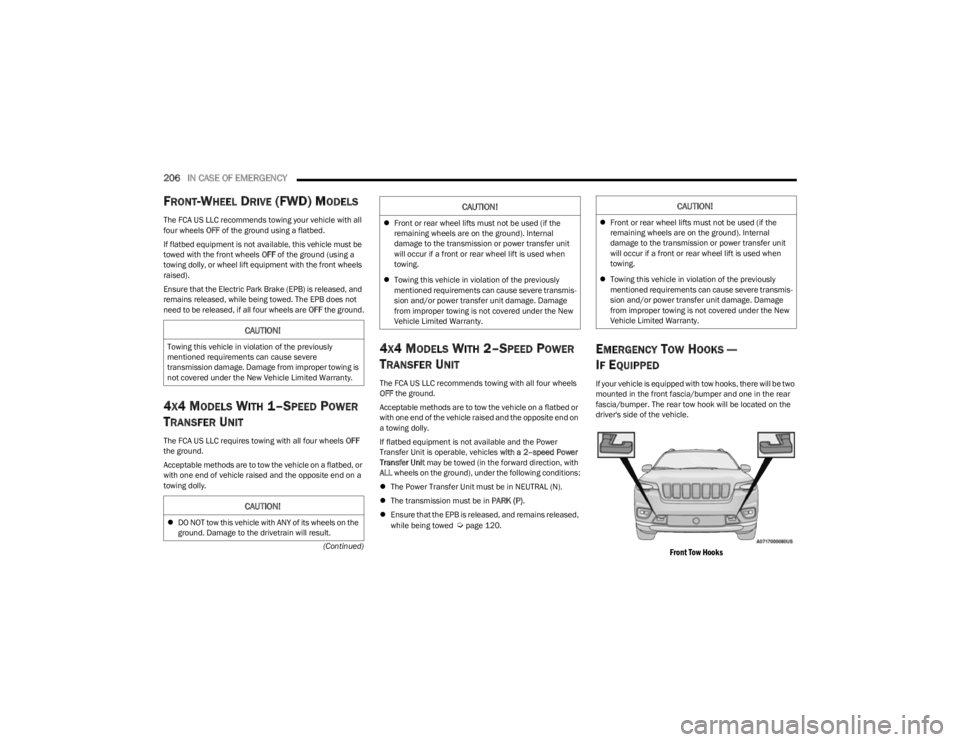
If your vehicle is equipped with tow hooks, there will be two
mounted in the front fascia/bumper and one in the rear
fascia/bumper. The rear tow hook will be located on the
driver's side of the vehicle.
Front Tow Hooks
CAUTION!
Towing this vehicle in violation of the previously
mentioned requirements can cause severe
transmission damage. Damage from improper towing is
not covered under the New Vehicle Limited Warranty.
CAUTION!
DO NOT tow this vehicle with ANY of its wheels on the
ground. Damage to the drivetrain will result.
Front or rear wheel lifts must not be used (if the
remaining wheels are on the ground). Internal
damage to the transmission or power transfer unit
will occur if a front or rear wheel lift is used when
towing.
Towing this vehicle in violation of the previously
mentioned requirements can cause severe transmis -
sion and/or power transfer unit damage. Damage
from improper towing is not covered under the New
Vehicle Limited Warranty.
CAUTION!CAUTION!
Front or rear wheel lifts must not be used (if the
remaining wheels are on the ground). Internal
damage to the transmission or power transfer unit
will occur if a front or rear wheel lift is used when
towing.
Towing this vehicle in violation of the previously
mentioned requirements can cause severe transmis -
sion and/or power transfer unit damage. Damage
from improper towing is not covered under the New
Vehicle Limited Warranty.
23_KL_OM_EN_USC_t.book Page 206
Page 234 of 276

232SERVICING AND MAINTENANCE
* 30 Amp mini fuse is substituted for 25 Amp Circuit Breaker.F85
15 Amp Blue –(CSWM) Heated Steering Wheel *
F86 20 Amp Yellow –Horn
F87 ––Not Used
F88 10 Amp Red –Seat Belt Reminder (SBR)*/Smart Camera *
F89 10 Amp Red –Auto/Manual Headlight Leveling*
F90 ––Not Used
F91 20 Amp Yellow –Power Outlet (Rear Seats Customer Selectable) *
F92 ––Not Used
F93 –40 Amp Green Brake System Module (BSM) – Pump Motor
F94 –30 Amp Pink Electric Park Brake (EPB) – Right
F95 10 Amp Red –Sunroof Module */ Rain Sensor Module (LRSM) */ ECMM /Passenger Window SW/ Power
Outlet Console/ Illumination / DTV
F96 10 Amp Red –Airbag
F97 10 Amp Red –Airbag
F98 25 Amp Clear –Audio Amplifier / ANC *
F99 ––Not Used
F100 ––Not Used
Circuit Breakers
CB1 25 AmpPower Seat (Driver)
CB2 25 AmpPower Seat (Pass)
CB3 25 AmpPower Window
Cavity
Blade Fuse Cartridge Fuse Description
* If Equipped
23_KL_OM_EN_USC_t.book Page 232
Page 244 of 276

242SERVICING AND MAINTENANCE
Example: If garage temperature = 68°F (20°C) and the
outside temperature = 32°F (0°C) then the cold tire
inflation pressure should be increased by 3 psi (21 kPa),
which equals 1 psi (7 kPa) for every 12°F (7°C) for this
outside temperature condition.
Tire pressure may increase from 2 to 6 psi (13 to 40 kPa)
during operation. DO NOT reduce this normal pressure
build up or your tire pressure will be too low.
Tire Pressures For High Speed Operation
The manufacturer advocates driving at safe speeds and
within posted speed limits. Where speed limits or
conditions are such that the vehicle can be driven at high
speeds, maintaining correct tire inflation pressure is very
important. Increased tire pressure and reduced vehicle
loading may be required for high-speed vehicle operation.
Refer to an authorized tire dealer or original equipment
vehicle dealer for recommended safe operating speeds,
loading and cold tire inflation pressures.
Radial Ply Tires
Tire Repair
If your tire becomes damaged, it may be repaired if it
meets the following criteria:
The tire has not been driven on when flat.
The damage is only on the tread section of your tire
(sidewall damage is not repairable).
The puncture is no greater than ¼ of an inch (6 mm).
Consult an authorized tire dealer for tire repairs and
additional information.
Damaged Run Flat tires, or Run Flat tires that have
experienced a loss of pressure should be replaced
immediately with another Run Flat tire of identical size and
service description (Load Index and Speed Symbol).
Replace the tire pressure sensor as well as it is not
designed to be reused.
Run Flat Tires — If Equipped
Run Flat tires allow you the capability to drive 50 miles
(80 km) at 50 mph (80 km/h) after a rapid loss of inflation
pressure. This rapid loss of inflation is referred to as the
Run Flat mode. A Run Flat mode occurs when the tire
inflation pressure is of/or below 14 psi (96 kPa). Once a Run Flat tire reaches the Run Flat mode it has limited
driving capabilities and needs to be replaced immediately.
A Run Flat tire is not repairable. When a Run Flat tire is
changed after being driven under a Run Flat mode 14 psi
(96 kPa) condition, please replace the TPMS sensor as it
is not designed to be reused.
NOTE:TPMS sensor must be replaced after driving the vehicle on
a flat tire condition.
It is not recommended driving a vehicle loaded at full
capacity or to tow a trailer while a tire is in the Run Flat
mode.
See the Tire Pressure Monitoring System section for more
information
Úpage 155.
Tire Spinning
When stuck in mud, sand, snow, or ice conditions, do not
spin your vehicle's wheels above 30 mph (48 km/h) or for
longer than 30 seconds continuously without stopping.
WARNING!
High speed driving with your vehicle under maximum
load is dangerous. The added strain on your tires could
cause them to fail. You could have a serious collision.
Do not drive a vehicle loaded to the maximum capacity
at continuous speeds above 75 mph (120 km/h).
WARNING!
Combining radial ply tires with other types of tires on
your vehicle will cause your vehicle to handle poorly.
The instability could cause a collision. Always use radial
ply tires in sets of four. Never combine them with other
types of tires.
WARNING!
Fast spinning tires can be dangerous. Forces generated
by excessive wheel speeds may cause tire damage or
failure. A tire could explode and injure someone. Do not
spin your vehicle's wheels faster than 30 mph (48 km/h)
for more than 30 seconds continuously when you are
stuck, and do not let anyone near a spinning wheel, no
matter what the speed.
23_KL_OM_EN_USC_t.book Page 242
Page 245 of 276

SERVICING AND MAINTENANCE243
(Continued)
Tread Wear Indicators
Tread wear indicators are in the original equipment tires to
help you in determining when your tires should be
replaced.
Tire Tread
These indicators are molded into the bottom of the tread
grooves. They will appear as bands when the tread depth
becomes 1/16 of an inch (1.6 mm). When the tread is
worn to the tread wear indicators, the tire should be
replaced
Úpage 243.
Life Of Tire
The service life of a tire is dependent upon varying factors
including, but not limited to:
Driving style.
Tire pressure - Improper cold tire inflation pressures can
cause uneven wear patterns to develop across the tire tread. These abnormal wear patterns will reduce tread
life, resulting in the need for earlier tire replacement.
Distance driven.
Performance tires, tires with a speed rating of V or
higher, and Summer tires typically have a reduced
tread life. Rotation of these tires per the vehicle sched-
uled maintenance is highly recommended.
NOTE:Wheel Valve Stem must be replaced as well when
installing new tires due to wear and tear in existing tires.
Keep dismounted tires in a cool, dry place with as little
exposure to light as possible. Protect tires from contact
with oil, grease, and gasoline.
Replacement Tires
The tires on your new vehicle provide a balance of many
characteristics. They should be inspected regularly for
wear and correct cold tire inflation pressures. The
manufacturer strongly recommends that you use tires
equivalent to the originals in size, quality and performance
when replacement is needed
Úpage 243. Refer to the
Tire And Loading Information Placard or the Vehicle Certification Label for the size designation of your tire. The
Load Index and Speed Symbol for your tire will be found on
the original equipment tire sidewall.
See the Tire Sizing Chart example found in the Tire Safety
Information for more information relating to the Load
Index and Speed Symbol of a tire
Úpage 236.
It is recommended to replace the two front tires or two rear
tires as a pair. Replacing just one tire can seriously affect
your vehicle’s handling. If you ever replace a wheel, make
sure that the wheel’s specifications match those of the
original wheels.
It is recommended you contact an authorized tire dealer or
original equipment dealer with any questions you may
have on tire specifications or capability. Failure to use
equivalent replacement tires may adversely affect the
safety, handling, and ride of your vehicle.
1 — Tread Wear Indicators
WARNING!
Tires and the spare tire should be replaced after six
years, regardless of the remaining tread. Failure to
follow this warning can result in sudden tire failure. You
could lose control and have a collision resulting in
serious injury or death.
WARNING!
Do not use a tire, wheel size, load rating, or speed
rating other than that specified for your vehicle.
Some combinations of unapproved tires and wheels
may change suspension dimensions and perfor -
mance characteristics, resulting in changes to
steering, handling, and braking of your vehicle. This
can cause unpredictable handling and stress to
steering and suspension components. You could
lose control and have a collision resulting in serious
injury or death. Use only the tire and wheel sizes with
load ratings approved for your vehicle.
8
23_KL_OM_EN_USC_t.book Page 243
Page 246 of 276

244SERVICING AND MAINTENANCE
TIRE TYPES
All Season Tires — If Equipped
All Season tires provide traction for all seasons (Spring,
Summer, Autumn, and Winter). Traction levels may vary
between different All Season tires. All Season tires can be
identified by the M+S, M&S, M/S or MS designation on the
tire sidewall. Use All Season tires only in sets of four;
failure to do so may adversely affect the safety and
handling of your vehicle.
Summer Or Three Season Tires —
If Equipped
Summer tires provide traction in both wet and dry
conditions, and are not intended to be driven in snow or on
ice. If your vehicle is equipped with Summer tires, be aware these tires are not designed for Winter or cold
driving conditions. Install Winter tires on your vehicle when
ambient temperatures are less than 40°F (5°C) or if
roads are covered with ice or snow. For more information,
contact an authorized dealer.
Summer tires do not contain the all season designation or
mountain/snowflake symbol on the tire sidewall. Use
Summer tires only in sets of four; failure to do so may
adversely affect the safety and handling of your vehicle.
Snow Tires
Some areas of the country require the use of snow tires
during the Winter. Snow tires can be identified by a
mountain/snowflake symbol on the tire sidewall.
If you need snow tires, select tires equivalent in
size and type to the original equipment tires.
Use snow tires only in sets of four; failure to do
so may adversely affect the safety and handling
of your vehicle.
Snow tires generally have lower speed ratings than what
was originally equipped with your vehicle and should not be
operated at sustained speeds over 75 mph (120 km/h). For
speeds above 75 mph (120 km/h) refer to original
equipment or an authorized tire dealer for recommended
safe operating speeds, loading and cold tire inflation
pressures.
While studded tires improve performance on ice, skid and
traction capability on wet or dry surfaces may be poorer
than that of non-studded tires. Some states prohibit
studded tires; therefore, local laws should be checked
before using these tire types.
SPARE TIRES — IF EQUIPPED
NOTE:For vehicles equipped with Tire Service Kit instead of a
spare tire, please refer to Tire Service Kit Úpage 196.
Refer to Towing Requirements - Tires for restrictions when
towing with a spare tire designated for temporary
emergency use
Úpage 118.
Spare Tire Matching Original Equipped Tire
And Wheel — If Equipped
Your vehicle may be equipped with a spare tire and wheel
equivalent in look and function to the original equipment
tire and wheel found on the front or rear axle of your
vehicle. This spare tire may be used in the tire rotation for
your vehicle. If your vehicle has this option, refer to an
authorized tire dealer for the recommended tire rotation
pattern.
Never use a tire with a smaller load index or capacity,
other than what was originally equipped on your
vehicle. Using a tire with a smaller load index could
result in tire overloading and failure. You could lose
control and have a collision.
Failure to equip your vehicle with tires having
adequate speed capability can result in sudden tire
failure and loss of vehicle control.
CAUTION!
Replacing original tires with tires of a different size may
result in false speedometer and odometer readings.
WARNING!
WARNING!
Do not use Summer tires in snow/ice conditions. You
could lose vehicle control, resulting in severe injury or
death. Driving too fast for conditions also creates the
possibility of loss of vehicle control.CAUTION!
Because of the reduced ground clearance, do not take
your vehicle through an automatic car wash with a
compact or limited use temporary spare installed.
Damage to the vehicle may result.
23_KL_OM_EN_USC_t.book Page 244