2023 JEEP CHEROKEE tow
[x] Cancel search: towPage 232 of 276

230SERVICING AND MAINTENANCE
F4320 Amp Yellow –Fuel Pump Motor
F44 –30 Amp Pink Trailer Tow Receptacle *
F45 –30 Amp Pink Passenger Door Module (PDM) *
F46 –25 Amp Clear Sunroof Control Module *
F47 ––Not Used
F48 –30 Amp Pink Driver Door Module *
F49 –30 Amp Pink Power Inverter (115 Volt/220 Volt A/C) *
F50 –30 Amp Pink Power Liftgate Module *
F51 ––Not Used
F52 –30 Amp Pink Front Wipers
F53 –30 Amp Pink Brake System Module (BSM) - ECU And Valves
F54 –30 Amp Pink Body Control Module (BCM) Feed 3
F55 10 Amp Red –Blind Spot Sensors*/Rearview Camera*/ Rear Heated Seat Switch *
F56 15 Amp Blue –Ignition Node Module (IGNM) / KIN / RF Hub / Electric Steering Column Lock (ESCL) /USB Port
F57 20 Amp Yellow –Trailer Tow Left Stop/Turn Lights *
F58 10 Amp Red –Occupant Classification Module/VSM/ESCL/TT Mod
F59 –30 Amp Pink Drivetrain Control Module (DTCM) *
F60 20 Amp Yellow –Power Outlet – Center Console
F61 20 Amp Yellow –Trailer Tow Right Stop/Turn Lights *
F62 20 Amp Yellow –Windshield De-Icer *
F63 20 Amp Yellow –Front Heated/Ventilated Seats *
F64 20 Amp Yellow –Rear Heated Seats *
Cavity
Blade Fuse Cartridge Fuse Description
* If Equipped
23_KL_OM_EN_USC_t.book Page 230
Page 233 of 276

SERVICING AND MAINTENANCE231
F6510 Amp Red –In Vehicle Temperature Sensor*/Humidity Sensor*/Driver Assist System Module (DASM)*/
Park Assist (PAM) *
F66 15 Amp Blue –HVAC (ECC)/Instrument Panel Cluster (IPC)/Gateway Module
F67 ––Not Used
F68 ––Not Used
F69 10 Amp Red –Transfer Case Switch (TSBM)/Active Grill Shutter (AGS) *
F70 5 Amp Tan –Intelligent Battery Sensor (IBS)
F71 ––Not Used
F72 10 Amp Red –Heated Mirrors * / PM Sensor *
F73 –20 Amp Blue NOX Sensors*/ Trailer Tow Backup *
F74 –30 Amp Pink Rear Defroster (EBL)
F75 20 Amp Yellow –Cigar Lighter *
F76 20 Amp Yellow –Rear Differential Module (RDM) 4WD *
F77 10 Amp Red –Hands Free Release */ Brake Pedal Switch *
F78 10 Amp Red –DTV / TBM / OBD Port
F79 10 Amp Red –Integrated Center Stack (ICS) / HVAC /Electric Park Brake (EPB) SW Steering Control Mod
(SCCM) /Instrument Panel Cluster (IPC)
F80 20 Amp Yellow –Radio
F81 ––Not Used
F82 5 Amp Tan –Gateway Module
F83 –20 Amp Blue Engine Controller Module (ECM)*
30 Amp Pink SCU Module *
F84 –30 Amp Pink Electric Park Brake (EPB) – Left
Cavity
Blade Fuse Cartridge Fuse Description
* If Equipped
8
23_KL_OM_EN_USC_t.book Page 231
Page 236 of 276

234SERVICING AND MAINTENANCE
Replacing Exterior Bulbs
BACK-UP LAMP
See below steps to replace:
1. Open the liftgate.
2. Use a fiber stick or flat blade screw driver at the top
of the bulb access cover to pry the lower trim panel
from the liftgate. 3. Once the access panel is loose, pull it back exposing
the insulation.
4. Move insulation towards center of vehicle to expose the back of liftgate lamp.
5. Twist the socket counterclockwise and remove from lamp. 6. Pull the bulb to remove it from the socket.
7. Replace the bulb, reinstall the socket.
8. Move insulation back to original position.
9. Close the liftgate.
Overhead Console Lamp
PLW214–2A
Reading Lamp WL212–2
Exterior Bulbs
Bulb Name Bulb Number
Low Beam/High Beam Headlamps LED
Front Park/Daytime Running Lamps LED
Front Turn Signal Lamps LED
Front Fog Lamps LED
Rear Tail/Stop Lamps LED
Rear Turn Signal Lamps LED
Center High Mounted Stop Lamp (CHMSL) LED
Back-Up Lamps W21W
License Plate Lamp LED
Interior Bulbs
Bulb Name Bulb Number
23_KL_OM_EN_USC_t.book Page 234
Page 241 of 276
SERVICING AND MAINTENANCE239
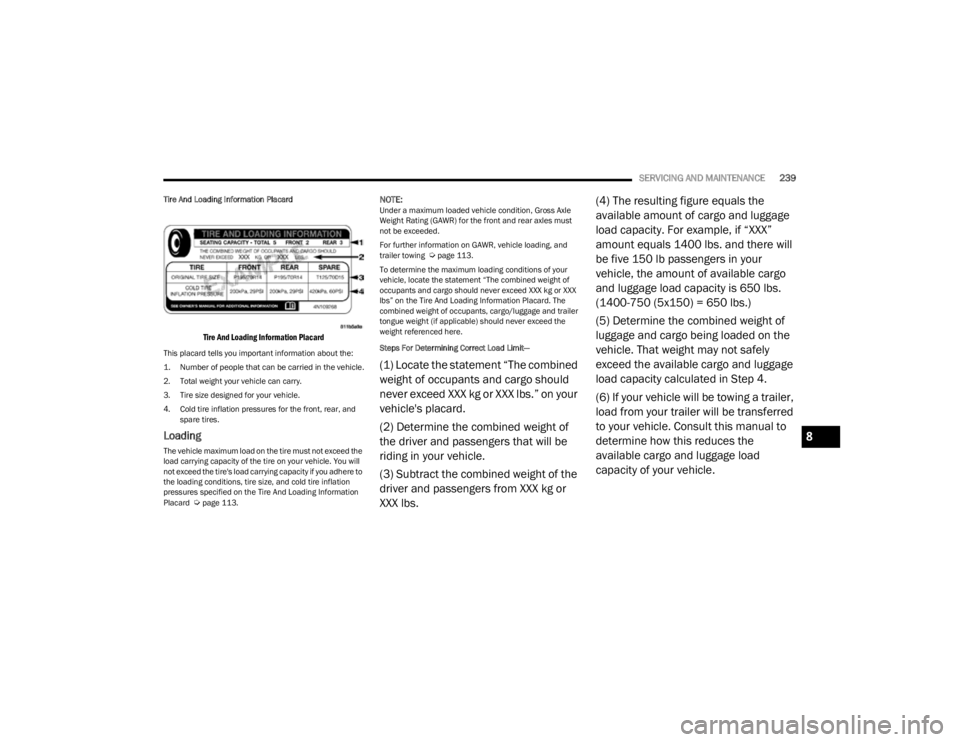
Tire And Loading Information Placard
Tire And Loading Information Placard
This placard tells you important information about the:
1. Number of people that can be carried in the vehicle.
2. Total weight your vehicle can carry.
3. Tire size designed for your vehicle.
4. Cold tire inflation pressures for the front, rear, and
spare tires.
Loading
The vehicle maximum load on the tire must not exceed the
load carrying capacity of the tire on your vehicle. You will
not exceed the tire's load carrying capacity if you adhere to
the loading conditions, tire size, and cold tire inflation
pressures specified on the Tire And Loading Information
Placard
Úpage 113.
NOTE:Under a maximum loaded vehicle condition, Gross Axle
Weight Rating (GAWR) for the front and rear axles must
not be exceeded.
For further information on GAWR, vehicle loading, and
trailer towing
Úpage 113.
To determine the maximum loading conditions of your
vehicle, locate the statement “The combined weight of
occupants and cargo should never exceed XXX kg or XXX
lbs” on the Tire And Loading Information Placard. The
combined weight of occupants, cargo/luggage and trailer
tongue weight (if applicable) should never exceed the
weight referenced here.
Steps For Determining Correct Load Limit—
(1) Locate the statement “The combined
weight of occupants and cargo should
never exceed XXX kg or XXX lbs.” on your
vehicle's placard.
(2) Determine the combined weight of
the driver and passengers that will be
riding in your vehicle.
(3) Subtract the combined weight of the
driver and passengers from XXX kg or
XXX lbs. (4) The resulting figure equals the
available amount of cargo and luggage
load capacity. For example, if “XXX”
amount equals 1400 lbs. and there will
be five 150 lb passengers in your
vehicle, the amount of available cargo
and luggage load capacity is 650 lbs.
(1400-750 (5x150) = 650 lbs.)
(5) Determine the combined weight of
luggage and cargo being loaded on the
vehicle. That weight may not safely
exceed the available cargo and luggage
load capacity calculated in Step 4.
(6) If your vehicle will be towing a trailer,
load from your trailer will be transferred
to your vehicle. Consult this manual to
determine how this reduces the
available cargo and luggage load
capacity of your vehicle.
8
23_KL_OM_EN_USC_t.book Page 239
Page 242 of 276
240SERVICING AND MAINTENANCE
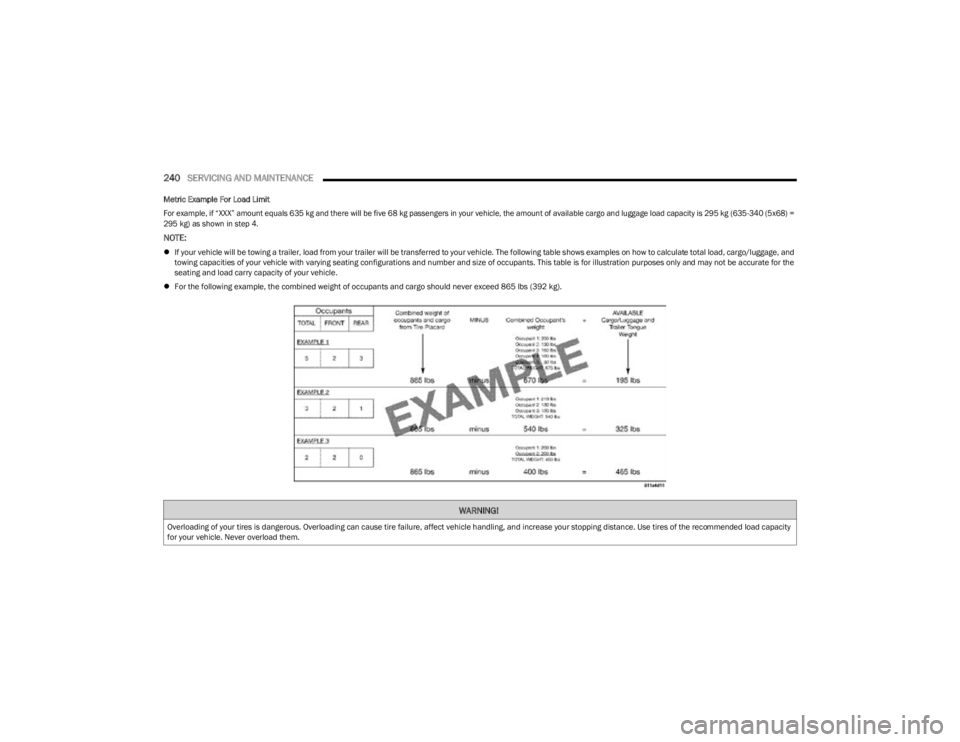
Metric Example For Load Limit
For example, if “XXX” amount equals 635 kg and there will be five 68 kg passengers in your vehicle, the amount of available cargo and luggage load capacity is 295 kg (635-340 (5x68) =
295 kg) as shown in step 4.
NOTE:
If your vehicle will be towing a trailer, load from your trailer will be transferred to your vehicle. The following table shows examples on how to calculate total load, cargo/luggage, and
towing capacities of your vehicle with varying seating configurations and number and size of occupants. This table is for illustration purposes only and may not be accurate for the
seating and load carry capacity of your vehicle.
For the following example, the combined weight of occupants and cargo should never exceed 865 lbs (392 kg).
WARNING!
Overloading of your tires is dangerous. Overloading can cause tire failure, affect vehicle handling, and increase your stopping distance. Use tires of the recommended load capacity
for your vehicle. Never overload them.
23_KL_OM_EN_USC_t.book Page 240
Page 244 of 276

242SERVICING AND MAINTENANCE
Example: If garage temperature = 68°F (20°C) and the
outside temperature = 32°F (0°C) then the cold tire
inflation pressure should be increased by 3 psi (21 kPa),
which equals 1 psi (7 kPa) for every 12°F (7°C) for this
outside temperature condition.
Tire pressure may increase from 2 to 6 psi (13 to 40 kPa)
during operation. DO NOT reduce this normal pressure
build up or your tire pressure will be too low.
Tire Pressures For High Speed Operation
The manufacturer advocates driving at safe speeds and
within posted speed limits. Where speed limits or
conditions are such that the vehicle can be driven at high
speeds, maintaining correct tire inflation pressure is very
important. Increased tire pressure and reduced vehicle
loading may be required for high-speed vehicle operation.
Refer to an authorized tire dealer or original equipment
vehicle dealer for recommended safe operating speeds,
loading and cold tire inflation pressures.
Radial Ply Tires
Tire Repair
If your tire becomes damaged, it may be repaired if it
meets the following criteria:
The tire has not been driven on when flat.
The damage is only on the tread section of your tire
(sidewall damage is not repairable).
The puncture is no greater than ¼ of an inch (6 mm).
Consult an authorized tire dealer for tire repairs and
additional information.
Damaged Run Flat tires, or Run Flat tires that have
experienced a loss of pressure should be replaced
immediately with another Run Flat tire of identical size and
service description (Load Index and Speed Symbol).
Replace the tire pressure sensor as well as it is not
designed to be reused.
Run Flat Tires — If Equipped
Run Flat tires allow you the capability to drive 50 miles
(80 km) at 50 mph (80 km/h) after a rapid loss of inflation
pressure. This rapid loss of inflation is referred to as the
Run Flat mode. A Run Flat mode occurs when the tire
inflation pressure is of/or below 14 psi (96 kPa). Once a Run Flat tire reaches the Run Flat mode it has limited
driving capabilities and needs to be replaced immediately.
A Run Flat tire is not repairable. When a Run Flat tire is
changed after being driven under a Run Flat mode 14 psi
(96 kPa) condition, please replace the TPMS sensor as it
is not designed to be reused.
NOTE:TPMS sensor must be replaced after driving the vehicle on
a flat tire condition.
It is not recommended driving a vehicle loaded at full
capacity or to tow a trailer while a tire is in the Run Flat
mode.
See the Tire Pressure Monitoring System section for more
information
Úpage 155.
Tire Spinning
When stuck in mud, sand, snow, or ice conditions, do not
spin your vehicle's wheels above 30 mph (48 km/h) or for
longer than 30 seconds continuously without stopping.
WARNING!
High speed driving with your vehicle under maximum
load is dangerous. The added strain on your tires could
cause them to fail. You could have a serious collision.
Do not drive a vehicle loaded to the maximum capacity
at continuous speeds above 75 mph (120 km/h).
WARNING!
Combining radial ply tires with other types of tires on
your vehicle will cause your vehicle to handle poorly.
The instability could cause a collision. Always use radial
ply tires in sets of four. Never combine them with other
types of tires.
WARNING!
Fast spinning tires can be dangerous. Forces generated
by excessive wheel speeds may cause tire damage or
failure. A tire could explode and injure someone. Do not
spin your vehicle's wheels faster than 30 mph (48 km/h)
for more than 30 seconds continuously when you are
stuck, and do not let anyone near a spinning wheel, no
matter what the speed.
23_KL_OM_EN_USC_t.book Page 242
Page 246 of 276

244SERVICING AND MAINTENANCE
TIRE TYPES
All Season Tires — If Equipped
All Season tires provide traction for all seasons (Spring,
Summer, Autumn, and Winter). Traction levels may vary
between different All Season tires. All Season tires can be
identified by the M+S, M&S, M/S or MS designation on the
tire sidewall. Use All Season tires only in sets of four;
failure to do so may adversely affect the safety and
handling of your vehicle.
Summer Or Three Season Tires —
If Equipped
Summer tires provide traction in both wet and dry
conditions, and are not intended to be driven in snow or on
ice. If your vehicle is equipped with Summer tires, be aware these tires are not designed for Winter or cold
driving conditions. Install Winter tires on your vehicle when
ambient temperatures are less than 40°F (5°C) or if
roads are covered with ice or snow. For more information,
contact an authorized dealer.
Summer tires do not contain the all season designation or
mountain/snowflake symbol on the tire sidewall. Use
Summer tires only in sets of four; failure to do so may
adversely affect the safety and handling of your vehicle.
Snow Tires
Some areas of the country require the use of snow tires
during the Winter. Snow tires can be identified by a
mountain/snowflake symbol on the tire sidewall.
If you need snow tires, select tires equivalent in
size and type to the original equipment tires.
Use snow tires only in sets of four; failure to do
so may adversely affect the safety and handling
of your vehicle.
Snow tires generally have lower speed ratings than what
was originally equipped with your vehicle and should not be
operated at sustained speeds over 75 mph (120 km/h). For
speeds above 75 mph (120 km/h) refer to original
equipment or an authorized tire dealer for recommended
safe operating speeds, loading and cold tire inflation
pressures.
While studded tires improve performance on ice, skid and
traction capability on wet or dry surfaces may be poorer
than that of non-studded tires. Some states prohibit
studded tires; therefore, local laws should be checked
before using these tire types.
SPARE TIRES — IF EQUIPPED
NOTE:For vehicles equipped with Tire Service Kit instead of a
spare tire, please refer to Tire Service Kit Úpage 196.
Refer to Towing Requirements - Tires for restrictions when
towing with a spare tire designated for temporary
emergency use
Úpage 118.
Spare Tire Matching Original Equipped Tire
And Wheel — If Equipped
Your vehicle may be equipped with a spare tire and wheel
equivalent in look and function to the original equipment
tire and wheel found on the front or rear axle of your
vehicle. This spare tire may be used in the tire rotation for
your vehicle. If your vehicle has this option, refer to an
authorized tire dealer for the recommended tire rotation
pattern.
Never use a tire with a smaller load index or capacity,
other than what was originally equipped on your
vehicle. Using a tire with a smaller load index could
result in tire overloading and failure. You could lose
control and have a collision.
Failure to equip your vehicle with tires having
adequate speed capability can result in sudden tire
failure and loss of vehicle control.
CAUTION!
Replacing original tires with tires of a different size may
result in false speedometer and odometer readings.
WARNING!
WARNING!
Do not use Summer tires in snow/ice conditions. You
could lose vehicle control, resulting in severe injury or
death. Driving too fast for conditions also creates the
possibility of loss of vehicle control.CAUTION!
Because of the reduced ground clearance, do not take
your vehicle through an automatic car wash with a
compact or limited use temporary spare installed.
Damage to the vehicle may result.
23_KL_OM_EN_USC_t.book Page 244
Page 254 of 276

252SERVICING AND MAINTENANCE
LEATHER SURFACES
Mopar® Total Clean is specifically recommended for
leather upholstery.
Your leather upholstery can be best preserved by regular
cleaning with a damp soft cloth. Small particles of dirt can
act as an abrasive and damage the leather upholstery and
should be removed promptly with a damp cloth. Stubborn
soils can be removed easily with a soft cloth and Mopar®
Total Clean. Care should be taken to avoid soaking your
leather upholstery with any liquid. Please do not use
polishes, oils, cleaning fluids, solvents, detergents, or
ammonia-based cleaners to clean your leather upholstery.
NOTE:If equipped with light colored leather, it tends to show any
foreign material, dirt, and fabric dye transfer more so than
darker colors. The leather is designed for easy cleaning,
and the manufacturer recommends Mopar® Total Clean
leather cleaner applied on a cloth to clean the leather
seats as needed.GLASS SURFACES
All glass surfaces should be cleaned on a regular basis
with Mopar® Glass Cleaner, or any commercial
household-type glass cleaner. Never use an abrasive type
cleaner. Use caution when cleaning the inside rear
window equipped with electric defrosters or windows
equipped with radio antennas. Do not use scrapers or
other sharp instruments that may scratch the elements.
When cleaning the rearview mirror, spray cleaner on the
towel or cloth that you are using. Do not spray cleaner
directly on the mirror.
CAUTION!
Do not use alcohol and alcohol-based and/or
ketone-based cleaning products to clean leather
upholstery, as damage to the upholstery may result.
23_KL_OM_EN_USC_t.book Page 252