2023 HYUNDAI SONATA Oli
[x] Cancel search: OliPage 493 of 555
08
8-23
Checking the Engine Oil Level
Engine oil is used for lubricating,
cooling, and operating various hydraulic
components in the engine. Engine oil
consumption while driving is normal,
and it is necessary to check and refill the
engine oil regularly. Also, check and refill
the oil level within the recommended
maintenance schedule to prevent
deterioration of oil performance.
Check the engine oil following the below
procedure.
1. Follow all of the oil manufacturer’sprecautions.
2. Be sure the vehicle is on the level
ground in P (Park) with the parking
brake set. If possible, block thewheels.
3. Turn the engine on and allow the engine to reach normal operating
temperature.
4. Turn the engine off and wait about
fifteen minutes for the oil to return tothe oil pan.
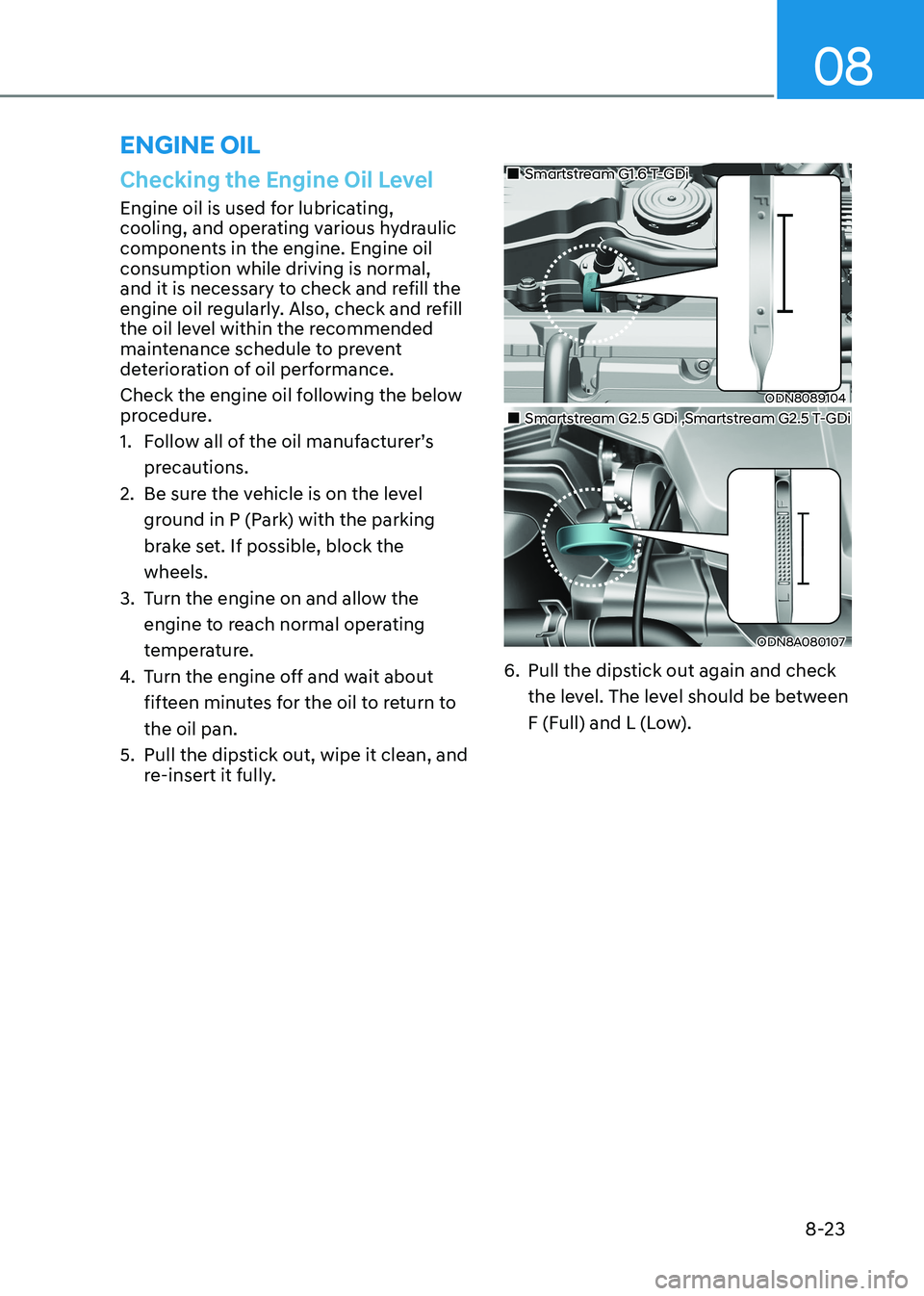
5. Pull the dipstick out, wipe it clean, and re-insert it fully.
ODN8089104
„
„Smartstream G1.6 T-GDi
ODN8A080107
„
„Smartstream G2.5 GDi ,Smartstream G2.5 T-GDi
6. Pull the dipstick out again and check the level. The level should be between
F (Full) and L (Low).
EnginE oiL
Page 495 of 555
08
8-25
Checking the Engine Oil and
Filter
• Have engine oil and filter changed
by an authorized HYUNDAI dealer
according to the Maintenance
Schedule at the beginning of this
chapter.
• If the maintenance schedule to
replace engine oil is exceeded,
the engine oil performance may
deteriorate, and the engine condition
may be affected. Therefore, replace
the engine oil according to the
maintenance schedule.
• To keep the engine in optimal
condition, use the recommended
engine oil and filter. If the
recommended engine oil and filter are
not used, replace it according to the
maintenance schedule under severe usage conditions.
• The purpose of the maintenance
schedule for engine oil replacement
is to prevent oil deterioration and it is
irrelevant to oil consumption. Check
and refill engine oil regularly.
WARNING
Used engine oil may cause irritation or
cancer of the skin if left in contact with
the skin for prolonged periods of time.
Always protect your skin by washing
your hands thoroughly with soap and
warm water as soon as possible after handling used oil.
Information
When the oil pressure is low due to insufficient engine oil, the Engine
Oil Pressure (
) warning light will
illuminate. In addition, the enhanced
engine protection system, which limits
the engine’s power is activated and the
Malfunction Indicator Lamp (
) will
illuminate when the vehicle is driven in
this state continuously. When oil pressure
is restored, the Engine Oil Pressure warning light will turn off and the engine
power will no longer be limited.
However, for gasoline 2.5 turbo engine,
when the oil pressure is restored, the warning light and the enhanced engine
protection system will turn off after the
engine is restarted.
CAUTION
The engine oil is very hot immediately
after the vehicle has been driven and
can cause burns during replacement.
Replace the engine oil after the engine
oil has cooled down.
Page 496 of 555
Maintenance
8-26
The high-pressure cooling system has a
reservoir filled with year-round antifreeze
coolant. The reservoir is filled at the
factory.
Check the antifreeze protection and
coolant level at least once a year, at
the beginning of the winter season and
before traveling to a colder climate.
NOTICE
• When the engine overheats from
low engine coolant, suddenly adding
engine coolant may cause cracks
in the engine. To prevent damage,
add engine coolant slowly in small
quantities.
• Do not drive with no engine coolant.
It may cause water pump failure and
engine seizure, etc.
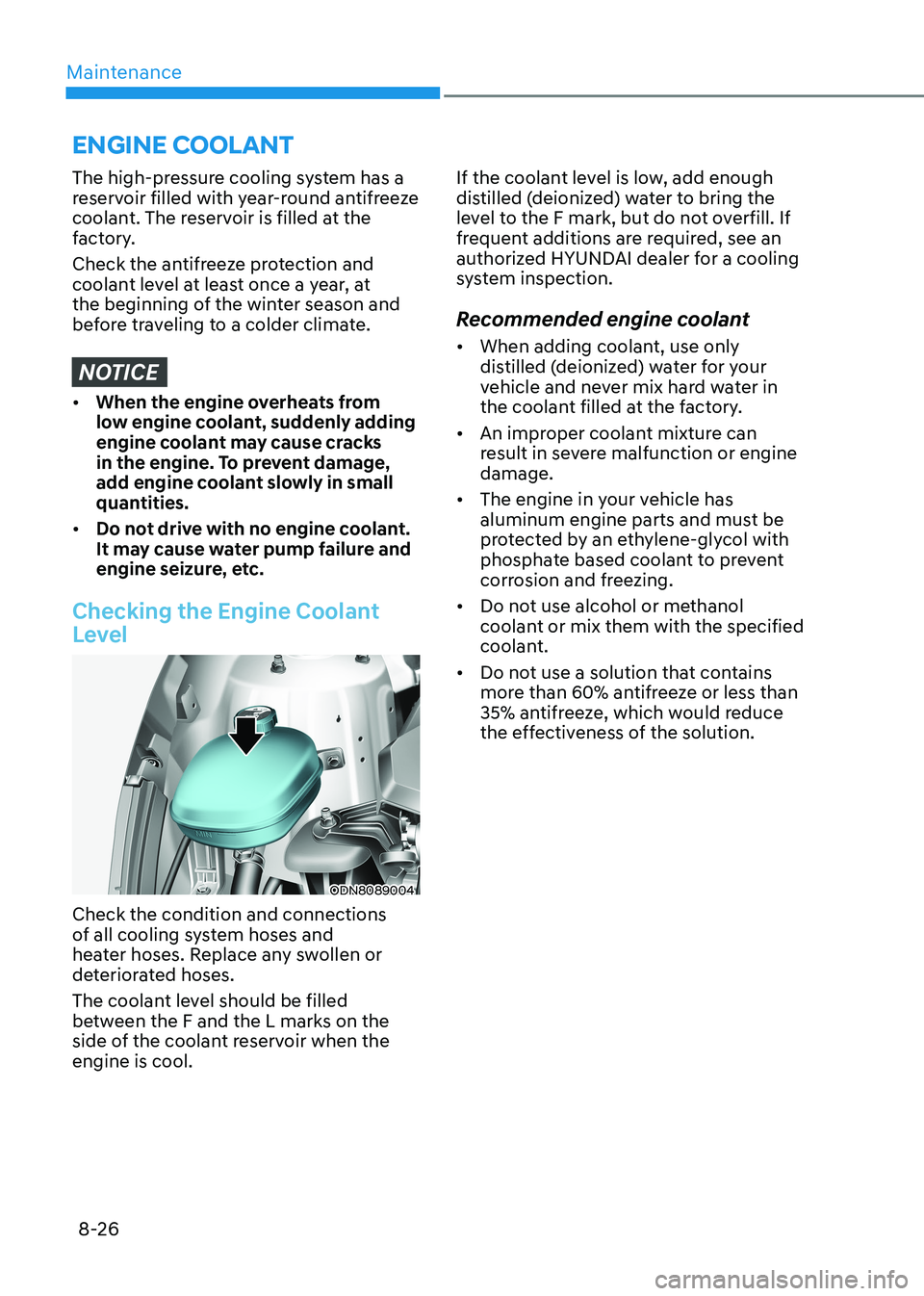
Checking the Engine Coolant
Level
ODN8089004
Check the condition and connections
of all cooling system hoses and
heater hoses. Replace any swollen or
deteriorated hoses.
The coolant level should be filled
between the F and the L marks on the
side of the coolant reservoir when the engine is cool. If the coolant level is low, add enough
distilled (deionized) water to bring the
level to the F mark, but do not overfill. If
frequent additions are required, see an
authorized HYUNDAI dealer for a cooling
system inspection.
Recommended engine coolant • When adding coolant, use only
distilled (deionized) water for your
vehicle and never mix hard water in
the coolant filled at the factory.
• An improper coolant mixture can
result in severe malfunction or engine damage.
• The engine in your vehicle has
aluminum engine parts and must be
protected by an ethylene-glycol with
phosphate based coolant to prevent
corrosion and freezing.
• Do not use alcohol or methanol
coolant or mix them with the specified
coolant.
• Do not use a solution that contains
more than 60% antifreeze or less than
35% antifreeze, which would reduce
the effectiveness of the solution.
EnginE CooLant
Page 497 of 555
08
8-27
For mixing percentage, refer to the
following table:
Ambient
Temperature Mixture Percentage
(volume)
Antifreeze Water
-15°C (5°F) 35 65
-25°C (-13°F) 40 60
-35°C (-31°F) 50 50
-45°C (-49°F) 60 40
Information
If in doubt about the mix ratio, a 50%
water and 50% antifreeze mix is the
easiest to mix together as it will be the same quantity of each. It is suitable to
use for most temperature ranges of -35°C
(-31°F) and higher.
WARNING
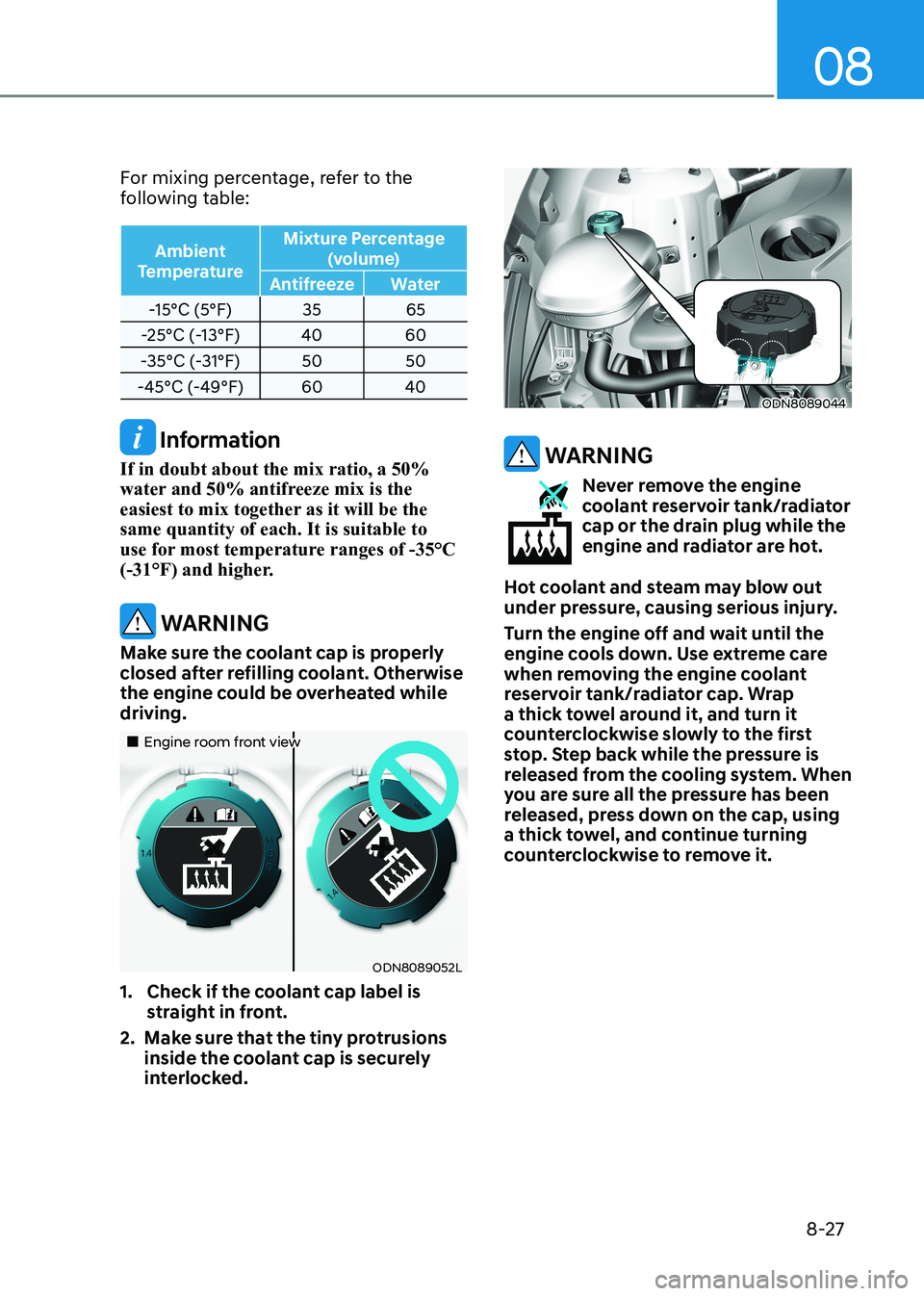
Make sure the coolant cap is properly
closed after refilling coolant. Otherwise
the engine could be overheated while driving.
„„Engine room front view
ODN8089052L
1. Check if the coolant cap label is straight in front.
2. Make sure that the tiny protrusions inside the coolant cap is securely
interlocked.
ODN8089044
WARNING
Never remove the engine
coolant reservoir tank/radiator
cap or the drain plug while the
engine and radiator are hot.
Hot coolant and steam may blow out
under pressure, causing serious injury.
Turn the engine off and wait until the
engine cools down. Use extreme care
when removing the engine coolant
reservoir tank/radiator cap. Wrap
a thick towel around it, and turn it
counterclockwise slowly to the first
stop. Step back while the pressure is
released from the cooling system. When
you are sure all the pressure has been
released, press down on the cap, using
a thick towel, and continue turning
counterclockwise to remove it.
Page 498 of 555
Maintenance
8-28
WARNING
The electric motor for the
cooling fan may continue to
operate or start up when the
engine is not running and can
cause serious injury. Keep
hands, clothing and tools away
from the rotating fan blades of
the cooling fan.
The electric motor for the cooling
fan is controlled by engine coolant
temperature, refrigerant pressure and
vehicle speed. As the engine coolant
temperature decreases, the electric
motor will automatically shut off. This
is a normal condition. If your vehicle is
equipped with GDI, the electric motor
for the cooling fan may begin to operate
at any time and continue to operate until
you disconnect the negative battery cable.
Changing Engine Coolant
Have coolant changed by an authorized
HYUNDAI dealer according to the
Maintenance Schedule at the beginning
of this chapter.
WARNING
Do not use engine coolant or antifreeze
in the washer fluid reservoir.
Engine coolant can severely obscure
visibility when sprayed on the
windshield and may cause loss of
vehicle control resulting in an accident.
Engine coolant may also cause damage
to paint and body trim.
NOTICE
To prevent damage to engine parts, put
a thick towel around the radiator cap
before refilling the coolant to prevent
the coolant from overflowing into
engine parts, such as the alternator.
Page 504 of 555
Maintenance
8-34
wipEr BLaDES
Blade Inspection
Contamination of either the windshield
or the wiper blades with foreign matter
can reduce the effectiveness of the
windshield wiper functionality. Common
sources of contamination are insects,
tree sap, and hot wax treatments used
by some commercial car washes. If the
blades are not wiping properly, clean
both the window and the blades with a
clean cloth dampened with washer fluid.
NOTICE
To prevent damage to the wiper blades,
arms or other components, do not: • Use gasoline, kerosene, paint
thinner, or other solvents on or near them.
• Attempt to move the wipers
manually.
• Use non-specified wiper blades.
Information
Commercial hot waxes applied by
automatic car washes have been known to make the windshield difficult to clean.
Blade Replacement
When the wipers no longer clean
adequately, the blades may be worn or
cracked, and require replacement.
NOTICE
• In order to prevent damage to the hood and the wiper arms, the wiper
arms should only be lifted when in
the top wiping position.
• Always return the wiper arms to the
windshield before driving.
NOTICE
The use of a non-specified wiper blade
could result in wiper malfunction and
failure.
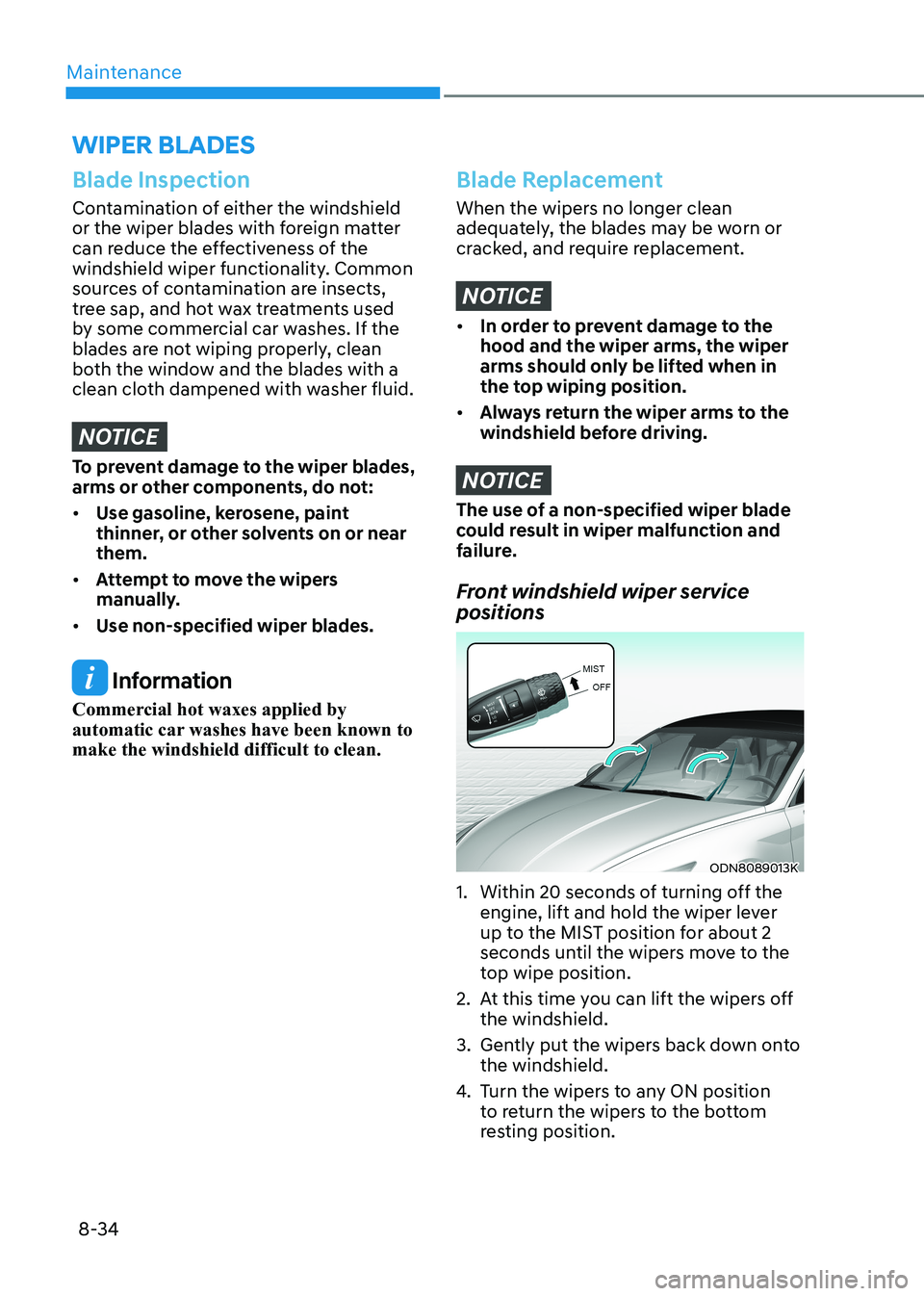
Front windshield wiper service positions
ODN8089013K
1. Within 20 seconds of turning off the engine, lift and hold the wiper lever
up to the MIST position for about 2
seconds until the wipers move to the
top wipe position.
2. At this time you can lift the wipers off the windshield.
3. Gently put the wipers back down onto the windshield.
4. Turn the wipers to any ON position
to return the wipers to the bottom
resting position.
Page 511 of 555
08
8-41
Tire Replacement
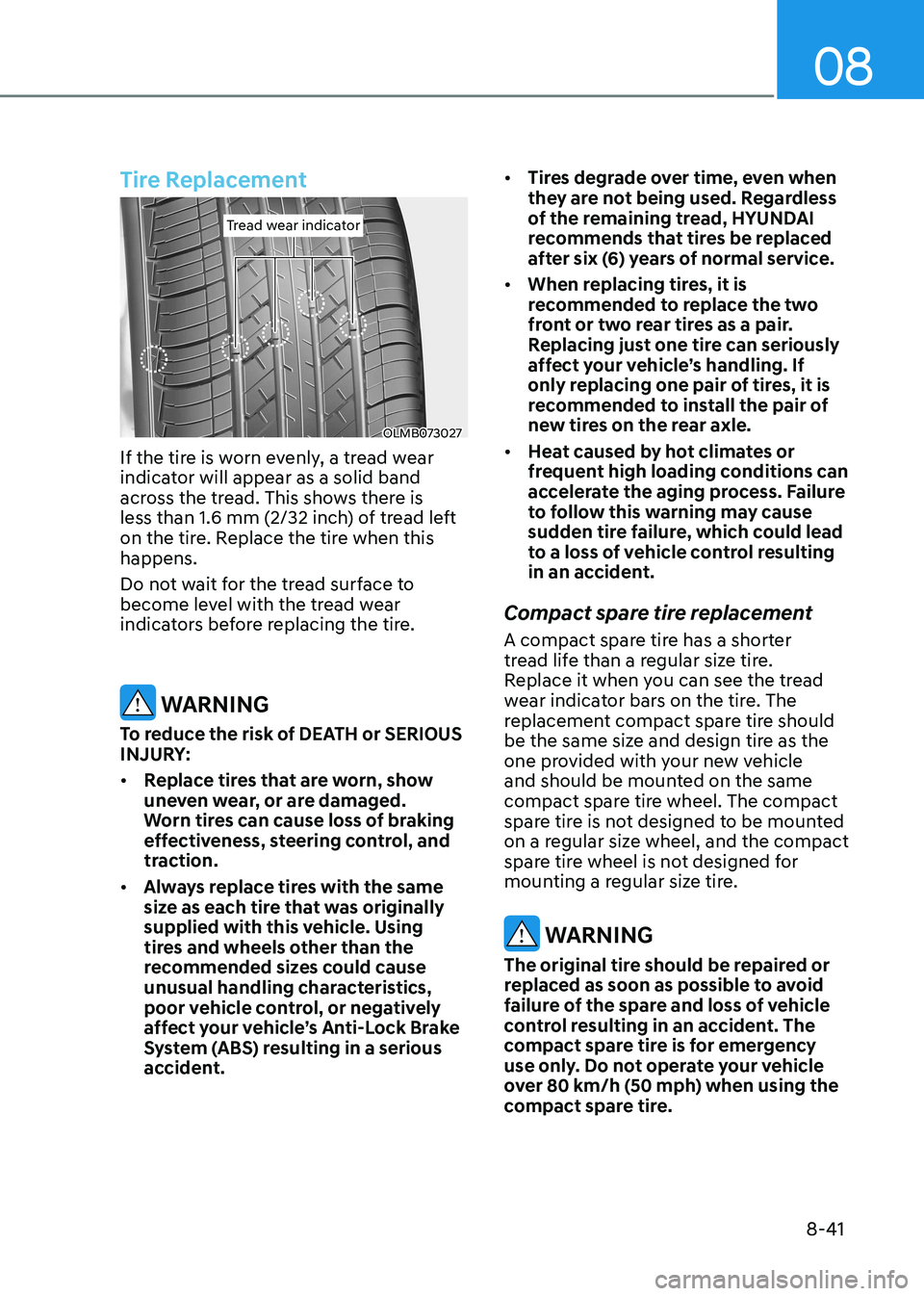
Tread wear indicatorTread wear indicator
OLMB073027
If the tire is worn evenly, a tread wear
indicator will appear as a solid band
across the tread. This shows there is
less than 1.6 mm (2/32 inch) of tread left
on the tire. Replace the tire when this happens.
Do not wait for the tread surface to
become level with the tread wear
indicators before replacing the tire.
WARNING
To reduce the risk of DEATH or SERIOUS
INJURY: • Replace tires that are worn, show
uneven wear, or are damaged.
Worn tires can cause loss of braking
effectiveness, steering control, and
traction.
• Always replace tires with the same
size as each tire that was originally
supplied with this vehicle. Using
tires and wheels other than the
recommended sizes could cause
unusual handling characteristics,
poor vehicle control, or negatively
affect your vehicle’s Anti-Lock Brake
System (ABS) resulting in a serious
accident. •
Tires degrade over time, even when
they are not being used. Regardless
of the remaining tread, HYUNDAI
recommends that tires be replaced
after six (6) years of normal service.
• When replacing tires, it is
recommended to replace the two
front or two rear tires as a pair.
Replacing just one tire can seriously
affect your vehicle’s handling. If
only replacing one pair of tires, it is
recommended to install the pair of
new tires on the rear axle.
• Heat caused by hot climates or
frequent high loading conditions can
accelerate the aging process. Failure
to follow this warning may cause
sudden tire failure, which could lead
to a loss of vehicle control resulting
in an accident.
Compact spare tire replacement
A compact spare tire has a shorter
tread life than a regular size tire.
Replace it when you can see the tread
wear indicator bars on the tire. The
replacement compact spare tire should
be the same size and design tire as the
one provided with your new vehicle
and should be mounted on the same
compact spare tire wheel. The compact
spare tire is not designed to be mounted
on a regular size wheel, and the compact
spare tire wheel is not designed for
mounting a regular size tire.
WARNING
The original tire should be repaired or
replaced as soon as possible to avoid
failure of the spare and loss of vehicle
control resulting in an accident. The
compact spare tire is for emergency
use only. Do not operate your vehicle
over 80 km/h (50 mph) when using the
compact spare tire.
Page 525 of 555
08
8-55
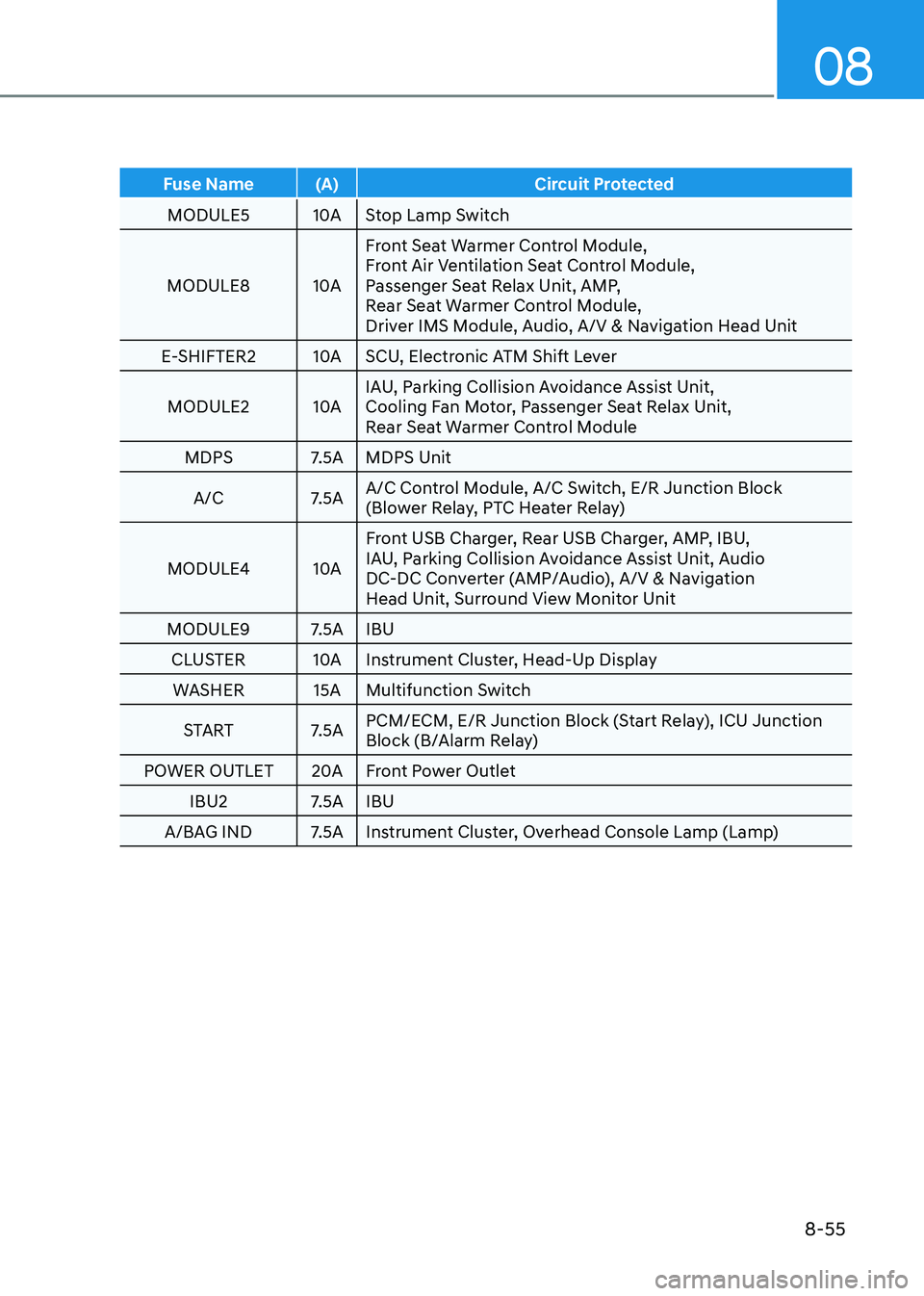
Fuse Name (A) Circuit Protected
MODULE5 10A Stop Lamp Switch
MODULE8 10A Front Seat Warmer Control Module,
Front Air Ventilation Seat Control Module,
Passenger Seat Relax Unit, AMP,
Rear Seat Warmer Control Module,
Driver IMS Module, Audio, A/V & Navigation Head Unit
E-SHIFTER2 10A SCU, Electronic ATM Shift Lever
MODULE2 10A IAU, Parking Collision Avoidance Assist Unit,
Cooling Fan Motor, Passenger Seat Relax Unit,
Rear Seat Warmer Control Module
MDPS 7.5A MDPS Unit
A/C 7.5A A/C Control Module, A/C Switch, E/R Junction Block
(Blower Relay, PTC Heater Relay)
MODULE4 10A Front USB Charger, Rear USB Charger, AMP, IBU,
IAU, Parking Collision Avoidance Assist Unit, Audio
DC-DC Converter (AMP/Audio), A/V & Navigation
Head Unit, Surround View Monitor Unit
MODULE9 7.5A IBU CLUSTER 10A Instrument Cluster, Head-Up Display WASHER 15A Multifunction Switch
START 7.5A PCM/ECM, E/R Junction Block (Start Relay), ICU Junction
Block (B/Alarm Relay)
POWER OUTLET 20A Front Power Outlet IBU2 7.5A IBU
A/BAG IND 7.5A Instrument Cluster, Overhead Console Lamp (Lamp)