Page 18 of 533

1-5
Your vehicle at a glance
1
I IN
NS
ST
TR
RU
UM
ME
EN
NT
T
P
PA
AN
NE
EL
L
O
OV
VE
ER
RV
VI
IE
EW
W
(
(I
I)
)
1. Instrument cluster ..........................3-41
2. Light control/Turn signals ................3-81
3. Wiper/Washer..................................3-92
4. Steering wheel audio controls/ ........4-4
Bluetooth
®wireless technology
hands-free controls ..........................4-5
5. Cruise controls/ ............................5-100
Smart cruise controls ....................5-106
6. Horn ................................................3-19
7. Driver’s front air bag........................2-47
8. Key ignition switch/ ..........................5-7
Engine Start/Stop button ................5-11
9. Audio system/ ..................................4-9
Navigation system ..........................4-5
10. Hazard warning flasher switch ........6-2
11. Central door lock switch ..............3-13
12. Manual climate control system/ ..3-105
Automatic climate control
system ........................................3-114
13. Passenger’s front air bag ..............2-47
14. Glove box ....................................3-131
15. Cup holder ..................................3-133
16. Console box ................................3-131
OPD017005RThe actual shape may differ from the illustration.
Page 20 of 533
1-7
Your vehicle at a glance
1
1. Engine coolant reservoir ......................7-31
2. Radiator cap.........................................7-32
3. Brake/clutch fluid reservoir ..................7-34
4. Air cleaner ............................................7-36
5. Engine oil dipstick ................................7-28
6. Engine oil filler cap ..............................7-28
7. Windscreen washer fluid reservoir ......7-35
8. Fuse box ..............................................7-61
9. Battery..................................................7-43
OPD077002R/OPD077098R
The actual engine compartment in the vehicle may differ from the illustration.
■ ■Petrol Engine (2.0 GDI)
■
■Petrol Engine (1.6 T-GDI)
E
EN
NG
GI
IN
NE
E
C
CO
OM
MP
PA
AR
RT
TM
ME
EN
NT
T
Page 21 of 533
1-8
Your vehicle at a glance
1. Engine coolant reservoir ......................7-31
2. Radiator cap.........................................7-32
3. Brake/clutch fluid reservoir ..................7-34
4. Air cleaner ............................................7-36
5. Engine oil dipstick ................................7-29
6. Engine oil filler cap ..............................7-30
7. Windscreen washer fluid reservoir ......7-35
8. Fuse box ..............................................7-61
9. Battery..................................................7-43
OPDE076003RThe actual engine compartment in the vehicle may differ from the illustration.
■ ■Diesel Engine (1.6 TCI)
Page 30 of 533
2-9
Safety system of your vehicle
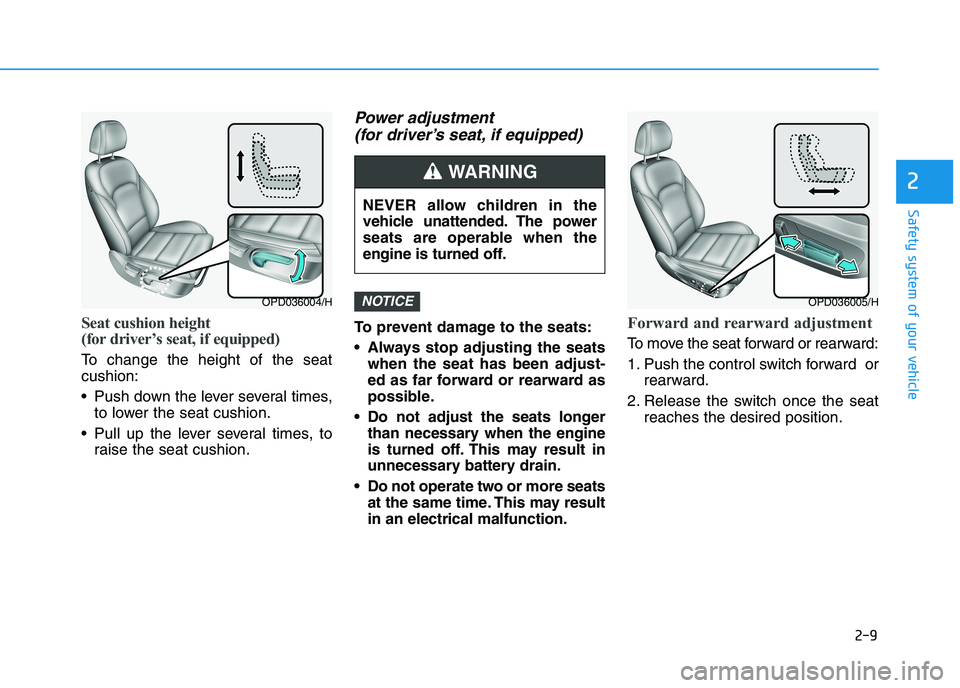
Seat cushion height
(for driver’s seat, if equipped)
To change the height of the seat
cushion:
Push down the lever several times,
to lower the seat cushion.
Pull up the lever several times, to
raise the seat cushion.
Power adjustment
(for driver’s seat, if equipped)
To prevent damage to the seats:
Always stop adjusting the seats
when the seat has been adjust-
ed as far forward or rearward as
possible.
Do not adjust the seats longer
than necessary when the engine
is turned off. This may result in
unnecessary battery drain.
Do not operate two or more seats
at the same time. This may result
in an electrical malfunction.Forward and rearward adjustment
To move the seat forward or rearward:
1. Push the control switch forward or
rearward.
2. Release the switch once the seat
reaches the desired position.
NOTICE
2
OPD036004/H
NEVER allow children in the
vehicle unattended. The power
seats are operable when the
engine is turned off.
WARNING
OPD036005/H
Page 35 of 533
2-14
Safety system of your vehicle
Do not place objects in the rear
seats, as they cannot be proper-
ly secured and may hit vehicle
occupants in a collision caus-
ing serious injury or death.
WARNING
Make sure the engine is off, the
shift lever is in P (Park), and the
parking brake is securely applied
whenever loading or unloading
the luggage compartment.
Failure to take these steps may
allow the vehicle to move if the
shift lever is inadvertently moved
to another position.
WARNING
Cargo should always be secured
to prevent it from being thrown
about the vehicle in a collision
and causing injury to the vehicle
occupants. Do not place objects
in the rear seats, as they cannot
be properly secured and may hit
the front seat occupants in a col-
lision.
WARNING
Be careful when loading the
luggage compartment through
the rear passenger seats to
prevent damage to the vehicle
interior.
When the luggage compart-
ment is loaded through the
rear passenger seats, ensure
the luggage compartment is
properly secured to prevent it
from moving whilst driving.
CAUTION
Page 41 of 533
2-20
Safety system of your vehicle
To prevent damage to the seat
warmers and seats:
Never use a solvent such as
paint thinner, benzene, alcohol
or petrol to clean the seats.
Do not place heavy or sharp
objects on seats equipped with
seat warmers.
Do not change the seat cover. It
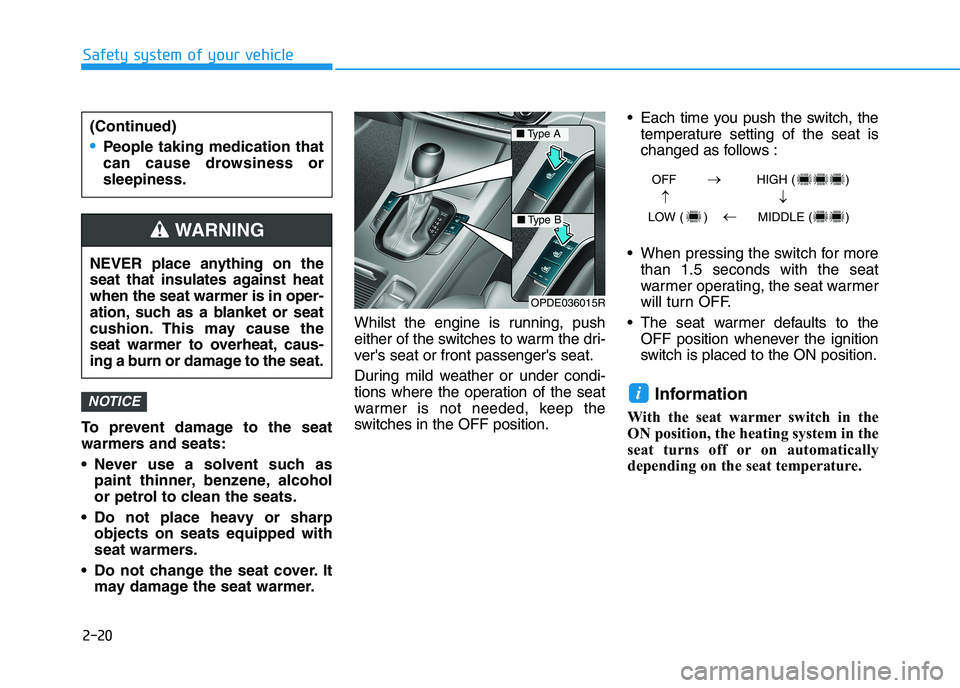
may damage the seat warmer.Whilst the engine is running, push
either of the switches to warm the dri-
ver's seat or front passenger's seat.
During mild weather or under condi-
tions where the operation of the seat
warmer is not needed, keep the
switches in the OFF position. Each time you push the switch, the
temperature setting of the seat is
changed as follows :
When pressing the switch for more
than 1.5 seconds with the seat
warmer operating, the seat warmer
will turn OFF.
The seat warmer defaults to the
OFF position whenever the ignition
switch is placed to the ON position.
Information
With the seat warmer switch in the
ON position, the heating system in the
seat turns off or on automatically
depending on the seat temperature.
iNOTICE
OPDE036015R
■Type A
■Type B
OFF HIGH ( )
LOW ( ) MIDDLE ( )
→→
→
→
(Continued)
People taking medication that
can cause drowsiness or
sleepiness.
NEVER place anything on the
seat that insulates against heat
when the seat warmer is in oper-
ation, such as a blanket or seat
cushion. This may cause the
seat warmer to overheat, caus-
ing a burn or damage to the seat.
WARNING
Page 42 of 533
2-21
Safety system of your vehicle
2
Front air ventilation seat
(if equipped)
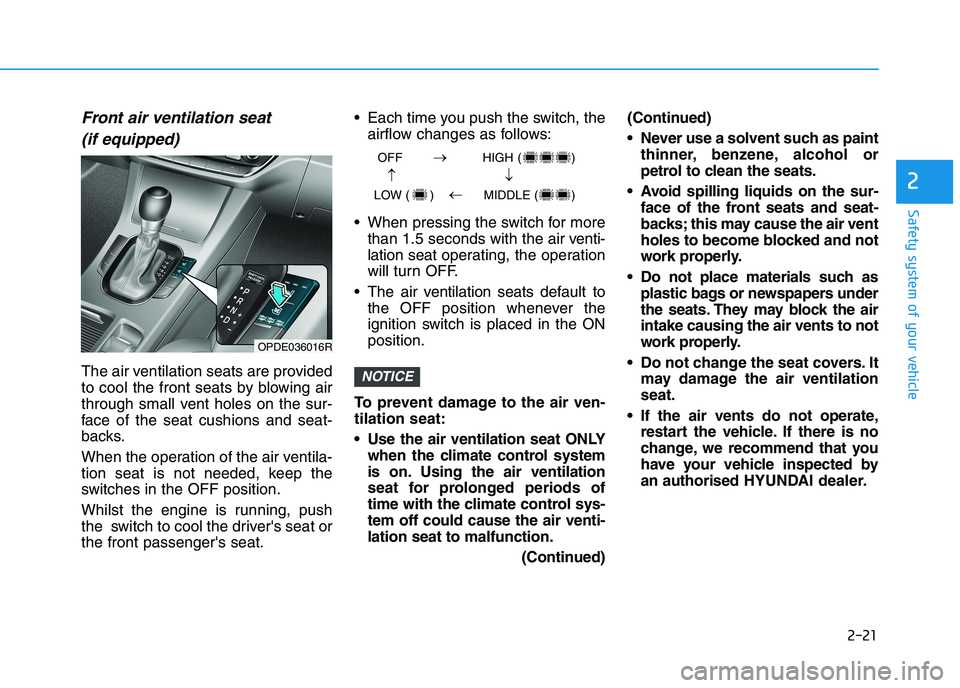
The air ventilation seats are provided
to cool the front seats by blowing air
through small vent holes on the sur-
face of the seat cushions and seat-
backs.
When the operation of the air ventila-
tion seat is not needed, keep the
switches in the OFF position.
Whilst the engine is running, push
the switch to cool the driver's seat or
the front passenger's seat. Each time you push the switch, the
airflow changes as follows:
When pressing the switch for more
than 1.5 seconds with the air venti-
lation seat operating, the operation
will turn OFF.
The air ventilation seats default to
the OFF position whenever the
ignition switch is placed in the ON
position.
To prevent damage to the air ven-
tilation seat:
Use the air ventilation seat ONLY
when the climate control system
is on. Using the air ventilation
seat for prolonged periods of
time with the climate control sys-
tem off could cause the air venti-
lation seat to malfunction.
(Continued)(Continued)
Never use a solvent such as paint
thinner, benzene, alcohol or
petrol to clean the seats.
Avoid spilling liquids on the sur-
face of the front seats and seat-
backs; this may cause the air vent
holes to become blocked and not
work properly.
Do not place materials such as
plastic bags or newspapers under
the seats. They may block the air
intake causing the air vents to not
work properly.
Do not change the seat covers. It
may damage the air ventilation
seat.
If the air vents do not operate,
restart the vehicle. If there is no
change, we recommend that you
have your vehicle inspected by
an authorisedHYUNDAI dealer.NOTICE
OFF HIGH ( )
LOW ( ) MIDDLE ( )
→→
→
→
OPDE036016R
Page 67 of 533
2-46
Safety system of your vehicle
The vehicles are equipped with a
Supplemental Air Bag System for the
driver’s seat and front passenger’s
seats.
The front air bags are designed to
supplement the three-point seat
belts. For these air bags to provide
protection, the seat belts must be
worn at all times when driving.
You can be severely injured or killed
in an accident if you are not wearing
a seat belt. Air bags are designed to
supplement seat belts, but do not
replace them. Also, air bags are not
designed to deploy in every collision.
In some accidents, the seat belts are
the only restraint protecting you.AIR BAG SAFETY PRECAUTIONS
ALWAYS use seat belts Child Restraint Systems - every trip, every
time, everyone! Even with air bags, you can be seriously injured or
killed in a collision if you are improperly restrained or not wearing
your seat.
NEVER place a child in any Child Restraint System or booster seat in
the front passenger seat.
An inflating air bag could forcefully strike the infant or child causing
serious or fatal injuries.
ABC - Always Buckle Children under age 13 in the back seat. It is the
safest place for children of any age to ride. If a child age 13 or older
must be seated in the front seat, he or she must be properly belted
and the seat should be moved as far back as possible.
All occupants should sit upright with the seatback in an upright posi-
tion, centred on the seat cushion with their seat belt on, legs com-
fortably extended and their feet on the floor until the vehicle is parked
and the engine is turned off. If an occupant is out of position during
an accident, the rapidly deploying air bag may forcefully contact the
occupant causing serious or fatal injuries.
You and your passengers should never sit or lean unnecessarily
close to the air bags or lean against the door or centre console.
Move your seat as far back as possible from front air bags, whilst still
maintaining control of the vehicle.
WARNING

