2023 HYUNDAI I30 Automatic
[x] Cancel search: AutomaticPage 448 of 533
![HYUNDAI I30 2023 Owners Manual 7-17
7
Maintenance
Normal Maintenance Schedule (Petrol Engine [2.0 GDI]) (Cont.)
Months1224364860728496
Km x 1,000153045607590105120
Disc brakes and padsIIIIIIII
Steering gear rack, linkage and bootsI](/manual-img/35/56144/w960_56144-447.png "HYUNDAI I30 2023 Owners Manual 7-17
7
Maintenance
Normal Maintenance Schedule (Petrol Engine [2.0 GDI]) (Cont.)
Months1224364860728496
Km x 1,000153045607590105120
Disc brakes and padsIIIIIIII
Steering gear rack, linkage and bootsI")
7-17
7
Maintenance
Normal Maintenance Schedule (Petrol Engine [2.0 GDI]) (Cont.)
Months1224364860728496
Km x 1,000153045607590105120
Disc brakes and padsIIIIIIII
Steering gear rack, linkage and bootsIIIIIIII
Driveshaft and bootsIIII
Tyres (pressure & tread wear)IIIIIIII
Front suspension ball jointsIIIIIIII
Air conditioner refrigerantIIIIIIII
Air conditioner compressor IIIIIIII
Climate control air filter IIIIIIII
Manual transmission fluid *8II
Automatic transmission fluidNo check, No service required
Exhaust systemIIII
I : Inspect and if necessary, adjust, correct, clean or replace.
R : Replace or change.
*
8: Manual transmission/Dual clutch transmission fluid should be changed anytime they have been submerged in water.
MAINTENANCE
INTERVALS
MAINTENANCE
ITEM
Page 450 of 533
7-19
7
Maintenance
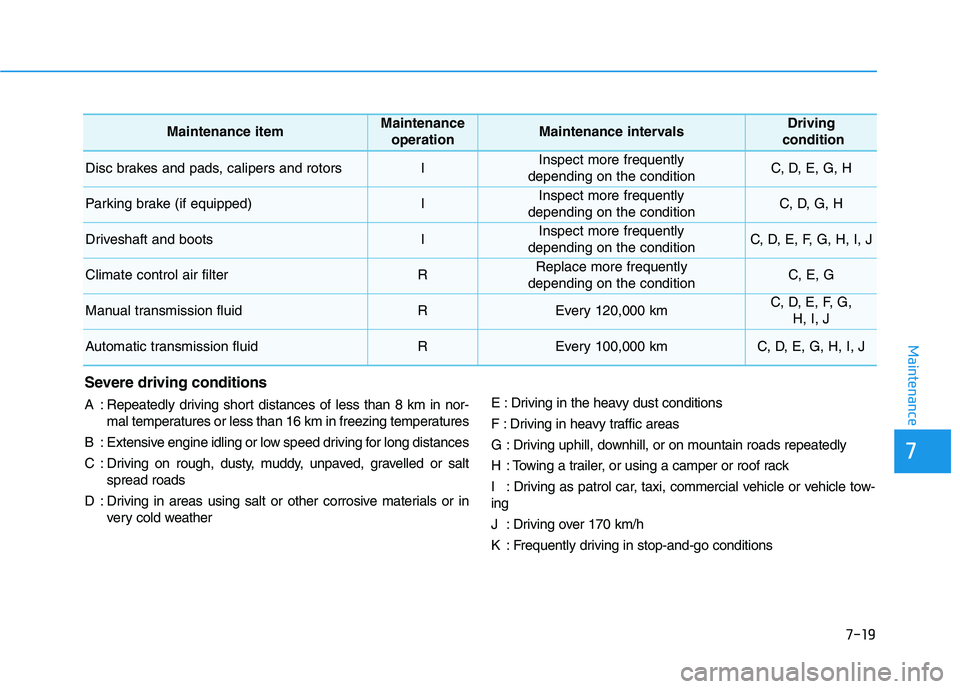
Maintenance itemMaintenance
operationMaintenance intervalsDriving
condition
Disc brakes and pads, calipers and rotorsIInspect more frequently
depending on the conditionC, D, E, G, H
Parking brake (if equipped)IInspect more frequently
depending on the conditionC, D, G, H
Driveshaft and bootsIInspect more frequently
depending on the conditionC, D, E, F, G, H, I, J
Climate control air filterRReplace more frequently
depending on the conditionC, E, G
Manual transmission fluidREvery 120,000 kmC, D, E, F, G,
H, I, J
Automatic transmission fluidREvery 100,000 kmC, D, E, G, H, I, J
Severe driving conditions
A : Repeatedly driving short distances of less than 8 km in nor-
mal temperatures or less than 16 km in freezing temperatures
B : Extensive engine idling or low speed driving for long distances
C : Driving on rough, dusty, muddy, unpaved, gravelled or salt
spread roads
D : Driving in areas using salt or other corrosive materials or in
very cold weatherE : Driving in the heavy dust conditions
F : Driving in heavy traffic areas
G : Driving uphill, downhill, or on mountain roads repeatedly
H : Towing a trailer, or using a camper or roof rack
I : Driving as patrol car, taxi, commercial vehicle or vehicle tow-
ing
J : Driving over 170 km/h
K : Frequently driving in stop-and-go conditions
Page 457 of 533

7-26
Maintenance
Air cleaner filter
We recommend that the air cleaner
filter be replaced by an authorised
HYUNDAI dealer.
Spark plugs
(for Petrol Engine)
Make sure to install new spark plugs
of the correct heat range.
Valve clearance
(for Petrol Engine)
Inspect excessive valve noise and/or
engine vibration and adjust if neces-
sary. We recommend that the system
be serviced by an authorised HYUNDAI
dealer.
Cooling system
Check the cooling system parts,
such as radiator, coolant reservoir,
hoses and connections for leakage
and damage. Replace any damaged
parts.
Engine coolant
The coolant should be changed at
the intervals specified in the mainte-
nance schedule.
Automatic transmission fluid
(if equipped)
Automatic transmission fluid should
not be checked under normal usage
conditions.
We recommend that the automatic
transmission fluid is changed by an
authorised HYUNDAI dealer accord-
ing to the maintenance schedule.
Information
Automatic transmission fluid colour is
red when new.
As the vehicle is driven, the automatic
transmission fluid will begin to look
darker.
This is a normal condition. It does not
need to be replaced based on the colour
change.
The use of a non-specified fluid
could result in transmission mal-
function and failure.
Use only specified automatic
transmission fluid.
(Refer to “Recommended lubri-
cants and capacities” in chapter 8.)
Manual transmission fluid
(if equipped)
Inspect the manual transmission
fluid according to the maintenance
schedule.
NOTICE
i
Do not disconnect and inspect
spark plugs when the engine is
hot. You may burn yourself.
WARNING
Page 463 of 533

7-32
Maintenance
The electric motor for the cooling fan
is controlled by engine coolant tem-
perature, refrigerant pressure and
vehicle speed. As the engine coolant
temperature decreases, the electric
motor will automatically shut off. This
is a normal condition. If your vehicle
is equipped with GDI, the electric
motor for the cooling fan may begin
to operate at any time and continue
to operate until you disconnect the
negative battery cable.The electric motor for
the cooling fan may
continue to operate
or start up when the
engine is not running
and can cause serious injury.
Keep hands, clothing and tools
away from the rotating fan blades
of the cooling fan.
WARNING
Never remove the
radiator cap or the
drain plug whilst the
engine and radiator
are hot. Hot coolant
and steam may blow out under
pressure, causing serious injury.
(Continued)
WARNING
OPD076015
(Continued)
Turn the engine off and wait until
the engine cools down. Use
extreme care when removing the
radiator cap. Wrap a thick towel
around it, and turn it anticlock-
wise slowly to the first stop. Step
back whilst the pressure is
released from the cooling sys-
tem. When you are sure all the
pressure has been released,
press down on the cap, using a
thick towel, and continue turning
anticlockwise to remove it.
Page 470 of 533

7-39
7
Maintenance
5. Replace the climate control air filter.
6. Reassemble in the reverse order
of disassembly.
Install a new climate control air filter
in the correct direction with the
arrow symbol (
↓ ↓) facing down-
wards, otherwise, it may be noisy
and the effectiveness of the filter
may be reduced.
Blade inspection
Contamination of either the wind-
screen or the wiper blades with for-
eign matter can reduce the effective-
ness of the windscreen wipers.
Common sources of contamination
are insects, tree sap, and hot wax
treatments used by some commer-
cial car washes. If the blades are not
wiping properly, clean both the win-
dow and the blades with a good
cleaner or mild detergent, and rinse
thoroughly with clean water.To prevent damage to the wiper
blades, arms or other compo-
nents, do not:
Use petrol, kerosene, paint thin-
ner, or other solvents on or near
them.
Attempt to move the wipers
manually.
Use non-specified wiper blades.
Information
Commercial hot waxes applied by
automatic car washes have been
known to make the windscreen diffi-
cult to clean.
Information
Wiper blades are a consumable item.
Normal wear of the wipers may not be
covered by your vehicle warranty.
i
i
NOTICE
NOTICE
W WI
IP
PE
ER
R
B
BL
LA
AD
DE
ES
S
OPD076026
Page 476 of 533
7-45
7
Maintenance
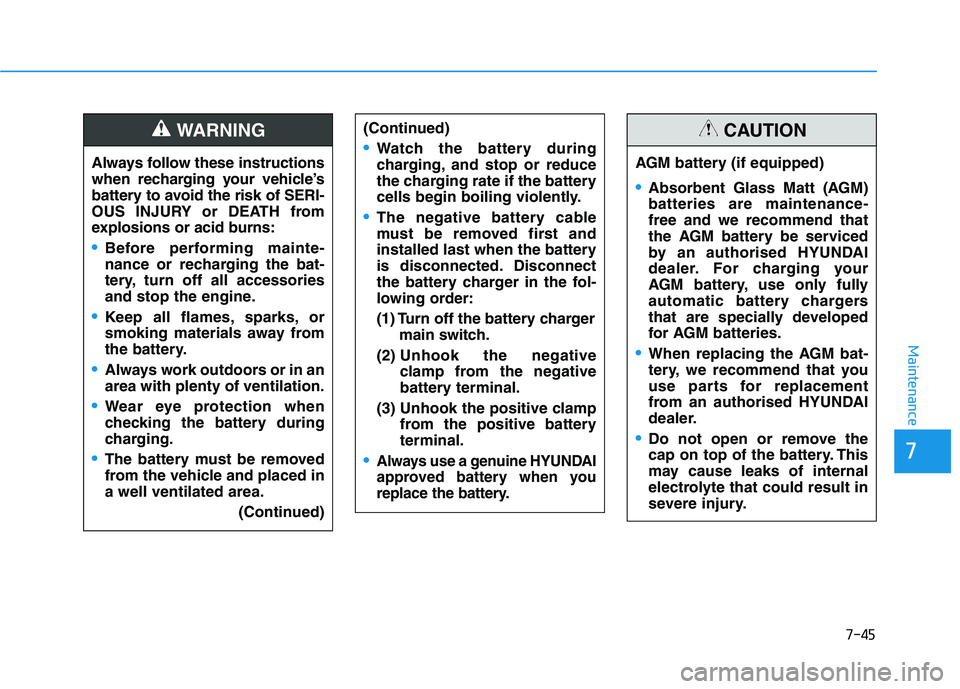
AGM battery (if equipped)
Absorbent Glass Matt (AGM)
batteries are maintenance-
free and we recommend that
the AGM battery be serviced
by an authorised HYUNDAI
dealer. For charging your
AGM battery, use only fully
automatic battery chargers
that are specially developed
for AGM batteries.
When replacing the AGM bat-
tery, we recommend that you
use parts for replacement
from an authorised HYUNDAI
dealer.
Do not open or remove the
cap on top of the battery. This
may cause leaks of internal
electrolyte that could result in
severe injury.
CAUTION
Always follow these instructions
when recharging your vehicle’s
battery to avoid the risk of SERI-
OUS INJURY or DEATH from
explosions or acid burns:
Before performing mainte-
nance or recharging the bat-
tery, turn off all accessories
and stop the engine.
Keep all flames, sparks, or
smoking materials away from
the battery.
Always work outdoors or in an
area with plenty of ventilation.
Wear eye protection when
checking the battery during
charging.
The battery must be removed
from the vehicle and placed in
a well ventilated area.
(Continued)
WARNING (Continued)
Watch the battery during
charging, and stop or reduce
the charging rate if the battery
cells begin boiling violently.
The negative battery cable
must be removed first and
installed last when the battery
is disconnected. Disconnect
the battery charger in the fol-
lowing order:
(1) Turn off the battery charger
main switch.
(2) Unhook the negative
clamp from the negative
battery terminal.
(3) Unhook the positive clamp
from the positive battery
terminal.
Always use a genuine HYUNDAI
approved battery when you
replace the battery.
Page 509 of 533

7-78
Maintenance
High-pressure washing
When using high-pressure washers,
make sure to maintain sufficient dis-
tance from the vehicle.
Insufficient clearance or excessive
pressure can lead to component
damage or water penetration.
Do not spray the camera, sensors or
its surrounding area directly with a
high pressure washer. Shock
applied from high pressure water
may cause the device to not operate
normally.
Do not bring the nozzle tip close to
boots (rubber or plastic covers) or
connectors as they may be dam-
aged if they come into contact with
high pressure water. Water washing in the engine com-
partment including high pressure
water washing may cause the fail-
ure of electrical circuits located in
the engine compartment.
Never allow water or other liquids
to come in contact with electri-
cal/electronic components inside
the vehicle as this may damage
them.Matte paint finish vehicle
Automatic car wash which uses
rotating brushes should not be
used as this can damage the sur-
face of your vehicle. A steam
cleaner which washes the vehicle
surface at high temperature may
result the oil to adhere and leave
stains that is difficult to remove.
Use a soft cloth (e.g. microfiber
towel or sponge) when washing
your vehicle and dry with a
microfiber towel. When you hand
wash your vehicle, you should not
use a cleaner that finishes with
wax. If the vehicle surface is too
dirty (sand, dirt, dust, contami-
nant, etc.), clean the surface with
water before washing the vehicle.
NOTICE
NOTICE
OLMB073082
Page 520 of 533
7-89
7
Maintenance
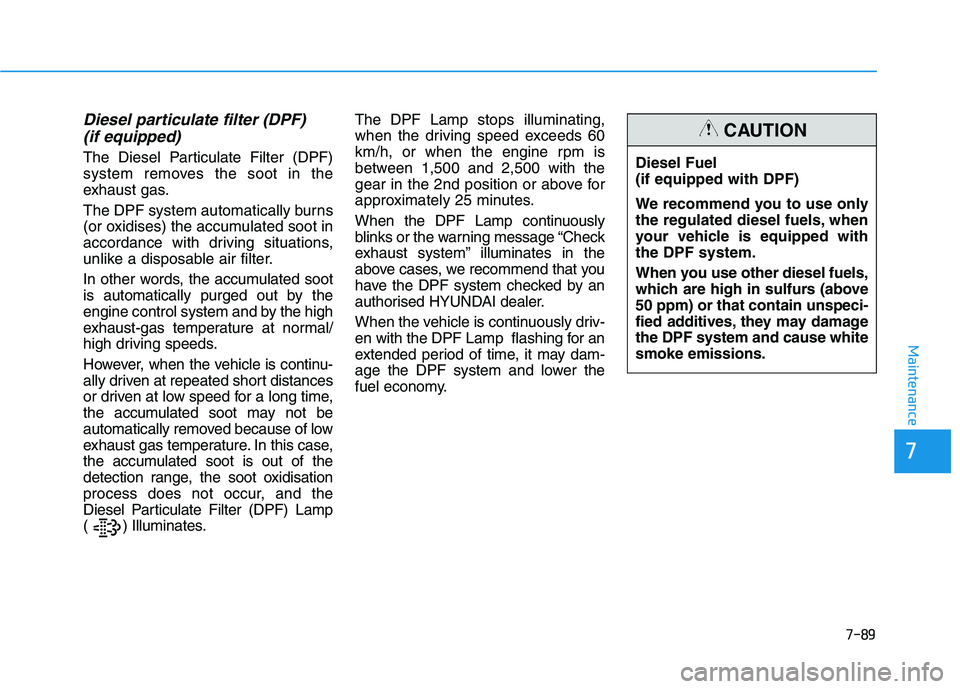
Diesel particulate filter (DPF)
(if equipped)
The Diesel Particulate Filter (DPF)
system removes the soot in the
exhaust gas.
The DPF system automatically burns
(or oxidises) the accumulated soot in
accordance with driving situations,
unlike a disposable air filter.
In other words, the accumulated soot
is automatically purged out by the
engine control system and by the high
exhaust-gas temperature at normal/
high driving speeds.
However, when the vehicle is continu-
ally driven at repeated short distances
or driven at low speed for a long time,
the accumulated soot may not be
automatically removed because of low
exhaust gas temperature. In this case,
the accumulated soot is out of the
detection range, the soot oxidisation
process does not occur, and the
Diesel Particulate Filter (DPF) Lamp
( ) Illuminates.The DPF Lamp stops illuminating,
when the driving speed exceeds 60
km/h, or when the engine rpm is
between 1,500 and 2,500 with the
gear in the 2nd position or above for
approximately 25 minutes.
When the DPF Lamp continuously
blinks or the warning message “Check
exhaust system” illuminates in the
above cases, we recommend that you
have the DPF system checked by an
authorised HYUNDAI dealer.
When the vehicle is continuously driv-
en with the DPF Lamp flashing for an
extended period of time, it may dam-
age the DPF system and lower the
fuel economy.Diesel Fuel
(if equipped with DPF)
We recommend you to use only
the regulated diesel fuels, when
your vehicle is equipped with
the DPF system.
When you use other diesel fuels,
which are high in sulfurs (above
50 ppm) or that contain unspeci-
fied additives, they may damage
the DPF system and cause white
smoke emissions.
CAUTION